通常,來自隨機實驗的隨機變數 X {\displaystyle X} 假設 固定 [ 1] θ ∈ R k {\displaystyle \theta \in \mathbb {R} ^{k}} [ 2] k {\displaystyle k} Θ {\displaystyle \Theta }
備註。
在頻率統計學 固定
另一方面,在貝葉斯統計學 隨機變數
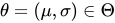
例如,假設隨機變數 X {\displaystyle X} N ( μ , σ 2 ) {\displaystyle {\mathcal {N}}(\mu ,\sigma ^{2})} θ = ( μ , σ ) ∈ Θ {\displaystyle \theta =(\mu ,\sigma )\in \Theta } Θ = { ( μ , σ ) : μ ∈ R , σ > 0 } {\displaystyle \Theta =\{(\mu ,\sigma ):\mu \in \mathbb {R} ,\sigma >0\}} 估計 X {\displaystyle X} 好 [ 3]
直觀地說,隨機樣本 X 1 , … , X n {\displaystyle X_{1},\dotsc ,X_{n}} 點估計 點估計 點估計值
定義。 (點估計)點估計 統計量 點
備註。
回想一下,統計量
我們將未知引數稱為總體引數 總體
統計量稱為點估計量 點估計值 點估計量 ^ {\displaystyle {\hat {}}} 點 區間 區間
示例. 假設 X 1 , … , X n {\displaystyle X_{1},\dotsc ,X_{n}} N ( μ , σ 2 ) {\displaystyle {\mathcal {N}}(\mu ,\sigma ^{2})} n {\displaystyle n}
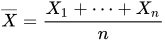
我們可以使用 統計量 X ¯ = X 1 + ⋯ + X n n {\displaystyle {\overline {X}}={\frac {X_{1}+\dotsb +X_{n}}{n}}} μ {\displaystyle \mu } X ¯ {\displaystyle {\overline {X}}} 點估計量 x ¯ {\displaystyle {\overline {x}}} 點估計
或者,我們可以簡單地使用統計量 X 1 {\displaystyle X_{1}} X 2 , … , X n {\displaystyle X_{2},\dotsc ,X_{n}} X 1 , … , X n {\displaystyle X_{1},\dotsc ,X_{n}} μ {\displaystyle \mu } 這種僅直接取一個隨機樣本的估計量稱為 單觀測估計量
我們稍後將討論如何評估點估計量的“好壞”。
接下來,我們將介紹兩個著名的點估計量,它們實際上“很好”,即 最大似然估計量 矩估計量
顧名思義,這種估計量是 最大化
為了激發最大似然估計量的定義,請考慮以下示例。
示例. 在一個隨機實驗中,一枚(公平或不公平)硬幣被拋擲一次。設隨機變數 X = 1 {\displaystyle X=1} 0 {\displaystyle 0} X {\displaystyle X} f ( x ; p ) = p x ( 1 − p ) 1 − x , x ∈ { 0 , 1 } {\displaystyle f(x;p)=p^{x}(1-p)^{1-x},\quad x\in \{0,1\}} p {\displaystyle p} p ∈ Θ = { p : p ∈ ( 0 , 1 ) } {\displaystyle p\in \Theta =\{p:p\in (0,1)\}}
現在,假設你得到一個隨機樣本 X 1 , X 2 , … , X n {\displaystyle X_{1},X_{2},\dotsc ,X_{n}} n {\displaystyle n} 獨立 x 1 , x 2 , … , x n {\displaystyle x_{1},x_{2},\dotsc ,x_{n}} X 1 = x 1 , X 2 = x 2 , … , and X n = x n {\displaystyle X_{1}=x_{1},X_{2}=x_{2},\dotsc ,{\text{ and }}X_{n}=x_{n}} P ( X 1 = x 1 ∩ X 2 = x 2 ∩ ⋯ ∩ X n = x n ) = P ( X 1 = x 1 ) P ( X 2 = x 2 ) ⋯ P ( X n = x n ) by independence = f ( x 1 ; p ) f ( x 2 ; p ) ⋯ f ( x n ; p ) = p x 1 ( 1 − p ) 1 − x 1 p x 2 ( 1 − p ) 1 − x 2 ⋯ p x n ( 1 − p ) 1 − x n = p x 1 + x 2 + ⋯ + x n ( 1 − p ) n − x 1 − x 2 − ⋯ − x n . {\displaystyle {\begin{aligned}\mathbb {P} (X_{1}=x_{1}\cap X_{2}=x_{2}\cap \dotsb \cap X_{n}=x_{n})&=\mathbb {P} (X_{1}=x_{1})\mathbb {P} (X_{2}=x_{2})\dotsb \mathbb {P} (X_{n}=x_{n})&{\text{by independence}}\\&=f(x_{1};p)f(x_{2};p)\dotsb f(x_{n};p)\\&=p^{x_{1}}(1-p)^{1-x_{1}}p^{x_{2}}(1-p)^{1-x_{2}}\dotsb p^{x_{n}}(1-p)^{1-x_{n}}\\&=p^{x_{1}+x_{2}+\dotsb +x_{n}}(1-p)^{n-x_{1}-x_{2}-\dotsb -x_{n}}.\end{aligned}}}
備註。
關於符號的說明 :你可能會注意到在 X {\displaystyle X} ; p {\displaystyle ;p} 引數值為 p {\displaystyle p} 強調 一般來說,我們用 f ( ⋅ ; θ ) {\displaystyle f(\cdot ;\theta )} θ {\displaystyle \theta } θ {\displaystyle \theta } 對於相同的含義,存在一些備選的記號: f ( ⋅ | θ ) , f θ ( ⋅ ) , … {\displaystyle f(\cdot |\theta ),f_{\theta }(\cdot ),\dotsc } 類似地,我們也有類似的記號,例如 P θ ( A ) , P ( A | θ ) , P ( A ; θ ) , … {\displaystyle \mathbb {P} _{\theta }(A),\mathbb {P} (A|\theta ),\mathbb {P} (A;\theta ),\dotsc } A {\displaystyle A} θ {\displaystyle \theta } P θ ( A ) {\displaystyle \mathbb {P} _{\theta }(A)}
對於均值、方差、協方差等,我們也有類似的記號,例如 E θ [ ⋅ ] , Var θ ( ⋅ ) , Cov θ ( ⋅ ) , … {\displaystyle \mathbb {E} _{\theta }[\cdot ],\operatorname {Var} _{\theta }(\cdot ),\operatorname {Cov} _{\theta }(\cdot ),\dotsc }
直觀地,對於這些特定的實現(固定的),我們希望找到一個 p {\displaystyle p}
定義。 (似然函式)設 X 1 , … , X n {\displaystyle X_{1},\dotsc ,X_{n}} 聯合 f {\displaystyle f} θ ∈ Θ {\displaystyle \theta \in \Theta } Θ {\displaystyle \Theta } x 1 , … , x n {\displaystyle x_{1},\dotsc ,x_{n}} X 1 , … , X n {\displaystyle X_{1},\dotsc ,X_{n}} 似然函式 L ( θ ; x 1 , … , x n ) {\displaystyle {\mathcal {L}}(\theta ;x_{1},\dotsc ,x_{n})} θ ↦ f ( x 1 , … , x n ; θ ) {\displaystyle \theta \mapsto f(x_{1},\dotsc ,x_{n};\theta )} θ {\displaystyle \theta } x 1 , … , x n {\displaystyle x_{1},\dotsc ,x_{n}}
備註。
為了簡便,我們可以使用符號 L ( θ ; x ) {\displaystyle {\mathcal {L}}(\theta ;\mathbf {x} )} L ( θ ; x 1 , … , x n ) {\displaystyle {\mathcal {L}}(\theta ;x_{1},\dotsc ,x_{n})} L ( θ ; x ) {\displaystyle {\mathcal {L}}(\theta ;\mathbf {x} )} 當我們將 x 1 , … , x n {\displaystyle x_{1},\dotsc ,x_{n}} X 1 , … , X n {\displaystyle X_{1},\dotsc ,X_{n}} L ( θ ; X 1 , … , X n ) {\displaystyle {\mathcal {L}}(\theta ;X_{1},\dotsc ,X_{n})} L ( θ ; X ) {\displaystyle {\mathcal {L}}(\theta ;\mathbf {X} )} 似然函式與聯合機率質量函式或機率密度函式本身形成對比,在聯合機率質量函式或機率密度函式中, θ {\displaystyle \theta } x 1 , … , x n {\displaystyle x_{1},\dotsc ,x_{n}}
當隨機樣本來自離散 θ {\displaystyle \theta } P ( X 1 = x 1 ∩ ⋯ ∩ X n = x n ) {\displaystyle \mathbb {P} (X_{1}=x_{1}\cap \dotsb \cap X_{n}=x_{n})}
當隨機樣本來自連續 不是 ( x 1 , … , x n ) {\displaystyle (x_{1},\dotsc ,x_{n})} ( x 1 , … , x n ) {\displaystyle (x_{1},\dotsc ,x_{n})}
似然函式的自然對數, ln L ( θ ; x ) {\displaystyle \ln {\mathcal {L}}(\theta ;\mathbf {x} )} ln L ( θ ; X ) {\displaystyle \ln {\mathcal {L}}(\theta ;\mathbf {X} )} 對數似然函式
請注意,似然函式的“表示式”實際上與聯合機率密度函式的表示式相同,只是輸入不同。因此,人們仍然可以對似然函式關於 x 1 , … , x n {\displaystyle x_{1},\dotsc ,x_{n}}
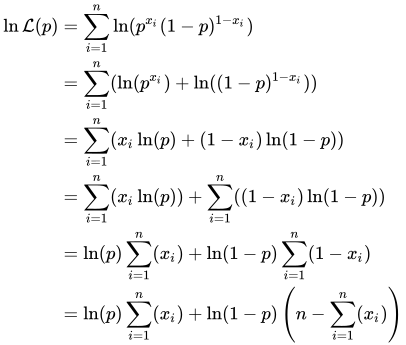
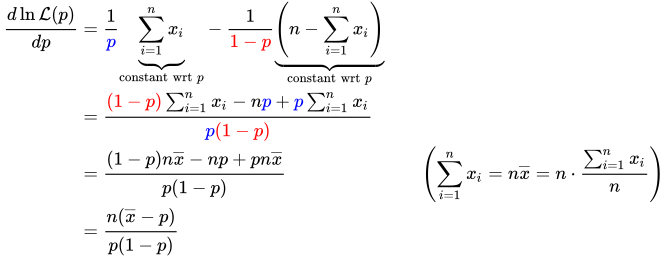
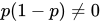
現在,讓我們找到之前拋硬幣示例中未知引數 p {\displaystyle p}
有時,在求解引數的最大似然估計時,會對引數施加約束。在這種情況下,引數的最大似然估計稱為受限
示例: 繼續前面拋硬幣的例子。假設對 p {\displaystyle p} 0 ≤ p ≤ 1 2 {\displaystyle 0\leq p\leq {\frac {1}{2}}} p {\displaystyle p}
解: p {\displaystyle p} X ¯ {\displaystyle {\overline {X}}} p {\displaystyle p} X ¯ {\displaystyle {\overline {X}}} X ¯ ≤ 1 2 {\displaystyle {\overline {X}}\leq {\frac {1}{2}}} X ¯ ≥ 0 {\displaystyle {\overline {X}}\geq 0} X ≥ 0 {\displaystyle X\geq 0}
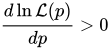
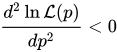
If X ¯ > 1 2 {\displaystyle {\overline {X}}>{\frac {1}{2}}} x ¯ > 1 / 2 {\displaystyle {\overline {x}}>1/2} ln L ( p ) {\displaystyle \ln {\mathcal {L}}(p)} p = x ¯ {\displaystyle p={\overline {x}}} X ¯ {\displaystyle {\overline {X}}} p {\displaystyle p} 0 ≤ p ≤ 1 2 {\displaystyle 0\leq p\leq {\frac {1}{2}}} d ln L ( p ) d p > 0 {\displaystyle {\frac {d\ln {\mathcal {L}}(p)}{dp}}>0} p ≤ 1 2 < X ¯ {\displaystyle p\leq {\frac {1}{2}}<{\overline {X}}} d ln L ( p ) d p > 0 {\displaystyle {\frac {d\ln {\mathcal {L}}(p)}{dp}}>0} p < x ¯ {\displaystyle p<{\overline {x}}} ln L ( p ) {\displaystyle \ln {\mathcal {L}}(p)} p ≤ 1 2 {\displaystyle p\leq {\frac {1}{2}}} ln L ( p ) {\displaystyle \ln {\mathcal {L}}(p)} p = 1 2 {\displaystyle p={\frac {1}{2}}} p {\displaystyle p} 1 2 {\displaystyle {\frac {1}{2}}} X 1 , … , X n {\displaystyle X_{1},\dotsc ,X_{n}}
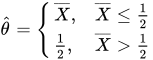
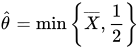
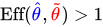
因此, p {\displaystyle p} θ ^ = { X ¯ , X ¯ ≤ 1 2 1 2 , X ¯ > 1 2 {\displaystyle {\hat {\theta }}={\begin{cases}{\overline {X}},&{\overline {X}}\leq {\frac {1}{2}}\\{\frac {1}{2}},&{\overline {X}}>{\frac {1}{2}}\end{cases}}} θ ^ = min { X ¯ , 1 2 } {\displaystyle {\hat {\theta }}=\min \left\{{\overline {X}},{\frac {1}{2}}\right\}}
為了找到最大似然估計,我們有時會使用導數檢驗以外的方法,並且不需要找到對數似然函式。讓我們在下面的例子中說明這一點。
示例: 令 X 1 , … , X n {\displaystyle X_{1},\dotsc ,X_{n}} U [ 0 , β ] {\displaystyle {\mathcal {U}}[0,\beta ]} β {\displaystyle \beta }
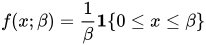
解: f ( x ; β ) = 1 β 1 { 0 ≤ x ≤ β } {\displaystyle f(x;\beta )={\frac {1}{\beta }}\mathbf {1} \{0\leq x\leq \beta \}} L ( β ) = ∏ i = 1 n 1 β 1 { 0 ≤ x i ≤ β } = 1 β n ∏ i = 1 n 1 { 0 ≤ x i ≤ β } {\displaystyle {\mathcal {L}}(\beta )=\prod _{i=1}^{n}{\frac {1}{\beta }}\mathbf {1} \{0\leq x_{i}\leq \beta \}={\frac {1}{\beta ^{n}}}\prod _{i=1}^{n}\mathbf {1} \{0\leq x_{i}\leq \beta \}}
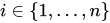
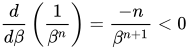
為了使 L ( β ) {\displaystyle {\mathcal {L}}(\beta )} i ∈ { 1 , … , n } {\displaystyle i\in \{1,\dotsc ,n\}} 0 ≤ x i ≤ β {\displaystyle 0\leq x_{i}\leq \beta } β ↦ 1 β n {\displaystyle \beta \mapsto {\frac {1}{\beta ^{n}}}} β {\displaystyle \beta } d d β ( 1 β n ) = − n β n + 1 < 0 {\displaystyle {\frac {d}{d\beta }}\left({\frac {1}{\beta ^{n}}}\right)={\frac {-n}{\beta ^{n+1}}}<0} n , β > 0 {\displaystyle n,\beta >0} β {\displaystyle \beta } 1 β n {\displaystyle {\frac {1}{\beta ^{n}}}} L ( β ) {\displaystyle {\mathcal {L}}(\beta )}
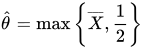
因此,我們應該選擇一個儘可能小的 β {\displaystyle \beta } i ∈ { 1 , … , n } {\displaystyle i\in \{1,\dotsc ,n\}} 0 ≤ x i ≤ β {\displaystyle 0\leq x_{i}\leq \beta } β ≥ x i {\displaystyle \beta \geq x_{i}} β {\displaystyle \beta } x i ≥ 0 {\displaystyle x_{i}\geq 0} β {\displaystyle \beta } x 1 , … , x n {\displaystyle x_{1},\dotsc ,x_{n}} L ( β ) {\displaystyle {\mathcal {L}}(\beta )} β {\displaystyle \beta } β ^ = max { X 1 , … , X n } {\displaystyle {\hat {\beta }}=\max\{X_{1},\dotsc ,X_{n}\}}
練習。 證明如果均勻分佈變為 U [ 0 , β ) {\displaystyle {\mathcal {U}}[0,\beta )} β {\displaystyle \beta }
解答
Proof. In this case, the constraint from the indicator functions become 0 ≤ x i < β {\displaystyle 0\leq x_{i}<\beta } i ∈ { 1 , … , n } {\displaystyle i\in \{1,\dotsc ,n\}} β {\displaystyle \beta } β {\displaystyle \beta } β > x i {\displaystyle \beta >x_{i}} i ∈ { 1 , … , n } {\displaystyle i\in \{1,\dotsc ,n\}} cannot β {\displaystyle \beta } x 1 , … , x n {\displaystyle x_{1},\dotsc ,x_{n}} β {\displaystyle \beta } x 1 , … , x n {\displaystyle x_{1},\dotsc ,x_{n}} β {\displaystyle \beta } β > max { x 1 , … , x n } {\displaystyle \beta >\max\{x_{1},\dotsc ,x_{n}\}} β {\displaystyle \beta } β {\displaystyle \beta } β ′ {\displaystyle \beta '} max { x 1 , … , x n } + β − max { x 1 , … , x n } 2 > max { x 1 , … , x n } {\displaystyle \max\{x_{1},\dotsc ,x_{n}\}+{\frac {\beta -\max\{x_{1},\dotsc ,x_{n}\}}{2}}>\max\{x_{1},\dotsc ,x_{n}\}} [ 4] β {\displaystyle \beta } ln L ( p ) {\displaystyle \ln {\mathcal {L}}(p)}
◻ {\displaystyle \Box }
在下面的例子中,我們將找到引數向量的最大似然估計。
例。 令 X 1 , … , X n {\displaystyle X_{1},\dotsc ,X_{n}} θ 1 {\displaystyle \theta _{1}} θ 2 {\displaystyle \theta _{2}} N ( θ 1 , θ 2 ) {\displaystyle {\mathcal {N}}(\theta _{1},\theta _{2})} ( θ 1 , θ 2 ) {\displaystyle (\theta _{1},\theta _{2})}
解 θ = ( θ 1 , θ 2 ) {\displaystyle \theta =(\theta _{1},\theta _{2})} L ( θ ; x ) = ∏ i = 1 n 1 2 π θ 2 exp ( − ( x i − θ 1 ) 2 2 θ 2 ) = ( 2 π θ 2 ) − n / 2 exp ( − ∑ i = 1 n ( x i − θ 1 ) 2 2 θ 2 ) {\displaystyle {\mathcal {L}}(\theta ;\mathbf {x} )=\prod _{i=1}^{n}{\frac {1}{\sqrt {2\pi \theta _{2}}}}\exp \left(-{\frac {(x_{i}-\theta _{1})^{2}}{2\theta _{2}}}\right)=(2\pi \theta _{2})^{-n/2}\exp \left(-\sum _{i=1}^{n}{\frac {(x_{i}-\theta _{1})^{2}}{2\theta _{2}}}\right)} ln L ( θ ; x ) = − n 2 ln ( 2 π θ 2 ) − ∑ i = 1 n ( x i − θ 1 ) 2 2 θ 2 {\displaystyle \ln {\mathcal {L}}(\theta ;\mathbf {x} )=-{\frac {n}{2}}\ln(2\pi \theta _{2})-\sum _{i=1}^{n}{\frac {(x_{i}-\theta _{1})^{2}}{2\theta _{2}}}}
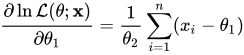
由於 ∂ ln L ( θ ; x ) ∂ θ 1 = 1 θ 2 ∑ i = 1 n ( x i − θ 1 ) {\displaystyle {\frac {\partial \ln {\mathcal {L}}(\theta ;\mathbf {x} )}{\partial \theta _{1}}}={\frac {1}{\theta _{2}}}\sum _{i=1}^{n}(x_{i}-\theta _{1})} ∂ ln L ( θ ; x ) ∂ θ 2 = − 2 n π 4 π θ 2 + 1 2 θ 2 2 ∑ i = 1 n ( x i − θ 1 ) 2 = − n 2 θ 2 + 1 2 θ 2 2 ∑ i = 1 n ( x i − θ 1 ) 2 {\displaystyle {\frac {\partial \ln {\mathcal {L}}(\theta ;\mathbf {x} )}{\partial \theta _{2}}}=-{\frac {2n\pi }{4\pi \theta _{2}}}+{\frac {1}{2\theta _{2}^{2}}}\sum _{i=1}^{n}(x_{i}-\theta _{1})^{2}=-{\frac {n}{2\theta _{2}}}+{\frac {1}{2\theta _{2}^{2}}}\sum _{i=1}^{n}(x_{i}-\theta _{1})^{2}}
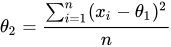
此外, ∂ ln L ( θ ; x ) ∂ θ 1 = 0 ⟹ ∑ i = 1 n ( x i − θ 1 ) = 0 ⟹ − n θ 1 + ∑ i = 1 n x i = 0 ⟹ θ 1 = ∑ i = 1 n x i n = x ¯ {\displaystyle {\frac {\partial \ln {\mathcal {L}}(\theta ;\mathbf {x} )}{\partial \theta _{1}}}=0\implies \sum _{i=1}^{n}(x_{i}-\theta _{1})=0\implies -n\theta _{1}+\sum _{i=1}^{n}x_{i}=0\implies \theta _{1}={\frac {\sum _{i=1}^{n}x_{i}}{n}}={\overline {x}}} θ 2 {\displaystyle \theta _{2}} ∂ ln L ( θ ; x ) ∂ θ 2 = 0 ⟹ n 2 θ 2 = 1 2 θ 2 2 ( ∑ i = 1 n ( x i − θ 1 ) 2 ) ⟹ n = 1 θ 2 ( ∑ i = 1 n ( x i − θ 1 ) 2 ) ⟹ θ 2 = ∑ i = 1 n ( x i − θ 1 ) 2 n {\displaystyle {\frac {\partial \ln {\mathcal {L}}(\theta ;\mathbf {x} )}{\partial \theta _{2}}}=0\implies {\frac {n}{2\theta _{2}}}={\frac {1}{2\theta _{2}^{2}}}\left(\sum _{i=1}^{n}(x_{i}-\theta _{1})^{2}\right)\implies n={\frac {1}{\theta _{2}}}\left(\sum _{i=1}^{n}(x_{i}-\theta _{1})^{2}\right)\implies \theta _{2}={\frac {\sum _{i=1}^{n}(x_{i}-\theta _{1})^{2}}{n}}}
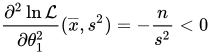
由於 ∂ 2 ln L ( θ ; x ) ∂ θ 1 2 = ∂ ∂ θ 1 ( 1 θ 2 ∑ i = 1 n ( x i − θ 1 ) ) = 1 θ 2 ∑ i = 1 n ( − 1 ) = − n θ 2 < 0 {\displaystyle {\frac {\partial ^{2}\ln {\mathcal {L}}(\theta ;\mathbf {x} )}{\partial \theta _{1}^{2}}}={\frac {\partial }{\partial \theta _{1}}}\left({\frac {1}{\theta _{2}}}\sum _{i=1}^{n}(x_{i}-\theta _{1})\right)={\frac {1}{\theta _{2}}}\sum _{i=1}^{n}(-1)={\frac {-n}{\theta _{2}}}<0} ln L ( θ ; x ) {\displaystyle \ln {\mathcal {L}}(\theta ;\mathbf {x} )} θ 1 = x ¯ {\displaystyle \theta _{1}={\overline {x}}} 在任意固定的 θ 2 {\displaystyle \theta _{2}}
另一方面,由於 ∂ 2 ln L ( θ ; x ) ∂ θ 2 2 = n 2 θ 2 2 − 1 θ 2 3 ∑ i = 1 n ( x i − θ 1 ) 2 {\displaystyle {\frac {\partial ^{2}\ln {\mathcal {L}}(\theta ;\mathbf {x} )}{\partial \theta _{2}^{2}}}={\frac {n}{2\theta _{2}^{2}}}-{\frac {1}{\theta _{2}^{3}}}\sum _{i=1}^{n}(x_{i}-\theta _{1})^{2}} ∂ 2 ln L ( θ ; x ) ∂ θ 2 2 | θ 2 = ∑ i = 1 n ( x i − θ 1 ) 2 n = 1 2 n ( ∑ i = 1 n ( x i − θ 1 ) 2 ) 2 − n 3 ( ∑ i = 1 n ( x i − θ 1 ) 2 ) 2 = 1 − 2 n 4 2 n ( ∑ i = 1 n ( x i − θ 1 ) 2 ) 2 < 0 {\displaystyle \left.{\frac {\partial ^{2}\ln {\mathcal {L}}(\theta ;\mathbf {x} )}{\partial \theta _{2}^{2}}}\right\vert _{\theta _{2}={\frac {\sum _{i=1}^{n}(x_{i}-\theta _{1})^{2}}{n}}}={\frac {1}{2n\left(\sum _{i=1}^{n}(x_{i}-\theta _{1})^{2}\right)^{2}}}-{\frac {n^{3}}{\left(\sum _{i=1}^{n}(x_{i}-\theta _{1})^{2}\right)^{2}}}={\frac {1-2n^{4}}{2n\left(\sum _{i=1}^{n}(x_{i}-\theta _{1})^{2}\right)^{2}}}<0} 2 n 4 > 1 {\displaystyle 2n^{4}>1}
因此,根據二階導數檢驗, ln L ( θ ; x ) {\displaystyle \ln {\mathcal {L}}(\theta ;\mathbf {x} )} θ 2 = ∑ i = 1 n ( x i − θ 1 ) 2 n {\displaystyle \theta _{2}={\frac {\sum _{i=1}^{n}(x_{i}-\theta _{1})^{2}}{n}}} 在任何給定的固定 θ 1 {\displaystyle \theta _{1}}
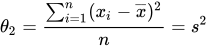
因此,現在我們固定 θ 1 = x ¯ {\displaystyle \theta _{1}={\overline {x}}} ln L ( θ ; x ) {\displaystyle \ln {\mathcal {L}}(\theta ;\mathbf {x} )} θ 2 = ∑ i = 1 n ( x i − x ¯ ) 2 n = s 2 {\displaystyle \theta _{2}={\frac {\sum _{i=1}^{n}(x_{i}-{\overline {x}})^{2}}{n}}=s^{2}} s 2 {\displaystyle s^{2}} S 2 {\displaystyle S^{2}} θ 2 {\displaystyle \theta _{2}} s 2 {\displaystyle s^{2}} ln L ( θ ; x ) {\displaystyle \ln {\mathcal {L}}(\theta ;\mathbf {x} )} θ 1 = x ¯ {\displaystyle \theta _{1}={\overline {x}}} θ 2 {\displaystyle \theta _{2}} θ 2 = s 2 {\displaystyle \theta _{2}=s^{2}} ln L ( θ ; x ) {\displaystyle \ln {\mathcal {L}}(\theta ;\mathbf {x} )} ( θ 1 , θ 2 ) = ( x ¯ , s 2 ) {\displaystyle (\theta _{1},\theta _{2})=({\overline {x}},s^{2})} ( θ 1 , θ 2 ) {\displaystyle (\theta _{1},\theta _{2})} ( X ¯ , S 2 ) {\displaystyle ({\overline {X}},S^{2})}
練習。
(a) 計算 ln L ( θ ; x ) {\displaystyle \ln {\mathcal {L}}(\theta ;\mathbf {x} )} ( θ 1 , θ 2 ) = ( x ¯ , s 2 ) {\displaystyle (\theta _{1},\theta _{2})=({\overline {x}},s^{2})} ∂ 2 ln L ∂ θ 1 2 ( x ¯ , s 2 ) ∂ 2 ln L ∂ θ 2 2 ( x ¯ , s 2 ) − ( ∂ 2 ln L ∂ θ 2 ∂ θ 1 ( x ¯ , s 2 ) ) 2 {\displaystyle {\frac {\partial ^{2}\ln {\mathcal {L}}}{\partial \theta _{1}^{2}}}({\overline {x}},s^{2}){\frac {\partial ^{2}\ln {\mathcal {L}}}{\partial \theta _{2}^{2}}}({\overline {x}},s^{2})-\left({\frac {\partial ^{2}\ln {\mathcal {L}}}{\partial \theta _{2}\partial \theta _{1}}}({\overline {x}},s^{2})\right)^{2}}
(b) 因此,使用二階偏導數檢驗驗證 ( θ 1 , θ 2 ) = ( x ¯ , s 2 ) {\displaystyle (\theta _{1},\theta _{2})=({\overline {x}},s^{2})} ln L ( θ ; x ) {\displaystyle \ln {\mathcal {L}}(\theta ;\mathbf {x} )}
解答
(a) 首先,
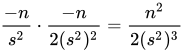
∂ 2 ln L ∂ θ 1 2 ( x ¯ , s 2 ) = above − n θ 2 | θ 2 = s 2 = − n s 2 {\displaystyle {\frac {\partial ^{2}\ln {\mathcal {L}}}{\partial \theta _{1}^{2}}}({\overline {x}},s^{2}){\overset {\text{above}}{=}}\left.{\frac {-n}{\theta _{2}}}\right\vert _{\theta _{2}=s^{2}}={\frac {-n}{s^{2}}}} ∂ 2 ln L ∂ θ 2 2 ( x ¯ , s 2 ) = above n 2 θ 2 2 − 1 θ 2 3 ∑ i = 1 n ( x i − θ 1 ) 2 | ( θ 1 , θ 2 ) = ( x ¯ , s 2 ) = n 2 ( s 2 ) 2 − 1 ( s 2 ) 3 ⋅ n s 2 = n 2 ( s 2 ) 2 − n ( s 2 ) 2 = − n 2 ( s 2 ) 2 {\displaystyle {\frac {\partial ^{2}\ln {\mathcal {L}}}{\partial \theta _{2}^{2}}}({\overline {x}},s^{2}){\overset {\text{above}}{=}}\left.{\frac {n}{2\theta _{2}^{2}}}-{\frac {1}{\theta _{2}^{3}}}\sum _{i=1}^{n}(x_{i}-\theta _{1})^{2}\right\vert _{(\theta _{1},\theta _{2})=({\overline {x}},s^{2})}={\frac {n}{2(s^{2})^{2}}}-{\frac {1}{(s^{2})^{3}}}\cdot ns^{2}={\frac {n}{2(s^{2})^{2}}}-{\frac {n}{(s^{2})^{2}}}={\frac {-n}{2(s^{2})^{2}}}} ∂ 2 ln L ∂ θ 2 ∂ θ 1 ( x ¯ , s 2 ) = above ∂ ∂ θ 2 ( 1 θ 2 ∑ i = 1 n ( x i − θ 1 ) ) | ( θ 1 , θ 2 ) = ( x ¯ , s 2 ) = − ∑ i = 1 n ( x i − θ 1 ) θ 2 2 | ( θ 1 , θ 2 ) = ( x ¯ , s 2 ) = − ∑ i = 1 n ( x i − x ¯ ) ( s 2 ) 2 = − ∑ i = 1 n ( x i ) − n x ¯ ( s 2 ) 2 = − n x ¯ − n x ¯ ( s 2 ) 2 = 0 {\displaystyle {\frac {\partial ^{2}\ln {\mathcal {L}}}{\partial \theta _{2}\partial \theta _{1}}}({\overline {x}},s^{2}){\overset {\text{above}}{=}}\left.{\frac {\partial }{\partial \theta _{2}}}\left({\frac {1}{\theta _{2}}}\sum _{i=1}^{n}(x_{i}-\theta _{1})\right)\right\vert _{(\theta _{1},\theta _{2})=({\overline {x}},s^{2})}=\left.-{\frac {\sum _{i=1}^{n}(x_{i}-\theta _{1})}{\theta _{2}^{2}}}\right\vert _{(\theta _{1},\theta _{2})=({\overline {x}},s^{2})}=-{\frac {\sum _{i=1}^{n}(x_{i}-{\overline {x}})}{(s^{2})^{2}}}=-{\frac {\sum _{i=1}^{n}(x_{i})-n{\overline {x}}}{(s^{2})^{2}}}=-{\frac {n{\overline {x}}-n{\overline {x}}}{(s^{2})^{2}}}=0} 因此,Hessian矩陣的行列式為 − n s 2 ⋅ − n 2 ( s 2 ) 2 = n 2 2 ( s 2 ) 3 {\displaystyle {\frac {-n}{s^{2}}}\cdot {\frac {-n}{2(s^{2})^{2}}}={\frac {n^{2}}{2(s^{2})^{3}}}}
(b) 從(a)可知,Hessian矩陣的行列式為正。此外, ∂ 2 ln L ∂ θ 1 2 ( x ¯ , s 2 ) = − n s 2 < 0 {\displaystyle {\frac {\partial ^{2}\ln {\mathcal {L}}}{\partial \theta _{1}^{2}}}({\overline {x}},s^{2})=-{\frac {n}{s^{2}}}<0} ln L ( θ ; x ) {\displaystyle \ln {\mathcal {L}}(\theta ;\mathbf {x} )} ( θ 1 , θ 2 ) = ( x ¯ , s 2 ) {\displaystyle (\theta _{1},\theta _{2})=({\overline {x}},s^{2})}
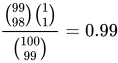
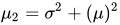
對於最大似然估計,我們需要利用似然函式,該函式來自分佈中隨機樣本的聯合機率質量函式或機率密度函式。然而,在實踐中我們可能並不知道分佈的機率質量函式或機率密度函式的確切形式。相反,我們可能只知道關於分佈的一些資訊,例如均值、方差和一些矩( r {\displaystyle r} X {\displaystyle X} E [ X r ] {\displaystyle \mathbb {E} [X^{r}]} μ r {\displaystyle \mu _{r}} N ( μ , σ 2 ) {\displaystyle {\mathcal {N}}(\mu ,\sigma ^{2})} μ = μ 1 {\displaystyle \mu =\mu _{1}} σ 2 = μ 2 − ( μ 1 ) 2 {\displaystyle \sigma ^{2}=\mu _{2}-(\mu _{1})^{2}}
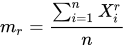
現在,我們想知道如何估計矩。我們令 m r = ∑ i = 1 n X i r n {\displaystyle m_{r}={\frac {\sum _{i=1}^{n}X_{i}^{r}}{n}}} r {\displaystyle r} 樣本矩 [ 5] X i {\displaystyle X_{i}} 大數定律
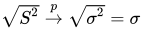
X ¯ = m 1 → p E [ X ] = μ 1 {\displaystyle {\overline {X}}=m_{1}\;{\overset {p}{\to }}\;\mathbb {E} [X]=\mu _{1}} m 2 → p E [ X 2 ] = μ 2 {\displaystyle m_{2}\;{\overset {p}{\to }}\;\mathbb {E} [X^{2}]=\mu _{2}} X {\displaystyle X} X 2 {\displaystyle X^{2}} 通常情況下,我們有 m r → p μ r {\displaystyle m_{r}\;{\overset {p}{\to }}\;\mu _{r}} X r {\displaystyle X^{r}} X {\displaystyle X}
基於這些結果,我們可以使用第 r {\displaystyle r} m r {\displaystyle m_{r}} r {\displaystyle r} μ r {\displaystyle \mu _{r}} n {\displaystyle n} m 1 {\displaystyle m_{1}} μ {\displaystyle \mu } m 2 − ( m 1 ) 2 {\displaystyle m_{2}-(m_{1})^{2}} σ 2 {\displaystyle \sigma ^{2}} 矩估計法
更準確地說,我們給出矩估計法
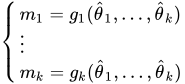
定義。 (矩估計法)設 X 1 , … , X n {\displaystyle X_{1},\dotsc ,X_{n}} f ( x ; θ 1 , … , θ k ) {\displaystyle f(x;\theta _{1},\dotsc ,\theta _{k})} k {\displaystyle k} μ 1 , … , μ k {\displaystyle \mu _{1},\dotsc ,\mu _{k}} θ 1 , … , θ k {\displaystyle \theta _{1},\dotsc ,\theta _{k}} g 1 ( θ 1 , … , θ k ) , … , g k ( θ 1 , … , θ k ) {\displaystyle g_{1}(\theta _{1},\dotsc ,\theta _{k}),\dotsc ,g_{k}(\theta _{1},\dotsc ,\theta _{k})} θ 1 , … , θ k {\displaystyle \theta _{1},\dotsc ,\theta _{k}} 矩估計量 θ ^ 1 , … , θ ^ k {\displaystyle {\hat {\theta }}_{1},\dotsc ,{\hat {\theta }}_{k}} θ ^ 1 , … , θ ^ k {\displaystyle {\hat {\theta }}_{1},\dotsc ,{\hat {\theta }}_{k}} m 1 , … , m k {\displaystyle m_{1},\dotsc ,m_{k}} k {\displaystyle k} μ 1 , … , μ k {\displaystyle \mu _{1},\dotsc ,\mu _{k}} { m 1 = g 1 ( θ ^ 1 , … , θ ^ k ) ⋮ m k = g k ( θ ^ 1 , … , θ ^ k ) {\displaystyle {\begin{cases}m_{1}=g_{1}({\hat {\theta }}_{1},\dotsc ,{\hat {\theta }}_{k})\\\vdots \\m_{k}=g_{k}({\hat {\theta }}_{1},\dotsc ,{\hat {\theta }}_{k})\\\end{cases}}}
在本節中,我們將介紹一些用於評估點估計量“好壞”的標準,即無偏性 有效性 一致性
對於 θ ^ {\displaystyle {\hat {\theta }}} θ {\displaystyle \theta } θ ^ {\displaystyle {\hat {\theta }}} θ {\displaystyle \theta } 偏差 θ ^ {\displaystyle {\hat {\theta }}} θ {\displaystyle \theta }
定義。 (偏差)估計量 θ ^ {\displaystyle {\hat {\theta }}} 偏差 Bias ( θ ^ ) = E [ θ ^ ] − θ . {\displaystyle \operatorname {Bias} ({\hat {\theta }})=\mathbb {E} [{\hat {\theta }}]-\theta .}
我們還將定義一些與偏差相關的術語。
備註。
無偏估計量必須是漸近無偏估計量,但反之不成立,即漸近無偏估計量可能不是無偏估計量。因此,有偏估計量也可能是漸近無偏估計量。
當我們根據無偏性討論估計量的優劣時,無偏估計量優於漸近無偏估計量,漸近無偏估計量優於有偏估計量。 然而,除了無偏性之外,還有其他評估估計量優劣的標準,因此,當我們也考慮其他標準時,有偏估計量在總體上可能比無偏估計量“更好”。
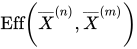
我們已經討論瞭如何評估估計量的無偏性。現在,如果我們有兩個無偏估計量, θ ^ {\displaystyle {\hat {\theta }}} θ ~ {\displaystyle {\tilde {\theta }}} 方差 效率
實際上,對於無偏估計量的方差,由於無偏估計量的均值是未知引數 θ {\displaystyle \theta } θ {\displaystyle \theta } 均方誤差
備註。
根據此定義, MSE ( θ ^ ) {\displaystyle \operatorname {MSE} ({\hat {\theta }})} θ ^ − θ {\displaystyle {\hat {\theta }}-\theta } 誤差 平方 均值 均方誤差
注意,在 MSE 的定義中,我們沒有規定 θ ^ {\displaystyle {\hat {\theta }}} θ ^ {\displaystyle {\hat {\theta }}} θ ^ {\displaystyle {\hat {\theta }}} MSE ( θ ^ ) {\displaystyle \operatorname {MSE} ({\hat {\theta }})} Var ( θ ^ ) {\displaystyle \operatorname {Var} ({\hat {\theta }})}
命題. (均方誤差與方差之間的關係)如果 Var ( θ ^ ) {\displaystyle \operatorname {Var} ({\hat {\theta }})} MSE ( θ ^ ) = Var ( θ ^ ) + [ Bias ( θ ^ ) ] 2 {\displaystyle \operatorname {MSE} ({\hat {\theta }})=\operatorname {Var} ({\hat {\theta }})+[\operatorname {Bias} ({\hat {\theta }})]^{2}}
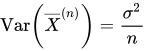
現在,我們知道無偏估計量的方差越小,其效率(和“更好”)就越高。因此,我們自然想知道什麼是最 一致最小方差無偏估計量 (UMVUE) [ 6]
定義。 (一致最小方差無偏估計量)一致最小方差無偏估計量 最小方差
事實上,UMVUE 是唯一
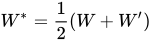
證明. 假設 W {\displaystyle W} τ ( θ ) {\displaystyle \tau (\theta )} W ′ {\displaystyle W'} τ ( θ ) {\displaystyle \tau (\theta )} W ∗ = 1 2 ( W + W ′ ) {\displaystyle W^{*}={\frac {1}{2}}(W+W')} E [ W ∗ ] = 1 2 ( E [ W ] + E [ W ′ ] ) = 1 2 ( τ ( θ + θ ) = τ ( θ ) {\displaystyle \mathbb {E} [W^{*}]={\frac {1}{2}}(\mathbb {E} [W]+\mathbb {E} [W'])={\frac {1}{2}}(\tau (\theta +\theta )=\tau (\theta )} W ∗ {\displaystyle W^{*}} τ ( θ ) {\displaystyle \tau (\theta )}
Now, we consider the variance of W ∗ {\displaystyle W^{*}} Var ( W ∗ ) = 1 4 Var ( W + W ′ ) = 1 4 [ Var ( W ) + Var ( W ′ ) + 2 Cov ( W , W ′ ) ] ≤ 1 4 Var ( W ) + 1 4 Var ( W ′ ) + 1 2 Var ( W ) Var ( W ′ ) ( covariance inequality ) = 1 4 Var ( W ) + 1 4 Var ( W ) + 1 2 ( Var ( W ) ) 2 ( Var ( W ) = Var ( W ′ ) since W and W ′ are both UMVUE ) = 1 2 Var ( W ) + 1 2 Var ( W ) ( Var ( W ) > 0 ) = Var ( W ) . {\displaystyle {\begin{aligned}\operatorname {Var} (W^{*})&={\frac {1}{4}}\operatorname {Var} (W+W')\\&={\frac {1}{4}}\left[\operatorname {Var} (W)+\operatorname {Var} (W')+2\operatorname {Cov} (W,W')\right]\\&\leq {\frac {1}{4}}\operatorname {Var} (W)+{\frac {1}{4}}\operatorname {Var} (W')+{\frac {1}{2}}{\sqrt {\operatorname {Var} (W)\operatorname {Var} (W')}}&({\text{covariance inequality}})\\&={\frac {1}{4}}\operatorname {Var} (W)+{\frac {1}{4}}\operatorname {Var} (W)+{\frac {1}{2}}{\sqrt {(\operatorname {Var} (W))^{2}}}&(\operatorname {Var} (W)=\operatorname {Var} (W'){\text{ since }}W{\text{ and }}W'{\text{ are both UMVUE}})\\&={\frac {1}{2}}\operatorname {Var} (W)+{\frac {1}{2}}\operatorname {Var} (W)&(\operatorname {Var} (W)>0)\\&=\operatorname {Var} (W).\end{aligned}}} Var ( W ∗ ) < Var ( W ) {\displaystyle \operatorname {Var} (W^{*})<\operatorname {Var} (W)} Var ( W ∗ ) = Var ( W ) {\displaystyle \operatorname {Var} (W^{*})=\operatorname {Var} (W)} W {\displaystyle W} not τ ( θ ) {\displaystyle \tau (\theta )} W ∗ {\displaystyle W^{*}} Var ( W ∗ ) = Var ( W ) . {\displaystyle \operatorname {Var} (W^{*})=\operatorname {Var} (W).} Cov ( W , W ′ ) = Var ( W ) Var ( W ′ ) ⟺ ρ ( W ′ , W ) = 1 , {\displaystyle \operatorname {Cov} (W,W')={\sqrt {\operatorname {Var} (W)\operatorname {Var} (W')}}\iff \rho (W',W)=1,} W ′ {\displaystyle W'} W {\displaystyle W} W ′ = a W + b {\displaystyle W'=aW+b} a > 0 {\displaystyle a>0} b {\displaystyle b}
現在,我們考慮協方差 Cov ( W , W ′ ) {\displaystyle \operatorname {Cov} (W,W')} Cov ( W , W ′ ) = above Cov ( W , a W + b ) = properties a Cov ( W , W ) = property a Var ( W ) . {\displaystyle \operatorname {Cov} (W,W'){\overset {\text{ above }}{=}}\operatorname {Cov} (W,aW+b){\overset {\text{ properties }}{=}}a\operatorname {Cov} (W,W){\overset {\text{ property }}{=}}a\operatorname {Var} (W).} Var ( W ) = Var ( W ′ ) {\displaystyle \operatorname {Var} (W)=\operatorname {Var} (W')} Cov ( W , W ′ ) = Var ( W ) Var ( W ′ ) = ( Var ( W ) ) 2 = Var ( W ) . {\displaystyle \operatorname {Cov} (W,W')={\sqrt {\operatorname {Var} (W)\operatorname {Var} (W')}}={\sqrt {(\operatorname {Var} (W))^{2}}}=\operatorname {Var} (W).} a = 1 {\displaystyle a=1}
接下來需要證明 b = 0 {\displaystyle b=0} W = W ′ {\displaystyle W=W'} W {\displaystyle W} 唯一的
從上面,我們現在有 W ′ = W + b ⟹ E [ W ′ ] = E [ W ] + b ⟹ τ ( θ ) = τ ( θ ) + b ⟹ b = 0 {\displaystyle W'=W+b\implies \mathbb {E} [W']=\mathbb {E} [W]+b\implies \tau (\theta )=\tau (\theta )+b\implies b=0}
◻ {\displaystyle \Box }
備註。
因此,當我們能夠找到一個UMVUE時,它就是唯一的,並且任何其他可能的無偏估計量的方差都嚴格大於UMVUE的方差。
在不使用一些結果的情況下,確定UMVUE是相當困難的,因為存在許多(甚至可能是無限多個)可能的無偏估計量,因此很難確保一個特定的無偏估計量相對於所有其他可能的無偏估計量更有效。
因此,我們將介紹一些有助於我們找到UMVUE的方法。對於第一種方法,我們找到所有可能的無偏估計量的方差的下界 [ 7]
備註。
存在許多可能的下界,但是當界限越大時,它就越接近方差的實際最小值,因此“更好”。
即使無偏估計量的方差沒有達到下界,它仍然可以是UMVUE。
找到這樣的下界的一種常見方法是使用克拉美-羅下界 克拉美-羅不等式
備註。
∂ ln L ( θ ; X ) ∂ θ {\displaystyle {\frac {\partial \ln {\mathcal {L}}({\boldsymbol {\theta }};\mathbf {X} )}{\partial \theta }}} 得分函式 S ( θ ; X ) {\displaystyle S(\theta ;\mathbf {X} )} “ θ {\displaystyle {\boldsymbol {\theta }}} θ {\displaystyle \theta } θ {\displaystyle {\boldsymbol {\theta }}} θ {\displaystyle \theta } I n ( θ ) {\displaystyle {\mathcal {I}}_{n}(\theta )} S ( θ ; X ) {\displaystyle S(\theta ;\mathbf {X} )} θ {\displaystyle \theta } ∂ ∂ θ {\displaystyle {\frac {\partial }{\partial \theta }}} θ {\displaystyle \theta }
可以定義“關於引數向量的費歇爾資訊”,但在這種情況下,費歇爾資訊採用矩陣 費歇爾資訊矩陣
由於得分函式的期望值為
E [ S ( θ ; X ) ] E [ ∂ ln L ( θ ; X ) ∂ θ ] = ∫ − ∞ ∞ ⋯ ∫ − ∞ ∞ ∂ ln L ( θ ; x ) ∂ θ ⋅ L ( θ ; x ) d x n ⋯ d x 1 = ∫ − ∞ ∞ ⋯ ∫ − ∞ ∞ ∂ L ( θ ; x ) ∂ θ L ( θ ; x ) ⋅ L ( θ ; x ) d x n ⋯ d x 1 = ∫ − ∞ ∞ ⋯ ∫ − ∞ ∞ ∂ L ( θ ; x ) ∂ θ d x n ⋯ d x 1 , {\displaystyle \mathbb {E} [S(\theta ;\mathbf {X} )]\mathbb {E} \left[{\frac {\partial \ln {\mathcal {L}}({\boldsymbol {\theta }};\mathbf {X} )}{\partial \theta }}\right]=\int _{-\infty }^{\infty }\dotsi \int _{-\infty }^{\infty }{\frac {\partial \ln {\mathcal {L}}({\boldsymbol {\theta }};\mathbf {x} )}{\partial \theta }}\cdot {\mathcal {L}}({\boldsymbol {\theta }};\mathbf {x} )\,dx_{n}\cdots \,dx_{1}=\int _{-\infty }^{\infty }\dotsi \int _{-\infty }^{\infty }{\frac {\frac {\partial {\mathcal {L}}({\boldsymbol {\theta }};\mathbf {x} )}{\partial \theta }}{{\mathcal {L}}({\boldsymbol {\theta }};\mathbf {x} )}}\cdot {\mathcal {L}}({\boldsymbol {\theta }};\mathbf {x} )\,dx_{n}\cdots \,dx_{1}=\int _{-\infty }^{\infty }\dotsi \int _{-\infty }^{\infty }{\frac {\partial {\mathcal {L}}({\boldsymbol {\theta }};\mathbf {x} )}{\partial \theta }}\,dx_{n}\cdots \,dx_{1},}
並且,在允許導數和積分交換的一些正則條件下 ∂ ∂ θ ∫ − ∞ ∞ ⋯ ∫ − ∞ ∞ L ( θ ; x ) d x n ⋯ d x 1 = ∂ ∂ θ ( 1 ) = 0 {\displaystyle {\frac {\partial }{\partial \theta }}\int _{-\infty }^{\infty }\dotsi \int _{-\infty }^{\infty }{\mathcal {L}}({\boldsymbol {\theta }};\mathbf {x} )\,dx_{n}\cdots \,dx_{1}={\frac {\partial }{\partial \theta }}(1)=0} θ {\displaystyle \theta } Var ( S ( θ ; X ) ) = Var ( ∂ ln L ( θ ; X ) ∂ θ ) {\displaystyle \operatorname {Var} (S(\theta ;\mathbf {X} ))=\operatorname {Var} \left({\frac {\partial \ln {\mathcal {L}}({\boldsymbol {\theta }};\mathbf {X} )}{\partial \theta }}\right)}
對於允許導數和積分交換的正則條件,它們包括
所涉及的偏導數應該存在,即所涉及函式的(自然對數)是可微的
所涉及的積分應該是可微的
支援域不依賴於所涉及的引數 我們有一些結果可以幫助我們計算費雪資訊。
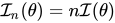
證明。 I n ( θ ) = E [ ( ∂ ln L ( θ ; x ) ∂ θ ) 2 ] = Var ( ∂ ln L ( θ ; x ) ∂ θ ) 根據以上說明 = Var ( ∂ ∂ θ ( ln ∏ i = 1 n f ( X i ; θ ) ) ) ( L ( θ ; x ) = ∏ i = 1 n f ( x i ; θ ) ) = Var ( ∂ ∂ θ ( ∑ i = 1 n ln f ( X i ; θ ) ) ) = Var ( ∑ i = 1 n ∂ ∂ θ ln f ( X i ; θ ) ) 根據微分的線性性質 = ∑ i = 1 n Var ( ∂ ∂ θ ln f ( X i ; θ ) ) 根據獨立性 = n Var ( ∂ ∂ θ ln f ( X i ; θ ) ) 根據同分布性 = n E [ ( ∂ ln f ( X ; θ ) ∂ θ ) 2 ] 根據以上說明 = n I ( θ ) . {\displaystyle {\begin{aligned}{\mathcal {I}}_{n}(\theta )&=\mathbb {E} \left[\left({\frac {\partial \ln {\mathcal {L}}({\boldsymbol {\theta }};\mathbf {x} )}{\partial \theta }}\right)^{2}\right]\\&=\operatorname {Var} \left({\frac {\partial \ln {\mathcal {L}}({\boldsymbol {\theta }};\mathbf {x} )}{\partial \theta }}\right)&{\text{根據以上說明}}\\&=\operatorname {Var} \left({\frac {\partial }{\partial \theta }}\left(\ln \prod _{i=1}^{n}f(X_{i};{\boldsymbol {\theta }})\right)\right)&\left({\mathcal {L}}(\theta ;\mathbf {x} )=\prod _{i=1}^{n}f(x_{i};\theta )\right)\\&=\operatorname {Var} \left({\frac {\partial }{\partial \theta }}\left(\sum _{i=1}^{n}\ln f(X_{i};{\boldsymbol {\theta }})\right)\right)\\&=\operatorname {Var} \left(\sum _{i=1}^{n}{\frac {\partial }{\partial \theta }}\ln f(X_{i};{\boldsymbol {\theta }})\right)&{\text{根據微分的線性性質}}\\&=\sum _{i=1}^{n}\operatorname {Var} \left({\frac {\partial }{\partial \theta }}\ln f(X_{i};{\boldsymbol {\theta }})\right)&{\text{根據獨立性}}\\&=n\operatorname {Var} \left({\frac {\partial }{\partial \theta }}\ln f(X_{i};{\boldsymbol {\theta }})\right)&{\text{根據同分布性}}\\&=n\mathbb {E} \left[\left({\frac {\partial \ln f(X;{\boldsymbol {\theta }})}{\partial \theta }}\right)^{2}\right]&{\text{根據以上說明}}\\&=n{\mathcal {I}}(\theta ).\end{aligned}}}
◻ {\displaystyle \Box }
命題。 在允許導數和積分交換的一些正則條件下, I ( θ ) = − E [ ∂ 2 ln f ( X ; θ ) ∂ θ 2 ] {\displaystyle {\mathcal {I}}(\theta )=-\mathbb {E} \left[{\frac {\partial ^{2}\ln f(X;{\boldsymbol {\theta }})}{\partial \theta ^{2}}}\right]}
備註。
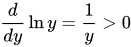
這個命題非常有用,因為在對 ln f ( X ; θ ) {\displaystyle \ln f(X;{\boldsymbol {\theta }})} X {\displaystyle X}
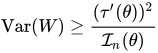
Proof. Since W {\displaystyle W} τ ( θ ) {\displaystyle \tau (\theta )} E [ W ] = τ ( θ ) {\displaystyle \mathbb {E} [W]=\tau (\theta )} E [ W ] = ∫ − ∞ ∞ ⋯ ∫ − ∞ ∞ w L ( θ ; x ) d x n ⋯ d x 1 {\displaystyle \mathbb {E} [W]=\int _{-\infty }^{\infty }\dotsi \int _{-\infty }^{\infty }w{\mathcal {L}}(\theta ;\mathbf {x} )\,dx_{n}\cdots \,dx_{1}} L ( θ ; x ) {\displaystyle {\mathcal {L}}(\theta ;\mathbf {x} )} ∫ − ∞ ∞ ⋯ ∫ − ∞ ∞ w L ( θ ; x ) d x n ⋯ d x 1 = τ ( θ ) ⇒ ∂ ∂ θ ∫ − ∞ ∞ ⋯ ∫ − ∞ ∞ w L ( θ ; x ) d x n ⋯ d x 1 = ∂ ∂ θ τ ( θ ) ⇒ ∫ − ∞ ∞ ⋯ ∫ − ∞ ∞ ∂ ∂ θ ( w L ( θ ; x ) ) d x n ⋯ d x 1 = τ ′ ( θ ) ⇒ ∫ − ∞ ∞ ⋯ ∫ − ∞ ∞ w ∂ ∂ θ ( L ( θ ; x ) ) ⋅ 1 L ( θ ; x ) ⋅ L ( θ ; x ) d x n ⋯ d x 1 = τ ′ ( θ ) ⇒ ∫ − ∞ ∞ ⋯ ∫ − ∞ ∞ w ∂ ln L ( θ ; x ) ∂ θ L ( θ ; x ) d x n ⋯ d x 1 = τ ′ ( θ ) ⇒ E [ W ⋅ ∂ ln L ( θ ; x ) ∂ θ ] = τ ′ ( θ ) ⇒ E [ W S ( θ ; X ) ] = τ ′ ( θ ) ( S ( θ ; X ) = ∂ ln L ( θ ; x ) ∂ θ ) ⇒ E [ W S ( θ ; X ) ] − E [ W ] E [ S ( θ ; X ) ] ⏟ = 0 = τ ′ ( θ ) ( E [ S ( θ ; X ) ] = 0 by remark about Fisher information ) ⇒ Cov ( W , S ( θ ; X ) ) = τ ′ ( θ ) {\displaystyle {\begin{aligned}&&\int _{-\infty }^{\infty }\dotsi \int _{-\infty }^{\infty }w{\mathcal {L}}(\theta ;\mathbf {x} )\,dx_{n}\cdots \,dx_{1}&=\tau (\theta )\\&\Rightarrow &{\frac {\partial }{\partial \theta }}\int _{-\infty }^{\infty }\dotsi \int _{-\infty }^{\infty }w{\mathcal {L}}(\theta ;\mathbf {x} )\,dx_{n}\cdots \,dx_{1}&={\frac {\partial }{\partial \theta }}\tau (\theta )\\&\Rightarrow &\int _{-\infty }^{\infty }\dotsi \int _{-\infty }^{\infty }{\frac {\partial }{\partial \theta }}\left(w{\mathcal {L}}(\theta ;\mathbf {x} )\right)\,dx_{n}\cdots \,dx_{1}&=\tau '(\theta )\\&\Rightarrow &\int _{-\infty }^{\infty }\dotsi \int _{-\infty }^{\infty }w{\frac {\partial }{\partial \theta }}\left({\mathcal {L}}(\theta ;\mathbf {x} )\right)\cdot {\frac {1}{{\mathcal {L}}(\theta ;\mathbf {x} )}}\cdot {\mathcal {L}}(\theta ;\mathbf {x} )\,dx_{n}\cdots \,dx_{1}&=\tau '(\theta )\\&\Rightarrow &\int _{-\infty }^{\infty }\dotsi \int _{-\infty }^{\infty }w{\frac {\partial \ln {\mathcal {L}}(\theta ;\mathbf {x} )}{\partial \theta }}{\mathcal {L}}(\theta ;\mathbf {x} )\,dx_{n}\cdots \,dx_{1}&=\tau '(\theta )\\&\Rightarrow &\mathbb {E} \left[W\cdot {\frac {\partial \ln {\mathcal {L}}(\theta ;\mathbf {x} )}{\partial \theta }}\right]&=\tau '(\theta )\\&\Rightarrow &\mathbb {E} \left[WS(\theta ;\mathbf {X} )\right]&=\tau '(\theta )&\left(S(\theta ;\mathbf {X} )={\frac {\partial \ln {\mathcal {L}}(\theta ;\mathbf {x} )}{\partial \theta }}\right)\\&\Rightarrow &\mathbb {E} \left[WS(\theta ;\mathbf {X} )\right]-\mathbb {E} [W]\underbrace {\mathbb {E} [S(\theta ;\mathbf {X} )]} _{=0}&=\tau '(\theta )&(\mathbb {E} [S(\theta ;\mathbf {X} )]=0{\text{ by remark about Fisher information}})\\&\Rightarrow &\operatorname {Cov} (W,S(\theta ;\mathbf {X} ))&=\tau '(\theta )\\\end{aligned}}} ( Cov ( X , Y ) ) 2 ≤ Var ( X ) Var ( Y ) {\displaystyle (\operatorname {Cov} (X,Y))^{2}\leq \operatorname {Var} (X)\operatorname {Var} (Y)} ( Cov ( W , S ( θ ; X ) ) ) 2 ≤ Var ( W ) Var ( S ( θ ; X ) ) ⟹ ( τ ′ ( θ ) ) 2 ≤ Var ( W ) Var ( S ( θ ; X ) ) ⟹ Var ( W ) ≥ ( τ ′ ( θ ) ) 2 Var ( S ( θ ; X ) ) = ( τ ′ ( θ ) ) 2 I n ( θ ) . {\displaystyle {\big (}\operatorname {Cov} (W,S(\theta ;\mathbf {X} )){\big )}^{2}\leq \operatorname {Var} (W)\operatorname {Var} (S(\theta ;\mathbf {X} ))\implies (\tau '(\theta ))^{2}\leq \operatorname {Var} (W)\operatorname {Var} (S(\theta ;\mathbf {X} ))\implies \operatorname {Var} (W)\geq {\frac {(\tau '(\theta ))^{2}}{\operatorname {Var} (S(\theta ;\mathbf {X} ))}}={\frac {(\tau '(\theta ))^{2}}{{\mathcal {I}}_{n}(\theta )}}.} I n ( θ ) = Var ( S ( θ ; X ) ) {\displaystyle {\mathcal {I}}_{n}(\theta )=\operatorname {Var} (S(\theta ;\mathbf {X} ))}
◻ {\displaystyle \Box }
有時,我們無法使用 CRLB 方法來尋找 UMVUE,因為
正則條件可能不滿足,因此我們無法使用克拉美-拉奧不等式,以及
無偏估計量的方差可能不等於 CRLB,但我們不能由此得出它不是 UMVUE 的結論,因為 CRLB 可能根本無法達到,並且所有無偏估計量中最小的方差實際上是該估計量的方差,它大於 CRLB。 我們將在下面舉例說明這兩種情況。
由於CRLB有時可以達到,有時無法達到,因此很自然地會提出這樣的問題:何時 可達條件
Proof. Considering the proof for Cramer-Rao inequality, we have Var ( W ) = ( τ ′ ( θ ) ) 2 I n ( θ ) ⟺ ( Cov ( W , S ( θ ; X ) ) ) 2 = Var ( W ) Var ( S ( θ ; X ) ) {\displaystyle \operatorname {Var} (W)={\frac {(\tau '(\theta ))^{2}}{{\mathcal {I}}_{n}(\theta )}}\iff (\operatorname {Cov} (W,S(\theta ;\mathbf {X} )))^{2}=\operatorname {Var} (W)\operatorname {Var} (S(\theta ;\mathbf {X} ))} Cov ( W , S ( θ ; X ) ) {\displaystyle \operatorname {Cov} (W,S(\theta ;\mathbf {X} ))} Cov ( W − τ ( θ ) ⏟ constant , S ( θ ; X ) ) {\displaystyle \operatorname {Cov} (W-\underbrace {\tau (\theta )} _{\text{constant}},S(\theta ;\mathbf {X} ))} Var ( W ) = Var ( W − τ ( θ ) ⏟ constant ) {\displaystyle \operatorname {Var} (W)=\operatorname {Var} (W-\underbrace {\tau (\theta )} _{\text{constant}})} ( Cov ( W − τ ( θ ) , S ( θ ; X ) ) ) 2 = Var ( W − τ ( θ ) ) Var ( S ( θ ; X ) ) ⇔ ( Cov ( W − τ ( θ ) , S ( θ ; X ) ) ) 2 Var ( W − τ ( θ ) ) Var ( S ( θ ; X ) ) = 1 ⇔ ( Cov ( S ( θ ; X ) , W − τ ( θ ) ) ) 2 Var ( W − τ ( θ ) ) Var ( S ( θ ; X ) ) = 1 ⇔ ( ρ ( S ( θ ; X ) , W − τ ( θ ) ) ) 2 = 1 ⇔ ρ ( S ( θ ; X ) , W − τ ( θ ) ) = ± 1 {\displaystyle {\begin{aligned}&&{\big (}\operatorname {Cov} (W-\tau (\theta ),S(\theta ;\mathbf {X} )){\big )}^{2}&=\operatorname {Var} (W-\tau (\theta ))\operatorname {Var} (S(\theta ;\mathbf {X} ))\\&\Leftrightarrow &{\frac {{\big (}\operatorname {Cov} (W-\tau (\theta ),S(\theta ;\mathbf {X} )){\big )}^{2}}{\operatorname {Var} (W-\tau (\theta ))\operatorname {Var} (S(\theta ;\mathbf {X} ))}}&=1\\&\Leftrightarrow &{\frac {{\big (}\operatorname {Cov} (S(\theta ;\mathbf {X} ),W-\tau (\theta )){\big )}^{2}}{\operatorname {Var} (W-\tau (\theta ))\operatorname {Var} (S(\theta ;\mathbf {X} ))}}&=1\\&\Leftrightarrow &{\big (}\rho (S(\theta ;\mathbf {X} ),W-\tau (\theta )){\big )}^{2}&=1\\&\Leftrightarrow &\rho (S(\theta ;\mathbf {X} ),W-\tau (\theta ))&=\pm 1\end{aligned}}} ρ ( ⋅ , ⋅ ) {\displaystyle \rho (\cdot ,\cdot )} S ( θ ; X ) {\displaystyle S(\theta ;\mathbf {X} )} W − τ ( θ ) {\displaystyle W-\tau (\theta )} S ( θ ; X ) = k ( W − τ ( θ ) ) + c {\displaystyle S(\theta ;\mathbf {X} )=k(W-\tau (\theta ))+c} c , k {\displaystyle c,k} c {\displaystyle c}
我們知道 E [ W ] = τ ( θ ) {\displaystyle \mathbb {E} [W]=\tau (\theta )} W {\displaystyle W} τ ( θ ) {\displaystyle \tau (\theta )} E [ S ( θ ; X ) ] = 0 {\displaystyle \mathbb {E} [S(\theta ;\mathbf {X} )]=0} E [ S ( θ ; X ) ] = k E [ W − τ ( θ ) ] + c ⟺ E [ S ( θ ; X ) ] = k ( E [ W ] − τ ( θ ) ⏟ = 0 ) + c ⟺ 0 = 0 + c ⟺ c = 0. {\displaystyle \mathbb {E} [S(\theta ;\mathbf {X} )]=k\mathbb {E} [W-\tau (\theta )]+c\iff \mathbb {E} [S(\theta ;\mathbf {X} )]=k(\underbrace {\mathbb {E} [W]-\tau (\theta )} _{=0})+c\iff 0=0+c\iff c=0.}
◻ {\displaystyle \Box }
示例。 延續前面的例子。證明 σ 2 {\displaystyle \sigma ^{2}}
備註。
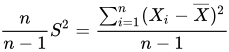
即使我們知道 σ 2 {\displaystyle \sigma ^{2}} n n − 1 ⋅ S 2 {\displaystyle {\frac {n}{n-1}}\cdot S^{2}}
我們之前討論過MLE,MLE實際上是漸近的(即,當樣本量 n → ∞ {\displaystyle n\to \infty }
Proof. Partial proof d d θ ln L ( θ ) {\displaystyle {\frac {d}{d\theta }}\ln {\mathcal {L}}(\theta )} d d θ ln L ( θ ^ ) = d d θ ln L ( θ ) + ( θ ^ − θ ) d 2 d θ 2 ln L ( θ ) + 1 2 ( θ ^ − θ ) 2 d 3 d θ 3 ln L ( θ ) | θ = θ ∗ {\displaystyle {\frac {d}{d\theta }}\ln {\mathcal {L}}({\hat {\theta }})={\frac {d}{d\theta }}\ln {\mathcal {L}}(\theta )+({\hat {\theta }}-\theta ){\frac {d^{2}}{d\theta ^{2}}}\ln {\mathcal {L}}(\theta )+{\frac {1}{2}}({\hat {\theta }}-\theta )^{2}{\frac {d^{3}}{d\theta ^{3}}}\ln {\mathcal {L}}(\theta ){\bigg \vert }_{\theta =\theta ^{*}}} θ ∗ {\displaystyle \theta ^{*}} θ {\displaystyle \theta } θ ^ {\displaystyle {\hat {\theta }}} θ ^ {\displaystyle {\hat {\theta }}} θ {\displaystyle \theta } d d θ ln L ( θ ^ ) = 0 {\displaystyle {\frac {d}{d\theta }}\ln {\mathcal {L}}({\hat {\theta }})=0} d d θ ln L ( θ ) + ( θ ^ − θ ) d 2 d θ 2 ln L ( θ ) + 1 2 ( θ ^ − θ ) 2 d 3 d θ 3 ln L ( θ ) | θ = θ ∗ = 0 ⇒ − n ( θ ^ − θ ) d 2 d θ 2 ln L ( θ ) − n 2 ( θ ^ − θ ) 2 d 3 d θ 3 ln L ( θ ) | θ = θ ∗ = n d d θ ln L ( θ ) ⇒ n ( θ ^ − θ ) = d d θ ln L ( θ ) / n − n − 1 d 2 d θ 2 ln L ( θ ) − ( 2 n ) − 1 ( θ ^ − θ ) d 3 d θ 3 ln L ( θ ) | θ = θ ∗ . {\displaystyle {\begin{aligned}&&{\frac {d}{d\theta }}\ln {\mathcal {L}}(\theta )+({\hat {\theta }}-\theta ){\frac {d^{2}}{d\theta ^{2}}}\ln {\mathcal {L}}(\theta )+{\frac {1}{2}}({\hat {\theta }}-\theta )^{2}{\frac {d^{3}}{d\theta ^{3}}}\ln {\mathcal {L}}(\theta ){\bigg \vert }_{\theta =\theta ^{*}}&=0\\&\Rightarrow &-{\sqrt {n}}({\hat {\theta }}-\theta ){\frac {d^{2}}{d\theta ^{2}}}\ln {\mathcal {L}}(\theta )-{\frac {\sqrt {n}}{2}}({\hat {\theta }}-\theta )^{2}{\frac {d^{3}}{d\theta ^{3}}}\ln {\mathcal {L}}(\theta ){\bigg \vert }_{\theta =\theta ^{*}}={\sqrt {n}}{\frac {d}{d\theta }}\ln {\mathcal {L}}(\theta )\\&\Rightarrow &{\sqrt {n}}({\hat {\theta }}-\theta )={\frac {{\frac {d}{d\theta }}\ln {\mathcal {L}}(\theta )/{\sqrt {n}}}{-n^{-1}{\frac {d^{2}}{d\theta ^{2}}}\ln {\mathcal {L}}(\theta )-(2n)^{-1}({\hat {\theta }}-\theta ){\frac {d^{3}}{d\theta ^{3}}}\ln {\mathcal {L}}(\theta ){\bigg \vert }_{\theta =\theta ^{*}}}}.\end{aligned}}} Var ( ∑ i = 1 n ∂ ln f ( X i ; θ ) ∂ θ ) = ∑ i = 1 n Var ( ∂ ln f ( X i ; θ ) ∂ θ ) = ∑ i = 1 n E [ ( ∂ ln f ( X i ; θ ) ∂ θ ) 2 ] = n I ( θ ) ( 1 ) , {\displaystyle \operatorname {Var} \left(\sum _{i=1}^{n}{\frac {\partial \ln f(X_{i};\theta )}{\partial \theta }}\right)=\sum _{i=1}^{n}\operatorname {Var} \left({\frac {\partial \ln f(X_{i};\theta )}{\partial \theta }}\right)=\sum _{i=1}^{n}\mathbb {E} \left[\left({\frac {\partial \ln f(X_{i};\theta )}{\partial \theta }}\right)^{2}\right]=n{\mathcal {I}}(\theta )\qquad (1),} d d θ ln L ( θ ) n = 1 n ∑ i = 1 n ∂ ln f ( X i ; θ ) ∂ θ → d N ( 0 , ( 1 / n ) n I ( θ ) ) ≡ N ( 0 , I ( θ ) ) . {\displaystyle {\frac {{\frac {d}{d\theta }}\ln {\mathcal {L}}(\theta )}{\sqrt {n}}}={\frac {1}{\sqrt {n}}}\sum _{i=1}^{n}{\frac {\partial \ln f(X_{i};\theta )}{\partial \theta }}\;{\overset {d}{\to }}\;{\mathcal {N}}(0,(1/n)nI(\theta ))\equiv {\mathcal {N}}(0,{\mathcal {I}}(\theta )).} − n − 1 d 2 d θ 2 ln L ( θ ) = − 1 n ∑ i = 1 n ∂ 2 ln f ( X i ; θ ) ∂ θ 2 → p − E [ ∂ 2 ln f ( X i ; θ ) ∂ θ 2 ] = I ( θ ) ( 2 ) . {\displaystyle -n^{-1}{\frac {d^{2}}{d\theta ^{2}}}\ln {\mathcal {L}}(\theta )=-{\frac {1}{n}}\sum _{i=1}^{n}{\frac {\partial ^{2}\ln f(X_{i};\theta )}{\partial \theta ^{2}}}\;{\overset {p}{\to }}\;-\mathbb {E} \left[{\frac {\partial ^{2}\ln f(X_{i};\theta )}{\partial \theta ^{2}}}\right]={\mathcal {I}}(\theta )\qquad (2).} − ( 2 n ) − 1 ( θ ^ − θ ) d 3 d θ 3 ln L ( θ ) | θ = θ ∗ → p 0. ( 3 ) . {\displaystyle -(2n)^{-1}({\hat {\theta }}-\theta ){\frac {d^{3}}{d\theta ^{3}}}\ln {\mathcal {L}}(\theta ){\bigg \vert }_{\theta =\theta ^{*}}\;{\overset {p}{\to }}\;0.\qquad (3).} ( 2 ) {\displaystyle (2)} ( 3 ) {\displaystyle (3)} − n − 1 d 2 d θ 2 ln L ( θ ) − ( 2 n ) − 1 ( θ ^ − θ ) d 3 d θ 3 ln L ( θ ) | θ = θ ∗ → p I ( θ ) + 0 = I ( θ ) ( 4 ) . {\displaystyle -n^{-1}{\frac {d^{2}}{d\theta ^{2}}}\ln {\mathcal {L}}(\theta )-(2n)^{-1}({\hat {\theta }}-\theta ){\frac {d^{3}}{d\theta ^{3}}}\ln {\mathcal {L}}(\theta ){\bigg \vert }_{\theta =\theta ^{*}}\;{\overset {p}{\to }}\;{\mathcal {I}}(\theta )+0={\mathcal {I}}(\theta )\qquad (4).} ( 1 ) {\displaystyle (1)} ( 4 ) {\displaystyle (4)} n ( θ ^ − θ ) = d d θ ln L ( θ ) / n − n − 1 d 2 d θ 2 ln L ( θ ) − ( 2 n ) − 1 ( θ ^ − θ ) d 3 d θ 3 ln L ( θ ) | θ = θ ∗ → d Y I ( θ ) {\displaystyle {\sqrt {n}}({\hat {\theta }}-\theta )={\frac {{\frac {d}{d\theta }}\ln {\mathcal {L}}(\theta )/{\sqrt {n}}}{-n^{-1}{\frac {d^{2}}{d\theta ^{2}}}\ln {\mathcal {L}}(\theta )-(2n)^{-1}({\hat {\theta }}-\theta ){\frac {d^{3}}{d\theta ^{3}}}\ln {\mathcal {L}}(\theta ){\bigg \vert }_{\theta =\theta ^{*}}}}\;{\overset {d}{\to }}\;{\frac {Y}{{\mathcal {I}}(\theta )}}} Y ∼ N ( 0 , I ( θ ) ) {\displaystyle Y\sim {\mathcal {N}}(0,{\mathcal {I}}(\theta ))} Y I ( θ ) ∼ N ( 0 , I ( θ ) [ I ( θ ) ] 2 ) ≡ N ( 0 , 1 / I ( θ ) ) {\displaystyle {\frac {Y}{{\mathcal {I}}(\theta )}}\sim {\mathcal {N}}\left(0,{\frac {{\mathcal {I}}(\theta )}{[{\mathcal {I}}(\theta )]^{2}}}\right)\equiv {\mathcal {N}}(0,1/{\mathcal {I}}(\theta ))} n ( θ ^ − θ ) → d N ( 0 , 1 / I ( θ ) ) . {\displaystyle {\sqrt {n}}({\hat {\theta }}-\theta )\;{\overset {d}{\to }}\;{\mathcal {N}}(0,1/{\mathcal {I}}(\theta )).} θ ^ − θ → d N ( 0 , 1 / ( n I ( θ ) ) ) ≡ N ( 0 , 1 / I n ( θ ) ) , {\displaystyle {\hat {\theta }}-\theta \;{\overset {d}{\to }}\;{\mathcal {N}}(0,1/(n{\mathcal {I}}(\theta )))\equiv {\mathcal {N}}(0,1/{\mathcal {I}}_{n}(\theta )),} θ ^ − θ 1 / I n ( θ ) → d N ( 0 , 1 / ( n I ( θ ) ) 1 / I n ( θ ) ⏟ = n I ( θ ) ) ≡ N ( 0 , 1 ) {\displaystyle {\frac {{\hat {\theta }}-\theta }{\sqrt {1/{\mathcal {I}}_{n}(\theta )}}}\;{\overset {d}{\to }}\;{\mathcal {N}}{\Bigg (}0,{\frac {1/(n{\mathcal {I}}(\theta ))}{1/\underbrace {{\mathcal {I}}_{n}(\theta )} _{=n{\mathcal {I}}(\theta )}}}{\Bigg )}\equiv {\mathcal {N}}(0,1)}
◻ {\displaystyle \Box }
由於在某些情況下我們無法使用CRLB來找到UMVUE,因此我們將在下面介紹另一種找到UMVUE的方法,該方法使用充分性 完備性
直觀地講,一個充分統計量 T ( X 1 , … , X n ) {\displaystyle T(X_{1},\dotsc ,X_{n})} X 1 , … , X n {\displaystyle X_{1},\dotsc ,X_{n}} θ {\displaystyle \theta } T ( X 1 , … , X n ) {\displaystyle T(X_{1},\dotsc ,X_{n})} θ {\displaystyle \theta }
正式地,我們可以如下定義和描述充分統計量
備註。
f ( x 1 , … , x n | T ; θ ) = f ( x 1 , … , x n | T ) {\displaystyle f(x_{1},\dotsc ,x_{n}|T;\theta )=f(x_{1},\dotsc ,x_{n}|T)}
其中 f {\displaystyle f} X 1 , … , X n {\displaystyle X_{1},\dotsc ,X_{n}} 該等式意味著 X 1 , … , X n {\displaystyle X_{1},\dotsc ,X_{n}} T {\displaystyle T} X 1 , … , X n {\displaystyle X_{1},\dotsc ,X_{n}} T {\displaystyle T} θ {\displaystyle \theta } 這意味著即使提供了引數值 θ {\displaystyle \theta } T {\displaystyle T} X 1 , … , X n {\displaystyle X_{1},\dotsc ,X_{n}} θ {\displaystyle \theta } f ( x 1 , … , x n | T ) {\displaystyle f(x_{1},\dotsc ,x_{n}|T)} f X 1 , … , X n | T ( x 1 , … , x n | t ) {\displaystyle f_{X_{1},\dotsc ,X_{n}|T}(x_{1},\dotsc ,x_{n}|t)} 在實現 T = t {\displaystyle T=t} T {\displaystyle T} 在實現 T = t {\displaystyle T=t} T {\displaystyle T} T = t {\displaystyle T=t}
我們將在下面正式陳述上述關於充分統計量變換的說明。
現在,我們討論一個定理,它可以幫助我們檢查統計量的充分性,即(Fisher-Neyman)因子分解定理
定理. (因子分解定理)設 f ( x 1 , … , x n ; θ ) {\displaystyle f(x_{1},\dotsc ,x_{n};\theta )} X 1 , … , X n {\displaystyle X_{1},\dotsc ,X_{n}} T = T ( X 1 , … , X n ) {\displaystyle T=T(X_{1},\dotsc ,X_{n})} θ {\displaystyle \theta } 充分統計量 g {\displaystyle g} h {\displaystyle h} f ( x 1 , … , x n ; θ ) = g ( T ( x 1 , … , x n ) ; θ ) h ( x 1 , … , x n ) {\displaystyle f(x_{1},\dotsc ,x_{n};\theta )=g(T(x_{1},\dotsc ,x_{n});\theta )h(x_{1},\dotsc ,x_{n})} g {\displaystyle g} 透過 T ( x 1 , … , x n ) {\displaystyle T(x_{1},\dotsc ,x_{n})} x 1 , … , x n {\displaystyle x_{1},\dotsc ,x_{n}} h {\displaystyle h} 不 θ {\displaystyle \theta }
證明。 由於連續情況下的證明相當複雜,我們只給出離散情況下的證明。為簡化表達,令 X = ( X 1 , … , X n ) {\displaystyle \mathbf {X} =(X_{1},\dotsc ,X_{n})} T = T ( X 1 , … , X n ) {\displaystyle T=T(X_{1},\dotsc ,X_{n})} x = ( x 1 , … , x n ) {\displaystyle \mathbf {x} =(x_{1},\dotsc ,x_{n})} t = T ( x 1 , … , x n ) {\displaystyle t=T(x_{1},\dotsc ,x_{n})} f X | T ( x | t ; θ ) = f X | T ( x , t ) {\displaystyle f_{\mathbf {X} |T}(\mathbf {x} |t;\theta )=f_{\mathbf {X} |T}(\mathbf {x} ,t)} X = x ⟺ X = x ∩ T ( X ) = T ( x ) ⟺ X = x ∩ T = t {\displaystyle \mathbf {X} =\mathbf {x} \iff \mathbf {X} =\mathbf {x} \cap T(\mathbf {X} )=T(\mathbf {x} )\iff \mathbf {X} =\mathbf {x} \cap T=t} f X , T ( x , t ; θ ) = f X ( x ; θ ) ( ∗ ) {\displaystyle f_{\mathbf {X} ,T}(\mathbf {x} ,t;\theta )=f_{\mathbf {X} }(\mathbf {x} ;\theta )\quad (*)}
“僅當” ( ⇒ {\displaystyle \Rightarrow } T {\displaystyle T} g ( t ; θ ) = f T ( t ; θ ) {\displaystyle g(t;\theta )=f_{T}(t;\theta )} h ( x ) = f X | T ( x | t ) {\displaystyle h(\mathbf {x} )=f_{\mathbf {X} |T}(\mathbf {x} |t)} θ {\displaystyle \theta }
因此, f X ( x ; θ ) = f X , T ( x , t ; θ ) = def f X | T ( x | t ; θ ) f T ( t ; θ ) = sufficiency f X | T ( x | t ) f T ( t ; θ ) = h ( x ) g ( t ; θ ) . {\displaystyle f_{\mathbf {X} }(\mathbf {x} ;\theta )=f_{\mathbf {X} ,T}(\mathbf {x} ,t;\theta ){\overset {\text{ def }}{=}}f_{\mathbf {X} |T}(\mathbf {x} |t;\theta )f_{T}(t;\theta ){\overset {\text{ sufficiency }}{=}}f_{\mathbf {X} |T}(\mathbf {x} |t)f_{T}(t;\theta )=h(\mathbf {x} )g(t;\theta ).}
"if" ( ⇐ {\displaystyle \Leftarrow } f X ( x ; θ ) = g ( t ; θ ) h ( x ) {\displaystyle f_{\mathbf {X} }(\mathbf {x} ;\theta )=g(t;\theta )h(\mathbf {x} )} f T ( t ; θ ) = marginal pmf ∑ x f X , T ( x , t ; θ ) = (*) ∑ x f X ( x ; θ ) = assumption ∑ x g ( t ; θ ) h ( x ) = g ( t ; θ ) ⏟ independent from x ∑ x h ( x ) . {\displaystyle f_{T}(t;\theta ){\overset {\text{ marginal pmf }}{=}}\sum _{\mathbf {x} }^{}f_{\mathbf {X} ,T}(\mathbf {x} ,t;\theta ){\overset {\text{ (*) }}{=}}\sum _{\mathbf {x} }^{}f_{\mathbf {X} }(\mathbf {x} ;\theta ){\overset {\text{ assumption }}{=}}\sum _{\mathbf {x} }^{}g(t;\theta )h(\mathbf {x} )=\underbrace {g(t;\theta )} _{{\text{independent from }}\mathbf {x} }\sum _{\mathbf {x} }^{}h(\mathbf {x} ).} f X | T ( x | t ) {\displaystyle f_{\mathbf {X} |T}(\mathbf {x} |t)} θ {\displaystyle \theta } T {\displaystyle T} θ {\displaystyle \theta } f X | T ( x | t ) = def f X , T ( x , t ; θ ) f T ( t ; θ ) = (*) f X ( x ; θ ) f T ( t ; θ ) = g ( t ; θ ) h ( x ) ⏞ assumption g ( t ; θ ) ∑ x h ( x ) ⏟ above = h ( x ) ∑ x h ( x ) , {\displaystyle f_{\mathbf {X} |T}(\mathbf {x} |t){\overset {\text{ def }}{=}}{\frac {f_{\mathbf {X} ,T}(\mathbf {x} ,t;\theta )}{f_{T}(t;\theta )}}{\overset {\text{ (*) }}{=}}{\frac {f_{\mathbf {X} }(\mathbf {x} ;\theta )}{f_{T}(t;\theta )}}={\frac {\overbrace {g(t;\theta )h(\mathbf {x} )} ^{\text{assumption}}}{\underbrace {g(t;\theta )\sum _{\mathbf {x} }^{}h(\mathbf {x} )} _{\text{above}}}}={\frac {h(\mathbf {x} )}{\sum _{\mathbf {x} }^{}h(\mathbf {x} )}},} θ {\displaystyle \theta }
◻ {\displaystyle \Box }
備註。
h ( x 1 , … , x n ) {\displaystyle h(x_{1},\dotsc ,x_{n})} θ {\displaystyle \theta }
示例. 考慮來自 N ( μ , σ 2 ) {\displaystyle {\mathcal {N}}(\mu ,\sigma ^{2})} X 1 , … , X n {\displaystyle X_{1},\dotsc ,X_{n}} θ = ( μ , σ 2 ) {\displaystyle \theta =(\mu ,\sigma ^{2})}
Solution X 1 , … , X n {\displaystyle X_{1},\dotsc ,X_{n}} f ( x 1 , … , x n ; θ ) = ∏ i = 1 n 1 2 π σ 2 exp ( − ( x i − μ ) 2 2 σ 2 ) = ( 2 π σ 2 ) − n / 2 exp ( ∑ i = 1 n ( x i − μ ) 2 2 σ 2 ) = ( 2 π σ 2 ) − n / 2 exp ( ∑ i = 1 n ( x i − x ¯ + x ¯ − μ ) 2 2 σ 2 ) = ( 2 π σ 2 ) − n / 2 exp ( ∑ i = 1 n ( x i − x ¯ ) 2 + 2 ( x i − x ¯ ) ( x ¯ − μ ) + ( x ¯ − μ ) 2 2 σ 2 ) = ( 2 π σ 2 ) − n / 2 exp ( ∑ i = 1 n ( x i − x ¯ ) 2 + ( x ¯ − μ ) 2 2 σ 2 ) ( ∑ i = 1 n ( x i − x ¯ ) ( x ¯ − μ ) = ( x ¯ − μ ) ∑ i = 1 n ( x i − x ¯ ) = ( x ¯ − μ ) ( ∑ i = 1 n x i − ∑ i = 1 n x ¯ ) = ( x ¯ − μ ) ( n x ¯ − n x ¯ ) = 0 ) = ( 2 π σ 2 ) − n / 2 exp ( 1 2 σ 2 ( ∑ i = 1 n ( x i − x ¯ ) 2 + ∑ i = 1 n ( x ¯ − μ ) 2 ) ) = ( 2 π ) − n / 2 ⏟ h ( x 1 , … , x n ) σ − n exp ( 1 2 σ 2 ( n s 2 + n ( x ¯ − μ ) 2 ) ) ⏟ g ( T ( x 1 , … , x n ) ; θ ) ( ( x ¯ − μ ) 2 is independent from i ) . {\displaystyle {\begin{aligned}f(x_{1},\dotsc ,x_{n};\theta )&=\prod _{i=1}^{n}{\frac {1}{\sqrt {2\pi \sigma ^{2}}}}\exp \left(-{\frac {(x_{i}-\mu )^{2}}{2\sigma ^{2}}}\right)\\&=(2\pi \sigma ^{2})^{-n/2}\exp \left(\sum _{i=1}^{n}{\frac {(x_{i}-\mu )^{2}}{2\sigma ^{2}}}\right)\\&=(2\pi \sigma ^{2})^{-n/2}\exp \left(\sum _{i=1}^{n}{\frac {(x_{i}{\color {darkgreen}-{\overline {x}}+{\overline {x}}}-\mu )^{2}}{2\sigma ^{2}}}\right)\\&=(2\pi \sigma ^{2})^{-n/2}\exp \left(\sum _{i=1}^{n}{\frac {(x_{i}{\color {darkgreen}-{\overline {x}}})^{2}+2(x_{i}-{\overline {x}})({\overline {x}}-\mu )+({\color {darkgreen}{\overline {x}}}-\mu )^{2}}{2\sigma ^{2}}}\right)\\&=(2\pi \sigma ^{2})^{-n/2}\exp \left(\sum _{i=1}^{n}{\frac {(x_{i}{\color {darkgreen}-{\overline {x}}})^{2}+({\color {darkgreen}{\overline {x}}}-\mu )^{2}}{2\sigma ^{2}}}\right)&\left(\sum _{i=1}^{n}(x_{i}-{\overline {x}})({\overline {x}}-\mu )=({\overline {x}}-\mu )\sum _{i=1}^{n}(x_{i}-{\overline {x}})=({\overline {x}}-\mu )\left(\sum _{i=1}^{n}x_{i}-\sum _{i=1}^{n}{\overline {x}}\right)=({\overline {x}}-\mu )(n{\overline {x}}-n{\overline {x}})=0\right)\\&=(2\pi \sigma ^{2})^{-n/2}\exp \left({\frac {1}{2\sigma ^{2}}}\left(\sum _{i=1}^{n}(x_{i}{\color {darkgreen}-{\overline {x}}})^{2}+\sum _{i=1}^{n}({\color {darkgreen}{\overline {x}}}-\mu )^{2}\right)\right)\\&=\underbrace {(2\pi )^{-n/2}} _{h(x_{1},\dotsc ,x_{n})}\underbrace {\sigma ^{-n}\exp \left({\frac {1}{2\sigma ^{2}}}\left(ns^{2}+n({\overline {x}}-\mu )^{2}\right)\right)} _{g(T(x_{1},\dotsc ,x_{n});\theta )}&\left(({\overline {x}}-\mu )^{2}{\text{ is independent from }}i\right).\\\end{aligned}}} g {\displaystyle g} x 1 , … , x n {\displaystyle x_{1},\dotsc ,x_{n}} T ( x 1 , … , x n ) = ( x ¯ , s 2 ) {\displaystyle T(x_{1},\dotsc ,x_{n})=({\overline {x}},s^{2})} T ( X 1 , … , X n ) = ( X ¯ , S 2 ) {\displaystyle T(X_{1},\dotsc ,X_{n})=({\overline {X}},S^{2})}
備註。
我們也可以將 ( X ¯ , S 2 ) {\displaystyle ({\overline {X}},S^{2})} ( S 2 , X ¯ ) {\displaystyle (S^{2},{\overline {X}})} θ {\displaystyle \theta } 直觀地說,這是因為後者也包含相同的統計量,因此包含相同的資訊。
或者,我們可以將函式 v {\displaystyle v} ( z 1 , z 2 ) ↦ ( z 2 , z 1 ) {\displaystyle (z_{1},z_{2})\mapsto (z_{2},z_{1})} v ( X ¯ , S 2 ) = ( S 2 , X ¯ ) {\displaystyle v({\overline {X}},S^{2})=(S^{2},{\overline {X}})} θ {\displaystyle \theta } 我們需要從 ( 2 π σ 2 ) − n / 2 {\displaystyle (2\pi \sigma ^{2})^{-n/2}} σ − n {\displaystyle \sigma ^{-n}} h ( x 1 , … , x n ) {\displaystyle h(x_{1},\dotsc ,x_{n})} θ = ( μ , σ 2 ) {\displaystyle \theta =(\mu ,\sigma ^{2})} h ( x 1 , … , x n ) {\displaystyle h(x_{1},\dotsc ,x_{n})} σ − n {\displaystyle \sigma ^{-n}}
在這種情況下,定義 g {\displaystyle g} h {\displaystyle h}
對於一些“良好”的分佈,它們屬於指數族
定義。 (指數族分佈)隨機變數 X {\displaystyle X} X {\displaystyle X} f ( x ; θ ) = h ( x ) g ( θ ) exp ( ∑ i = 1 s η i ( θ ) T i ( x ) ) {\displaystyle f(x;\theta )=h(x)g(\theta )\exp \left(\sum _{i=1}^{\color {darkgreen}s}\eta _{i}(\theta )T_{i}(x)\right)} θ = ( θ 1 , … , θ s ) ∈ Θ ⊆ R s {\displaystyle \theta =(\theta _{1},\dotsc ,\theta _{\color {darkgreen}s})\in \Theta \subseteq \mathbb {R} ^{\color {darkgreen}s}} h , g , η i , T i {\displaystyle h,g,\eta _{i},T_{i}} i = 1 , 2 … , s {\displaystyle i=1,2\dotsc ,s}
定理. (指數族的充分統計量)設 X 1 , … , X n {\displaystyle X_{1},\dotsc ,X_{n}} f ( x ; θ ) {\displaystyle f(x;\theta )} θ ∈ R s {\displaystyle \theta \in \mathbb {R} ^{s}} θ {\displaystyle \theta } 充分統計量 T ( X 1 , … , X n ) = ( ∑ j = 1 n T 1 ( X j ) , … , ∑ j = 1 n T s ( X j ) ) . {\displaystyle T(X_{1},\dotsc ,X_{n})=\left(\sum _{j=1}^{n}T_{1}(X_{j}),\dotsc ,\sum _{j=1}^{n}T_{s}(X_{j})\right).}
Proof. Since the distribution belongs to the exponential family, the joint pdf or pmf of X 1 , … , X n {\displaystyle X_{1},\dotsc ,X_{n}} f ( x 1 , … , x n ; θ ) = ∏ j = 1 n [ h ( x j ) g ( θ ) exp ( ∑ i = 1 s η i ( θ ) T i ( x j ) ) ] = [ ∏ j = 1 n h ( x j ) ] ( g ( θ ) ) n exp ( ∑ j = 1 n ∑ i = 1 s η i ( θ ) T i ( x j ) ) = [ ∏ j = 1 n h ( x j ) ] ( g ( θ ) ) n exp ( ∑ i = 1 s ∑ j = 1 n η i ( θ ) T i ( x j ) ) ( changing summation order, where the upper bounds are constants ) = [ ∏ j = 1 n h ( x j ) ] ( g ( θ ) ) n exp ( ∑ i = 1 s η i ( θ ) ⏟ independent from j ∑ j = 1 n T i ( x j ) ) = [ ∏ j = 1 n h ( x j ) ] ( g ( θ ) ) n exp ( η 1 ( θ ) ∑ j = 1 n T 1 ( x j ) + ⋯ + η s ( θ ) ∑ j = 1 n T s ( x j ) ) . {\displaystyle {\begin{aligned}f(x_{1},\dotsc ,x_{n};\theta )&=\prod _{{\color {blue}j}=1}^{n}\left[h(x_{\color {blue}j})g(\theta )\exp \left(\sum _{i=1}^{\color {darkgreen}s}\eta _{i}(\theta )T_{i}(x_{\color {blue}j})\right)\right]\\&=\left[\prod _{j=1}^{n}h(x_{j})\right](g(\theta ))^{n}\exp \left(\sum _{{\color {blue}j}=1}^{n}\sum _{i=1}^{s}\eta _{i}(\theta )T_{i}(x_{\color {blue}j})\right)\\&=\left[\prod _{j=1}^{n}h(x_{j})\right](g(\theta ))^{n}\exp \left(\sum _{i=1}^{s}\sum _{{\color {blue}j}=1}^{n}\eta _{i}(\theta )T_{i}(x_{\color {blue}j})\right)&({\text{changing summation order, where the upper bounds are constants}})\\&=\left[\prod _{j=1}^{n}h(x_{j})\right](g(\theta ))^{n}\exp \left(\sum _{i=1}^{s}\underbrace {\eta _{i}(\theta )} _{{\text{independent from }}j}\sum _{{\color {blue}j}=1}^{n}T_{i}(x_{\color {blue}j})\right)\\&={\color {purple}\left[\prod _{j=1}^{n}h(x_{j})\right]}{\color {red}(g(\theta ))^{n}\exp \left(\eta _{1}(\theta )\sum _{{\color {blue}j}=1}^{n}T_{1}(x_{\color {blue}j})+\dotsb +\eta _{s}(\theta )\sum _{{\color {blue}j}=1}^{n}T_{s}(x_{\color {blue}j})\right)}.\\\end{aligned}}} purple part of the function as " h ( x 1 , … , x n ) {\displaystyle h(x_{1},\dotsc ,x_{n})} red part of the function as " g ( T ( x 1 , … , x n ) ; θ ) {\displaystyle g(T(x_{1},\dotsc ,x_{n});\theta )} red part of the function depends on x 1 , … , x n {\displaystyle x_{1},\dotsc ,x_{n}} ( ∑ j = 1 n T 1 ( x j ) , … , ∑ j = 1 n T s ( x j ) ) {\displaystyle \left(\sum _{j=1}^{n}T_{1}(x_{j}),\dotsc ,\sum _{j=1}^{n}T_{s}(x_{j})\right)}
◻ {\displaystyle \Box }
例. 考慮來自 N ( μ , σ 2 ) {\displaystyle {\mathcal {N}}(\mu ,\sigma ^{2})} X 1 , … , X n {\displaystyle X_{1},\dotsc ,X_{n}} θ = ( μ , σ 2 ) {\displaystyle \theta =(\mu ,\sigma ^{2})} ( X ¯ , S 2 ) {\displaystyle \left({\overline {X}},S^{2}\right)}
證明. 從前面的例子中,我們已經證明正態分佈屬於指數族,並且從那裡的表示式中,我們可以看出 θ {\displaystyle \theta } T = ( ∑ j = 1 n X , ∑ j = 1 n X 2 ) = ( n X ¯ , n X 2 ¯ ) {\displaystyle T=\left(\sum _{j=1}^{n}X,\sum _{j=1}^{n}X^{2}\right)=\left(n{\overline {X}},n{\overline {X^{2}}}\right)}
由於 S 2 = 1 n ∑ j = 1 n ( X j − X ¯ ) 2 = 1 n ∑ j = 1 n ( X j 2 − 2 X j X ¯ + ( X ¯ ) 2 ) = ∑ j = 1 n X j 2 n − 2 X ¯ n ∑ j = 1 n X j + ( X ¯ ) 2 = X 2 ¯ − 2 ( X ¯ ) 2 + ( X ¯ ) 2 = X 2 ¯ − ( X ¯ ) 2 {\displaystyle S^{2}={\frac {1}{n}}\sum _{j=1}^{n}(X_{j}-{\overline {X}})^{2}={\frac {1}{n}}\sum _{j=1}^{n}\left(X_{j}^{2}-2X_{j}{\overline {X}}+({\overline {X}})^{2}\right)={\frac {\sum _{j=1}^{n}X_{j}^{2}}{n}}-{\frac {2{\overline {X}}}{n}}\sum _{j=1}^{n}X_{j}+({\overline {X}})^{2}={\overline {X^{2}}}-2({\overline {X}})^{2}+({\overline {X}})^{2}={\overline {X^{2}}}-({\overline {X}})^{2}} v {\displaystyle v} ( z 1 , z 2 ) ↦ ( z 1 / n , z 2 / n − ( z 1 / n ) 2 ) , {\displaystyle (z_{1},z_{2})\mapsto \left(z_{1}/n,z_{2}/n-(z_{1}/n)^{2}\right),}
因此, v ( T ) = ( X ¯ , S 2 ) {\displaystyle v(T)=\left({\overline {X}},S^{2}\right)} θ {\displaystyle \theta }
◻ {\displaystyle \Box }
現在,我們將開始討論充分統計量與UMVUE之間的關係。我們從Rao-Blackwell定理
為了實際確定UMVUE,我們需要另一個定理,稱為萊曼-謝菲定理 完備性
當隨機樣本 X 1 , … , X n {\displaystyle X_{1},\dotsc ,X_{n}}
定理. (指數族的完備統計量)如果 X 1 , … , X n {\displaystyle X_{1},\dotsc ,X_{n}} θ ∈ Θ ⊆ R s {\displaystyle \theta \in \Theta \subseteq \mathbb {R} ^{\color {darkgreen}s}} T ( X 1 , … , X n ) = ( ∑ j = 1 n T 1 ( X j ) , ∑ j = 1 n T 2 ( X j ) , … , ∑ j = 1 n T s ( X j ) ) {\displaystyle T(X_{1},\dotsc ,X_{n})=\left(\sum _{j=1}^{n}T_{1}(X_{j}),\sum _{j=1}^{n}T_{2}(X_{j}),\dotsc ,\sum _{j=1}^{n}T_{\color {darkgreen}s}(X_{j})\right)} 前提是 Θ {\displaystyle \Theta } 在 R s {\displaystyle \mathbb {R} ^{\color {darkgreen}s}}
證明. 略。
◻ {\displaystyle \Box }
示例. 考慮來自 N ( μ , σ 2 ) {\displaystyle {\mathcal {N}}(\mu ,\sigma ^{2})} X 1 , … , X n {\displaystyle X_{1},\dotsc ,X_{n}} θ = ( μ , σ 2 ) {\displaystyle \theta =(\mu ,\sigma ^{2})}
(a) 證明 θ {\displaystyle \theta } ( X ¯ , S 2 ) {\displaystyle \left({\overline {X}},S^{2}\right)}
(b) 因此,證明 X ¯ {\displaystyle {\overline {X}}} n n − 1 ⋅ S 2 {\displaystyle {\frac {n}{n-1}}\cdot S^{2}} μ {\displaystyle \mu } σ 2 {\displaystyle \sigma ^{2}}
解答
(a)
(b)
示例。 考慮來自伯努利分佈的隨機樣本 X 1 , … , X n {\displaystyle X_{1},\dotsc ,X_{n}} p {\displaystyle p} Ber ( p ) {\displaystyle \operatorname {Ber} (p)} f ( x ; p ) = p x ( 1 − p ) 1 − x , x = 0 , 1 {\displaystyle f(x;p)=p^{x}(1-p)^{1-x},\quad x=0,1}
(a) 找到 p {\displaystyle p} T {\displaystyle T}
(b) 因此,找到 p {\displaystyle p}
(c) 證明 1 { X 1 = 1 } {\displaystyle \mathbf {1} \{X_{1}=1\}} p {\displaystyle p} E [ 1 { X 1 = 1 } | T ] {\displaystyle \mathbb {E} [\mathbf {1} \{X_{1}=1\}|T]} p {\displaystyle p}
解答
(a) 機率質量函式 (pmf) f ( x ; p ) = p x ( 1 − p ) 1 − x = ( 1 − p ) ( p 1 − p ) x = ( 1 ) ⏟ h ( x ) ( 1 − p ) ⏟ g ( θ ) exp ( x ⏟ T ( x ) ln ( p 1 − p ) ⏟ η ( p ) ) {\displaystyle f(x;p)=p^{x}(1-p)^{1-x}=(1-p)\left({\frac {p}{1-p}}\right)^{x}=\underbrace {(1)} _{h(x)}\underbrace {(1-p)} _{g(\theta )}\exp \left(\underbrace {x} _{T(x)}\underbrace {\ln \left({\frac {p}{1-p}}\right)} _{\eta (p)}\right)} Θ = { p : 0 ≤ p ≤ 1 } {\displaystyle \Theta =\{p:0\leq p\leq 1\}} R {\displaystyle \mathbb {R} } T = ∑ j = 1 n X j {\displaystyle T=\sum _{j=1}^{n}X_{j}} p {\displaystyle p}
(b) 注意到 E [ T / n ] = E [ X ¯ ] = n p n = p {\displaystyle \mathbb {E} [T/n]=\mathbb {E} [{\overline {X}}]={\frac {np}{n}}=p} X ¯ {\displaystyle {\overline {X}}} T {\displaystyle T} p {\displaystyle p}
(c)
證明。 由於 E [ 1 { X 1 = 1 } ] = ( 1 ) P ( X 1 = 1 ) = p {\displaystyle \mathbb {E} [\mathbf {1} \{X_{1}=1\}]=(1)\mathbb {P} (X_{1}=1)=p} 1 { X 1 = 1 } {\displaystyle \mathbf {1} \{X_{1}=1\}} p {\displaystyle p}
Now, we consider E [ 1 { X 1 = 1 } | T ] = E [ 1 { X 1 = 1 } | ∑ j = 1 n X j ] {\displaystyle \mathbb {E} [\mathbf {1} \{X_{1}=1\}|T]=\mathbb {E} \left[\mathbf {1} \{X_{1}=1\}|\sum _{j=1}^{n}X_{j}\right]} ∑ j = 1 n X j {\displaystyle \sum _{j=1}^{n}X_{j}} S n {\displaystyle S_{n}} E [ 1 { X 1 = 1 } | S n ] {\displaystyle \mathbb {E} [\mathbf {1} \{X_{1}=1\}|S_{n}]} E [ 1 { X 1 = 1 } | S n = s n ] {\displaystyle \mathbb {E} [\mathbf {1} \{X_{1}=1\}|S_{n}=s_{n}]} E [ 1 { X 1 = 1 } | ∑ j = 1 n X j = s n ] = ( 1 ) P ( 1 { X 1 = 1 } = 1 | ∑ j = 1 n X j = s n ) ( definition ) = P ( X 1 = 1 | ∑ j = 1 n X j = s n ) = P ( ∑ j = 1 n X j = s n | X 1 = 1 ) P ( X 1 = 1 ) P ( ∑ j = 1 n X j = s n ) ( Bayes' theorem ) = P ( ∑ j = 2 n X j = s n − 1 ) ⋅ p P ( ∑ j = 1 n X j = s n ) {\displaystyle {\begin{aligned}\mathbb {E} \left[\mathbf {1} \{X_{1}=1\}|\sum _{j=1}^{n}X_{j}=s_{n}\right]&=(1)\mathbb {P} \left(\mathbf {1} \{X_{1}=1\}=1|\sum _{j=1}^{n}X_{j}=s_{n}\right)&({\text{definition}})\\&=\mathbb {P} \left(X_{1}=1|\sum _{j=1}^{n}X_{j}=s_{n}\right)\\&={\frac {\mathbb {P} \left(\sum _{j=1}^{n}X_{j}=s_{n}|X_{1}=1\right)\mathbb {P} (X_{1}=1)}{\mathbb {P} \left(\sum _{j=1}^{n}X_{j}=s_{n}\right)}}&({\text{Bayes' theorem}})\\&={\frac {\mathbb {P} \left(\sum _{j=2}^{n}X_{j}=s_{n}-1\right)\cdot p}{\mathbb {P} \left(\sum _{j=1}^{n}X_{j}=s_{n}\right)}}\\\end{aligned}}} ∑ j = 1 n X j {\displaystyle \sum _{j=1}^{n}X_{j}} n {\displaystyle n} p {\displaystyle p} Binom ( n , p ) {\displaystyle \operatorname {Binom} (n,p)} ∑ j = 2 n X j ∼ Binom ( n − 1 , p ) {\displaystyle \sum _{j=2}^{n}X_{j}\sim \operatorname {Binom} (n-1,p)} P ( ∑ j = 2 n X j = s n − 1 ) ⋅ p P ( ∑ j = 1 n X j = s n ) = ( n − 1 s n − 1 ) p s n − 1 ( 1 − p ) n − 1 − s n + 1 ⋅ p ( n s n ) p s n ( 1 − p ) n − s n ( binomial distribution pmf's ) = ( n − 1 ) ! ( s n − 1 ) ! ( n − s n ) ! n ! s n ! ( n − s n ) ! = ( n − 1 ) ! s n ( s n − 1 ) ! n ( n − 1 ) ! ( s n − 1 ) ! ( s n ! = s n ( s n − 1 ) ! and n ! = n ( n − 1 ) ! ) = s n n . {\displaystyle {\begin{aligned}{\frac {\mathbb {P} \left(\sum _{j=2}^{n}X_{j}=s_{n}-1\right)\cdot p}{\mathbb {P} \left(\sum _{j=1}^{n}X_{j}=s_{n}\right)}}&={\frac {{\binom {n-1}{s_{n}-1}}p^{s_{n}-1}(1-p)^{n-1-s_{n}+1}\cdot p}{{\binom {n}{s_{n}}}p^{s_{n}}(1-p)^{n-s_{n}}}}&({\text{binomial distribution pmf's}})\\&={\frac {\frac {(n-1)!}{(s_{n}-1)!(n-s_{n})!}}{\frac {n!}{s_{n}!(n-s_{n})!}}}\\&={\frac {(n-1)!s_{n}(s_{n}-1)!}{n(n-1)!(s_{n}-1)!}}&(s_{n}!=s_{n}(s_{n}-1)!{\text{ and }}n!=n(n-1)!)\\&={\frac {s_{n}}{n}}.\end{aligned}}} s n {\displaystyle s_{n}} S n = ∑ j = 1 n X j {\displaystyle S_{n}=\sum _{j=1}^{n}X_{j}} E [ 1 { X 1 = 1 } | ∑ j = 1 n X j ] = ∑ j = 1 n X j n = X ¯ , {\displaystyle \mathbb {E} \left[\mathbf {1} \{X_{1}=1\}|\sum _{j=1}^{n}X_{j}\right]={\frac {\sum _{j=1}^{n}X_{j}}{n}}={\overline {X}},} p {\displaystyle p}
◻ {\displaystyle \Box }
練習。 我們能否使用 p {\displaystyle p} p {\displaystyle p}
解答
不可以。這是因為對數似然函式不可微(僅當 x = 0 , 1 {\displaystyle x=0,1}
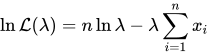
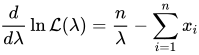
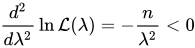
練習。 考慮來自引數為 λ {\displaystyle \lambda } X 1 , … , X n {\displaystyle X_{1},\dotsc ,X_{n}} f ( x ; λ ) = e − λ λ x x ! {\displaystyle f(x;\lambda )={\frac {e^{-\lambda }\lambda ^{x}}{x!}}}
(a) 求 λ {\displaystyle \lambda }
(b) 求 λ / n {\displaystyle \lambda /n}
在前面的章節中,我們討論了 無偏性 有效性 一致性
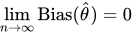
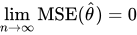
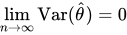
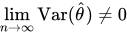
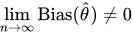
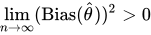
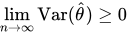
Proof. Assume θ ^ {\displaystyle {\hat {\theta }}} θ {\displaystyle \theta } Var ( θ ^ ) → 0 {\displaystyle \operatorname {Var} ({\hat {\theta }})\to 0} n → ∞ {\displaystyle n\to \infty } θ ^ {\displaystyle {\hat {\theta }}} θ {\displaystyle \theta } lim n → ∞ Bias ( θ ^ ) = 0 {\displaystyle \lim _{n\to \infty }\operatorname {Bias} ({\hat {\theta }})=0} θ {\displaystyle \theta } lim n → ∞ Var ( θ ^ ) = 0 {\displaystyle \lim _{n\to \infty }\operatorname {Var} ({\hat {\theta }})=0} lim n → ∞ MSE ( θ ^ ) = 0 ⇒ lim n → ∞ E [ ( θ ^ − θ ) 2 ] = 0 {\displaystyle \lim _{n\to \infty }\operatorname {MSE} ({\hat {\theta }})=0\Rightarrow \lim _{n\to \infty }\mathbb {E} [({\hat {\theta }}-\theta )^{2}]=0} n → ∞ {\displaystyle n\to \infty } MSE ( θ ^ ) = E [ ( θ ^ − θ ) 2 ] {\displaystyle \operatorname {MSE} ({\hat {\theta }})=\mathbb {E} [({\hat {\theta }}-\theta )^{2}]} ε > 0 {\displaystyle \varepsilon >0} P ( | θ ^ − θ | > ε ) ≤ E [ ( θ ^ − θ ) 2 ] ε 2 → 0 ε 2 = 0. {\displaystyle \mathbb {P} (|{\hat {\theta }}-\theta |>\varepsilon )\leq {\frac {\mathbb {E} [({\hat {\theta }}-\theta )^{2}]}{\varepsilon ^{2}}}\to {\frac {0}{\varepsilon ^{2}}}=0.} ≥ 0 {\displaystyle \geq 0} n → ∞ {\displaystyle n\to \infty } n → ∞ {\displaystyle n\to \infty } θ ^ {\displaystyle {\hat {\theta }}} consistent estimator θ {\displaystyle \theta }
◻ {\displaystyle \Box }
↑ 對於引數向量,它包含控制分佈的所有引數。 ↑ 當我們不知道它是引數向量還是隻是一個引數時,我們將簡單地使用“ θ {\displaystyle \theta } θ {\displaystyle \theta } ↑ 我們將在#估計量的性質 部分討論“好”的一些標準。 ↑ β − β ′ = ( max { x 1 , … , x n } + β − max { x 1 , … , x n } ) − ( max { x 1 , … , x n } + β − max { x 1 , … , x n } 2 ) = β − max { x 1 , … , x n } 2 > 0 {\displaystyle \beta -\beta '={\big (}\max\{x_{1},\dotsc ,x_{n}\}+\beta -\max\{x_{1},\dotsc ,x_{n}\}{\big )}-\left(\max\{x_{1},\dotsc ,x_{n}\}+{\frac {\beta -\max\{x_{1},\dotsc ,x_{n}\}}{2}}\right)={\frac {\beta -\max\{x_{1},\dotsc ,x_{n}\}}{2}}>0} β ′ < β {\displaystyle \beta '<\beta } ↑ 對於每個正整數 r {\displaystyle r} m r {\displaystyle m_{r}} μ r {\displaystyle \mu _{r}} ↑ “一致”表示與其他無偏估計量相比,方差最小,在引數空間 Θ {\displaystyle \Theta } θ ∈ Θ {\displaystyle \theta \in \Theta } θ {\displaystyle \theta } θ {\displaystyle \theta } ↑ 這與最小值不同。對於下界 ↑ 注意,這比 Rao-Blackwell 定理中的結果更強,後者僅說明 Var ( φ ( T ) ) ≤ Var ( W ) {\displaystyle \operatorname {Var} (\varphi (T))\leq \operatorname {Var} (W)} 對於與 φ ( T ) {\displaystyle \varphi (T)} W {\displaystyle W} ↑ 實際上,我們知道 UMVUE 根據之前的命題必須是唯一的。但是,在這個論證中,當我們證明 φ ( T ) {\displaystyle \varphi (T)} 






















![{\displaystyle \mathbb {E} _{\theta }[\cdot ],\operatorname {Var} _{\theta }(\cdot ),\operatorname {Cov} _{\theta }(\cdot ),\dotsc }](https://wikimedia.org/api/rest_v1/media/math/render/svg/bc76c20c4c008a9413337d34988fea4374b43b30)























![{\displaystyle {\mathcal {U}}[0,\beta ]}](https://wikimedia.org/api/rest_v1/media/math/render/svg/26e464bf1c9cc4b969d78d704f8b1f5c2fdc4db7)












































![{\displaystyle \mathbb {E} [X^{r}]}](https://wikimedia.org/api/rest_v1/media/math/render/svg/32e0ab77f3c82bbc915bcba1735832ad396f7e3b)




![{\displaystyle {\overline {X}}=m_{1}\;{\overset {p}{\to }}\;\mathbb {E} [X]=\mu _{1}}](https://wikimedia.org/api/rest_v1/media/math/render/svg/353477fc62727d534f79b3608d8b8d8d1a4dcbdc)
![{\displaystyle m_{2}\;{\overset {p}{\to }}\;\mathbb {E} [X^{2}]=\mu _{2}}](https://wikimedia.org/api/rest_v1/media/math/render/svg/d14a57803263e1436023a214272da6d10054e729)





![{\displaystyle \mathbb {E} [X^{1/2}]}](https://wikimedia.org/api/rest_v1/media/math/render/svg/f9bcbb1a68b410d204293d833360e9e380b2e83e)


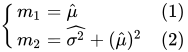




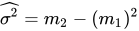


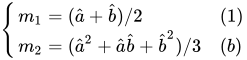
![{\displaystyle {\mathcal {U}}[a,b]}](https://wikimedia.org/api/rest_v1/media/math/render/svg/140992400aff9597adf2989ac9a7c4540902ebe5)












![{\displaystyle \operatorname {Bias} ({\hat {\theta }})=\mathbb {E} [{\hat {\theta }}]-\theta .}](https://wikimedia.org/api/rest_v1/media/math/render/svg/6dcdda08699ccfda373def11234302fea2e5de1f)

![{\displaystyle \mathbb {E} [{\overline {X}}]={\frac {1}{n}}\cdot \mathbb {E} \left[\sum _{i=1}^{n}X_{i}\right]={\frac {1}{n}}\sum _{i=1}^{n}\mathbb {E} [X_{i}]={\frac {1}{n}}\cdot \sum _{i=1}^{n}p={\frac {np}{n}}=p}](https://wikimedia.org/api/rest_v1/media/math/render/svg/82fccb3343c286db9abf799ba6ed36f66e6b810e)
![{\displaystyle \mathbb {E} [{\overline {X}}]={\frac {1}{n}}\sum _{i=1}^{n}\mathbb {E} [X_{i}]={\frac {1}{n}}\sum _{i=1}^{n}np=np\neq p}](https://wikimedia.org/api/rest_v1/media/math/render/svg/556489baece90e7c11056d793a485be75c17a2df)


![{\displaystyle \mathbb {E} [{\overline {X}}]={\frac {1}{n}}\sum _{i=1}^{n}\mathbb {E} [X_{i}]={\frac {1}{n}}\sum _{i=1}^{n}\mu =\mu }](https://wikimedia.org/api/rest_v1/media/math/render/svg/64a26b3f8eeec054beffb14142dcd6463fda789f)
![{\displaystyle {\begin{aligned}\mathbb {E} [S^{2}]&={\frac {1}{n}}\sum _{i=1}^{n}\mathbb {E} \left[(X_{i}-{\overline {X}})^{2}\right]\\&={\frac {1}{n}}\sum _{i=1}^{n}\operatorname {Var} \left(X_{i}-{\overline {X}}\right)&{\text{since }}\mathbb {E} [X_{i}-{\overline {X}}]=\mathbb {E} [X_{i}]-\mathbb {E} [{\overline {X}}]=\mu -\mu =0\\&={\frac {1}{n}}\sum _{i=1}^{n}\operatorname {Var} \left(X_{i}-{\frac {X_{1}+\dotsb +X_{i-1}+X_{i}+\dotsb +X_{n}}{n}}\right)\\&={\frac {1}{n}}\sum _{i=1}^{n}\operatorname {Var} \left({\frac {{\color {blue}n}X_{i}}{n}}-{\frac {X_{1}+\dotsb +X_{i-1}+X_{i}+\dotsb +X_{n}}{n}}\right)\\&={\frac {1}{n}}\sum _{i=1}^{n}\operatorname {Var} \left({\frac {X_{1}+\dotsb +X_{i-1}+({\color {blue}n}-1)X_{i}+\dotsb +X_{n}}{n}}\right)\\&={\frac {1}{n}}\sum _{i=1}^{n}\operatorname {Var} \left({\frac {(n-1)X_{i}}{n}}+{\frac {X_{1}+\dotsb +X_{i-1}+X_{i+1}X_{n}}{n}}\right)\\&={\frac {1}{n}}\sum _{i=1}^{n}\left[\operatorname {Var} \left({\frac {(n-1)X_{i}}{n}}\right)+\operatorname {Var} \left({\frac {X_{1}+\dotsb +X_{i-1}+X_{i+1}+\dotsb +X_{n}}{n}}\right)\right]&{\text{by independence}}\\&={\frac {1}{n}}\sum _{i=1}^{n}\left[\operatorname {Var} \left({\frac {(n-1)X_{i}}{n}}\right)+\operatorname {Var} \left({\frac {X_{1}+\dotsb +X_{i-1}+X_{i+1}+\dotsb +X_{n}}{n}}\right)\right]\\&={\frac {1}{n}}\sum _{i=1}^{n}\left[{\frac {(n-1)^{2}}{n^{2}}}\sigma ^{2}+{\frac {1}{n^{2}}}\operatorname {Var} \left(X_{1}+\dotsb +X_{i-1}+X_{i+1}+\dotsb +X_{n}\right)\right]\\&={\frac {1}{n}}\sum _{i=1}^{n}\left[{\frac {(n-1)^{2}}{n^{2}}}\sigma ^{2}+{\frac {n-1}{n^{2}}}\sigma ^{2}\right]&{\text{by iid}}\\&={\frac {1}{n}}\sum _{i=1}^{n}\left[{\frac {\sigma ^{2}}{n^{2}}}(n^{2}-2n+1+n-1)\right]\\&={\frac {1}{n}}\sum _{i=1}^{n}\left[{\frac {(n^{2}-n)\sigma ^{2}}{n^{2}}}\right]\\&={\frac {1}{n}}\sum _{i=1}^{n}\left[{\frac {(n-1)\sigma ^{2}}{n}}\right]\\&={\frac {1}{n}}\cdot n\cdot {\frac {(n-1)\sigma ^{2}}{n}}\\&={\frac {n-1}{n}}\sigma ^{2}\\\end{aligned}}}](https://wikimedia.org/api/rest_v1/media/math/render/svg/f7bd08d02adde0462a293142b80dd062d5223519)
![{\displaystyle \lim _{n\to \infty }\mathbb {E} [S^{2}]=\lim _{n\to \infty }\left({\frac {n-1}{n}}\sigma ^{2}\right)=\sigma ^{2}\lim _{n\to \infty }\left(1-{\frac {1}{n}}\right)=\sigma ^{2}\left(1-\lim _{n\to \infty }{\frac {1}{n}}\right)=\sigma ^{2}}](https://wikimedia.org/api/rest_v1/media/math/render/svg/6e2856d3aa6ee54cd46d1bbdf8cc84107dae28f3)





![{\displaystyle \operatorname {MSE} ({\hat {\theta }})=\mathbb {E} [({\hat {\theta }}-\theta )^{2}]}](https://wikimedia.org/api/rest_v1/media/math/render/svg/1cfc649499cbe9342d2ffff1ad69fe61860c5923)


![{\displaystyle \operatorname {MSE} ({\hat {\theta }})=\operatorname {Var} ({\hat {\theta }})+[\operatorname {Bias} ({\hat {\theta }})]^{2}}](https://wikimedia.org/api/rest_v1/media/math/render/svg/e6a4b041e9dcc5287f52677d0fbb5f1ebbaa23a9)
![{\displaystyle \operatorname {Var} ({\hat {\theta }})=\mathbb {E} \left[({\hat {\theta }}-\mathbb {E} [{\hat {\theta }}])^{2}\right]}](https://wikimedia.org/api/rest_v1/media/math/render/svg/bdfa6ff27b91fec758bd88460574c686b4965cd1)
![{\displaystyle {\begin{aligned}\operatorname {MSE} ({\hat {\theta }})&=\mathbb {E} [({\hat {\theta }}-\theta )^{2}]\\&=\mathbb {E} \left[{\big (}({\hat {\theta }}-{\color {darkgreen}\mathbb {E} [{\hat {\theta }}]})+({\color {darkgreen}\mathbb {E} [{\hat {\theta }}]}-\theta ){\big )}^{2}\right]\\&=\mathbb {E} [({\hat {\theta }}-{\color {darkgreen}\mathbb {E} [{\hat {\theta }}]})^{2}+2({\hat {\theta }}-{\color {darkgreen}\mathbb {E} [{\hat {\theta }}]})\underbrace {({\color {darkgreen}\mathbb {E} [{\hat {\theta }}]}-\theta )} _{\text{constant}}+({\color {darkgreen}\mathbb {E} [{\hat {\theta }}]}-\theta )^{2}]\\&=\operatorname {Var} ({\hat {\theta }})+2({\color {darkgreen}\mathbb {E} [{\hat {\theta }}]}-\theta )\underbrace {\mathbb {E} [{\hat {\theta }}-{\color {darkgreen}\mathbb {E} [{\hat {\theta }}]}]} _{=\mathbb {E} [{\hat {\theta }}]-{\color {darkgreen}\mathbb {E} [{\hat {\theta }}]}=0}+[\operatorname {Bias} ({\hat {\theta }})]^{2}\\&=\operatorname {Var} ({\hat {\theta }})+[\operatorname {Bias} ({\hat {\theta }})]^{2},\end{aligned}}}](https://wikimedia.org/api/rest_v1/media/math/render/svg/8805e0f4b8386b144fd3175bfbac242ec2e2f248)

![{\displaystyle \mathbb {E} [X_{1}]=\mu }](https://wikimedia.org/api/rest_v1/media/math/render/svg/cc34b0d539e8774567cf6f7901aae81abff14aa9)





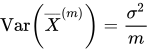
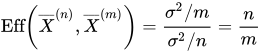
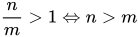






![{\displaystyle \mathbb {E} [W^{*}]={\frac {1}{2}}(\mathbb {E} [W]+\mathbb {E} [W'])={\frac {1}{2}}(\tau (\theta +\theta )=\tau (\theta )}](https://wikimedia.org/api/rest_v1/media/math/render/svg/397552f7434fb33f077ad88f79511a442cb2afd4)

![{\displaystyle {\begin{aligned}\operatorname {Var} (W^{*})&={\frac {1}{4}}\operatorname {Var} (W+W')\\&={\frac {1}{4}}\left[\operatorname {Var} (W)+\operatorname {Var} (W')+2\operatorname {Cov} (W,W')\right]\\&\leq {\frac {1}{4}}\operatorname {Var} (W)+{\frac {1}{4}}\operatorname {Var} (W')+{\frac {1}{2}}{\sqrt {\operatorname {Var} (W)\operatorname {Var} (W')}}&({\text{covariance inequality}})\\&={\frac {1}{4}}\operatorname {Var} (W)+{\frac {1}{4}}\operatorname {Var} (W)+{\frac {1}{2}}{\sqrt {(\operatorname {Var} (W))^{2}}}&(\operatorname {Var} (W)=\operatorname {Var} (W'){\text{ since }}W{\text{ and }}W'{\text{ are both UMVUE}})\\&={\frac {1}{2}}\operatorname {Var} (W)+{\frac {1}{2}}\operatorname {Var} (W)&(\operatorname {Var} (W)>0)\\&=\operatorname {Var} (W).\end{aligned}}}](https://wikimedia.org/api/rest_v1/media/math/render/svg/1ba21442fdd8d022f8d6aea2956bbfd396279ecc)












![{\displaystyle W'=W+b\implies \mathbb {E} [W']=\mathbb {E} [W]+b\implies \tau (\theta )=\tau (\theta )+b\implies b=0}](https://wikimedia.org/api/rest_v1/media/math/render/svg/7ddc34c063aadca3edb85495aaf251e3660cbb06)
![{\displaystyle {\mathcal {I}}_{n}(\theta )=\mathbb {E} \left[\left({\frac {\partial \ln {\mathcal {L}}({\boldsymbol {\theta }};\mathbf {X} )}{\partial \theta }}\right)^{2}\right]}](https://wikimedia.org/api/rest_v1/media/math/render/svg/4a7d197d5e3f5cb3dc3e7216d39537ef7c3e66e3)



![{\displaystyle \mathbb {E} [S(\theta ;\mathbf {X} )]\mathbb {E} \left[{\frac {\partial \ln {\mathcal {L}}({\boldsymbol {\theta }};\mathbf {X} )}{\partial \theta }}\right]=\int _{-\infty }^{\infty }\dotsi \int _{-\infty }^{\infty }{\frac {\partial \ln {\mathcal {L}}({\boldsymbol {\theta }};\mathbf {x} )}{\partial \theta }}\cdot {\mathcal {L}}({\boldsymbol {\theta }};\mathbf {x} )\,dx_{n}\cdots \,dx_{1}=\int _{-\infty }^{\infty }\dotsi \int _{-\infty }^{\infty }{\frac {\frac {\partial {\mathcal {L}}({\boldsymbol {\theta }};\mathbf {x} )}{\partial \theta }}{{\mathcal {L}}({\boldsymbol {\theta }};\mathbf {x} )}}\cdot {\mathcal {L}}({\boldsymbol {\theta }};\mathbf {x} )\,dx_{n}\cdots \,dx_{1}=\int _{-\infty }^{\infty }\dotsi \int _{-\infty }^{\infty }{\frac {\partial {\mathcal {L}}({\boldsymbol {\theta }};\mathbf {x} )}{\partial \theta }}\,dx_{n}\cdots \,dx_{1},}](https://wikimedia.org/api/rest_v1/media/math/render/svg/560f1e7c11a25b0474b821e589d8ae73962fc245)


![{\displaystyle {\mathcal {I}}(\theta )=\mathbb {E} \left[\left({\frac {\partial \ln f(X;{\boldsymbol {\theta }})}{\partial \theta }}\right)^{2}\right]}](https://wikimedia.org/api/rest_v1/media/math/render/svg/517544d6341dd1f80f635b3edb589586539da777)
![{\displaystyle {\begin{aligned}{\mathcal {I}}_{n}(\theta )&=\mathbb {E} \left[\left({\frac {\partial \ln {\mathcal {L}}({\boldsymbol {\theta }};\mathbf {x} )}{\partial \theta }}\right)^{2}\right]\\&=\operatorname {Var} \left({\frac {\partial \ln {\mathcal {L}}({\boldsymbol {\theta }};\mathbf {x} )}{\partial \theta }}\right)&{\text{根據以上說明}}\\&=\operatorname {Var} \left({\frac {\partial }{\partial \theta }}\left(\ln \prod _{i=1}^{n}f(X_{i};{\boldsymbol {\theta }})\right)\right)&\left({\mathcal {L}}(\theta ;\mathbf {x} )=\prod _{i=1}^{n}f(x_{i};\theta )\right)\\&=\operatorname {Var} \left({\frac {\partial }{\partial \theta }}\left(\sum _{i=1}^{n}\ln f(X_{i};{\boldsymbol {\theta }})\right)\right)\\&=\operatorname {Var} \left(\sum _{i=1}^{n}{\frac {\partial }{\partial \theta }}\ln f(X_{i};{\boldsymbol {\theta }})\right)&{\text{根據微分的線性性質}}\\&=\sum _{i=1}^{n}\operatorname {Var} \left({\frac {\partial }{\partial \theta }}\ln f(X_{i};{\boldsymbol {\theta }})\right)&{\text{根據獨立性}}\\&=n\operatorname {Var} \left({\frac {\partial }{\partial \theta }}\ln f(X_{i};{\boldsymbol {\theta }})\right)&{\text{根據同分布性}}\\&=n\mathbb {E} \left[\left({\frac {\partial \ln f(X;{\boldsymbol {\theta }})}{\partial \theta }}\right)^{2}\right]&{\text{根據以上說明}}\\&=n{\mathcal {I}}(\theta ).\end{aligned}}}](https://wikimedia.org/api/rest_v1/media/math/render/svg/ea27d4f7d62f8e2f290d90c51c9d6ac3a4d2e715)
![{\displaystyle {\mathcal {I}}(\theta )=-\mathbb {E} \left[{\frac {\partial ^{2}\ln f(X;{\boldsymbol {\theta }})}{\partial \theta ^{2}}}\right]}](https://wikimedia.org/api/rest_v1/media/math/render/svg/5f51e214dc03dd321e0a42a856fb5de7ea119a8a)
![{\displaystyle {\begin{aligned}\mathbb {E} \left[{\frac {\partial ^{2}\ln f(X;{\boldsymbol {\theta }})}{\partial \theta ^{2}}}\right]&=\mathbb {E} \left[{\frac {\partial }{\partial \theta }}\left({\frac {\partial \ln f(X;{\boldsymbol {\theta }})}{\partial \theta }}\right)\right]\\&=\mathbb {E} \left[{\frac {\partial }{\partial \theta }}\left({\frac {1}{f(X;{\boldsymbol {\theta }})}}\cdot {\frac {\partial f(X;{\boldsymbol {\theta }})}{\partial \theta }}\right)\right]\\&=\mathbb {E} \left[{\frac {1}{f(X;{\boldsymbol {\theta }})}}\cdot {\frac {\partial ^{2}f(X;{\boldsymbol {\theta }})}{\partial \theta ^{2}}}-{\frac {\partial f(X;{\boldsymbol {\theta }})}{\partial \theta }}\cdot {\frac {1}{(f(X;{\boldsymbol {\theta }}))^{2}}}\cdot {\frac {\partial f(X;{\boldsymbol {\theta }})}{\partial \theta }}\right]\\&=\mathbb {E} \left[{\frac {1}{f(X;{\boldsymbol {\theta }})}}\cdot {\frac {\partial ^{2}f(X;{\boldsymbol {\theta }})}{\partial \theta ^{2}}}-\left({\frac {\partial f(X;{\boldsymbol {\theta }})}{\partial \theta }}\right)^{2}\cdot {\frac {1}{(f(X;{\boldsymbol {\theta }}))^{2}}}\right]\\&=\mathbb {E} \left[{\frac {1}{f(X;{\boldsymbol {\theta }})}}\cdot {\frac {\partial ^{2}f(X;{\boldsymbol {\theta }})}{\partial \theta ^{2}}}\right]-\mathbb {E} \left[\left({\frac {\partial \ln f(X;{\boldsymbol {\theta }})}{\partial \theta }}\right)^{2}\right]\\&=\mathbb {E} \left[{\frac {1}{f(X;{\boldsymbol {\theta }})}}\cdot {\frac {\partial ^{2}f(X;{\boldsymbol {\theta }})}{\partial \theta ^{2}}}\right]-{\mathcal {I}}(\theta )\\\end{aligned}}}](https://wikimedia.org/api/rest_v1/media/math/render/svg/be8b6a0a7e6270d094582582848ca8fcbb44fa06)
![{\displaystyle \mathbb {E} \left[{\frac {1}{f(X;{\boldsymbol {\theta }})}}\cdot {\frac {\partial ^{2}f(X;{\boldsymbol {\theta }})}{\partial \theta ^{2}}}\right]=0}](https://wikimedia.org/api/rest_v1/media/math/render/svg/8a1fc75bb3280f31e02372277a364c36d2b4423a)
![{\displaystyle {\begin{aligned}\mathbb {E} \left[{\frac {1}{f(X;{\boldsymbol {\theta }})}}\cdot {\frac {\partial ^{2}f(X;{\boldsymbol {\theta }})}{\partial \theta ^{2}}}\right]&=\int _{-\infty }^{\infty }{\frac {1}{f(x;{\boldsymbol {\theta }})}}\cdot {\frac {\partial ^{2}f(x;{\boldsymbol {\theta }})}{\partial \theta ^{2}}}\cdot f(x;{\boldsymbol {\theta }})\,dx\\&=\int _{-\infty }^{\infty }{\frac {\partial ^{2}f(x;{\boldsymbol {\theta }})}{\partial \theta ^{2}}}\,dx\\&={\frac {\partial ^{2}}{\partial \theta ^{2}}}\int _{-\infty }^{\infty }f(x;{\boldsymbol {\theta }})\,dx\\&={\frac {\partial ^{2}}{\partial \theta ^{2}}}(1)\\&=0.\\\end{aligned}}}](https://wikimedia.org/api/rest_v1/media/math/render/svg/f39f64d3ec4949244d242966526cefedf653a0fa)

![{\displaystyle \mathbb {E} [W]=\tau (\theta )}](https://wikimedia.org/api/rest_v1/media/math/render/svg/3c737d8d1b9cc68bd063909b787f2243eccf68e6)
![{\displaystyle \mathbb {E} [W]=\int _{-\infty }^{\infty }\dotsi \int _{-\infty }^{\infty }w{\mathcal {L}}(\theta ;\mathbf {x} )\,dx_{n}\cdots \,dx_{1}}](https://wikimedia.org/api/rest_v1/media/math/render/svg/f870bbb0af81e34358e61259c074cbbaae6276b4)
![{\displaystyle {\begin{aligned}&&\int _{-\infty }^{\infty }\dotsi \int _{-\infty }^{\infty }w{\mathcal {L}}(\theta ;\mathbf {x} )\,dx_{n}\cdots \,dx_{1}&=\tau (\theta )\\&\Rightarrow &{\frac {\partial }{\partial \theta }}\int _{-\infty }^{\infty }\dotsi \int _{-\infty }^{\infty }w{\mathcal {L}}(\theta ;\mathbf {x} )\,dx_{n}\cdots \,dx_{1}&={\frac {\partial }{\partial \theta }}\tau (\theta )\\&\Rightarrow &\int _{-\infty }^{\infty }\dotsi \int _{-\infty }^{\infty }{\frac {\partial }{\partial \theta }}\left(w{\mathcal {L}}(\theta ;\mathbf {x} )\right)\,dx_{n}\cdots \,dx_{1}&=\tau '(\theta )\\&\Rightarrow &\int _{-\infty }^{\infty }\dotsi \int _{-\infty }^{\infty }w{\frac {\partial }{\partial \theta }}\left({\mathcal {L}}(\theta ;\mathbf {x} )\right)\cdot {\frac {1}{{\mathcal {L}}(\theta ;\mathbf {x} )}}\cdot {\mathcal {L}}(\theta ;\mathbf {x} )\,dx_{n}\cdots \,dx_{1}&=\tau '(\theta )\\&\Rightarrow &\int _{-\infty }^{\infty }\dotsi \int _{-\infty }^{\infty }w{\frac {\partial \ln {\mathcal {L}}(\theta ;\mathbf {x} )}{\partial \theta }}{\mathcal {L}}(\theta ;\mathbf {x} )\,dx_{n}\cdots \,dx_{1}&=\tau '(\theta )\\&\Rightarrow &\mathbb {E} \left[W\cdot {\frac {\partial \ln {\mathcal {L}}(\theta ;\mathbf {x} )}{\partial \theta }}\right]&=\tau '(\theta )\\&\Rightarrow &\mathbb {E} \left[WS(\theta ;\mathbf {X} )\right]&=\tau '(\theta )&\left(S(\theta ;\mathbf {X} )={\frac {\partial \ln {\mathcal {L}}(\theta ;\mathbf {x} )}{\partial \theta }}\right)\\&\Rightarrow &\mathbb {E} \left[WS(\theta ;\mathbf {X} )\right]-\mathbb {E} [W]\underbrace {\mathbb {E} [S(\theta ;\mathbf {X} )]} _{=0}&=\tau '(\theta )&(\mathbb {E} [S(\theta ;\mathbf {X} )]=0{\text{ by remark about Fisher information}})\\&\Rightarrow &\operatorname {Cov} (W,S(\theta ;\mathbf {X} ))&=\tau '(\theta )\\\end{aligned}}}](https://wikimedia.org/api/rest_v1/media/math/render/svg/b960b6e182d43521f3827b9bb81d2980e8fed699)








![{\displaystyle {\mathcal {I}}(\mu )=-\mathbb {E} \left[{\frac {\partial ^{2}}{\partial \mu ^{2}}}\left(-{\frac {1}{2}}(\ln 2\pi \sigma ^{2})-{\frac {X^{2}-2\mu X+\mu ^{2}}{2\sigma ^{2}}}\right)\right]=-\mathbb {E} \left[{\frac {\partial }{\partial \mu }}\left(-{\frac {-2X+2\mu }{2\sigma ^{2}}}\right)\right]=-\mathbb {E} \left[-\left({\frac {2}{2\sigma ^{2}}}\right)\right]=-\mathbb {E} [\underbrace {-{\frac {1}{\sigma ^{2}}}} _{{\text{constant wrt }}X}]={\frac {1}{\sigma ^{2}}}.}](https://wikimedia.org/api/rest_v1/media/math/render/svg/b88d50eaa169efd72dc28551810b556653a96faf)
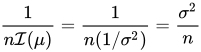
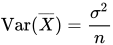

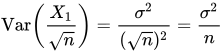
![{\displaystyle \mathbb {E} \left[{\frac {X_{1}}{\sqrt {n}}}\right]={\frac {\mu }{\sqrt {n}}}\neq \mu }](https://wikimedia.org/api/rest_v1/media/math/render/svg/8e0b2c31fcab0e2351d6f70fc0e25ed174213638)

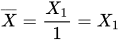
![{\displaystyle [0,\beta ]}](https://wikimedia.org/api/rest_v1/media/math/render/svg/674fc279ca2ffeed24baf18e3de63732f301b1e5)
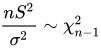


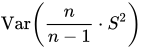


![{\displaystyle {\begin{aligned}{\mathcal {I}}(\theta )&=-\mathbb {E} \left[{\frac {\partial ^{2}}{\partial (\sigma )^{2}}}\left(-{\frac {1}{2}}(\ln 2\pi \sigma ^{2})-{\frac {(X-\mu )^{2}}{2\sigma ^{2}}}\right)\right]\\&=-\mathbb {E} \left[{\frac {\partial }{\partial \sigma }}\left(-{\frac {4\pi \sigma }{2(2\pi \sigma ^{2}}}+{\frac {(X-\mu )^{2}}{\sigma ^{3}}}\right)\right]\\&=-\mathbb {E} \left[{\frac {\partial }{\partial \sigma }}\left(-{\frac {1}{\sigma }}+{\frac {(X-\mu )^{2}}{\sigma ^{3}}}\right)\right]\\&=-\mathbb {E} \left[{\frac {1}{\sigma ^{2}}}-{\frac {3(X-\mu )^{2}}{\sigma ^{4}}}\right]\\&=-{\frac {1}{\sigma ^{2}}}+{\frac {3}{\sigma ^{4}}}\mathbb {E} [(X-\mu )^{2}]\\&=-{\frac {1}{\sigma ^{2}}}+{\frac {3}{\sigma ^{4}}}\cdot \sigma ^{2}\\&={\frac {2}{\sigma ^{2}}},\\\end{aligned}}}](https://wikimedia.org/api/rest_v1/media/math/render/svg/1decf07082fdf9993bb3442039670161e53699a0)
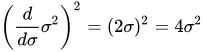
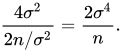

![{\displaystyle \mathbb {E} \left[{\frac {n}{n-1}}\cdot S^{2}\right]={\frac {n}{n-1}}\left({\frac {n-1}{n}}\sigma ^{2}\right)=\sigma ^{2}}](https://wikimedia.org/api/rest_v1/media/math/render/svg/dbb7aea7a3b273fc4dfa32308f61b7663cc5456a)
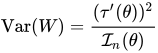

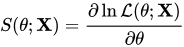


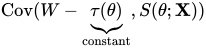
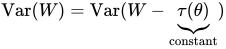
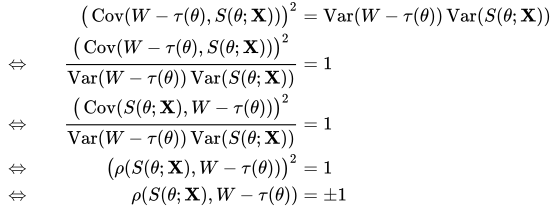





![{\displaystyle \mathbb {E} [S(\theta ;\mathbf {X} )]=0}](https://wikimedia.org/api/rest_v1/media/math/render/svg/c73d34c6e3076505c2bb246e7bbd0c4a7f7f3949)
![{\displaystyle \mathbb {E} [S(\theta ;\mathbf {X} )]=k\mathbb {E} [W-\tau (\theta )]+c\iff \mathbb {E} [S(\theta ;\mathbf {X} )]=k(\underbrace {\mathbb {E} [W]-\tau (\theta )} _{=0})+c\iff 0=0+c\iff c=0.}](https://wikimedia.org/api/rest_v1/media/math/render/svg/34714f3dc401d085166aab9040f22d2a603a635f)







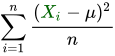



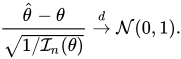



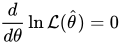
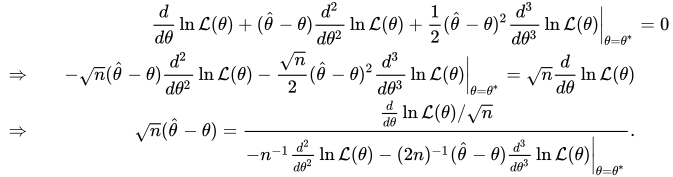
![{\displaystyle \operatorname {Var} \left(\sum _{i=1}^{n}{\frac {\partial \ln f(X_{i};\theta )}{\partial \theta }}\right)=\sum _{i=1}^{n}\operatorname {Var} \left({\frac {\partial \ln f(X_{i};\theta )}{\partial \theta }}\right)=\sum _{i=1}^{n}\mathbb {E} \left[\left({\frac {\partial \ln f(X_{i};\theta )}{\partial \theta }}\right)^{2}\right]=n{\mathcal {I}}(\theta )\qquad (1),}](https://wikimedia.org/api/rest_v1/media/math/render/svg/ef7a1a2ef72c7dfc59cc8f690595be3ab6a8825e)

![{\displaystyle -n^{-1}{\frac {d^{2}}{d\theta ^{2}}}\ln {\mathcal {L}}(\theta )=-{\frac {1}{n}}\sum _{i=1}^{n}{\frac {\partial ^{2}\ln f(X_{i};\theta )}{\partial \theta ^{2}}}\;{\overset {p}{\to }}\;-\mathbb {E} \left[{\frac {\partial ^{2}\ln f(X_{i};\theta )}{\partial \theta ^{2}}}\right]={\mathcal {I}}(\theta )\qquad (2).}](https://wikimedia.org/api/rest_v1/media/math/render/svg/b10867b817634561eb5b05eadb7842b21ced8932)






![{\displaystyle {\frac {Y}{{\mathcal {I}}(\theta )}}\sim {\mathcal {N}}\left(0,{\frac {{\mathcal {I}}(\theta )}{[{\mathcal {I}}(\theta )]^{2}}}\right)\equiv {\mathcal {N}}(0,1/{\mathcal {I}}(\theta ))}](https://wikimedia.org/api/rest_v1/media/math/render/svg/24c413e7f303efbd2d905cbf69d7ee34202e8518)


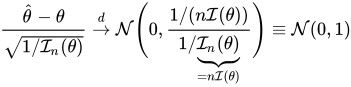
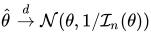












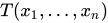















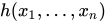

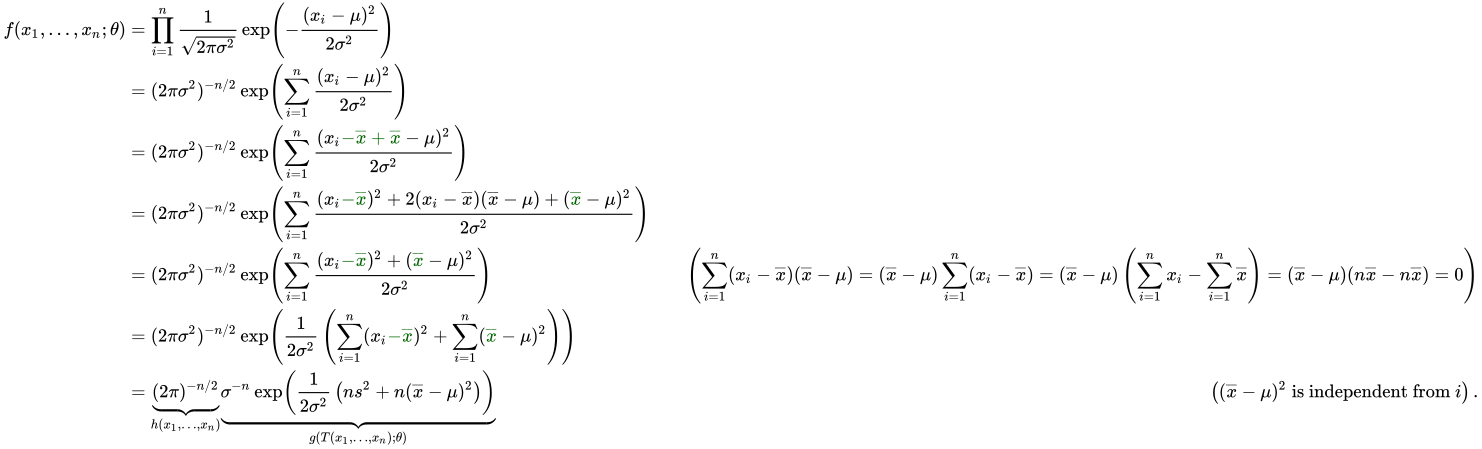














![{\displaystyle f(x;\theta )={\frac {1}{\sqrt {2\pi \sigma ^{2}}}}\exp \left(-{\frac {(x-\mu )^{2}}{2\sigma ^{2}}}\right)={\frac {1}{\sqrt {2\pi \sigma ^{2}}}}\exp \left(-{\frac {x^{2}-2\mu x+\mu ^{2}}{2\sigma ^{2}}}\right)=\left[{\frac {1}{\sqrt {2\pi \sigma ^{2}}}}\exp \left(-{\frac {\mu ^{2}}{2\sigma ^{2}}}\right)\right]\exp \left(-{\frac {x^{2}-2\mu x}{2\sigma ^{2}}}\right)=\underbrace {(1)} _{h(x)}\underbrace {\left[{\frac {1}{\sqrt {2\pi \sigma ^{2}}}}\exp \left(-{\frac {\mu ^{2}}{2\sigma ^{2}}}\right)\right]} _{g(\theta )}\exp {\Bigg [}\underbrace {\frac {\mu }{\sigma ^{2}}} _{\eta _{1}(\theta )}\cdot \underbrace {x} _{T_{1}(x)}+\underbrace {\left(-{\frac {1}{2\sigma ^{2}}}\right)} _{\eta _{2}(\theta )}\cdot \underbrace {x^{2}} _{T_{2}(x)}{\Bigg ]}}](https://wikimedia.org/api/rest_v1/media/math/render/svg/65bdc59c915a18fb343c3d47fb33ad235acf6bc2)



![{\displaystyle {\begin{aligned}f(x_{1},\dotsc ,x_{n};\theta )&=\prod _{{\color {blue}j}=1}^{n}\left[h(x_{\color {blue}j})g(\theta )\exp \left(\sum _{i=1}^{\color {darkgreen}s}\eta _{i}(\theta )T_{i}(x_{\color {blue}j})\right)\right]\\&=\left[\prod _{j=1}^{n}h(x_{j})\right](g(\theta ))^{n}\exp \left(\sum _{{\color {blue}j}=1}^{n}\sum _{i=1}^{s}\eta _{i}(\theta )T_{i}(x_{\color {blue}j})\right)\\&=\left[\prod _{j=1}^{n}h(x_{j})\right](g(\theta ))^{n}\exp \left(\sum _{i=1}^{s}\sum _{{\color {blue}j}=1}^{n}\eta _{i}(\theta )T_{i}(x_{\color {blue}j})\right)&({\text{changing summation order, where the upper bounds are constants}})\\&=\left[\prod _{j=1}^{n}h(x_{j})\right](g(\theta ))^{n}\exp \left(\sum _{i=1}^{s}\underbrace {\eta _{i}(\theta )} _{{\text{independent from }}j}\sum _{{\color {blue}j}=1}^{n}T_{i}(x_{\color {blue}j})\right)\\&={\color {purple}\left[\prod _{j=1}^{n}h(x_{j})\right]}{\color {red}(g(\theta ))^{n}\exp \left(\eta _{1}(\theta )\sum _{{\color {blue}j}=1}^{n}T_{1}(x_{\color {blue}j})+\dotsb +\eta _{s}(\theta )\sum _{{\color {blue}j}=1}^{n}T_{s}(x_{\color {blue}j})\right)}.\\\end{aligned}}}](https://wikimedia.org/api/rest_v1/media/math/render/svg/2ca7912f04b5ffc2edb901c5a15feda6cc07f124)

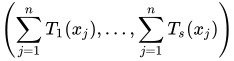

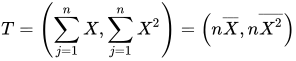


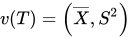
![{\displaystyle \varphi (T)=\mathbb {E} [W|T]}](https://wikimedia.org/api/rest_v1/media/math/render/svg/925bfaf8eb676b9b0bd4548881a4723e708a976c)


![{\displaystyle \mathbb {E} [\varphi (T)]=\mathbb {E} [\mathbb {E} [W|T]]{\overset {\text{ law of total expectation }}{=}}\mathbb {E} [W]{\overset {\text{ unbiasedness }}{=}}\tau (\theta )}](https://wikimedia.org/api/rest_v1/media/math/render/svg/8a2b51a6bff68c81c44968001290c7ffc07b53c5)
![{\displaystyle \operatorname {Var} (W)=\operatorname {Var} (\mathbb {E} [W|T])+\mathbb {E} [\operatorname {Var} (W|T)]{\overset {\text{ def }}{=}}\operatorname {Var} (\varphi (T))+\overbrace {\mathbb {E} [\underbrace {\operatorname {Var} (W|T)} _{\geq 0}]} ^{\geq 0}\geq \operatorname {Var} (\varphi (T)),}](https://wikimedia.org/api/rest_v1/media/math/render/svg/0c034e68c682f02d02fe33895fd0ac0d81f3d75e)
![{\displaystyle \varphi (t)=\mathbb {E} [W|T=t]}](https://wikimedia.org/api/rest_v1/media/math/render/svg/0fcf5bfb50c6a9531ed1d027fa6d6f9b8507f509)

![{\displaystyle \mathbb {E} [g(T)]=0}](https://wikimedia.org/api/rest_v1/media/math/render/svg/7eadf52673f5b6947c25236688dee4a590cb8fd5)





![{\displaystyle \mathbb {E} [\varphi (T)]=\tau (\theta )}](https://wikimedia.org/api/rest_v1/media/math/render/svg/294899094f4ef02a9f605b4973c9b512d5c063bc)

![{\displaystyle \psi (T)=\mathbb {E} [W'|T]}](https://wikimedia.org/api/rest_v1/media/math/render/svg/d0bee6f0ec1f89361a5c1dcd5f6fd0c96ada662d)
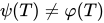


![{\displaystyle \mathbb {E} [\varphi (T)]=\mathbb {E} [\psi (T)]\implies \mathbb {E} [\varphi (T)-\psi (T)]=0.}](https://wikimedia.org/api/rest_v1/media/math/render/svg/cbbb6c96177cf36f9605310e5d739d07157d1a23)

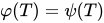
![{\displaystyle \mathbb {E} [W|T]}](https://wikimedia.org/api/rest_v1/media/math/render/svg/106acde6ac3fbf639d979f9284dd1a33ca63c722)

![{\displaystyle \mathbb {E} [\phi (T)]=\tau (\theta )}](https://wikimedia.org/api/rest_v1/media/math/render/svg/7770d5ea84ca6322e2e80851b1ff40804b2c73b3)

![{\displaystyle \mathbb {E} [{\overline {X}}]=\mu }](https://wikimedia.org/api/rest_v1/media/math/render/svg/d5e92e1f40bdfb09a81024edd04ff2bd9483cb17)
![{\displaystyle \mathbb {E} \left[{\frac {n}{n-1}}\cdot S^{2}\right]=\sigma ^{2}}](https://wikimedia.org/api/rest_v1/media/math/render/svg/da3e15a410ea86646402930b53c9c16c39c17023)



![{\displaystyle \mathbb {E} [\mathbf {1} \{X_{1}=1\}|T]}](https://wikimedia.org/api/rest_v1/media/math/render/svg/ffa89e70ded2161742e11105e037f343a0bc579d)



![{\displaystyle \mathbb {E} [T/n]=\mathbb {E} [{\overline {X}}]={\frac {np}{n}}=p}](https://wikimedia.org/api/rest_v1/media/math/render/svg/3418bb9557d01c76e0555d66f34a25cc38a1eb09)
![{\displaystyle \mathbb {E} [\mathbf {1} \{X_{1}=1\}]=(1)\mathbb {P} (X_{1}=1)=p}](https://wikimedia.org/api/rest_v1/media/math/render/svg/dd377f407d82726e04cfa2dae5074a63c3606252)
![{\displaystyle \mathbb {E} [\mathbf {1} \{X_{1}=1\}|T]=\mathbb {E} \left[\mathbf {1} \{X_{1}=1\}|\sum _{j=1}^{n}X_{j}\right]}](https://wikimedia.org/api/rest_v1/media/math/render/svg/ae68a700a861beb3547204817fb5b1003481bf26)


![{\displaystyle \mathbb {E} [\mathbf {1} \{X_{1}=1\}|S_{n}]}](https://wikimedia.org/api/rest_v1/media/math/render/svg/ad60438565076916bb36763a95ce4de0f0571b7d)
![{\displaystyle \mathbb {E} [\mathbf {1} \{X_{1}=1\}|S_{n}=s_{n}]}](https://wikimedia.org/api/rest_v1/media/math/render/svg/5e34fe1fac1d773dbedf41d2c3a42578e1a8a6b7)
![{\displaystyle {\begin{aligned}\mathbb {E} \left[\mathbf {1} \{X_{1}=1\}|\sum _{j=1}^{n}X_{j}=s_{n}\right]&=(1)\mathbb {P} \left(\mathbf {1} \{X_{1}=1\}=1|\sum _{j=1}^{n}X_{j}=s_{n}\right)&({\text{definition}})\\&=\mathbb {P} \left(X_{1}=1|\sum _{j=1}^{n}X_{j}=s_{n}\right)\\&={\frac {\mathbb {P} \left(\sum _{j=1}^{n}X_{j}=s_{n}|X_{1}=1\right)\mathbb {P} (X_{1}=1)}{\mathbb {P} \left(\sum _{j=1}^{n}X_{j}=s_{n}\right)}}&({\text{Bayes' theorem}})\\&={\frac {\mathbb {P} \left(\sum _{j=2}^{n}X_{j}=s_{n}-1\right)\cdot p}{\mathbb {P} \left(\sum _{j=1}^{n}X_{j}=s_{n}\right)}}\\\end{aligned}}}](https://wikimedia.org/api/rest_v1/media/math/render/svg/0b605ccff01c20d86e8a5d38b6b04da41fe013a2)

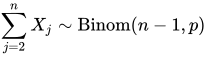
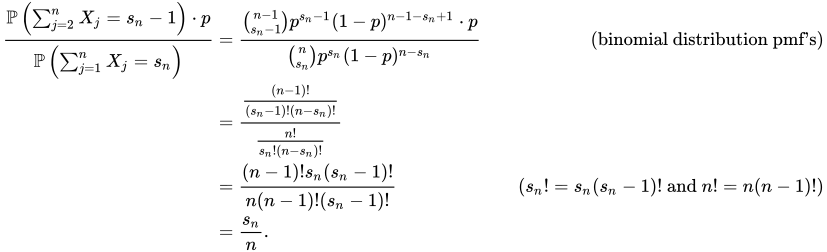


![{\displaystyle \mathbb {E} \left[\mathbf {1} \{X_{1}=1\}|\sum _{j=1}^{n}X_{j}\right]={\frac {\sum _{j=1}^{n}X_{j}}{n}}={\overline {X}},}](https://wikimedia.org/api/rest_v1/media/math/render/svg/267e9b4302b9ca444030900359d69d7c5c95653a)

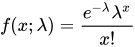



![{\displaystyle \mathbb {E} [T]=\mathbb {E} \left[\sum _{j=1}^{n}X_{j}\right]=n\lambda }](https://wikimedia.org/api/rest_v1/media/math/render/svg/0bcc7a61675f17f8e5dd79e65449104752a9bf1d)
![{\displaystyle \mathbb {E} [T/n^{2}]=\lambda /n=\tau (\lambda ).}](https://wikimedia.org/api/rest_v1/media/math/render/svg/f2e28656cbd2ee11994700094cd7a51d29748da6)
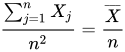




![{\displaystyle \lim _{n\to \infty }\operatorname {MSE} ({\hat {\theta }})=0\Rightarrow \lim _{n\to \infty }\mathbb {E} [({\hat {\theta }}-\theta )^{2}]=0}](https://wikimedia.org/api/rest_v1/media/math/render/svg/490d6d2a455e67ad37ad954e24221beac2fe26b9)
![{\displaystyle \mathbb {P} (|{\hat {\theta }}-\theta |>\varepsilon )\leq {\frac {\mathbb {E} [({\hat {\theta }}-\theta )^{2}]}{\varepsilon ^{2}}}\to {\frac {0}{\varepsilon ^{2}}}=0.}](https://wikimedia.org/api/rest_v1/media/math/render/svg/a3943b865bb963b6404cdd5367866f4dfe02af5e)







![{\displaystyle {\overline {X^{2}}}\;{\overset {p}{\to }}\;\mathbb {E} [X^{2}]}](https://wikimedia.org/api/rest_v1/media/math/render/svg/ce9eb02728d9d48a07d762df2aff6873d72d674e)

![{\displaystyle S^{2}={\overline {X^{2}}}-({\overline {X}})^{2}\;{\overset {p}{\to }}\;\mathbb {E} [X^{2}]-\mu ^{2}=\sigma ^{2}.}](https://wikimedia.org/api/rest_v1/media/math/render/svg/33c5f8147cb2050919d83b9c9c8a80fd101af59a)