複數最早是在16世紀中期發展起來的,作為解決某些三次方程的一種方法。它們由虛部(以 i 或 − 1 {\displaystyle {\sqrt {-1}}} 67 {\displaystyle {\sqrt {67}}}
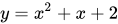
以前,人們無法解決任何包含負數根的方程。例如,二次方程 y = x 2 + x + 2 {\displaystyle y=x^{2}+x+2}
 It cannot be factorised
 It cannot be solved with the quadratic equation (as the discriminate would be negative, and one could not square root a negative number).
但是,使用“虛數”允許對負數開平方根
            −
            1


        =
        i


    {\displaystyle {\sqrt {-1}}=i}
應用這一點和對根式的瞭解,我們可以將其用於任何負數。因此
            −
            9


        =


            9


        ×


            −
            1


        =
        ±
        3
        i


    {\displaystyle {\sqrt {-9}}={\sqrt {9}}\times {\sqrt {-1}}=\pm 3i}


            −
            10


        =


            10


        ×


            −
            1


        =
        ±


            10


        i


    {\displaystyle {\sqrt {-10}}={\sqrt {10}}\times {\sqrt {-1}}=\pm {\sqrt {10}}i}


            −
            8


        =


            8


        ×


            −
            1


        =
        ±
        2


            2


        i


    {\displaystyle {\sqrt {-8}}={\sqrt {8}}\times {\sqrt {-1}}=\pm 2{\sqrt {2}}i}
複數是一個包含虛部的數,換句話說,它包含 i {\displaystyle i}
            z


        =
        1
        +
        3


            i


    {\displaystyle {\mathit {z}}=1+3{\mathit {i}}\!}


        z
        =


              3

            2


        +
        3
        i


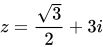
    {\displaystyle z={\frac {\sqrt {3}}{2}}+3i}


        z
        =
        −
        2
        +


            2


        i


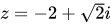
    {\displaystyle z=-2+{\sqrt {2}}i}


        z
        =


              3
              +


                  5


              i

            2


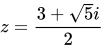
    {\displaystyle z={\frac {3+{\sqrt {5}}i}{2}}}
即使在更復雜的例子中,我們也應該始終能夠將實部與虛部分開。考慮上面的最後一個例子
        z
        =


              3
              +


                  5


              i

            2


    {\displaystyle z={\frac {3+{\sqrt {5}}i}{2}}}
在這個數字中,實部是 3 2 {\displaystyle 3 \over 2} 5 2 i {\displaystyle {\frac {\sqrt {5}}{2}}i}
類似地,如果我們要考慮
        z
        =


            3


        (


            2


        +
        i
        )


    {\displaystyle z={\sqrt {3}}({\sqrt {2}}+i)}
實部將是 3 × 2 = 6 {\displaystyle {\sqrt {3}}\times {\sqrt {2}}={\sqrt {6}}} 3 i {\displaystyle {\sqrt {3}}i}
我們也應該注意這裡:在 2 i {\displaystyle {\sqrt {2}}i} i {\displaystyle {\mathit {i}}\!} 2 × i {\displaystyle {\sqrt {2}}\times i}
上面的每個例子(以及所有複數)都可以用以下方式表示
z
=
a
+
b
i
{\displaystyle {\mathit {z}}={\mathit {a}}+{\mathit {b}}{\mathit {i}}\!}
a
∈
R
{\displaystyle a\in \mathbb {R} \!}
b
∈
R
{\displaystyle b\in \mathbb {R} \!}
值得熟悉一下像 a ∈ R {\displaystyle a\in \mathbb {R} \!} R {\displaystyle \mathbb {R} \!} R {\displaystyle \mathbb {R} \!}
每個複數都有一個“共軛複數”。儘管名字很複雜,但這是一個非常簡單的概念。
The Complex Number
z
=
a
+
b
i
{\displaystyle {\mathit {z}}={\mathit {a}}+{\mathit {b}}{\mathit {i}}\!}
z
∗
=
a
−
b
i
{\displaystyle {\mathit {z}}*={\mathit {a}}-{\mathit {b}}{\mathit {i}}\!}
共軛複數有很多用處。例如,如果一個方程有一個復根 (1+3i),那麼它的共軛複數 (1-3i) 也是一個根。同樣地,為了除複數,我們必須使用共軛複數來“有理化”分母,這將在後面講解。我們透過用 z ∗ z ∗ {\displaystyle {\frac {z*}{z*}}} a+ib 的形式。
對於任何複數,其共軛複數用 * 表示。例如,複數 'a' 的共軛複數為 'a*'。複數 'y' 的共軛複數為 'y*'。考試中通常會使用複數 z 和 w。
假設我們要定義
        z
        =
        3
        +


            2


        i


    {\displaystyle z=3+{\sqrt {2}}i}


        w
        =
        −
        2
        +
        3


            2


        i


    {\displaystyle w=-2+3{\sqrt {2}}i}
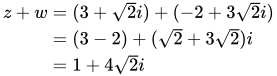
複數的加法是分別對實部和虛部進行的 - 也就是說,將實部加在一起,將虛部加在一起。使用我們之前定義的例子
                z
                +
                w


                =
                (
                3
                +


                    2


                i
                )
                +
                (
                −
                2
                +
                3


                    2


                i
                )


                =
                (
                3
                −
                2
                )
                +
                (


                    2


                +
                3


                    2


                )
                i


                =
                1
                +
                4


                    2


                i


    {\displaystyle {\begin{aligned}z+w&=(3+{\sqrt {2}}i)+(-2+3{\sqrt {2}}i)\\&=(3-2)+({\sqrt {2}}+3{\sqrt {2}})i\\&=1+4{\sqrt {2}}i\\\end{aligned}}}
複數的加法與實數的加法一樣,與加法的順序無關 - 換句話說, z + w ≡ w + z {\displaystyle z+w\equiv w+z}
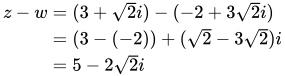
同樣地,如果我們考慮之前定義的那對複數,它們可以用相同的方式進行減法。
                z
                −
                w


                =
                (
                3
                +


                    2


                i
                )
                −
                (
                −
                2
                +
                3


                    2


                i
                )


                =
                (
                3
                −
                (
                −
                2
                )
                )
                +
                (


                    2


                −
                3


                    2


                )
                i


                =
                5
                −
                2


                    2


                i


    {\displaystyle {\begin{aligned}z-w&=(3+{\sqrt {2}}i)-(-2+3{\sqrt {2}}i)\\&=(3-(-2))+({\sqrt {2}}-3{\sqrt {2}})i\\&=5-2{\sqrt {2}}i\\\end{aligned}}}
與實數的減法一樣,複數的減法也與減法的順序無關 - 換句話說
z
−
w
≠
w
−
z
{\displaystyle z-w\neq w-z}
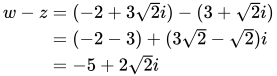
因此
                w
                −
                z


                =
                (
                −
                2
                +
                3


                    2


                i
                )
                −
                (
                3
                +


                    2


                i
                )


                =
                (
                −
                2
                −
                3
                )
                +
                (
                3


                    2


                −


                    2


                )
                i


                =
                −
                5
                +
                2


                    2


                i


    {\displaystyle {\begin{aligned}w-z&=(-2+3{\sqrt {2}}i)-(3+{\sqrt {2}}i)\\&=(-2-3)+(3{\sqrt {2}}-{\sqrt {2}})i\\&=-5+2{\sqrt {2}}i\\\end{aligned}}}
用常數乘以複數非常簡單 - 對於常數 'k',只需將實部乘以 k,將虛部乘以 k。因此,使用我們之前定義的 z
        k
        z
        =
        k
        (
        3
        +


            2


        i
        )
        =
        3
        k
        +
        k


            2


        i


    {\displaystyle kz=k(3+{\sqrt {2}}i)=3k+k{\sqrt {2}}i}
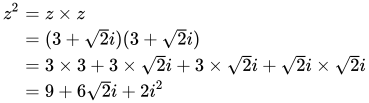
如果我們要用一個複數乘以另一個複數,我們需要遵循與展開像 ( 2 x + 2 ) ( x + 3 ) {\displaystyle ({\sqrt {2}}x+2)(x+3)}
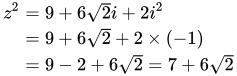
                  z

                    2


                =
                z
                ×
                z


                =
                (
                3
                +


                    2


                i
                )
                (
                3
                +


                    2


                i
                )


                =
                3
                ×
                3
                +
                3
                ×


                    2


                i
                +
                3
                ×


                    2


                i
                +


                    2


                i
                ×


                    2


                i


                =
                9
                +
                6


                    2


                i
                +
                2

                  i

                    2


    {\displaystyle {\begin{aligned}z^{2}&=z\times z\\&=(3+{\sqrt {2}}i)(3+{\sqrt {2}}i)\\&=3\times 3+3\times {\sqrt {2}}i+3\times {\sqrt {2}}i+{\sqrt {2}}i\times {\sqrt {2}}i\\&=9+6{\sqrt {2}}i+2i^{2}\\\end{aligned}}}
我們可能會想當然地將解寫成與乘未知數時一樣的形式。但是, i 2 {\displaystyle i^{2}\!}
                  z

                    2


                =
                9
                +
                6


                    2


                i
                +
                2

                  i

                    2


                =
                9
                +
                6


                    2


                +
                2
                ×
                (
                −
                1
                )


                =
                9
                −
                2
                +
                6


                    2


                =
                7
                +
                6


                    2


    {\displaystyle {\begin{aligned}z^{2}&=9+6{\sqrt {2}}i+2i^{2}\\&=9+6{\sqrt {2}}+2\times (-1)\\&=9-2+6{\sqrt {2}}=7+6{\sqrt {2}}\\\end{aligned}}}
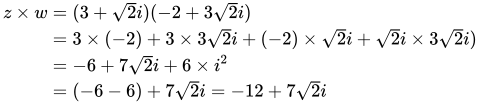
同樣地,我們可以用不同的複數相乘
                z
                ×
                w


                =
                (
                3
                +


                    2


                i
                )
                (
                −
                2
                +
                3


                    2


                i
                )


                =
                3
                ×
                (
                −
                2
                )
                +
                3
                ×
                3


                    2


                i
                +
                (
                −
                2
                )
                ×


                    2


                i
                +


                    2


                i
                ×
                3


                    2


                i
                )


                =
                −
                6
                +
                7


                    2


                i
                +
                6
                ×

                  i

                    2


                =
                (
                −
                6
                −
                6
                )
                +
                7


                    2


                i
                =
                −
                12
                +
                7


                    2


                i


    {\displaystyle {\begin{aligned}z\times w&=(3+{\sqrt {2}}i)(-2+3{\sqrt {2}}i)\\&=3\times (-2)+3\times 3{\sqrt {2}}i+(-2)\times {\sqrt {2}}i+{\sqrt {2}}i\times 3{\sqrt {2}}i)\\&=-6+7{\sqrt {2}}i+6\times i^{2}\\&=(-6-6)+7{\sqrt {2}}i=-12+7{\sqrt {2}}i\\\end{aligned}}}
這是一個稍微複雜的過程,類似於在涉及根式的運算中將分母有理化。
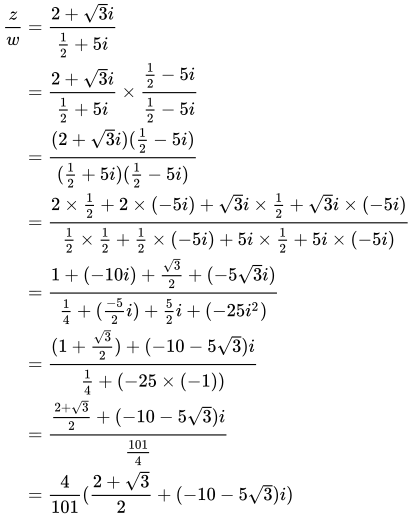
例如: 2 + 3 i 1 2 + 5 i {\displaystyle {\frac {2+{\sqrt {3}}i}{{\frac {1}{2}}+{\sqrt {5}}i}}} 1 2 + 5 i {\displaystyle {\frac {1}{2}}+5i} 1 2 − 5 i {\displaystyle {\frac {1}{2}}-5i} 1 2 − 5 i 1 2 − 5 i {\displaystyle {\frac {{\frac {1}{2}}-5i}{{\frac {1}{2}}-5i}}}
這個過程可以透過數學方法解決。
        z
        =
        2
        +


            3


        i


    {\displaystyle z=2+{\sqrt {3}}i}


        w
        =


            1
            2


        +
        5
        i


    {\displaystyle w={\frac {1}{2}}+5i}


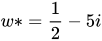
        w
        ∗
        =


            1
            2


        −
        5
        i


    {\displaystyle w*={\frac {1}{2}}-5i}
z
w
=
2
+
3
i
1
2
+
5
i
=
2
+
3
i
1
2
+
5
i
×
1
2
−
5
i
1
2
−
5
i
=
(
2
+
3
i
)
(
1
2
−
5
i
)
(
1
2
+
5
i
)
(
1
2
−
5
i
)
=
2
×
1
2
+
2
×
(
−
5
i
)
+
3
i
×
1
2
+
3
i
×
(
−
5
i
)
1
2
×
1
2
+
1
2
×
(
−
5
i
)
+
5
i
×
1
2
+
5
i
×
(
−
5
i
)
=
1
+
(
−
10
i
)
+
3
2
+
(
−
5
3
i
)
1
4
+
(
−
5
2
i
)
+
5
2
i
+
(
−
25
i
2
)
=
(
1
+
3
2
)
+
(
−
10
−
5
3
)
i
1
4
+
(
−
25
×
(
−
1
)
)
=
2
+
3
2
+
(
−
10
−
5
3
)
i
101
4
=
4
101
(
2
+
3
2
+
(
−
10
−
5
3
)
i
)
{\displaystyle {\begin{aligned}{\frac {z}{w}}&={\frac {2+{\sqrt {3}}i}{{\frac {1}{2}}+5i}}\\&={\frac {2+{\sqrt {3}}i}{{\frac {1}{2}}+5i}}\times {\frac {{\frac {1}{2}}-5i}{{\frac {1}{2}}-5i}}\\&={\frac {(2+{\sqrt {3}}i)({\frac {1}{2}}-5i)}{({\frac {1}{2}}+5i)({\frac {1}{2}}-5i)}}\\&={\frac {2\times {\frac {1}{2}}+2\times (-5i)+{\sqrt {3}}i\times {\frac {1}{2}}+{\sqrt {3}}i\times (-5i)}{{\frac {1}{2}}\times {\frac {1}{2}}+{\frac {1}{2}}\times (-5i)+5i\times {\frac {1}{2}}+5i\times (-5i)}}\\&={\frac {1+(-10i)+{\frac {\sqrt {3}}{2}}+(-5{\sqrt {3}}i)}{{\frac {1}{4}}+({\frac {-5}{2}}i)+{\frac {5}{2}}i+(-25i^{2})}}\\&={\frac {(1+{\frac {\sqrt {3}}{2}})+(-10-5{\sqrt {3}})i}{{\frac {1}{4}}+(-25\times (-1))}}\\&={\frac {{\frac {2+{\sqrt {3}}}{2}}+(-10-5{\sqrt {3}})i}{\frac {101}{4}}}\\&={\frac {4}{101}}({\frac {2+{\sqrt {3}}}{2}}+(-10-5{\sqrt {3}})i)\\\end{aligned}}}
雖然這個過程為了清晰起見進行了擴充套件,但它確實強調了在除複數時需要謹慎和準確。同樣,雖然數字可能有點複雜,但過程相當簡單。它也非常類似於“有理化分母”,即消去分母中的“i”項,使分母成為整體表達式的因子。
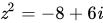
z 2 {\displaystyle {\mathit {z}}^{2}} [ 編輯 | 編輯原始碼 ] 想象一下複數
z 2 = − 8 + 6 i {\displaystyle {\mathit {z}}^{2}=-8+6{\mathit {i}}\!}
那麼如何找到 z {\displaystyle {\mathit {z}}\!} a + b i {\displaystyle {\mathit {a}}+{\mathit {b}}{\mathit {i}}\!}
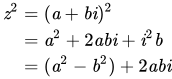
Let us initially define
z
{\displaystyle {\mathit {z}}\!}
z
=
a
+
b
i
{\displaystyle {\mathit {z}}={\mathit {a}}+{\mathit {b}}{\mathit {i}}\!}
z
2
=
(
a
+
b
i
)
2
=
a
2
+
2
a
b
i
+
i
2
b
=
(
a
2
−
b
2
)
+
2
a
b
i
{\displaystyle {\begin{aligned}{\mathit {z}}^{2}&=({\mathit {a}}+{\mathit {b}}{\mathit {i}})^{2}\\&={\mathit {a}}^{2}+2{\mathit {a}}{\mathit {b}}{\mathit {i}}+{\mathit {i}}^{2}{\mathit {b}}\!\\&=({\mathit {a}}^{2}-{\mathit {b}}^{2})+2{\mathit {a}}{\mathit {b}}{\mathit {i}}\!\\\end{aligned}}}
這種 z 2 {\displaystyle {\mathit {z}}^{2}\!} ( a 2 − b 2 ) {\displaystyle ({\mathit {a}}^{2}-{\mathit {b}}^{2}\!)} ( 2 a b i ) {\displaystyle (2{\mathit {a}}{\mathit {b}}{\mathit {i}})\!}
We can relate the given value of
z
2
{\displaystyle {\mathit {z}}^{2}\!}
−
8
+
6
i
=
(
a
2
−
b
2
)
+
2
a
b
i
{\displaystyle -8+6{\mathit {i}}=({\mathit {a}}^{2}-{\mathit {b}}^{2})+2{\mathit {a}}{\mathit {b}}{\mathit {i}}\!}
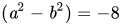
(
a
2
−
b
2
)
=
−
8
{\displaystyle ({\mathit {a}}^{2}-{\mathit {b}}^{2})=-8\!}
2
a
b
=
6
{\displaystyle 2{\mathit {a}}{\mathit {b}}=6\!}
現在,很明顯, a {\displaystyle {\mathit {a}}\!} b {\displaystyle {\mathit {b}}\!}
2
a
b
=
6
{\displaystyle 2{\mathit {a}}{\mathit {b}}=6\!}
∴
a
b
=
3
{\displaystyle \therefore {\mathit {a}}{\mathit {b}}=3\!}
∴
a
=
3
b
{\displaystyle \therefore {\mathit {a}}={\frac {3}{b}}}
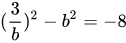
(
3
b
)
2
−
b
2
=
−
8
{\displaystyle ({\frac {3}{b}})^{2}-{b}^{2}=-8\!}
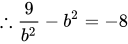
∴
9
b
2
−
b
2
=
−
8
{\displaystyle \therefore {\frac {9}{b^{2}}}-b^{2}=-8}
∴
9
−
b
4
=
−
8
b
2
{\displaystyle \therefore 9-{\mathit {b}}^{4}=-8{\mathit {b}}^{2}\!}
∴
b
4
−
8
b
2
−
9
=
0
{\displaystyle \therefore {\mathit {b}}^{4}-8{\mathit {b}}^{2}-9=0}
現在我們得到了一個關於 b 2 {\displaystyle {\mathit {b}}^{2}\!}
b
4
−
8
b
2
−
9
=
0
{\displaystyle {\mathit {b}}^{4}-8{\mathit {b}}^{2}-9=0\!}
(
b
2
−
9
)
(
b
2
+
1
)
=
0
{\displaystyle ({\mathit {b}}^{2}-9)({\mathit {b}}^{2}+1)=0\!}
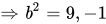
⇒
b
2
=
9
,
−
1
{\displaystyle \Rightarrow {\mathit {b}}^{2}=9,-1\!}
b
∈
ℜ
{\displaystyle {\mathit {b}}\in \Re \!}
⇒
b
2
=
9
{\displaystyle \Rightarrow {\mathit {b}}^{2}=9\!}
∴
b
=
±
3
{\displaystyle \therefore {\mathit {b}}=\pm 3\!}
然後我們可以將這些值代回我們最初的任何一個方程。
        2


            a


            b


        =
        6


    {\displaystyle 2{\mathit {a}}{\mathit {b}}=6\!}


            b


        =
        3
        ⇒
        3
        ×
        2


            a


        =
        6
        ∴


            a


        =
        1


    {\displaystyle {\mathit {b}}=3\Rightarrow 3\times 2{\mathit {a}}=6\therefore {\mathit {a}}=1\!}


            b


        =
        −
        3
        ⇒
        −
        3
        ×
        2


            b


        =
        6
        ∴


            a


        =
        −
        1


    {\displaystyle {\mathit {b}}=-3\Rightarrow -3\times 2{\mathit {b}}=6\therefore {\mathit {a}}=-1\!}
最後,我們得到了 a {\displaystyle {\mathit {a}}\!} b {\displaystyle {\mathit {b}}\!}
When
z
2
=
−
8
+
6
i
{\displaystyle {\mathit {z}}^{2}=-8+6{\mathit {i}}\!}
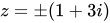
z
=
±
(
1
+
3
i
)
{\displaystyle z=\pm (1+3i)}
二次方程(即 x {\displaystyle x\!} x 2 {\displaystyle x^{2}\!} ( x + 2 ) 2 = 0 {\displaystyle (x+2)^{2}=0\!}
現在考慮二次方程 z 2 + 1 = 0 {\displaystyle {\mathit {z}}^{2}+1=0\!} ± − 1 {\displaystyle \pm {\mathit {-1}}\!} i {\displaystyle {\mathit {i}}\!}
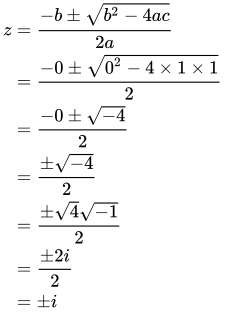
Using the quadratic formula gives:


                z


                =


                      −
                      b
                      ±


                            b

                              2


                          −
                          4
                          a
                          c


                      2
                      a


                =


                      −
                      0
                      ±


                            0

                              2


                          −
                          4
                          ×
                          1
                          ×
                          1


                    2


                =


                      −
                      0
                      ±


                          −
                          4


                    2


                =


                      ±


                          −
                          4


                    2


                =


                      ±


                          4


                          −
                          1


                    2


                =


                      ±
                      2
                      i

                    2


                =

                  ±
                  i


    {\displaystyle {\begin{aligned}z&={-b\pm {\sqrt {b^{2}-4ac}} \over 2a}\\&={-0\pm {\sqrt {0^{2}-4\times 1\times 1}} \over 2}\\&={-0\pm {\sqrt {-4}} \over 2}\\&={\pm {\sqrt {-4}} \over 2}\\&={\pm {\sqrt {4}}{\sqrt {-1}} \over 2}\\&={\pm 2i \over 2}\\&={\pm i}\\\end{aligned}}}
然後我們可以使用因式定理證明,要麼 z = i {\displaystyle z=i\!} z = − i {\displaystyle z=-i\!} z 2 + 1 = 0 {\displaystyle z^{2}+1=0\!}
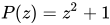
Let
P
(
z
)
=
z
2
+
1
{\displaystyle P(z)=z^{2}+1\!}
z
=
i
⇒
P
(
z
)
=
i
2
+
1
=
(
−
1
)
+
1
=
0
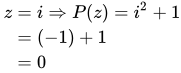
{\displaystyle {\begin{aligned}z&=i\Rightarrow P(z)=i^{2}+1\!\\&=(-1)+1\!\\&=0\!\\\end{aligned}}}
P
(
i
)
=
0
⇒
i
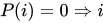
{\displaystyle P(i)=0\Rightarrow i\!}
z
2
+
1
{\displaystyle z^{2}+1\!}
對於 − i {\displaystyle -i\!} − 1 = ± i {\displaystyle {\sqrt {-1}}=\pm i\!}
⇒ P ( z ) = ( z + i ) ( z − i ) {\displaystyle \Rightarrow P(z)=(z+i)(z-i)}
對於複數根也可以做同樣的事情
Consider the quadratic equation:
z
2
−
14
z
+
53
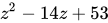
{\displaystyle z^{2}-14z+53\!}
z
=
−
b
±
b
2
−
4
a
c
2
a
=
−
(
−
14
)
±
(
−
14
)
2
−
4
×
1
×
53
2
=
14
±
196
−
212
2
=
14
±
−
16
2
=
14
±
4
i
2
=
7
±
2
i
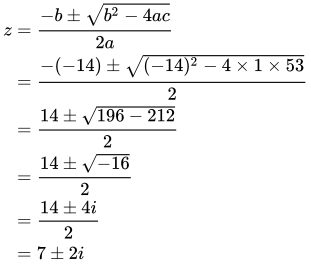
{\displaystyle {\begin{aligned}z&={-b\pm {\sqrt {b^{2}-4ac}} \over 2a}\\&={-(-14)\pm {\sqrt {(-14)^{2}-4\times 1\times 53}} \over 2}\\&={14\pm {\sqrt {196-212}} \over 2}\\&={14\pm {\sqrt {-16}} \over 2}\\&={14\pm 4i \over 2}\\&=7\pm 2i\!\\\end{aligned}}}
z
2
−
14
z
+
53
=
(
z
−
(
7
+
2
i
)
)
(
z
−
(
7
−
2
i
)
)
{\displaystyle z^{2}-14z+53=(z-(7+2i))(z-(7-2i))\!}
再次注意, 7 ± 2 i {\displaystyle 7\pm 2i\!} 7 + 2 i {\displaystyle 7+2i\!} 7 − 2 i {\displaystyle 7-2i\!}
這是通用的阿根圖,顯示了複數 z = a + bi 當我們考慮到複數的一部分是完全虛數時,這是一個有趣的概念。如何用數學方式表示完全虛數的東西呢?“阿根圖”就是用來圖形化表示複數的工具。它將複數的實部作為 x 座標,虛部作為 y 座標進行處理。
阿根圖在確定複數的“幅角”方面非常有用。它還可以更直觀地表示覆數的“模”的含義。
這與在圖上找到任何給定直線的長度非常相似。假設你有兩個點 - 原點 (0,0) 和點 A (3,4)。畫出連線這兩個點的線段 OA。為了找到這條線的長度,可以使用在 C1 和 C2 中學習過的勾股定理。
L
e
n
g
t
h
O
A
=
(
3
−
0
)
2
+
(
4
−
0
)
2
=
9
+
16
=
25
=
5
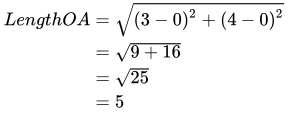
{\displaystyle {\begin{aligned}LengthOA&={\sqrt {(3-0)^{2}+(4-0)^{2}}}\\&={\sqrt {9+16}}\\&={\sqrt {25}}\\&=5\end{aligned}}}