


演算法實現/數學/多項式插值

拉格朗日插值是一種演算法,它返回透過給定點集 (xi, yi) 的最小次數多項式。
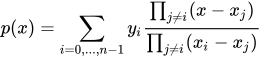
給定 n 個點 (x0, y0), ..., (xn-1, yn-1),計算拉格朗日插值多項式 。請注意,總和中的 ith 項, 被構造為,當 xj 替換為 x 時,只要 j≠i,其值為零,而只要 j = i,其值為 yj。由此產生的拉格朗日插值多項式是這些項的總和,因此對於每個指定點 (xj, yj),其值均為 p(xj) = 0 + 0 + ... + yj + ... + 0 = yj。
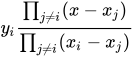
在下面的虛擬碼和每個實現中,多項式 p(x) = a0 + a1x + a2x2 + ... + an-1xn-1 表示為其係數陣列,(a0, a1, a2, ..., an-1)。
algorithm lagrange-interpolate is
input: points (x0, y0), ..., (xn-1, yn-1)
output: Polynomial p such that p(x) passes through the input points and is of minimal degree
for each point (xi, yi) do
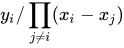
compute tmp :=
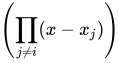
compute term := tmp*
return p, the sum of the values of term
在下面的示例實現中,多項式 p(x) = a0 + a1x + a2x2 + ... + an-1xn-1 表示為其係數陣列,(a0, a1, a2, ..., an-1)。
雖然程式碼被編寫為期望從實數(即浮點數)中獲取點,並返回一個具有實數係數的多項式,但這個基本演算法可以被調整為使用來自任何域(例如複數、模素數的整數或有限域)的輸入和多項式係數。
#include <stdio.h>
#include <stdlib.h>

// input: numpts, xval, yval
// output: thepoly
void interpolate(int numpts, const float xval[restrict numpts], const float yval[restrict numpts],
    float thepoly[numpts])
{
    float theterm[numpts];
    float prod;
    int i, j, k;
    for (i = 0; i < numpts; i++)
        thepoly[i] = 0.0;
    for (i = 0; i < numpts; i++) {
        prod = 1.0;
        for (j = 0; j < numpts; j++) {
            theterm[j] = 0.0;
        };
        // Compute Prod_{j != i} (x_i - x_j)
        for (j = 0; j < numpts; j++) {
            if (i == j)
                continue;
            prod *= (xval[i] - xval[j]);
        };
        // Compute y_i/Prod_{j != i} (x_i - x_j)
        prod = yval[i] / prod;
        theterm[0] = prod;
        // Compute theterm := prod*Prod_{j != i} (x - x_j)
        for (j = 0; j < numpts; j++) {
            if (i == j)
                continue;
            for (k = numpts - 1; k > 0; k--) {
                theterm[k] += theterm[k - 1];
                theterm[k - 1] *= (-xval[j]);
            };
        };
        // thepoly += theterm (as coeff vectors)
        for (j = 0; j < numpts; j++) {
            thepoly[j] += theterm[j];
        };
    };
}
from typing import Tuple, List

def interpolate(inpts: List[Tuple[float, float]]) -> List[float]:
    n = len(inpts)
    thepoly = n * [0.0]
    for i in range(n):
        prod = 1.0
        # Compute Prod_{j != i} (x_i - x_j)
        for j in (j for j in range(n) if (j != i)):
            prod *= (inpts[i][0] - inpts[j][0])
        # Compute y_i/Prod_{j != i} (x_i - x_j)
        prod = inpts[i][1] / prod
        theterm = [prod] + (n - 1) * [0]
        # Compute theterm := prod*Prod_{j != i} (x - x_j)
        for j in (j for j in range(n) if (j != i)):
            for k in range(n - 1, 0, -1):
                theterm[k] += theterm[k - 1]
                theterm[k - 1] *= (-inpts[j][0])
        # thepoly += theterm
        for j in range(n):
            thepoly[j] += theterm[j]
    return thepoly