定義 24.1 (有限生成代數) :
令 R {\displaystyle R} R {\displaystyle R} A {\displaystyle A} a 1 , … , a n ∈ A {\displaystyle a_{1},\ldots ,a_{n}\in A} R [ a 1 , … , a n ] {\displaystyle R[a_{1},\ldots ,a_{n}]} A {\displaystyle A} A = R [ a 1 , … , a n ] {\displaystyle A=R[a_{1},\ldots ,a_{n}]}
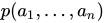
A {\displaystyle A} R {\displaystyle R} A {\displaystyle A} p ( a 1 , … , a n ) {\displaystyle p(a_{1},\ldots ,a_{n})} p ∈ R [ x 1 , … , x n ] {\displaystyle p\in R[x_{1},\ldots ,x_{n}]}
引理 24.2 (阿廷-泰特) :
設 R ⊆ S ⊆ T {\displaystyle R\subseteq S\subseteq T} R {\displaystyle R} T {\displaystyle T} S {\displaystyle S} R {\displaystyle R} S {\displaystyle S} R {\displaystyle R}
證明 :
由於 T {\displaystyle T} S {\displaystyle S} u 1 , … , u n ∈ T {\displaystyle u_{1},\ldots ,u_{n}\in T} T = ⟨ u 1 , … , u n ⟩ {\displaystyle T=\langle u_{1},\ldots ,u_{n}\rangle } S {\displaystyle S} T {\displaystyle T} R {\displaystyle R} v 1 , … , v m ∈ T {\displaystyle v_{1},\ldots ,v_{m}\in T} T {\displaystyle T} R [ v 1 , … , v n ] {\displaystyle R[v_{1},\ldots ,v_{n}]} u 1 , … , u n {\displaystyle u_{1},\ldots ,u_{n}} a i , j ∈ S {\displaystyle a_{i,j}\in S} i {\displaystyle i} { 1 , … , n } {\displaystyle \{1,\ldots ,n\}} j {\displaystyle j} { 1 , … , m } {\displaystyle \{1,\ldots ,m\}}
v j = a 1 , j u 1 + ⋯ + a n , j u n {\displaystyle v_{j}=a_{1,j}u_{1}+\cdots +a_{n,j}u_{n}} j ∈ { 1 , … , m } ( ∗ ) {\displaystyle j\in \{1,\ldots ,m\}~~~~~~~(*)} 此外,存在合適的 b i , j , k {\displaystyle b_{i,j,k}} i , j , k ∈ { 1 , … , n } {\displaystyle i,j,k\in \{1,\ldots ,n\}}
u j u k = b 1 , j , k u 1 + ⋯ + b n , j , k u n ( ∗ ∗ ) {\displaystyle u_{j}u_{k}=b_{1,j,k}u_{1}+\cdots +b_{n,j,k}u_{n}~~~~~~~(**)} 我們定義 S ′ := R [ a i , j ( 1 ≤ i ≤ n , 1 ≤ j ≤ m ) , b i , j , k ( 1 ≤ i , j , k ≤ n ) ] ⊆ T {\displaystyle S':=R[a_{i,j}(1\leq i\leq n,1\leq j\leq m),b_{i,j,k}(1\leq i,j,k\leq n)]\subseteq T} S ′ {\displaystyle S'} a i , j , b i , j , k {\displaystyle a_{i,j},b_{i,j,k}} T {\displaystyle T} S ′ {\displaystyle S'} T {\displaystyle T} S ′ ⊆ S {\displaystyle S'\subseteq S} R ⊆ S ′ {\displaystyle R\subseteq S'} R {\displaystyle R} S ′ {\displaystyle S'}
我們斷言 T {\displaystyle T} S ′ {\displaystyle S'} t ∈ T {\displaystyle t\in T} v 1 , … , v m {\displaystyle v_{1},\ldots ,v_{m}} ( ∗ ) {\displaystyle (*)} ( ∗ ∗ ) {\displaystyle (**)} u 1 , … , u n {\displaystyle u_{1},\ldots ,u_{n}} S ′ {\displaystyle S'} T {\displaystyle T} S ′ {\displaystyle S'} T {\displaystyle T} S ′ {\displaystyle S'}
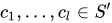
因此, S {\displaystyle S} S ′ {\displaystyle S'} T {\displaystyle T} S {\displaystyle S} R {\displaystyle R} m 1 , … , m l ∈ S {\displaystyle m_{1},\ldots ,m_{l}\in S} S ′ {\displaystyle S'} S {\displaystyle S} s ∈ S {\displaystyle s\in S}
s = c 1 m 1 + ⋯ + c l m l {\displaystyle s=c_{1}m_{1}+\cdots +c_{l}m_{l}} c 1 , … , c l ∈ S ′ {\displaystyle c_{1},\ldots ,c_{l}\in S'} 每個 c i {\displaystyle c_{i}} S ′ {\displaystyle S'} a i , j , b i , j , k {\displaystyle a_{i,j},b_{i,j,k}} R {\displaystyle R} s {\displaystyle s} a i , j , b i , j , k , m i {\displaystyle a_{i,j},b_{i,j,k},m_{i}} R {\displaystyle R} ◻ {\displaystyle \Box }
證明 1 (Azarang 2015) :
事實 1. 如果域 F {\displaystyle F} D {\displaystyle D} D {\displaystyle D}
事實 2. 如果 D {\displaystyle D} D {\displaystyle D}
Proof of the Lemma: We use induction on n {\displaystyle n} K {\displaystyle K} L {\displaystyle L} n = 1 {\displaystyle n=1} n > 1 {\displaystyle n>1} n {\displaystyle n} n {\displaystyle n} α i {\displaystyle \alpha _{i}} α 1 {\displaystyle \alpha _{1}} K {\displaystyle K} K [ α 1 , … , α n ] = K ( α 1 ) [ α 2 , … , α n ] {\displaystyle K[\alpha _{1},\ldots ,\alpha _{n}]=K(\alpha _{1})[\alpha _{2},\ldots ,\alpha _{n}]} α 2 , … , α n {\displaystyle \alpha _{2},\ldots ,\alpha _{n}} K ( α 1 ) {\displaystyle K(\alpha _{1})} f 2 ( α 1 ) , … , f n ( α 1 ) ∈ K [ α 1 ] {\displaystyle f_{2}(\alpha _{1}),\ldots ,f_{n}(\alpha _{1})\in K[\alpha _{1}]} α i {\displaystyle \alpha _{i}} A = K [ α 1 ] [ 1 / f 2 ( α 1 ) , … , 1 / f n ( α 1 ) ] {\displaystyle A=K[\alpha _{1}][1/f_{2}(\alpha _{1}),\ldots ,1/f_{n}(\alpha _{1})]} R {\displaystyle R} A {\displaystyle A} A {\displaystyle A} A = K ( α 1 ) {\displaystyle A=K(\alpha _{1})}
證明 2 (Artin-Tate) :
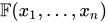
如果 A {\displaystyle A} F {\displaystyle \mathbb {F} } A {\displaystyle A} F {\displaystyle \mathbb {F} } A {\displaystyle A} F {\displaystyle \mathbb {F} }
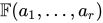
實際上,假設 A = F [ a 1 , … , a n ] {\displaystyle A=\mathbb {F} [a_{1},\ldots ,a_{n}]} a 1 , … , a r {\displaystyle a_{1},\ldots ,a_{r}} F {\displaystyle \mathbb {F} } r ≥ 1 {\displaystyle r\geq 1} a r + 1 , … , a n {\displaystyle a_{r+1},\ldots ,a_{n}} F {\displaystyle \mathbb {F} } A = F [ a 1 , … , a n ] ⊆ F ( a 1 , … , a n ) {\displaystyle A=\mathbb {F} [a_{1},\ldots ,a_{n}]\subseteq \mathbb {F} (a_{1},\ldots ,a_{n})} F ( a 1 , … , a n ) ⊆ A {\displaystyle \mathbb {F} (a_{1},\ldots ,a_{n})\subseteq A} A {\displaystyle A} a 1 , … , a n {\displaystyle a_{1},\ldots ,a_{n}} F {\displaystyle \mathbb {F} } A = F ( a 1 , … , a n ) {\displaystyle A=\mathbb {F} (a_{1},\ldots ,a_{n})}
由於所有 a r + 1 , … , a n {\displaystyle a_{r+1},\ldots ,a_{n}} F {\displaystyle \mathbb {F} } F ( a 1 , … , a r ) {\displaystyle \mathbb {F} (a_{1},\ldots ,a_{r})} f ∈ F [ x 1 , … , x n ] ∖ { 0 } {\displaystyle f\in \mathbb {F} [x_{1},\ldots ,x_{n}]\setminus \{0\}} f ( a 1 , … , a r ) = 0 {\displaystyle f(a_{1},\ldots ,a_{r})=0} a r {\displaystyle a_{r}} F ( a 1 , … , a r − 1 ) {\displaystyle \mathbb {F} (a_{1},\ldots ,a_{r-1})} a r {\displaystyle a_{r}} r {\displaystyle r} a r + 1 , … , a n {\displaystyle a_{r+1},\ldots ,a_{n}} F ( a 1 , … , a r ) {\displaystyle \mathbb {F} (a_{1},\ldots ,a_{r})} a 1 {\displaystyle a_{1}} F {\displaystyle \mathbb {F} } A {\displaystyle A} F ( a 1 ) {\displaystyle \mathbb {F} (a_{1})} F ( a 1 ) ( a 2 ) {\displaystyle \mathbb {F} (a_{1})(a_{2})}
因此,我們可以假設 a 1 , … , a r {\displaystyle a_{1},\ldots ,a_{r}} F {\displaystyle \mathbb {F} }
F [ x 1 , … , x r ] → F [ a 1 , … , a r ] , f ( x 1 , … , x r ) ↦ f ( a 1 , … , a r ) {\displaystyle \mathbb {F} [x_{1},\ldots ,x_{r}]\to \mathbb {F} [a_{1},\ldots ,a_{r}],f(x_{1},\ldots ,x_{r})\mapsto f(a_{1},\ldots ,a_{r})} 是一個同構(它是同態,滿射和單射),因此 F [ a 1 , … , a r ] {\displaystyle \mathbb {F} [a_{1},\ldots ,a_{r}]} F [ x 1 , … , x r ] {\displaystyle \mathbb {F} [x_{1},\ldots ,x_{r}]}
現在設 G := F ( a 1 , … , a r ) {\displaystyle \mathbb {G} :=\mathbb {F} (a_{1},\ldots ,a_{r})} F ⊆ G ⊆ A {\displaystyle \mathbb {F} \subseteq \mathbb {G} \subseteq A} A {\displaystyle A} F {\displaystyle \mathbb {F} } G {\displaystyle \mathbb {G} } G {\displaystyle \mathbb {G} } G {\displaystyle \mathbb {G} } F {\displaystyle \mathbb {F} }
f 1 ( a 1 , … , a n ) g 1 ( a 1 , … , a n ) , … , f m ( a 1 , … , a n ) g m ( a 1 , … , a n ) {\displaystyle {\frac {f_{1}(a_{1},\ldots ,a_{n})}{g_{1}(a_{1},\ldots ,a_{n})}},\ldots ,{\frac {f_{m}(a_{1},\ldots ,a_{n})}{g_{m}(a_{1},\ldots ,a_{n})}}} 是 G {\displaystyle \mathbb {G} } F {\displaystyle \mathbb {F} } p 1 , … , p l {\displaystyle p_{1},\ldots ,p_{l}} g 1 , … , g m {\displaystyle g_{1},\ldots ,g_{m}} F [ a 1 , … , a r ] {\displaystyle \mathbb {F} [a_{1},\ldots ,a_{r}]}
假設 q 1 , … , q k {\displaystyle q_{1},\ldots ,q_{k}} F [ a 1 , … , a r ] {\displaystyle \mathbb {F} [a_{1},\ldots ,a_{r}]} q 1 ⋅ q 2 ⋯ q n + 1 ∈ F [ a 1 , … , a r ] {\displaystyle q_{1}\cdot q_{2}\cdots q_{n}+1\in \mathbb {F} [a_{1},\ldots ,a_{r}]} q 1 , … , q k {\displaystyle q_{1},\ldots ,q_{k}} q j {\displaystyle q_{j}}
1 = q j ( q 1 ⋯ q j − 1 q j + 1 ⋯ q k + s ) {\displaystyle 1=q_{j}(q_{1}\cdots q_{j-1}q_{j+1}\cdots q_{k}+s)} 對於某個 s ∈ F [ a 1 , … , a r ] {\displaystyle s\in \mathbb {F} [a_{1},\ldots ,a_{r}]} F [ x 1 , … , x r ] {\displaystyle \mathbb {F} [x_{1},\ldots ,x_{r}]} 1 {\displaystyle 1} 1 {\displaystyle 1}
因此,我們可以選擇 p ∉ { p 1 , … , p l } {\displaystyle p\notin \{p_{1},\ldots ,p_{l}\}} 1 / p {\displaystyle 1/p} G {\displaystyle \mathbb {G} } ◻ {\displaystyle \Box }
證明 3(使用 Noether 規範化) :
根據域的 Noether 規範化引理,我們可以選擇 c 1 , … , c k ∈ A {\displaystyle c_{1},\ldots ,c_{k}\in A} F {\displaystyle \mathbb {F} } A {\displaystyle A} F [ c 1 , … , c k ] {\displaystyle \mathbb {F} [c_{1},\ldots ,c_{k}]} m 1 , … , m l {\displaystyle m_{1},\ldots ,m_{l}} A {\displaystyle A} F [ c 1 , … , c k ] {\displaystyle \mathbb {F} [c_{1},\ldots ,c_{k}]} A {\displaystyle A} ⇒ {\displaystyle \Rightarrow } F [ c 1 , … , c k ] {\displaystyle \mathbb {F} [c_{1},\ldots ,c_{k}]} A {\displaystyle A} F [ c 1 , … , c k ] {\displaystyle \mathbb {F} [c_{1},\ldots ,c_{k}]} F [ c 1 , … , c k ] {\displaystyle \mathbb {F} [c_{1},\ldots ,c_{k}]} k ≥ 1 {\displaystyle k\geq 1} c 1 , … , c k {\displaystyle c_{1},\ldots ,c_{k}}
F [ x 1 , … , x k ] → F [ c 1 , … , c k ] , f ( x 1 , … , x k ) ↦ f ( c 1 , … , c k ) {\displaystyle \mathbb {F} [x_{1},\ldots ,x_{k}]\to \mathbb {F} [c_{1},\ldots ,c_{k}],f(x_{1},\ldots ,x_{k})\mapsto f(c_{1},\ldots ,c_{k})} 實際上是一個同構,因此 F [ c 1 , … , c k ] {\displaystyle \mathbb {F} [c_{1},\ldots ,c_{k}]} k = 0 {\displaystyle k=0} A {\displaystyle A} F {\displaystyle \mathbb {F} } A {\displaystyle A} F {\displaystyle \mathbb {F} } ◻ {\displaystyle \Box }
有幾個密切相關的結果都以“希爾伯特零點定理”命名。我們將陳述並證明文獻中常見的那些結果。這些結果是“弱形式”、“公共根形式”和“強形式”。希爾伯特最初證明的結果是強形式。
希爾伯特零點定理弱形式的表述和證明自然地需要以下引理。
引理 24.5 :
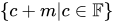
令 F {\displaystyle \mathbb {F} } m ≤ F [ x 1 , … , x n ] {\displaystyle m\leq \mathbb {F} [x_{1},\ldots ,x_{n}]} F [ x 1 , … , x n ] / m {\displaystyle \mathbb {F} [x_{1},\ldots ,x_{n}]/m} { c + m | c ∈ F } ⊆ F [ x 1 , … , x n ] / m {\displaystyle \{c+m|c\in \mathbb {F} \}\subseteq \mathbb {F} [x_{1},\ldots ,x_{n}]/m} F {\displaystyle \mathbb {F} } 真 有限域擴張),那麼 F [ x 1 , … , x n ] / m = { c + m | c ∈ F } {\displaystyle \mathbb {F} [x_{1},\ldots ,x_{n}]/m=\{c+m|c\in \mathbb {F} \}}
證明 1(使用扎里斯基引理) :
F [ x 1 , … , x n ] / m {\displaystyle \mathbb {F} [x_{1},\ldots ,x_{n}]/m} { c + m | c ∈ F } {\displaystyle \{c+m|c\in \mathbb {F} \}} F [ x 1 , … , x n ] {\displaystyle \mathbb {F} [x_{1},\ldots ,x_{n}]} { x 1 + m , … , x n + m } {\displaystyle \{x_{1}+m,\ldots ,x_{n}+m\}} F [ x 1 , … , x n ] / m {\displaystyle \mathbb {F} [x_{1},\ldots ,x_{n}]/m} { c + m | c ∈ F } {\displaystyle \{c+m|c\in \mathbb {F} \}} F [ x 1 , … , x n ] / m {\displaystyle \mathbb {F} [x_{1},\ldots ,x_{n}]/m} { c + m | c ∈ F } {\displaystyle \{c+m|c\in \mathbb {F} \}} ◻ {\displaystyle \Box }
證明 2(使用雅各布森環) :
我們用關於 n {\displaystyle n}
當 n = 1 {\displaystyle n=1} F [ x 1 ] {\displaystyle \mathbb {F} [x_{1}]} m ≤ F [ x 1 ] {\displaystyle m\leq \mathbb {F} [x_{1}]} m = ⟨ f ⟩ {\displaystyle m=\langle f\rangle } f ∈ F [ x 1 ] {\displaystyle f\in \mathbb {F} [x_{1}]} F [ x 1 ] / m {\displaystyle \mathbb {F} [x_{1}]/m} m {\displaystyle m} { c + m | c ∈ F } {\displaystyle \{c+m|c\in \mathbb {F} \}} 1 + m , x 1 + m , x 1 2 + m , … , x 1 d − 1 + m {\displaystyle 1+m,x_{1}+m,x_{1}^{2}+m,\ldots ,x_{1}^{d-1}+m} d := deg f {\displaystyle d:=\deg f} m = ⟨ f ⟩ {\displaystyle m=\langle f\rangle } F [ x 1 ] / m {\displaystyle \mathbb {F} [x_{1}]/m}
a d x d + m = − ( a d − 1 x d − 1 + ⋯ + a 1 x + a 0 ) + m {\displaystyle a_{d}x^{d}+m=-(a_{d-1}x^{d-1}+\cdots +a_{1}x+a_{0})+m} f ( x ) = a d x d + ⋯ + a 1 x + a 0 {\displaystyle f(x)=a_{d}x^{d}+\cdots +a_{1}x+a_{0}} 使我們能夠用更小的單項式來表示次數 ≥ d {\displaystyle \geq d}
現在假設 n − 1 {\displaystyle n-1} m ≤ F [ x 1 , … , x n ] {\displaystyle m\leq \mathbb {F} [x_{1},\ldots ,x_{n}]} F [ x 1 , … , x n − 1 ] {\displaystyle \mathbb {F} [x_{1},\ldots ,x_{n-1}]} F {\displaystyle \mathbb {F} } F [ x 1 , … , x n ] = F [ x 1 , … , x n − 1 ] [ x n ] {\displaystyle \mathbb {F} [x_{1},\ldots ,x_{n}]=\mathbb {F} [x_{1},\ldots ,x_{n-1}][x_{n}]} m {\displaystyle m} F [ x 1 , … , x n − 1 ] [ x n ] {\displaystyle \mathbb {F} [x_{1},\ldots ,x_{n-1}][x_{n}]} m 0 := F [ x 1 , … , x n − 1 ] ∩ m {\displaystyle m_{0}:=\mathbb {F} [x_{1},\ldots ,x_{n-1}]\cap m} F [ x 1 , … , x n − 1 ] {\displaystyle \mathbb {F} [x_{1},\ldots ,x_{n-1}]} F [ x 1 , … , x n − 1 ] / m 0 {\displaystyle \mathbb {F} [x_{1},\ldots ,x_{n-1}]/m_{0}} { c + m 0 | c ∈ F } {\displaystyle \{c+m_{0}|c\in \mathbb {F} \}}
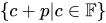
我們定義理想 p := m 0 F [ x 1 , … , x n ] {\displaystyle p:=m_{0}\mathbb {F} [x_{1},\ldots ,x_{n}]}
φ : F [ x 1 , … , x n − 1 ] [ x n ] / p ↦ ( F [ x 1 , … , x n − 1 ] / m 0 ) [ x n ] a k x n k + ⋯ + a 1 x n + a 0 + p ↦ ( a k + m 0 ) x n k + ⋯ + ( a 1 + m 0 ) x n + ( a 0 + m 0 ) {\displaystyle {\begin{aligned}\varphi :\mathbb {F} [x_{1},\ldots ,x_{n-1}][x_{n}]/p&\mapsto (\mathbb {F} [x_{1},\ldots ,x_{n-1}]/m_{0})[x_{n}]\\a_{k}x_{n}^{k}+\cdots +a_{1}x_{n}+a_{0}+p&\mapsto (a_{k}+m_{0})x_{n}^{k}+\cdots +(a_{1}+m_{0})x_{n}+(a_{0}+m_{0})\end{aligned}}} 該對映將 { c + p | c ∈ F } {\displaystyle \{c+p|c\in \mathbb {F} \}} { ( c + m 0 ) | c ∈ F } {\displaystyle \{(c+m_{0})|c\in \mathbb {F} \}}
此外,由於 m ⊊ p {\displaystyle m\subsetneq p} π p ( m ) {\displaystyle \pi _{p}(m)} F [ x 1 , … , x n − 1 ] [ x n ] / p {\displaystyle \mathbb {F} [x_{1},\ldots ,x_{n-1}][x_{n}]/p} φ ( p / m ) {\displaystyle \varphi (p/m)} ( F [ x 1 , … , x n − 1 ] / m 0 ) [ x n ] {\displaystyle (\mathbb {F} [x_{1},\ldots ,x_{n-1}]/m_{0})[x_{n}]} ( ( F [ x 1 , … , x n − 1 ] / m 0 ) [ x n ] ) / φ ( π p ( m ) ) {\displaystyle \left((\mathbb {F} [x_{1},\ldots ,x_{n-1}]/m_{0})[x_{n}]\right){\big /}\varphi (\pi _{p}(m))} n = 1 {\displaystyle n=1} { d + φ ( m / p ) | d ∈ F [ x 1 , … , x n − 1 ] / m 0 } {\displaystyle \{d+\varphi (m/p)|d\in \mathbb {F} [x_{1},\ldots ,x_{n-1}]/m_{0}\}}
一般來說,任何 F [ x 1 , … , x n ] {\displaystyle \mathbb {F} [x_{1},\ldots ,x_{n}]} F {\displaystyle \mathbb {F} } F [ x 1 , … , x n ] {\displaystyle \mathbb {F} [x_{1},\ldots ,x_{n}]} F [ x 1 , … , x n ] {\displaystyle \mathbb {F} [x_{1},\ldots ,x_{n}]} c + m {\displaystyle c+m} F [ x 1 , … , x n ] / m {\displaystyle \mathbb {F} [x_{1},\ldots ,x_{n}]/m} c {\displaystyle c}
F [ x 1 , … , x n ] / m ⊇ { c + m | c ∈ F } ≅ F , c + m ↦ c {\displaystyle \mathbb {F} [x_{1},\ldots ,x_{n}]/m\supseteq \{c+m|c\in \mathbb {F} \}\cong \mathbb {F} ,c+m\mapsto c} 因此,當 F {\displaystyle \mathbb {F} } F [ x 1 , … , x n ] / m ≅ F {\displaystyle \mathbb {F} [x_{1},\ldots ,x_{n}]/m\cong \mathbb {F} }
定理 24.6(希爾伯特零點定理,弱形式) :
令 F = F ¯ {\displaystyle \mathbb {F} ={\overline {\mathbb {F} }}} ξ = ( ξ 1 , … , ξ n ) ∈ F n {\displaystyle \xi =(\xi _{1},\ldots ,\xi _{n})\in \mathbb {F} ^{n}}
m ξ := ⟨ x 1 − ξ 1 , … , x n − ξ n ⟩ ≤ F [ x 1 , … , x n ] {\displaystyle m_{\xi }:=\langle x_{1}-\xi _{1},\ldots ,x_{n}-\xi _{n}\rangle \leq \mathbb {F} [x_{1},\ldots ,x_{n}]} 根據引理 21.12, m ξ {\displaystyle m_{\xi }}
弱 Hilbert 零點定理的斷言是:每個極大理想 m ≤ F [ x 1 , … , x n ] {\displaystyle m\leq \mathbb {F} [x_{1},\ldots ,x_{n}]} m ξ {\displaystyle m_{\xi }} ξ ∈ F n {\displaystyle \xi \in \mathbb {F} ^{n}}
證明 :
Let m ≤ F [ x 1 , … , x n ] {\displaystyle m\leq \mathbb {F} [x_{1},\ldots ,x_{n}]} F [ x 1 , … , x n ] {\displaystyle \mathbb {F} [x_{1},\ldots ,x_{n}]} F {\displaystyle \mathbb {F} } F [ x 1 , … , x n ] / m ≅ F {\displaystyle \mathbb {F} [x_{1},\ldots ,x_{n}]/m\cong \mathbb {F} } c + m {\displaystyle c+m} c {\displaystyle c} x j + m {\displaystyle x_{j}+m} α j {\displaystyle \alpha _{j}} F {\displaystyle \mathbb {F} } α j + m {\displaystyle \alpha _{j}+m} α j ∈ F {\displaystyle \alpha _{j}\in \mathbb {F} } α j + m = x j + m ⇔ x j − α j ∈ m {\displaystyle \alpha _{j}+m=x_{j}+m\Leftrightarrow x_{j}-\alpha _{j}\in m} ⟨ x 1 − α 1 , … , x n − α n ⟩ ⊆ m {\displaystyle \langle x_{1}-\alpha _{1},\ldots ,x_{n}-\alpha _{n}\rangle \subseteq m} α 1 , … , α n {\displaystyle \alpha _{1},\ldots ,\alpha _{n}} ⟨ x 1 − α 1 , … , x n − α n ⟩ {\displaystyle \langle x_{1}-\alpha _{1},\ldots ,x_{n}-\alpha _{n}\rangle } ⟨ x 1 − α 1 , … , x n − α n ⟩ = m {\displaystyle \langle x_{1}-\alpha _{1},\ldots ,x_{n}-\alpha _{n}\rangle =m} ◻ {\displaystyle \Box }
定理 24.7 (Hilbert 零點定理,公共根形式) :
令 F = F ¯ {\displaystyle \mathbb {F} ={\overline {\mathbb {F} }}} f 1 , … , f k ∈ F [ x 1 , … , x n ] {\displaystyle f_{1},\ldots ,f_{k}\in \mathbb {F} [x_{1},\ldots ,x_{n}]}
⟨ f 1 , … , f k ⟩ ⊊ F [ x 1 , … , x n ] {\displaystyle \langle f_{1},\ldots ,f_{k}\rangle \subsetneq \mathbb {F} [x_{1},\ldots ,x_{n}]} 那麼存在 ξ = ( ξ 1 , … , ξ n ) ∈ F n {\displaystyle \xi =(\xi _{1},\ldots ,\xi _{n})\in \mathbb {F} ^{n}} f 1 ( ξ ) = f 2 ( ξ ) = … = f k ( ξ ) = 0 {\displaystyle f_{1}(\xi )=f_{2}(\xi )=\ldots =f_{k}(\xi )=0}
證明 :
這是從弱形式得出的,因為 ⟨ f 1 , … , f k ⟩ {\displaystyle \langle f_{1},\ldots ,f_{k}\rangle } m ≤ F [ x 1 , … , x n ] {\displaystyle m\leq \mathbb {F} [x_{1},\ldots ,x_{n}]} m = ⟨ x 1 − α 1 , … , x n − α n ⟩ {\displaystyle m=\langle x_{1}-\alpha _{1},\ldots ,x_{n}-\alpha _{n}\rangle } α 1 , … , α n ∈ F {\displaystyle \alpha _{1},\ldots ,\alpha _{n}\in \mathbb {F} } { ( α 1 , … , α n ) } = V ( m ) ⊆ V ( ⟨ f 1 , … , f k ⟩ ) {\displaystyle \{(\alpha _{1},\ldots ,\alpha _{n})\}=V(m)\subseteq V(\langle f_{1},\ldots ,f_{k}\rangle )} ( α 1 , … , α n ) ∈ V ( ⟨ f 1 , … , f k ⟩ ) {\displaystyle (\alpha _{1},\ldots ,\alpha _{n})\in V(\langle f_{1},\ldots ,f_{k}\rangle )} ξ := ( α 1 , … , α n ) {\displaystyle \xi :=(\alpha _{1},\ldots ,\alpha _{n})} f 1 , … , f k {\displaystyle f_{1},\ldots ,f_{k}} ◻ {\displaystyle \Box }
特別是,如果 I {\displaystyle I} r ( I ) = I {\displaystyle r(I)=I}
I ( V ( I ) ) = I {\displaystyle I(V(I))=I} 注意,結合規則
V ( I ( V ( S ) ) ) = V ( S ) {\displaystyle V(I(V(S)))=V(S)} 對於任何代數集 V ( S ) {\displaystyle V(S)} F [ x 1 , … , x n ] {\displaystyle \mathbb {F} [x_{1},\ldots ,x_{n}]} F n {\displaystyle \mathbb {F} ^{n}}
V ( ⋅ ) : { radical ideals of F [ x 1 , … , x n ] } → { algebraic sets in F n } {\displaystyle V(\cdot ):\{{\text{radical ideals of }}\mathbb {F} [x_{1},\ldots ,x_{n}]\}\to \{{\text{algebraic sets in }}\mathbb {F} ^{n}\}} 和逆
I ( ⋅ ) : { algebraic sets in F n } → { radical ideals of F [ x 1 , … , x n ] } {\displaystyle I(\cdot ):\{{\text{algebraic sets in }}\mathbb {F} ^{n}\}\to \{{\text{radical ideals of }}\mathbb {F} [x_{1},\ldots ,x_{n}]\}} 證明 1(使用 Jacobson 環) :
當然,域是一個 Jacobson 環。此外,根據 Goldman 的第一個準則(定理 14.4),我們可以推斷 F [ x 1 , … , x n ] {\displaystyle \mathbb {F} [x_{1},\ldots ,x_{n}]} f ∈ F [ x 1 , … , x n ] {\displaystyle f\in \mathbb {F} [x_{1},\ldots ,x_{n}]} V ( I ) {\displaystyle V(I)} m ≤ F [ x 1 , … , x n ] {\displaystyle m\leq \mathbb {F} [x_{1},\ldots ,x_{n}]} F [ x 1 , … , x n ] {\displaystyle \mathbb {F} [x_{1},\ldots ,x_{n}]} I {\displaystyle I} m {\displaystyle m} m ξ = ⟨ x 1 − ξ 1 , … , x n − ξ n ⟩ {\displaystyle m_{\xi }=\langle x_{1}-\xi _{1},\ldots ,x_{n}-\xi _{n}\rangle } ξ = ( ξ 1 , … , ξ n ) ∈ F n {\displaystyle \xi =(\xi _{1},\ldots ,\xi _{n})\in \mathbb {F} ^{n}}
現在我們有 ξ ∈ V ( m ξ ) {\displaystyle \xi \in V(m_{\xi })} m ξ {\displaystyle m_{\xi }} F [ x 1 , … , x n ] {\displaystyle \mathbb {F} [x_{1},\ldots ,x_{n}]} x 1 − ξ 1 , … , x n − ξ n {\displaystyle x_{1}-\xi _{1},\ldots ,x_{n}-\xi _{n}} I ( V ( m ξ ) ) {\displaystyle I(V(m_{\xi }))} F [ x 1 , … , x n ] {\displaystyle \mathbb {F} [x_{1},\ldots ,x_{n}]} m ξ ⊆ I ( V ( m ξ ) ) {\displaystyle m_{\xi }\subseteq I(V(m_{\xi }))} m ξ {\displaystyle m_{\xi }} I ( V ( m ξ ) ) = m ξ {\displaystyle I(V(m_{\xi }))=m_{\xi }}
此外, V ( m ξ ) ⊆ V ( I ) {\displaystyle V(m_{\xi })\subseteq V(I)} I ( V ( I ) ) ⊆ I ( V ( m ξ ) ) {\displaystyle I(V(I))\subseteq I(V(m_{\xi }))} f ∈ I ( V ( m ξ ) ) = m ξ {\displaystyle f\in I(V(m_{\xi }))=m_{\xi }}
由於 f ∈ I ( V ( I ) ) {\displaystyle f\in I(V(I))} I ( V ( I ) ) {\displaystyle I(V(I))} I {\displaystyle I} F [ x 1 , … , x n ] {\displaystyle \mathbb {F} [x_{1},\ldots ,x_{n}]} I ( V ( I ) ) ⊆ r ( I ) {\displaystyle I(V(I))\subseteq r(I)} r ( I ) ⊆ I ( V ( I ) ) {\displaystyle r(I)\subseteq I(V(I))} I ( V ( I ) ) = r ( I ) {\displaystyle I(V(I))=r(I)} ◻ {\displaystyle \Box }
證明 2 (Rabinowitsch 技巧) :
首先,我們注意到 ⊇ {\displaystyle \supseteq } g n ∈ I {\displaystyle g^{n}\in I} g ( x ) n = 0 {\displaystyle g(x)^{n}=0} x ∈ V ( I ) {\displaystyle x\in V(I)} g ( x ) = 0 {\displaystyle g(x)=0} x ∈ V ( I ) {\displaystyle x\in V(I)} g ∈ I ( V ( I ) ) {\displaystyle g\in I(V(I))}
⊆ {\displaystyle \subseteq } F [ x 1 , … , x n ] {\displaystyle \mathbb {F} [x_{1},\ldots ,x_{n}]} I {\displaystyle I} F [ x 1 , … , x n ] {\displaystyle \mathbb {F} [x_{1},\ldots ,x_{n}]}
I = ⟨ f 1 ( x ) , … , f k ( x ) ⟩ {\displaystyle I=\langle f_{1}(x),\ldots ,f_{k}(x)\rangle } 令 g ∈ I ( V ( I ) ) {\displaystyle g\in I(V(I))} F [ x 1 , … , x n , z ] {\displaystyle \mathbb {F} [x_{1},\ldots ,x_{n},z]} h ( x 1 , … , x n , z ) := 1 − z g ( x 1 , … , x n ) {\displaystyle h(x_{1},\ldots ,x_{n},z):=1-zg(x_{1},\ldots ,x_{n})} f 1 , … , f n , h {\displaystyle f_{1},\ldots ,f_{n},h} f 1 , … , f n {\displaystyle f_{1},\ldots ,f_{n}} x 1 , … , x n , z {\displaystyle x_{1},\ldots ,x_{n},z} f j ( x 1 , … , x n , z ) := f j ( x 1 , … , x n ) {\displaystyle f_{j}(x_{1},\ldots ,x_{n},z):=f_{j}(x_{1},\ldots ,x_{n})} f 1 , … , f n {\displaystyle f_{1},\ldots ,f_{n}} ( α 1 , … , α n , β ) {\displaystyle (\alpha _{1},\ldots ,\alpha _{n},\beta )} β {\displaystyle \beta } f 1 , … , f n {\displaystyle f_{1},\ldots ,f_{n}} g {\displaystyle g} h ( α 1 , … , α n , β ) = 1 − β ⋅ 0 = 1 ≠ 0 {\displaystyle h(\alpha _{1},\ldots ,\alpha _{n},\beta )=1-\beta \cdot 0=1\neq 0}
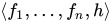
現在我們可以將 Nullstellensatz 的公共根形式應用於 n + 1 {\displaystyle n+1} f 1 , … , f n , h {\displaystyle f_{1},\ldots ,f_{n},h} ⟨ f 1 , … , f n , h ⟩ {\displaystyle \langle f_{1},\ldots ,f_{n},h\rangle } F [ x 1 , … , x n , z ] {\displaystyle \mathbb {F} [x_{1},\ldots ,x_{n},z]} η 1 , … , η n , μ ∈ F [ x 1 , … , x n , z ] {\displaystyle \eta _{1},\ldots ,\eta _{n},\mu \in \mathbb {F} [x_{1},\ldots ,x_{n},z]}
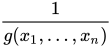
1 = η 1 ( x 1 , … , x n , z ) f 1 ( x 1 , … , x n , z ) + ⋯ + η n ( x 1 , … , x n , z ) f n ( x 1 , … , x n , z ) + μ ( x 1 , … , x n , z ) h ( x 1 , … , x n , z ) {\displaystyle 1=\eta _{1}(x_{1},\ldots ,x_{n},z)f_{1}(x_{1},\ldots ,x_{n},z)+\cdots +\eta _{n}(x_{1},\ldots ,x_{n},z)f_{n}(x_{1},\ldots ,x_{n},z)+\mu (x_{1},\ldots ,x_{n},z)h(x_{1},\ldots ,x_{n},z)} 轉到有理函式域 F ( x 1 , … , x n ) {\displaystyle \mathbb {F} (x_{1},\ldots ,x_{n})} 1 g ( x 1 , … , x n ) {\displaystyle {\frac {1}{g(x_{1},\ldots ,x_{n})}}} z {\displaystyle z} g ≢ 0 {\displaystyle g\not \equiv 0}
1 = η 1 ( x 1 , … , x n , 1 / g ) f 1 ( x 1 , … , x n , 1 / g ) + ⋯ + η n ( x 1 , … , x n , 1 / g ) f n ( x 1 , … , x n , 1 / g ) + μ ( x 1 , … , x n , 1 / g ) h ( x 1 , … , x n , 1 / g ) {\displaystyle 1=\eta _{1}(x_{1},\ldots ,x_{n},1/g)f_{1}(x_{1},\ldots ,x_{n},1/g)+\cdots +\eta _{n}(x_{1},\ldots ,x_{n},1/g)f_{n}(x_{1},\ldots ,x_{n},1/g)+\mu (x_{1},\ldots ,x_{n},1/g)h(x_{1},\ldots ,x_{n},1/g)} 為了讓公式在螢幕上顯示,我們省略了 g {\displaystyle g} h ( x 1 , … , x n , 1 / g ) = 1 − g ( x 1 , … , x n ) g ( x 1 , … , x n ) = 0 {\displaystyle h(x_{1},\ldots ,x_{n},1/g)=1-{\frac {g(x_{1},\ldots ,x_{n})}{g(x_{1},\ldots ,x_{n})}}=0}
1 = η 1 ( x 1 , … , x n , 1 / g ) f 1 ( x 1 , … , x n , 1 / g ) + ⋯ + η n ( x 1 , … , x n , 1 / g ) f n ( x 1 , … , x n , 1 / g ) {\displaystyle 1=\eta _{1}(x_{1},\ldots ,x_{n},1/g)f_{1}(x_{1},\ldots ,x_{n},1/g)+\cdots +\eta _{n}(x_{1},\ldots ,x_{n},1/g)f_{n}(x_{1},\ldots ,x_{n},1/g)} 將此方程乘以 g {\displaystyle g} N ∈ N {\displaystyle N\in \mathbb {N} } f 1 , … , f n {\displaystyle f_{1},\ldots ,f_{n}} g N {\displaystyle g^{N}} F [ x 1 , … , x n ] {\displaystyle \mathbb {F} [x_{1},\ldots ,x_{n}]} f 1 , … , f n {\displaystyle f_{1},\ldots ,f_{n}} I {\displaystyle I} g ∈ r ( I ) {\displaystyle g\in r(I)} ◻ {\displaystyle \Box }
請注意 Yuri Rainich ("Rabinowitsch") 可能 是如何發現這個技巧的。也許他意識到弱零點定理是針對任意 n {\displaystyle n} n {\displaystyle n}
該圖表展示了本書中介紹的通往希爾伯特零點定理的不同路徑。 





![{\displaystyle R[a_{1},\ldots ,a_{n}]}](https://wikimedia.org/api/rest_v1/media/math/render/svg/c4d8b1a39634120d82e9547da3a372f99129dff8)
![{\displaystyle A=R[a_{1},\ldots ,a_{n}]}](https://wikimedia.org/api/rest_v1/media/math/render/svg/4984a7e404e7fa7495523e58ac58134354cf0c95)
![{\displaystyle p\in R[x_{1},\ldots ,x_{n}]}](https://wikimedia.org/api/rest_v1/media/math/render/svg/d28c8d26a9ba52c68cbd9f79b9be18952b4013a8)





![{\displaystyle R[v_{1},\ldots ,v_{n}]}](https://wikimedia.org/api/rest_v1/media/math/render/svg/33f71b220a34a0b3051aa925ac7fdb7830c559c1)







![{\displaystyle S':=R[a_{i,j}(1\leq i\leq n,1\leq j\leq m),b_{i,j,k}(1\leq i,j,k\leq n)]\subseteq T}](https://wikimedia.org/api/rest_v1/media/math/render/svg/8055d3e9678edb5b0c0d36424b0c49f8efb06eab)







![{\displaystyle R=K[\alpha _{1},\ldots ,\alpha _{n}]}](https://wikimedia.org/api/rest_v1/media/math/render/svg/a442072ddb255910a036cafcfc5c49c7dad483b2)


![{\displaystyle K[\alpha _{1},\ldots ,\alpha _{n}]=K(\alpha _{1})[\alpha _{2},\ldots ,\alpha _{n}]}](https://wikimedia.org/api/rest_v1/media/math/render/svg/f7c97d858d88f51b697c31a69521e7cf4316ae62)


![{\displaystyle f_{2}(\alpha _{1}),\ldots ,f_{n}(\alpha _{1})\in K[\alpha _{1}]}](https://wikimedia.org/api/rest_v1/media/math/render/svg/3c97d837cf3800b6b8a28d9b7c57513b1fd74c58)
![{\displaystyle A=K[\alpha _{1}][1/f_{2}(\alpha _{1}),\ldots ,1/f_{n}(\alpha _{1})]}](https://wikimedia.org/api/rest_v1/media/math/render/svg/1779f9acbfb6a69ac5d02c5d5fe95367e057c846)


![{\displaystyle A=\mathbb {F} [a_{1},\ldots ,a_{n}]}](https://wikimedia.org/api/rest_v1/media/math/render/svg/ec4ecdfe7a33874b395337aca286b719ded7cbc3)


![{\displaystyle A=\mathbb {F} [a_{1},\ldots ,a_{n}]\subseteq \mathbb {F} (a_{1},\ldots ,a_{n})}](https://wikimedia.org/api/rest_v1/media/math/render/svg/f7a8f891a915e4ee76fcb00af2fc47a5bcbc28b3)



![{\displaystyle f\in \mathbb {F} [x_{1},\ldots ,x_{n}]\setminus \{0\}}](https://wikimedia.org/api/rest_v1/media/math/render/svg/c4ae22e4faf856a2d2d43a5bd02d29af45a12c0d)





![{\displaystyle \mathbb {F} [x_{1},\ldots ,x_{r}]\to \mathbb {F} [a_{1},\ldots ,a_{r}],f(x_{1},\ldots ,x_{r})\mapsto f(a_{1},\ldots ,a_{r})}](https://wikimedia.org/api/rest_v1/media/math/render/svg/898a6714496f82c1d4f0d172808ca38ef03983c2)
![{\displaystyle \mathbb {F} [a_{1},\ldots ,a_{r}]}](https://wikimedia.org/api/rest_v1/media/math/render/svg/cdedc0afdf83a8af31a54c35e024a72406a74095)
![{\displaystyle \mathbb {F} [x_{1},\ldots ,x_{r}]}](https://wikimedia.org/api/rest_v1/media/math/render/svg/31841d3027f515e4f392762b0c707d33d8b4c70e)






![{\displaystyle q_{1}\cdot q_{2}\cdots q_{n}+1\in \mathbb {F} [a_{1},\ldots ,a_{r}]}](https://wikimedia.org/api/rest_v1/media/math/render/svg/c1d7a9fadbc65ac76b6c025057626d58396b5ba1)


![{\displaystyle s\in \mathbb {F} [a_{1},\ldots ,a_{r}]}](https://wikimedia.org/api/rest_v1/media/math/render/svg/c21290e6c708c595f19c447f4f89d37638e8432b)




![{\displaystyle \mathbb {F} [c_{1},\ldots ,c_{k}]}](https://wikimedia.org/api/rest_v1/media/math/render/svg/3af29d29e72e60f05ceb9681d1de39dd0b8ebb92)


![{\displaystyle \mathbb {F} [x_{1},\ldots ,x_{k}]\to \mathbb {F} [c_{1},\ldots ,c_{k}],f(x_{1},\ldots ,x_{k})\mapsto f(c_{1},\ldots ,c_{k})}](https://wikimedia.org/api/rest_v1/media/math/render/svg/57de54357c20fa4b0021ca202e5b5f3644cd5abf)

![{\displaystyle m\leq \mathbb {F} [x_{1},\ldots ,x_{n}]}](https://wikimedia.org/api/rest_v1/media/math/render/svg/ac31e744799a9b8fb0acc55433a34a0407e882a9)
![{\displaystyle \mathbb {F} [x_{1},\ldots ,x_{n}]/m}](https://wikimedia.org/api/rest_v1/media/math/render/svg/ece42b53a75d83ad6eba4fbf653f9bca21b3b194)
![{\displaystyle \{c+m|c\in \mathbb {F} \}\subseteq \mathbb {F} [x_{1},\ldots ,x_{n}]/m}](https://wikimedia.org/api/rest_v1/media/math/render/svg/e501d4d1ba40b300bbd8e0c30740a52980a87a35)
![{\displaystyle \mathbb {F} [x_{1},\ldots ,x_{n}]/m=\{c+m|c\in \mathbb {F} \}}](https://wikimedia.org/api/rest_v1/media/math/render/svg/90db3bb3b4e9f63e526761b84a56697bd693acc3)
![{\displaystyle \mathbb {F} [x_{1},\ldots ,x_{n}]}](https://wikimedia.org/api/rest_v1/media/math/render/svg/096a47b8d74b985081288a6194e5035494194845)

![{\displaystyle \mathbb {F} [x_{1}]}](https://wikimedia.org/api/rest_v1/media/math/render/svg/f4c54aa0a3dad2990b0c7600f18318b210924513)
![{\displaystyle m\leq \mathbb {F} [x_{1}]}](https://wikimedia.org/api/rest_v1/media/math/render/svg/c2e8c31efc07d9c7fb4124a11c859845851b5d18)

![{\displaystyle f\in \mathbb {F} [x_{1}]}](https://wikimedia.org/api/rest_v1/media/math/render/svg/3039bed08f705ffa6edf83647b12e673e292bd8c)
![{\displaystyle \mathbb {F} [x_{1}]/m}](https://wikimedia.org/api/rest_v1/media/math/render/svg/23e6ab6c32e643a723049f80d42a11358f43b1d1)







![{\displaystyle \mathbb {F} [x_{1},\ldots ,x_{n-1}]}](https://wikimedia.org/api/rest_v1/media/math/render/svg/894bab282ee3ec83dce764e29799dd66b85ff461)
![{\displaystyle \mathbb {F} [x_{1},\ldots ,x_{n}]=\mathbb {F} [x_{1},\ldots ,x_{n-1}][x_{n}]}](https://wikimedia.org/api/rest_v1/media/math/render/svg/69a963625a9527f137cf01696e0b24287d6fa92d)
![{\displaystyle \mathbb {F} [x_{1},\ldots ,x_{n-1}][x_{n}]}](https://wikimedia.org/api/rest_v1/media/math/render/svg/d7fedb7c51c7043af596c44bef6029e7958aeca3)
![{\displaystyle m_{0}:=\mathbb {F} [x_{1},\ldots ,x_{n-1}]\cap m}](https://wikimedia.org/api/rest_v1/media/math/render/svg/249cc19df1fc21fd5962d6e8cd8b4920334c80f4)
![{\displaystyle \mathbb {F} [x_{1},\ldots ,x_{n-1}]/m_{0}}](https://wikimedia.org/api/rest_v1/media/math/render/svg/b53b2036ea433f483e523e42882b82536d53a0f7)

![{\displaystyle p:=m_{0}\mathbb {F} [x_{1},\ldots ,x_{n}]}](https://wikimedia.org/api/rest_v1/media/math/render/svg/f45a7cab43aabe8800c1d70a783fcaf547d98dea)
![{\displaystyle {\begin{aligned}\varphi :\mathbb {F} [x_{1},\ldots ,x_{n-1}][x_{n}]/p&\mapsto (\mathbb {F} [x_{1},\ldots ,x_{n-1}]/m_{0})[x_{n}]\\a_{k}x_{n}^{k}+\cdots +a_{1}x_{n}+a_{0}+p&\mapsto (a_{k}+m_{0})x_{n}^{k}+\cdots +(a_{1}+m_{0})x_{n}+(a_{0}+m_{0})\end{aligned}}}](https://wikimedia.org/api/rest_v1/media/math/render/svg/1c3e34edf42dbf22b7d78cf1195e701ebaa69603)



![{\displaystyle \mathbb {F} [x_{1},\ldots ,x_{n-1}][x_{n}]/p}](https://wikimedia.org/api/rest_v1/media/math/render/svg/eef4b03e3dcce12f721c1db7ce7f7da3aec8fdee)

![{\displaystyle (\mathbb {F} [x_{1},\ldots ,x_{n-1}]/m_{0})[x_{n}]}](https://wikimedia.org/api/rest_v1/media/math/render/svg/91243cd7f5f795cdff840aec2d18375e7b437a74)
![{\displaystyle \left((\mathbb {F} [x_{1},\ldots ,x_{n-1}]/m_{0})[x_{n}]\right){\big /}\varphi (\pi _{p}(m))}](https://wikimedia.org/api/rest_v1/media/math/render/svg/2aff7f7732a72a16c641e86e4228911c66238d28)
![{\displaystyle \{d+\varphi (m/p)|d\in \mathbb {F} [x_{1},\ldots ,x_{n-1}]/m_{0}\}}](https://wikimedia.org/api/rest_v1/media/math/render/svg/cfcbbad11587be107e8ba99e54100cc72833000e)


![{\displaystyle \mathbb {F} [x_{1},\ldots ,x_{n}]/m\supseteq \{c+m|c\in \mathbb {F} \}\cong \mathbb {F} ,c+m\mapsto c}](https://wikimedia.org/api/rest_v1/media/math/render/svg/e4987adfdf75c46dfa2ce348b7009413a5fd1fb2)
![{\displaystyle \mathbb {F} [x_{1},\ldots ,x_{n}]/m\cong \mathbb {F} }](https://wikimedia.org/api/rest_v1/media/math/render/svg/e87a0f1e7a071164f9b8c53992597c7661c76851)


![{\displaystyle m_{\xi }:=\langle x_{1}-\xi _{1},\ldots ,x_{n}-\xi _{n}\rangle \leq \mathbb {F} [x_{1},\ldots ,x_{n}]}](https://wikimedia.org/api/rest_v1/media/math/render/svg/1bf15d90ab910814f78477c77260156177fdf20e)






![{\displaystyle f_{1},\ldots ,f_{k}\in \mathbb {F} [x_{1},\ldots ,x_{n}]}](https://wikimedia.org/api/rest_v1/media/math/render/svg/291138cdc11f252039ffc51d6ca4d3ea8791ed4b)
![{\displaystyle \langle f_{1},\ldots ,f_{k}\rangle \subsetneq \mathbb {F} [x_{1},\ldots ,x_{n}]}](https://wikimedia.org/api/rest_v1/media/math/render/svg/6324586575a11318a174c69fa021b9c80e44689f)








![{\displaystyle I\leq \mathbb {F} [x_{1},\ldots ,x_{n}]}](https://wikimedia.org/api/rest_v1/media/math/render/svg/789a8598e8570ea1b248db8b991d948147d688ed)






![{\displaystyle V(\cdot ):\{{\text{radical ideals of }}\mathbb {F} [x_{1},\ldots ,x_{n}]\}\to \{{\text{algebraic sets in }}\mathbb {F} ^{n}\}}](https://wikimedia.org/api/rest_v1/media/math/render/svg/366bcf92c1621464972749db712bd49d2196267b)
![{\displaystyle I(\cdot ):\{{\text{algebraic sets in }}\mathbb {F} ^{n}\}\to \{{\text{radical ideals of }}\mathbb {F} [x_{1},\ldots ,x_{n}]\}}](https://wikimedia.org/api/rest_v1/media/math/render/svg/9d405cdccdec74d45a0e8ec71bc5352449e5c837)
![{\displaystyle f\in \mathbb {F} [x_{1},\ldots ,x_{n}]}](https://wikimedia.org/api/rest_v1/media/math/render/svg/afe87b11d04d0b531a4519e5c3a8bf262acd59da)


















![{\displaystyle \mathbb {F} [x_{1},\ldots ,x_{n},z]}](https://wikimedia.org/api/rest_v1/media/math/render/svg/437ad0f2f93eb8b7499423e625747beca1d8c8f9)









![{\displaystyle \eta _{1},\ldots ,\eta _{n},\mu \in \mathbb {F} [x_{1},\ldots ,x_{n},z]}](https://wikimedia.org/api/rest_v1/media/math/render/svg/6da58547fff0527c6f3e53911bfd52202a7e59d0)