


計算機程式設計/物理/物體在空間中的運動(分段近似)
關於 加速物體位置函式 的問題是,儘管它在理論上是正確的,但它在描述物體在空間中的運動方面並不具有很強的適應性。為了糾正這一點,我們採用分段計算的方式。
我們回顧一下 泰勒級數形式的位置函式
- .
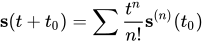
如果我們將時鐘同步,使 為零,則可以將其簡化為 麥克勞林級數

- .
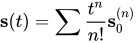
問題的解決方案就在這裡。該方程本身描述了基於初始常數因子 的完整路徑。但是,如果我們分段處理它,也就是說,我們計算 等於某個小的增量時間 的數值解,並在每次計算迴圈後將 重新同步到 ,那麼我們就可以使用以下函式的增量形式,透過連續計算來動態構建物體路徑。


- .

注意,隨著 以及我們使用的項數越多,精度就越高。

根據初始常數因子計算出物體的初始位置變化後,我們只需提供影響物體的任何外部加速度,,然後我們可以計算出物體的下一個位置和速度,以及下一組常數因子,其中,和都是已知的。


速度由以下公式計算:
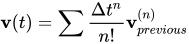
或
- .
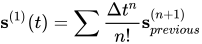
其他值可以近似為:

- 當 時,
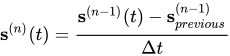

前提是 非常小。
也就是說,
- .

C++
[edit | edit source]template<class Vector,class Number>
void Motion(Vector *s,Vector *prev_s,Vector a,Number dt,size_t Accuracy)
//s[] is the array of "current derivative of s values" that we are trying to calculate
//prev_s[] is the array of "previous derivative of s values" that is used as the constant factors
{
size_t n(0);
Number factor(1);
//Note: the following code for position and velocity can be optimized for speed
// but isn't in order to explicitly show the algorithm
for(s[0]=0;n<Accuracy;n++)
//Position
{
if(n)factor*=(t/n);
s[0]+=(factor*prev_s[n]);
}
for(s[1]=0,n=0,factor=1;n<(Accuracy-1);n++)
//Velocity
{
if(n)factor*=(t/n);
s[1]+=(factor*prev_s[n+1]);
}
s[2]= a; //Acceleration
//+PositionDependentAcceleration(s[0]) //e.g. Newtonian Gravity
//+VelocityDependentAcceleration(s[1]) //e.g. Infinite Electro-magnetic field
//+PositionVelocityDependentAcceleration(s[0],s[1]); //e.g. Finite Electro-magnetic field
for(n=3;n<Accuracy;n++)
//Everything else
//We're going to assume that dt is so small that s-prev_s is also very small
// i.e. approximates the differential
{
s[n]=(s[n-1]-prev_s[n-1])/dt;
}
}
//Calling the function
//...
Vector *s,*prev_s,*temp;
//...
//The previous "current s" becomes the current "previous s"
temp=prev_s; //Speed optimization (instead of copying all of the s array
prev_s=s; // into the prev_s array, we just swap the pointers)
s=temp;
Motion(s,prev_s,a,dt,Accuracy);
//...