


R語言中的資料探勘演算法/頻繁模式挖掘/Eclat演算法
簡介
Eclat演算法用於執行項集挖掘。項集挖掘使我們能夠在資料中找到頻繁模式,例如,如果消費者購買牛奶,他也會購買麵包。這種型別的模式稱為關聯規則,並用於許多應用領域。
Eclat演算法的基本思想是使用tid集交集來計算候選項集的支援度,避免生成字首樹中不存在的子集。它最初由Zaki、Parthasarathy等人提出。
Eclat演算法是遞迴定義的。初始呼叫使用所有具有其tid集的單個專案。在每次遞迴呼叫中,函式IntersectTidsets驗證每個項集-tid集對與所有其他對以生成新的候選。如果新的候選頻繁,則將其新增到集合中。然後,遞迴地,它在分支中查詢所有頻繁項集。該演算法以DFS方式搜尋以找到所有頻繁集。


Eclat演算法可以在R系統的arule包中找到。
   * R package: arules
   * Method: eclat
   * Documentation : arules package
用法
eclat(data, parameter = NULL, control = NULL)
引數
- data
- transactions類物件或任何可以強制轉換為transactions的資料結構(例如,二進位制矩陣、data.frame)。
- parameter
- ECparameter類物件或命名列表(預設值為:support 0.1和maxlen 5)
- control
- ECcontrol類物件或命名列表,用於演算法控制。
返回值
返回itemsets類物件
示例
data("Adult")

## Mine itemsets with minimum support of 0.1.
itemsets <- eclat(Adult, parameter = list(supp = 0.1, maxlen = 15))
arules包為項集實現了某些視覺化方法,這些方法是Eclat演算法的返回型別。以下是一些示例
示例1
data("Adult")

## Mine frequent itemsets with Eclat.
fsets <- eclat(Adult, parameter = list(supp = 0.5))

## Display the 5 itemsets with the highest support.
fsets.top5 <- sort(fsets)
inspect(fsets.top5)

## Get the itemsets as a list
as(items(fsets.top5), "list")

## Get the itemsets as a binary matrix
as(items(fsets.top5), "matrix")

## Get the itemsets as a sparse matrix, a ngCMatrix from package Matrix.
## Warning: for efficiency reasons, the ngCMatrix you get is transposed
as(items(fsets.top5), "ngCMatrix")
示例2
## Create transaction data set.
data <- list(
  c("a","b","c"),
  c("a","b"),
  c("a","b","d"),
  c("b","e"),
  c("b","c","e"),
  c("a","d","e"),
  c("a","c"),
  c("a","b","d"),
  c("c","e"),
  c("a","b","d","e")
)

t <- as(data, "transactions")

## Mine itemsets with tidLists.
f <- eclat(data, parameter = list(support = 0, tidLists = TRUE))

## Get dimensions of the tidLists.
dim(tidLists(f))

## Coerce tidLists to list.
as(tidLists(f), "list")

## Inspect visually.
image(tidLists(f))

##Show the Frequent itemsets and respectives supports
inspect(f)
-
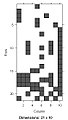 示例2的結果

| # | 專案 | 支援度 |
|---|---|---|
| 1 | {b, c, e} | 0.1 |
| 2 | {a, b, c} | 0.1 |
| 3 | {a, c} | 0.2 |
| 4 | {b, c} | 0.2 |
| 5 | {c, e} | 0.2 |
| 6 | {a, b,d, e} | 0.1 |
| 7 | {a, d, e} | 0.2 |
| 8 | {b, d, e} | 0.1 |
| 9 | {a, b, d} | 0.3 |
| 10 | {a, d} | 0.4 |
| 11 | {b, d} | 0.3 |
| 12 | {d, e} | 0.2 |
| 13 | {a, b, e} | 0.1 |
| 14 | {a, e} | 0.2 |
| 15 | {b, e} | 0.3 |
| 16 | {a, b} | 0.5 |
| 17 | {a} | 0.7 |
| 18 | {b} | 0.7 |
| 19 | {e} | 0.5 |
| 20 | {d} | 0.4 |
| 21 | {c} | 0.4 |
為了檢視Eclat演算法使用的一些實際示例,我們將使用來自northwind資料庫的一些資料。northwind資料庫可免費下載,並表示企業資料。在本示例中,我們將使用資料庫中的訂單明細表。訂單明細表用於將訂單與產品相關聯(在多對多關係中)。Eclat演算法將用於從此資料中查詢頻繁模式,以檢視是否存在一起購買的任何產品。
給定來自northwind資料庫訂單明細表的資料,查詢所有支援度=0.1且長度至少為2的頻繁項集。
訂單明細表包含以下欄位
- ID
- 主鍵
- 訂單ID
- 來自Orders表的外部鍵
- 產品ID
- 來自Products表的外部鍵
- 數量
- 購買的數量
- 折扣
- 提供的折扣
- 單價
- 產品的單價
要使用資料,需要進行一些預處理。該表可能包含許多屬於同一訂單的行,因此該表被轉換為以下方式:一個訂單的所有行在新的表中僅成為一行,其中包含屬於該訂單的產品ID。欄位ID、訂單ID、數量、折扣和單價被丟棄。資料儲存在名為northwind-orders.txt的txt檔案中。該檔案以一種方式編寫,以便在R中作為列表物件載入。
要執行示例,需要在R中載入arules包。
首先,資料在R中載入到列表物件中
## 1041 transactions is loaded, the listing below was shortened
## some duplicates transactions was introduced to produce some results for the algorithm
data = list(
 c("2","3","4","6","7","8","10","12","13","14","16","20","23","32","39","41","46","52","55","60","64","66","73","75","77"),
 c("11","42","72"),
 c("14","51"),
 c("41","51","65"),
 c("22","57","65"),
 ...)
其次,使用Eclat演算法。
itemsets <- eclat(data, parameter = list(support = 0.1, minlen=2, tidLists = TRUE, target="frequent itemsets"))
parameter specification:
 tidLists support minlen maxlen            target   ext
     TRUE     0.1      2      5 frequent itemsets FALSE

algorithmic control:
 sparse sort verbose
      7   -2    TRUE

eclat - find frequent item sets with the eclat algorithm
version 2.6 (2004.08.16)         (c) 2002-2004   Christian Borgelt
create itemset ...
set transactions ...[78 item(s), 1041 transaction(s)] done [0.00s].
sorting and recoding items ... [3 item(s)] done [0.00s].
creating bit matrix ... [3 row(s), 1041 column(s)] done [0.00s].
writing  ... [4 set(s)] done [0.00s].
Creating S4 object  ... done [0.00s].
itemsets物件儲存Eclat演算法執行的輸出。如上所示,生成了4個集合。要檢視結果,可以使用
inspect(itemsets)
  items   support
1 {11,
   42,
   72}  0.1940442
2 {42,
   72}  0.1940442
3 {11,
   42}  0.1940442
4 {11,
   72}  0.1959654
如上所示,eclat演算法的結果有4個頻繁項集。這個輸出是由資料中多次重複事務{11, 42, 72}引起的。結果表明,元組{11,42,72}、{42,72}和{11,42}的支援度為19.40%;元組{11,72}的支援度為19.60%。
產品ID 11、42和72分別代表產品Queso Cabrales、Singaporean Hokkien Fried Mee和Mozzarella di Giovanni。因此,eclat演算法的輸出表明,購買這些商品一起的購物模式非常頻繁。
這三種演算法由Deng等人提出[1] [2] [3],並基於三種新穎的資料結構,分別稱為節點列表[1]、N列表[2]和節點集[3],以方便頻繁項集的挖掘過程。它們是FP樹中節點的集合,每個節點都使用先序遍歷和後序遍歷進行編碼。與節點列表相比,N列表和節點集效率更高。這導致PrePost[2]和FIN[3]的效率高於PPV[1]。更多細節請參見[1] [2] [3]。
- Hahsler, M.;Buchta, C.;Gruen, B. & Hornik, K. arules:挖掘關聯規則和頻繁項集。2009年。
- Hahsler, M.;Gruen, B. & Hornik, K. arules -- 挖掘關聯規則和頻繁項集的計算環境。《統計軟體雜誌》,2005年,14卷,1-25頁。
- Mohammed Javeed Zaki,Srinivasan Parthasarathy,Wei Li。用於並行關聯挖掘的區域性演算法。SPAA 1997:321-330。
- Mohammed Javeed Zaki,Srinivasan Parthasarathy,Mitsunori Ogihara,Wei Li。快速發現關聯規則的新演算法。KDD 1997:283-286。
- Mohammed Javeed Zaki,Srinivasan Parthasarathy,Mitsunori Ogihara,Wei Li。關聯規則發現的並行演算法。《資料探勘與知識發現》,1卷(4期):343-373(1997)。
- Christian Borgelt(2003)Apriori和Eclat的有效實現。頻繁項集挖掘實現研討會(FIMI 2003,美國佛羅里達州梅爾本)。