定義(第二可數) :
令 X {\displaystyle X} X {\displaystyle X} 第二可數 當且僅當 X {\displaystyle X}
由於可數集的子集是可數的,並且開鄰域生成 N ( x ) {\displaystyle N(x)}
命題 () :
第二可數空間是可分的
(在可數選擇公理的條件下。)
證明: 令 ( U n ) n ∈ N {\displaystyle (U_{n})_{n\in \mathbb {N} }} X {\displaystyle X} x n ∈ U n {\displaystyle x_{n}\in U_{n}} S := { x n | n ∈ N } {\displaystyle S:=\{x_{n}|n\in \mathbb {N} \}} ◻ {\displaystyle \Box }
證明: 拓撲空間 X {\displaystyle X} ( U n ) n ∈ N {\displaystyle (U_{n})_{n\in \mathbb {N} }} S {\displaystyle S} ( S ∩ U n ) n ∈ N {\displaystyle (S\cap U_{n})_{n\in \mathbb {N} }} ◻ {\displaystyle \Box }
命題 () :
連續函式到豪斯多夫空間,其值由稠密子空間唯一確定
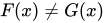
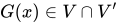
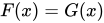
Proof: Let x ∈ X {\displaystyle x\in X} V ⊆ Y {\displaystyle V\subseteq Y} G ( x ) {\displaystyle G(x)} G {\displaystyle G} U {\displaystyle U} x {\displaystyle x} V {\displaystyle V} V ′ {\displaystyle V'} F ( x ) {\displaystyle F(x)} U ′ {\displaystyle U'} V ′ {\displaystyle V'} U ∩ U ′ {\displaystyle U\cap U'} V ∩ V ′ {\displaystyle V\cap V'} F ( x ) , G ( x ) ⊆ V ∩ V ′ {\displaystyle F(x),G(x)\subseteq V\cap V'} V {\displaystyle V} G ( x ) {\displaystyle G(x)} V ′ {\displaystyle V'} F ( x ) {\displaystyle F(x)} F ( x ) ≠ G ( x ) {\displaystyle F(x)\neq G(x)} V ∩ V ′ = ∅ {\displaystyle V\cap V'=\emptyset } V , V ′ {\displaystyle V,V'} G ( x ) ∈ V ∩ V ′ {\displaystyle G(x)\in V\cap V'} F ( x ) = G ( x ) {\displaystyle F(x)=G(x)} x {\displaystyle x} ◻ {\displaystyle \Box }