數值方法導論/方程求根
< 數值方法導論
目標
- 找到二次方程和三次方程的解
- 推匯出公式並遵循以下方法求解非線性方程的演算法:
- 二分法
- 牛頓-拉夫森法
- 割線法
- 試位法
資源
函式 f(x) 的根(或零點) 是產生輸出為 0 的 x 值。根可以是實數或複數。找到 的根與解方程 是相同的。解方程 是找到滿足方程指定條件的值。


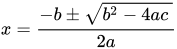
低次(二次、三次和四次)多項式有閉式解,但數值方法可能更容易使用。為了解二次方程,我們可以使用二次公式

有許多 求根演算法 用於數值求解方程。
二分法從兩個猜測開始,並使用二分查詢演算法來改進答案。如果函式在兩個初始猜測之間是連續的,則保證二分法會收斂。這是一張說明該想法的圖片
![A few steps of the bisection method applied over the starting range [a1;b1]. The bigger red dot is the root of the function.](/wiki/File:Bisection_method.svg)
二分法的優點包括在連續函式上保證收斂,並且誤差是有界的。
二分法的缺點包括收斂速度相對較慢,並且在某些函式上不收斂。
牛頓法(又稱牛頓-拉夫森方法)是一種求解非線性方程的開放方法。與區間收縮法(例如二分法)相反,牛頓法只需要一個初始猜測,但它不保證收斂。
牛頓法的基本思想如下
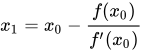
- 給定一個“x”的函式 f 和一個初始猜測 用於該函式的根,一個更好的猜測 是
- 這就是牛頓-拉夫森公式。


以下動畫說明了該方法

讓我們使用牛頓法求解以下方程



from sympy import Symbol, diff, sin
x = Symbol('x')
y = sin(x)
derivative = diff(y, x)

'''
Solve f with initial guess g using Newton's method.
Stop when the absolute relative approximate error is
smaller than the tolerance or the max # iterations
is reached.
'''
def newton(f, derivative, g, tolerance, max_iteration):
  x_previous = g
  for i in range(max_iteration):
    x_current = x_previous - \
      y.subs(x, x_previous).evalf()/derivative.subs(x, x_previous).evalf()

    error = abs((x_current-x_previous)/x_current)
    print "current x:", x_current, " error:", error

    x_previous = x_current

    if error < tolerance:
      break;

newton(y, derivative, 5, 0.005, 15)
$ python newton.py
current x: 8.38051500624659  error: 0.403377955140806
current x: 10.1008867567293  error: 0.170318883075941
current x: 9.29864101772707  error: 0.0862755898924158
current x: 9.42545121429349  error: 0.0134540186653470
current x: 9.42477796066766  error: 7.14344283379346e-5
由於牛頓公式中涉及除法,當分母為零時,該方法將無法繼續正確執行。以下程式演示了此問題。
from sympy import Symbol, diff
x = Symbol('x')
y = 4 - 1.0/x
derivative = diff(y, x)

'''
Solve f with initial guess g using Newton's method.
Stop when the absolute relative approximate error is
smaller than the tolerance or the max # iterations
is reached.
'''
def newton(f, derivative, g, tolerance, max_iteration):
  x_previous = g
  for i in range(max_iteration):
    x_current = x_previous - \
      y.subs(x, x_previous)/derivative.subs(x, x_previous)

    error = abs((x_current-x_previous)/x_current)
    print "current x:", x_current, " error:", error

    x_previous = x_current

    if error < tolerance:
      break;

newton(y, derivative, 0.5, 0.005, 15)
輸出
$ python newton.py
current x: 0  error: oo
current x: nan  error: nan
current x: nan  error: nan
current x: nan  error: nan
current x: nan  error: nan
current x: nan  error: nan
...
當初始猜測接近拐點時,該方法可能會偏離所需的根。
以下程式碼使用牛頓法的相同實現(假設newton函式已匯入)演示了拐點(x=0)處的發散。
from sympy import Symbol, diff
x = Symbol('x')
y = (x-1)**3 + 0.5

derivative = diff(y, x)
newton(y, derivative, 5, 0.005, 15)
$ python newton.py
current x: 3.65625000000000  error: 0.367521367521368
current x: 2.74721164936563  error: 0.330894909696631
current x: 2.11021215705302  error: 0.301865141940137
current x: 1.60492272680972  error: 0.314837232847788
current x: 0.947823175470885  error: 0.693272298403532
current x: -60.2548036313237  error: 1.01573025084058
current x: -39.8365801731819  error: 0.512549605648313
current x: -26.2244867245776  error: 0.519060433539279
current x: -17.1498826852607  error: 0.529135050417335
current x: -11.1004277326071  error: 0.544974941360464
current x: -7.06809009701998  error: 0.570498901434099
current x: -4.38128712811798  error: 0.613245124168828
current x: -2.59328016409484  error: 0.689476975445585
current x: -1.40842833626215  error: 0.841258157995587
current x: -0.634351912031382  error: 1.22026340513730
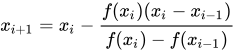
割線法類似於牛頓法,因為它是一種開方法,並使用交點來獲得根的改進估計。割線法透過使用割線的斜率來估計導數值,從而避免計算一階導數。
下圖說明了割線法,其中有兩個初始猜測和兩個連續的改進估計:
割線法的公式如下
試位法類似於二分法,因為它需要兩個初始猜測(區間法)。試位法不是使用中點作為改進的猜測,而是使用穿過兩個端點的割線的根。下圖說明了這個想法。
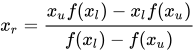
試位法的公式如下