The continuous Dirichlet-to-Neumann operator can be calculated explicitly for certain domains, such as a half-space, a ball and a cylinder and a shell with uniform conductivity. For example, for a unit ball in N -dimensions, writing the Laplace equation in spherical coordinates:
Δ f = r 1 − N ∂ ∂ r ( r N − 1 ∂ f ∂ r ) + r − 2 Δ S N − 1 f , {\displaystyle \Delta f=r^{1-N}{\frac {\partial }{\partial r}}\left(r^{N-1}{\frac {\partial f}{\partial r}}\right)+r^{-2}\Delta _{S^{N-1}}f,} 因此,狄利克雷-諾伊曼運算元滿足以下方程
Λ ( Λ − ( N − 2 ) I d ) + Δ S N − 1 = 0 {\displaystyle \Lambda (\Lambda -(N-2)Id)+\Delta _{S^{N-1}}=0} 在二維中,該方程具有特別簡單的形式
Λ 2 = − Δ S 1 . {\displaystyle \Lambda ^{2}=-\Delta _{S^{1}}.} 本章材料的研究很大程度上受到華盛頓大學數學教授岡特·烏爾曼的問題的啟發:“該方程是否有離散模擬?”
為了使單位圓狄利克雷-諾伊曼運算元的函式方程與均勻電導率相匹配,需要找到具有旋轉對稱性的自對偶分層平面網路。這種圖G 的狄利克雷-諾伊曼運算元等於
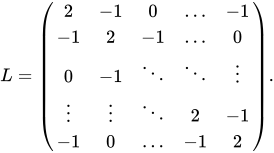
Λ G 2 = L , {\displaystyle \Lambda _{G}^{2}=L,} 其中-L 等於圓上的拉普拉斯運算元
L = ( 2 − 1 0 … − 1 − 1 2 − 1 … 0 0 − 1 ⋱ ⋱ ⋮ ⋮ ⋮ ⋱ 2 − 1 − 1 0 … − 1 2 ) . {\displaystyle L={\begin{pmatrix}2&-1&0&\ldots &-1\\-1&2&-1&\ldots &0\\0&-1&\ddots &\ddots &\vdots \\\vdots &\vdots &\ddots &2&-1\\-1&0&\ldots &-1&2\\\end{pmatrix}}.} 練習(*)。 證明 Λ G {\displaystyle \Lambda _{G}} The problem then reduces to calculating a Stieltjes continued fraction equalled to 1 at the non-zero eigenvalues of L . For the (2n+1) -case, where n is a natural number, the eigenvalues are 0 with the multiplicity one and
2 sin ( k π 2 n + 1 ) , k = 1 , 2 , … n {\displaystyle 2\sin({\frac {k\pi }{2n+1}}),k=1,2,\ldots n} 且具有二倍的重數。具有n 層的這種分數的存在性和唯一性來自我們對分層網路的結果,參見[BIMS]。
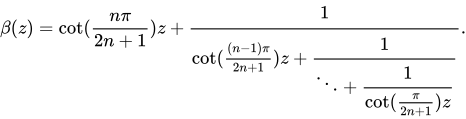
練習 (***)。 證明該連分數由以下公式給出 β ( z ) = cot ( n π 2 n + 1 ) z + 1 cot ( ( n − 1 ) π 2 n + 1 ) z + 1 ⋱ + 1 cot ( π 2 n + 1 ) z . {\displaystyle \beta (z)=\cot({\frac {n\pi }{2n+1}})z+{\cfrac {1}{\cot({\frac {(n-1)\pi }{2n+1}})z+{\cfrac {1}{\ddots +{\cfrac {1}{\cot({\frac {\pi }{2n+1}})z}}}}}}.} 練習 2(*)。 利用上一道練習證明以下三角公式 tan ( n π 2 n + 1 ) = 2 ∑ k sin ( k π 2 n + 1 ) . {\displaystyle \tan({\frac {n\pi }{2n+1}})=2\sum _{k}\sin({\frac {k\pi }{2n+1}}).} 練習 3(**)。 在以下三角公式中找到正確的符號 tan ( l π 2 n + 1 ) = 2 ∑ k ( ± ) sin ( k π 2 n + 1 ) , l = 1 , 2 , … n . {\displaystyle \tan({\frac {l\pi }{2n+1}})=2\sum _{k}(\pm )\sin({\frac {k\pi }{2n+1}}),l=1,2,\ldots n.} 例如:下圖給出了當n=8 時的解,白色和黑色方塊分別代表1 和-1 。
正確的符號