我們將從建立描述應力 σ {\displaystyle \sigma } ε {\displaystyle \varepsilon }
圖 1 : (a) 作用於物體的外部力 P , {\displaystyle \mathbf {P} ,} A {\displaystyle A} 應力和應變的概念起源於考慮作用於物體上的力和物體的位移。從力開始,可以施加兩種型別的力。首先是表面力,它可以是點力,也可以是作用在表面上的分佈力。其次是體力,它作用於物體的每個元素,而不僅僅是表面(例如,重力、電場等)。
所關注的物體受到許多力的作用,這些力透過材料傳遞。在物體內部的任何一點,您可以想象將其切開以觀察想象的切割表面上的力,如圖 1 所示。這些力是切割面兩側的材料之間的相互作用。我們將物體中某點的應力定義為作用在該想象切割表面的力。
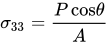
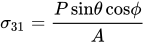
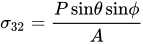
圖 2 : 一個具有應力的無窮小長方體材料,根據 ( x 1 , x 2 , x 3 ) {\displaystyle (x_{1},x_{2},x_{3})} 您還記得,應力被定義為力除以作用力的面積。力 P {\displaystyle \mathbf {P} } θ {\displaystyle \theta } σ 33 = P cos θ A {\displaystyle \sigma _{33}={\frac {P\cos \!\theta }{A}}} P sin θ {\displaystyle P\sin \!\theta } x 1 {\displaystyle x_{1}} x 2 {\displaystyle x_{2}} ϕ {\displaystyle \phi } σ 31 = P sin θ cos ϕ A {\displaystyle \sigma _{31}={\frac {P\sin \!\theta \cos \!\phi }{A}}} σ 32 = P sin θ sin ϕ A {\displaystyle \sigma _{32}={\frac {P\sin \!\theta \sin \!\phi }{A}}}
這裡需要注意的是,我們定義的座標系使得 x 3 {\displaystyle x_{3}} ( x 1 , x 2 , x 3 ) {\displaystyle (x_{1},x_{2},x_{3})} ( x , y , z ) {\displaystyle (x,y,z)} σ 33 {\displaystyle \sigma _{33}} x 3 {\displaystyle x_{3}} x 3 {\displaystyle x_{3}} σ 31 {\displaystyle \sigma _{31}} σ 32 {\displaystyle \sigma _{32}} x 3 {\displaystyle x_{3}} x 1 {\displaystyle x_{1}} x 2 {\displaystyle x_{2}} 圖2 所示。為了比較,一些教科書中使用的符號將寫法嚮應力為 σ x {\displaystyle \sigma _{x}} σ 11 {\displaystyle \sigma _{11}} τ {\displaystyle \tau } τ x y {\displaystyle \tau _{xy}} σ 12 {\displaystyle \sigma _{12}}
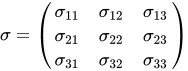
σ = ( σ 11 σ 12 σ 13 σ 21 σ 22 σ 23 σ 31 σ 32 σ 33 ) {\displaystyle \sigma =\left({\begin{aligned}\sigma _{11}\quad \sigma _{12}\quad \sigma _{13}\\\sigma _{21}\quad \sigma _{22}\quad \sigma _{23}\\\sigma _{31}\quad \sigma _{32}\quad \sigma _{33}\end{aligned}}\right)} 圖 1 中透過物體上某點切出的想象切片可以是任何平面,但作用力保持不變。這會導致表面法線的定義改變,並可能導致應力表示式發生變化。應力的物理存在不會改變,但描述方式會改變,即座標系會發生改變。本節的其餘部分將重點介紹應力座標變換的表達和分析。
我們將從簡化正在處理的圖景開始。平面應力條件存在於薄的二維物體中,例如一張紙,該物體在平面外沒有應力。這使我們能夠寫成 σ 33 = 0 {\displaystyle \sigma _{33}=0} x 3 {\displaystyle x_{3}} σ 13 = σ 23 = 0 {\displaystyle \sigma _{13}=\sigma _{23}=0}
圖 3 :(a) 平面應力條件下定義的面積 A {\displaystyle A} x 1 ′ {\displaystyle x_{1}'} x 1 {\displaystyle x_{1}} θ {\displaystyle \theta } x 1 {\displaystyle x_{1}} x 1 {\displaystyle x_{1}} (b) 圖中顯示了作用在該面積上的總應力的分量。對於該物體,零力方向為 x 3 {\displaystyle x_{3}} x 1 {\displaystyle x_{1}} x 2 {\displaystyle x_{2}} σ 11 {\displaystyle \sigma _{11}} σ 22 {\displaystyle \sigma _{22}} σ 12 = σ 21 {\displaystyle \sigma _{12}=\sigma _{21}}
想象一個新的區域,它定義在一個繞 x 3 {\displaystyle x_{3}} x 1 ′ {\displaystyle x_{1}'} x 1 {\displaystyle x_{1}} θ {\displaystyle \theta }
作用在該區域上的力的分量由原始應力作用在新區域的投影面上確定。
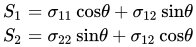
F 1 = σ 11 A cos θ + σ 12 A sin θ = S 1 A F 2 = σ 22 A sin θ + σ 12 A cos θ = S 2 A {\displaystyle {\begin{aligned}F_{1}=\sigma _{11}A\cos \!\theta +\sigma _{12}A\sin \!\theta =S_{1}A\\F_{2}=\sigma _{22}A\sin \!\theta +\sigma _{12}A\cos \!\theta =S_{2}A\end{aligned}}} [1 & 2] 其中元素 A cos θ {\displaystyle A\cos \!\theta } A sin θ {\displaystyle A\sin \!\theta } 圖 3 (a) 所示,以及 S 1 {\displaystyle S_{1}} S 2 {\displaystyle S_{2}} x 1 {\displaystyle x_{1}} x 2 {\displaystyle x_{2}} σ 12 = σ 21 {\displaystyle \sigma _{12}=\sigma _{21}}
S 1 = σ 11 cos θ + σ 12 sin θ S 2 = σ 22 sin θ + σ 12 cos θ {\displaystyle {\begin{aligned}S_{1}=\sigma _{11}\cos \!\theta +\sigma _{12}\sin \!\theta \\S_{2}=\sigma _{22}\sin \!\theta +\sigma _{12}\cos \!\theta \end{aligned}}} [3 & 4] 將圖 3 (b) 所示的總應力投影到 x 1 ′ {\displaystyle x_{1}'}
σ 11 ′ = S 1 cos θ + S 2 sin θ {\displaystyle \sigma _{11}'=S_{1}\!\cos \!\theta +S_{2}\!\sin \!\theta } [5] 類似地,我們將切線投影到平面並得到
σ 12 ′ = S 2 cos θ − S 1 sin θ {\displaystyle \sigma _{12}'=S_{2}\!\cos \!\theta -S_{1}\!\sin \!\theta } [6] 得到
σ 11 ′ = ( σ 11 cos θ + σ 12 sin θ ) cos θ + ( σ 22 sin θ + σ 12 cos θ ) sin θ = σ 11 cos 2 θ + σ 22 sin 2 θ + 2 σ 12 sin θ cos θ {\displaystyle {\begin{aligned}\sigma _{11}'&=(\sigma _{11}\cos \!\theta +\sigma _{12}\sin \!\theta )\cos \!\theta +(\sigma _{22}\sin \!\theta +\sigma _{12}\cos \!\theta )\sin \!\theta \\&=\sigma _{11}\cos ^{2}\!\theta +\sigma _{22}\sin ^{2}\!\theta +2\ \sigma _{12}\sin \!\theta \cos \!\theta \end{aligned}}} [7] 和
σ 12 ′ = ( σ 22 sin θ + σ 12 cos θ ) cos θ − ( σ 11 cos θ + σ 12 sin θ ) sin θ = σ 12 ( c o s 2 θ − sin 2 θ ) + ( σ 22 − σ 11 ) sin θ cos θ {\displaystyle {\begin{aligned}\sigma _{12}'&=(\sigma _{22}\sin \!\theta +\sigma _{12}\cos \!\theta )\cos \!\theta -(\sigma _{11}\cos \!\theta +\sigma _{12}\sin \!\theta )\sin \!\theta \\&=\sigma _{12}(cos^{2}\!\theta -\sin ^{2}\!\theta )+(\sigma _{22}-\sigma _{11})\sin \!\theta \cos \!\theta \end{aligned}}} [8] 圖 4 : 一個新的區域,它相對於圖 3 中所示的原始區域旋轉了 π 2 {\displaystyle {\frac {\pi }{2}}} 已知 σ 12 ′ = σ 21 ′ {\displaystyle \sigma _{12}'=\sigma _{21}'} σ 22 ′ {\displaystyle \sigma _{22}'} π {\textstyle \pi }
S 1 A = σ 11 A cos ( θ + π 2 ) + σ 12 A sin ( θ + π 2 ) S 1 = − σ 11 sin θ + σ 12 cos θ {\displaystyle {\begin{aligned}S_{1}A&=\sigma _{11}A\cos(\theta +{\pi \over 2})+\sigma _{12}A\sin(\theta +{\pi \over 2})\\S_{1}&=-\sigma _{11}\sin \!\theta +\sigma _{12}\cos \!\theta \end{aligned}}} [9] 和
S 2 A = σ 22 A sin ( θ + π 2 ) + σ 12 A cos ( θ + π 2 ) S 2 = σ 22 cos θ − σ 12 sin θ {\displaystyle {\begin{aligned}S_{2}A&=\sigma _{22}A\sin(\theta +{\pi \over 2})+\sigma _{12}A\cos(\theta +{\pi \over 2})\\S_{2}&=\sigma _{22}\cos \!\theta -\sigma _{12}\sin \!\theta \end{aligned}}} [10] 將總應力投影到法線方向得到
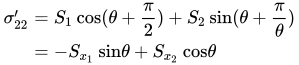
σ 22 ′ = S 1 cos ( θ + π 2 ) + S 2 sin ( θ + π θ ) = − S x 1 sin θ + S x 2 cos θ {\displaystyle {\begin{aligned}\sigma _{22}'&=S_{1}\cos(\theta +{\pi \over 2})+S_{2}\sin(\theta +{\pi \over \theta })\\&=-S_{x_{1}}\sin \!\theta +S_{x_{2}}\cos \!\theta \end{aligned}}} [11] 將公式 9 和10 代入公式 11 中的 S 1 {\displaystyle S_{1}} S 2 {\displaystyle S_{2}} σ 22 ′ {\displaystyle \sigma _{22}'}
σ 22 ′ = − ( − σ 11 sin θ + σ 12 cos θ ) sin θ + ( σ 22 cos θ − σ 12 sin θ ) cos θ = σ 11 sin 2 θ + σ 22 cos 2 θ − 2 σ 12 sin θ cos θ {\displaystyle {\begin{aligned}\sigma _{22}'&=-(-\sigma _{11}\sin \!\theta +\sigma _{12}\cos \!\theta )\sin \!\theta +(\sigma _{22}\cos \!\theta -\sigma _{12}\sin \!\theta )\cos \!\theta \\&=\sigma _{11}\sin ^{2}\!\theta +\sigma _{22}\cos ^{2}\!\theta -2\ \sigma _{12}\sin \!\theta \cos \!\theta \end{aligned}}} [12] 眾所周知的三角恆等式
cos 2 θ = cos 2 θ + 1 2 sin 2 θ = 1 − cos 2 θ 2 2 sin θ cos θ = sin 2 θ cos 2 θ − sin 2 θ = cos 2 θ {\displaystyle {\begin{array}{lcl}\cos ^{2}\!\theta ={\cos 2\theta +1 \over 2}&\quad &\sin ^{2}\!\theta ={1-\cos 2\theta \over 2}\\2\sin \!\theta \cos \!\theta =\sin 2\theta &&\cos ^{2}\!\theta -\sin ^{2}\theta =\cos 2\theta \end{array}}} 分別應用於公式 7 、8 和12 中的 σ 11 ′ {\displaystyle \sigma _{11}'} σ 12 ′ {\displaystyle \sigma _{12}'} σ 22 ′ {\displaystyle \sigma _{22}'}
σ 11 ′ = σ 11 + σ 22 2 + σ 11 − σ 22 2 cos 2 θ + σ 12 sin 2 θ {\displaystyle {\begin{aligned}\sigma _{11}'&={\sigma _{11}+\sigma _{22} \over 2}+{\sigma _{11}-\sigma _{22} \over 2}\cos {2\theta }+\sigma _{12}\sin {2\theta }\end{aligned}}} [13] σ 22 ′ = σ 11 + σ 22 2 − σ 11 − σ 22 2 cos 2 θ − σ 12 sin 2 θ {\displaystyle {\begin{aligned}\sigma _{22}'&={\sigma _{11}+\sigma _{22} \over 2}-{\sigma _{11}-\sigma _{22} \over 2}\cos {2\theta }-\sigma _{12}\sin {2\theta }\end{aligned}}} [14] 和
σ 12 ′ = σ 22 − σ 11 2 sin 2 θ + σ 12 cos 2 θ {\displaystyle {\begin{aligned}\sigma _{12}'&={\sigma _{22}-\sigma _{11} \over 2}\sin 2\theta +\sigma _{12}\cos 2\theta \end{aligned}}} [15] 從這個推導中可以得到許多直接結果,從這些結果中我們可以獲得更深入的見解。從 σ ′ {\displaystyle \sigma '} σ 11 ′ + σ 22 ′ = σ 11 + σ 22 {\displaystyle \sigma _{11}'+\sigma _{22}'=\sigma _{11}+\sigma _{22}} θ {\displaystyle \theta } σ {\displaystyle {\boldsymbol {\sigma }}}
第二個結果是,最大法嚮應力和剪下應力以週期為 π {\displaystyle \pi } π {\displaystyle \pi } π {\displaystyle \pi } π {\displaystyle \pi }
任何應力狀態都可以旋轉,以產生 σ 12 = σ 21 = 0 {\displaystyle \sigma _{12}=\sigma _{21}=0} σ p 1 {\displaystyle \sigma _{p1}} σ p 2 {\displaystyle \sigma _{p2}} σ p 3 {\displaystyle \sigma _{p3}} σ p 1 {\displaystyle \sigma _{p1}} σ p 2 {\displaystyle \sigma _{p2}}
我們知道 σ 12 = 0 {\displaystyle \sigma _{12}=0} 方程式 8 來表示 σ 12 ′ {\displaystyle \sigma _{12}'} σ {\displaystyle {\boldsymbol {\sigma }}} σ ′ {\displaystyle \sigma '} θ {\displaystyle \theta }
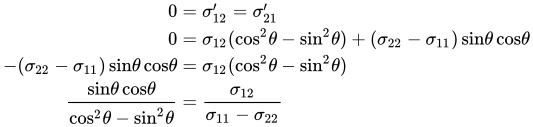
0 = σ 12 ′ = σ 21 ′ 0 = σ 12 ( cos 2 θ − sin 2 θ ) + ( σ 22 − σ 11 ) sin θ cos θ − ( σ 22 − σ 11 ) sin θ cos θ = σ 12 ( cos 2 θ − sin 2 θ ) sin θ cos θ cos 2 θ − sin 2 θ = σ 12 σ 11 − σ 22 {\displaystyle {\begin{aligned}0&=\sigma _{12}'=\sigma _{21}'\\0&=\sigma _{12}(\cos ^{2}\!\theta -\sin ^{2}\!\theta )+(\sigma _{22}-\sigma _{11})\sin \!\theta \cos \!\theta \\-(\sigma _{22}-\sigma _{11})\sin \!\theta \cos \!\theta &=\sigma _{12}(\cos ^{2}\!\theta -\sin ^{2}\!\theta )\\{\sin \!\theta \cos \!\theta \over \cos ^{2}\!\theta -\sin ^{2}\!\theta }&={\sigma _{12} \over \sigma _{11}-\sigma _{22}}\end{aligned}}} 得到
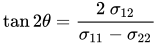
tan 2 θ = 2 σ 12 σ 11 − σ 22 {\displaystyle {\begin{aligned}\tan 2\theta &={2\ \sigma _{12} \over \sigma _{11}-\sigma _{22}}\end{aligned}}} [16] 如圖 5 所示,透過繪製 tan 2 θ {\displaystyle \tan 2\theta } π {\textstyle \pi }
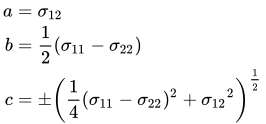
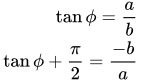
圖 5 : t a n 2 θ {\displaystyle tan2\theta } π 2 {\displaystyle {\frac {\pi }{2}}} 對於一個簡單的直角三角形,斜邊為 c {\displaystyle c} a {\displaystyle a} b {\displaystyle b}
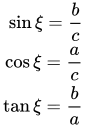
sin ξ = b c cos ξ = a c tan ξ = b a {\displaystyle {\begin{aligned}\sin \xi ={b \over c}\\\cos \xi ={a \over c}\\\tan \xi ={b \over a}\end{aligned}}} 這可以與勾股定理 a 2 + b 2 = c 2 {\displaystyle a^{2}+b^{2}=c^{2}}
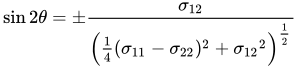
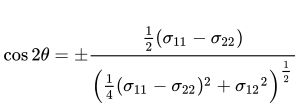
a = σ 12 b = 1 2 ( σ 11 − σ 22 ) c = ± ( 1 4 ( σ 11 − σ 22 ) 2 + σ 12 2 ) 1 2 {\displaystyle {\begin{aligned}a&=\sigma _{12}\\b&={1 \over 2}(\sigma _{11}-\sigma _{22})\\c&=\pm \left({1 \over 4}(\sigma _{11}-\sigma _{22})^{2}+{\sigma _{12}}^{2}\right)^{1 \over 2}\end{aligned}}} 這些可以進一步組合,得到
sin 2 θ = ± σ 12 ( 1 4 ( σ 11 − σ 22 ) 2 + σ 12 2 ) 1 2 {\displaystyle {\begin{aligned}\sin 2\theta &=\pm {\sigma _{12} \over \left({1 \over 4}(\sigma _{11}-\sigma _{22})^{2}+{\sigma _{12}}^{2}\right)^{1 \over 2}}\end{aligned}}} [17] 和
cos 2 θ = ± 1 2 ( σ 11 − σ 22 ) ( 1 4 ( σ 11 − σ 22 ) 2 + σ 12 2 ) 1 2 {\displaystyle {\begin{aligned}\\\cos 2\theta &=\pm {{1 \over 2}(\sigma _{11}-\sigma _{22}) \over \left({1 \over 4}(\sigma _{11}-\sigma _{22})^{2}+{\sigma _{12}}^{2}\right)^{1 \over 2}}\end{aligned}}} [18] 這些方程式告訴我們,對於給定的應力狀態, σ {\displaystyle \sigma } σ {\displaystyle \sigma }
將這些方程式代入公式 13 中的 σ 11 ′ {\displaystyle \sigma _{11}'}
σ p = σ 11 + σ 22 2 + σ 11 − σ 22 2 ( ± 1 2 ( σ 11 − σ 22 ) ( 1 4 ( σ 11 − σ 22 ) 2 + σ 12 2 ) 1 2 ) + σ 12 ( σ 12 ± ( 1 4 ( σ 11 − σ 22 ) 2 + σ 12 2 ) 1 2 ) = σ 11 + σ 22 2 + 1 4 ( σ 11 − σ 22 ) 2 ± ( 1 4 ( σ 11 − σ 22 ) 2 + σ 12 2 ) 1 2 + σ 12 2 ± ( 1 4 ( σ 11 − σ 22 ) 2 + 得到
= σ 11 + σ 22 2 ± ( 1 4 ( σ 11 − σ 22 ) 2 + σ 12 2 ) 1 2 {\displaystyle {\begin{aligned}&={\sigma _{11}+\sigma _{22} \over 2}\pm \left({1 \over 4}(\sigma _{11}-\sigma _{22})^{2}+{\sigma _{12}}^{2}\right)^{1 \over 2}\end{aligned}}} [19] 使用公式 19 代入公式 16 中,求解 θ {\displaystyle \theta } 0 < θ < π 4 {\displaystyle 0<\theta <{\pi \over 4}}
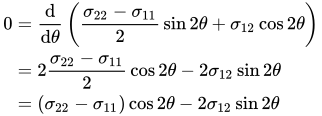
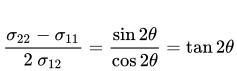
為了找到最大剪下應力,我們將簡化的公式 15 對 σ 12 ′ {\displaystyle \sigma _{12}'} 0 {\displaystyle 0}
0 = d d θ ( σ 22 − σ 11 2 sin 2 θ + σ 12 cos 2 θ ) = 2 σ 22 − σ 11 2 cos 2 θ − 2 σ 12 sin 2 θ = ( σ 22 − σ 11 ) cos 2 θ − 2 σ 12 sin 2 θ {\displaystyle {\begin{aligned}0&={\operatorname {d} \over \operatorname {d} \!\theta }\left({\sigma _{22}-\sigma _{11} \over 2}\sin 2\theta +\sigma _{12}\cos 2\theta \right)\\&=2{\sigma _{22}-\sigma _{11} \over 2}\cos 2\theta -2\sigma _{12}\sin 2\theta \\&=(\sigma _{22}-\sigma _{11})\cos 2\theta -2\sigma _{12}\sin 2\theta \end{aligned}}} 得到關於 2 θ {\displaystyle 2\theta }
σ 22 − σ 11 2 σ 12 = sin 2 θ cos 2 θ = tan 2 θ {\displaystyle {\begin{aligned}\\{\sigma _{22}-\sigma _{11} \over 2\ \sigma _{12}}&={\sin 2\theta \over \cos 2\theta }=\tan 2\theta \end{aligned}}} [20] 注意到公式 20 和公式 16 是負倒數關係,這意味著 2 θ p {\displaystyle 2\theta _{p}} 2 θ M A X {\displaystyle 2\theta _{MAX}} π {\displaystyle \pi }
tan ϕ = a b tan ϕ + π 2 = − b a {\displaystyle {\begin{aligned}\tan \phi ={\frac {a}{b}}\\\tan \phi +{\frac {\pi }{2}}={\frac {-b}{a}}\end{aligned}}} 這意味著 2 θ p {\displaystyle 2\theta _{p}} 2 θ M A X {\displaystyle 2\theta _{MAX}} π {\displaystyle \pi } σ 12 M A X {\displaystyle \sigma _{12MAX}}
σ 12 M A X = ± [ ( σ 11 − σ 22 2 ) 2 + σ 12 2 ] 1 2 {\displaystyle \sigma _{12MAX}=\pm \left[\left({\sigma _{11}-\sigma _{22} \over 2}\right)^{2}+{\sigma _{12}}^{2}\right]^{1 \over 2}} [21] 一個方便視覺化角度關係的方法是使用莫爾圓,我們將在下面推導。對 **方程** **13** 關於 σ 11 ′ {\displaystyle \sigma _{11}'} σ 12 ′ {\displaystyle \sigma _{12}'}
σ 11 ′ − σ 11 + σ 22 2 = σ 11 − σ 22 2 cos 2 θ + σ 12 sin 2 θ {\displaystyle {\begin{aligned}\sigma _{11}'-{\sigma _{11}+\sigma _{22} \over 2}&={\sigma _{11}-\sigma _{22} \over 2}\cos {2\theta }+\sigma _{12}\sin {2\theta }\end{aligned}}} [22] σ 12 ′ = σ 22 − σ 11 2 sin 2 θ + σ 12 cos 2 θ {\displaystyle {\begin{aligned}\sigma _{12}'={\sigma _{22}-\sigma _{11} \over 2}\sin {2\theta }+\sigma _{12}\cos {2\theta }\end{aligned}}} [23] 對這兩個表示式進行平方,
( σ 11 ′ − σ 11 + σ 22 2 ) 2 = ( σ 11 − σ 22 2 cos 2 θ + σ 12 sin 2 θ ) 2 {\displaystyle {\begin{aligned}\left(\sigma _{11}'-{\sigma _{11}+\sigma _{22} \over 2}\right)^{2}&=\left({\sigma _{11}-\sigma _{22} \over 2}\cos {2\theta }+\sigma _{12}\sin {2\theta }\right)^{2}\end{aligned}}} ( σ 12 ′ ) 2 = ( σ 22 − σ 11 2 sin 2 θ + σ 12 cos 2 θ ) 2 {\displaystyle {\begin{aligned}\left(\sigma _{12}'\right)^{2}&=\left({\sigma _{22}-\sigma _{11} \over 2}\sin 2\theta +\sigma _{12}\cos 2\theta \right)^{2}\end{aligned}}} 接下來,將它們加在一起得到
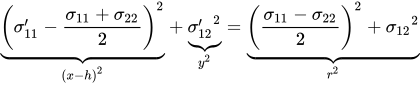
( σ 11 ′ − σ 11 + σ 22 2 ) 2 + σ 12 ′ 2 = ( σ 11 − σ 22 2 ) 2 ( cos 2 2 θ + sin 2 2 θ ) + σ 12 2 ( cos 2 2 θ + sin 2 2 θ ) ( σ 11 ′ − σ 11 + σ 22 2 ) 2 + σ 12 ′ 2 = ( σ 11 − σ 22 2 ) 2 + σ 12 2 {\displaystyle {\begin{aligned}\left(\sigma _{11}'-{\sigma _{11}+\sigma _{22} \over 2}\right)^{2}+{\sigma _{12}'}^{2}&=\left({\sigma _{11}-\sigma _{22} \over 2}\right)^{2}(\cos ^{2}\!2\theta +\sin ^{2}\!2\theta )+{\sigma _{12}}^{2}(\cos ^{2}\!2\theta +\sin ^{2}\!2\theta )\\{\left(\sigma _{11}'-{\sigma _{11}+\sigma _{22} \over 2}\right)^{2}}+{\sigma _{12}'}^{2}&=\left({\sigma _{11}-\sigma _{22} \over 2}\right)^{2}+{\sigma _{12}}^{2}\end{aligned}}} 得到的表示式是圓的方程: ( x − h ) 2 + y 2 = r 2 {\displaystyle (x-h)^{2}+y^{2}=r^{2}}
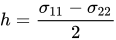
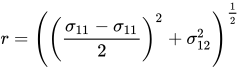
圖 6 :平面應力條件下的莫爾圓。初始應力狀態為 σ {\displaystyle \sigma } θ {\displaystyle \theta } σ ′ {\displaystyle \sigma '} 2 θ {\displaystyle 2\theta } ( σ 11 ′ − σ 11 + σ 22 2 ) 2 ⏟ ( x − h ) 2 + σ 12 ′ 2 ⏟ y 2 = ( σ 11 − σ 22 2 ) 2 + σ 12 2 ⏟ r 2 {\displaystyle \underbrace {\left(\sigma _{11}'-{\sigma _{11}+\sigma _{22} \over 2}\right)^{2}} _{(x-h)^{2}}+\underbrace {{\sigma _{12}'}^{2}} _{y^{2}}=\underbrace {\left({\sigma _{11}-\sigma _{22} \over 2}\right)^{2}+{\sigma _{12}}^{2}} _{r^{2}}} [24] 從該表示式中,在圖 6 中繪製了莫爾圓。對於給定的應力狀態, σ {\displaystyle \sigma } h = σ 11 − σ 22 2 {\displaystyle h={\frac {\sigma _{11}-\sigma _{22}}{2}}} r = ( ( σ 11 − σ 11 2 ) 2 + σ 12 2 ) 1 2 {\displaystyle r=\left(\left({\frac {\sigma _{11}-\sigma _{11}}{2}}\right)^{2}+\sigma _{12}^{2}\right)^{\frac {1}{2}}} σ 11 {\displaystyle \sigma _{11}} σ 22 {\displaystyle \sigma _{22}} σ 12 {\displaystyle \sigma _{12}} 2 π {\displaystyle 2\pi } ϕ {\displaystyle \phi } 2 π {\displaystyle 2\pi } π {\displaystyle \pi } θ = π {\displaystyle \theta =\pi } π {\displaystyle \pi } θ = π {\displaystyle \theta =\pi } σ {\displaystyle \sigma }
從二維泛化到三維,我們從一個雙軸平面應力系統過渡到一個三軸系統。確定主軸和角關係類似於二維情況,將在下面說明。注意,按照慣例,當三個主應力中的兩個相等時,我們稱該系統為“圓柱形”,如果所有三個主應力都相等,我們稱該系統為“靜水壓力”或“球形”。
與雙軸系統的情況類似,我們首先定義一個面積為 A {\displaystyle A} x 1 {\displaystyle x_{1}} x 2 {\displaystyle x_{2}} x 3 {\displaystyle x_{3}} 7 所示。該平面在 ( J {\displaystyle J} K {\displaystyle K} L {\displaystyle L}
定義 ℓ {\displaystyle \ell } m {\displaystyle m} n {\displaystyle n} x 1 {\displaystyle x_{1}} x 2 {\displaystyle x_{2}} x 3 {\displaystyle x_{3}} x 1 {\displaystyle x_{1}} x 2 {\displaystyle x_{2}} x 3 {\displaystyle x_{3}} i ^ {\displaystyle {\hat {i}}} j ^ {\displaystyle {\hat {j}}} k ^ {\displaystyle {\hat {k}}}
圖 7 : 穿過 x、y、z 座標系的 3D 座標平面 JKL ,其中 O {\displaystyle O} ℓ = cos θ 1 = i ^ ⋅ σ | σ | m = cos θ 2 = j ^ ⋅ σ | σ | ; n = cos θ 3 = k ^ ⋅ σ | σ | {\displaystyle \ell =\cos \theta _{1}={{\hat {i}}\cdot {\boldsymbol {\sigma }} \over |{\boldsymbol {\sigma |}}}\quad m=\cos \theta _{2}={{\hat {j}}\cdot {\boldsymbol {\sigma }} \over |{\boldsymbol {\sigma |}}};\quad n=\cos \theta _{3}={{\hat {k}}\cdot {\boldsymbol {\sigma }} \over |{\boldsymbol {\sigma |}}}}}} 應力沿 x 1 {\displaystyle x_{1}} x 2 {\displaystyle x_{2}} x 3 {\displaystyle x_{3}} S 1 {\displaystyle S_{1}} S 2 {\displaystyle S_{2}} S 3 {\displaystyle S_{3}}
S 1 = σ p ℓ ; S 2 = σ p m ; S 3 = σ p n {\displaystyle S_{1}=\sigma _{p}\ell ;\quad S_{2}=\sigma _{p}m;\quad S_{3}=\sigma _{p}n} 在雙軸推導中,面積被投影到三個方向,在 **圖 7** 中產生三角形,面積分別為 L O K = A ℓ {\displaystyle LOK=A\ell } J O L = A m {\displaystyle JOL=Am} J O K = A n {\displaystyle JOK=An}
S 1 A = σ p ℓ A = F x = L O K σ 11 + J O L σ 21 + J O K σ 31 + = A ℓ σ 11 + A m σ 21 + A n σ 31 {\displaystyle {\begin{aligned}S_{1}A=\sigma _{p}\ell A=F_{x}&=LOK\sigma _{11}+JOL\sigma _{21}+JOK\sigma _{31}+\\&=A\ell \sigma _{11}+Am\sigma _{21}+An\sigma _{31}\end{aligned}}} 所以,
σ p ℓ = σ 11 ℓ + σ 21 m + σ 31 n {\displaystyle {\begin{aligned}\sigma _{p}\ell &=\sigma _{11}\ell +\sigma _{21}m+\sigma _{31}n\end{aligned}}} [25] 透過類似的過程, F x 2 {\displaystyle F_{x_{2}}} F x 3 {\displaystyle F_{x_{3}}}
σ p m = σ 12 ℓ + σ 22 m + σ 32 n {\displaystyle {\begin{aligned}\sigma _{p}m&=\sigma _{12}\ell +\sigma _{22}m+\sigma _{32}n\end{aligned}}} [26] σ p n = σ 13 ℓ + σ 23 m + σ 33 n {\displaystyle {\begin{aligned}\sigma _{p}n&=\sigma _{13}\ell +\sigma _{23}m+\sigma _{33}n\end{aligned}}} [27] 這些方程可以重新整理為
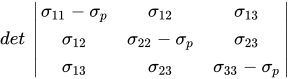
0 = ( σ 11 − σ p ) ℓ + σ 12 m + σ 13 n {\displaystyle {\begin{aligned}0&=(\sigma _{11}-\sigma _{p})\ell +\sigma _{12}m+\sigma _{13}n\end{aligned}}} [28] 0 = σ 12 ℓ + ( σ 22 − σ p ) m + σ 23 n {\displaystyle {\begin{aligned}0&=\sigma _{12}\ell +(\sigma _{22}-\sigma _{p})m+\sigma _{23}n\end{aligned}}} [29] 0 = σ 13 ℓ + σ 23 m + ( σ 33 − σ p ) n {\displaystyle {\begin{aligned}0&=\sigma _{13}\ell +\sigma _{23}m+(\sigma _{33}-\sigma _{p})n\end{aligned}}} [30] 這一組方程可以解出 [ ℓ , m , n ] {\displaystyle \left[\ell ,m,n\right]} σ p {\displaystyle \sigma _{p}} σ p {\displaystyle \sigma _{p}} [ ℓ , m , n ] {\displaystyle \left[\ell ,m,n\right]} ℓ , m , {\displaystyle \ell ,m,} n {\displaystyle n}
d e t | σ 11 − σ p σ 12 σ 13 σ 12 σ 22 − σ p σ 23 σ 13 σ 23 σ 33 − σ p | {\displaystyle det\ \left|{\begin{matrix}\sigma _{11}-\sigma _{p}&\sigma _{12}&\sigma _{13}\\\sigma _{12}&\sigma _{22}-\sigma _{p}&\sigma _{23}\\\sigma _{13}&\sigma _{23}&\sigma _{33}-\sigma _{p}\end{matrix}}\right|} 設為零並解出特徵值和隨後的特徵向量。
重新排列後,我們得到
0 = σ p 3 − ( σ 11 + σ 22 + σ 33 ) σ p 2 + ( σ 11 σ 22 + σ 22 σ 33 + + σ 33 σ 11 − σ 12 2 − σ 23 2 − σ 31 2 ) σ p − ( σ 11 σ 22 σ 33 + 2 σ 12 σ 23 σ 31 − σ 11 σ 23 2 − σ 22 σ 13 2 − σ 33 σ 12 2 ) {\displaystyle {\begin{aligned}0={\sigma _{p}}^{3}-&(\sigma _{11}+\sigma _{22}+\sigma _{33}){\sigma _{p}}^{2}\\&\quad +(\sigma _{11}\sigma _{22}+\sigma _{22}\sigma _{33}++\sigma _{33}\sigma _{11}-{\sigma _{12}}^{2}-{\sigma _{23}}^{2}-{\sigma _{31}}^{2})\sigma _{p}\\&\qquad \qquad -(\sigma _{11}\sigma _{22}\sigma _{33}+2\sigma _{12}\sigma _{23}\sigma _{31}-\sigma _{11}{\sigma _{23}}^{2}-\sigma _{22}{\sigma _{13}}^{2}-\sigma _{33}{\sigma _{12}}^{2})\end{aligned}}} [31] 該三次方程的三個根給出主應力, σ p 1 {\displaystyle \sigma _{p1}} σ p 2 {\displaystyle \sigma _{p2}} σ p 3 {\displaystyle \sigma _{p3}} 方程 28-30 以確定對應於 [ ℓ , m , n ] {\displaystyle \left[\ell ,m,n\right]} ℓ 2 + m 2 + n 2 = 1 {\displaystyle \ell ^{2}+m^{2}+n^{2}=1}
求解三次方程不是本文的重點,但方程 31 很重要,因為主應力前面的係數必須是不變的,也就是說,無論座標系的方位如何,都必須存在相同的主座標。從三次方程可以看出,三個不變數是
I 1 = ( σ 11 + σ 22 + σ 33 ) {\displaystyle {\begin{aligned}I_{1}=(\sigma _{11}+\sigma _{22}+\sigma _{33})\end{aligned}}} [32] I 2 = ( σ 11 σ 22 + σ 22 σ 33 + σ 33 σ 11 − σ 12 2 − σ 23 2 − σ 31 2 ) {\displaystyle {\begin{aligned}I_{2}=(\sigma _{11}\sigma _{22}+\sigma _{22}\sigma _{33}+\sigma _{33}\sigma _{11}-{\sigma _{12}}^{2}-{\sigma _{23}}^{2}-{\sigma _{31}}^{2})\end{aligned}}} [33] I 3 = ( σ 11 σ 22 σ 33 + 2 σ 12 σ 23 σ 31 − σ 11 σ 23 2 − σ 22 σ 13 2 − σ 33 σ 12 2 ) {\displaystyle {\begin{aligned}I_{3}=(\sigma _{11}\sigma _{22}\sigma _{33}+2\sigma _{12}\sigma _{23}\sigma _{31}-\sigma _{11}{\sigma _{23}}^{2}-\sigma _{22}{\sigma _{13}}^{2}-\sigma _{33}{\sigma _{12}}^{2})\end{aligned}}} [34] 這很有用,因為這些不變數關係決定了不同方向上應力之間的關係,即給定 σ {\displaystyle \sigma } σ 1 {\displaystyle \sigma _{1}} σ 2 {\displaystyle \sigma _{2}} σ 3 {\displaystyle \sigma _{3}}
現在,我們將把我們的解決方案推廣到不僅包括主應力。就像我們之前做的那樣,我們可以寫出總的力
S x 1 A = F x 1 = σ 11 ℓ A + σ 12 m A + σ 31 n A {\displaystyle {\begin{aligned}S_{x_{1}}A=F_{x_{1}}=\sigma _{11}\ell A+\sigma _{12}mA+\sigma _{31}nA\end{aligned}}} S x 1 = σ 11 ℓ + σ 12 m + σ 33 n {\displaystyle {\begin{aligned}\qquad S_{x_{1}}=\sigma _{11}\ell +\sigma _{12}m+\sigma _{33}n\end{aligned}}} [35] S x 2 = σ 12 ℓ + σ 22 m + σ 23 n {\displaystyle {\begin{aligned}\qquad S_{x_{2}}=\sigma _{12}\ell +\sigma _{22}m+\sigma _{23}n\end{aligned}}} [36] S x 3 = σ 13 ℓ + σ 23 m + σ 33 n {\displaystyle {\begin{aligned}\qquad S_{x_{3}}=\sigma _{13}\ell +\sigma _{23}m+\sigma _{33}n\end{aligned}}} [37] 這些公式給出了總應力
S 2 = S x 1 2 + S x 2 2 + S x 3 2 {\displaystyle S^{2}={S_{x_{1}}}^{2}+{S_{x_{2}}}^{2}+{S_{x_{3}}}^{2}} [38] 由此,法向分量的投影為
σ ′ = S x 1 ℓ + S x 2 m + S x 3 n {\displaystyle \sigma '=S_{x_{1}}\ell +S_{x_{2}}m+S_{x_{3}}n} [39] 將 **公式** **34-36** 代入 **公式** **38** 中,得到
σ ′ = ( σ 11 ℓ + σ 12 m + σ 31 n ) ℓ + ( σ 12 ℓ + σ 22 m + σ 31 n ) m + ( σ 13 ℓ + σ 31 m + σ 33 n ) n {\displaystyle {\begin{aligned}\sigma '&=(\sigma _{11}\ell +\sigma _{12}m+\sigma _{31}n)\ \ell +(\sigma _{12}\ell +\sigma _{22}m+\sigma _{31}n)\ m+(\sigma _{13}\ell +\sigma _{31}m+\sigma _{33}n)\ n\end{aligned}}} 簡化為
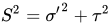
σ ′ = σ 11 ℓ 2 + σ 22 m 2 + σ 33 n 2 + 2 σ 12 ℓ m + 2 σ 23 m n + 2 σ 31 n ℓ {\displaystyle \sigma '=\sigma _{11}\ell ^{2}+\sigma _{22}m^{2}+\sigma _{33}n^{2}+2\sigma _{12}\ell m+2\sigma _{23}mn+2\sigma _{31}n\ell } [40] 剪下分量的幅值可以透過利用 S 2 = σ ′ 2 + τ 2 {\displaystyle S^{2}={\sigma '}^{2}+\tau ^{2}} σ 11 = σ p 1 {\displaystyle \sigma _{11}=\sigma _{p_{1}}} σ 22 = σ p 2 {\displaystyle \sigma _{22}=\sigma _{p_{2}}} σ 33 = σ p 3 {\displaystyle \sigma _{33}=\sigma _{p_{3}}} 公式 39 被改寫為
σ ′ = σ p 1 ℓ 2 + σ p 2 m 2 + σ p 3 n 2 {\displaystyle \sigma '=\sigma _{p_{1}}\ell ^{2}+\sigma _{p_{2}}m^{2}+\sigma _{p_{3}}n^{2}} [41] 對該公式進行平方運算,我們得到
σ ′ 2 = σ p 1 2 ℓ 4 + σ p 2 2 m 4 + σ p 3 2 n 4 + 2 σ p 1 σ p 2 ℓ 2 m 2 + 2 σ p 1 σ p 3 ℓ 2 n 2 + 2 σ p 2 σ p 3 m 2 n 2 p {\displaystyle {\sigma '}^{2}={\sigma _{p_{1}}}^{2}\ell ^{4}+{\sigma _{p_{2}}}^{2}m^{4}+{\sigma _{p_{3}}}^{2}n^{4}+2\sigma _{p_{1}}\sigma _{p_{2}}\ell ^{2}m^{2}+2\sigma _{p_{1}}\sigma _{p_{3}}\ell ^{2}n^{2}+2\sigma _{p_{2}}\sigma {p_{3}}m^{2}n_{2}^{p}} [42] 然後我們可以使用主成分並將公式 34-36 代入公式 37 得到
S 2 = σ 11 2 ℓ 2 + σ 22 2 m 2 + σ 33 2 n 2 {\displaystyle S^{2}={\sigma _{11}}^{2}\ell ^{2}+{\sigma _{22}}^{2}m^{2}+{\sigma _{33}}^{2}n^{2}} [43] 經過大量的代數運算並將公式 41 & 42 代入公式 40 ,我們得到
τ M A X 2 = ( σ 11 − σ 22 ) 2 ℓ 2 m 2 + ( σ 11 − σ 33 ) 2 ℓ 2 n 2 + ( σ 22 − σ 33 ) 2 m 2 n 2 {\displaystyle \tau _{MAX}^{2}=(\sigma _{11}-\sigma _{22})^{2}\ell ^{2}m^{2}+(\sigma _{11}-\sigma _{33})^{2}\ell ^{2}n^{2}+(\sigma _{22}-\sigma _{33})^{2}m^{2}n^{2}} [44] 透過這個解決方案,我們現在有三個可能的平面。一個平面平分 σ 11 {\displaystyle \sigma _{11}} σ 22 {\displaystyle \sigma _{22}} σ 11 {\displaystyle \sigma _{11}} σ 33 {\displaystyle \sigma _{33}} σ 22 {\displaystyle \sigma _{22}} σ 33 {\displaystyle \sigma _{33}} θ = π 4 {\textstyle \theta ={\pi \over 4}} cos π 4 = 2 2 {\textstyle \cos {\pi \over 4}={{\sqrt {2}} \over 2}} ℓ , m , n {\displaystyle \ell ,m,n} τ {\displaystyle \tau }
ℓ {\displaystyle {\boldsymbol {\ell }}} m {\displaystyle {\boldsymbol {m}}} n {\displaystyle {\boldsymbol {n}}} τ {\displaystyle {\boldsymbol {\tau }}}
0 {\displaystyle 0} 2 2 {\displaystyle {\frac {\sqrt {2}}{2}}} 2 2 {\displaystyle {\frac {\sqrt {2}}{2}}} 1 2 ( σ 22 − σ 33 ) {\displaystyle {\frac {1}{2}}(\sigma _{22}-\sigma _{33})}
2 2 {\displaystyle {\frac {\sqrt {2}}{2}}} 0 {\displaystyle 0} 2 2 {\displaystyle {\frac {\sqrt {2}}{2}}} 1 2 ( σ 11 − σ 33 ) {\displaystyle {\frac {1}{2}}(\sigma _{11}-\sigma _{33})}
2 2 {\displaystyle {\frac {\sqrt {2}}{2}}} 2 2 {\displaystyle {\frac {\sqrt {2}}{2}}} 0 {\displaystyle 0} 1 2 ( σ 11 − σ 22 ) {\displaystyle {\frac {1}{2}}(\sigma _{11}-\sigma _{22})}
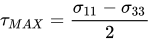
按照慣例, σ 11 > σ 22 > σ 33 {\displaystyle \sigma _{11}>\sigma _{22}>\sigma _{33}}
τ M A X = σ 11 − σ 33 2 {\displaystyle \tau _{MAX}={\sigma _{11}-\sigma _{33} \over 2}} 圖 8 :一個 3D 莫爾圓包含三個圓,每個軸一個圓,並遵循 σ 11 > σ 22 > σ 33 {\displaystyle \sigma _{11}>\sigma _{22}>\sigma _{33}} 請注意,我們知道存在兩個最大剪下應力平面,它們彼此旋轉了 π {\textstyle \pi } ± 2 2 {\textstyle \pm {{\sqrt {2}} \over 2}}
由於這些軸向旋轉是解耦的,我們可以使用莫爾圓來表示 3D 應力狀態,如圖 8 所示。
















































![{\displaystyle \sigma _{12MAX}=\pm \left[\left({\sigma _{11}-\sigma _{22} \over 2}\right)^{2}+{\sigma _{12}}^{2}\right]^{1 \over 2}}](https://wikimedia.org/api/rest_v1/media/math/render/svg/27ff9153bf6b0751b8685013c678110499064b10)





















![{\displaystyle \left[\ell ,m,n\right]}](https://wikimedia.org/api/rest_v1/media/math/render/svg/5a9dcae54880c69cb3b75a49b7ab30db68b7d800)