


並行譜數值方法/三次非線性薛定諤方程
三次非線性薛定諤方程出現在許多領域,包括量子力學、非線性光學和水面波。可以在http://en.wikipedia.org/wiki/Schrodinger_equation和http://en.wikipedia.org/wiki/Nonlinear_Schrodinger_equation找到一般介紹。薛定諤方程的數學介紹可以在 Sulem 和 Sulem[1]和楊[2]中找到。在本節中,我們將介紹運算元分裂的概念,然後解釋如何將其應用於一維、二維和三維的非線性薛定諤方程。在一維中,可以證明三次非線性薛定諤方程是亞臨界的,因此存在所有時間的解。在二維中,它是臨界的,因此解可能表現出範數的爆炸,即解的梯度的平方積分可以在有限時間內變為無窮大。最後,在三維中,非線性薛定諤方程是超臨界的,因此解的平方積分也可以在有限時間內變為無窮大。有關範數和希爾伯特空間的介紹,請參閱偏微分方程或分析的教科書,例如 Evans[3]、Linares 和 Ponce[4]、Lieb 和 Loss[5]或 Renardy 和 Rogers[6]。一個有趣的問題是如何發生這種爆炸,數值模擬經常被用來理解這一點;參見 Sulem 和 Sulem[7]以獲取此類示例。三次非線性薛定諤方程[8]由下式給出



其中 是波函式, 是拉普拉斯運算元,因此在一維中它是 ,在二維中,,在三維中它是 。 對應於聚焦三次非線性薛定諤方程,而 對應於散焦三次非線性薛定諤方程。該方程具有許多守恆量,包括“質量”,





和“能量”,
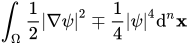
其中 是維度, 是解的域。正如 Klein[9] 解釋的那樣,這兩個量可以為數值生成解的精度提供有用的檢驗。


分裂
[edit | edit source]我們將考慮一種稱為分裂的數值方法來求解此方程。這種方法在多個應用中出現,並且當方程可以分裂成兩個單獨的方程時,它是一種有用的數值方法,每個方程都可以精確求解,或者每個部分最適合由不同的數值方法求解。 Holden 等人[10],McLachlan 和 Quispel[11],Thalhammer[12],Shen、Tang 和 Wang[13],Weideman 和 Herbst[14] 以及 Yang[15] 提供了對分裂的介紹,http://en.wikipedia.org/wiki/Split-step_method 也對此進行了介紹。 對於那些對非線性薛定諤方程的時間步進方法比較感興趣的人,請參閱 Klein[16]。 為了描述該方法的基本原理,我們考慮 Holden 等人[17] 給出的一個例子,即常微分方程:
-
其中 .()


我們可以透過變數分離相對簡單地求解此方程,發現
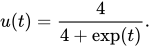
現在,一個有趣的觀察結果是,我們也可以單獨求解方程 和 。對於第一個,我們得到 ,對於第二個,我們得到 。分裂背後的原理是交替地求解這兩個單獨的方程,時間很短。我們將描述 Strang 分裂,雖然還有其他形式的分裂,例如 Godunov 分裂以及加性分裂。我們在這裡不介紹這些,而是將您推薦給前面提到的參考文獻,特別是 Holden 等人[18]。 為了理解如何使用分裂求解微分方程,請考慮線性常微分方程


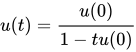

其中 .


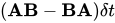
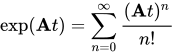
We can first solve for a time and then using , we solve also for a time to get and finally solve for a time with initial data . Thus in this case , and , which in this case is the exact solution. One can perform a similar splitting for matrix differential equations. Consider solving , where and are matrices, the exact solution is , and an approximate solution produced after one time step of splitting is , which is not in general equal to unless the matrices and commute[19], and so the error in doing splitting in this case is of the form [20]. Listing A uses Matlab to demonstrate how to do splitting for eq. 1 .











|
()
|
% A program to solve the u_t=u(u-1) using a
% Strang Splitting method

clear all; format compact; format short;
set(0,'defaultaxesfontsize',30,'defaultaxeslinewidth',.7,...
    'defaultlinelinewidth',6,'defaultpatchlinewidth',3.7,...
    'defaultaxesfontweight','bold')
Nt = 1000; % number of time slices
tmax = 1; % maximum time
dt=tmax/Nt; % increment between times
time=(linspace(1,Nt,Nt)-1)*dt; % time
uexact=4./(4+exp(time)); % exact solution
u(1)=0.8

for i=1:Nt-1
    c=-1/u(i);
    utemp=-1/(c+0.5*dt);
    utemp2=utemp*exp(-dt);
    c=-1/utemp2;
    u(i+1)=-1/(c+0.5*dt);
end
figure(1)
plot(time,u,'r+',time,uexact,'b-');
|
()
|
"""
A program to solve u_t'=u(u-1) using a Strang
splitting method
"""

import time
import numpy
import matplotlib.pyplot as plt

Nt = 1000	# Number of timesteps
tmax = 1.0	# Maximum time
dt=tmax/Nt # increment between times
u0 = 0.8 # Initial value
t0 = 0	# Starting time
u = [u0]	# Variables holding the values of iterations
t = [t0]	# Times of discrete solutions

T0 = time.clock()
for i in xrange(Nt):
c = -1.0/u[i]
utemp=-1.0/(c+0.5*dt)
utemp2=utemp*numpy.exp(-dt)
c = -1.0/utemp2
unew=-1.0/(c+0.5*dt)
u.append(unew)
t.append(t[i]+dt)

T = time.clock() - T0
uexact = [4.0/(4.0+numpy.exp(tt)) for tt in t]

print
print "Elapsed time is %f" % (T)

plt.figure()
plt.plot(t,u,'r+',t,uexact,'b-.')
plt.xlabel('Time')
plt.ylabel('Solution')
plt.legend(('Numerical Solution', 'Exact solution'))
plt.title('Numerical solution of du/dt=u(u-1)')
plt.show()
練習
[edit | edit source]- 修改 Matlab 程式碼,以計算時間 1 處的誤差,並選擇多個不同的時間步長。 數值驗證 Strang 分裂的二階精度。
- 修改 Matlab 程式碼以使用 Godunov 分裂,其中求解 時間為 ,然後使用 作為初始資料,求解 也為時間 ,以獲得對 的近似值。計算時間為 1 時的誤差,對於不同的時間步長選擇。數值驗證 Godunov 分裂是一階精度的。


對於非線性薛定諤方程
-
,()

我們首先求解
-
()

使用傅立葉變換精確求解,得到
.

然後我們求解
-
()
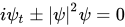
其中
作為初始資料,時間步長為 。正如 Klein[21] 和 Thalhammer[22] 所解釋的,這可以在實空間中精確求解,因為在等式 4 中, 是空間和時間的每個點的守恆量。為了證明這一點,令 表示 的複共軛,所以


.

然後使用方程式 3 計算另一個半步,該半步使用透過求解方程式 4 生成的解來獲得時間 處的近似解。下面是演示拆分的示例 Matlab 程式碼。
非線性薛定諤方程的示例 Matlab 和 Python 程式
[edit | edit source]清單 B 中的程式計算對聚焦非線性薛定諤方程的顯式已知精確解的近似值。
|
()
|
% A program to solve the nonlinear Schr\"{o}dinger equation using a
% splitting method

clear all; format compact; format short;
set(0,'defaultaxesfontsize',30,'defaultaxeslinewidth',.7,...
    'defaultlinelinewidth',6,'defaultpatchlinewidth',3.7,...
    'defaultaxesfontweight','bold')

Lx = 20; % period 2*pi * L
Nx = 16384; % number of harmonics
Nt = 1000; % number of time slices
dt = 0.25*pi/Nt; % time step
U=zeros(Nx,Nt/10);

Es = -1; % focusing or defocusing parameter

% initialise variables
x = (2*pi/Nx)*(-Nx/2:Nx/2 -1)'*Lx; % x coordinate
kx = 1i*[0:Nx/2-1 0 -Nx/2+1:-1]'/Lx; % wave vector
k2x = kx.^2; % square of wave vector
% initial conditions
t=0; tdata(1)=t;
u=4*exp(1i*t)*(cosh(3*x)+3*exp(8*1i*t)*cosh(x))...
    ./(cosh(4*x)+4*cosh(2*x)+3*cos(8*t));
v=fft(u);
figure(1); clf; plot(x,u);xlim([-2,2]); drawnow;
U(:,1)=u;

% mass
ma = fft(abs(u).^2);
ma0 = ma(1);

% solve pde and plot results
for n =2:Nt+1

    vna=exp(0.5*1i*dt*k2x).*v;
    una=ifft(vna);
    pot=2*(una.*conj(una));
    unb=exp(-1i*Es*dt*pot).*una;
    vnb=fft(unb);
    v=exp(0.5*1i*dt*k2x).*vnb;
    t=(n-1)*dt;

    if (mod(n,10)==0)
        tdata(n/10)=t;
        u=ifft(v);
        U(:,n/10)=u;
        uexact=4*exp(1i*t)*(cosh(3*x)+3*exp(8*1i*t)*cosh(x))...
            ./(cosh(4*x)+4*cosh(2*x)+3*cos(8*t));
        figure(1); clf; plot(x,abs(u).^2); ...
            xlim([-0.5,0.5]); title(num2str(t));
        figure(2); clf; plot(x,abs(u-uexact).^2);...
            xlim([-0.5,0.5]); title(num2str(t));
        drawnow;
        ma = fft(abs(u).^2);
        ma = ma(1);
        test = log10(abs(1-ma/ma0))
    end
end
figure(3); clf; mesh(tdata(1:(n-1)/10),x,abs(U(:,1:(n-1)/10)).^2);
|
()
|
"""
A program to solve the 1D Nonlinear Schrodinger equation using a
second order splitting method. The numerical solution is compared
to an exact soliton solution. The exact equation solved is
iu_t+u_{xx}+2|u|^2u=0

More information on visualization can be found on the Mayavi
website, in particular:
http://github.enthought.com/mayavi/mayavi/mlab.html
which was last checked on 6 April 2012

"""

import math
import numpy
import matplotlib.pyplot as plt
import time

plt.ion()

# Grid
Lx=16.0 # Period 2*pi*Lx
Nx=8192 # Number of harmonics
Nt=1000 # Number of time slices
tmax=1.0 # Maximum time
dt=tmax/Nt # time step
plotgap=10 # time steps between plots
Es= -1.0 # focusing (+1) or defocusing (-1) parameter
numplots=Nt/plotgap # number of plots to make

x = [i*2.0*math.pi*(Lx/Nx) for i in xrange(-Nx/2,1+Nx/2)]
k_x = (1.0/Lx)*numpy.array([complex(0,1)*n for n in range(0,Nx/2) \
+ [0] + range(-Nx/2+1,0)])

k2xm=numpy.zeros((Nx), dtype=float)
xx=numpy.zeros((Nx), dtype=float)

for i in xrange(Nx):
   k2xm[i] = numpy.real(k_x[i]**2)
   xx[i]=x[i]


# allocate arrays
usquared=numpy.zeros((Nx), dtype=float)
pot=numpy.zeros((Nx), dtype=float)
u=numpy.zeros((Nx), dtype=complex)
uexact=numpy.zeros((Nx), dtype=complex)
una=numpy.zeros((Nx), dtype=complex)
unb=numpy.zeros((Nx), dtype=complex)
v=numpy.zeros((Nx), dtype=complex)
vna=numpy.zeros((Nx), dtype=complex)
vnb=numpy.zeros((Nx), dtype=complex)
mass=numpy.zeros((Nx), dtype=complex)
test=numpy.zeros((numplots-1),dtype=float)
tdata=numpy.zeros((numplots-1), dtype=float)

t=0.0
u=4.0*numpy.exp(complex(0,1.0)*t)*\
   (numpy.cosh(3.0*xx)+3.0*numpy.exp(8.0*complex(0,1.0)*t)*numpy.cosh(xx))\
   /(numpy.cosh(4*xx)+4.0*numpy.cosh(2.0*xx)+3.0*numpy.cos(8.0*t))
uexact=u
v=numpy.fft.fftn(u)
usquared=abs(u)**2
fig =plt.figure()
ax = fig.add_subplot(311)
ax.plot(xx,numpy.real(u),'b-')
plt.xlabel('x')
plt.ylabel('real u')
ax = fig.add_subplot(312)
ax.plot(xx,numpy.imag(u),'b-')
plt.xlabel('x')
plt.ylabel('imaginary u')
ax = fig.add_subplot(313)
ax.plot(xx,abs(u-uexact),'b-')
plt.xlabel('x')
plt.ylabel('error')
plt.show()


# initial mass
usquared=abs(u)**2
mass=numpy.fft.fftn(usquared)
ma=numpy.real(mass[0])
maO=ma
tdata[0]=t
plotnum=0
#solve pde and plot results
for nt in xrange(numplots-1):
    for n in xrange(plotgap):
        vna=v*numpy.exp(complex(0,0.5)*dt*k2xm)
        una=numpy.fft.ifftn(vna)
        usquared=2.0*abs(una)**2
        pot=Es*usquared
        unb=una*numpy.exp(complex(0,-1)*dt*pot)
        vnb=numpy.fft.fftn(unb)
        v=vnb*numpy.exp(complex(0,0.5)*dt*k2xm)
        u=numpy.fft.ifftn(v)
        t+=dt
    plotnum+=1
    usquared=abs(u)**2
    uexact = 4.0*numpy.exp(complex(0,1.0)*t)*\
      (numpy.cosh(3.0*xx)+3.0*numpy.exp(8.0*complex(0,1.0)*t)*numpy.cosh(xx))\
      /(numpy.cosh(4*xx)+4.0*numpy.cosh(2.0*xx)+3.0*numpy.cos(8.0*t))
    ax = fig.add_subplot(311)
    plt.cla()
    ax.plot(xx,numpy.real(u),'b-')
    plt.title(t)
    plt.xlabel('x')
    plt.ylabel('real u')
    ax = fig.add_subplot(312)
    plt.cla()
    ax.plot(xx,numpy.imag(u),'b-')
    plt.xlabel('x')
    plt.ylabel('imaginary u')
    ax = fig.add_subplot(313)
    plt.cla()
    ax.plot(xx,abs(u-uexact),'b-')
    plt.xlabel('x')
    plt.ylabel('error')
    plt.draw()
    mass=numpy.fft.fftn(usquared)
    ma=numpy.real(mass[0])
    test[plotnum-1]=numpy.log(abs(1-ma/maO))
    print(test[plotnum-1])
    tdata[plotnum-1]=t

plt.ioff()
plt.show()
|
()
|
% A program to solve the 2D nonlinear Schr\"{o}dinger equation using a
% splitting method

clear all; format compact; format short;
set(0,'defaultaxesfontsize',30,'defaultaxeslinewidth',.7,...
    'defaultlinelinewidth',6,'defaultpatchlinewidth',3.7,'defaultaxesfontweight','bold')

% set up grid
tic
Lx = 20; % period 2*pi*L
Ly = 20; % period 2*pi*L
Nx = 2*256; % number of harmonics
Ny = 2*256; % number of harmonics
Nt = 100; % number of time slices
dt = 5.0/Nt; % time step

Es = 1.0;

% initialise variables
x = (2*pi/Nx)*(-Nx/2:Nx/2 -1)'*Lx; % x coordinate
kx = 1i*[0:Nx/2-1 0 -Nx/2+1:-1]'/Lx; % wave vector
y = (2*pi/Ny)*(-Ny/2:Ny/2 -1)'*Ly; % y coordinate
ky = 1i*[0:Ny/2-1 0 -Ny/2+1:-1]'/Ly; % wave vector
[xx,yy]=meshgrid(x,y);
[k2xm,k2ym]=meshgrid(kx.^2,ky.^2);
% initial conditions
u = exp(-(xx.^2+yy.^2));
v=fft2(u);
figure(1); clf; mesh(xx,yy,u); drawnow;
t=0; tdata(1)=t;

% mass
ma = fft2(abs(u).^2);
ma0 = ma(1,1);

% solve pde and plot results
for n =2:Nt+1
    vna=exp(0.5*1i*dt*(k2xm + k2ym)).*v;
    una=ifft2(vna);
    pot=Es*((abs(una)).^2);
    unb=exp(-1i*dt*pot).*una;
    vnb=fft2(unb);
    v=exp(0.5*1i*dt*(k2xm + k2ym)).*vnb;
    u=ifft2(v);
    t=(n-1)*dt;
    tdata(n)=t;
     if (mod(n,10)==0)
         figure(2); clf; mesh(xx,yy,abs(u).^2); title(num2str(t));
         drawnow;
         ma = fft2(abs(u).^2);
         ma = ma(1,1);
         test = log10(abs(1-ma/ma0))
     end
end
figure(4); clf; mesh(xx,yy,abs(u).^2);
toc
|
()
|
"""
A program to solve the 2D Nonlinear Schrodinger equation using a
second order splitting method

More information on visualization can be found on the Mayavi
website, in particular:
http://github.enthought.com/mayavi/mayavi/mlab.html
which was last checked on 6 April 2012

"""

import math
import numpy
from mayavi import mlab
import matplotlib.pyplot as plt
import time

# Grid
Lx=4.0 # Period 2*pi*Lx
Ly=4.0 # Period 2*pi*Ly
Nx=64 # Number of harmonics
Ny=64 # Number of harmonics
Nt=100 # Number of time slices
tmax=1.0 # Maximum time
dt=tmax/Nt # time step
plotgap=10 # time steps between plots
Es= 1.0 # focusing (+1) or defocusing (-1) parameter
numplots=Nt/plotgap # number of plots to make

x = [i*2.0*math.pi*(Lx/Nx) for i in xrange(-Nx/2,1+Nx/2)]
y = [i*2.0*math.pi*(Ly/Ny) for i in xrange(-Ny/2,1+Ny/2)]
k_x = (1.0/Lx)*numpy.array([complex(0,1)*n for n in range(0,Nx/2) \
+ [0] + range(-Nx/2+1,0)])
k_y = (1.0/Ly)*numpy.array([complex(0,1)*n for n in range(0,Ny/2) \
+ [0] + range(-Ny/2+1,0)])

k2xm=numpy.zeros((Nx,Ny), dtype=float)
k2ym=numpy.zeros((Nx,Ny), dtype=float)
xx=numpy.zeros((Nx,Ny), dtype=float)
yy=numpy.zeros((Nx,Ny), dtype=float)


for i in xrange(Nx):
    for j in xrange(Ny):
            k2xm[i,j] = numpy.real(k_x[i]**2)
            k2ym[i,j] = numpy.real(k_y[j]**2)
            xx[i,j]=x[i]
            yy[i,j]=y[j]


# allocate arrays
usquared=numpy.zeros((Nx,Ny), dtype=float)
pot=numpy.zeros((Nx,Ny), dtype=float)
u=numpy.zeros((Nx,Ny), dtype=complex)
una=numpy.zeros((Nx,Ny), dtype=complex)
unb=numpy.zeros((Nx,Ny), dtype=complex)
v=numpy.zeros((Nx,Ny), dtype=complex)
vna=numpy.zeros((Nx,Ny), dtype=complex)
vnb=numpy.zeros((Nx,Ny), dtype=complex)
mass=numpy.zeros((Nx,Ny), dtype=complex)
test=numpy.zeros((numplots-1),dtype=float)
tdata=numpy.zeros((numplots-1), dtype=float)

u=numpy.exp(-(xx**2 + yy**2 ))
v=numpy.fft.fftn(u)
usquared=abs(u)**2
src = mlab.surf(xx,yy,usquared,colormap='YlGnBu',warp_scale='auto')
mlab.scalarbar()
mlab.xlabel('x',object=src)
mlab.ylabel('y',object=src)
mlab.zlabel('abs(u)^2',object=src)

# initial mass
usquared=abs(u)**2
mass=numpy.fft.fftn(usquared)
ma=numpy.real(mass[0,0])
print(ma)
maO=ma
t=0.0
tdata[0]=t
plotnum=0
#solve pde and plot results
for nt in xrange(numplots-1):
    for n in xrange(plotgap):
        vna=v*numpy.exp(complex(0,0.5)*dt*(k2xm+k2ym))
        una=numpy.fft.ifftn(vna)
        usquared=abs(una)**2
        pot=Es*usquared
        unb=una*numpy.exp(complex(0,-1)*dt*pot)
        vnb=numpy.fft.fftn(unb)
        v=vnb*numpy.exp(complex(0,0.5)*dt*(k2xm+k2ym) )
        u=numpy.fft.ifftn(v)
        t+=dt
    plotnum+=1
    usquared=abs(u)**2
    src.mlab_source.scalars = usquared
    mass=numpy.fft.fftn(usquared)
    ma=numpy.real(mass[0,0])
    test[plotnum-1]=numpy.log(abs(1-ma/maO))
    print(test[plotnum-1])
    tdata[plotnum-1]=t

plt.figure()
plt.plot(tdata,test,'r-')
plt.title('Time Dependence of Change in Mass')
plt.show()
|
()
|
% A program to solve the 3D nonlinear Schr\"{o}dinger equation using a
% splitting method
% updated by Abdullah Bargash , AbdulAziz Al-thiban
% vol3d can be downloaded from http://www.mathworks.com/matlabcentral/fileexchange/22940-vol3d-v2
%
clear all; format compact; format short;
set(0,'defaultaxesfontsize',30,'defaultaxeslinewidth',.7,...
    'defaultlinelinewidth',6,'defaultpatchlinewidth',3.7,...
    'defaultaxesfontweight','bold')

% set up grid
tic
Lx = 4; % period 2*pi*L
Ly = 4; % period 2*pi*L
Lz = 4; % period 2*pi*L
Nx = 64; % number of harmonics
Ny = 64; % number of harmonics
Nz = 64; % number of harmonics
Nt = 100; % number of time slices
dt = 1.0/Nt; % time step

Es = 1.0; % focusing or defocusing parameter

% initialise variables
x = (2*pi/Nx)*(-Nx/2:Nx/2 -1)'*Lx; % x coordinate
kx = 1i*[0:Nx/2-1 0 -Nx/2+1:-1]'/Lx; % wave vector
y = (2*pi/Ny)*(-Ny/2:Ny/2 -1)'*Ly; % y coordinate
ky = 1i*[0:Ny/2-1 0 -Ny/2+1:-1]'/Ly; % wave vector
z = (2*pi/Nz)*(-Nz/2:Nz/2 -1)'*Lz; % y coordinate
kz = 1i*[0:Nz/2-1 0 -Nz/2+1:-1]'/Lz; % wave vector
[xx,yy,zz]=meshgrid(x,y,z);
[k2xm,k2ym,k2zm]=meshgrid(kx.^2,ky.^2,kz.^2);

% initial conditions
u = exp(-(xx.^2+yy.^2+zz.^2));
v=fftn(u);
figure(1); clf; UP = abs(u).^2;
    H = vol3d('CData',UP,'texture','3D','XData',x,'YData',y,'ZData',z);
    xlabel('x'); ylabel('y'); zlabel('z'); colorbar;
    axis equal; axis square; view(3);

    xlabel('x'); ylabel('y'); zlabel('z');
axis equal; axis square; view(3); drawnow;
t=0; tdata(1)=t;

% mass
ma = fftn(abs(u).^2);
ma0 = ma(1,1,1);

% solve pde and plot results

for n =2:Nt+1
    vna=exp(0.5*1i*dt*(k2xm + k2ym + k2zm)).*v;
    una=ifftn(vna);
    pot=Es*((abs(una)).^2);
    unb=exp(-1i*dt*pot).*una;
    vnb=fftn(unb);
    v=exp(0.5*1i*dt*(k2xm + k2ym + k2zm)).*vnb;
    u=ifftn(v);
    t=(n-1)*dt;
    tdata(n)=t;
    if (mod(n,10)==0)

    figure(1); clf; UP = abs(u).^2;

    H = vol3d('CData',UP,'texture','3D','XData',x,'YData',y,'ZData',z);
    xlabel('x'); ylabel('y'); zlabel('z'); colorbar;
    axis equal; axis square; view(3);
    title(num2str(t));


        xlabel('x'); ylabel('y'); zlabel('z');
        axis equal; axis square; view(3); drawnow;
        ma = fftn(abs(u).^2);
        ma = ma(1,1,1); test = log10(abs(1-ma/ma0))

    end

end

    figure(1); clf; UP = abs(u).^2;

    H = vol3d('CData',UP,'texture','3D','XData',x,'YData',y,'ZData',z);
    xlabel('x'); ylabel('y'); zlabel('z'); colorbar;
    axis equal; axis square; view(3);
非線性薛定諤方程的示例一維 Fortran 程式
[edit | edit source]在考慮並行程式之前,我們需要了解如何為一維非線性薛定諤方程編寫 Fortran 程式碼。下面是一個示例 Fortran 程式,後面是一個 Matlab 繪圖指令碼,用於視覺化結果。在編譯 Fortran 程式時,需要標準 Fortran 編譯器和 FFTW 庫。由於所需命令與熱方程 makefile 中的命令相似,因此此處不再贅述。
|
()
|
!--------------------------------------------------------------------
!
!
! PURPOSE
!
! This program solves nonlinear Schrodinger equation in 1 dimension
! i*u_t+Es*|u|^2u+u_{xx}=0
! using a second order time spectral splitting scheme
!
! The boundary conditions are u(0)=u(2*L*\pi)
! The initial condition is u=exp(-x^2)
!
! .. Parameters ..
! Nx = number of modes in x - power of 2 for FFT
! Nt = number of timesteps to take
! Tmax = maximum simulation time
! plotgap = number of timesteps between plots
! FFTW_IN_PLACE = value for FFTW input
! FFTW_MEASURE = value for FFTW input
! FFTW_EXHAUSTIVE = value for FFTW input
! FFTW_PATIENT = value for FFTW input
! FFTW_ESTIMATE = value for FFTW input
! FFTW_FORWARD = value for FFTW input
! FFTW_BACKWARD = value for FFTW input
! pi = 3.14159265358979323846264338327950288419716939937510d0
! L = width of box
! ES = +1 for focusing and -1 for defocusing
! .. Scalars ..
! i = loop counter in x direction
! n = loop counter for timesteps direction
! allocatestatus = error indicator during allocation
! start = variable to record start time of program
! finish = variable to record end time of program
! count_rate = variable for clock count rate
! planfx = Forward 1d fft plan in x
! planbx = Backward 1d fft plan in x
! dt = timestep
! .. Arrays ..
! u = approximate solution
! v = Fourier transform of approximate solution
! .. Vectors ..
! una = temporary field
! unb = temporary field
! vna = temporary field
! pot = potential
! kx = fourier frequencies in x direction
! x = x locations
! time = times at which save data
! name_config = array to store filename for data to be saved
! fftfx = array to setup x Fourier transform
! fftbx = array to setup x Fourier transform
! REFERENCES
!
! ACKNOWLEDGEMENTS
!
! ACCURACY
!
! ERROR INDICATORS AND WARNINGS
!
! FURTHER COMMENTS
! Check that the initial iterate is consistent with the
! boundary conditions for the domain specified
!--------------------------------------------------------------------
! External routines required
!
! External libraries required
! FFTW3 -- Fast Fourier Transform in the West Library
! (http://www.fftw.org/)


PROGRAM main

! Declare variables
IMPLICIT NONE
INTEGER(kind=4), PARAMETER :: Nx=8*256
INTEGER(kind=4), PARAMETER	:: Nt=200
REAL(kind=8), PARAMETER	&
:: pi=3.14159265358979323846264338327950288419716939937510d0
REAL(kind=8), PARAMETER	:: L=5.0d0
REAL(kind=8), PARAMETER	:: Es=1.0d0
REAL(kind=8)	:: dt=2.0d0/Nt
COMPLEX(kind=8), DIMENSION(:), ALLOCATABLE	:: kx
REAL(kind=8), DIMENSION(:), ALLOCATABLE	:: x
COMPLEX(kind=8), DIMENSION(:,:), ALLOCATABLE	:: u
COMPLEX(kind=8), DIMENSION(:,:), ALLOCATABLE	:: v
COMPLEX(kind=8), DIMENSION(:), ALLOCATABLE	:: una,vn
COMPLEX(kind=8), DIMENSION(:), ALLOCATABLE	:: unb,pot
REAL(kind=8), DIMENSION(:), ALLOCATABLE	:: time
INTEGER(kind=4)	:: i,j,k,n,modes,AllocateStatus
INTEGER(kind=4)	:: start, finish, count_rate
INTEGER(kind=4), PARAMETER	:: FFTW_IN_PLACE = 8, FFTW_MEASURE = 0, &
FFTW_EXHAUSTIVE = 8, FFTW_PATIENT = 32, FFTW_ESTIMATE = 64
INTEGER(kind=4), PARAMETER :: FFTW_FORWARD = -1, FFTW_BACKWARD=1
COMPLEX(kind=8), DIMENSION(:), ALLOCATABLE	:: fftfx,fftbx
INTEGER(kind=8)	:: planfx,planbx
   CHARACTER*100	:: name_config

CALL system_clock(start,count_rate)
ALLOCATE(kx(1:Nx),x(1:Nx),u(1:Nx,1:Nt+1),v(1:Nx,1:Nt+1),&
una(1:Nx),vn(1:Nx),unb(1:Nx),pot(1:Nx),time(1:Nt+1),&
fftfx(1:Nx),fftbx(1:Nx),stat=AllocateStatus)
IF (allocatestatus .ne. 0) STOP
! set up ffts
CALL dfftw_plan_dft_1d_(planfx,Nx,fftfx(1:Nx),fftbx(1:Nx),&
FFTW_FORWARD,FFTW_PATIENT)
CALL dfftw_plan_dft_1d_(planbx,Nx,fftbx(1:Nx),fftfx(1:Nx),&
FFTW_BACKWARD,FFTW_PATIENT)
PRINT *,'Setup FFTs'
! setup fourier frequencies
DO i=1,1+Nx/2
kx(i)= cmplx(0.0d0,1.0d0)*(i-1.0d0)/L
END DO
kx(1+Nx/2)=0.0d0
DO i = 1,Nx/2 -1
kx(i+1+Nx/2)=-kx(1-i+Nx/2)
END DO
DO i=1,Nx
x(i)=(-1.0d0 + 2.0d0*REAL(i-1,kind(0d0))/REAL(Nx,kind(0d0)))*pi*L
END DO
PRINT *,'Setup grid and fourier frequencies'

DO i=1,Nx
u(i,1)=exp(-1.0d0*(x(i)**2))
END DO
! transform initial data
CALL dfftw_execute_dft_(planfx,u(1:Nx,1),v(1:Nx,1))
PRINT *,'Got initial data, starting timestepping'
time(1)=0.0d0
DO n=1,Nt
time(n+1)=n*dt
DO i=1,Nx
vn(i)=exp(0.5d0*dt*kx(i)*kx(i)*cmplx(0.0d0,1.0d0))*v(i,n)
END DO
CALL dfftw_execute_dft_(planbx,vn(1:Nx),una(1:Nx))
! normalize
DO i=1,Nx
una(i)=una(1:Nx)/REAL(Nx,kind(0d0))
pot(i)=Es*una(i)*conjg(una(i))
unb(i)=exp(cmplx(0.0d0,-1.0d0)*dt*pot(i))*una(i)
END DO
CALL dfftw_execute_dft_(planfx,unb(1:Nx),vn(1:Nx))
DO i=1,Nx
v(i,n+1)=exp(0.50d0*dt*kx(i)*kx(i)*cmplx(0.0d0,1.0d0))*vn(i)
END DO
CALL dfftw_execute_dft_(planbx,v(1:Nx,n+1),u(1:Nx,n+1))
! normalize
DO i=1,Nx
u(i,n+1)=u(i,n+1)/REAL(Nx,kind(0d0))
END DO
END DO
PRINT *,'Finished time stepping'
CALL system_clock(finish,count_rate)
PRINT*,'Program took ',&
REAL(finish-start,kind(0d0))/REAL(count_rate,kind(0d0)),'for execution'

name_config = 'u.dat'
OPEN(unit=11,FILE=name_config,status="UNKNOWN")
REWIND(11)
DO j=1,Nt
DO i=1,Nx
WRITE(11,*) abs(u(i,j))**2
END DO
END DO
CLOSE(11)

name_config = 'tdata.dat'
OPEN(unit=11,FILE=name_config,status="UNKNOWN")
REWIND(11)
DO j=1,Nt
WRITE(11,*) time(j)
END DO
CLOSE(11)

name_config = 'xcoord.dat'
OPEN(unit=11,FILE=name_config,status="UNKNOWN")
REWIND(11)
DO i=1,Nx
WRITE(11,*) x(i)
END DO
CLOSE(11)

PRINT *,'Saved data'

CALL dfftw_destroy_plan_(planbx)
CALL dfftw_destroy_plan_(planfx)
CALL dfftw_cleanup_()

DEALLOCATE(kx,x,u,v,una,vn,unb,&
pot,time,fftfx,fftbx,&
stat=AllocateStatus)
IF (allocatestatus .ne. 0) STOP
PRINT *,'deallocated memory'
PRINT *,'Program execution complete'
END PROGRAM main
|
()
|
% A program to plot the computed results

clear all; format compact, format short,
set(0,'defaultaxesfontsize',18,'defaultaxeslinewidth',.9,...
    'defaultlinelinewidth',3.5,'defaultpatchlinewidth',5.5);

% Load data
load('./u.dat');
load('./tdata.dat');
load('./xcoord.dat');
Tsteps = length(tdata);

Nx = length(xcoord); Nt = length(tdata);

u = reshape(u,Nx,Nt);

% Plot data
figure(3); clf; mesh(tdata,xcoord,u); xlabel t; ylabel x; zlabel('|u|^2');
共享記憶體並行:OpenMP
[edit | edit source]我們回顧一下,OpenMP 是一組編譯器指令,可以讓您輕鬆地讓 Fortran、C 或 C++ 程式在共享記憶體機器上執行——也就是說,所有計算程序都可以訪問同一全域性定址記憶體空間的計算機。它允許對已用上述語言之一編寫的序列程式進行輕鬆的並行化。
我們將演示二維非線性薛定諤方程的一種並行形式,其中我們將使用 OpenMP 命令對迴圈進行並行化,但將使用執行緒化的 FFTW 庫為我們並行化變換。示例程式在清單 E 中。在練習中概述了使用 OpenMP 命令顯式並行化迴圈和快速傅立葉變換的第二種方法。
|
()
|
!--------------------------------------------------------------------
!
!
! PURPOSE
!
! This program solves nonlinear Schrodinger equation in 2 dimensions
! i*u_t+Es*|u|^2u+u_{xx}+u_{yy}=0
! using a second order time spectral splitting scheme
!
! The boundary conditions are u(x=0,y)=u(2*Lx*\pi,y),
! u(x,y=0)=u(x,y=2*Ly*\pi)
! The initial condition is u=exp(-x^2-y^2)
!
! .. Parameters ..
! Nx = number of modes in x - power of 2 for FFT
! Ny = number of modes in y - power of 2 for FFT
! Nt = number of timesteps to take
! Tmax = maximum simulation time
! plotgap = number of timesteps between plots
! FFTW_IN_PLACE = value for FFTW input
! FFTW_MEASURE = value for FFTW input
! FFTW_EXHAUSTIVE = value for FFTW input
! FFTW_PATIENT = value for FFTW input
! FFTW_ESTIMATE = value for FFTW input
! FFTW_FORWARD = value for FFTW input
! FFTW_BACKWARD = value for FFTW input
! pi = 3.14159265358979323846264338327950288419716939937510d0
! Lx = width of box in x direction
! Ly = width of box in y direction
! ES = +1 for focusing and -1 for defocusing
! .. Scalars ..
! i = loop counter in x direction
! j = loop counter in y direction
! n = loop counter for timesteps direction
! allocatestatus = error indicator during allocation
! numthreads = number of openmp threads
! ierr = error return code
! start = variable to record start time of program
! finish = variable to record end time of program
! count_rate = variable for clock count rate
! planfx = Forward 1d fft plan in x
! planbx = Backward 1d fft plan in x
! planfy = Forward 1d fft plan in y
! planby = Backward 1d fft plan in y
! dt = timestep
! .. Arrays ..
! u = approximate solution
! v = Fourier transform of approximate solution
! unax = temporary field
! vnax = temporary field
! vnbx = temporary field
! vnay = temporary field
! vnby = temporary field
! potx = potential
! .. Vectors ..
! kx = fourier frequencies in x direction
! ky = fourier frequencies in y direction
! x = x locations
! y = y locations
! time = times at which save data
! name_config = array to store filename for data to be saved
! fftfx = array to setup x Fourier transform
! fftbx = array to setup x Fourier transform
! fftfy = array to setup y Fourier transform
! fftby = array to setup y Fourier transform
!
! REFERENCES
!
! ACKNOWLEDGEMENTS
!
! ACCURACY
!
! ERROR INDICATORS AND WARNINGS
!
! FURTHER COMMENTS
! Check that the initial iterate is consistent with the
! boundary conditions for the domain specified
!--------------------------------------------------------------------
! External routines required
!
! External libraries required
! FFTW3 -- Fast Fourier Transform in the West Library
! (http://www.fftw.org/)
! OpenMP library
PROGRAM main
USE omp_lib
IMPLICIT NONE
! Declare variables
INTEGER(kind=4), PARAMETER :: Nx=1024
INTEGER(kind=4), PARAMETER :: Ny=1024
INTEGER(kind=4), PARAMETER	:: Nt=20
INTEGER(kind=4), PARAMETER	:: plotgap=5
REAL(kind=8), PARAMETER	:: &
pi=3.14159265358979323846264338327950288419716939937510d0
REAL(kind=8), PARAMETER	:: Lx=2.0d0
REAL(kind=8), PARAMETER	:: Ly=2.0d0
REAL(kind=8), PARAMETER	:: Es=1.0d0
REAL(kind=8)	:: dt=0.10d0/Nt
COMPLEX(kind=8), DIMENSION(:), ALLOCATABLE	:: kx
COMPLEX(kind=8), DIMENSION(:), ALLOCATABLE	:: ky
REAL(kind=8), DIMENSION(:), ALLOCATABLE	:: x
REAL(kind=8), DIMENSION(:), ALLOCATABLE	:: y
COMPLEX(kind=8), DIMENSION(:,:), ALLOCATABLE:: unax,vnax,vnbx,potx
COMPLEX(kind=8), DIMENSION(:,:), ALLOCATABLE:: vnay,vnby
REAL(kind=8), DIMENSION(:), ALLOCATABLE	:: time
INTEGER(kind=4)	:: i,j,k,n,allocatestatus,ierr
INTEGER(kind=4)	:: start, finish, count_rate, numthreads
INTEGER(kind=8), PARAMETER :: FFTW_IN_PLACE=8, FFTW_MEASURE=0,&
FFTW_EXHAUSTIVE=8, FFTW_PATIENT=32,&
                    FFTW_ESTIMATE=64
INTEGER(kind=8),PARAMETER :: FFTW_FORWARD=-1, FFTW_BACKWARD=1
INTEGER(kind=8)	:: planfxy,planbxy
    CHARACTER*100	:: name_config,number_file

numthreads=omp_get_max_threads()
PRINT *,'There are ',numthreads,' threads.'

ALLOCATE(kx(1:Nx),ky(1:Nx),x(1:Nx),y(1:Nx),unax(1:Nx,1:Ny),&
vnax(1:Nx,1:Ny),potx(1:Nx,1:Ny),time(1:1+Nt/plotgap),&
stat=allocatestatus)
IF (allocatestatus .ne. 0) stop
PRINT *,'allocated memory'

! set up multithreaded ffts
CALL dfftw_init_threads_(ierr)
PRINT *,'Initiated threaded FFTW'
CALL dfftw_plan_with_nthreads_(numthreads)
PRINT *,'Inidicated number of threads to be used in planning'
CALL dfftw_plan_dft_2d_(planfxy,Nx,Ny,unax(1:Nx,1:Ny),vnax(1:Nx,1:Ny),&
FFTW_FORWARD,FFTW_ESTIMATE)
  CALL dfftw_plan_dft_2d_(planbxy,Nx,Ny,vnax(1:Nx,1:Ny),unax(1:Nx,1:Ny),&
  FFTW_BACKWARD,FFTW_ESTIMATE)
PRINT *,'Setup FFTs'

! setup fourier frequencies
!$OMP PARALLEL PRIVATE(i,j)
!$OMP DO SCHEDULE(static)
DO i=1,1+Nx/2
kx(i)= cmplx(0.0d0,1.0d0)*REAL(i-1,kind(0d0))/Lx
END DO
!$OMP END DO
kx(1+Nx/2)=0.0d0
!$OMP DO SCHEDULE(static)
DO i = 1,Nx/2 -1
kx(i+1+Nx/2)=-kx(1-i+Nx/2)
END DO
!$OMP END DO
!$OMP DO SCHEDULE(static)
   DO i=1,Nx
x(i)=(-1.0d0+2.0d0*REAL(i-1,kind(0d0))/REAL(Nx,kind(0d0)) )*pi*Lx
END DO
!$OMP END DO
!$OMP DO SCHEDULE(static)
DO j=1,1+Ny/2
ky(j)= cmplx(0.0d0,1.0d0)*REAL(j-1,kind(0d0))/Ly
END DO
!$OMP END DO
ky(1+Ny/2)=0.0d0
!$OMP DO SCHEDULE(static)
DO j = 1,Ny/2 -1
ky(j+1+Ny/2)=-ky(1-j+Ny/2)
END DO
!$OMP END DO
!$OMP DO SCHEDULE(static)
   DO j=1,Ny
y(j)=(-1.0d0+2.0d0*REAL(j-1,kind(0d0))/REAL(Ny,kind(0d0)) )*pi*Ly
END DO
!$OMP END DO
PRINT *,'Setup grid and fourier frequencies'
!$OMP DO SCHEDULE(static)
DO j=1,Ny
unax(1:Nx,j)=exp(-1.0d0*(x(1:Nx)**2 +y(j)**2))
END DO
!$OMP END DO
!$OMP END PARALLEL
name_config = 'uinitial.dat'
OPEN(unit=11,FILE=name_config,status="UNKNOWN")
REWIND(11)
DO j=1,Ny
DO i=1,Nx
WRITE(11,*) abs(unax(i,j))**2
END DO
END DO
CLOSE(11)
! transform initial data and do first half time step
CALL dfftw_execute_dft_(planfxy,unax(1:Nx,1:Ny),vnax(1:Nx,1:Ny))

PRINT *,'Got initial data, starting timestepping'
time(1)=0.0d0
CALL system_clock(start,count_rate)
DO n=1,Nt
!$OMP PARALLEL DO PRIVATE(j) SCHEDULE(static)
DO j=1,Ny
DO i=1,Nx
vnax(i,j)=exp(0.5d0*dt*(kx(i)*kx(i) + ky(j)*ky(j))&
*cmplx(0.0d0,1.0d0))*vnax(i,j)
END DO
END DO
!$OMP END PARALLEL DO
CALL dfftw_execute_dft_(planbxy,vnax(1:Nx,1:Ny),unax(1:Nx,1:Ny))
!$OMP PARALLEL DO PRIVATE(j) SCHEDULE(static)
DO j=1,Ny
DO i=1,Nx
unax(i,j)=unax(i,j)/REAL(Nx*Ny,kind(0d0))
potx(i,j)=Es*unax(i,j)*conjg(unax(i,j))
unax(i,j)=exp(cmplx(0.0d0,-1.0d0)*dt*potx(i,j))&
*unax(i,j)
END DO
END DO
!$OMP END PARALLEL DO
CALL dfftw_execute_dft_(planfxy,unax(1:Nx,1:Ny),vnax(1:Nx,1:Ny))
!$OMP PARALLEL DO PRIVATE(i) SCHEDULE(static)
DO j=1,Ny
DO i=1,Nx
vnax(i,j)=exp(0.5d0*dt*(kx(i)*kx(i) + ky(j)*ky(j))&
*cmplx(0.0d0,1.0d0))*vnax(i,j)
END DO
END DO
!$OMP END PARALLEL DO
IF (mod(n,plotgap)==0) then
time(1+n/plotgap)=n*dt
PRINT *,'time',n*dt
CALL dfftw_execute_dft_(planbxy,vnax(1:Nx,1:Ny),unax(1:Nx,1:Ny))
!$OMP PARALLEL DO PRIVATE(j) SCHEDULE(static)
DO j=1,Ny
DO i=1,Nx
unax(i,j)=unax(i,j)/REAL(Nx*Ny,kind(0d0))
END DO
END DO
!$OMP END PARALLEL DO
name_config='./data/u'
WRITE(number_file,'(i0)') 10000000+1+n/plotgap
ind=index(name_config,' ') -1
name_config=name_config(1:ind)//numberfile
ind=index(name_config,' ') -1
name_config=name_config(1:ind)//'.dat'
OPEN(unit=11,FILE=name_config,status="UNKNOWN")
REWIND(11)
DO j=1,Ny
DO i=1,Nx
WRITE(11,*) abs(unax(i,j))**2
END DO
END DO
CLOSE(11)
END IF
END DO
PRINT *,'Finished time stepping'
CALL system_clock(finish,count_rate)
PRINT*,'Program took ',REAL(finish-start)/REAL(count_rate),&
'for Time stepping'


name_config = 'tdata.dat'
OPEN(unit=11,FILE=name_config,status="UNKNOWN")
REWIND(11)
DO j=1,1+Nt/plotgap
WRITE(11,*) time(j)
END DO
CLOSE(11)

name_config = 'xcoord.dat'
OPEN(unit=11,FILE=name_config,status="UNKNOWN")
REWIND(11)
DO i=1,Nx
WRITE(11,*) x(i)
END DO
CLOSE(11)

name_config = 'ycoord.dat'
OPEN(unit=11,FILE=name_config,status="UNKNOWN")
REWIND(11)
DO j=1,Ny
WRITE(11,*) y(j)
END DO
CLOSE(11)
PRINT *,'Saved data'

CALL dfftw_destroy_plan_(planbxy)
CALL dfftw_destroy_plan_(planfxy)
CALL dfftw_cleanup_threads_()

DEALLOCATE(unax,vnax,potx,stat=allocatestatus)
IF (allocatestatus .ne. 0) STOP
PRINT *,'Deallocated memory'

PRINT *,'Program execution complete'
END PROGRAM main
|
()
|
#define the complier
COMPILER = gfortran
# compilation settings, optimization, precision, parallelization
FLAGS = -O3 -fopenmp


# libraries
LIBS = -L/usr/local/lib -lfftw3 -lm
# source list for main program
SOURCES = NLSsplitting.f90

test: $(SOURCES)
${COMPILER} -o NLSsplitting $(FLAGS) $(SOURCES) $(LIBS)

clean:
rm *.o

clobber:
rm NLSsplitting
該示例假設您使用的是 Flux 並且已載入 GCC 編譯器以及 GCC 編譯的 FFTW 版本的環境。要使用 Intel 編譯器使用此程式碼,需要明確設定 OMP 棧大小以確保足夠大。如果您使用的是 PGI 編譯器而不是 GCC 編譯器,請將 makefile 中的標誌 更改為 。


|
()
|
% A program to plot the computed results for the 2D NLS equation

clear all; format compact, format short,
set(0,'defaultaxesfontsize',18,'defaultaxeslinewidth',.9,...
    'defaultlinelinewidth',3.5,'defaultpatchlinewidth',5.5);

% Load data
load('./ufinal.dat');
load('./tdata.dat');
load('./ycoord.dat');
load('./xcoord.dat');

Ny = length(ycoord); Nx = length(xcoord); Nt = length(tdata);

ufinal = reshape(ufinal,Nx,Ny);

% Plot data
figure(3); clf; mesh(xcoord,ycoord,ufinal); xlabel x; ylabel y; zlabel('|u|^2');
|
()
|
#!/bin/bash
#PBS -N NLS
#PBS -l nodes=1:ppn=2,walltime=00:03:00
#PBS -q flux
#PBS -l qos=math471f11_flux
#PBS -A math471f11_flux
#PBS -M your_username@umich.edu
#PBS -m abe
#PBS -V
#
# Create a local directory to run and copy your files to local.
# Let PBS handle your output
cp ${HOME}/parallelspectralintro/NLSsplitting /nobackup/your_username/NLSsplitting
cd /nobackup/your_username

export OMP_NUM_THREADS=2
./NLSsplitting
練習
[edit | edit source]下載與 Klein、Muite 和 Roidot 預印本[23] 附帶的示例 Matlab 程式。檢查這些薛定諤型方程的質量和能量是如何計算的。在非線性薛定諤方程的 Matlab 程式中新增程式碼以檢查質量和能量的守恆性。
- Gross-Pitaevskii 方程[24] 由 給出,其中我們將取 ,其中 是空間維度。證明該方程可以透過將其拆分為以下兩個方程來求解
-
()
和
-
.()
-
修改Matlab程式碼以求解一維、二維和三維的Gross-Pitaevskii方程。
修改序列Fortran程式碼以求解一維、二維和三維的Gross-Pitaevskii方程。
清單 J 和 K 給出了一種並行化OpenMP程式的替代方法。使清單 G 中的程式儘可能高效,並儘可能類似於 J 中的程式,但不要更改並行化策略。比較兩個不同程式的速度。嘗試改變使用的網格點數和核心數。哪段程式碼在您的系統上更快?您認為這是為什麼?
一個使用分裂方法求解二維非線性薛定諤方程的OpenMP Fortran程式 程式碼下載()!-------------------------------------------------------------------- ! ! ! PURPOSE ! ! This program solves nonlinear Schrodinger equation in 2 dimensions ! i*u_t+Es*|u|^2u+u_{xx}+u_{yy}=0 ! using a second order time spectral splitting scheme ! ! The boundary conditions are u(x=0,y)=u(2*Lx*\pi,y), ! u(x,y=0)=u(x,y=2*Ly*\pi) ! The initial condition is u=exp(-x^2-y^2) ! ! .. Parameters .. ! Nx = number of modes in x - power of 2 for FFT ! Ny = number of modes in y - power of 2 for FFT ! Nt = number of timesteps to take ! Tmax = maximum simulation time ! plotgap = number of timesteps between plots ! FFTW_IN_PLACE = value for FFTW input ! FFTW_MEASURE = value for FFTW input ! FFTW_EXHAUSTIVE = value for FFTW input ! FFTW_PATIENT = value for FFTW input ! FFTW_ESTIMATE = value for FFTW input ! FFTW_FORWARD = value for FFTW input ! FFTW_BACKWARD = value for FFTW input ! pi = 3.14159265358979323846264338327950288419716939937510d0 ! Lx = width of box in x direction ! Ly = width of box in y direction ! ES = +1 for focusing and -1 for defocusing ! .. Scalars .. ! i = loop counter in x direction ! j = loop counter in y direction ! n = loop counter for timesteps direction ! allocatestatus = error indicator during allocation ! start = variable to record start time of program ! finish = variable to record end time of program ! count_rate = variable for clock count rate ! planfx = Forward 1d fft plan in x ! planbx = Backward 1d fft plan in x ! planfy = Forward 1d fft plan in y ! planby = Backward 1d fft plan in y ! dt = timestep ! .. Arrays .. ! u = approximate solution ! v = Fourier transform of approximate solution ! unax = temporary field ! vnax = temporary field ! vnbx = temporary field ! vnay = temporary field ! vnby = temporary field ! potx = potential ! .. Vectors .. ! kx = fourier frequencies in x direction ! ky = fourier frequencies in y direction ! x = x locations ! y = y locations ! time = times at which save data ! name_config = array to store filename for data to be saved ! fftfx = array to setup x Fourier transform ! fftbx = array to setup x Fourier transform ! fftfy = array to setup y Fourier transform ! fftby = array to setup y Fourier transform ! ! REFERENCES ! ! ACKNOWLEDGEMENTS ! ! ACCURACY ! ! ERROR INDICATORS AND WARNINGS ! ! FURTHER COMMENTS ! Check that the initial iterate is consistent with the ! boundary conditions for the domain specified !-------------------------------------------------------------------- ! External routines required ! ! External libraries required ! FFTW3 -- Fast Fourier Transform in the West Library ! (http://www.fftw.org/) ! OpenMP library PROGRAM main USE omp_lib IMPLICIT NONE ! Declare variables INTEGER(kind=4), PARAMETER :: Nx=2**8 INTEGER(kind=4), PARAMETER :: Ny=2**8 INTEGER(kind=4), PARAMETER :: Nt=20 INTEGER(kind=4), PARAMETER :: plotgap=5 REAL(kind=8), PARAMETER :: & pi=3.14159265358979323846264338327950288419716939937510d0 REAL(kind=8), PARAMETER :: Lx=2.0d0 REAL(kind=8), PARAMETER :: Ly=2.0d0 REAL(kind=8), PARAMETER :: Es=0.0d0 REAL(kind=8) :: dt=0.10d0/Nt COMPLEX(kind=8), DIMENSION(:), ALLOCATABLE :: kx,ky REAL(kind=8), DIMENSION(:), ALLOCATABLE :: x,y COMPLEX(kind=8), DIMENSION(:,:), ALLOCATABLE:: unax,vnax,vnbx,potx COMPLEX(kind=8), DIMENSION(:,:), ALLOCATABLE:: vnay,vnby REAL(kind=8), DIMENSION(:), ALLOCATABLE :: time INTEGER(kind=4) :: i,j,k,n,allocatestatus INTEGER(kind=4) :: start, finish, count_rate INTEGER(kind=8), PARAMETER :: FFTW_IN_PLACE=8, FFTW_MEASURE=0,& FFTW_EXHAUSTIVE=8, FFTW_PATIENT=32,& FFTW_ESTIMATE=64 INTEGER(kind=8),PARAMETER :: FFTW_FORWARD=-1, FFTW_BACKWARD=1 COMPLEX(kind=8), DIMENSION(:), ALLOCATABLE :: fftfx,fftbx,fftfy,fftby INTEGER(kind=8) :: planfx,planbx,planfy,planby CHARACTER*100 :: name_config ALLOCATE(kx(1:Nx),ky(1:Nx),x(1:Nx),y(1:Nx),unax(1:Nx,1:Ny),& vnax(1:Nx,1:Ny),vnbx(1:Nx,1:Ny),potx(1:Nx,1:Ny),fftfx(1:Nx),& fftbx(1:Nx),fftfy(1:Nx),fftby(1:Nx),vnay(1:Ny,1:Nx),& vnby(1:Ny,1:Nx),time(1:1+Nt/plotgap),stat=allocatestatus) IF (allocatestatus .ne. 0) stop PRINT *,'allocated memory' ! set up ffts CALL dfftw_plan_dft_1d_(planfx,Nx,fftfx(1:Nx),fftbx(1:Nx),& FFTW_FORWARD,FFTW_ESTIMATE) CALL dfftw_plan_dft_1d_(planbx,Nx,fftbx(1:Nx),fftfx(1:Nx),& FFTW_BACKWARD,FFTW_ESTIMATE) CALL dfftw_plan_dft_1d_(planfy,Ny,fftfy(1:Ny),fftby(1:Ny),& FFTW_FORWARD,FFTW_ESTIMATE) CALL dfftw_plan_dft_1d_(planby,Ny,fftby(1:Ny),fftfy(1:Ny),& FFTW_BACKWARD,FFTW_ESTIMATE) PRINT *,'Setup FFTs' ! setup fourier frequencies !$OMP PARALLEL DO PRIVATE(i) SCHEDULE(static) DO i=1,1+Nx/2 kx(i)= cmplx(0.0d0,1.0d0)*REAL(i-1,kind(0d0))/Lx END DO !$OMP END PARALLEL DO kx(1+Nx/2)=0.0d0 !$OMP PARALLEL DO PRIVATE(i) SCHEDULE(static) DO i = 1,Nx/2 -1 kx(i+1+Nx/2)=-kx(1-i+Nx/2) END DO !$OMP END PARALLEL DO !$OMP PARALLEL DO PRIVATE(i) SCHEDULE(static) DO i=1,Nx x(i)=(-1.0d0+2.0d0*REAL(i-1,kind(0d0))/REAL(Nx,kind(0d0)) )*pi*Lx END DO !$OMP END PARALLEL DO !$OMP PARALLEL DO PRIVATE(j) SCHEDULE(static) DO j=1,1+Ny/2 ky(j)= cmplx(0.0d0,1.0d0)*REAL(j-1,kind(0d0))/Ly END DO !$OMP END PARALLEL DO ky(1+Ny/2)=0.0d0 !$OMP PARALLEL DO PRIVATE(j) SCHEDULE(static) DO j = 1,Ny/2 -1 ky(j+1+Ny/2)=-ky(1-j+Ny/2) END DO !$OMP END PARALLEL DO !$OMP PARALLEL DO PRIVATE(j) SCHEDULE(static) DO j=1,Ny y(j)=(-1.0d0+2.0d0*REAL(j-1,kind(0d0))/REAL(Ny,kind(0d0)) )*pi*Ly END DO !$OMP END PARALLEL DO PRINT *,'Setup grid and fourier frequencies' !$OMP PARALLEL DO PRIVATE(j) SCHEDULE(static) DO j=1,Ny DO i=1,Nx unax(i,j)=exp(-1.0d0*(x(i)**2 +y(j)**2)) END DO END DO !$OMP END PARALLEL DO name_config = 'uinitial.dat' OPEN(unit=11,FILE=name_config,status="UNKNOWN") REWIND(11) DO j=1,Ny DO i=1,Nx WRITE(11,*) abs(unax(i,j))**2 END DO END DO CLOSE(11) !$OMP PARALLEL DO PRIVATE(j) SCHEDULE(static) DO j=1,Ny DO i=1,Nx CALL dfftw_execute_dft_(planfx,unax(i,j),vnax(i,j)) END DO END DO !$OMP END PARALLEL DO vnay(1:Ny,1:Nx)=TRANSPOSE(vnax(1:Nx,1:Ny)) ! transform initial data and do first half time step !$OMP PARALLEL DO PRIVATE(i) SCHEDULE(static) DO i=1,Nx CALL dfftw_execute_dft_(planfy,vnay(1:Ny,i),vnby(1:Ny,i)) DO j=1,Ny vnby(j,i)=exp(0.5d0*dt*(kx(i)*kx(i) + ky(j)*ky(j))& *cmplx(0.0d0,1.0d0))*vnby(j,i) END DO CALL dfftw_execute_dft_(planby,vnby(j,i),vnay(j,i)) END DO !$OMP END PARALLEL DO PRINT *,'Got initial data, starting timestepping' time(1)=0.0d0 CALL system_clock(start,count_rate) DO n=1,Nt vnbx(1:Nx,1:Ny)=TRANSPOSE(vnay(1:Ny,1:Nx))/REAL(Ny,kind(0d0)) !$OMP PARALLEL DO PRIVATE(j) SCHEDULE(static) DO j=1,Ny CALL dfftw_execute_dft_(planbx,vnbx(1:Nx,j),unax(1:Nx,j)) DO i=1,Nx unax(i,j)=unax(1:Nx,j)/REAL(Nx,kind(0d0)) potx(i,j)=Es*unax(i,j)*conjg(unax(i,j)) unax(i,j)=exp(cmplx(0.0d0,-1.0d0)*dt*potx(i,j))& *unax(i,j) END DO CALL dfftw_execute_dft_(planfx,unax(1:Nx,j),vnax(1:Nx,j)) END DO !$OMP END PARALLEL DO vnby(1:Ny,1:Nx)=TRANSPOSE(vnax(1:Nx,1:Ny)) !$OMP PARALLEL DO PRIVATE(i) SCHEDULE(static) DO i=1,Nx CALL dfftw_execute_dft_(planfy,vnby(1:Ny,i),vnay(1:Ny,i)) DO j=1,Ny vnby(j,i)=exp(dt*(kx(i)*kx(i) + ky(j)*ky(j))& *cmplx(0.0d0,1.0d0))*vnay(j,i) END DO CALL dfftw_execute_dft_(planby,vnby(1:Ny,i),vnay(1:Ny,i)) END DO !$OMP END PARALLEL DO IF (mod(n,plotgap)==0) then time(1+n/plotgap)=n*dt PRINT *,'time',n*dt END IF END DO PRINT *,'Finished time stepping' CALL system_clock(finish,count_rate) PRINT*,'Program took ',REAL(finish-start)/REAL(count_rate),& 'for Time stepping' ! transform back final data and do another half time step vnbx(1:Nx,1:Ny)=transpose(vnay(1:Ny,1:Nx))/REAL(Ny,kind(0d0)) !$OMP PARALLEL DO PRIVATE(j) SCHEDULE(static) DO j=1,Ny CALL dfftw_execute_dft_(planbx,vnbx(1:Nx,j),unax(1:Nx,j)) unax(1:Nx,j)=unax(1:Nx,j)/REAL(Nx,kind(0d0)) potx(1:Nx,j)=Es*unax(1:Nx,j)*conjg(unax(1:Nx,j)) unax(1:Nx,j)=exp(cmplx(0,-1)*dt*potx(1:Nx,j))*unax(1:Nx,j) CALL dfftw_execute_dft_(planfx,unax(1:Nx,j),vnax(1:Nx,j)) END DO !$OMP END PARALLEL DO vnby(1:Ny,1:Nx)=TRANSPOSE(vnax(1:Nx,1:Ny)) !$OMP PARALLEL DO PRIVATE(i) SCHEDULE(static) DO i=1,Nx CALL dfftw_execute_dft_(planfy,vnby(1:Ny,i),vnay(1:Ny,i)) vnby(1:Ny,i)=exp(0.5d0*dt*(kx(i)*kx(i) + ky(1:Ny)*ky(1:Ny))& *cmplx(0,1))*vnay(1:Ny,i) CALL dfftw_execute_dft_(planby,vnby(1:Ny,i),vnay(1:Ny,i)) END DO !$OMP END PARALLEL DO vnbx(1:Nx,1:Ny)=TRANSPOSE(vnay(1:Ny,1:Nx))/REAL(Ny,kind(0d0)) !$OMP PARALLEL DO PRIVATE(j) SCHEDULE(static) DO j=1,Ny CALL dfftw_execute_dft_(planbx,vnbx(1:Nx,j),unax(1:Nx,j)) unax(1:Nx,j)=unax(1:Nx,j)/REAL(Nx,kind(0d0)) END DO !$OMP END PARALLEL DO name_config = 'ufinal.dat' OPEN(unit=11,FILE=name_config,status="UNKNOWN") REWIND(11) DO j=1,Ny DO i=1,Nx WRITE(11,*) abs(unax(i,j))**2 END DO END DO CLOSE(11) name_config = 'tdata.dat' OPEN(unit=11,FILE=name_config,status="UNKNOWN") REWIND(11) DO j=1,1+Nt/plotgap WRITE(11,*) time(j) END DO CLOSE(11) name_config = 'xcoord.dat' OPEN(unit=11,FILE=name_config,status="UNKNOWN") REWIND(11) DO i=1,Nx WRITE(11,*) x(i) END DO CLOSE(11) name_config = 'ycoord.dat' OPEN(unit=11,FILE=name_config,status="UNKNOWN") REWIND(11) DO j=1,Ny WRITE(11,*) y(j) END DO CLOSE(11) PRINT *,'Saved data' CALL dfftw_destroy_plan_(planbx) CALL dfftw_destroy_plan_(planfx) CALL dfftw_destroy_plan_(planby) CALL dfftw_destroy_plan_(planfy) CALL dfftw_cleanup_() DEALLOCATE(unax,vnax,vnbx,potx, vnay,vnby,stat=allocatestatus) IF (allocatestatus .ne. 0) STOP PRINT *,'Deallocated memory' PRINT *,'Program execution complete' END PROGRAM main
此示例假設您使用的是Flux,並且已載入了intel編譯器以及Intel編譯版本的FFTW的環境。如果您使用的是免費的GCC編譯器而不是Intel編譯器,請將makefile中的標誌 更改為 。
一個用於編譯清單 J 中OpenMP程式的示例makefile 程式碼下載()#define the complier COMPILER = gfortran # compilation settings, optimization, precision, parallelization FLAGS = -O0 -fopenmp # libraries LIBS = -L/usr/local/lib -lfftw3 -lm # source list for main program SOURCES = NLSsplitting.f90 test: $(SOURCES) ${COMPILER} -o NLSsplitting $(FLAGS) $(SOURCES) $(LIBS) clean: rm *.o clobber: rm NLSsplitting
修改OpenMP Fortran程式碼以求解二維和三維的Gross-Pitaevskii方程。
- [25] 一些等離子體的量子流體動力學模型與非線性薛定諤方程非常相似,也可以使用分裂方法進行數值近似。Eliasson和Shukla[26] 使用的一個等離子體模型是
-
()
和
-
()
其中 是有效波函式, 是靜電勢, 是維度,通常為 1、2 或 3。此方程可以以與Klein、Muite和Roidot[27] 中的Davey-Stewartson方程類似的方式求解。具體來說,首先求解
-
()
使用傅立葉變換,使得
其中 。然後求解
-
()
使用傅立葉變換。最後,求解
-
()
-
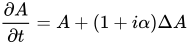
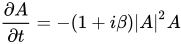
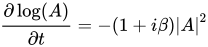
[28] 運算元分裂法可以用於除非線性薛定諤方程以外的其他方程。另一個可以使用運算元分裂法的方程是復 Ginzburg-Landau 方程 其中 是一個複函式,通常是一個、兩個或三個變數的函式。基於 Blanes、Casa、Chartier 和 Miura 早期有限差分程式碼,列表 L 提供了一個一維程式碼示例,該示例使用了 Blanes 等人[29] 描述的方法。透過使用復係數,Blanes 等人[30] 可以為拋物線方程建立高階分裂方法。以前的嘗試失敗了,因為如果只使用實係數,則對於高於二階的方法,所需的向後步驟會導致數值不穩定。修改示例程式碼,以解決一維、二維和三維空間中的復 Ginzburg-Landau 方程。線性部分 可以使用傅立葉變換顯式求解。要解決非線性部分, 考慮 並精確地求解 。為了恢復相位,觀察 ,它也可以顯式積分,因為 是已知的。
一個使用 16 階分裂法來解決三次非線性薛定諤方程的 Matlab 程式 程式碼下載()% A program to solve the nonlinear Schr\"{o}dinger equation using a % splitting method. The numerical solution is compared to an exact % solution. % S. Blanes, F. Casas, P. Chartier and A. Murua % "Optimized high-order splitting methods for some classes of parabolic % equations" % ArXiv pre-print 1102.1622v2 % Forthcoming Mathematics of Computation clear all; format compact; format short; set(0,'defaultaxesfontsize',30,'defaultaxeslinewidth',.7,... 'defaultlinelinewidth',6,'defaultpatchlinewidth',3.7,... 'defaultaxesfontweight','bold') % set up grid Lx = 20; % period 2*pi * L Nx = 16384; % number of harmonics Nt = 2000; % number of time slices dt = 0.25*pi/Nt;% time step U=zeros(Nx,Nt/10); method=3; % splitting method: 1 Strang, 2 CCDV10, 3 Blanes et al 2012 % initialise variables x = (2*pi/Nx)*(-Nx/2:Nx/2 -1)'*Lx; % x coordinate kx = 1i*[0:Nx/2-1 0 -Nx/2+1:-1]'/Lx; % wave vector % initial conditions t=0; tdata(1)=t; u=4*exp(1i*t)*(cosh(3*x)+3*exp(8*1i*t)*cosh(x))... ./(cosh(4*x)+4*cosh(2*x)+3*cos(8*t)); v=fft(u); figure(1); clf; plot(x,u);xlim([-2,2]); drawnow; U(:,1)=u; % mass ma = fft(abs(u).^2); ma0 = ma(1); if method==1, % % Strang-Splitting % s=2; a=[1;0]; b=[1/2;1/2]; % elseif method==2, % % Method of Castella, Chartier, Descombes and Vilmart % BIT Numerical Analysis vol 49 pp 487-508, 2009 % s=5; a=[1/4;1/4;1/4;1/4;0]; b=[1/10-1i/30;4/15+2*1i/15;4/15-1i/5;4/15+2*1i/15;1/10-1i/30]; % elseif method==3, % % Method of Blanes, Casas, Chartier and Murua 2012 % s=17; a=1/16*[1;1;1;1;1;1;1;1;1;1;1;1;1;1;1;1;0]; b=[0.028920177910074098791 - 0.005936580835725746103*1i; 0.056654351383649876160 + 0.020841963949772627119*1i; 0.067258385822722143569 - 0.039386393748812362460*1i; 0.070333980553260772061 + 0.058952097930307840316*1i; 0.077095100838099173580 - 0.038247636602014810025*1i; 0.042022140317231098258 - 0.033116379859951038579*1i; 0.050147397749937784280 + 0.061283684958324249562*1i; 0.047750191909146143447 - 0.032332468814362628262*1i; 0.119636547031757819706 + 0.015883426044923736862*1i; 0.047750191909146143447 - 0.032332468814362628262*1i; 0.050147397749937784280 + 0.061283684958324249562*1i; 0.042022140317231098258 - 0.033116379859951038579*1i; 0.077095100838099173580 - 0.038247636602014810025*1i; 0.070333980553260772061 + 0.058952097930307840316*1i; 0.067258385822722143569 - 0.039386393748812362460*1i; 0.056654351383649876160 + 0.020841963949772627119*1i; 0.028920177910074098791 - 0.005936580835725746103*1i]; end; % solve pde and plot results for n =2:Nt+1 for m=1:(s-1) vna=exp(b(m)*1i*dt*kx.*kx).*v; una=ifft(vna); pot=(2*una.*conj(una)); unb=exp(-1i*a(m)*(-1)*dt*pot).*una; v=fft(unb); end v=exp(b(s)*1i*dt*kx.*kx).*v; u=ifft(v); t=(n-1)*dt; if (mod(n,10)==0) tdata(n/10)=t; u=ifft(v); U(:,n/10)=u; uexact=... 4*exp(1i*t)*(cosh(3*x)+3*exp(8*1i*t)*cosh(x))... ./(cosh(4*x)+4*cosh(2*x)+3*cos(8*t)); figure(1); clf; plot(x,abs(u).^2); ... xlim([-0.5,0.5]); title(num2str(t)); figure(2); clf; loglog(abs(v(1:Nx/2))); ... title('Fourier Coefficients'); figure(3); clf; plot(x,abs(u-uexact).^2); ... xlim([-0.5,0.5]); title('error'); drawnow; ma = fft(abs(u).^2); ma = ma(1); test = log10(abs(1-ma/ma0)) end end figure(4); clf; mesh(tdata(1:(n-1)/10),x,abs(U(:,1:(n-1)/10)).^2); xlim([0,t]);




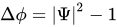



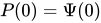



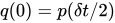
![{\displaystyle Q(\delta t)=\exp \left[i\left(\phi -|\Phi |^{4/D}\right)\delta t\right]Q(0)}](https://wikimedia.org/api/rest_v1/media/math/render/svg/5f48538d101098662f838d2206476d7005de58fe)
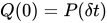
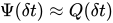





在本節中,我們將使用從 http://www.2decomp.org/index.html 獲得的 2DECOMP&FFT 庫。該網站包含一些示例,說明了如何使用此庫,特別是 http://www.2decomp.org/case_study1.html 中的示例程式碼,非常有助於說明如何將使用 FFTW 的程式碼轉換為使用 MPI 和上述庫的程式碼。
在使用 2DECOMP&FFT 建立並行 MPI 程式碼之前,我們將生成一個使用分裂法來解決 3D 非線性薛定諤方程的序列 Fortran 程式碼。我們不會使用基於迴圈的並行化來執行一系列一維快速傅立葉變換,而是使用 FFTW 的三維 FFT,這樣序列版本和 MPI 並行版本就具有相同的結構。序列版本在列表 E 中。此檔案可以透過與 Fortran 程式章節中的列表 A 中相同的方式進行編譯。
|
()
|
!--------------------------------------------------------------------
!
!
! PURPOSE
!
! This program solves nonlinear Schrodinger equation in 3 dimensions
! i*u_t+Es*|u|^2u+u_{xx}+u_{yy}+u_{zz}=0
! using a second order time spectral splitting scheme
!
! The boundary conditions are u(x=0,y,z)=u(2*Lx*\pi,y,z),
! u(x,y=0,z)=u(x,y=2*Ly*\pi,z), u(x,y,z=0)=u(x,y,z=2*Lz*\pi)
! The initial condition is u=exp(-x^2-y^2)
!
! .. Parameters ..
! Nx = number of modes in x - power of 2 for FFT
! Ny = number of modes in y - power of 2 for FFT
! Nz = number of modes in z - power of 2 for FFT
! Nt = number of timesteps to take
! Tmax = maximum simulation time
! plotgap = number of timesteps between plots
! FFTW_IN_PLACE = value for FFTW input
! FFTW_MEASURE = value for FFTW input
! FFTW_EXHAUSTIVE = value for FFTW input
! FFTW_PATIENT = value for FFTW input
! FFTW_ESTIMATE = value for FFTW input
! FFTW_FORWARD = value for FFTW input
! FFTW_BACKWARD = value for FFTW input
! pi = 3.14159265358979323846264338327950288419716939937510d0
! Lx = width of box in x direction
! Ly = width of box in y direction
! Lz = width of box in z direction
! ES = +1 for focusing and -1 for defocusing
! .. Scalars ..
! i = loop counter in x direction
! j = loop counter in y direction
! k = loop counter in z direction
! n = loop counter for timesteps direction
! allocatestatus = error indicator during allocation
! start = variable to record start time of program
! finish = variable to record end time of program
! count_rate = variable for clock count rate
! count = keep track of information written to disk
! iol = size of array to write to disk
! planfxyz = Forward 3d fft plan
! planbxyz = Backward 3d fft plan
! dt = timestep
! modescalereal = Number to scale after backward FFT
! ierr = error code
! .. Arrays ..
! unax = approximate solution
! vnax = Fourier transform of approximate solution
! potx = potential
! .. Vectors ..
! kx = fourier frequencies in x direction
! ky = fourier frequencies in y direction
! x = x locations
! y = y locations
! time = times at which save data
! name_config = array to store filename for data to be saved
! fftfxy = array to setup 2D Fourier transform
! fftbxy = array to setup 2D Fourier transform
!
! REFERENCES
!
! ACKNOWLEDGEMENTS
!
! ACCURACY
!
! ERROR INDICATORS AND WARNINGS
!
! FURTHER COMMENTS
! Check that the initial iterate is consistent with the
! boundary conditions for the domain specified
!--------------------------------------------------------------------
! External routines required
!
! External libraries required
! FFTW3 -- Fast Fourier Transform in the West Library
! (http://www.fftw.org/)
PROGRAM main
! Declare variables
IMPLICIT NONE
INTEGER(kind=4), PARAMETER	:: Nx=2**5
INTEGER(kind=4), PARAMETER :: Ny=2**5
INTEGER(kind=4), PARAMETER :: Nz=2**5
INTEGER(kind=4), PARAMETER	:: Nt=50
INTEGER(kind=4), PARAMETER	:: plotgap=10
REAL(kind=8), PARAMETER	::&
pi=3.14159265358979323846264338327950288419716939937510d0
REAL(kind=8), PARAMETER	:: Lx=2.0d0,Ly=2.0d0,Lz=2.0d0
REAL(kind=8), PARAMETER	:: Es=1.0d0
REAL(kind=8)	:: dt=0.10d0/Nt
REAL(kind=8) :: modescalereal
COMPLEX(kind=8), DIMENSION(:), ALLOCATABLE	:: kx,ky,kz
REAL(kind=8), DIMENSION(:), ALLOCATABLE	:: x,y,z
COMPLEX(kind=8), DIMENSION(:,:,:), ALLOCATABLE	:: unax,vnax,potx
REAL(kind=8), DIMENSION(:), ALLOCATABLE	:: time
INTEGER(kind=4)	:: i,j,k,n,AllocateStatus,count,iol
! timing
INTEGER(kind=4)	:: start, finish, count_rate
   ! fftw variables
INTEGER(kind=8), PARAMETER	:: FFTW_IN_PLACE = 8, FFTW_MEASURE = 0, &
FFTW_EXHAUSTIVE = 8, FFTW_PATIENT = 32, FFTW_ESTIMATE = 64
INTEGER(kind=8),PARAMETER	:: FFTW_FORWARD = -1, FFTW_BACKWARD=1
INTEGER(kind=8)	::	planfxyz,planbxyz
CHARACTER*100	::	name_config, number_file

CALL system_clock(start,count_rate)
ALLOCATE(unax(1:Nx,1:Ny,1:Nz),vnax(1:Nx,1:Ny,1:Nz),potx(1:Nx,1:Ny,1:Nz),&
    kx(1:Nx),ky(1:Ny),kz(1:Nz),x(1:Nx),y(1:Ny),z(1:Nz),&
    time(1:1+Nt/plotgap),stat=AllocateStatus)
IF (AllocateStatus .ne. 0) STOP
PRINT *,'allocated space'
modescalereal=1.0d0/REAL(Nx,KIND(0d0))
modescalereal=modescalereal/REAL(Ny,KIND(0d0))
modescalereal=modescalereal/REAL(Nz,KIND(0d0))

! set up ffts
CALL dfftw_plan_dft_3d_(planfxyz,Nx,Ny,Nz,unax(1:Nx,1:Ny,1:Nz),&
vnax(1:Nx,1:Ny,1:Nz),FFTW_FORWARD,FFTW_ESTIMATE)
  CALL dfftw_plan_dft_3d_(planbxyz,Nx,Ny,Nz,vnax(1:Nx,1:Ny,1:Nz),&
  unax(1:Nx,1:Ny,1:Nz),FFTW_BACKWARD,FFTW_ESTIMATE)

PRINT *,'Setup FFTs'

! setup fourier frequencies and grid points
DO i=1,1+Nx/2
kx(i)= cmplx(0.0d0,1.0)*REAL(i-1,kind(0d0))/Lx
END DO
kx(1+Nx/2)=0.0d0
DO i = 1,Nx/2 -1
kx(i+1+Nx/2)=-kx(1-i+Nx/2)
END DO
DO i=1,Nx
x(i)=(-1.0d0+2.0d0*REAL(i-1,kind(0d0))/REAL(Nx,kind(0d0)) )*pi*Lx
END DO
DO j=1,1+Ny/2
ky(j)= cmplx(0.0d0,1.0d0)*REAL(j-1,kind(0d0))/Ly
END DO
ky(1+Ny/2)=0.0d0
DO j = 1,Ny/2 -1
ky(j+1+Ny/2)=-ky(1-j+Ny/2)
END DO
DO j=1,Ny
y(j)=(-1.0d0+2.0d0*REAL(j-1,kind(0d0))/REAL(Ny,kind(0d0)) )*pi*Ly
END DO
DO k=1,1+Nz/2
kz(k)= cmplx(0.0d0,1.0d0)*REAL(k-1,kind(0d0))/Lz
END DO
kz(1+Nz/2)=0.0d0
DO k = 1,Nz/2 -1
kz(k+1+Nz/2)=-kz(1-k+Nz/2)
END DO
DO k=1,Nz
z(k)=(-1.0d0+2.0d0*REAL(k-1,kind(0d0))/REAL(Nz,kind(0d0)) )*pi*Lz
END DO

PRINT *,'Setup grid and fourier frequencies'

DO k=1,Nz;	DO j=1,Ny; DO i=1,Nx
unax(i,j,k)=exp(-1.0d0*(x(i)**2 +y(j)**2+z(k)**2))
END DO; END DO; END DO
name_config = 'uinitial.dat'
INQUIRE(iolength=iol) unax(1,1,1)
OPEN(unit=11,FILE=name_config,form="unformatted", &
access="direct",recl=iol)
count=1
DO k=1,Nz; DO j=1,Ny; DO i=1,Nx
WRITE(11,rec=count) unax(i,j,k)
        count=count+1
END DO; END DO; END DO
CLOSE(11)

CALL dfftw_execute_dft_(planfxyz,unax(1:Nx,1:Ny,1:Nz),vnax(1:Nx,1:Ny,1:Nz))

PRINT *,'Got initial data, starting timestepping'
time(1)=0
DO n=1,Nt
DO k=1,Nz; DO j=1,Ny; DO i=1,Nx
vnax(i,j,k)=exp(0.50d0*dt*&
(kz(k)*kz(k) + kx(i)*kx(i) + ky(j)*ky(j))&
*cmplx(0.0d0,1.0d0))*vnax(i,j,k)
END DO; END DO; END DO
CALL dfftw_execute_dft_(planbxyz,vnax(1:Nx,1:Ny,1:Nz),&
unax(1:Nx,1:Ny,1:Nz))

DO k=1,Nz; DO j=1,Ny; DO i=1,Nx
unax(i,j,k)=unax(i,j,k)*modescalereal
potx(i,j,k)=Es*unax(i,j,k)*conjg(unax(i,j,k))
unax(i,j,k)=exp(cmplx(0.0d0,-1.0d0)*dt*potx(i,j,k))&
*unax(i,j,k)
END DO; END DO; END DO
CALL dfftw_execute_dft_(planfxyz,unax(1:Nx,1:Ny,1:Nz),&
vnax(1:Nx,1:Ny,1:Nz))

DO k=1,Nz; DO j=1,Ny; DO i=1,Nx
vnax(i,j,k)=exp(0.5d0*dt*&
(kx(i)*kx(i) + ky(j)*ky(j)+ kz(k)*kz(k))&
*cmplx(0.0d0,1.0d0))*vnax(i,j,k)
END DO; END DO; END DO
IF (mod(n,plotgap)==0) THEN
time(1+n/plotgap)=n*dt
PRINT *,'time',n*dt
CALL dfftw_execute_dft_(planbxyz,vnax(1:Nx,1:Ny,1:Nz),unax(1:Nx,1:Ny,1:Nz))
DO k=1,Nz; DO j=1,Ny; DO i=1,Nx
unax(i,j,k)=unax(i,j,k)*modescalereal
END DO; END DO; END DO
name_config='./data/u'
WRITE(number_file,'(i0)') 10000000+1+n/plotgap
ind=index(name_config,' ') -1
name_config=name_config(1:ind)//numberfile
ind=index(name_config,' ') -1
name_config=name_config(1:ind)//'.dat'
OPEN(unit=11,FILE=name_config,status="UNKNOWN")
REWIND(11)
DO j=1,Ny
DO i=1,Nx
WRITE(11,*) abs(unax(i,j))**2
END DO
END DO
CLOSE(11)

END IF
END DO
PRINT *,'Finished time stepping'

! transform back final data and do another half time step
CALL system_clock(finish,count_rate)
PRINT*,'Program took ',REAL(finish-start)/REAL(count_rate),'for execution'

name_config = 'tdata.dat'
OPEN(unit=11,FILE=name_config,status="UNKNOWN")
REWIND(11)
DO j=1,1+Nt/plotgap
WRITE(11,*) time(j)
END DO
CLOSE(11)

name_config = 'xcoord.dat'
OPEN(unit=11,FILE=name_config,status="UNKNOWN")
REWIND(11)
DO i=1,Nx
WRITE(11,*) x(i)
END DO
CLOSE(11)

name_config = 'ycoord.dat'
OPEN(unit=11,FILE=name_config,status="UNKNOWN")
REWIND(11)
DO j=1,Ny
WRITE(11,*) y(j)
END DO
CLOSE(11)

name_config = 'zcoord.dat'
OPEN(unit=11,FILE=name_config,status="UNKNOWN")
REWIND(11)
DO k=1,Nz
WRITE(11,*) z(k)
END DO
CLOSE(11)
PRINT *,'Saved data'

CALL dfftw_destroy_plan_(planbxyz)
CALL dfftw_destroy_plan_(planfxyz)
CALL dfftw_cleanup_()

DEALLOCATE(unax,vnax,potx,&
    kx,ky,kz,x,y,z,&
    time,stat=AllocateStatus)
IF (AllocateStatus .ne. 0) STOP
PRINT *,'Program execution complete'
END PROGRAM main
與之前的程式相比,列表 E 中的程式將其最終資料作為二進位制檔案寫入。這通常比寫入文字檔案快得多,並且生成的二進位制檔案的大小通常也小得多。當寫入多個此類檔案時,或者當單個檔案很大時,這一點很重要。由於格式發生了變化,二進位制檔案也需要使用稍微不同的方式讀入。列表 N 中的 Matlab 指令碼展示瞭如何做到這一點。
|
()
|
% A program to plot the computed results

clear all; format compact, format short,
set(0,'defaultaxesfontsize',18,'defaultaxeslinewidth',.9,...
    'defaultlinelinewidth',3.5,'defaultpatchlinewidth',5.5);

% Load data
tdata=load('./tdata.dat');
x=load('./xcoord.dat');
y=load('./ycoord.dat');
z=load('./zcoord.dat');
Tsteps = length(tdata);

Nx = length(x); Nt = length(tdata);
Ny = length(y); Nz = length(z);
fid=fopen('./ufinal.datbin','r');
[fname,mode,mformat]=fopen(fid);
u=fread(fid,Nx*Ny*Nz,'double',mformat);
u = reshape(u,Nx,Ny,Nz);

% Plot data
figure (1); clf ; UP = abs(u).^2;
p1 = patch(isosurface(x,y,z,UP,.0025) ,...
'FaceColor','yellow','EdgeColor','none');
p2 = patch(isocaps(x,y,z,UP,.0025) ,...
'FaceColor','interp','EdgeColor','none');
isonormals(UP,p1); lighting phong;
xlabel('x'); ylabel('y'); zlabel('z');
axis equal; axis square; view(3); drawnow;
現在,我們將修改上述程式碼,以使用 MPI 和 2DECOMP&FFT 庫。2DECOMP&FFT 庫隱藏了大多數 MPI 的細節,儘管有一些命令對使用者理解非常有用。這些命令是
- USE mpi或INCLUDE 'mpif.h'
- MPI_INIT
- MPI_COMM_SIZE
- MPI_COMM_RANK
- MPI_FINALIZE
程式在清單 O 中列出,請將其與 E 中的序列程式碼進行比較。庫 2DECOMP&FFT 對陣列進行域分解,以便將陣列的不同部分放到不同的處理器上。即使陣列儲存在不同的處理器上,該庫也可以對陣列執行傅立葉變換——該庫執行執行傅立葉變換所需的所有必要訊息傳遞和轉置。需要注意的是,傅立葉變換後陣列中條目順序不一定與 FFTW 使用的順序相同。但是,結構將返回條目的正確排序decomp因此,此結構用於獲取迴圈的起始和結束條目。我們假設庫 2DECOMP&FFT 已安裝在適當的位置。
|
()
|
!--------------------------------------------------------------------
!
!
! PURPOSE
!
! This program solves nonlinear Schrodinger equation in 3 dimensions
! i*u_t+Es*|u|^2u+u_{xx}+u_{yy}+u_{zz}=0
! using a second order time spectral splitting scheme
!
! The boundary conditions are u(x=0,y,z)=u(2*Lx*\pi,y,z),
! u(x,y=0,z)=u(x,y=2*Ly*\pi,z), u(x,y,z=0)=u(x,y,z=2*Lz*\pi)
! The initial condition is u=exp(-x^2-y^2)
!
! .. Parameters ..
! Nx = number of modes in x - power of 2 for FFT
! Ny = number of modes in y - power of 2 for FFT
! Nz = number of modes in z - power of 2 for FFT
! Nt = number of timesteps to take
! Tmax = maximum simulation time
! plotgap = number of timesteps between plots
! pi = 3.14159265358979323846264338327950288419716939937510d0
! Lx = width of box in x direction
! Ly = width of box in y direction
! Lz = width of box in z direction
! ES = +1 for focusing and -1 for defocusing
! .. Scalars ..
! i = loop counter in x direction
! j = loop counter in y direction
! k = loop counter in z direction
! n = loop counter for timesteps direction
! allocatestatus = error indicator during allocation
! start = variable to record start time of program
! finish = variable to record end time of program
! count_rate = variable for clock count rate
! dt = timestep
! modescalereal = Number to scale after backward FFT
! myid = Process id
! ierr = error code
! p_row = number of rows for domain decomposition
! p_col = number of columns for domain decomposition
! filesize = total filesize
! disp = displacement to start writing data from
! ind = index in array to write
! plotnum = number of plot to save
! numberfile = number of the file to be saved to disk
! stat = error indicator when reading inputfile
! .. Arrays ..
! u = approximate solution
! v = Fourier transform of approximate solution
! pot = potential
! .. Vectors ..
! kx = fourier frequencies in x direction
! ky = fourier frequencies in y direction
! kz = fourier frequencies in z direction
! x = x locations
! y = y locations
! z = z locations
! time = times at which save data
! nameconfig = array to store filename for data to be saved
! InputFileName = name of the Input File
! .. Special Structures ..
! decomp = contains information on domain decomposition
! see http://www.2decomp.org/ for more information
!
! REFERENCES
!
! ACKNOWLEDGEMENTS
!
! ACCURACY
!
! ERROR INDICATORS AND WARNINGS
!
! FURTHER COMMENTS
! Check that the initial iterate is consistent with the
! boundary conditions for the domain specified
!--------------------------------------------------------------------
! External routines required
!
! External libraries required
! 2DECOMP&FFT -- Domain decomposition and Fast Fourier Library
! (http://www.2decomp.org/index.html)
! MPI library

PROGRAM main
USE decomp_2d
USE decomp_2d_fft
USE decomp_2d_io
USE MPI
! Declare variables
IMPLICIT NONE
INTEGER(kind=4)	:: Nx=2**5
INTEGER(kind=4) :: Ny=2**5
INTEGER(kind=4) :: Nz=2**5
INTEGER(kind=4)	:: Nt=50
INTEGER(kind=4)	:: plotgap=10
REAL(kind=8), PARAMETER	::&
pi=3.14159265358979323846264338327950288419716939937510d0
REAL(kind=8)	:: Lx=2.0d0,Ly=2.0d0,Lz=2.0d0
REAL(kind=8)	:: Es=1.0d0
REAL(kind=8)	:: dt=0.0010d0
COMPLEX(kind=8), DIMENSION(:), ALLOCATABLE	:: kx,ky,kz
REAL(kind=8), DIMENSION(:), ALLOCATABLE	:: x,y,z
COMPLEX(kind=8), DIMENSION(:,:,:), ALLOCATABLE	:: u,v,pot
REAL(kind=8), DIMENSION(:), ALLOCATABLE	:: time
INTEGER(KIND=4), DIMENSION(1:5)	:: intcomm
REAL(KIND=8), DIMENSION(1:5)	:: dpcomm
REAL(kind=8) :: modescalereal
INTEGER(kind=4)	:: i,j,k,n,AllocateStatus,stat
INTEGER(kind=4)	:: myid,numprocs,ierr
TYPE(DECOMP_INFO)	:: decomp
INTEGER(kind=MPI_OFFSET_KIND) :: filesize, disp
INTEGER(kind=4)	:: p_row=0, p_col=0
  INTEGER(kind=4)	:: start, finish, count_rate, ind, plotnum
CHARACTER*50	::	nameconfig
CHARACTER*20	::	numberfile
! initialisation of MPI
CALL MPI_INIT(ierr)
CALL MPI_COMM_SIZE(MPI_COMM_WORLD, numprocs, ierr)
CALL MPI_COMM_RANK(MPI_COMM_WORLD, myid, ierr)

! initialisation of 2decomp
! do automatic domain decomposition
CALL decomp_2d_init(Nx,Ny,Nz,p_row,p_col)
! get information about domain decomposition choosen
CALL decomp_info_init(Nx,Ny,Nz,decomp)
! initialise FFT library
CALL decomp_2d_fft_init
ALLOCATE(u(decomp%xst(1):decomp%xen(1),&
    decomp%xst(2):decomp%xen(2),&
    decomp%xst(3):decomp%xen(3)),&
            v(decomp%zst(1):decomp%zen(1),&
             decomp%zst(2):decomp%zen(2),&
             decomp%zst(3):decomp%zen(3)),&
            pot(decomp%xst(1):decomp%xen(1),&
             decomp%xst(2):decomp%xen(2),&
             decomp%xst(3):decomp%xen(3)),&
    kx(1:Nx),ky(1:Ny),kz(1:Nz),&
    x(1:Nx),y(1:Ny),z(1:Nz),&
    time(1:1+Nt/plotgap),stat=AllocateStatus)
IF (AllocateStatus .ne. 0) STOP

IF (myid.eq.0) THEN
PRINT *,'allocated space'
END IF
modescalereal=1.0d0/REAL(Nx,KIND(0d0))
modescalereal=modescalereal/REAL(Ny,KIND(0d0))
modescalereal=modescalereal/REAL(Nz,KIND(0d0))

! setup fourier frequencies and grid points
DO i=1,1+Nx/2
kx(i)= cmplx(0.0d0,1.0d0)*REAL(i-1,kind(0d0))/Lx
END DO
kx(1+Nx/2)=0.0d0
DO i = 1,Nx/2 -1
kx(i+1+Nx/2)=-kx(1-i+Nx/2)
END DO
DO i=1,Nx
x(i)=(-1.0d0 + 2.0d0*REAL(i-1,kind(0d0))/REAL(Nx,kind(0d0)))*pi*Lx
END DO
DO j=1,1+Ny/2
ky(j)= cmplx(0.0d0,1.0d0)*REAL(j-1,kind(0d0))/Ly
END DO
ky(1+Ny/2)=0.0d0
DO j = 1,Ny/2 -1
ky(j+1+Ny/2)=-ky(1-j+Ny/2)
END DO
DO j=1,Ny
y(j)=(-1.0d0 + 2.0d0*REAL(j-1,kind(0d0))/REAL(Ny,kind(0d0)))*pi*Ly
END DO
DO k=1,1+Nz/2
kz(k)= cmplx(0.0d0,1.0d0)*REAL(k-1,kind(0d0))/Lz
END DO
kz(1+Nz/2)=0.0d0
DO k = 1,Nz/2 -1
kz(k+1+Nz/2)=-kz(1-k+Nz/2)
END DO
DO k=1,Nz
z(k)=(-1.0d0 + 2.0d0*REAL(k-1,kind(0d0))/REAL(Nz,kind(0d0)))*pi*Lz
END DO

IF (myid.eq.0) THEN
PRINT *,'Setup grid and fourier frequencies'
END IF
DO k=decomp%xst(3),decomp%xen(3)
DO j=decomp%xst(2),decomp%xen(2)
DO i=decomp%xst(1),decomp%xen(1)
u(i,j,k)=exp(-1.0d0*(x(i)**2 +y(j)**2+z(k)**2))
END DO
END DO
END DO

! write out using 2DECOMP&FFT MPI-IO routines
nameconfig='./data/u'
plotnum=0
WRITE(numberfile,'(i0)') 10000000+plotnum
ind=index(nameconfig,' ') -1
nameconfig=nameconfig(1:ind)//numberfile
ind=index(nameconfig,' ') -1
nameconfig=nameconfig(1:ind)//'.datbin'
CALL decomp_2d_write_one(1,u,nameconfig)

CALL decomp_2d_fft_3d(u,v,DECOMP_2D_FFT_FORWARD)
IF (myid.eq.0) THEN
PRINT *,'Got initial data, starting timestepping'
END IF
CALL system_clock(start,count_rate)
time(1)=0
DO n=1,Nt
! Use Strang splitting
DO k=decomp%zst(3),decomp%zen(3)
DO j=decomp%zst(2),decomp%zen(2)
DO i=decomp%zst(1),decomp%zen(1)
v(i,j,k)=exp(0.50d0*dt*&
(kz(k)*kz(k) + kx(i)*kx(i) + ky(j)*ky(j))&
*cmplx(0.0d0,1.0d0))*v(i,j,k)
END DO
END DO
END DO

CALL decomp_2d_fft_3d(v,u,DECOMP_2D_FFT_BACKWARD)

DO k=decomp%xst(3),decomp%xen(3)
DO j=decomp%xst(2),decomp%xen(2)
DO i=decomp%xst(1),decomp%xen(1)
u(i,j,k)=u(i,j,k)*modescalereal
pot(i,j,k)=Es*u(i,j,k)*conjg(u(i,j,k))
u(i,j,k)=exp(cmplx(0.0d0,-1.0d0)*dt*pot(i,j,k))*u(i,j,k)
END DO
END DO
END DO
CALL decomp_2d_fft_3d(u,v,DECOMP_2D_FFT_FORWARD)

DO k=decomp%zst(3),decomp%zen(3)
DO j=decomp%zst(2),decomp%zen(2)
DO i=decomp%zst(1),decomp%zen(1)
v(i,j,k)=exp(dt*0.5d0*&
(kx(i)*kx(i) +ky(j)*ky(j) +kz(k)*kz(k))&
*cmplx(0.0d0,1.0d0))*v(i,j,k)
END DO
END DO
END DO
IF (mod(n,plotgap)==0) THEN
time(1+n/plotgap)=n*dt
IF (myid.eq.0) THEN
PRINT *,'time',n*dt
END IF
CALL decomp_2d_fft_3d(v,u,DECOMP_2D_FFT_BACKWARD)
u=u*modescalereal
nameconfig='./data/u'
plotnum=plotnum+1
WRITE(numberfile,'(i0)') 10000000+plotnum
ind=index(nameconfig,' ') -1
nameconfig=nameconfig(1:ind)//numberfile
ind=index(nameconfig,' ') -1
nameconfig=nameconfig(1:ind)//'.datbin'
! write out using 2DECOMP&FFT MPI-IO routines
CALL decomp_2d_write_one(1,u,nameconfig)
END IF
END DO
IF (myid.eq.0) THEN
PRINT *,'Finished time stepping'
END IF

CALL system_clock(finish,count_rate)

IF (myid.eq.0) THEN
PRINT*,'Program took ',REAL(finish-start)/REAL(count_rate),'for execution'
END IF
IF (myid.eq.0) THEN
! Save times at which output was made in text format
nameconfig = './data/tdata.dat'
OPEN(unit=11,FILE=nameconfig,status="UNKNOWN")
REWIND(11)
DO j=1,1+Nt/plotgap
WRITE(11,*) time(j)
END DO
CLOSE(11)
! Save x grid points in text format
nameconfig = './data/xcoord.dat'
OPEN(unit=11,FILE=nameconfig,status="UNKNOWN")
REWIND(11)
DO i=1,Nx
WRITE(11,*) x(i)
END DO
CLOSE(11)
! Save y grid points in text format
nameconfig = './data/ycoord.dat'
OPEN(unit=11,FILE=nameconfig,status="UNKNOWN")
REWIND(11)
DO j=1,Ny
WRITE(11,*) y(j)
END DO
CLOSE(11)
! Save z grid points in text format
nameconfig = './data/zcoord.dat'
OPEN(unit=11,FILE=nameconfig,status="UNKNOWN")
REWIND(11)
DO k=1,Nz
WRITE(11,*) z(k)
END DO
CLOSE(11)
PRINT *,'Saved data'
END IF

! clean up
   CALL decomp_2d_fft_finalize
   CALL decomp_2d_finalize
  DEALLOCATE(u,v,pot,&
    kx,ky,kz,x,y,z,&
    time,stat=AllocateStatus)
IF (AllocateStatus .ne. 0) STOP
IF (myid.eq.0) THEN
PRINT *,'Program execution complete'
END IF
CALL MPI_FINALIZE(ierr)
END PROGRAM main
要編譯程式碼,請根據您的系統在清單 P 中相應地修改 makefile。鍵入 make,然後在編譯後您應該就可以執行它了。假設 FFTW 是 2DECOMP&FFT 呼叫的底層一維快速傅立葉變換庫,因此如果使用其他庫,則應更改它。請注意,如果您要更改問題大小或執行時間,則需要重新構建程式。
|
()
|
COMPILER =  mpif90
decompdir=../2decomp_fft
FLAGS = -O0

DECOMPLIB = -I${decompdir}/include -L${decompdir}/lib -l2decomp_fft
LIBS = -L${FFTW_LINK} -lfftw3_threads -lfftw3 -lm
SOURCES = NLSsplitting.f90

NLSsplitting: $(SOURCES)
		${COMPILER} -o NLSsplitting $(FLAGS) $(SOURCES) $(LIBS) $(DECOMPLIB)


clean:
	rm -f *.o
	rm -f *.mod
clobber:
	rm -f NLSsplitting
練習
[edit | edit source]- ASCII 字元集需要每個字元 7 位,因此至少需要 7 位來儲存 0 到 9 之間的數字。IEEE 算術中的雙精度數需要 64 位來儲存一個雙精度數,大約有 15 位十進位制數和大約 3 位十進位制數指數。儲存 IEEE 雙精度數需要多少位?假設一個檔案有 個雙精度數。如果數字儲存為 IEEE 雙精度數,則檔案的最小大小是多少?如果數字儲存為字元,則檔案的最小大小是多少?
- 使用 2DECOMP&FFT 編寫一個 MPI 程式碼來求解三維 Gross-Pitaevskii 方程。
- 學習使用 VisIt (https://wci.llnl.gov/codes/visit/) 或 Paraview (http://www.paraview.org/) 並編寫一個指令碼以類似於 Matlab 程式碼的方式視覺化二維和三維輸出。

注意
[edit | edit source]- ↑ Sulem 和 Sulem (1999)
- ↑ 楊 (2010)
- ↑ Evans (2010)
- ↑ Linares 和 Ponce (2009)
- ↑ Lieb 和 Loss (2003)
- ↑ Rennardy 和 Rogers (2004)
- ↑ Sulem 和 Sulem (1989)
- ↑ 為了簡化演示,我們主要考慮聚焦立方非線性薛定諤方程。
- ↑ Klein (2008)
- ↑ Holden 等人 (2011)
- ↑ McLachlan 和 Quispel (2002)
- ↑ Thalhammer
- ↑ Shen、Tang 和 Wang (2011)
- ↑ Weideman 和 Herbst (1986)
- ↑ 楊 (2010)
- ↑ Klein (2008)
- ↑ Holden 等人 (2011)
- ↑ Holden 等人 (2011)
- ↑ 也就是說 。
- ↑ 可以使用指數函式的級數展開來推匯出它,,並從 中減去 。
- ↑ Klein (2008)
- ↑ Thalhammer (2008)
- ↑ Klein、Muite 和 Roidot (2011)
- ↑ http://en.wikipedia.org/wiki/Gross\%E2\%80\%93Pitaevskii\_equation
- ↑
這個問題是由 Joshua Kirschenheiter 的專案引起的。
- ↑ Eliasson 和 Shukla (2009)
- ↑ Klein、Muite 和 Roidot (2011)
- ↑
這個問題是由 Kohei Harada 和 Matt Warnez 的專案引起的。
- ↑ Blanes 等人
- ↑ Blanes 等人



Blanes, S.; Casas, F.; Chartier, P.; Murua, A. "Splitting methods with complex coefficients for some classes of evolution equations". Mathematics of Computation.
Shukla, P.K. (2009). "Nonlinear aspects of quantum plasma physics: Nanoplasmonics and nanostructures in dense plasmas". Plasma and Fusion Research: Review Articles. 4: 32.
Evans, L.C. (2010). Partial Differential Equations. American Mathematical Society.
Holden, H.; Karlsen, K.H.; Risebro, N.H.; Tao, T. (2011). "Operator splitting for the KdV equation". Mathematics of Computation. 80: 821–846.
Klein, C. (2008). "Fourth order time-stepping for low dispersion Korteweg-De Vries and nonlinear Schrödinger equations". Electronic Transactions on Numerical Analysis. 29: 116–135.
Klein, C.; Muite, B.K.; Roidot, K. (2011). "Numerical Study of Blowup in the Davey-Stewartson System". {{cite journal}}: Cite journal requires |journal= (help)
Klein, C.; Roidot, K. (2011). "Fourth order time-stepping for Kadomstev-Petviashvili and Davey-Stewartson Equations". SIAM Journal on Scientific Computation. 33: 3333–3356.
Loss, M. (2003). Analysis. American Mathematical Society.
Ponce, G. (2009). Introduction to Nonlinear Dispersive Equations. Springer.
McLachlan, R.I.; Quispel, G.R.W. (2002). "Splitting Methods". Acta Numerica. 11: 341–434.
Rogers, R.C. (2004). An Introduction to Partial Differential Equations. Springer.
Wang, L.-L. (2011). Spectral Methods: Algorithms, Analysis and Applications. Springer.
Sulem, P.L. (1999). The Nonlinear Schrödinger equation: Self-Focusing and Wave Collapse. Springer.
Thalhammer, M. Time-Splitting Spectral Methods for Nonlinear Schrödinger Equations (PDF). {{cite book}}: Cite has empty unknown parameter: |coauthors= (help)
Weideman, J.A.C.; Herbst, B.M. (1986). "Split-step methods for the solution of the nonlinear Schrödinger equation". SIAM Journal on Numerical Analysis. SIAM. 23 (3): 485–507.
Yang, J. (2010). Nonlinear Waves in Integrable and Nonintegrable Systems. SIAM.