假設我們給定一個離散隨機變數 X {\displaystyle X} Y {\displaystyle Y} f X ( x ) = ( 1 { x = 0 } + 1 { x = 1 } ) / 2 and f Y ( y ) = ( 1 { y = 0 } + 1 { y = 2 } ) / 2 {\displaystyle f_{X}(x)=(\mathbf {1} \{x=0\}+\mathbf {1} \{x=1\})/2\quad {\text{and}}\quad f_{Y}(y)=(\mathbf {1} \{y=0\}+\mathbf {1} \{y=2\})/2} X {\displaystyle X} Y {\displaystyle Y}
例如,隨機變數 X {\displaystyle X} X = 1 {\displaystyle X=1} X = 0 {\displaystyle X=0} Y {\displaystyle Y} Y = 2 {\displaystyle Y=2} Y = 0 {\displaystyle Y=0} X {\displaystyle X} Y {\displaystyle Y}
另一種可能性是隨機變數 Y {\displaystyle Y} Y = 2 X {\displaystyle Y=2X} Y = 0 {\displaystyle Y=0} X {\displaystyle X} Y {\displaystyle Y}
然而,在以上兩個例子中, X {\displaystyle X} Y {\displaystyle Y}
因此,為了說明 關係 X {\displaystyle X} Y {\displaystyle Y} 聯合
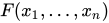
定義。 (聯合累積分佈函式) 設 X 1 , … , X n {\displaystyle X_{1},\dotsc ,X_{n}} Ω {\displaystyle \Omega } X 1 , … , X n {\displaystyle X_{1},\dotsc ,X_{n}} 聯合 F ( x 1 , … , x n ) = P ( X 1 ≤ x 1 ∩ ⋯ ∩ X n ≤ x n ) = P ( ⋂ i = 1 n { ω ∈ Ω : X i ( ω ) ≤ x i } ) . {\displaystyle F(x_{1},\dotsc ,x_{n})=\mathbb {P} (X_{1}\leq x_{1}\cap \cdots \cap X_{n}\leq x_{n})=\mathbb {P} \left(\bigcap _{i=1}^{n}\{\omega \in \Omega :X_{i}(\omega )\leq x_{i}\}\right).}
有時,我們可能想知道一個聯合CDF中涉及的隨機變數的隨機行為。我們可以透過從聯合CDF計算邊際CDF來實現這一點。邊際CDF的定義如下
備註。 實際上, X i {\displaystyle X_{i}} X i {\displaystyle X_{i}}
命題。 (從聯合累積分佈函式 (CDF) 獲得邊緣 CDF)給定一個聯合 CDF F ( x 1 , … , x n ) {\displaystyle F(x_{1},\dotsc ,x_{n})} X i {\displaystyle X_{i}} F X i ( x ) = F ( ∞ , … , ∞ , x ⏟ i -th position , ∞ , … , ∞ ) . {\displaystyle F_{X_{i}}(x)=F(\infty ,\dotsc ,\infty ,\underbrace {x} _{i{\text{-th position}}},\infty ,\dotsc ,\infty ).}
備註。 一般來說,我們無法從給定的一組邊緣 CDF 推匯出聯合 CDF。
類似於單變數情況,我們有聯合 PMF 和聯合 PDF。同樣地,我們也有邊緣 PMF 和邊緣 PDF。
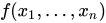
定義。 (聯合機率質量函式) X 1 , … , X n {\displaystyle X_{1},\dotsc ,X_{n}} 聯合機率質量函式 f ( x 1 , … , x n ) = P ( ( X 1 , … , X n ) = ( x 1 , … , x n ) ) , ( x 1 , … , x n ) ∈ R n . {\displaystyle f(x_{1},\dotsc ,x_{n})=\mathbb {P} {\big (}(X_{1},\dotsc ,X_{n})=(x_{1},\dotsc ,x_{n}){\big )},\quad (x_{1},\dotsc ,x_{n})\in \mathbb {R} ^{n}.}
命題. (從聯合機率質量函式獲取邊緣機率質量函式) 對於離散隨機變數 X 1 , … , X n {\displaystyle X_{1},\dotsc ,X_{n}} f {\displaystyle f} X i {\displaystyle X_{i}} f X i ( x ) = ∑ u 1 ⋯ ∑ u i − 1 ∑ u i + 1 ⋯ ∑ u n ⏟ n − 1 summations f ( u 1 , … , u i − 1 , x , u i + 1 , … , u n ) . {\displaystyle f_{X_{i}}({\color {red}x})=\underbrace {\sum _{u_{1}}\cdots \sum _{u_{i-1}}\sum _{u_{i+1}}\cdots \sum _{u_{n}}} _{n-1\;{\text{summations}}}f(u_{1},\dotsc ,u_{i-1},{\color {red}x},u_{i+1},\dotsc ,u_{n}).}
證明。 考慮只有兩個隨機變數的情況,比如 X {\displaystyle X} Y {\displaystyle Y} ∑ y f ( x , y ) = ∑ y P ( X = x ∩ Y = y ) = P ( X = x ) by law of total probability . {\displaystyle \sum _{\color {green}y}f({\color {red}x},{\color {green}y})=\sum _{\color {green}y}\mathbb {P} (X={\color {red}x}\cap {\color {green}Y=y})=\mathbb {P} (X={\color {red}x})\qquad {\text{by law of total probability}}.} ∑ u n f ( u 1 , … , u i − 1 , x , u i + 1 , … , u n ) = ∑ u n P ( X 1 ≤ u 1 ∩ ⋯ ∩ X i − 1 u i − 1 ∩ X i ≤ x ∩ X i + 1 ≤ u i + 1 ∩ ⋯ ∩ X n − 1 ≤ u n − 1 ∩ X n ≤ u n ) = P ( X 1 ≤ u 1 ∩ ⋯ ∩ X i − 1 u i − 1 ∩ X i ≤ x ∩ X i + 1 ≤ u i + 1 ∩ ⋯ ∩ X n − 1 ≤ u n − 1 ) by law of total probability . {\displaystyle {\begin{aligned}\sum _{\color {green}u_{n}}f(u_{1},\dotsc ,u_{i-1},{\color {red}x},u_{i+1},\dotsc ,{\color {green}u_{n}})&=\sum _{\color {green}u_{n}}\mathbb {P} (X_{1}\leq u_{1}\cap \cdots \cap X_{i-1}u_{i-1}\cap X_{i}\leq {\color {red}x}\cap X_{i+1}\leq u_{i+1}\cap \cdots \cap X_{n-1}\leq u_{n-1}\cap {\color {green}X_{n}\leq u_{n}})\\&=\mathbb {P} (X_{1}\leq u_{1}\cap \cdots \cap X_{i-1}u_{i-1}\cap X_{i}\leq {\color {red}x}\cap X_{i+1}\leq u_{i+1}\cap \cdots \cap X_{n-1}\leq u_{n-1})\qquad {\text{by law of total probability}}.\end{aligned}}} n − 2 {\displaystyle n-2} n − 1 {\displaystyle n-1} ◻ {\displaystyle \Box }
備註。 這個過程有時被稱為“對其他變數的所有可能值求和”。
示例: 假設我們擲一個公平的六面骰子兩次。設 X {\displaystyle X} Y {\displaystyle Y} ( X , Y ) {\displaystyle (X,Y)} 聯合機率質量函式 f ( x , y ) = P ( X = x ∩ Y = y ) = 1 6 ⋅ 1 6 = 1 36 . {\displaystyle f(x,y)=\mathbb {P} (X=x\cap Y=y)={\frac {1}{6}}\cdot {\frac {1}{6}}={\frac {1}{36}}.} x , y ∈ { 1 , 2 , 3 , 4 , 5 , 6 } {\displaystyle x,y\in \{1,2,3,4,5,6\}} f ( x , y ) = 0 {\displaystyle f(x,y)=0} X {\displaystyle X} 邊緣機率質量函式 f X ( x ) = ∑ y f ( x , y ) = f ( x , 1 ) + f ( x , 2 ) + ⋯ + f ( x , 6 ) = 6 ( 1 / 36 ) = 1 6 {\displaystyle f_{X}(x)=\sum _{y}f(x,y)=f(x,1)+f(x,2)+\cdots +f(x,6)=6(1/36)={\frac {1}{6}}} x ∈ { 1 , 2 , 3 , 4 , 5 , 6 } {\displaystyle x\in \{1,2,3,4,5,6\}} f X ( x ) = 0 {\displaystyle f_{X}(x)=0}
透過對稱性(將所有 X {\displaystyle X} Y {\displaystyle Y} x {\displaystyle x} y {\displaystyle y} Y {\displaystyle Y} 邊緣機率質量函式 f Y ( y ) = 1 6 {\displaystyle f_{Y}(y)={\frac {1}{6}}} y ∈ { 1 , 2 , 3 , 4 , 5 , 6 } {\displaystyle y\in \{1,2,3,4,5,6\}} f Y ( x ) = 0 {\displaystyle f_{Y}(x)=0}
練習。 回顧動機部分的例子。
(a) 假設我們擲一枚公平的硬幣兩次。設 X = 1 { 正面朝上 } {\displaystyle X=\mathbf {1} \{{\text{正面朝上}}\}} Y = 2 ⋅ 1 { 正面朝上 } {\displaystyle Y=2\cdot \mathbf {1} \{{\text{正面朝上}}\}} ( X , Y ) {\displaystyle (X,Y)} f ( x , y ) = 1 { x ∈ { 0 , 1 } ∩ y ∈ { 0 , 2 } } 4 . {\displaystyle f(x,y)={\frac {\mathbf {1} \{x\in \{0,1\}\cap y\in \{0,2\}\}}{4}}.}
(b) 假設我們擲一枚公平的硬幣一次。設 X = 1 { 正面朝上 } {\displaystyle X=\mathbf {1} \{{\text{正面朝上}}\}} Y = 2 X {\displaystyle Y=2X} ( X , Y ) {\displaystyle (X,Y)} f ( x , y ) = 1 { x ∈ { 0 , 1 } ∩ y = 2 x } 2 . {\displaystyle f(x,y)={\frac {\mathbf {1} \{x\in \{0,1\}\cap y=2x\}}{2}}.}
(c) 證明 X {\displaystyle X} Y {\displaystyle Y} f X ( x ) = 1 { x ∈ { 0 , 1 } } 2 and f Y ( y ) = 1 { y ∈ { 0 , 2 } } 2 {\displaystyle f_{X}(x)={\frac {\mathbf {1} \{x\in \{0,1\}\}}{2}}\quad {\text{and}}\quad f_{Y}(y)={\frac {\mathbf {1} \{y\in \{0,2\}\}}{2}}}
證明。
(a) 由於 ( X , Y ) {\displaystyle (X,Y)} { ( 0 , 0 ) , ( 0 , 2 ) , ( 1 , 0 ) , ( 1 , 2 ) } {\displaystyle \{(0,0),(0,2),(1,0),(1,2)\}} ( X , Y ) {\displaystyle (X,Y)} f ( x , y ) = P ( X = 0 ∩ Y = 0 ) + P ( X = 0 ∩ Y = 2 ) + P ( X = 1 ∩ Y = 0 ) + P ( X = 1 ∩ Y = 2 ) = 1 { x ∈ { 0 , 1 } ∩ y ∈ { 0 , 2 } } 4 . {\displaystyle f(x,y)=\mathbb {P} (X=0\cap Y=0)+\mathbb {P} (X=0\cap Y=2)+\mathbb {P} (X=1\cap Y=0)+\mathbb {P} (X=1\cap Y=2)={\frac {\mathbf {1} \{x\in \{0,1\}\cap y\in \{0,2\}\}}{4}}.}
(b) 由於 ( X , Y ) {\displaystyle (X,Y)} x ∈ { 0 , 1 } ∩ y = 2 x {\displaystyle x\in \{0,1\}\cap y=2x} ( X , Y ) {\displaystyle (X,Y)} f ( x , y ) = P ( X = 0 ∩ Y = 2 ( 0 ) = 0 ) + P ( X = 1 ∩ Y = 2 ( 1 ) = 2 ) = 1 { x ∈ { 0 , 1 } ∩ y = 2 x } 2 . {\displaystyle f(x,y)=\mathbb {P} (X=0\cap Y=2(0)=0)+\mathbb {P} (X=1\cap Y=2(1)=2)={\frac {\mathbf {1} \{x\in \{0,1\}\cap y=2x\}}{2}}.}
(c) (a) 部分: X {\displaystyle X} f X ( x ) = f ( x , 0 ) + f ( x , 2 ) = 2 1 { x ∈ { 0 , 1 } } 4 = 1 { x ∈ { 0 , 1 } } 2 , {\displaystyle f_{X}(x)=f(x,0)+f(x,2)={\frac {2\mathbf {1} \{x\in \{0,1\}\}}{4}}={\frac {\mathbf {1} \{x\in \{0,1\}\}}{2}},} Y {\displaystyle Y} f Y ( y ) = f ( 0 , y ) + f ( 1 , y ) = 2 1 { y ∈ { 0 , 2 } } 4 = 1 { y ∈ { 0 , 2 } } 2 . {\displaystyle f_{Y}(y)=f(0,y)+f(1,y)={\frac {2\mathbf {1} \{y\in \{0,2\}\}}{4}}={\frac {\mathbf {1} \{y\in \{0,2\}\}}{2}}.}
部分 (b): X {\displaystyle X} f X ( x ) = f ( x , 0 ) + f ( x , 2 ) = 1 { x ∈ { 0 , 1 } ∩ 0 = 2 x ⏞ x = 0 } 2 + 1 { x ∈ { 0 , 1 } ∩ 2 = 2 x ⏞ x = 1 } 2 = 1 { x = 0 } + 1 { x = 1 } ⏞ 1 { x = 0 ∪ x = 1 } 2 = 1 { x ∈ { 0 , 1 } } 2 . {\displaystyle f_{X}(x)=f(x,0)+f(x,2)={\frac {\mathbf {1} \{\overbrace {x\in \{0,1\}\cap 0=2x} ^{x=0}\}}{2}}+{\frac {\mathbf {1} \{\overbrace {x\in \{0,1\}\cap 2=2x} ^{x=1}\}}{2}}={\frac {\overbrace {\mathbf {1} \{x=0\}+\mathbf {1} \{x=1\}} ^{\mathbf {1} \{x=0\cup x=1\}}}{2}}={\frac {\mathbf {1} \{x\in \{0,1\}\}}{2}}.} Y {\displaystyle Y} f Y ( y ) = f ( 0 , y ) + f ( 1 , y ) = 1 { 0 ∈ { 0 , 1 } ∩ y = 0 } 2 + 1 { 1 ∈ { 0 , 1 } ∩ y = 2 } 2 = 1 { 0 ∈ { 0 , 1 } } ⏞ 1 1 { y = 0 } + 1 { 1 ∈ { 0 , 1 } } ⏞ 1 1 { y = 2 } 2 = 1 { y ∈ { 0 , 2 } } 2 . {\displaystyle f_{Y}(y)=f(0,y)+f(1,y)={\frac {\mathbf {1} \{0\in \{0,1\}\cap y=0\}}{2}}+{\frac {\mathbf {1} \{1\in \{0,1\}\cap y=2\}}{2}}={\frac {\overbrace {\mathbf {1} \{0\in \{0,1\}\}} ^{1}\mathbf {1} \{y=0\}+\overbrace {\mathbf {1} \{1\in \{0,1\}\}} ^{1}\mathbf {1} \{y=2\}}{2}}={\frac {\mathbf {1} \{y\in \{0,2\}\}}{2}}.}
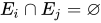
對於 聯合
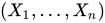
定義。 (聯合連續隨機變數)隨機變數 X 1 , … , X n {\displaystyle X_{1},\dotsc ,X_{n}} 聯合連續 P ( ( X 1 , … , X n ) ∈ S ) = ∫ ⋯ ∫ S f ( x 1 , … , x n ) d x 1 ⋯ d x n , S ⊆ R n , {\displaystyle \mathbb {P} {\big (}(X_{1},\dotsc ,X_{n})\in S{\big )}=\int \dotsi \int _{S}f(x_{1},\dotsc ,x_{n})\,dx_{1}\cdots \,dx_{n},\quad S\subseteq \mathbb {R} ^{n},} f {\displaystyle f}
備註。
函式 f {\displaystyle f} 聯合機率密度函式 joint pdf X 1 , … , X n {\displaystyle X_{1},\dotsc ,X_{n}}
類似地, f ( x 1 , … , x n ) d x 1 ⋯ d x n {\displaystyle f(x_{1},\dotsc ,x_{n})\,dx_{1}\cdots \,dx_{n}} [ x 1 , x 1 + d x 1 ] × ⋯ × [ x n , x n + d x n ] {\displaystyle [x_{1},x_{1}+dx_{1}]\times \dotsb \times [x_{n},x_{n}+dx_{n}]} f ( x 1 , … , x n ) {\displaystyle f(x_{1},\dotsc ,x_{n})} P ( X ∈ [ x 1 , x 1 + d x 1 ] × ⋯ × [ x n , x n + d x n ] ) d x 1 ⋯ d x n {\displaystyle {\frac {\mathbb {P} {\big (}X\in [x_{1},x_{1}+dx_{1}]\times \dotsb \times [x_{n},x_{n}+dx_{n}]{\big )}}{dx_{1}\dotsb dx_{n}}}}
透過設定 S = ( − ∞ , x 1 ] × ⋯ × ( − ∞ , x n ] {\displaystyle S=(-\infty ,x_{1}]\times \dotsb \times (-\infty ,x_{n}]} F ( x 1 , … , x n ) = ∫ − ∞ x 1 ⋯ ∫ − ∞ x n ⏟ n integrations f ( u 1 , … , u n ) d u n ⋯ d u 1 , {\displaystyle F(x_{1},\dotsc ,x_{n})=\underbrace {\int _{-\infty }^{x_{1}}\cdots \int _{-\infty }^{x_{n}}} _{n\;{\text{integrations}}}f(u_{1},\dotsc ,u_{n})\,du_{n}\cdots \,du_{1},}
這與一元的情況類似。
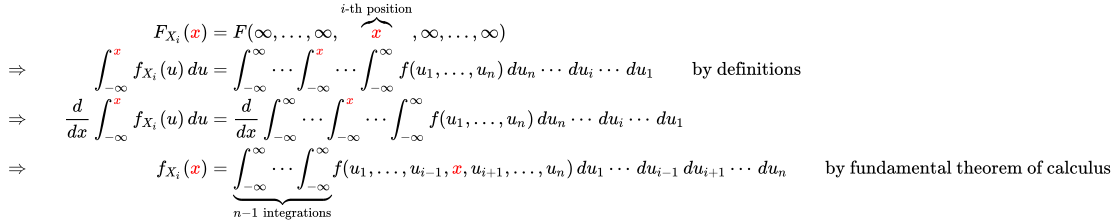
命題。 (從聯合 pdf 獲得邊緣 pdf) 對於連續隨機變數 X 1 , … , X n {\displaystyle X_{1},\dotsc ,X_{n}} f {\displaystyle f} X i {\displaystyle X_{i}} f X i ( x ) = ∫ − ∞ ∞ ⋯ ∫ − ∞ ∞ ⏟ n − 1 integrations f ( u 1 , … , u i − 1 , x , u i + 1 , … , u n ) d u 1 ⋯ d u i − 1 d u i + 1 ⋯ d u n . {\displaystyle f_{X_{i}}({\color {red}x})=\underbrace {\int _{-\infty }^{\infty }\cdots \int _{-\infty }^{\infty }} _{n-1\;{\text{integrations}}}f(u_{1},\dotsc ,u_{i-1},{\color {red}x},u_{i+1},\dotsc ,u_{n})\,du_{1}\cdots \,du_{i-1}\,du_{i+1}\cdots \,du_{n}.}
證明。 回憶關於從聯合累積分佈函式得到邊緣累積分佈函式的命題。我們有 F X i ( x ) = F ( ∞ , … , ∞ , x ⏞ i -th position , ∞ , … , ∞ ) ⇒ ∫ − ∞ x f X i ( u ) d u = ∫ − ∞ ∞ ⋯ ∫ − ∞ x ⋯ ∫ − ∞ ∞ f ( u 1 , … , u n ) d u n ⋯ d u i ⋯ d u 1 by definitions ⇒ d d x ∫ − ∞ x f X i ( u ) d u = d d x ∫ − ∞ ∞ ⋯ ∫ − ∞ x ⋯ ∫ − ∞ ∞ f ( u 1 , … , u n ) d u n ⋯ d u i ⋯ d u 1 ⇒ f X i ( x ) = ∫ − ∞ ∞ ⋯ ∫ − ∞ ∞ ⏟ n − 1 integrations f ( u 1 , … , u i − 1 , x , u i + 1 , … , u n ) d u 1 ⋯ d u i − 1 d u i + 1 ⋯ d u n by fundamental theorem of calculus {\displaystyle {\begin{aligned}&&F_{X_{i}}({\color {red}x})&=F(\infty ,\dotsc ,\infty ,\overbrace {\color {red}x} ^{i{\text{-th position}}},\infty ,\dotsc ,\infty )\\&\Rightarrow &\int _{-\infty }^{\color {red}x}f_{X_{i}}(u)\,du&=\int _{-\infty }^{\infty }\cdots \int _{-\infty }^{\color {red}x}\cdots \int _{-\infty }^{\infty }f(u_{1},\dotsc ,u_{n})\,du_{n}\cdots \,du_{i}\cdots \,du_{1}\qquad {\text{by definitions}}\\&\Rightarrow &{\frac {d}{dx}}\int _{-\infty }^{\color {red}x}f_{X_{i}}(u)\,du&={\frac {d}{dx}}\int _{-\infty }^{\infty }\cdots \int _{-\infty }^{\color {red}x}\cdots \int _{-\infty }^{\infty }f(u_{1},\dotsc ,u_{n})\,du_{n}\cdots \,du_{i}\cdots \,du_{1}\\&\Rightarrow &f_{X_{i}}({\color {red}x})&=\underbrace {\int _{-\infty }^{\infty }\cdots \int _{-\infty }^{\infty }} _{n-1\;{\text{integrations}}}f(u_{1},\dotsc ,u_{i-1},{\color {red}x},u_{i+1},\dotsc ,u_{n})\,du_{1}\cdots \,du_{i-1}\,du_{i+1}\cdots \,du_{n}\qquad {\text{by fundamental theorem of calculus}}\end{aligned}}}
◻ {\displaystyle \Box }
命題。 (從聯合累積分佈函式得到聯合機率密度函式) 如果聯合累積分佈函式 F {\displaystyle F} ( x 1 , … , x n ) {\displaystyle (x_{1},\dotsc ,x_{n})} 偏導數 f ( x 1 , … , x n ) = ∂ n ∂ x 1 ⋯ ∂ x n F ( x 1 , ⋯ , x n ) . {\displaystyle f(x_{1},\dotsc ,x_{n})={\frac {\partial ^{n}}{\partial x_{1}\cdots \partial x_{n}}}F(x_{1},\cdots ,x_{n}).}
證明。 它來自於使用微積分基本定理 n {\displaystyle n}
◻ {\displaystyle \Box }
示例。 如果聯合連續隨機變數 ( X , Y ) {\displaystyle (X,Y)} f ( x , y ) = 1 4 x y ( 1 { x , y ∈ [ 0 , 1 ] } ) , {\displaystyle f(x,y)={\frac {1}{4}}xy(\mathbf {1} \{x,y\in [0,1]\}),} X {\displaystyle X} f X ( x ) = ∫ − ∞ ∞ 1 4 x y ( 1 { x ∈ [ 0 , 1 ] } 1 { y ∈ [ 0 , 1 ] } ) d y = 1 4 x ( 1 { x ∈ [ 0 , 1 ] } ) ∫ 0 1 y d y ⏟ 1 2 / 2 − 0 2 / 2 = 1 8 x ( 1 { x ∈ [ 0 , 1 ] } ) . {\displaystyle f_{X}(x)=\int _{-\infty }^{\infty }{\frac {1}{4}}xy(\mathbf {1} \{x\in [0,1]\}\mathbf {1} \{y\in [0,1]\})\,dy={\frac {1}{4}}x(\mathbf {1} \{x\in [0,1]\})\underbrace {\int _{0}^{1}y\,dy} _{1^{2}/2-0^{2}/2}={\frac {1}{8}}x(\mathbf {1} \{x\in [0,1]\}).} P ( ( X , Y ) ≤ ( 1 / 2 , 1 / 2 ) ) = ∫ − ∞ 1 / 2 ∫ − ∞ 1 / 2 1 4 x y ( 1 { x , y ∈ [ 0 , 1 ] } d x d y = 1 4 ∫ 0 1 / 2 y ∫ 0 1 / 2 x d x d y = 1 4 ⋅ ( 1 / 2 ) 2 2 ∫ 0 1 / 2 y d y = 1 4 ⋅ 1 8 ⋅ 1 8 = 1 256 . {\displaystyle \mathbb {P} ((X,Y)\leq (1/2,1/2))=\int _{-\infty }^{1/2}\int _{-\infty }^{1/2}{\frac {1}{4}}xy(\mathbf {1} \{x,y\in [0,1]\}\,dx\,dy={\frac {1}{4}}\int _{0}^{1/2}y\int _{0}^{1/2}x\,dx\,dy={\frac {1}{4}}\cdot {\frac {(1/2)^{2}}{2}}\int _{0}^{1/2}y\,dy={\frac {1}{4}}\cdot {\frac {1}{8}}\cdot {\frac {1}{8}}={\frac {1}{256}}.}
回想一下,如果多個事件的交集的機率等於每個事件的機率的乘積,那麼根據定義,這些事件是獨立的。由於 { X ∈ A } {\displaystyle \{X\in A\}} 隨機變數
定義。 (隨機變數的獨立性)隨機變數 X 1 , X 2 , … , X n {\displaystyle X_{1},X_{2},\dotsc ,X_{n}} 獨立 P ( X 1 ∈ A 1 ∩ ⋯ ∩ X n ∈ A n ) = P ( X 1 ∈ A 1 ) ⋯ P ( X n ∈ A n ) {\displaystyle \mathbb {P} (X_{1}\in A_{1}\cap \cdots \cap X_{n}\in A_{n})=\mathbb {P} (X_{1}\in A_{1})\cdots \mathbb {P} (X_{n}\in A_{n})} n {\displaystyle n} A 1 , A 2 , … , A n ⊆ R {\displaystyle A_{1},A_{2},\dotsc ,A_{n}\subseteq \mathbb {R} }
備註。 在這種情況下,事件 { X 1 ∈ A 1 } , … , { X n ∈ A n } {\displaystyle \{X_{1}\in A_{1}\},\dotsc ,\{X_{n}\in A_{n}\}}
定理。 (隨機變數獨立性的另一種條件)隨機變數 X 1 , X 2 , … , X n {\displaystyle X_{1},X_{2},\dotsc ,X_{n}} 獨立 當且僅當 ( X 1 , … , X n ) {\displaystyle (X_{1},\dotsc ,X_{n})} F ( x 1 , … , x n ) = F X 1 ( x 1 ) ⋯ F X n ( x n ) {\displaystyle F(x_{1},\dotsc ,x_{n})=F_{X_{1}}(x_{1})\cdots F_{X_{n}}(x_{n})} ( X 1 , … , X n ) {\displaystyle (X_{1},\dotsc ,X_{n})} f ( x 1 , … , x n ) = f X 1 ( x 1 ) ⋯ f X n ( x n ) {\displaystyle f(x_{1},\dotsc ,x_{n})=f_{X_{1}}(x_{1})\cdots f_{X_{n}}(x_{n})} x 1 , … , x n ∈ R {\displaystyle x_{1},\dotsc ,x_{n}\in \mathbb {R} }
證明。 部分
僅當部分:如果隨機變數 X 1 , X 2 , … , X n {\displaystyle X_{1},X_{2},\dotsc ,X_{n}} P ( X 1 ∈ A 1 ∩ ⋯ ∩ X n ∈ A n ) = P ( X 1 ∈ A 1 ) ⋯ P ( X n ∈ A n ) {\displaystyle \mathbb {P} (X_{1}\in A_{1}\cap \cdots \cap X_{n}\in A_{n})=\mathbb {P} (X_{1}\in A_{1})\cdots \mathbb {P} (X_{n}\in A_{n})} n {\displaystyle n} A 1 , A 2 , … , A n ⊆ R {\displaystyle A_{1},A_{2},\dotsc ,A_{n}\subseteq \mathbb {R} } A 1 = ( − ∞ , x 1 ) , … , A n = ( − ∞ , x n ) {\displaystyle A_{1}=(-\infty ,x_{1}),\dotsc ,A_{n}=(-\infty ,x_{n})} P ( X 1 ≤ x 1 ∩ ⋯ ∩ X n ≤ x n ) = P ( X 1 ≤ x 1 ) ⋯ P ( X n ≤ x n ) ⟹ F ( x 1 , … , x n ) = F X 1 ( x 1 ) ⋯ F X n ( x n ) . {\displaystyle \mathbb {P} (X_{1}\leq x_{1}\cap \cdots \cap X_{n}\leq x_{n})=\mathbb {P} (X_{1}\leq x_{1})\cdots \mathbb {P} (X_{n}\leq x_{n})\implies F(x_{1},\dotsc ,x_{n})=F_{X_{1}}(x_{1})\cdots F_{X_{n}}(x_{n}).}
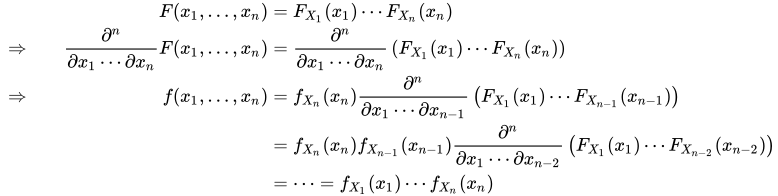
對於聯合pdf部分, F ( x 1 , … , x n ) = F X 1 ( x 1 ) ⋯ F X n ( x n ) ⇒ ∂ n ∂ x 1 ⋯ ∂ x n F ( x 1 , … , x n ) = ∂ n ∂ x 1 ⋯ ∂ x n ( F X 1 ( x 1 ) ⋯ F X n ( x n ) ) ⇒ f ( x 1 , … , x n ) = f X n ( x n ) ∂ n ∂ x 1 ⋯ ∂ x n − 1 ( F X 1 ( x 1 ) ⋯ F X n − 1 ( x n − 1 ) ) = f X n ( x n ) f X n − 1 ( x n − 1 ) ∂ n ∂ x 1 ⋯ ∂ x n − 2 ( F X 1 ( x 1 ) ⋯ F X n − 2 ( x n − 2 ) ) = ⋯ = f X 1 ( x 1 ) ⋯ f X n ( x n ) {\displaystyle {\begin{aligned}&&F(x_{1},\dotsc ,x_{n})&=F_{X_{1}}(x_{1})\cdots F_{X_{n}}(x_{n})\\&\Rightarrow &{\frac {\partial ^{n}}{\partial x_{1}\cdots \partial x_{n}}}F(x_{1},\dotsc ,x_{n})&={\frac {\partial ^{n}}{\partial x_{1}\cdots \partial x_{n}}}\left(F_{X_{1}}(x_{1})\cdots F_{X_{n}}(x_{n})\right)\\&\Rightarrow &f(x_{1},\dotsc ,x_{n})&=f_{X_{n}}(x_{n}){\frac {\partial ^{n}}{\partial x_{1}\cdots \partial x_{n-1}}}\left(F_{X_{1}}(x_{1})\cdots F_{X_{n-1}}(x_{n-1})\right)\\&&&=f_{X_{n}}(x_{n})f_{X_{n-1}}(x_{n-1}){\frac {\partial ^{n}}{\partial x_{1}\cdots \partial x_{n-2}}}\left(F_{X_{1}}(x_{1})\cdots F_{X_{n-2}}(x_{n-2})\right)\\&&&=\cdots =f_{X_{1}}(x_{1})\cdots f_{X_{n}}(x_{n})\end{aligned}}}
◻ {\displaystyle \Box }
備註。
也就是說,如果聯合cdf(聯合pdf(pmf))可以分解為邊緣cdf(邊緣pdf(pmf))的乘積
實際上,如果我們可以將聯合cdf或聯合pdf或聯合pmf分解為每個變數中一些函式的乘積,那麼該條件也滿足。
示例。 兩個獨立 λ {\displaystyle \lambda } X {\displaystyle X} Y {\displaystyle Y} f ( x , y ) = ( 1 { x ≥ 0 } λ e − λ x ) ( 1 { y ≥ 0 } λ e − λ y ) = 1 { x , y ≥ 0 } λ 2 e − λ ( x + y ) . {\displaystyle f(x,y)=(\mathbf {1} \{x\geq 0\}\lambda e^{-\lambda x})(\mathbf {1} \{y\geq 0\}\lambda e^{-\lambda y})=\mathbf {1} \{x,y\geq 0\}\lambda ^{2}e^{-\lambda (x+y)}.} X {\displaystyle X} Y {\displaystyle Y} 獨立同分布
一般來說, n {\displaystyle n} λ {\displaystyle \lambda } 獨立 f ( x 1 , … , x n ) = 1 { x 1 , … , x n ≥ 0 } λ n e − λ ( x 1 + ⋯ + x n ) . {\displaystyle f(x_{1},\dotsc ,x_{n})=\mathbf {1} \{x_{1},\dotsc ,x_{n}\geq 0\}\lambda ^{n}e^{-\lambda (x_{1}+\cdots +x_{n})}.} X 1 , … , X n {\displaystyle X_{1},\dotsc ,X_{n}}
另一方面,如果兩個隨機變數 V {\displaystyle V} W {\displaystyle W} f ( v , w ) = 1 { w ≤ 2 − 2 v } , {\displaystyle f(v,w)=\mathbf {1} \{w\leq 2-2v\},} V {\displaystyle V} W {\displaystyle W} 相關的
練習。 令 X , Y , Z {\displaystyle X,Y,Z} ( X , Y , Z ) {\displaystyle (X,Y,Z)} f ( x , y , z ) = 1 { x , y , z ≥ 0 } 1 { x + y + z / k ≤ 1 } . {\displaystyle f(x,y,z)=\mathbf {1} \{x,y,z\geq 0\}\mathbf {1} \{x+y+z/k\leq 1\}.}
( X , Y , Z ) {\displaystyle (X,Y,Z)} f ( x , y , z ) = 1 { x , y , z ≥ 0 } 1 { y ≤ 1 − x } 1 { z ≤ k } {\displaystyle f(x,y,z)=\mathbf {1} \{x,y,z\geq 0\}\mathbf {1} \{y\leq 1-x\}\mathbf {1} \{z\leq k\}}
( X , Y , Z ) {\displaystyle (X,Y,Z)} f ( x , y , z ) = k x y z 1 { x , y ∈ [ 0 , 1 ] } 1 { z ∈ [ 0 , 2 ] } . {\displaystyle f(x,y,z)=kxyz\mathbf {1} \{x,y\in [0,1]\}\mathbf {1} \{z\in [0,2]\}.}
命題. (關於獨立隨機變數不相交集的事件的獨立性)假設隨機變數 X 1 , X 2 , … {\displaystyle X_{1},X_{2},\dotsc } r < s < t < ⋯ {\displaystyle r<s<t<\cdots } f 1 , f 2 , f 3 , … {\displaystyle f_{1},f_{2},f_{3},\dotsc } Y 1 = f 1 ( X 1 , … , X r ) , Y 2 = f 2 ( X r + 1 , … , X s ) , Y 3 = f 3 ( X s + 1 , … , X t ) , … {\displaystyle Y_{1}=f_{1}(X_{1},\dotsc ,X_{\color {red}r}),\quad Y_{2}=f_{2}(X_{{\color {red}r}+1},\dotsc ,X_{\color {blue}s}),\quad Y_{3}=f_{3}(X_{{\color {blue}s}+1},\dotsc ,X_{t}),\dotsc }
練習。
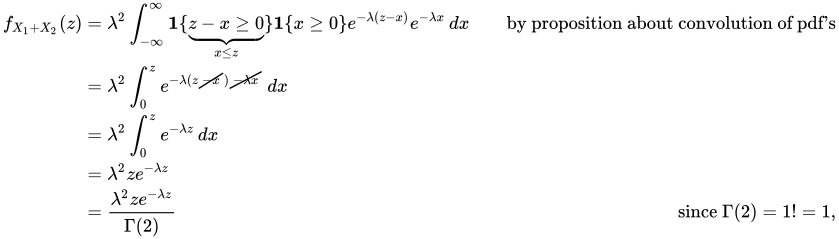
一般來說,我們使用聯合累積分佈函式、機率密度函式或機率質量函式,根據基本原理來確定獨立隨機變數之和的分佈。特別地,關於和 獨立的
獨立隨機變數之和
證明。
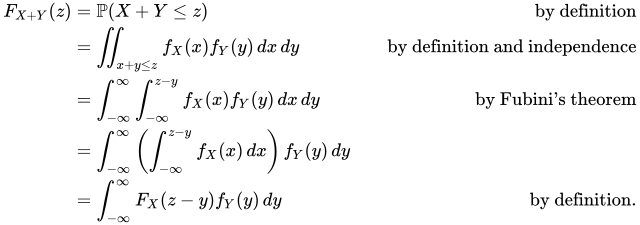
cdf: F X + Y ( z ) = P ( X + Y ≤ z ) by definition = ∬ x + y ≤ z f X ( x ) f Y ( y ) d x d y by definition and independence = ∫ − ∞ ∞ ∫ − ∞ z − y f X ( x ) f Y ( y ) d x d y by Fubini's theorem = ∫ − ∞ ∞ ( ∫ − ∞ z − y f X ( x ) d x ) f Y ( y ) d y = ∫ − ∞ ∞ F X ( z − y ) f Y ( y ) d y by definition . {\displaystyle {\begin{aligned}F_{X+Y}(z)&=\mathbb {P} (X+Y\leq z)&{\text{by definition}}\\&=\iint _{x+y\leq z}f_{X}(x)f_{Y}(y)\,dx\,dy&{\text{by definition and independence}}\\&=\int _{-\infty }^{\infty }\int _{-\infty }^{z-y}f_{X}(x)f_{Y}(y)\,dx\,dy&{\text{by Fubini's theorem}}\\&=\int _{-\infty }^{\infty }\left(\int _{-\infty }^{z-y}f_{X}(x)\,dx\right)f_{Y}(y)\,dy\\&=\int _{-\infty }^{\infty }F_{X}(z-y)f_{Y}(y)\,dy&{\text{by definition}}.\end{aligned}}} /\
//\ y
///\|
////*
////|\
////|/\
////|//\ x+y=z <=> x=z-y
////|///\
////|////\
----*-----*--------------- x
////|//////\
////|///////\
-->: -infty to z-y
^
|: -infty to infty
*--*
|//| : x+y <= z
*--*
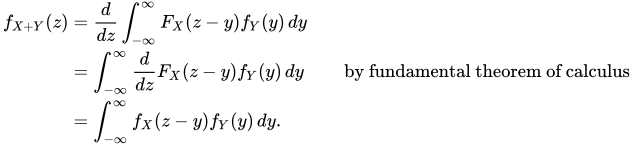
pdf: f X + Y ( z ) = d d z ∫ − ∞ ∞ F X ( z − y ) f Y ( y ) d y = ∫ − ∞ ∞ d d z F X ( z − y ) f Y ( y ) d y by fundamental theorem of calculus = ∫ − ∞ ∞ f X ( z − y ) f Y ( y ) d y . {\displaystyle {\begin{aligned}f_{X+Y}(z)&={\frac {d}{dz}}\int _{-\infty }^{\infty }F_{X}(z-y)f_{Y}(y)\,dy\\&=\int _{-\infty }^{\infty }{\frac {d}{dz}}F_{X}(z-y)f_{Y}(y)\,dy&{\text{by fundamental theorem of calculus}}\\&=\int _{-\infty }^{\infty }f_{X}(z-y)f_{Y}(y)\,dy.\end{aligned}}} ◻ {\displaystyle \Box }
例子。
令 X {\displaystyle X} f ( x ) = 1 { 0 ≤ x ≤ 1 } {\displaystyle f(x)=\mathbf {1} \{0\leq {\color {blue}x}\leq 1\}}
令 Y {\displaystyle Y} f ( y ) = 1 { − 1 ≤ y ≤ 0 } {\displaystyle f(y)=\mathbf {1} \{-1\leq y\leq 0\}}
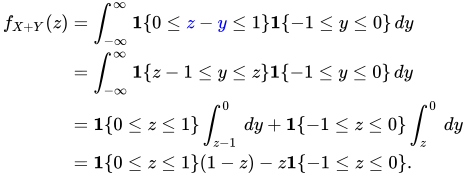
那麼, X + Y {\displaystyle X+Y} f X + Y ( z ) = ∫ − ∞ ∞ 1 { 0 ≤ z − y ≤ 1 } 1 { − 1 ≤ y ≤ 0 } d y = ∫ − ∞ ∞ 1 { z − 1 ≤ y ≤ z } 1 { − 1 ≤ y ≤ 0 } d y = 1 { 0 ≤ z ≤ 1 } ∫ z − 1 0 d y + 1 { − 1 ≤ z ≤ 0 } ∫ z 0 d y = 1 { 0 ≤ z ≤ 1 } ( 1 − z ) − z 1 { − 1 ≤ z ≤ 0 } . {\displaystyle {\begin{aligned}f_{X+Y}(z)&=\int _{-\infty }^{\infty }\mathbf {1} \{0\leq {\color {blue}z-y}\leq 1\}\mathbf {1} \{-1\leq y\leq 0\}\,dy\\&=\int _{-\infty }^{\infty }\mathbf {1} \{z-1\leq y\leq z\}\mathbf {1} \{-1\leq y\leq 0\}\,dy\\&=\mathbf {1} \{0\leq z\leq 1\}\int _{z-1}^{0}\,dy+\mathbf {1} \{-1\leq z\leq 0\}\int _{z}^{0}\,dy\\&=\mathbf {1} \{0\leq z\leq 1\}(1-z)-z\mathbf {1} \{-1\leq z\leq 0\}.\end{aligned}}}
        y
        |
        |
        |
     *  * 1
      \ |\
  y=-z \| \ y=1-z
-----*--*--*----- z
    -1 O|  1
        |
     -1 *
        |
練習。
例如: 我們連續兩次擲一個公平的六面骰子(獨立地)。 那麼,兩次擲出的數字之和為 7 的機率是 ( 1 / 6 ) ( 1 / 6 ) + ⋯ + ( 1 / 6 ) ( 1 / 6 ) ⏟ 6 times = 1 / 6 {\displaystyle \underbrace {(1/6)(1/6)+\dotsb +(1/6)(1/6)} _{6{\text{ times}}}=1/6}
練習。
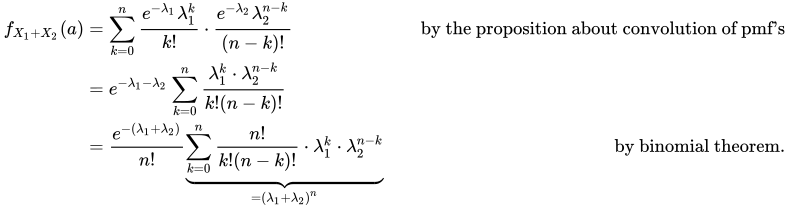
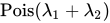
示例。 設有兩個服務櫃檯,第一個櫃檯每小時收到 X ∼ Pois ( 3 ) {\displaystyle X\sim \operatorname {Pois} (3)} Y ∼ Pois ( 4 ) {\displaystyle Y\sim \operatorname {Pois} (4)} X {\displaystyle X} Y {\displaystyle Y} Pois ( 3 + 4 ) = Pois ( 7 ) {\displaystyle \operatorname {Pois} (3+4)=\operatorname {Pois} (7)}
證明。
兩個櫃檯每小時收到的諮詢數量是 X + Y {\displaystyle X+Y}
然後,結果來自 Poisson 隨機變數之和的命題。 ◻ {\displaystyle \Box }
練習。
定義. (順序統計量) 設 X 1 , … , X n {\displaystyle X_{1},\dotsc ,X_{n}} n {\displaystyle n} F ( x ) {\displaystyle F(x)} X ( 1 ) , X ( 2 ) , … , X ( n ) {\displaystyle X_{(1)},X_{(2)},\dotsc ,X_{(n)}} X 1 , X 2 , … , X n {\displaystyle X_{1},X_{2},\dotsc ,X_{n}} X ( 1 ) ≤ X ( 2 ) ≤ ⋯ ≤ X ( n ) {\displaystyle X_{(1)}\leq X_{(2)}\leq \dotsb \leq X_{(n)}} 順序統計量
示例。 令 X 1 , X 2 , X 3 {\displaystyle X_{1},X_{2},X_{3}} Exp ( 2 ) {\displaystyle \operatorname {Exp} (2)} X ( 2 ) {\displaystyle X_{(2)}} ∑ j = 2 3 ( 3 j ) ( F ( x ) ) j ( 1 − F ( x ) ) 3 − j = 1 { x ≥ 0 } ( ( 3 2 ) ( 1 − e − 2 x ) 2 ( e − 2 x ) + ( 3 3 ) ( 1 − e − 2 x ) 3 ) = 1 { x ≥ 0 } ( 3 ( 1 − e − 2 x ) 2 ( e 2 x ) + ( 1 − e − 2 x ) 3 ) . {\displaystyle \sum _{j=2}^{3}{\binom {3}{j}}(F(x))^{j}(1-F(x))^{3-j}=\mathbf {1} \{x\geq 0\}\left({\binom {3}{2}}(1-e^{-2x})^{2}(e^{-2x})+{\binom {3}{3}}(1-e^{-2x})^{3}\right)=\mathbf {1} \{x\geq 0\}\left(3(1-e^{-2x})^{2}(e^{2x})+(1-e^{-2x})^{3}\right).}
練習。
泊松過程有一些重要的性質。
命題: (固定時間間隔內的到達次數)固定時間間隔內到達事件的次數,其時間長度為 t {\displaystyle t} Pois ( λ t ) {\displaystyle \operatorname {Pois} (\lambda t)}
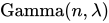
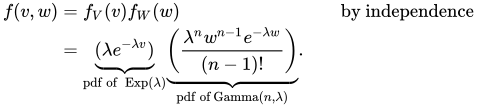
Proof. For each nonnegative integer n {\displaystyle n} V {\displaystyle V} n {\displaystyle n} n + 1 {\displaystyle n+1} W {\displaystyle W} n {\displaystyle n} ( V , W ) {\displaystyle (V,W)} f ( v , w ) = f V ( v ) f W ( w ) by independence = ( λ e − λ v ) ⏟ pdf of Exp ( λ ) ( λ n w n − 1 e − λ w ( n − 1 ) ! ) ⏟ pdf of Gamma ( n , λ ) . {\displaystyle {\begin{aligned}f(v,w)&=f_{V}(v)f_{W}(w)&{\text{by independence}}\\&=\underbrace {(\lambda e^{-\lambda v})} _{{\text{pdf of}}\;\operatorname {Exp} (\lambda )}\underbrace {\left({\frac {\lambda ^{n}w^{n-1}e^{-\lambda w}}{(n-1)!}}\right)} _{{\text{pdf of}}\operatorname {Gamma} (n,\lambda )}.\end{aligned}}} N {\displaystyle N} N {\displaystyle N} P ( N = n ) = P ( W ≤ t ∩ V + W > t ⏟ V > t − W ) = ∫ 0 t ∫ t − w ∞ f ( v , w ) ⏟ joint pdf of ( V , W ) d v d w = ∫ 0 t ∫ t − w ∞ ( λ e − λ v ) ( λ n w n − 1 e − λ w ( n − 1 ) ! ) d v d w = ∫ 0 t λ n w n − 1 e − λ w ( n − 1 ) ! ∫ t − w ∞ λ e − λ v d v d w = λ n ( n − 1 ) ! ∫ 0 t w n − 1 e − λ w ( 0 − ( − e − λ ( t − w ) ) ) d w = λ n e − λ t ( n − 1 ) ! ∫ 0 t w n − 1 d w = λ n e − λ t ( n − 1 ) ! ⋅ ( t n n − 0 ) = e − λ t ( λ t ) n n ! {\displaystyle {\begin{aligned}\mathbb {P} (N=n)&=\mathbb {P} (W\leq t\cap \underbrace {V+W>t} _{V>t-W})\\&=\int _{0}^{t}\int _{t-w}^{\infty }\underbrace {f(v,w)} _{{\text{joint pdf of}}\;(V,W)}\,dv\,dw\\&=\int _{0}^{t}\int _{t-w}^{\infty }(\lambda e^{-\lambda v})\left({\frac {\lambda ^{n}w^{n-1}e^{-\lambda w}}{(n-1)!}}\right)\,dv\,dw\\&=\int _{0}^{t}{\frac {\lambda ^{n}w^{n-1}e^{-\lambda w}}{(n-1)!}}\int _{t-w}^{\infty }\lambda e^{-\lambda v}\,dv\,dw\\&={\frac {\lambda ^{n}}{(n-1)!}}\int _{0}^{t}w^{n-1}{\cancel {e^{-\lambda w}}}(0-(-e^{-\lambda (t{\cancel {-w}})}))\,dw\\&={\frac {\lambda ^{n}{\color {green}e^{-\lambda t}}}{(n-1)!}}\int _{0}^{t}w^{n-1}\,dw\\&={\frac {\lambda ^{n}e^{-\lambda t}}{(n-1)!}}\cdot \left({\frac {t^{n}}{n}}-0\right)\\&={\frac {e^{-\lambda t}(\lambda t)^{n}}{n!}}\end{aligned}}} Pois ( λ t ) {\displaystyle \operatorname {Pois} (\lambda t)}
◻ {\displaystyle \Box }
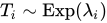
命題。 (第一個到達時間, n {\displaystyle n} T 1 , T 2 , … , T n {\displaystyle T_{1},T_{2},\dotsc ,T_{n}} T i ∼ Exp ( λ i ) {\displaystyle T_{i}\sim \operatorname {Exp} (\lambda _{i})} i = 1 , 2 , … , n {\displaystyle i=1,2,\dotsc ,n} T = min { T 1 , … , T n } {\displaystyle T=\min\{T_{1},\dotsc ,T_{n}\}} n {\displaystyle n} T ∼ Exp ( λ 1 + λ 2 + ⋯ + λ n ) {\displaystyle T\sim \operatorname {Exp} (\lambda _{1}+\lambda _{2}+\cdots +\lambda _{n})}
證明。 對於每個 t > 0 {\displaystyle t>0} P ( T > t ) = P ( T 1 > t ∩ ⋯ ∩ T n > t ) = P ( T 1 > t ) ⋯ P ( T n > t ) by independence = [ 1 − ( 1 − e − λ 1 t ⏟ cdf of Exp ( λ 1 ) ) ] ⋯ [ 1 − ( 1 − e − λ n t ⏟ cdf of Exp ( λ n ) ) ] = e − t ( λ 1 + ⋯ + λ n ) ⇒ P ( T ≤ t ) = 1 − e − t ( λ 1 + ⋯ + λ n ) ⇒ T ∼ Exp ( λ 1 + λ 2 + ⋯ + λ n ) {\displaystyle {\begin{aligned}&&\mathbb {P} (T>t)&=\mathbb {P} (T_{1}>t\cap \cdots \cap T_{n}>t)\\&&&=\mathbb {P} (T_{1}>t)\cdots \mathbb {P} (T_{n}>t)&{\text{by independence}}\\&&&=[1-(\underbrace {1-e^{-\lambda _{1}t}} _{{\text{cdf of}}\;\operatorname {Exp} (\lambda _{1})})]\cdots [1-(\underbrace {1-e^{-\lambda _{n}t}} _{{\text{cdf of}}\;\operatorname {Exp} (\lambda _{n})})]\\&&&=e^{-t(\lambda _{1}+\cdots +\lambda _{n})}\\&\Rightarrow &\mathbb {P} (T\leq t)&=1-e^{-t(\lambda _{1}+\cdots +\lambda _{n})}\\&\Rightarrow &T&\sim \operatorname {Exp} (\lambda _{1}+\lambda _{2}+\cdots +\lambda _{n})\end{aligned}}}
◻ {\displaystyle \Box }
示例. 假設有兩個服務櫃檯,櫃檯 A 和 B,它們的服務時間獨立,服從速率為 λ {\displaystyle \lambda }
首先,你需要等待的服務時間(即約翰或彼得中一人離開櫃檯的時間)是從現在開始算起的約翰和彼得的服務時間的最小值,它們相互獨立,服從速率為 λ {\displaystyle \lambda } 等待時間 速率為 λ + λ = 2 λ {\displaystyle \lambda +\lambda =2\lambda } 指數分佈
假設現在約翰離開櫃檯 A,而你正在櫃檯 A 接受服務。那麼,你比彼得先離開櫃檯的機率 1 / 2 {\displaystyle 1/2} 無記憶性 對稱性





















































![{\displaystyle [x_{1},x_{1}+dx_{1}]\times \dotsb \times [x_{n},x_{n}+dx_{n}]}](https://wikimedia.org/api/rest_v1/media/math/render/svg/1bffe37e384820feec4fb313335f7aca3245e03d0)
![{\displaystyle {\frac {\mathbb {P} {\big (}X\in [x_{1},x_{1}+dx_{1}]\times \dotsb \times [x_{n},x_{n}+dx_{n}]{\big )}}{dx_{1}\dotsb dx_{n}}}}](https://wikimedia.org/api/rest_v1/media/math/render/svg/9178274885989b4e42101f6d3cfc1e94192c4b03)
![{\displaystyle S=(-\infty ,x_{1}]\times \dotsb \times (-\infty ,x_{n}]}](https://wikimedia.org/api/rest_v1/media/math/render/svg/ed4e7d562da70cd61ebe2e8657928b4c8010366a)






![{\displaystyle f(x,y)={\frac {1}{4}}xy(\mathbf {1} \{x,y\in [0,1]\}),}](https://wikimedia.org/api/rest_v1/media/math/render/svg/d40d5bfd1aa20ae518a9f9ae12ecaef4b851d829)
![{\displaystyle f_{X}(x)=\int _{-\infty }^{\infty }{\frac {1}{4}}xy(\mathbf {1} \{x\in [0,1]\}\mathbf {1} \{y\in [0,1]\})\,dy={\frac {1}{4}}x(\mathbf {1} \{x\in [0,1]\})\underbrace {\int _{0}^{1}y\,dy} _{1^{2}/2-0^{2}/2}={\frac {1}{8}}x(\mathbf {1} \{x\in [0,1]\}).}](https://wikimedia.org/api/rest_v1/media/math/render/svg/c5979737b557e1bec59e1e5f2875a5761c8db51e)
![{\displaystyle \mathbb {P} ((X,Y)\leq (1/2,1/2))=\int _{-\infty }^{1/2}\int _{-\infty }^{1/2}{\frac {1}{4}}xy(\mathbf {1} \{x,y\in [0,1]\}\,dx\,dy={\frac {1}{4}}\int _{0}^{1/2}y\int _{0}^{1/2}x\,dx\,dy={\frac {1}{4}}\cdot {\frac {(1/2)^{2}}{2}}\int _{0}^{1/2}y\,dy={\frac {1}{4}}\cdot {\frac {1}{8}}\cdot {\frac {1}{8}}={\frac {1}{256}}.}](https://wikimedia.org/api/rest_v1/media/math/render/svg/c4c5cc0a123852d9a76065589ec30da9d7458e56)
![{\displaystyle F(x,y)=\mathbf {1} \{x,y\in [0,2]\}{\frac {x^{2}y^{3}}{32}}.}](https://wikimedia.org/api/rest_v1/media/math/render/svg/4ab8dcadd53c9d8414e0752f8021af753a78f746)


















![{\displaystyle f(x,y,z)=kxyz\mathbf {1} \{x,y\in [0,1]\}\mathbf {1} \{z\in [0,2]\}.}](https://wikimedia.org/api/rest_v1/media/math/render/svg/4c2043de662fdfa07edb1ce9694d74f5c024a873)





























































![{\displaystyle {\begin{aligned}&&\mathbb {P} (T>t)&=\mathbb {P} (T_{1}>t\cap \cdots \cap T_{n}>t)\\&&&=\mathbb {P} (T_{1}>t)\cdots \mathbb {P} (T_{n}>t)&{\text{by independence}}\\&&&=[1-(\underbrace {1-e^{-\lambda _{1}t}} _{{\text{cdf of}}\;\operatorname {Exp} (\lambda _{1})})]\cdots [1-(\underbrace {1-e^{-\lambda _{n}t}} _{{\text{cdf of}}\;\operatorname {Exp} (\lambda _{n})})]\\&&&=e^{-t(\lambda _{1}+\cdots +\lambda _{n})}\\&\Rightarrow &\mathbb {P} (T\leq t)&=1-e^{-t(\lambda _{1}+\cdots +\lambda _{n})}\\&\Rightarrow &T&\sim \operatorname {Exp} (\lambda _{1}+\lambda _{2}+\cdots +\lambda _{n})\end{aligned}}}](https://wikimedia.org/api/rest_v1/media/math/render/svg/dfbcdd5cd405595643e954728c94ff479461e40a)


