


水蝕/坡面漫流土壤剝蝕

土壤表面的坡面漫流是相互交織或編織的水道,沒有明顯的溝渠,而不是深度均勻的薄層水。水流被石頭和卵石以及植被覆蓋物打斷,經常繞著草叢和小灌木旋轉。
在雷諾數和弗勞德數的基本水力關係中,重要的因素是流速,通常用曼寧公式表示
(1.7)

其中是水力半徑,是坡度,是曼寧糙率係數。該公式假設完全湍流流過粗糙表面。


由於土壤的固有阻力,速度必須達到臨界值才能開始侵蝕。基本上,當水流施加的力超過保持土壤顆粒靜止的力時,單個土壤顆粒就會從土壤團塊中分離出來。當河流中相對平緩的斜坡上的顆粒運動開始時,所涉及的過程和起作用的力受無量綱剪下應力和顆粒粗糙雷諾數的臨界條件控制,分別定義為


(1.8)
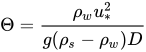
(1.9)

其中是希爾茲(1936)數[1],和分別是水和土壤的密度,是重力加速度,是相應土壤顆粒的直徑,是流動的剪下速度,表示為


(1.10)

當 的值大於 40(湍流)時, 的臨界值在顆粒運動中保持恆定的 0.05。不幸的是,當顆粒沒有完全浸沒或流動處於層流範圍內時,該值不成立,就像地面徑流的情況一樣。對淺層流中岩石碎片的研究表明, 的值約為 0.01(Poesen,1987[2];Torri 和 Poesen,1988[3])。


其他研究(Govers,1987[5];Guy 和 Dickinson,1990[6];Torri 和 Borselli,1991[7])表明,謝弗數始終高估了顆粒運動的水力要求。這意味著顆粒運動的開始不僅僅是流體剪下應力的現象,而是由其他因素增強。
- 雨滴衝擊對流動的影響,
- 顆粒相對於地面坡度的休止角,
- 隨著坡度陡度的增加,重力的強烈影響,
- 土壤的凝聚力,
- 隨著流中泥沙濃度增加,流體密度的變化,
- 流動中的顆粒與下方土壤之間的磨損。
由於上述方法沒有證明令人滿意,因此 Savat(1982)[8] 採用了經驗方法,基於流動剪下速度的臨界值來啟動顆粒運動(圖 1.2)。一旦超過顆粒運動的臨界條件,土壤顆粒可能以取決於流的剪下速度和單位流量的速率從土壤體中分離出來(Govers 和 Rauws,1986)[9]。
然而,這隻有在剪下速度完全作用於土壤顆粒時才有效,這意味著對流動的阻力完全是由於顆粒阻力。這種情況只有在完全光滑的裸露土壤表面上才成立。實際上,由於土壤表面的微地形形態和植被覆蓋而產生的阻力通常更為重要,顆粒阻力可能僅佔流動所承受的總阻力的 5%(Abrahams 等人,1992)[10]。
土壤剝蝕
[edit | edit source]由於很難確定顆粒阻力的水平,因此只能開發非常普遍的關係來描述剝蝕率 ,這取決於剝蝕與流速之間簡化的關係。透過整合連續性和曼寧的流速方程,Meyer(1965)[11] 表明

(1.11)

對於恆定的粗糙度條件,其中 是流量或流速。假設剝蝕率 隨速度的平方而變化,Meyer 和 Wishmeier(1969)[12] 表明

(1.12)

其中 ,以及 。Quansah(1985)[13] 透過實驗獲得了更精確的指數值,f = 1.5,j = 1.44,適用於從粘土到沙子的各種土壤型別。這兩個版本僅與水流在土壤表面上的作用有關。當流動伴隨著降雨時,他發現指數值降低到 f = 1.12 和 j = 0.64,表明雨滴的衝擊抑制了流動剝蝕土壤顆粒的能力。


然而,剝離取決於流中已懸浮的沉積物量(Meyer 和 Monke,1965)[14], 在公式 1.12 中適用於僅在水流清澈時發生的剝離能力。在其他條件下, 取決於流中實際沉積物濃度 與流所能容納的最大濃度 之間的差異(Foster 和 Meyer,1972)[15]


(1.13)

這意味著理論上,隨著流中沉積物濃度的增加,剝離速率下降,當達到最大沉積物濃度時,剝離速率變為零。
Flanagan 和 Nearing (1995)[16] 將溝間剝離速率 描述為基線溝間侵蝕性的明確函式 、有效降雨強度 、溝間徑流率 、冠層、地面覆蓋物和溝間坡度調整因子 、 和 、溝的間距和寬度 和 ,以及沉積物輸送率


(1.14)

其中
(1.15)

(1.16)

(1.17)

其中是土壤被冠層覆蓋的比例,是有效冠層高度,是溝間表面被植物殘體覆蓋的比例,而是溝間坡度角。根據 Foster (1982)[17] 可以被估計為土壤表面隨機粗糙度、溝間坡度和溝間沉積物粒度分佈的函式。


參考文獻
[edit | edit source]- ↑ Shields, A. (1936). Anwendung der Aehnlichkeitsmechanik und der Turbulenzfoschung auf die Geschiebebewegung, volume 26 of Mitteilungen der Preussischen Anstalt Wasserbau und Schiffbau.
- ↑ Poesen, J. (1987). Transport of rock fragments by rill flow: a field study. Catena Supplement, 8:35–54.
- ↑ Torri, D. and Poesen, J. (1988). Incipient motion conditions for single rock fragments in simulated rill flow. Earth Surface Processes and Landforms, 13:225–237.
- ↑ Savat, J. (1982). Common and uncommon selectivity in the process of fluid transportation: field observations and laboratory experiments on bare surfaces. Catena Supplement, 1:139–160.
- ↑ Govers, G. (1987). Initiation of motion in overland flow. Sedimentology, 34:1157–1164.
- ↑ Guy, B. and Dickinson, W. (1990). Inception of sediemnt transport in shallow overland flow. Catena Supplement, 17:91–109.
- ↑ Torri, D. and Borselli, L. (1991). Overland flow and soil erosion: some processes and their interactions. Catena Supplement, 19:129–137.
- ↑ Savat, J. (1979). Laboratory experiments on erosion and deposition of loess by laminar sheet flow and turbulent rill flow. In Vogt, H. and Vogt, T., editors, Colloque sur l’erosion agricole des sols en milieu tempere non Mediterraneen, pages 139–143. L’Universite Lois Pasteur, Strasbourg.
- ↑ Govers, G. and Rauws, G. (1986). Transporting capacity of overladn flow on a plane and on irregular beds. Earth Surface Processes and Landforms, 11:515–524.
- ↑ Abrahams, A., Parsons, A., and Hirsch, P. (1992). Field and laboratory studies of resistance to interrill overland flow on semi-arid hillslopes, southern arizona. In Parsons, A. and Abrahams, A., editors, Overland flow: hydraulics and erosion mechanics, pages 1–23. UCL Press, London.
- ↑ Meyer, L. (1965). Mathematical relationships governing soil erosion by water. Journal of Soil and Water Conservation, 20:149–150.
- ↑ Meyer, L. and Wishmeier, W. (1969). Mathematical simulation of the process of soil erosion by water. Transactions of the American Society of Agricultural Engineers, 12:754–758,762.
- ↑ Quansah, C. (1985). Rate of soil detached by overland flow, with and without rain, and its relationship with discharge, slope steepness and soil type. In El-Swaify, S., Moldenhauer, W., and Lo, A., editors, Soil erosion and conservation, pages 406–423. Soil Conservation Society of America, Ankeny, IA.
- ↑ Meyer, L. and Monke, E. (1965). Mechanics of soil erosion by rainfall and overland flow. Transactions of the American Society of Agricultural Engineers, 8:572–577.
- ↑ Foster, R. and Meyer, L. (1972). A closed-form soil erosion equation for upland areas. In Shen, H., editor, Sedimentation. Department of Civil Engineering, Colorado State University, Cort Collins.
- ↑ Flanagan, D. and Nearing, M. (1995). USDA-Water Erosion Prediction Project (WEPP: Technical Documentation, volume 10 of NSERL Report. National Soil Erosion Research Laboratory, West Lafayette, IN.
- ↑ Foster, G. (1982). Modelling the soil erosion process. In Haan, C., Johnson, H., and Brakensiek, D., editors, Hydrologic modelling of small watersheds, volume 5, pages 940–947. American Society of Agricultural Engineers Monograph.