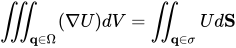
本章將使用多點、多路徑、多曲面和多體積等簡單概念,對向量微積分進行直觀的解釋。 標量場不會簡單地被視為函式 f : R 3 → R {\displaystyle f:\mathbb {R} ^{3}\to \mathbb {R} } F : R 3 → R 3 {\displaystyle \mathbf {F} :\mathbb {R} ^{3}\to \mathbb {R} ^{3}}
基本結構是多點、多路徑、多曲面和多體積。
點 q 0 {\displaystyle \mathbf {q} _{0}} Q = { ( q 1 , w 1 ) , ( q 2 , w 2 ) , . . . , ( q k , w k ) } {\displaystyle \mathbf {Q} =\{(\mathbf {q} _{1},w_{1}),(\mathbf {q} _{2},w_{2}),...,(\mathbf {q} _{k},w_{k})\}} w i {\displaystyle w_{i}} q i {\displaystyle \mathbf {q} _{i}} ( q , w 1 ) {\displaystyle (\mathbf {q} ,w_{1})} ( q , w 2 ) {\displaystyle (\mathbf {q} ,w_{2})} q {\displaystyle \mathbf {q} } ( q , w 1 + w 2 ) {\displaystyle (\mathbf {q} ,w_{1}+w_{2})} ( q , w 1 ) {\displaystyle (\mathbf {q} ,w_{1})} ( q , w 2 ) {\displaystyle (\mathbf {q} ,w_{2})} ( q , 0 ) {\displaystyle (\mathbf {q} ,0)} Q {\displaystyle \mathbf {Q} }
任意一點 q 0 {\displaystyle \mathbf {q} _{0}} δ 0 ( q ; q 0 ) = { + ∞ 3 ( q = q 0 ) 0 ( q ≠ q 0 ) {\displaystyle \delta _{0}(\mathbf {q} ;\mathbf {q} _{0})=\left\{{\begin{array}{cc}+\infty ^{3}&(\mathbf {q} =\mathbf {q} _{0})\\0&(\mathbf {q} \neq \mathbf {q} _{0})\end{array}}\right.} q 0 {\displaystyle \mathbf {q} _{0}} + ∞ 3 {\displaystyle +\infty ^{3}} q 0 {\displaystyle \mathbf {q} _{0}} ω 0 ( q 0 , v ) {\displaystyle \omega _{0}(\mathbf {q} _{0},v)} q 0 {\displaystyle \mathbf {q} _{0}} v {\displaystyle v} δ 0 ( q ; q 0 ) {\displaystyle \delta _{0}(\mathbf {q} ;\mathbf {q} _{0})} Δ 0 ( q ; q 0 , v ) = { 1 / v ( q ∈ ω 0 ( q 0 , v ) ) 0 ( q ∉ ω 0 ( q 0 , v ) ) {\displaystyle \Delta _{0}(\mathbf {q} ;\mathbf {q} _{0},v)=\left\{{\begin{array}{cc}1/v&(\mathbf {q} \in \omega _{0}(\mathbf {q} _{0},v))\\0&(\mathbf {q} \notin \omega _{0}(\mathbf {q} _{0},v))\end{array}}\right.} ω 0 ( q 0 , v ) {\displaystyle \omega _{0}(\mathbf {q} _{0},v)} δ 0 ( q ; q 0 ) {\displaystyle \delta _{0}(\mathbf {q} ;\mathbf {q} _{0})} [ length − 3 ] {\displaystyle [{\text{length}}^{-3}]}
多點 Q = { ( q 1 , w 1 ) , ( q 2 , w 2 ) , . . . , ( q k , w k ) } {\displaystyle \mathbf {Q} =\{(\mathbf {q} _{1},w_{1}),(\mathbf {q} _{2},w_{2}),...,(\mathbf {q} _{k},w_{k})\}} δ 0 ( q ; Q ) = ∑ i = 1 k w i δ 0 ( q ; q i ) {\displaystyle \delta _{0}(\mathbf {q} ;\mathbf {Q} )=\sum _{i=1}^{k}w_{i}\delta _{0}(\mathbf {q} ;\mathbf {q} _{i})} Q {\displaystyle \mathbf {Q} } δ 0 ( q ; Q ) {\displaystyle \delta _{0}(\mathbf {q} ;\mathbf {Q} )}
在下圖中,左面板中的多點透過對每個單元格的點權重進行平均,轉換為中心面板中的標量場。每個單元格的體積應該無限小。右面板中的多點對應於同一個標量場,並且處於更規範的形式,其中相反權重的點已經抵消。
左邊的多點(一系列加權點)可以用中間的標量場表示。右邊是具有相同標量場的更規範的多點,其中附近符號相反的點已經抵消。 下圖顯示瞭如何生成連續標量場 ρ : R 3 → R {\displaystyle \rho :\mathbb {R} ^{3}\to \mathbb {R} } q 0 {\displaystyle \mathbf {q} _{0}} v {\displaystyle v} ω 0 ( q 0 , v ) {\displaystyle \omega _{0}(\mathbf {q} _{0},v)} ω 0 ( q 0 , v ) {\displaystyle \omega _{0}(\mathbf {q} _{0},v)} ∭ q ∈ ω 0 ( q 0 , v ) ρ ( q ) d V ≈ v ⋅ ρ ( q 0 ) {\displaystyle \iiint _{\mathbf {q} \in \omega _{0}(\mathbf {q} _{0},v)}\rho (\mathbf {q} )dV\approx v\cdot \rho (\mathbf {q} _{0})} v ⋅ ρ ( q 0 ) {\displaystyle v\cdot \rho (\mathbf {q} _{0})} ω 0 ( q 0 , v ) {\displaystyle \omega _{0}(\mathbf {q} _{0},v)}
可以將權重為 1 的單個點“塗抹”到其所在的體積上。將該點分成越來越多的具有分數權重的點。經過無限步後,將有無限多個點填充該體積,並且每個點都具有無窮小的權重。 概括地說,多點由一個標量場表示,該標量場量化了每個點的**密度**,任何量化每個點的**密度**的標量場最好解釋為多點。
A simple path (also called a simple curve) C {\displaystyle C} C ( 0 ) {\displaystyle C(0)} C ( 1 ) {\displaystyle C(1)} t ∈ [ 0 , 1 ] {\displaystyle t\in [0,1]} C ( t ) {\displaystyle C(t)} C = { ( C 1 , w 1 ) , ( C 2 , w 2 ) , . . . , ( C k , w k ) } {\displaystyle \mathbf {C} =\{(C_{1},w_{1}),(C_{2},w_{2}),...,(C_{k},w_{k})\}} w i {\displaystyle w_{i}} C i {\displaystyle C_{i}} ( C , w 1 ) {\displaystyle (C,w_{1})} ( C , w 2 ) {\displaystyle (C,w_{2})} C {\displaystyle C} ( C , w 1 + w 2 ) {\displaystyle (C,w_{1}+w_{2})} ( C , w 1 ) {\displaystyle (C,w_{1})} ( C , w 2 ) {\displaystyle (C,w_{2})} ( C , 0 ) {\displaystyle (C,0)} ( C 1 , w ) {\displaystyle (C_{1},w)} ( C 2 , w ) {\displaystyle (C_{2},w)} w {\displaystyle w} C 1 ( 1 ) = C 2 ( 0 ) {\displaystyle C_{1}(1)=C_{2}(0)} C 1 {\displaystyle C_{1}} C 2 {\displaystyle C_{2}} ( C 1 + C 2 , w ) {\displaystyle (C_{1}+C_{2},w)} ( C 1 , w ) {\displaystyle (C_{1},w)} ( C 2 , w ) {\displaystyle (C_{2},w)} − C {\displaystyle -C} C {\displaystyle C} ( C , − w ) {\displaystyle (C,-w)} ( − C , w ) {\displaystyle (-C,w)} C {\displaystyle \mathbf {C} }
此影像描繪了簡單路徑的狄拉克δ函式。與點的狄拉克δ函式(它是標量場)不同,路徑的狄拉克δ函式是向量場。 An arbitrary curve C {\displaystyle C} δ 1 ( q ; C ) = { ( + ∞ 2 ) n ^ ( q ; C ) ( q ∈ C ) 0 ( q ∉ C ) {\displaystyle \delta _{1}(\mathbf {q} ;C)=\left\{{\begin{array}{cc}(+\infty ^{2}){\hat {\mathbf {n} }}(\mathbf {q} ;C)&(\mathbf {q} \in C)\\\mathbf {0} &(\mathbf {q} \notin C)\end{array}}\right.} C {\displaystyle C} n ^ ( q ; C ) {\displaystyle {\hat {\mathbf {n} }}(\mathbf {q} ;C)} C {\displaystyle C} q ∈ C {\displaystyle \mathbf {q} \in C} n ^ ( q ; C ) = 0 {\displaystyle {\hat {\mathbf {n} }}(\mathbf {q} ;C)=\mathbf {0} } q ∉ C {\displaystyle \mathbf {q} \notin C} C {\displaystyle C} n ^ ( q ; C ) {\displaystyle {\hat {\mathbf {n} }}(\mathbf {q} ;C)} + ∞ 2 {\displaystyle +\infty ^{2}} C {\displaystyle C} ω 1 ( C , a ) {\displaystyle \omega _{1}(C,a)} a {\displaystyle a} C {\displaystyle C} δ 1 ( q ; C ) {\displaystyle \delta _{1}(\mathbf {q} ;C)} Δ 1 ( q ; C , a ) = { ( 1 / a ) n ^ ∗ ( q ; C , a ) ( q ∈ ω 1 ( C , a ) ) 0 ( q ∉ ω 1 ( C , a ) ) {\displaystyle \Delta _{1}(\mathbf {q} ;C,a)=\left\{{\begin{array}{cc}(1/a){\hat {\mathbf {n} }}_{*}(\mathbf {q} ;C,a)&(\mathbf {q} \in \omega _{1}(C,a))\\\mathbf {0} &(\mathbf {q} \notin \omega _{1}(C,a))\end{array}}\right.} n ^ ∗ ( q ; C , a ) {\displaystyle {\hat {\mathbf {n} }}_{*}(\mathbf {q} ;C,a)} n ^ ( q ; C ) {\displaystyle {\hat {\mathbf {n} }}(\mathbf {q} ;C)} ω 1 ( C , a ) {\displaystyle \omega _{1}(C,a)} ω 1 ( C , a ) {\displaystyle \omega _{1}(C,a)} δ 1 ( q ; C ) {\displaystyle \delta _{1}(\mathbf {q} ;C)} [ length − 2 ] {\displaystyle [{\text{length}}^{-2}]}
右側的影像描繪了簡單曲線的狄拉克δ函式。向量場 δ 1 ( q ; C ) {\displaystyle \delta _{1}(\mathbf {q} ;C)} 0 {\displaystyle \mathbf {0} }
多路徑 C = { ( C 1 , w 1 ) , ( C 2 , w 2 ) , . . . , ( C k , w k ) } {\displaystyle \mathbf {C} =\{(C_{1},w_{1}),(C_{2},w_{2}),...,(C_{k},w_{k})\}} δ 1 ( q ; C ) = ∑ i = 1 k w i δ 1 ( q ; C i ) {\displaystyle \delta _{1}(\mathbf {q} ;\mathbf {C} )=\sum _{i=1}^{k}w_{i}\delta _{1}(\mathbf {q} ;C_{i})} C {\displaystyle \mathbf {C} } δ 1 ( q ; C ) {\displaystyle \delta _{1}(\mathbf {q} ;\mathbf {C} )}
在下圖中,左面板中的多路徑透過計算每個單元格的總位移並在體積上取平均值來轉換為中心面板中的向量場。每個單元格的體積應該是無限小的。右面板中的多路徑對應於同一個向量場,並且處於更規範的形式,其中各個路徑不相互交叉。
左邊的多路徑(一組加權路徑)可以用中間的向量場表示(在生成向量場時,每條路徑都被近似地透過一條邊的中間進入每個單元格)。右邊是一個更規範的多路徑,具有相同的向量場,其中方向相反的附近路徑段已抵消,並且各個路徑不相互交叉。 概括地說,多路徑由一個向量場表示,該向量場量化了每個點的**路徑/流量密度**,任何量化每個點的**流量密度**的向量場(例如電流密度)最好解釋為多路徑。(流量密度是一個向量,它指向流動的淨方向,並且其長度等於透過垂直於淨流動的表面的單位面積的流量。)
A simple surface σ {\displaystyle \sigma } S = { ( σ 1 , w 1 ) , ( σ 2 , w 2 ) , . . . , ( σ k , w k ) } {\displaystyle \mathbf {S} =\{(\sigma _{1},w_{1}),(\sigma _{2},w_{2}),...,(\sigma _{k},w_{k})\}} w i {\displaystyle w_{i}} σ i {\displaystyle \sigma _{i}} ( σ , w 1 ) {\displaystyle (\sigma ,w_{1})} ( σ , w 2 ) {\displaystyle (\sigma ,w_{2})} σ {\displaystyle \sigma } ( σ , w 1 + w 2 ) {\displaystyle (\sigma ,w_{1}+w_{2})} ( σ , w 1 ) {\displaystyle (\sigma ,w_{1})} ( σ , w 2 ) {\displaystyle (\sigma ,w_{2})} ( σ , 0 ) {\displaystyle (\sigma ,0)} ( σ 1 , w ) {\displaystyle (\sigma _{1},w)} ( σ 2 , w ) {\displaystyle (\sigma _{2},w)} w {\displaystyle w} σ 1 {\displaystyle \sigma _{1}} σ 2 {\displaystyle \sigma _{2}} ( σ 1 + σ 2 , w ) {\displaystyle (\sigma _{1}+\sigma _{2},w)} ( σ 1 , w ) {\displaystyle (\sigma _{1},w)} ( σ 2 , w ) {\displaystyle (\sigma _{2},w)} − σ {\displaystyle -\sigma } σ {\displaystyle \sigma } ( σ , − w ) {\displaystyle (\sigma ,-w)} ( − σ , w ) {\displaystyle (-\sigma ,w)} S {\displaystyle \mathbf {S} }
An arbitrary surface σ {\displaystyle \sigma } δ 2 ( q ; σ ) = { ( + ∞ ) n ^ ( q ; σ ) ( q ∈ σ ) 0 ( q ∉ σ ) {\displaystyle \delta _{2}(\mathbf {q} ;\sigma )=\left\{{\begin{array}{cc}(+\infty ){\hat {\mathbf {n} }}(\mathbf {q} ;\sigma )&(\mathbf {q} \in \sigma )\\\mathbf {0} &(\mathbf {q} \notin \sigma )\end{array}}\right.} σ {\displaystyle \sigma } n ^ ( q ; σ ) {\displaystyle {\hat {\mathbf {n} }}(\mathbf {q} ;\sigma )} σ {\displaystyle \sigma } q ∈ σ {\displaystyle \mathbf {q} \in \sigma } n ^ ( q ; σ ) = 0 {\displaystyle {\hat {\mathbf {n} }}(\mathbf {q} ;\sigma )=\mathbf {0} } q ∉ σ {\displaystyle \mathbf {q} \notin \sigma } σ {\displaystyle \sigma } n ^ ( q ; σ ) {\displaystyle {\hat {\mathbf {n} }}(\mathbf {q} ;\sigma )} + ∞ {\displaystyle +\infty } σ {\displaystyle \sigma } ω 2 ( σ , t ) {\displaystyle \omega _{2}(\sigma ,t)} t {\displaystyle t} σ {\displaystyle \sigma } δ 2 ( q ; σ ) {\displaystyle \delta _{2}(\mathbf {q} ;\sigma )} Δ 2 ( q ; σ , t ) = { ( 1 / t ) n ^ ∗ ( q ; σ , t ) ( q ∈ ω 2 ( σ , t ) ) 0 ( q ∉ ω 2 ( σ , t ) ) {\displaystyle \Delta _{2}(\mathbf {q} ;\sigma ,t)=\left\{{\begin{array}{cc}(1/t){\hat {\mathbf {n} }}_{*}(\mathbf {q} ;\sigma ,t)&(\mathbf {q} \in \omega _{2}(\sigma ,t))\\\mathbf {0} &(\mathbf {q} \notin \omega _{2}(\sigma ,t))\end{array}}\right.} n ^ ∗ ( q ; σ , t ) {\displaystyle {\hat {\mathbf {n} }}_{*}(\mathbf {q} ;\sigma ,t)} n ^ ( q ; σ ) {\displaystyle {\hat {\mathbf {n} }}(\mathbf {q} ;\sigma )} ω 2 ( σ , t ) {\displaystyle \omega _{2}(\sigma ,t)} ω 2 ( σ , t ) {\displaystyle \omega _{2}(\sigma ,t)} δ 2 ( q ; σ ) {\displaystyle \delta _{2}(\mathbf {q} ;\sigma )} [ length − 1 ] {\displaystyle [{\text{length}}^{-1}]}
多重曲面 S = { ( σ 1 , w 1 ) , ( σ 2 , w 2 ) , . . . , ( σ k , w k ) } {\displaystyle \mathbf {S} =\{(\sigma _{1},w_{1}),(\sigma _{2},w_{2}),...,(\sigma _{k},w_{k})\}} δ 2 ( q ; S ) = ∑ i = 1 k w i δ 2 ( q ; σ i ) {\displaystyle \delta _{2}(\mathbf {q} ;\mathbf {S} )=\sum _{i=1}^{k}w_{i}\delta _{2}(\mathbf {q} ;\sigma _{i})} S {\displaystyle \mathbf {S} } δ 2 ( q ; S ) {\displaystyle \delta _{2}(\mathbf {q} ;\mathbf {S} )}
在下面的圖片中,左邊的面板中的多重曲面透過計算每個單元格的總曲面並對體積進行平均轉化為中間面板中的向量場。每個單元格的體積應該是無限小的。右面板中的多重曲面對應於相同的向量場,並且處於更規範的形式,其中各個曲面彼此不相交。
左邊的多重曲面(一堆帶權重的曲面)可以用中間的向量場表示(在生成向量場時,每個曲面都被近似為與中間每個正方形的邊緣相交)。右邊是一個更規範的多重曲面,它具有相同的向量場,其中方向相反的相鄰曲面段相互抵消,並且各個曲面不相互交叉。 總之,多重曲面用一個向量場來表示,該向量場量化了每個點的增益率 。為了描述增益率,想象一下,以首選方向穿過曲面會獲得“能量”。增益率是一個向量,它指向能量增加速率最大的方向,並且長度等於單位長度能量增加的最大速率。任何在每個點量化增益率 的向量場(例如力場)最好解釋為多重曲面。
A volume Ω {\displaystyle \Omega } U = { ( Ω 1 , w 1 ) , ( Ω 2 , w 2 ) , . . . , ( Ω k , w k ) } {\displaystyle \mathbf {U} =\{(\Omega _{1},w_{1}),(\Omega _{2},w_{2}),...,(\Omega _{k},w_{k})\}} w i {\displaystyle w_{i}} Ω i {\displaystyle \Omega _{i}} ( Ω , w 1 ) {\displaystyle (\Omega ,w_{1})} ( Ω , w 2 ) {\displaystyle (\Omega ,w_{2})} Ω {\displaystyle \Omega } ( Ω , w 1 + w 2 ) {\displaystyle (\Omega ,w_{1}+w_{2})} ( Ω , w 1 ) {\displaystyle (\Omega ,w_{1})} ( Ω , w 2 ) {\displaystyle (\Omega ,w_{2})} ( Ω , 0 ) {\displaystyle (\Omega ,0)} ( Ω 1 , w ) {\displaystyle (\Omega _{1},w)} ( Ω 2 , w ) {\displaystyle (\Omega _{2},w)} w {\displaystyle w} Ω 1 ∩ Ω 2 = ∅ {\displaystyle \Omega _{1}\cap \Omega _{2}=\emptyset } Ω 1 {\displaystyle \Omega _{1}} Ω 2 {\displaystyle \Omega _{2}} ( Ω 1 ∪ Ω 2 , w ) {\displaystyle (\Omega _{1}\cup \Omega _{2},w)} ( Ω 1 , w ) {\displaystyle (\Omega _{1},w)} ( Ω 2 , w ) {\displaystyle (\Omega _{2},w)} U {\displaystyle \mathbf {U} }
任意體積 Ω {\displaystyle \Omega } δ 3 ( q ; Ω ) = { 1 ( q ∈ Ω ) 0 ( q ∉ Ω ) {\displaystyle \delta _{3}(\mathbf {q} ;\Omega )=\left\{{\begin{array}{cc}1&(\mathbf {q} \in \Omega )\\0&(\mathbf {q} \notin \Omega )\end{array}}\right.} Ω {\displaystyle \Omega } δ 3 ( q ; Ω ) {\displaystyle \delta _{3}(\mathbf {q} ;\Omega )}
多體積 U = { ( Ω 1 , w 1 ) , ( Ω 2 , w 2 ) , . . . , ( Ω k , w k ) } {\displaystyle \mathbf {U} =\{(\Omega _{1},w_{1}),(\Omega _{2},w_{2}),...,(\Omega _{k},w_{k})\}} δ 3 ( q ; U ) = ∑ i = 1 k w i δ 3 ( q ; Ω i ) {\displaystyle \delta _{3}(\mathbf {q} ;\mathbf {U} )=\sum _{i=1}^{k}w_{i}\delta _{3}(\mathbf {q} ;\Omega _{i})} U {\displaystyle \mathbf {U} } δ 3 ( q ; U ) {\displaystyle \delta _{3}(\mathbf {q} ;\mathbf {U} )}
在下圖中,左側面板中的多體積透過對每個單元格中的體積權重進行平均來轉換為中間面板中的標量場。每個單元格的體積應該是無限小的。右側面板中的多體積對應於相同的標量場,並且處於更規範的形式,其中相反權重的體積相互抵消,而剩餘的體積已經擴散到每個單元格。
左側的多體積(加權體積的集合)可以用中間的標量場表示(在生成標量場時,忽略了每個體積的斜角)。右側是一個具有相同標量場的更規範的多體積,其中相反符號的體積相互抵消,而剩餘的體積被塗抹以填充每個單元格。 總之,多體積用一個標量場來表示,該標量場量化了每個點的勢 ,任何量化每個點的勢 的標量場都可以最好地解釋為多體積。
一個重要的要求是,所有多點、多路徑、多曲面和多體積都不能延伸到無窮遠。所有結構都可以延伸到任意大的範圍,只要這個範圍不是無界的。允許結構延伸到無窮遠會導致後續討論中出現問題。
對於大多數與向量微積分相關的定理,通常不允許路徑延伸到無窮遠。 對於大多數與向量微積分相關的定理,通常不允許曲面延伸到無窮遠。 對於大多數與向量微積分相關的定理,通常不允許體積延伸到無窮遠。
這些部分將描述多點的總權重、多路徑的總位移、多曲面的總面積和多體積的總體積。
給定一個多點 Q = { ( q 1 , w 1 ) , ( q 2 , w 2 ) , . . . , ( q k , w k ) } {\displaystyle \mathbf {Q} =\{(\mathbf {q} _{1},w_{1}),(\mathbf {q} _{2},w_{2}),...,(\mathbf {q} _{k},w_{k})\}} ∑ i = 1 k w i {\displaystyle \sum _{i=1}^{k}w_{i}} ρ {\displaystyle \rho } ρ {\displaystyle \rho } ∭ q ∈ R 3 ρ ( q ) d V {\displaystyle \iiint _{\mathbf {q} \in \mathbb {R} ^{3}}\rho (\mathbf {q} )dV} q 0 {\displaystyle \mathbf {q} _{0}} ∭ q ∈ R 3 δ 0 ( q ; q 0 ) d V = 1 {\displaystyle \iiint _{\mathbf {q} \in \mathbb {R} ^{3}}\delta _{0}(\mathbf {q} ;\mathbf {q} _{0})dV=1}
兩點之間的位移與連線它們的路徑無關。 給定一個簡單路徑 C {\displaystyle C} C ( 0 ) {\displaystyle C(0)} C ( 1 ) {\displaystyle C(1)} C {\displaystyle C} ∫ q ∈ C d q = C ( 1 ) − C ( 0 ) {\displaystyle \int _{\mathbf {q} \in C}d\mathbf {q} =C(1)-C(0)}
閉合迴路產生的位移是 0 {\displaystyle \mathbf {0} }
給定一個多路徑 C = { ( C 1 , w 1 ) , ( C 2 , w 2 ) , . . . , ( C k , w k ) } {\displaystyle \mathbf {C} =\{(C_{1},w_{1}),(C_{2},w_{2}),...,(C_{k},w_{k})\}} C {\displaystyle \mathbf {C} } ∑ i = 1 k w i ∫ q ∈ C i d q = ∑ i = 1 k w i ( C i ( 1 ) − C i ( 0 ) ) {\displaystyle \sum _{i=1}^{k}w_{i}\int _{\mathbf {q} \in C_{i}}d\mathbf {q} =\sum _{i=1}^{k}w_{i}(C_{i}(1)-C_{i}(0))}
給定一個向量場 J {\displaystyle \mathbf {J} } J {\displaystyle \mathbf {J} } ∭ q ∈ R 3 J ( q ) d V {\displaystyle \iiint _{\mathbf {q} \in \mathbb {R} ^{3}}\mathbf {J} (\mathbf {q} )dV} C {\displaystyle C} ∫ q ∈ C d q = C ( 1 ) − C ( 0 ) {\displaystyle \int _{\mathbf {q} \in C}d\mathbf {q} =C(1)-C(0)} ∭ q ∈ R 3 δ 1 ( q ; C ) d V = ∫ q ∈ C d q = C ( 1 ) − C ( 0 ) {\displaystyle \iiint _{\mathbf {q} \in \mathbb {R} ^{3}}\delta _{1}(\mathbf {q} ;C)dV=\int _{\mathbf {q} \in C}d\mathbf {q} =C(1)-C(0)}
路徑積分可以轉換為體積積分,方法是將位移微分 dq 替換為與體積微分 dV 成比例的表示式。如所示,路徑被擴散以填充一個細管。體積積分的被積函式在細管之外的所有點的值為 0。 從 ∫ q ∈ C d q = ∭ q ∈ R 3 δ 1 ( q ; C ) d V {\displaystyle \int _{\mathbf {q} \in C}d\mathbf {q} =\iiint _{\mathbf {q} \in \mathbb {R} ^{3}}\delta _{1}(\mathbf {q} ;C)dV} C {\displaystyle C} d q {\displaystyle d\mathbf {q} } δ 1 ( q ; C ) d V {\displaystyle \delta _{1}(\mathbf {q} ;C)dV} ∫ q ∈ C f ( q , d q ) = ∭ q ∈ R 3 f ( q , δ 1 ( q ; C ) d V ) {\displaystyle \int _{\mathbf {q} \in C}f(\mathbf {q} ,d\mathbf {q} )=\iiint _{\mathbf {q} \in \mathbb {R} ^{3}}f(\mathbf {q} ,\delta _{1}(\mathbf {q} ;C)dV)} f {\displaystyle f} d q = n ^ ⋅ Δ l {\displaystyle d\mathbf {q} ={\hat {\mathbf {n} }}\cdot \Delta l} ( n ^ Δ A ) d V = δ 1 ( q ; C ) d V {\displaystyle \left({\frac {\hat {\mathbf {n} }}{\Delta A}}\right)dV=\delta _{1}(\mathbf {q} ;C)dV} Δ A {\displaystyle \Delta A} q ∉ C {\displaystyle \mathbf {q} \notin C} f ( q , δ 1 ( q ; C ) d V ) = f ( q , 0 ) = 0 {\displaystyle f(\mathbf {q} ,\delta _{1}(\mathbf {q} ;C)dV)=f(\mathbf {q} ,\mathbf {0} )=0}
此圖展示了一個面積為“A”的平面,其逆時針邊界由箭頭表示,指向平面外的方向。法向量“n”長度為 1,垂直於該平面,指向與圖示一致的平面外。該平面本身可以用向量“A n”來描述。其長度代表面積,其方向代表方向。 給定一個任意定向曲面 σ {\displaystyle \sigma } ∂ σ {\displaystyle \partial \sigma } σ {\displaystyle \sigma } σ {\displaystyle \sigma } ∂ σ {\displaystyle \partial \sigma } σ {\displaystyle \sigma }
給定一個如右圖所示的平面,該平面可以用“曲面向量”來量化,該向量垂直於該平面(法向量)指向首選方向,其長度等於該平面的面積。在右圖中,一個平面面積為 A {\displaystyle A} n ^ {\displaystyle {\hat {\mathbf {n} }}} A ⋅ n ^ {\displaystyle A\cdot {\hat {\mathbf {n} }}}
給定一個非平面曲面 σ {\displaystyle \sigma } σ {\displaystyle \sigma } σ {\displaystyle \sigma } S = ∬ q ∈ σ d S {\displaystyle \mathbf {S} =\iint _{\mathbf {q} \in \sigma }d\mathbf {S} }
類似於路徑的總位移只取決於端點的方式,曲面的總曲面向量只取決於其逆時針邊界。這不是直觀的,將在下面使用兩種方法詳細解釋。
顯示了兩個不同的曲面。兩個曲面具有相同的逆時針邊界,因此,每個曲面的“總曲面向量”都相同。類似於路徑上的總位移純粹取決於其端點的方式,曲面的總曲面向量純粹取決於其邊界。 下面顯示了與二維空間中的曲面向量相關的兩張圖片。左邊的圖片顯示了二維空間中的曲面向量。在二維中,曲面被稱為一維曲面,類似於路徑。一維曲面的邊界由兩個點組成。一維曲面段的曲面向量是該段的 90 度旋轉,並且指向曲面的方向。一維曲面的總曲面向量是所有單個分量的曲面向量的總和。對於曲面的每個分量,曲面向量都是穿過該分量的位移的 90 度旋轉,因此總曲面向量是形成曲面邊界點的位移的 90 度旋轉。這證明在二維中,總曲面向量僅取決於一維曲面的邊界。
右側的圖片展示了將二維空間中的 1D 曲面擠壓成三維空間中的 2D “帶”。頂部顯示了一個閉合的“帶”。這個“帶”是一個始終平行於垂直方向的曲面,其邊界形成了兩個垂直偏移的相同迴路。邊界迴路也垂直於垂直方向。帶本身被分割成許多小矩形,這些矩形的高度與帶的高度相同。左下角顯示了從上往下看同一個帶的檢視。可以看出,每個曲面向量的長度與對應矩形段的長度成正比,因為高度都是一致的。右下角,透過將曲面向量繞垂直方向旋轉 90 度,曲面向量現在加起來為 0 {\displaystyle \mathbf {0} } 因此未旋轉的曲面向量的總和也是 0 {\displaystyle \mathbf {0} }
這幅圖描述了在二維空間中,1D 曲面的總曲面向量是兩個端點(1D 曲面的邊界)之間位移的 90 度旋轉,因此它僅僅是端點的函式。在左側面板中,1D 曲面是一系列黑色線段,每個線段的曲面向量用紅色虛線箭頭表示。每個曲面向量都是沿曲面位移的 90 度旋轉。長灰色線是曲面端點之間的淨位移,紅色虛線箭頭是這個淨位移的 90 度旋轉。在右側面板中,粉色箭頭顯示為紅色虛線箭頭向量的總和,因此“總曲面”僅僅是 1D 曲面端點的函式。 這幅圖演示了閉合帶狀曲面的總曲面向量為 0。頂部的圖片顯示了一個帶狀曲面,該曲面是一個閉合帶,其中帶的寬度恆定,寬度始終平行於垂直方向,邊緣始終垂直於垂直方向。曲面被細分為許多小矩形部分,這些部分的曲面向量如圖所示。左下角的圖片顯示了從上往下看同一個曲面的檢視。在右下角的圖片中,所有曲面向量都繞垂直方向逆時針旋轉了 90 度,並且顯然加起來為 0。
閉合帶的總曲面向量為 0 {\displaystyle \mathbf {0} } 0 {\displaystyle \mathbf {0} }
向曲面新增海拔(這幅圖中是凹陷)或浮雕不會改變總曲面向量。紅色水平曲面顯然是保留的,儘管它們位於不同的海拔高度。綠色垂直曲面在每個層級/海拔高度上加起來為 0。 向曲面新增海拔(這幅圖中是凹陷)或浮雕不會改變總曲面向量。水平曲面顯然是保留的,儘管它們位於不同的海拔高度。綠色垂直曲面在低於紅色下方的曲面時,加起來為它們在紅色上方的初始值,並且加起來為 0。 在這幅圖中,有兩個曲面。第一個曲面是紅色和綠色平面的並集,逆時針邊界用粗黑色線表示。第二個曲面是藍色平面,逆時針邊界用藍色虛線表示。紅色、綠色和藍色平面的曲面向量如圖所示。第一個曲面的總曲面向量是紅色和綠色平面曲面向量的總和,等於藍色平面的曲面向量。這一切都意味著,將傾斜的平面曲面替換為其水平和垂直分量(投影)不會改變傾斜的平面曲面的總曲面向量。
可以使用簡單定向曲線上的總位移來計算特定方向上的淨位移。給定一條簡單定向曲線 C {\displaystyle C} n ^ {\displaystyle {\hat {\mathbf {n} }}} C {\displaystyle C} Δ q {\displaystyle \Delta \mathbf {q} } n ^ ⋅ Δ q {\displaystyle {\hat {\mathbf {n} }}\cdot \Delta \mathbf {q} }
為了便於理解,假設有一個簡單的定向曲面 σ {\displaystyle \sigma } ∂ σ {\displaystyle \partial \sigma } n ^ {\displaystyle {\hat {\mathbf {n} }}} σ {\displaystyle \sigma } σ {\displaystyle \sigma } d S {\displaystyle d\mathbf {S} } n ^ ⋅ d S {\displaystyle {\hat {\mathbf {n} }}\cdot d\mathbf {S} } ∬ q ∈ σ n ^ ⋅ d S = n ^ ⋅ ∬ q ∈ σ d S = n ^ ⋅ S {\displaystyle \iint _{\mathbf {q} \in \sigma }{\hat {\mathbf {n} }}\cdot d\mathbf {S} ={\hat {\mathbf {n} }}\cdot \iint _{\mathbf {q} \in \sigma }d\mathbf {S} ={\hat {\mathbf {n} }}\cdot \mathbf {S} } S {\displaystyle \mathbf {S} } σ {\displaystyle \sigma }
投影到平面上的總的有符號面積 n ^ ⋅ S {\displaystyle {\hat {\mathbf {n} }}\cdot \mathbf {S} } ∂ σ {\displaystyle \partial \sigma } σ {\displaystyle \sigma } ∂ σ {\displaystyle \partial \sigma } S {\displaystyle \mathbf {S} } ∂ σ {\displaystyle \partial \sigma }
由於 n ^ ⋅ S {\displaystyle {\hat {\mathbf {n} }}\cdot \mathbf {S} } ∂ σ {\displaystyle \partial \sigma } n ^ {\displaystyle {\hat {\mathbf {n} }}} S {\displaystyle \mathbf {S} } ∂ σ {\displaystyle \partial \sigma }
給定任意方向的路徑,垂直投影到方向直線上的路徑所覆蓋的總位移與路徑內部點的放置無關。位移僅取決於端點。由於無論選擇哪條直線都是如此,所以定向曲線生成的總三維位移向量純粹是其端點的函式,並且如果內部點移動則不會改變。 定向曲面投影到方向平面的總帶符號面積僅取決於邊界,而與任何內部點無關。如果內部點移動,則“陰影”不會改變。如果曲面變形導致“懸垂”,即一些投影點落在投影邊界之外,例如右側示例,則這些點會與懸垂對面(頂部或底部)的點抵消。上下顛倒的曲面投射負面積,在右側示例中,所有負投影面積都被投影到懸垂頂部的直立曲面上的正面積抵消。
計算平面曲面投影到平面上的帶符號投影面積等同於計算曲面向量投影到垂直於平面的直線上的帶符號投影長度。
閉合曲面生成的總表面向量為 0 {\displaystyle \mathbf {0} }
給定多曲面 S = { ( σ 1 , w 1 ) , ( σ 2 , w 2 ) , . . . , ( σ k , w k ) } {\displaystyle \mathbf {S} =\{(\sigma _{1},w_{1}),(\sigma _{2},w_{2}),...,(\sigma _{k},w_{k})\}} S {\displaystyle \mathbf {S} } ∑ i = 1 k w i ∬ q ∈ σ i d S {\displaystyle \sum _{i=1}^{k}w_{i}\iint _{\mathbf {q} \in \sigma _{i}}d\mathbf {S} }
給定一個表示多表面的向量場 F {\displaystyle \mathbf {F} } F {\displaystyle \mathbf {F} } ∭ q ∈ R 3 F ( q ) d V {\displaystyle \iiint _{\mathbf {q} \in \mathbb {R} ^{3}}\mathbf {F} (\mathbf {q} )dV} σ {\displaystyle \sigma } ∬ q ∈ σ d S {\displaystyle \iint _{\mathbf {q} \in \sigma }d\mathbf {S} } ∭ q ∈ R 3 δ 2 ( q ; σ ) d V = ∬ q ∈ σ d S {\displaystyle \iiint _{\mathbf {q} \in \mathbb {R} ^{3}}\delta _{2}(\mathbf {q} ;\sigma )dV=\iint _{\mathbf {q} \in \sigma }d\mathbf {S} } σ {\displaystyle \sigma } d S {\displaystyle d\mathbf {S} } δ 2 ( q ; σ ) d V {\displaystyle \delta _{2}(\mathbf {q} ;\sigma )dV} ∬ q ∈ σ f ( q , d S ) = ∭ q ∈ R 3 f ( q , δ 2 ( q ; σ ) d V ) {\displaystyle \iint _{\mathbf {q} \in \sigma }f(\mathbf {q} ,d\mathbf {S} )=\iiint _{\mathbf {q} \in \mathbb {R} ^{3}}f(\mathbf {q} ,\delta _{2}(\mathbf {q} ;\sigma )dV)} f {\displaystyle f}
考慮一個多卷的 U = { ( Ω 1 , w 1 ) , ( Ω 2 , w 2 ) , . . . , ( Ω k , w k ) } {\displaystyle \mathbf {U} =\{(\Omega _{1},w_{1}),(\Omega _{2},w_{2}),...,(\Omega _{k},w_{k})\}} Ω 1 , Ω 2 , . . . , Ω k {\displaystyle \Omega _{1},\Omega _{2},...,\Omega _{k}} V 1 , V 2 , . . . , V k {\displaystyle V_{1},V_{2},...,V_{k}} U {\displaystyle \mathbf {U} } ∑ i = 1 k w i V i {\displaystyle \sum _{i=1}^{k}w_{i}V_{i}} V i {\displaystyle V_{i}} V i = ∭ q ∈ Ω i d V = ∭ q ∈ R 3 δ 3 ( q ; Ω i ) d V {\displaystyle V_{i}=\iiint _{\mathbf {q} \in \Omega _{i}}dV=\iiint _{\mathbf {q} \in \mathbb {R} ^{3}}\delta _{3}(\mathbf {q} ;\Omega _{i})dV} U {\displaystyle \mathbf {U} } V = ∑ i = 1 k w i V i = ∑ i = 1 k w i ∭ q ∈ Ω i d V = ∑ i = 1 k w i ∭ q ∈ R 3 δ 3 ( q ; Ω i ) d V {\displaystyle V=\sum _{i=1}^{k}w_{i}V_{i}=\sum _{i=1}^{k}w_{i}\iiint _{\mathbf {q} \in \Omega _{i}}dV=\sum _{i=1}^{k}w_{i}\iiint _{\mathbf {q} \in \mathbb {R} ^{3}}\delta _{3}(\mathbf {q} ;\Omega _{i})dV} = ∭ q ∈ R 3 ( ∑ i = 1 k w i δ 3 ( q ; Ω i ) ) d V = ∭ q ∈ R 3 δ 3 ( q ; U ) d V {\displaystyle =\iiint _{\mathbf {q} \in \mathbb {R} ^{3}}\left(\sum _{i=1}^{k}w_{i}\delta _{3}(\mathbf {q} ;\Omega _{i})\right)dV=\iiint _{\mathbf {q} \in \mathbb {R} ^{3}}\delta _{3}(\mathbf {q} ;\mathbf {U} )dV}
如果一個多體積 U {\displaystyle \mathbf {U} } U {\displaystyle U} U {\displaystyle \mathbf {U} } ∭ q ∈ R 3 U ( q ) d V {\displaystyle \iiint _{\mathbf {q} \in \mathbb {R} ^{3}}U(\mathbf {q} )dV}
給定任意體積 Ω {\displaystyle \Omega } Ω {\displaystyle \Omega } R 3 {\displaystyle \mathbb {R} ^{3}} d V {\displaystyle dV} δ 3 ( q ; Ω ) d V {\displaystyle \delta _{3}(\mathbf {q} ;\Omega )dV}
∭ q ∈ Ω f ( q , d V ) = ∭ q ∈ R 3 f ( q , δ 3 ( q ; Ω ) d V ) {\displaystyle \iiint _{\mathbf {q} \in \Omega }f(\mathbf {q} ,dV)=\iiint _{\mathbf {q} \in \mathbb {R} ^{3}}f(\mathbf {q} ,\delta _{3}(\mathbf {q} ;\Omega )dV)} f {\displaystyle f}
由標量場 ρ 1 {\displaystyle \rho _{1}} ρ 2 {\displaystyle \rho _{2}} ρ 1 + ρ 2 {\displaystyle \rho _{1}+\rho _{2}}
並集
結構
多點 ρ 2 {\displaystyle \rho _{2}}
多路徑 J 2 {\displaystyle \mathbf {J} _{2}}
多表面 F 2 {\displaystyle \mathbf {F} _{2}}
多體積 U 2 {\displaystyle U_{2}}
多點 ρ 1 {\displaystyle \rho _{1}}
多點 ρ 1 + ρ 2 {\displaystyle \rho _{1}+\rho _{2}}
n/a
n/a
n/a
多路徑 J 1 {\displaystyle \mathbf {J} _{1}}
n/a
多路徑 J 1 + J 2 {\displaystyle \mathbf {J} _{1}+\mathbf {J} _{2}}
n/a
n/a
多表面 F 1 {\displaystyle \mathbf {F} _{1}}
n/a
n/a
多表面 F 1 + F 2 {\displaystyle \mathbf {F} _{1}+\mathbf {F} _{2}}
n/a
多體積 U 1 {\displaystyle U_{1}}
n/a
n/a
n/a
多體積 U 1 + U 2 {\displaystyle U_{1}+U_{2}}
另一方面,交集則更為複雜,可能發生在不同型別的結構之間。
當一個點 q {\displaystyle \mathbf {q} } w 1 {\displaystyle w_{1}} w 2 {\displaystyle w_{2}} Ω {\displaystyle \Omega } q {\displaystyle \mathbf {q} } w 1 w 2 {\displaystyle w_{1}w_{2}}
左圖顯示了一個多點和一個多體積。右圖顯示了多點和多體積之間的交集,它本身就是一個多點。注意,與權重為 -1 的體積相交的點,其權重被翻轉為負值。 給定一個標量場為 ρ {\displaystyle \rho } U {\displaystyle U} ρ U {\displaystyle \rho U}
多點 ρ {\displaystyle \rho } U {\displaystyle U} ∭ q ∈ R 3 ρ ( q ) U ( q ) d V {\displaystyle \iiint _{\mathbf {q} \in \mathbb {R} ^{3}}\rho (\mathbf {q} )U(\mathbf {q} )dV}
如果 ρ {\displaystyle \rho } q 0 {\displaystyle \mathbf {q} _{0}} ∭ q ∈ R 3 δ 0 ( q ; q 0 ) U ( q ) d V = U ( q 0 ) {\displaystyle \iiint _{\mathbf {q} \in \mathbb {R} ^{3}}\delta _{0}(\mathbf {q} ;\mathbf {q} _{0})U(\mathbf {q} )dV=U(\mathbf {q} _{0})}
如果 U {\displaystyle U} Ω {\displaystyle \Omega } ∭ q ∈ R 3 ρ ( q ) δ 3 ( q ; Ω ) d V = ∭ q ∈ Ω ρ ( q ) d V {\displaystyle \iiint _{\mathbf {q} \in \mathbb {R} ^{3}}\rho (\mathbf {q} )\delta _{3}(\mathbf {q} ;\Omega )dV=\iiint _{\mathbf {q} \in \Omega }\rho (\mathbf {q} )dV}
當一條路徑 C {\displaystyle C} w 1 {\displaystyle w_{1}} w 2 {\displaystyle w_{2}} σ {\displaystyle \sigma } q {\displaystyle \mathbf {q} } q {\displaystyle \mathbf {q} } ± w 1 w 2 {\displaystyle \pm w_{1}w_{2}} C {\displaystyle C} σ {\displaystyle \sigma } σ {\displaystyle \sigma } + w 1 w 2 {\displaystyle +w_{1}w_{2}} C {\displaystyle C} σ {\displaystyle \sigma } σ {\displaystyle \sigma } − w 1 w 2 {\displaystyle -w_{1}w_{2}}
二維影像顯示多路徑(深藍色虛線曲線)與多表面(深紅色實線曲線)的交點。正交點(紅色圓圈)發生在路徑沿優選方向與表面相交時。負交點(青綠色圓圈)發生在路徑沿相反方向與表面相交時。交點實際上是一個多點。 三維影像顯示簡單路徑(紅色曲線)與簡單表面(綠色表面,逆時針邊界突出顯示)的交點。正交點用紅色“+”符號表示,負交點用藍色“−”符號表示。 多路徑(以藍色管狀顯示)與多表面(以紅色板層顯示)之間的交點。向量 F 是透過藍色管狀的流動密度。向量 G 是紅色板層中的表面密度。綠色平行四邊形是交點體積的二維投影。隨著角度 theta 的增大,交點變得更加稀疏,因此交點密度是 F 和 G 的點積。
在上面的影像的最右邊,多路徑用一個向量場表示,該向量場在藍色管內值為 F {\displaystyle \mathbf {F} } 0 {\displaystyle \mathbf {0} } G {\displaystyle \mathbf {G} } 0 {\displaystyle \mathbf {0} } | F | Δ A {\displaystyle |\mathbf {F} |\Delta A} | G | Δ t {\displaystyle |\mathbf {G} |\Delta t} ( | F | Δ A ) ( | G | Δ t ) = | F | | G | Δ A Δ t {\displaystyle (|\mathbf {F} |\Delta A)(|\mathbf {G} |\Delta t)=|\mathbf {F} ||\mathbf {G} |\Delta A\Delta t} Δ A Δ t / cos θ {\displaystyle \Delta A\Delta t/\cos \theta } | F | | G | Δ A Δ t Δ A Δ t / cos θ = | F | | G | cos θ = F ⋅ G {\displaystyle {\frac {|\mathbf {F} ||\mathbf {G} |\Delta A\Delta t}{\Delta A\Delta t/\cos \theta }}=|\mathbf {F} ||\mathbf {G} |\cos \theta =\mathbf {F} \cdot \mathbf {G} }
給定一個具有向量場 J {\displaystyle \mathbf {J} } F {\displaystyle \mathbf {F} } J ⋅ F {\displaystyle \mathbf {J} \cdot \mathbf {F} }
多路徑 J {\displaystyle \mathbf {J} } F {\displaystyle \mathbf {F} } ∭ q ∈ R 3 ( J ( q ) ⋅ F ( q ) ) d V {\displaystyle \iiint _{\mathbf {q} \in \mathbb {R} ^{3}}(\mathbf {J} (\mathbf {q} )\cdot \mathbf {F} (\mathbf {q} ))dV}
如果 J {\displaystyle \mathbf {J} } C {\displaystyle C} ∭ q ∈ R 3 ( δ 1 ( q ; C ) ⋅ F ( q ) ) d V = ∫ q ∈ C F ( q ) ⋅ d q {\displaystyle \iiint _{\mathbf {q} \in \mathbb {R} ^{3}}(\delta _{1}(\mathbf {q} ;C)\cdot \mathbf {F} (\mathbf {q} ))dV=\int _{\mathbf {q} \in C}\mathbf {F} (\mathbf {q} )\cdot d\mathbf {q} }
如果 F {\displaystyle \mathbf {F} } σ {\displaystyle \sigma } ∭ q ∈ R 3 ( J ( q ) ⋅ δ 2 ( q ; σ ) ) d V = ∬ q ∈ σ J ( q ) ⋅ d S {\displaystyle \iiint _{\mathbf {q} \in \mathbb {R} ^{3}}(\mathbf {J} (\mathbf {q} )\cdot \delta _{2}(\mathbf {q} ;\sigma ))dV=\iint _{\mathbf {q} \in \sigma }\mathbf {J} (\mathbf {q} )\cdot d\mathbf {S} }
當一條帶權重 w 1 {\displaystyle w_{1}} C {\displaystyle C} w 2 {\displaystyle w_{2}} Ω {\displaystyle \Omega } w 1 w 2 {\displaystyle w_{1}w_{2}} C ∩ Ω {\displaystyle C\cap \Omega }
左側面板描繪了多路徑和多體積。右側面板描繪了多路徑和多體積之間的交點,它本身也是一個多路徑。請注意,路徑的方向在負權重體積中反轉。此外,位於中間權重為 2 的體積區域內的路徑段的權重為 2,如較粗的線條所示。 給定一個具有向量場 J {\displaystyle \mathbf {J} } U {\displaystyle U} J U {\displaystyle \mathbf {J} U}
多路徑 J {\displaystyle \mathbf {J} } U {\displaystyle U} ∭ q ∈ R 3 J ( q ) U ( q ) d V {\displaystyle \iiint _{\mathbf {q} \in \mathbb {R} ^{3}}\mathbf {J} (\mathbf {q} )U(\mathbf {q} )dV}
如果 J {\displaystyle \mathbf {J} } C {\displaystyle C} ∭ q ∈ R 3 δ 1 ( q ; C ) U ( q ) d V = ∫ q ∈ C U ( q ) d q {\displaystyle \iiint _{\mathbf {q} \in \mathbb {R} ^{3}}\delta _{1}(\mathbf {q} ;C)U(\mathbf {q} )dV=\int _{\mathbf {q} \in C}U(\mathbf {q} )d\mathbf {q} }
如果 U {\displaystyle U} Ω {\displaystyle \Omega } ∭ q ∈ R 3 J ( q ) δ 3 ( q ; Ω ) d V = ∭ q ∈ Ω J ( q ) d V {\displaystyle \iiint _{\mathbf {q} \in \mathbb {R} ^{3}}\mathbf {J} (\mathbf {q} )\delta _{3}(\mathbf {q} ;\Omega )dV=\iiint _{\mathbf {q} \in \Omega }\mathbf {J} (\mathbf {q} )dV}
當一個曲面 σ 1 {\displaystyle \sigma _{1}} w 1 {\displaystyle w_{1}} σ 2 {\displaystyle \sigma _{2}} w 2 {\displaystyle w_{2}} σ 1 ∩ σ 2 {\displaystyle \sigma _{1}\cap \sigma _{2}} w 1 w 2 {\displaystyle w_{1}w_{2}} σ 1 ∩ σ 2 {\displaystyle \sigma _{1}\cap \sigma _{2}} σ 1 {\displaystyle \sigma _{1}} σ 2 {\displaystyle \sigma _{2}} σ 1 {\displaystyle \sigma _{1}} σ 2 {\displaystyle \sigma _{2}} σ 1 {\displaystyle \sigma _{1}} σ 2 {\displaystyle \sigma _{2}}
一張 3D 影像,展示了兩個曲面的交集。曲面 1 是藍色的,法向量朝上。曲面 2 是紅色的,法向量朝右。交集是黑色的曲線。交集曲線的方向由右手規則確定,其中曲面 1 的曲面法向量是“x”方向,曲面 2 的曲面法向量是“y”方向。 兩個多曲面的交集。第一個多曲面是藍色的層疊板,第二個多曲面是紅色的層疊板。向量 F 是藍色板中的曲面密度。向量 G 是紅色板中的曲面密度。綠色平行四邊形是形成交集的稜柱體的 2D 橫截面。隨著角度 theta 與 90 度的偏離,交集路徑變得更加稀疏,因此交集路徑密度是 F 和 G 的叉積。在本例中,交集路徑也指向螢幕外。
在上圖右側,第一個多曲面由一個向量場表示,該向量場在藍色薄片中值為 F {\displaystyle \mathbf {F} } 0 {\displaystyle \mathbf {0} } G {\displaystyle \mathbf {G} } 0 {\displaystyle \mathbf {0} } | F | Δ t 1 {\displaystyle |\mathbf {F} |\Delta t_{1}} | G | Δ t 2 {\displaystyle |\mathbf {G} |\Delta t_{2}} ( | F | Δ t 1 ) ( | G | Δ t 2 ) = | F | | G | Δ t 1 Δ t 2 {\displaystyle (|\mathbf {F} |\Delta t_{1})(|\mathbf {G} |\Delta t_{2})=|\mathbf {F} ||\mathbf {G} |\Delta t_{1}\Delta t_{2}} Δ t 1 Δ t 2 / sin θ {\displaystyle \Delta t_{1}\Delta t_{2}/\sin \theta } | F | | G | Δ t 1 Δ t 2 Δ t 1 Δ t 2 / sin θ = | F | | G | sin θ = | F × G | {\displaystyle {\frac {|\mathbf {F} ||\mathbf {G} |\Delta t_{1}\Delta t_{2}}{\Delta t_{1}\Delta t_{2}/\sin \theta }}=|\mathbf {F} ||\mathbf {G} |\sin \theta =|\mathbf {F} \times \mathbf {G} |}
給定一個具有向量場 F 1 {\displaystyle \mathbf {F} _{1}} F 2 {\displaystyle \mathbf {F} _{2}} F 1 × F 2 {\displaystyle \mathbf {F} _{1}\times \mathbf {F} _{2}}
多曲面 F 1 {\displaystyle \mathbf {F} _{1}} F 2 {\displaystyle \mathbf {F} _{2}} ∭ q ∈ R 3 ( F 1 ( q ) × F 2 ( q ) ) d V {\displaystyle \iiint _{\mathbf {q} \in \mathbb {R} ^{3}}(\mathbf {F} _{1}(\mathbf {q} )\times \mathbf {F} _{2}(\mathbf {q} ))dV}
如果 F 2 {\displaystyle \mathbf {F} _{2}} σ {\displaystyle \sigma } ∭ q ∈ R 3 ( F 1 ( q ) × δ 2 ( q ; σ ) ) d V = ∬ q ∈ σ F 1 ( q ) × d S {\displaystyle \iiint _{\mathbf {q} \in \mathbb {R} ^{3}}(\mathbf {F} _{1}(\mathbf {q} )\times \delta _{2}(\mathbf {q} ;\sigma ))dV=\iint _{\mathbf {q} \in \sigma }\mathbf {F} _{1}(\mathbf {q} )\times d\mathbf {S} }
當一個權重為 w 1 {\displaystyle w_{1}} σ {\displaystyle \sigma } w 2 {\displaystyle w_{2}} Ω {\displaystyle \Omega } w 1 w 2 {\displaystyle w_{1}w_{2}} σ ∩ Ω {\displaystyle \sigma \cap \Omega }
左圖描繪了一個多曲面和一個多體積。右圖描繪了多曲面和多體積之間的交集,它本身也是一個多曲面。注意,曲面在負權體積中的方向是反轉的。此外,左上角權重為 2 的體積區域中的曲面段的權重為 2,如較粗的線所示。 給定一個具有向量場 F {\displaystyle \mathbf {F} } U {\displaystyle U} F U {\displaystyle \mathbf {F} U}
多曲面 F {\displaystyle \mathbf {F} } U {\displaystyle U} ∭ q ∈ R 3 F ( q ) U ( q ) d V {\displaystyle \iiint _{\mathbf {q} \in \mathbb {R} ^{3}}\mathbf {F} (\mathbf {q} )U(\mathbf {q} )dV}
如果 F {\displaystyle \mathbf {F} } σ {\displaystyle \sigma } ∭ q ∈ R 3 δ 2 ( q ; σ ) U ( q ) d V = ∬ q ∈ σ U ( q ) d S {\displaystyle \iiint _{\mathbf {q} \in \mathbb {R} ^{3}}\delta _{2}(\mathbf {q} ;\sigma )U(\mathbf {q} )dV=\iint _{\mathbf {q} \in \sigma }U(\mathbf {q} )d\mathbf {S} }
如果 U {\displaystyle U} Ω {\displaystyle \Omega } ∭ q ∈ R 3 F ( q ) δ 3 ( q ; Ω ) d V = ∭ q ∈ Ω F ( q ) d V {\displaystyle \iiint _{\mathbf {q} \in \mathbb {R} ^{3}}\mathbf {F} (\mathbf {q} )\delta _{3}(\mathbf {q} ;\Omega )dV=\iiint _{\mathbf {q} \in \Omega }\mathbf {F} (\mathbf {q} )dV}
當一個體積為 Ω 1 {\displaystyle \Omega _{1}} Ω 2 {\displaystyle \Omega _{2}} Ω 1 ∩ Ω 2 {\displaystyle \Omega _{1}\cap \Omega _{2}} w 1 w 2 {\displaystyle w_{1}w_{2}}
左邊的兩個面板分別顯示了一個多體積,最右邊的面板顯示了這兩個多體積的交集。兩個簡單體積的交集的權重是這兩個體積的權重的乘積。 給定一個具有標量場 U 1 {\displaystyle U_{1}} U 2 {\displaystyle U_{2}} U 1 U 2 {\displaystyle U_{1}U_{2}}
多體積 U 1 {\displaystyle U_{1}} U 2 {\displaystyle U_{2}} ∭ q ∈ R 3 U 1 ( q ) U 2 ( q ) d V {\displaystyle \iiint _{\mathbf {q} \in \mathbb {R} ^{3}}U_{1}(\mathbf {q} )U_{2}(\mathbf {q} )dV}
如果 U 2 {\displaystyle U_{2}} Ω {\displaystyle \Omega } ∭ q ∈ R 3 U 1 ( q ) δ 3 ( q ; Ω ) d V = ∭ q ∈ Ω U 1 ( q ) d V {\displaystyle \iiint _{\mathbf {q} \in \mathbb {R} ^{3}}U_{1}(\mathbf {q} )\delta _{3}(\mathbf {q} ;\Omega )dV=\iiint _{\mathbf {q} \in \Omega }U_{1}(\mathbf {q} )dV}
其他型別的交集,例如點-點交集、點-路徑交集、點-表面交集和路徑-路徑交集,不被考慮,因為這些型別的交集只能透過設計發生。例如,兩個隨機選擇的點相交的機率為 0,但如果隨機選擇一個點和一個體積,那麼該點落在該體積內的機率是非零的。對於兩個不相關的點,這兩個點永遠不會落在彼此之上,因為點要重合,必須存在先前的關係。以下是各種型別的交集的總結
交集
結構
多點 ρ 2 {\displaystyle \rho _{2}}
多路徑 J 2 {\displaystyle \mathbf {J} _{2}}
多表面 F 2 {\displaystyle \mathbf {F} _{2}}
多體積 U 2 {\displaystyle U_{2}}
多點 ρ 1 {\displaystyle \rho _{1}}
n/a
n/a
n/a
多點 ρ 1 U 2 {\displaystyle \rho _{1}U_{2}}
多路徑 J 1 {\displaystyle \mathbf {J} _{1}}
n/a
n/a
多點 J 1 ⋅ F 2 {\displaystyle \mathbf {J} _{1}\cdot \mathbf {F} _{2}}
多路徑 J 1 U 2 {\displaystyle \mathbf {J} _{1}U_{2}}
多表面 F 1 {\displaystyle \mathbf {F} _{1}}
n/a
多點 F 1 ⋅ J 2 {\displaystyle \mathbf {F} _{1}\cdot \mathbf {J} _{2}}
多路徑 F 1 × F 2 {\displaystyle \mathbf {F} _{1}\times \mathbf {F} _{2}}
多曲面 F 1 U 2 {\displaystyle \mathbf {F} _{1}U_{2}}
多體積 U 1 {\displaystyle U_{1}}
多點 U 1 ρ 2 {\displaystyle U_{1}\rho _{2}}
多路徑 U 1 J 2 {\displaystyle U_{1}\mathbf {J} _{2}}
多曲面 U 1 F 2 {\displaystyle U_{1}\mathbf {F} _{2}}
多體積 U 1 U 2 {\displaystyle U_{1}U_{2}}
給定一條簡單路徑 C {\displaystyle C} C ( 0 ) {\displaystyle C(0)} C ( 1 ) {\displaystyle C(1)} C {\displaystyle C} { ( C ( 0 ) , + 1 ) , ( C ( 1 ) , − 1 ) } {\displaystyle \{(C(0),+1),(C(1),-1)\}} C {\displaystyle C} δ 1 ( q ; C ) {\displaystyle \delta _{1}(\mathbf {q} ;C)} δ 0 ( q ; C ( 0 ) ) − δ 0 ( q ; C ( 1 ) ) {\displaystyle \delta _{0}(\mathbf {q} ;C(0))-\delta _{0}(\mathbf {q} ;C(1))}
一系列面板,每個面板描繪了一條定向路徑及其端點。路徑的端點由起始點處的正權重點和結束點處的負權重點組成。 給定一條多路徑 C = { ( C 1 , w 1 ) , ( C 2 , w 2 ) , . . . , ( C k , w k ) } {\displaystyle \mathbf {C} =\{(C_{1},w_{1}),(C_{2},w_{2}),...,(C_{k},w_{k})\}} C {\displaystyle \mathbf {C} } { ( C 1 ( 0 ) , + 1 ) , ( C 1 ( 1 ) , − 1 ) , ( C 2 ( 0 ) , + 1 ) , ( C 2 ( 1 ) , − 1 ) , . . . , ( C k ( 0 ) , + 1 ) , ( C k ( 1 ) , − 1 ) } {\displaystyle \{(C_{1}(0),+1),(C_{1}(1),-1),(C_{2}(0),+1),(C_{2}(1),-1),...,(C_{k}(0),+1),(C_{k}(1),-1)\}}
給定一個表示多路徑的向量場 J {\displaystyle \mathbf {J} } ∇ ⋅ J {\displaystyle \nabla \cdot \mathbf {J} } q {\displaystyle \mathbf {q} } ∇ ⋅ J {\displaystyle \nabla \cdot \mathbf {J} } ∇ ⋅ J ( q ) {\displaystyle \nabla \cdot \mathbf {J} (\mathbf {q} )} ( ∇ ⋅ J ) ( q ) {\displaystyle (\nabla \cdot \mathbf {J} )(\mathbf {q} )} ∇ ⋅ J | q {\displaystyle \nabla \cdot \mathbf {J} |_{\mathbf {q} }}
沒有路徑延伸到無窮遠的要求意味著每個起點都與一個終點配對,因此所有終點的總權重為0: ∭ q ∈ R 3 ( ∇ ⋅ J ( q ) ) d V = 0 {\displaystyle \iiint _{\mathbf {q} \in \mathbb {R} ^{3}}(\nabla \cdot \mathbf {J} (\mathbf {q} ))dV=0}
路徑的終點是路徑與“現實表面”的交點。 符號 ∇ ⋅ J {\displaystyle \nabla \cdot \mathbf {J} } J {\displaystyle \mathbf {J} } F {\displaystyle \mathbf {F} } F ⋅ J {\displaystyle \mathbf {F} \cdot \mathbf {J} } ∇ {\displaystyle \nabla }
在右邊的影像中,展示了對 ∇ {\displaystyle \nabla } F {\displaystyle \mathbf {F} } ∇ ⋅ F {\displaystyle \nabla \cdot \mathbf {F} } F ext {\displaystyle \mathbf {F} _{\text{ext}}} F {\displaystyle \mathbf {F} } G ∇ {\displaystyle \mathbf {G} _{\nabla }} F ext {\displaystyle \mathbf {F} _{\text{ext}}} G ∇ {\displaystyle \mathbf {G} _{\nabla }} G ∇ {\displaystyle \mathbf {G} _{\nabla }} F {\displaystyle \mathbf {F} } G ∇ ⋅ F ext = ∇ ⋅ F {\displaystyle \mathbf {G} _{\nabla }\cdot \mathbf {F} _{\text{ext}}=\nabla \cdot \mathbf {F} }
給定一個定向表面 σ {\displaystyle \sigma } σ {\displaystyle \sigma } ∂ σ {\displaystyle \partial \sigma } σ {\displaystyle \sigma }
一系列面板,每個面板都描繪了一個定向表面及其逆時針方向邊界。表面法向量由紅色箭頭表示。 給定一個多曲面 S = { ( σ 1 , w 1 ) , ( σ 2 , w 2 ) , . . . , ( σ k , w k ) } {\displaystyle \mathbf {S} =\{(\sigma _{1},w_{1}),(\sigma _{2},w_{2}),...,(\sigma _{k},w_{k})\}} S {\displaystyle \mathbf {S} } { ( ∂ σ 1 , w 1 ) , ( ∂ σ 2 , w 2 ) , . . . , ( ∂ σ k , w k ) } {\displaystyle \{(\partial \sigma _{1},w_{1}),(\partial \sigma _{2},w_{2}),...,(\partial \sigma _{k},w_{k})\}}
給定一個向量場 F {\displaystyle \mathbf {F} } F {\displaystyle \mathbf {F} } ∇ × F {\displaystyle \nabla \times \mathbf {F} } q {\displaystyle \mathbf {q} } ∇ × F {\displaystyle \nabla \times \mathbf {F} } ∇ × F ( q ) {\displaystyle \nabla \times \mathbf {F} (\mathbf {q} )} ( ∇ × F ) ( q ) {\displaystyle (\nabla \times \mathbf {F} )(\mathbf {q} )} ∇ × F | q {\displaystyle \nabla \times \mathbf {F} |_{\mathbf {q} }}
要求表面權重不能無限延伸意味著所有逆時針邊界形成閉合迴路,因此總逆時針邊界的總位移為 0 {\displaystyle \mathbf {0} } ∭ q ∈ R 3 ( ∇ × F ( q ) ) d V = 0 {\displaystyle \iiint _{\mathbf {q} \in \mathbb {R} ^{3}}(\nabla \times \mathbf {F} (\mathbf {q} ))dV=\mathbf {0} }
還需要注意的是,逆時針邊界沒有端點: ∇ ⋅ ( ∇ × F ) = 0 {\displaystyle \nabla \cdot (\nabla \times \mathbf {F} )=0}
表面的邊界類似於表面與“現實表面”的交點。 符號 ∇ × F 2 {\displaystyle \nabla \times \mathbf {F} _{2}} F 1 {\displaystyle \mathbf {F} _{1}} F 2 {\displaystyle \mathbf {F} _{2}} F 1 × F 2 {\displaystyle \mathbf {F} _{1}\times \mathbf {F} _{2}} ∇ {\displaystyle \nabla }
右邊的影像展示了 ∇ {\displaystyle \nabla } F {\displaystyle \mathbf {F} } ∇ × F {\displaystyle \nabla \times \mathbf {F} } F ext {\displaystyle \mathbf {F} _{\text{ext}}} F {\displaystyle \mathbf {F} } G ∇ {\displaystyle \mathbf {G} _{\nabla }} F ext {\displaystyle \mathbf {F} _{\text{ext}}} F {\displaystyle \mathbf {F} } G ∇ {\displaystyle \mathbf {G} _{\nabla }} G ∇ × F ext = ∇ × F {\displaystyle \mathbf {G} _{\nabla }\times \mathbf {F} _{\text{ext}}=\nabla \times \mathbf {F} }
給定一個體積 Ω {\displaystyle \Omega } Ω {\displaystyle \Omega } ∂ Ω {\displaystyle \partial \Omega } Ω {\displaystyle \Omega }
一系列面板,每個面板都描繪了一個體積及其向內方向表面。表面的向內方向由指向內部的紅色箭頭表示。 給定一個多體積 U = { ( Ω 1 , w 1 ) , ( Ω 2 , w 2 ) , . . . , ( Ω k , w k ) } {\displaystyle \mathbf {U} =\{(\Omega _{1},w_{1}),(\Omega _{2},w_{2}),...,(\Omega _{k},w_{k})\}} U {\displaystyle \mathbf {U} } { ( ∂ Ω 1 , w 1 ) , ( ∂ Ω 2 , w 2 ) , . . . , ( ∂ Ω k , w k ) } {\displaystyle \{(\partial \Omega _{1},w_{1}),(\partial \Omega _{2},w_{2}),...,(\partial \Omega _{k},w_{k})\}}
給定一個標量場 U {\displaystyle U} U {\displaystyle U} ∇ U {\displaystyle \nabla U} ∇ U {\displaystyle \nabla U} q {\displaystyle \mathbf {q} } ∇ U ( q ) {\displaystyle \nabla U(\mathbf {q} )} ( ∇ U ) ( q ) {\displaystyle (\nabla U)(\mathbf {q} )} ∇ U | q {\displaystyle \nabla U|_{\mathbf {q} }}
沒有體積權重延伸到無窮大的要求意味著所有內向表面形成閉合表面,因此總內向表面的總表面向量為 0 {\displaystyle \mathbf {0} } ∭ q ∈ R 3 ( ∇ U ( q ) ) d V = 0 {\displaystyle \iiint _{\mathbf {q} \in \mathbb {R} ^{3}}(\nabla U(\mathbf {q} ))dV=\mathbf {0} }
同樣重要的是要注意,內向表面沒有邊界: ∇ × ( ∇ U ) = 0 {\displaystyle \nabla \times (\nabla U)=\mathbf {0} }
在這個二維橫截面中,體積的表面類似於體積與“現實表面”的交集。 符號 ∇ U {\displaystyle \nabla U} F {\displaystyle \mathbf {F} } U {\displaystyle U} F U {\displaystyle \mathbf {F} U} ∇ {\displaystyle \nabla }
在右側的影像中,顯示了 ∇ {\displaystyle \nabla } U {\displaystyle U} ∇ U {\displaystyle \nabla U} U ext {\displaystyle U_{\text{ext}}} U {\displaystyle U} G ∇ {\displaystyle \mathbf {G} _{\nabla }} U ext {\displaystyle U_{\text{ext}}} U {\displaystyle U} G ∇ {\displaystyle \mathbf {G} _{\nabla }} G ∇ U ext = ∇ U {\displaystyle \mathbf {G} _{\nabla }U_{\text{ext}}=\nabla U}
如果簡單路徑的起點和終點相同,則該路徑為“閉合”或“迴路”,因此由於起點和終點的權重抵消,總端點為 0。更一般地說,如果 ∇ ⋅ J = 0 {\displaystyle \nabla \cdot \mathbf {J} =0} J {\displaystyle \mathbf {J} }
如果簡單曲面沒有邊界,則該曲面為“閉合”或“氣泡”。更一般地說,如果 ∇ × F = 0 {\displaystyle \nabla \times \mathbf {F} =\mathbf {0} } F {\displaystyle \mathbf {F} }
很明顯,在一個封閉的多路徑中存在的總位移是 0 {\displaystyle \mathbf {0} } ∇ ⋅ J = 0 ⟹ ∭ q ∈ R 3 J d V = 0 {\displaystyle \nabla \cdot \mathbf {J} =0\implies \iiint _{\mathbf {q} \in \mathbb {R} ^{3}}\mathbf {J} dV=\mathbf {0} } 0 {\displaystyle \mathbf {0} } ∇ × F = 0 ⟹ ∭ q ∈ R 3 F d V = 0 {\displaystyle \nabla \times \mathbf {F} =\mathbf {0} \implies \iiint _{\mathbf {q} \in \mathbb {R} ^{3}}\mathbf {F} dV=\mathbf {0} }
給定一個簡單迴圈和一個簡單氣泡,迴圈進入氣泡的次數等於迴圈離開氣泡的次數。 給定一個簡單迴圈和一個簡單氣泡,所有交點的總點權為 0:迴圈每次進入氣泡,就必須離開氣泡,這兩個交點的權重相互抵消。更一般地,給定一個封閉的多路徑 J {\displaystyle \mathbf {J} } F {\displaystyle \mathbf {F} } ( ∇ ⋅ J = 0 and ∇ × F = 0 ) ⟹ ∭ q ∈ R 3 ( J ⋅ F ) d V = 0 {\displaystyle (\nabla \cdot \mathbf {J} =0\;{\text{and}}\;\nabla \times \mathbf {F} =\mathbf {0} )\implies \iiint _{\mathbf {q} \in \mathbb {R} ^{3}}(\mathbf {J} \cdot \mathbf {F} )dV=0}
上述恆等式導致以下觀察結果
多迴圈和多曲面的總交點權重純粹是多迴圈和多曲面的逆時針邊界函式:多曲面的內部無關緊要。如果 ∇ ⋅ J = 0 {\displaystyle \nabla \cdot \mathbf {J} =0} ∇ × F 1 = ∇ × F 2 {\displaystyle \nabla \times \mathbf {F} _{1}=\nabla \times \mathbf {F} _{2}} ∭ q ∈ R 3 ( J ⋅ F 1 ) d V = ∭ q ∈ R 3 ( J ⋅ F 2 ) d V {\displaystyle \iiint _{\mathbf {q} \in \mathbb {R} ^{3}}(\mathbf {J} \cdot \mathbf {F} _{1})dV=\iiint _{\mathbf {q} \in \mathbb {R} ^{3}}(\mathbf {J} \cdot \mathbf {F} _{2})dV}
多路徑和多泡的總交點權重純粹是多泡和多路徑的端點的函式:多路徑的內部無關緊要。如果 ∇ × F = 0 {\displaystyle \nabla \times \mathbf {F} =\mathbf {0} } ∇ ⋅ J 1 = ∇ ⋅ J 2 {\displaystyle \nabla \cdot \mathbf {J} _{1}=\nabla \cdot \mathbf {J} _{2}} ∭ q ∈ R 3 ( J 1 ⋅ F ) d V = ∭ q ∈ R 3 ( J 2 ⋅ F ) d V {\displaystyle \iiint _{\mathbf {q} \in \mathbb {R} ^{3}}(\mathbf {J} _{1}\cdot \mathbf {F} )dV=\iiint _{\mathbf {q} \in \mathbb {R} ^{3}}(\mathbf {J} _{2}\cdot \mathbf {F} )dV} 體積的內向表面是閉合的。相反,給定一個閉合表面,存在一個“填充”該表面的體積。更一般地,給定一個多泡 F {\displaystyle \mathbf {F} } U {\displaystyle U} F {\displaystyle \mathbf {F} } U {\displaystyle U} ∇ × F = 0 ⟹ ∃ U : ∇ U = F {\displaystyle \nabla \times \mathbf {F} =\mathbf {0} \implies \exists U:\nabla U=\mathbf {F} } F {\displaystyle \mathbf {F} } U {\displaystyle U}
表面的逆時針方向邊界是閉合的。相反,給定一個迴圈,存在一個“填充”該迴圈的表面。更一般地,給定一個多迴圈 J {\displaystyle \mathbf {J} } F {\displaystyle \mathbf {F} } J {\displaystyle \mathbf {J} } F {\displaystyle \mathbf {F} } ∇ ⋅ J = 0 ⟹ ∃ F : ∇ × F = J {\displaystyle \nabla \cdot \mathbf {J} =0\implies \exists \mathbf {F} :\nabla \times \mathbf {F} =\mathbf {J} } J {\displaystyle \mathbf {J} } F {\displaystyle \mathbf {F} } 不是 唯一的,除非有額外的限制。
此影像描繪了頂部的廣義座標格。影像底部是單個體積元素,其中包含基礎位移(逆變)向量,以及基礎曲面(協變)向量。 本節將描述如何在給定曲線座標系的情況下計算各種量,例如交點、端點、邊界和曲面。
設曲線座標系為任意。設索引所有點的 3 個座標為 c 1 , c 2 , c 3 {\displaystyle c_{1},c_{2},c_{3}} ( c 1 , c 2 , c 3 ) {\displaystyle (c_{1},c_{2},c_{3})}
在下文中,將使用以下符號:
給定任意表達式 f : { 1 , 2 , 3 } → R {\displaystyle f:\{1,2,3\}\to \mathbb {R} } i = 1 , 2 , 3 {\displaystyle i=1,2,3} ( i ; f ( i ) ) {\displaystyle (i;f(i))} ( f ( 1 ) , f ( 2 ) , f ( 3 ) ) {\displaystyle (f(1),f(2),f(3))} 給定索引變數 i , j ∈ { 1 , 2 , 3 } {\displaystyle i,j\in \{1,2,3\}} 1 ( i = j ) {\displaystyle \mathbf {1} (i=j)} i = j {\displaystyle i=j} 給定任意表達式 f : { 1 , 2 , 3 } → R {\displaystyle f:\{1,2,3\}\to \mathbb {R} } i = 1 , 2 , 3 {\displaystyle i=1,2,3} ∑ i f ( i ) {\displaystyle \sum _{i}f(i)} f ( 1 ) + f ( 2 ) + f ( 3 ) {\displaystyle f(1)+f(2)+f(3)} 給定一個索引變數 i ∈ { 1 , 2 , 3 } {\displaystyle i\in \{1,2,3\}} i + 1 {\displaystyle i+1} i {\displaystyle i} i + 2 {\displaystyle i+2} i {\displaystyle i} i + 1 = { i + 1 ( i = 1 , 2 ) 1 ( i = 3 ) {\displaystyle i+1=\left\{{\begin{array}{cc}i+1&(i=1,2)\\1&(i=3)\end{array}}\right.} i + 2 = { 3 ( i = 1 ) i − 1 ( i = 2 , 3 ) {\displaystyle i+2=\left\{{\begin{array}{cc}3&(i=1)\\i-1&(i=2,3)\end{array}}\right.} 從任意座標 ( c 1 ′ , c 2 ′ , c 3 ′ ) = ( j ; c j ′ ) {\displaystyle (c'_{1},c'_{2},c'_{3})=(j;c'_{j})} Δ c 1 {\displaystyle \Delta c_{1}} Δ c 2 {\displaystyle \Delta c_{2}} Δ c 3 {\displaystyle \Delta c_{3}} ( j ; c j ′ ) {\displaystyle (j;c'_{j})}
For each i ∈ { 1 , 2 , 3 } {\displaystyle i\in \{1,2,3\}} C i ( ( j ; c j ′ ) ) {\displaystyle C_{i}((j;c'_{j}))} ( j ; c j ′ ) {\displaystyle (j;c'_{j})} ( j ; c j ′ + Δ c i 1 ( j = i ) ) {\displaystyle (j;c'_{j}+\Delta c_{i}\mathbf {1} (j=i))} c i ′ ≤ c i < c i ′ + Δ c i {\displaystyle c'_{i}\leq c_{i}<c'_{i}+\Delta c_{i}} c i + 1 = c i + 1 ′ {\displaystyle c_{i+1}=c'_{i+1}} c i + 2 = c i + 2 ′ {\displaystyle c_{i+2}=c'_{i+2}} C i ( ( j ; c j ′ ) ) {\displaystyle C_{i}((j;c'_{j}))} Δ c i ⋅ l i ( ( j ; c j ′ ) ) ⋅ a ^ i ( ( j ; c j ′ ) ) {\displaystyle \Delta c_{i}\cdot l_{i}((j;c'_{j}))\cdot {\hat {\mathbf {a} }}_{i}((j;c'_{j}))} a ^ i ( ( j ; c j ′ ) ) {\displaystyle {\hat {\mathbf {a} }}_{i}((j;c'_{j}))} ( j ; c j ′ ) {\displaystyle (j;c'_{j})} ( j ; c j ′ + Δ c i 1 ( j = i ) ) {\displaystyle (j;c'_{j}+\Delta c_{i}\mathbf {1} (j=i))} Δ c i ⋅ l i ( ( j ; c j ′ ) ) {\displaystyle \Delta c_{i}\cdot l_{i}((j;c'_{j}))} Δ c i {\displaystyle \Delta c_{i}} l i ( ( j ; c j ′ ) ) {\displaystyle l_{i}((j;c'_{j}))} { a ^ 1 ( ( j ; c j ′ ) ) , a ^ 2 ( ( j ; c j ′ ) ) , a ^ 3 ( ( j ; c j ′ ) ) } {\displaystyle \{{\hat {\mathbf {a} }}_{1}((j;c'_{j})),{\hat {\mathbf {a} }}_{2}((j;c'_{j})),{\hat {\mathbf {a} }}_{3}((j;c'_{j}))\}} displacement basis vectors . For each i ∈ { 1 , 2 , 3 } {\displaystyle i\in \{1,2,3\}} σ i ( ( j ; c j ′ ) ) {\displaystyle \sigma _{i}((j;c'_{j}))} c i = c i ′ {\displaystyle c_{i}=c'_{i}} c i + 1 ′ ≤ c i + 1 < c i + 1 ′ + Δ c i + 1 {\displaystyle c'_{i+1}\leq c_{i+1}<c'_{i+1}+\Delta c_{i+1}} c i + 2 ′ ≤ c i + 2 < c i + 2 ′ + Δ c i + 2 {\displaystyle c'_{i+2}\leq c_{i+2}<c'_{i+2}+\Delta c_{i+2}} σ i ( ( j ; c j ′ ) ) {\displaystyle \sigma _{i}((j;c'_{j}))} c i {\displaystyle c_{i}} σ i ( ( j ; c j ′ ) ) {\displaystyle \sigma _{i}((j;c'_{j}))} Δ c i + 1 Δ c i + 2 ⋅ A i ( ( j ; c j ′ ) ) ⋅ a ^ i ( ( j ; c j ′ ) ) {\displaystyle \Delta c_{i+1}\Delta c_{i+2}\cdot A_{i}((j;c'_{j}))\cdot {\hat {\mathbf {a} }}^{i}((j;c'_{j}))} a ^ i ( ( j ; c j ′ ) ) {\displaystyle {\hat {\mathbf {a} }}^{i}((j;c'_{j}))} σ i ( ( j ; c j ′ ) ) {\displaystyle \sigma _{i}((j;c'_{j}))} Δ c i + 1 Δ c i + 2 ⋅ A i ( ( j ; c j ′ ) ) {\displaystyle \Delta c_{i+1}\Delta c_{i+2}\cdot A_{i}((j;c'_{j}))} σ i ( ( j ; c j ′ ) ) {\displaystyle \sigma _{i}((j;c'_{j}))} σ i ( ( j ; c j ′ ) ) {\displaystyle \sigma _{i}((j;c'_{j}))} Δ c i + 1 Δ c i + 2 {\displaystyle \Delta c_{i+1}\Delta c_{i+2}} A i ( ( j ; c j ′ ) ) {\displaystyle A_{i}((j;c'_{j}))} { a ^ 1 ( ( j ; c j ′ ) ) , a ^ 2 ( ( j ; c j ′ ) ) , a ^ 3 ( ( j ; c j ′ ) ) } {\displaystyle \{{\hat {\mathbf {a} }}^{1}((j;c'_{j})),{\hat {\mathbf {a} }}^{2}((j;c'_{j})),{\hat {\mathbf {a} }}^{3}((j;c'_{j}))\}} surface basis vectors . 存在一個無限小的體積 Ω ( ( j ; c j ′ ) ) {\displaystyle \Omega ((j;c'_{j}))} c 1 ′ ≤ c 1 < c 1 ′ + Δ c 1 {\displaystyle c'_{1}\leq c_{1}<c'_{1}+\Delta c_{1}} c 2 ′ ≤ c 2 < c 2 ′ + Δ c 2 {\displaystyle c'_{2}\leq c_{2}<c'_{2}+\Delta c_{2}} c 3 ′ ≤ c 3 < c 3 ′ + Δ c 3 {\displaystyle c'_{3}\leq c_{3}<c'_{3}+\Delta c_{3}} Ω ( ( j ; c j ′ ) ) {\displaystyle \Omega ((j;c'_{j}))} Ω ( ( j ; c j ′ ) ) {\displaystyle \Omega ((j;c'_{j}))} Δ c 1 Δ c 2 Δ c 3 ⋅ V ( ( j ; c j ′ ) ) {\displaystyle \Delta c_{1}\Delta c_{2}\Delta c_{3}\cdot V((j;c'_{j}))} Ω ( ( j ; c j ′ ) ) {\displaystyle \Omega ((j;c'_{j}))} Δ c 1 Δ c 2 Δ c 3 {\displaystyle \Delta c_{1}\Delta c_{2}\Delta c_{3}} V ( ( j ; c j ′ ) ) {\displaystyle V((j;c'_{j}))} 需要注意的是
( i ; c i ) ∈ Ω ( ( j ; c j ′ ) ) {\displaystyle (i;c_{i})\in \Omega ((j;c'_{j}))} c 1 ′ ≤ c 1 < c 1 ′ + Δ c 1 {\displaystyle c'_{1}\leq c_{1}<c'_{1}+\Delta c_{1}} c 2 ′ ≤ c 2 < c 2 ′ + Δ c 2 {\displaystyle c'_{2}\leq c_{2}<c'_{2}+\Delta c_{2}} c 3 ′ ≤ c 3 < c 3 ′ + Δ c 3 {\displaystyle c'_{3}\leq c_{3}<c'_{3}+\Delta c_{3}} 對於所有 i ∈ { 1 , 2 , 3 } {\displaystyle i\in \{1,2,3\}} C i ( ( j ; c j ) ) ⊆ Ω ( ( j ; c j ′ ) ) {\displaystyle C_{i}((j;c_{j}))\subseteq \Omega ((j;c'_{j}))} c i = c i ′ {\displaystyle c_{i}=c'_{i}} c i + 1 ′ ≤ c i + 1 < c i + 1 ′ + Δ c i + 1 {\displaystyle c'_{i+1}\leq c_{i+1}<c'_{i+1}+\Delta c_{i+1}} c i + 2 ′ ≤ c i + 2 < c i + 2 ′ + Δ c i + 2 {\displaystyle c'_{i+2}\leq c_{i+2}<c'_{i+2}+\Delta c_{i+2}}
對於所有 i ∈ { 1 , 2 , 3 } {\displaystyle i\in \{1,2,3\}} σ i ( ( j ; c j ) ) ⊆ Ω ( ( j ; c j ′ ) ) {\displaystyle \sigma _{i}((j;c_{j}))\subseteq \Omega ((j;c'_{j}))} c i ′ ≤ c i < c i ′ + Δ c i {\displaystyle c'_{i}\leq c_{i}<c'_{i}+\Delta c_{i}} c i + 1 = c i + 1 ′ {\displaystyle c_{i+1}=c'_{i+1}} c i + 2 = c i + 2 ′ {\displaystyle c_{i+2}=c'_{i+2}} 多點、多路徑、多曲面和多體及其各自的標量場和向量場之間的轉換如下所示
This conversion is performed by subdividing space into discrete volumes or cells. Infinitesimal differences Δ c 1 {\displaystyle \Delta c_{1}} Δ c 2 {\displaystyle \Delta c_{2}} Δ c 3 {\displaystyle \Delta c_{3}} ( j ; k j Δ c j ) {\displaystyle (j;k_{j}\Delta c_{j})} ( j ; k j ) {\displaystyle (j;k_{j})} ( j ; k j ) {\displaystyle (j;k_{j})} ( j ; k j Δ c j ) {\displaystyle (j;k_{j}\Delta c_{j})} C i ( ( j ; k j Δ c j ) ) {\displaystyle C_{i}((j;k_{j}\Delta c_{j}))} i ∈ { 1 , 2 , 3 } {\displaystyle i\in \{1,2,3\}} σ i ( ( j ; k j Δ c j ) ) {\displaystyle \sigma _{i}((j;k_{j}\Delta c_{j}))} i ∈ { 1 , 2 , 3 } {\displaystyle i\in \{1,2,3\}} Ω ( ( j ; k j Δ c j ) ) {\displaystyle \Omega ((j;k_{j}\Delta c_{j}))} ( j ; c j ) {\displaystyle (j;c_{j})} k i Δ c i ≤ c i < ( k i + 1 ) Δ c i {\displaystyle k_{i}\Delta c_{i}\leq c_{i}<(k_{i}+1)\Delta c_{i}} i ∈ { 1 , 2 , 3 } {\displaystyle i\in \{1,2,3\}} ( j ; k j ) {\displaystyle (j;k_{j})} ( j ; c j ) {\displaystyle (j;c_{j})} ( j ; c j ) {\displaystyle (j;c_{j})} ( j ; k j ) = ( j ; ⌊ c j Δ c j ⌋ ) {\displaystyle (j;k_{j})=\left(j;\left\lfloor {\frac {c_{j}}{\Delta c_{j}}}\right\rfloor \right)} ( j ; c j ′ ) = ( j ; k j Δ c j ) {\displaystyle (j;c'_{j})=(j;k_{j}\Delta c_{j})}
透過計算每個像元包含的總點權重、位移、曲面向量或體積,然後對像元的體積進行平均,將多點、多路徑、多曲面或多體轉換為標量場或向量場。
將標量場 ρ {\displaystyle \rho } ( j ; k j ) {\displaystyle (j;k_{j})} ∭ q ∈ Ω ( ( j ; k j Δ c j ) ) ρ ( q ) d V ≈ ρ ( ( j ; k j Δ c j ) ) V ( ( j ; k j Δ c j ) ) Δ c 1 Δ c 2 Δ c 3 {\displaystyle \iiint _{\mathbf {q} \in \Omega ((j;k_{j}\Delta c_{j}))}\rho (\mathbf {q} )dV\approx \rho ((j;k_{j}\Delta c_{j}))V((j;k_{j}\Delta c_{j}))\Delta c_{1}\Delta c_{2}\Delta c_{3}} ( j ; k j Δ c j ) {\displaystyle (j;k_{j}\Delta c_{j})}
A vector-field J = ∑ i J i a ^ i {\displaystyle \mathbf {J} =\sum _{i}J_{i}{\hat {\mathbf {a} }}_{i}} ( j ; k j ) {\displaystyle (j;k_{j})} ∭ q ∈ Ω ( ( j ; k j Δ c j ) ) J ( q ) d V ≈ ( ∑ i J i ( ( j ; k j Δ c j ) ) a ^ i ( ( j ; k j Δ c j ) ) ) V ( ( j ; k j Δ c j ) ) Δ c 1 Δ c 2 Δ c 3 {\displaystyle \iiint _{\mathbf {q} \in \Omega ((j;k_{j}\Delta c_{j}))}\mathbf {J} (\mathbf {q} )dV\approx \left(\sum _{i}J_{i}((j;k_{j}\Delta c_{j})){\hat {\mathbf {a} }}_{i}((j;k_{j}\Delta c_{j}))\right)V((j;k_{j}\Delta c_{j}))\Delta c_{1}\Delta c_{2}\Delta c_{3}} a ^ 1 {\displaystyle {\hat {\mathbf {a} }}_{1}} a ^ 2 {\displaystyle {\hat {\mathbf {a} }}_{2}} a ^ 3 {\displaystyle {\hat {\mathbf {a} }}_{3}} i ∈ { 1 , 2 , 3 } {\displaystyle i\in \{1,2,3\}} a ^ i {\displaystyle {\hat {\mathbf {a} }}_{i}} ∭ q ∈ Ω ( ( j ; k j Δ c j ) ) J i ( q ) d V ≈ J i ( ( j ; k j Δ c j ) ) V ( ( j ; k j Δ c j ) ) Δ c 1 Δ c 2 Δ c 3 {\displaystyle \iiint _{\mathbf {q} \in \Omega ((j;k_{j}\Delta c_{j}))}J_{i}(\mathbf {q} )dV\approx J_{i}((j;k_{j}\Delta c_{j}))V((j;k_{j}\Delta c_{j}))\Delta c_{1}\Delta c_{2}\Delta c_{3}} i ∈ { 1 , 2 , 3 } {\displaystyle i\in \{1,2,3\}} a ^ i {\displaystyle {\hat {\mathbf {a} }}_{i}} C i ( ( j ; k j Δ c j ) ) {\displaystyle C_{i}((j;k_{j}\Delta c_{j}))} J i ( ( j ; k j Δ c j ) ) V ( ( j ; k j Δ c j ) ) l i ( ( j ; k j Δ c j ) ) Δ c i + 1 Δ c i + 2 {\displaystyle J_{i}((j;k_{j}\Delta c_{j})){\frac {V((j;k_{j}\Delta c_{j}))}{l_{i}((j;k_{j}\Delta c_{j}))}}\Delta c_{i+1}\Delta c_{i+2}} C i ( ( j ; k j Δ c j ) ) {\displaystyle C_{i}((j;k_{j}\Delta c_{j}))}
A vector-field F = ∑ i F i a ^ i {\displaystyle \mathbf {F} =\sum _{i}F_{i}{\hat {\mathbf {a} }}^{i}} ( j ; k j ) {\displaystyle (j;k_{j})} ∭ q ∈ Ω ( ( j ; k j Δ c j ) ) F ( q ) d V ≈ ( ∑ i F i ( ( j ; k j Δ c j ) ) a ^ i ( ( j ; k j Δ c j ) ) ) V ( ( j ; k j Δ c j ) ) Δ c 1 Δ c 2 Δ c 3 {\displaystyle \iiint _{\mathbf {q} \in \Omega ((j;k_{j}\Delta c_{j}))}\mathbf {F} (\mathbf {q} )dV\approx \left(\sum _{i}F_{i}((j;k_{j}\Delta c_{j})){\hat {\mathbf {a} }}^{i}((j;k_{j}\Delta c_{j}))\right)V((j;k_{j}\Delta c_{j}))\Delta c_{1}\Delta c_{2}\Delta c_{3}} a ^ 1 {\displaystyle {\hat {\mathbf {a} }}^{1}} a ^ 2 {\displaystyle {\hat {\mathbf {a} }}^{2}} a ^ 3 {\displaystyle {\hat {\mathbf {a} }}^{3}} i ∈ { 1 , 2 , 3 } {\displaystyle i\in \{1,2,3\}} a ^ i {\displaystyle {\hat {\mathbf {a} }}^{i}} ∭ q ∈ Ω ( ( j ; k j Δ c j ) ) F i ( q ) d V ≈ F i ( ( j ; k j Δ c j ) ) V ( ( j ; k j Δ c j ) ) Δ c 1 Δ c 2 Δ c 3 {\displaystyle \iiint _{\mathbf {q} \in \Omega ((j;k_{j}\Delta c_{j}))}F_{i}(\mathbf {q} )dV\approx F_{i}((j;k_{j}\Delta c_{j}))V((j;k_{j}\Delta c_{j}))\Delta c_{1}\Delta c_{2}\Delta c_{3}} i ∈ { 1 , 2 , 3 } {\displaystyle i\in \{1,2,3\}} a ^ i {\displaystyle {\hat {\mathbf {a} }}^{i}} σ i ( ( j ; k j Δ c j ) ) {\displaystyle \sigma _{i}((j;k_{j}\Delta c_{j}))} F i ( ( j ; k j Δ c j ) ) V ( ( j ; k j Δ c j ) ) A i ( ( j ; k j Δ c j ) ) Δ c i {\displaystyle F_{i}((j;k_{j}\Delta c_{j})){\frac {V((j;k_{j}\Delta c_{j}))}{A_{i}((j;k_{j}\Delta c_{j}))}}\Delta c_{i}} σ i ( ( j ; k j Δ c j ) ) {\displaystyle \sigma _{i}((j;k_{j}\Delta c_{j}))}
將標量場 U {\displaystyle U} ( j ; k j ) {\displaystyle (j;k_{j})} ∭ q ∈ Ω ( ( j ; k j Δ c j ) ) U ( q ) d V ≈ U ( ( j ; k j Δ c j ) ) V ( ( j ; k j Δ c j ) ) Δ c 1 Δ c 2 Δ c 3 {\displaystyle \iiint _{\mathbf {q} \in \Omega ((j;k_{j}\Delta c_{j}))}U(\mathbf {q} )dV\approx U((j;k_{j}\Delta c_{j}))V((j;k_{j}\Delta c_{j}))\Delta c_{1}\Delta c_{2}\Delta c_{3}} Ω ( ( j ; k j Δ c j ) ) {\displaystyle \Omega ((j;k_{j}\Delta c_{j}))} U ( ( j ; k j Δ c j ) ) {\displaystyle U((j;k_{j}\Delta c_{j}))} Ω ( ( j ; k j Δ c j ) ) {\displaystyle \Omega ((j;k_{j}\Delta c_{j}))}
計算任何結構與多體積的交集是件簡單的事:只需將向量場的標量乘以表示多體積的標量場即可。然而,當兩個結構都由向量場表示時,計算交集就變得不那麼簡單了。
為了節省空間,將省略各種術語中的 ( j ; c j ) {\displaystyle (j;c_{j})} ( j ; k j Δ c j ) {\displaystyle (j;k_{j}\Delta c_{j})}
給定一個多路徑 C {\displaystyle \mathbf {C} } J = ∑ i J i a ^ i {\displaystyle \mathbf {J} =\sum _{i}J_{i}{\hat {\mathbf {a} }}_{i}} S {\displaystyle \mathbf {S} } F = ∑ i F i a ^ i {\displaystyle \mathbf {F} =\sum _{i}F_{i}{\hat {\mathbf {a} }}^{i}}
以下計算適用於每個單元格
對於每個 i ∈ { 1 , 2 , 3 } {\displaystyle i\in \{1,2,3\}} C i {\displaystyle C_{i}} C {\displaystyle \mathbf {C} } Δ c 1 Δ c 2 Δ c 3 ⋅ V ⋅ J i {\displaystyle \Delta c_{1}\Delta c_{2}\Delta c_{3}\cdot V\cdot J_{i}} a ^ i {\displaystyle {\hat {\mathbf {a} }}_{i}} C i {\displaystyle C_{i}} C i {\displaystyle C_{i}} Δ c 1 Δ c 2 Δ c 3 ⋅ V ⋅ J i Δ c i ⋅ l i = V l i ⋅ Δ c i + 1 Δ c i + 2 ⋅ J i {\displaystyle {\frac {\Delta c_{1}\Delta c_{2}\Delta c_{3}\cdot V\cdot J_{i}}{\Delta c_{i}\cdot l_{i}}}={\frac {V}{l_{i}}}\cdot \Delta c_{i+1}\Delta c_{i+2}\cdot J_{i}}
對於每個 i ∈ { 1 , 2 , 3 } {\displaystyle i\in \{1,2,3\}} S {\displaystyle \mathbf {S} } σ i {\displaystyle \sigma _{i}} Δ c 1 Δ c 2 Δ c 3 ⋅ V ⋅ F i {\displaystyle \Delta c_{1}\Delta c_{2}\Delta c_{3}\cdot V\cdot F_{i}} a ^ i {\displaystyle {\hat {\mathbf {a} }}^{i}} σ i {\displaystyle \sigma _{i}} σ i {\displaystyle \sigma _{i}} Δ c 1 Δ c 2 Δ c 3 ⋅ V ⋅ F i Δ c i + 1 Δ c i + 2 ⋅ A i = V A i ⋅ Δ c i ⋅ F i {\displaystyle {\frac {\Delta c_{1}\Delta c_{2}\Delta c_{3}\cdot V\cdot F_{i}}{\Delta c_{i+1}\Delta c_{i+2}\cdot A_{i}}}={\frac {V}{A_{i}}}\cdot \Delta c_{i}\cdot F_{i}}
C i {\displaystyle C_{i}} σ i {\displaystyle \sigma _{i}} ( V l i ⋅ Δ c i + 1 Δ c i + 2 ⋅ J i ) ( V A i ⋅ Δ c i ⋅ F i ) {\displaystyle \left({\frac {V}{l_{i}}}\cdot \Delta c_{i+1}\Delta c_{i+2}\cdot J_{i}\right)\left({\frac {V}{A_{i}}}\cdot \Delta c_{i}\cdot F_{i}\right)} = V 2 l i A i ⋅ Δ c 1 Δ c 2 Δ c 3 ⋅ J i F i {\displaystyle ={\frac {V^{2}}{l_{i}A_{i}}}\cdot \Delta c_{1}\Delta c_{2}\Delta c_{3}\cdot J_{i}F_{i}}
除了每個單元格中 C i {\displaystyle C_{i}} σ i {\displaystyle \sigma _{i}} i ∈ { 1 , 2 , 3 } {\displaystyle i\in \{1,2,3\}} ∑ i V 2 l i A i ⋅ Δ c 1 Δ c 2 Δ c 3 ⋅ J i F i {\displaystyle \sum _{i}{\frac {V^{2}}{l_{i}A_{i}}}\cdot \Delta c_{1}\Delta c_{2}\Delta c_{3}\cdot J_{i}F_{i}} = V 2 ⋅ Δ c 1 Δ c 2 Δ c 3 ∑ i 1 l i A i ⋅ J i F i {\displaystyle =V^{2}\cdot \Delta c_{1}\Delta c_{2}\Delta c_{3}\sum _{i}{\frac {1}{l_{i}A_{i}}}\cdot J_{i}F_{i}}
當前單元格處 J ⋅ F {\displaystyle \mathbf {J} \cdot \mathbf {F} } 1 Δ c 1 Δ c 2 Δ c 3 ⋅ V ⋅ V 2 ⋅ Δ c 1 Δ c 2 Δ c 3 ∑ i 1 l i A i ⋅ J i F i {\displaystyle {\frac {1}{\Delta c_{1}\Delta c_{2}\Delta c_{3}\cdot V}}\cdot V^{2}\cdot \Delta c_{1}\Delta c_{2}\Delta c_{3}\sum _{i}{\frac {1}{l_{i}A_{i}}}\cdot J_{i}F_{i}} = V ∑ i 1 l i A i ⋅ J i F i {\displaystyle =V\sum _{i}{\frac {1}{l_{i}A_{i}}}\cdot J_{i}F_{i}} 1 Δ c 1 Δ c 2 Δ c 3 ⋅ V {\displaystyle {\frac {1}{\Delta c_{1}\Delta c_{2}\Delta c_{3}\cdot V}}}
因此 J ⋅ F = V ∑ i 1 l i A i ⋅ J i F i {\displaystyle \mathbf {J} \cdot \mathbf {F} =V\sum _{i}{\frac {1}{l_{i}A_{i}}}\cdot J_{i}F_{i}} J {\displaystyle \mathbf {J} } F {\displaystyle \mathbf {F} }
為了節省空間,將省略各種術語中的 ( j ; c j ) {\displaystyle (j;c_{j})} ( j ; k j Δ c j ) {\displaystyle (j;k_{j}\Delta c_{j})}
給定一個由向量場 F = ∑ i F i a ^ i {\displaystyle \mathbf {F} =\sum _{i}F_{i}{\hat {\mathbf {a} }}^{i}} S 1 {\displaystyle \mathbf {S} _{1}} G = ∑ i G i a ^ i {\displaystyle \mathbf {G} =\sum _{i}G_{i}{\hat {\mathbf {a} }}^{i}} S 2 {\displaystyle \mathbf {S} _{2}}
以下計算適用於每個單元格
對於每個 i ∈ { 1 , 2 , 3 } {\displaystyle i\in \{1,2,3\}} σ i {\displaystyle \sigma _{i}} S 1 {\displaystyle \mathbf {S} _{1}} Δ c 1 Δ c 2 Δ c 3 ⋅ V ⋅ F i {\displaystyle \Delta c_{1}\Delta c_{2}\Delta c_{3}\cdot V\cdot F_{i}} a ^ i {\displaystyle {\hat {\mathbf {a} }}^{i}} σ i {\displaystyle \sigma _{i}} σ i {\displaystyle \sigma _{i}} Δ c 1 Δ c 2 Δ c 3 ⋅ V ⋅ F i Δ c i + 1 Δ c i + 2 ⋅ A i = V A i ⋅ Δ c i ⋅ F i {\displaystyle {\frac {\Delta c_{1}\Delta c_{2}\Delta c_{3}\cdot V\cdot F_{i}}{\Delta c_{i+1}\Delta c_{i+2}\cdot A_{i}}}={\frac {V}{A_{i}}}\cdot \Delta c_{i}\cdot F_{i}} σ i {\displaystyle \sigma _{i}} S 2 {\displaystyle \mathbf {S} _{2}} V A i ⋅ Δ c i ⋅ G i {\displaystyle {\frac {V}{A_{i}}}\cdot \Delta c_{i}\cdot G_{i}}
σ i + 1 {\displaystyle \sigma _{i+1}} σ i + 2 {\displaystyle \sigma _{i+2}} C i {\displaystyle C_{i}} ( V A i + 1 ⋅ Δ c i + 1 ⋅ F i + 1 ) ( V A i + 2 ⋅ Δ c i + 2 ⋅ G i + 2 ) {\displaystyle \left({\frac {V}{A_{i+1}}}\cdot \Delta c_{i+1}\cdot F_{i+1}\right)\left({\frac {V}{A_{i+2}}}\cdot \Delta c_{i+2}\cdot G_{i+2}\right)} = V 2 A i + 1 A i + 2 ⋅ Δ c i + 1 Δ c i + 2 ⋅ F i + 1 G i + 2 {\displaystyle ={\frac {V^{2}}{A_{i+1}A_{i+2}}}\cdot \Delta c_{i+1}\Delta c_{i+2}\cdot F_{i+1}G_{i+2}} σ i + 2 {\displaystyle \sigma _{i+2}} σ i + 1 {\displaystyle \sigma _{i+1}} C i {\displaystyle C_{i}} − V 2 A i + 2 A i + 1 ⋅ Δ c i + 2 Δ c i + 1 ⋅ F i + 2 G i + 1 {\displaystyle -{\frac {V^{2}}{A_{i+2}A_{i+1}}}\cdot \Delta c_{i+2}\Delta c_{i+1}\cdot F_{i+2}G_{i+1}}
除了 σ i + 1 {\displaystyle \sigma _{i+1}} σ i + 2 {\displaystyle \sigma _{i+2}} σ i + 2 {\displaystyle \sigma _{i+2}} σ i + 1 {\displaystyle \sigma _{i+1}} i ∈ { 1 , 2 , 3 } {\displaystyle i\in \{1,2,3\}} i ∈ { 1 , 2 , 3 } {\displaystyle i\in \{1,2,3\}} C i {\displaystyle C_{i}} V 2 A i + 1 A i + 2 ⋅ Δ c i + 1 Δ c i + 2 ⋅ F i + 1 G i + 2 − V 2 A i + 2 A i + 1 ⋅ Δ c i + 2 Δ c i + 1 ⋅ F i + 2 G i + 1 {\displaystyle {\frac {V^{2}}{A_{i+1}A_{i+2}}}\cdot \Delta c_{i+1}\Delta c_{i+2}\cdot F_{i+1}G_{i+2}-{\frac {V^{2}}{A_{i+2}A_{i+1}}}\cdot \Delta c_{i+2}\Delta c_{i+1}\cdot F_{i+2}G_{i+1}} = V 2 A i + 1 A i + 2 ⋅ Δ c i + 1 Δ c i + 2 ⋅ ( F i + 1 G i + 2 − F i + 2 G i + 1 ) {\displaystyle ={\frac {V^{2}}{A_{i+1}A_{i+2}}}\cdot \Delta c_{i+1}\Delta c_{i+2}\cdot (F_{i+1}G_{i+2}-F_{i+2}G_{i+1})}
當前單元格中 F × G {\displaystyle \mathbf {F} \times \mathbf {G} } ∑ i l i ⋅ Δ c i ⋅ a ^ i V ⋅ Δ c 1 Δ c 2 Δ c 3 ⋅ V 2 A i + 1 A i + 2 ⋅ Δ c i + 1 Δ c i + 2 ⋅ ( F i + 1 G i + 2 − F i + 2 G i + 1 ) {\displaystyle \sum _{i}{\frac {l_{i}\cdot \Delta c_{i}\cdot {\hat {\mathbf {a} }}_{i}}{V\cdot \Delta c_{1}\Delta c_{2}\Delta c_{3}}}\cdot {\frac {V^{2}}{A_{i+1}A_{i+2}}}\cdot \Delta c_{i+1}\Delta c_{i+2}\cdot (F_{i+1}G_{i+2}-F_{i+2}G_{i+1})} = ∑ i V l i A i + 1 A i + 2 ⋅ ( F i + 1 G i + 2 − F i + 2 G i + 1 ) a ^ i {\displaystyle =\sum _{i}{\frac {Vl_{i}}{A_{i+1}A_{i+2}}}\cdot (F_{i+1}G_{i+2}-F_{i+2}G_{i+1}){\hat {\mathbf {a} }}_{i}} l i ⋅ Δ c i ⋅ a ^ i V ⋅ Δ c 1 Δ c 2 Δ c 3 {\displaystyle {\frac {l_{i}\cdot \Delta c_{i}\cdot {\hat {\mathbf {a} }}_{i}}{V\cdot \Delta c_{1}\Delta c_{2}\Delta c_{3}}}}
因此 F × G = ∑ i V l i A i + 1 A i + 2 ⋅ ( F i + 1 G i + 2 − F i + 2 G i + 1 ) a ^ i {\displaystyle \mathbf {F} \times \mathbf {G} =\sum _{i}{\frac {Vl_{i}}{A_{i+1}A_{i+2}}}\cdot (F_{i+1}G_{i+2}-F_{i+2}G_{i+1}){\hat {\mathbf {a} }}_{i}} F {\displaystyle \mathbf {F} } G {\displaystyle \mathbf {G} } F × G {\displaystyle \mathbf {F} \times \mathbf {G} }
為了節省空間,符號 ( j ; k j ) {\displaystyle (j;k_{j})} ( j ; c j ) {\displaystyle (j;c_{j})} ( j ; k j Δ c j ) {\displaystyle (j;k_{j}\Delta c_{j})} Q {\displaystyle Q} i ∈ { 1 , 2 , 3 } {\displaystyle i\in \{1,2,3\}} [ Q ] − i {\displaystyle [Q]_{-i}} i {\displaystyle i} − i {\displaystyle -i}
給定一個由向量場 J = ∑ i J i a ^ i {\displaystyle \mathbf {J} =\sum _{i}J_{i}{\hat {\mathbf {a} }}_{i}} C {\displaystyle \mathbf {C} }
以下計算適用於每個單元格
對於每個 i ∈ { 1 , 2 , 3 } {\displaystyle i\in \{1,2,3\}} C i {\displaystyle C_{i}} C {\displaystyle \mathbf {C} } Δ c 1 Δ c 2 Δ c 3 ⋅ V ⋅ J i {\displaystyle \Delta c_{1}\Delta c_{2}\Delta c_{3}\cdot V\cdot J_{i}} a ^ i {\displaystyle {\hat {\mathbf {a} }}_{i}} C i {\displaystyle C_{i}} C i {\displaystyle C_{i}} Δ c 1 Δ c 2 Δ c 3 ⋅ V ⋅ J i Δ c i ⋅ l i = V l i ⋅ Δ c i + 1 Δ c i + 2 ⋅ J i {\displaystyle {\frac {\Delta c_{1}\Delta c_{2}\Delta c_{3}\cdot V\cdot J_{i}}{\Delta c_{i}\cdot l_{i}}}={\frac {V}{l_{i}}}\cdot \Delta c_{i+1}\Delta c_{i+2}\cdot J_{i}}
對於每個 i ∈ { 1 , 2 , 3 } {\displaystyle i\in \{1,2,3\}} C i {\displaystyle C_{i}} + V l i ⋅ Δ c i + 1 Δ c i + 2 ⋅ J i {\displaystyle +{\frac {V}{l_{i}}}\cdot \Delta c_{i+1}\Delta c_{i+2}\cdot J_{i}} [ C i ] − i {\displaystyle [C_{i}]_{-i}} − [ V l i ⋅ Δ c i + 1 Δ c i + 2 ⋅ J i ] − i {\displaystyle -\left[{\frac {V}{l_{i}}}\cdot \Delta c_{i+1}\Delta c_{i+2}\cdot J_{i}\right]_{-i}}
當前單元格的晶格點的總權重為 ∑ i ( + V l i ⋅ Δ c i + 1 Δ c i + 2 ⋅ J i − [ V l i ⋅ Δ c i + 1 Δ c i + 2 ⋅ J i ] − i ) {\displaystyle \sum _{i}\left(+{\frac {V}{l_{i}}}\cdot \Delta c_{i+1}\Delta c_{i+2}\cdot J_{i}-\left[{\frac {V}{l_{i}}}\cdot \Delta c_{i+1}\Delta c_{i+2}\cdot J_{i}\right]_{-i}\right)} ≈ ∑ i Δ c i ∂ ∂ c i ( V l i ⋅ Δ c i + 1 Δ c i + 2 ⋅ J i ) {\displaystyle \approx \sum _{i}\Delta c_{i}{\frac {\partial }{\partial c_{i}}}\left({\frac {V}{l_{i}}}\cdot \Delta c_{i+1}\Delta c_{i+2}\cdot J_{i}\right)} = Δ c 1 Δ c 2 Δ c 3 ∑ i ∂ ∂ c i ( V l i ⋅ J i ) {\displaystyle =\Delta c_{1}\Delta c_{2}\Delta c_{3}\sum _{i}{\frac {\partial }{\partial c_{i}}}\left({\frac {V}{l_{i}}}\cdot J_{i}\right)}
將分配給當前晶格點的權重分散到當前單元格的體積上得到: ∇ ⋅ J = 1 Δ c 1 Δ c 2 Δ c 3 ⋅ V ⋅ Δ c 1 Δ c 2 Δ c 3 ∑ i ∂ ∂ c i ( V l i ⋅ J i ) {\displaystyle \nabla \cdot \mathbf {J} ={\frac {1}{\Delta c_{1}\Delta c_{2}\Delta c_{3}\cdot V}}\cdot \Delta c_{1}\Delta c_{2}\Delta c_{3}\sum _{i}{\frac {\partial }{\partial c_{i}}}\left({\frac {V}{l_{i}}}\cdot J_{i}\right)} = 1 V ∑ i ∂ ∂ c i ( V l i ⋅ J i ) {\displaystyle ={\frac {1}{V}}\sum _{i}{\frac {\partial }{\partial c_{i}}}\left({\frac {V}{l_{i}}}\cdot J_{i}\right)}
因此: ∇ ⋅ J = 1 V ∑ i ∂ ∂ c i ( V l i ⋅ J i ) {\displaystyle \nabla \cdot \mathbf {J} ={\frac {1}{V}}\sum _{i}{\frac {\partial }{\partial c_{i}}}\left({\frac {V}{l_{i}}}\cdot J_{i}\right)} J {\displaystyle \mathbf {J} }
為了節省空間,符號 ( j ; k j ) {\displaystyle (j;k_{j})} ( j ; c j ) {\displaystyle (j;c_{j})} ( j ; k j Δ c j ) {\displaystyle (j;k_{j}\Delta c_{j})} Q {\displaystyle Q} i ∈ { 1 , 2 , 3 } {\displaystyle i\in \{1,2,3\}} [ Q ] − i {\displaystyle [Q]_{-i}} i {\displaystyle i} − i {\displaystyle -i}
給定一個由向量場表示的多曲面 S {\displaystyle \mathbf {S} } F = ∑ i F i a ^ i {\displaystyle \mathbf {F} =\sum _{i}F_{i}{\hat {\mathbf {a} }}^{i}}
以下計算適用於每個單元格
對於每個 i ∈ { 1 , 2 , 3 } {\displaystyle i\in \{1,2,3\}} S {\displaystyle \mathbf {S} } σ i {\displaystyle \sigma _{i}} Δ c 1 Δ c 2 Δ c 3 ⋅ V ⋅ F i {\displaystyle \Delta c_{1}\Delta c_{2}\Delta c_{3}\cdot V\cdot F_{i}} a ^ i {\displaystyle {\hat {\mathbf {a} }}^{i}} σ i {\displaystyle \sigma _{i}} σ i {\displaystyle \sigma _{i}} Δ c 1 Δ c 2 Δ c 3 ⋅ V ⋅ F i Δ c i + 1 Δ c i + 2 ⋅ A i = V A i ⋅ Δ c i ⋅ F i {\displaystyle {\frac {\Delta c_{1}\Delta c_{2}\Delta c_{3}\cdot V\cdot F_{i}}{\Delta c_{i+1}\Delta c_{i+2}\cdot A_{i}}}={\frac {V}{A_{i}}}\cdot \Delta c_{i}\cdot F_{i}}
For each i ∈ { 1 , 2 , 3 } {\displaystyle i\in \{1,2,3\}} C i {\displaystyle C_{i}} σ i + 1 {\displaystyle \sigma _{i+1}} [ σ i + 1 ] − ( i + 2 ) {\displaystyle [\sigma _{i+1}]_{-(i+2)}} σ i + 2 {\displaystyle \sigma _{i+2}} [ σ i + 2 ] − ( i + 1 ) {\displaystyle [\sigma _{i+2}]_{-(i+1)}} C i {\displaystyle C_{i}} − V A i + 1 ⋅ Δ c i + 1 ⋅ F i + 1 {\displaystyle -{\frac {V}{A_{i+1}}}\cdot \Delta c_{i+1}\cdot F_{i+1}} σ i + 1 {\displaystyle \sigma _{i+1}} + [ V A i + 1 ⋅ Δ c i + 1 ⋅ F i + 1 ] − ( i + 2 ) {\displaystyle +\left[{\frac {V}{A_{i+1}}}\cdot \Delta c_{i+1}\cdot F_{i+1}\right]_{-(i+2)}} [ σ i + 1 ] − ( i + 2 ) {\displaystyle [\sigma _{i+1}]_{-(i+2)}} + V A i + 2 ⋅ Δ c i + 2 ⋅ F i + 2 {\displaystyle +{\frac {V}{A_{i+2}}}\cdot \Delta c_{i+2}\cdot F_{i+2}} σ i + 2 {\displaystyle \sigma _{i+2}} − [ V A i + 2 ⋅ Δ c i + 2 ⋅ F i + 2 ] − ( i + 1 ) {\displaystyle -\left[{\frac {V}{A_{i+2}}}\cdot \Delta c_{i+2}\cdot F_{i+2}\right]_{-(i+1)}} [ σ i + 2 ] − ( i + 1 ) {\displaystyle [\sigma _{i+2}]_{-(i+1)}} C i {\displaystyle C_{i}} − V A i + 1 ⋅ Δ c i + 1 ⋅ F i + 1 + [ V A i + 1 ⋅ Δ c i + 1 ⋅ F i + 1 ] − ( i + 2 ) + V A i + 2 ⋅ Δ c i + 2 ⋅ F i + 2 − [ V A i + 2 ⋅ Δ c i + 2 ⋅ F i + 2 ] − ( i + 1 ) {\displaystyle -{\frac {V}{A_{i+1}}}\cdot \Delta c_{i+1}\cdot F_{i+1}+\left[{\frac {V}{A_{i+1}}}\cdot \Delta c_{i+1}\cdot F_{i+1}\right]_{-(i+2)}+{\frac {V}{A_{i+2}}}\cdot \Delta c_{i+2}\cdot F_{i+2}-\left[{\frac {V}{A_{i+2}}}\cdot \Delta c_{i+2}\cdot F_{i+2}\right]_{-(i+1)}} ≈ − Δ c i + 2 ∂ ∂ c i + 2 ( V A i + 1 ⋅ Δ c i + 1 ⋅ F i + 1 ) + Δ c i + 1 ⋅ ∂ ∂ c i + 1 ( V A i + 2 ⋅ Δ c i + 2 ⋅ F i + 2 ) {\displaystyle \approx -\Delta c_{i+2}{\frac {\partial }{\partial c_{i+2}}}\left({\frac {V}{A_{i+1}}}\cdot \Delta c_{i+1}\cdot F_{i+1}\right)+\Delta c_{i+1}\cdot {\frac {\partial }{\partial c_{i+1}}}\left({\frac {V}{A_{i+2}}}\cdot \Delta c_{i+2}\cdot F_{i+2}\right)} = Δ c i + 1 Δ c i + 2 ( ∂ ∂ c i + 1 ( V A i + 2 ⋅ F i + 2 ) − ∂ ∂ c i + 2 ( V A i + 1 ⋅ F i + 1 ) ) {\displaystyle =\Delta c_{i+1}\Delta c_{i+2}\left({\frac {\partial }{\partial c_{i+1}}}\left({\frac {V}{A_{i+2}}}\cdot F_{i+2}\right)-{\frac {\partial }{\partial c_{i+2}}}\left({\frac {V}{A_{i+1}}}\cdot F_{i+1}\right)\right)}
將每個 C i {\displaystyle C_{i}} ∇ × F = ∑ i Δ c i ⋅ l i ⋅ a ^ i Δ c 1 Δ c 2 Δ c 3 ⋅ V ⋅ Δ c i + 1 Δ c i + 2 ( ∂ ∂ c i + 1 ( V A i + 2 ⋅ F i + 2 ) − ∂ ∂ c i + 2 ( V A i + 1 ⋅ F i + 1 ) ) {\displaystyle \nabla \times \mathbf {F} =\sum _{i}{\frac {\Delta c_{i}\cdot l_{i}\cdot {\hat {\mathbf {a} }}_{i}}{\Delta c_{1}\Delta c_{2}\Delta c_{3}\cdot V}}\cdot \Delta c_{i+1}\Delta c_{i+2}\left({\frac {\partial }{\partial c_{i+1}}}\left({\frac {V}{A_{i+2}}}\cdot F_{i+2}\right)-{\frac {\partial }{\partial c_{i+2}}}\left({\frac {V}{A_{i+1}}}\cdot F_{i+1}\right)\right)} = ∑ i l i V ( ∂ ∂ c i + 1 ( V A i + 2 ⋅ F i + 2 ) − ∂ ∂ c i + 2 ( V A i + 1 ⋅ F i + 1 ) ) a ^ i {\displaystyle =\sum _{i}{\frac {l_{i}}{V}}\left({\frac {\partial }{\partial c_{i+1}}}\left({\frac {V}{A_{i+2}}}\cdot F_{i+2}\right)-{\frac {\partial }{\partial c_{i+2}}}\left({\frac {V}{A_{i+1}}}\cdot F_{i+1}\right)\right){\hat {\mathbf {a} }}_{i}}
因此: ∇ × F = ∑ i l i V ( ∂ ∂ c i + 1 ( V A i + 2 ⋅ F i + 2 ) − ∂ ∂ c i + 2 ( V A i + 1 ⋅ F i + 1 ) ) a ^ i {\displaystyle \nabla \times \mathbf {F} =\sum _{i}{\frac {l_{i}}{V}}\left({\frac {\partial }{\partial c_{i+1}}}\left({\frac {V}{A_{i+2}}}\cdot F_{i+2}\right)-{\frac {\partial }{\partial c_{i+2}}}\left({\frac {V}{A_{i+1}}}\cdot F_{i+1}\right)\right){\hat {\mathbf {a} }}_{i}} F {\displaystyle \mathbf {F} } ∇ × F {\displaystyle \nabla \times \mathbf {F} }
為了節省空間,符號 ( j ; k j ) {\displaystyle (j;k_{j})} ( j ; c j ) {\displaystyle (j;c_{j})} ( j ; k j Δ c j ) {\displaystyle (j;k_{j}\Delta c_{j})} Q {\displaystyle Q} i ∈ { 1 , 2 , 3 } {\displaystyle i\in \{1,2,3\}} [ Q ] − i {\displaystyle [Q]_{-i}} i {\displaystyle i} − i {\displaystyle -i}
給定一個由標量場 U {\displaystyle U} U {\displaystyle \mathbf {U} }
以下計算適用於每個單元格
細胞的體積 Ω {\displaystyle \Omega } U {\displaystyle U}
對於每個 i ∈ { 1 , 2 , 3 } {\displaystyle i\in \{1,2,3\}} σ i {\displaystyle \sigma _{i}} U {\displaystyle U} − i {\displaystyle -i} − [ U ] − i {\displaystyle -[U]_{-i}} U − [ U ] − i ≈ Δ c i ∂ U ∂ c i {\displaystyle U-[U]_{-i}\approx \Delta c_{i}{\frac {\partial U}{\partial c_{i}}}} σ i {\displaystyle \sigma _{i}} ∇ U = ∑ i Δ c i + 1 Δ c i + 2 ⋅ A i ⋅ a ^ i Δ c 1 Δ c 2 Δ c 3 ⋅ V ⋅ Δ c i ∂ U ∂ c i {\displaystyle \nabla U=\sum _{i}{\frac {\Delta c_{i+1}\Delta c_{i+2}\cdot A_{i}\cdot {\hat {\mathbf {a} }}^{i}}{\Delta c_{1}\Delta c_{2}\Delta c_{3}\cdot V}}\cdot \Delta c_{i}{\frac {\partial U}{\partial c_{i}}}} = ∑ i A i V ∂ U ∂ c i a ^ i {\displaystyle =\sum _{i}{\frac {A_{i}}{V}}{\frac {\partial U}{\partial c_{i}}}{\hat {\mathbf {a} }}^{i}}
因此: ∇ U = ∑ i A i V ∂ U ∂ c i a ^ i {\displaystyle \nabla U=\sum _{i}{\frac {A_{i}}{V}}{\frac {\partial U}{\partial c_{i}}}{\hat {\mathbf {a} }}^{i}} ∇ U {\displaystyle \nabla U}
給定多路徑 J = ∑ i J i a ^ i {\displaystyle \mathbf {J} =\sum _{i}J_{i}{\hat {\mathbf {a} }}_{i}} F = ∑ i F i a ^ i {\displaystyle \mathbf {F} =\sum _{i}F_{i}{\hat {\mathbf {a} }}^{i}} J {\displaystyle \mathbf {J} } F {\displaystyle \mathbf {F} } J ⋅ F = ∑ i V l i A i J i F i {\displaystyle \mathbf {J} \cdot \mathbf {F} =\sum _{i}{\frac {V}{l_{i}A_{i}}}J_{i}F_{i}}
給定多表面 F = ∑ i F i a ^ i {\displaystyle \mathbf {F} =\sum _{i}F_{i}{\hat {\mathbf {a} }}^{i}} G = ∑ i G i a ^ i {\displaystyle \mathbf {G} =\sum _{i}G_{i}{\hat {\mathbf {a} }}^{i}} F {\displaystyle \mathbf {F} } G {\displaystyle \mathbf {G} } F × G = ∑ i l i V A i + 1 A i + 2 ( F i + 1 G i + 2 − F i + 2 G i + 1 ) a ^ i {\displaystyle \mathbf {F} \times \mathbf {G} =\sum _{i}{\frac {l_{i}V}{A_{i+1}A_{i+2}}}(F_{i+1}G_{i+2}-F_{i+2}G_{i+1}){\hat {\mathbf {a} }}_{i}}
給定多路徑 J = ∑ i J i a ^ i {\displaystyle \mathbf {J} =\sum _{i}J_{i}{\hat {\mathbf {a} }}_{i}} J {\displaystyle \mathbf {J} } ∇ ⋅ J = ∑ i 1 V ∂ ∂ c i ( V l i J i ) {\displaystyle \nabla \cdot \mathbf {J} =\sum _{i}{\frac {1}{V}}{\frac {\partial }{\partial c_{i}}}\left({\frac {V}{l_{i}}}J_{i}\right)}
給定多表面 F = ∑ i F i a ^ i {\displaystyle \mathbf {F} =\sum _{i}F_{i}{\hat {\mathbf {a} }}^{i}} F {\displaystyle \mathbf {F} } ∇ × F = ∑ i l i V ( ∂ ∂ c i + 1 ( V A i + 2 F i + 2 ) − ∂ ∂ c i + 2 ( V A i + 1 F i + 1 ) ) a ^ i {\displaystyle \nabla \times \mathbf {F} =\sum _{i}{\frac {l_{i}}{V}}\left({\frac {\partial }{\partial c_{i+1}}}\left({\frac {V}{A_{i+2}}}F_{i+2}\right)-{\frac {\partial }{\partial c_{i+2}}}\left({\frac {V}{A_{i+1}}}F_{i+1}\right)\right){\hat {\mathbf {a} }}_{i}}
給定多體積 U {\displaystyle U} U {\displaystyle U} ∇ U = ∑ i A i V ∂ U ∂ c i a ^ i {\displaystyle \nabla U=\sum _{i}{\frac {A_{i}}{V}}{\frac {\partial U}{\partial c_{i}}}{\hat {\mathbf {a} }}^{i}} 在位移基向量 { a ^ 1 , a ^ 2 , a ^ 3 } {\displaystyle \{{\hat {\mathbf {a} }}_{1},{\hat {\mathbf {a} }}_{2},{\hat {\mathbf {a} }}_{3}\}}
表面基向量與位移基向量相同: ∀ i ∈ { 1 , 2 , 3 } : a ^ i = a ^ i {\displaystyle \forall i\in \{1,2,3\}:{\hat {\mathbf {a} }}^{i}={\hat {\mathbf {a} }}_{i}}
對於每個 i ∈ { 1 , 2 , 3 } {\displaystyle i\in \{1,2,3\}} A i = l i + 1 l i + 2 {\displaystyle A_{i}=l_{i+1}l_{i+2}}
V = l 1 l 2 l 3 {\displaystyle V=l_{1}l_{2}l_{3}} 上述公式簡化為
( ∑ i J i a ^ i ) ⋅ ( ∑ i F i a ^ i ) = ∑ i J i F i {\displaystyle \left(\sum _{i}J_{i}{\hat {\mathbf {a} }}_{i}\right)\cdot \left(\sum _{i}F_{i}{\hat {\mathbf {a} }}^{i}\right)=\sum _{i}J_{i}F_{i}} ( ∑ i F i a ^ i ) × ( ∑ i G i a ^ i ) = ∑ i ( F i + 1 G i + 2 − F i + 2 G i + 1 ) a ^ i {\displaystyle \left(\sum _{i}F_{i}{\hat {\mathbf {a} }}^{i}\right)\times \left(\sum _{i}G_{i}{\hat {\mathbf {a} }}^{i}\right)=\sum _{i}(F_{i+1}G_{i+2}-F_{i+2}G_{i+1}){\hat {\mathbf {a} }}_{i}} ∇ ⋅ ( ∑ i J i a ^ i ) = ∑ i 1 l 1 l 2 l 3 ∂ ∂ c ∇ × ( ∑ i F i a ^ i ) = ∑ i 1 l i + 1 l i + 2 ( ∂ ∂ c i + 1 ( l i + 2 F i + 2 ) − ∂ ∂ c i + 2 ( l i + 1 F i + 1 ) ) a ^ i {\displaystyle \nabla \times \left(\sum _{i}F_{i}{\hat {\mathbf {a} }}^{i}\right)=\sum _{i}{\frac {1}{l_{i+1}l_{i+2}}}\left({\frac {\partial }{\partial c_{i+1}}}(l_{i+2}F_{i+2})-{\frac {\partial }{\partial c_{i+2}}}\left(l_{i+1}F_{i+1}\right)\right){\hat {\mathbf {a} }}_{i}} ∇ U = ∑ i 1 l i ∂ U ∂ c i a ^ i {\displaystyle \nabla U=\sum _{i}{\frac {1}{l_{i}}}{\frac {\partial U}{\partial c_{i}}}{\hat {\mathbf {a} }}^{i}} 對於笛卡爾座標系, c 1 = x {\displaystyle c_{1}=x} c 2 = y {\displaystyle c_{2}=y} c 3 = z {\displaystyle c_{3}=z} a ^ 1 = a ^ 1 = x ^ {\displaystyle {\hat {\mathbf {a} }}^{1}={\hat {\mathbf {a} }}_{1}={\hat {\mathbf {x} }}} a ^ 2 = a ^ 2 = y ^ {\displaystyle {\hat {\mathbf {a} }}^{2}={\hat {\mathbf {a} }}_{2}={\hat {\mathbf {y} }}} a ^ 3 = a ^ 3 = z ^ {\displaystyle {\hat {\mathbf {a} }}^{3}={\hat {\mathbf {a} }}_{3}={\hat {\mathbf {z} }}} l 1 = 1 {\displaystyle l_{1}=1} l 2 = 1 {\displaystyle l_{2}=1} l 3 = 1 {\displaystyle l_{3}=1}
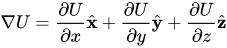
( J x x ^ + J y y ^ + J z z ^ ) ⋅ ( F x x ^ + F y y ^ + F z z ^ ) = J x F x + J y F y + J z F z {\displaystyle (J_{x}{\hat {\mathbf {x} }}+J_{y}{\hat {\mathbf {y} }}+J_{z}{\hat {\mathbf {z} }})\cdot (F_{x}{\hat {\mathbf {x} }}+F_{y}{\hat {\mathbf {y} }}+F_{z}{\hat {\mathbf {z} }})=J_{x}F_{x}+J_{y}F_{y}+J_{z}F_{z}} ( F x x ^ + F y y ^ + F z z ^ ) × ( G x x ^ + G y y ^ + G z z ^ ) = ( F y G z − F z G y ) x ^ + ( F z G x − F x G z ) y ^ + ( F x G y − F y G x ) z ^ {\displaystyle (F_{x}{\hat {\mathbf {x} }}+F_{y}{\hat {\mathbf {y} }}+F_{z}{\hat {\mathbf {z} }})\times (G_{x}{\hat {\mathbf {x} }}+G_{y}{\hat {\mathbf {y} }}+G_{z}{\hat {\mathbf {z} }})=(F_{y}G_{z}-F_{z}G_{y}){\hat {\mathbf {x} }}+(F_{z}G_{x}-F_{x}G_{z}){\hat {\mathbf {y} }}+(F_{x}G_{y}-F_{y}G_{x}){\hat {\mathbf {z} }}} ∇ ⋅ ( J x x ^ + J y y ^ + J z z ^ ) = ∂ J x ∂ x + ∂ J y ∂ y + ∂ J z ∂ z {\displaystyle \nabla \cdot (J_{x}{\hat {\mathbf {x} }}+J_{y}{\hat {\mathbf {y} }}+J_{z}{\hat {\mathbf {z} }})={\frac {\partial J_{x}}{\partial x}}+{\frac {\partial J_{y}}{\partial y}}+{\frac {\partial J_{z}}{\partial z}}} ∇ × ( F x x ^ + F y y ^ + F z z ^ ) = ( ∂ F z ∂ y − ∂ F y ∂ z ) x ^ + ( ∂ F x ∂ z − ∂ F z ∂ x ) y ^ + ( ∂ F y ∂ x − ∂ F x ∂ y ) z ^ {\displaystyle \nabla \times (F_{x}{\hat {\mathbf {x} }}+F_{y}{\hat {\mathbf {y} }}+F_{z}{\hat {\mathbf {z} }})=\left({\frac {\partial F_{z}}{\partial y}}-{\frac {\partial F_{y}}{\partial z}}\right){\hat {\mathbf {x} }}+\left({\frac {\partial F_{x}}{\partial z}}-{\frac {\partial F_{z}}{\partial x}}\right){\hat {\mathbf {y} }}+\left({\frac {\partial F_{y}}{\partial x}}-{\frac {\partial F_{x}}{\partial y}}\right){\hat {\mathbf {z} }}} ∇ U = ∂ U ∂ x x ^ + ∂ U ∂ y y ^ + ∂ U ∂ z z ^ {\displaystyle \nabla U={\frac {\partial U}{\partial x}}{\hat {\mathbf {x} }}+{\frac {\partial U}{\partial y}}{\hat {\mathbf {y} }}+{\frac {\partial U}{\partial z}}{\hat {\mathbf {z} }}} 對於柱座標系, c 1 = ρ {\displaystyle c_{1}=\rho } c 2 = ϕ {\displaystyle c_{2}=\phi } c 3 = z {\displaystyle c_{3}=z} a ^ 1 = a ^ 1 = ρ ^ {\displaystyle {\hat {\mathbf {a} }}^{1}={\hat {\mathbf {a} }}_{1}={\hat {\mathbf {\rho } }}} a ^ 2 = a ^ 2 = ϕ ^ {\displaystyle {\hat {\mathbf {a} }}^{2}={\hat {\mathbf {a} }}_{2}={\hat {\mathbf {\phi } }}} a ^ 3 = a ^ 3 = z ^ {\displaystyle {\hat {\mathbf {a} }}^{3}={\hat {\mathbf {a} }}_{3}={\hat {\mathbf {z} }}} l 1 = 1 {\displaystyle l_{1}=1} l 2 = ρ {\displaystyle l_{2}=\rho } l 3 = 1 {\displaystyle l_{3}=1}
( J ρ ρ ^ + J ϕ ϕ ^ + J z z ^ ) ⋅ ( F ρ ρ ^ + F ϕ ϕ ^ + F z z ^ ) = J ρ F ρ + J ϕ F ϕ + J z F z {\displaystyle (J_{\rho }{\hat {\mathbf {\rho } }}+J_{\phi }{\hat {\mathbf {\phi } }}+J_{z}{\hat {\mathbf {z} }})\cdot (F_{\rho }{\hat {\mathbf {\rho } }}+F_{\phi }{\hat {\mathbf {\phi } }}+F_{z}{\hat {\mathbf {z} }})=J_{\rho }F_{\rho }+J_{\phi }F_{\phi }+J_{z}F_{z}} ( F ρ ρ ^ + F ϕ ϕ ^ + F z z ^ ) × ( F ρ ρ ^ + F ϕ ϕ ^ + F z z ^ ) = ( F ϕ G z − F z G ϕ ) ρ ^ + ( F z G ρ − F ρ G z ) ϕ ^ + ( F ρ G ϕ − F ϕ G ρ ) z ^ {\displaystyle (F_{\rho }{\hat {\mathbf {\rho } }}+F_{\phi }{\hat {\mathbf {\phi } }}+F_{z}{\hat {\mathbf {z} }})\times (F_{\rho }{\hat {\mathbf {\rho } }}+F_{\phi }{\hat {\mathbf {\phi } }}+F_{z}{\hat {\mathbf {z} }})=(F_{\phi }G_{z}-F_{z}G_{\phi }){\hat {\mathbf {\rho } }}+(F_{z}G_{\rho }-F_{\rho }G_{z}){\hat {\mathbf {\phi } }}+(F_{\rho }G_{\phi }-F_{\phi }G_{\rho }){\hat {\mathbf {z} }}} ∇ ⋅ ( J ρ ρ ^ + J ϕ ϕ ^ + J z z ^ ) = 1 ρ ( ∂ ∂ ρ ( ρ J ρ ) + ∂ F ϕ ∂ ϕ + ∂ ∂ z ( ρ F z ) ) {\displaystyle \nabla \cdot (J_{\rho }{\hat {\mathbf {\rho } }}+J_{\phi }{\hat {\mathbf {\phi } }}+J_{z}{\hat {\mathbf {z} }})={\frac {1}{\rho }}\left({\frac {\partial }{\partial \rho }}(\rho J_{\rho })+{\frac {\partial F_{\phi }}{\partial \phi }}+{\frac {\partial }{\partial z}}(\rho F_{z})\right)} ∇ × ( F ρ ρ ^ + F ϕ ϕ ^ + F z z ^ ) = 1 ρ ( ∂ F z ∂ ϕ − ∂ ∂ z ( ρ F ϕ ) ) ρ ^ + ( ∂ F ρ ∂ z − ∂ F z ∂ ρ ) ϕ ^ + 1 ρ ( ∂ ∂ ρ ( ρ F ϕ ) − ∂ F ρ ∂ ϕ ) z ^ {\displaystyle \nabla \times (F_{\rho }{\hat {\mathbf {\rho } }}+F_{\phi }{\hat {\mathbf {\phi } }}+F_{z}{\hat {\mathbf {z} }})={\frac {1}{\rho }}\left({\frac {\partial F_{z}}{\partial \phi }}-{\frac {\partial }{\partial z}}(\rho F_{\phi })\right){\hat {\mathbf {\rho } }}+\left({\frac {\partial F_{\rho }}{\partial z}}-{\frac {\partial F_{z}}{\partial \rho }}\right){\hat {\mathbf {\phi } }}+{\frac {1}{\rho }}\left({\frac {\partial }{\partial \rho }}(\rho F_{\phi })-{\frac {\partial F_{\rho }}{\partial \phi }}\right){\hat {\mathbf {z} }}} ∇ U = ∂ U ∂ ρ ρ ^ + 1 ρ ∂ U ∂ ϕ ϕ ^ + ∂ U ∂ z z ^ {\displaystyle \nabla U={\frac {\partial U}{\partial \rho }}{\hat {\mathbf {\rho } }}+{\frac {1}{\rho }}{\frac {\partial U}{\partial \phi }}{\hat {\mathbf {\phi } }}+{\frac {\partial U}{\partial z}}{\hat {\mathbf {z} }}} 對於球座標系, c 1 = r {\displaystyle c_{1}=r} c 2 = θ {\displaystyle c_{2}=\theta } c 3 = ϕ {\displaystyle c_{3}=\phi } a ^ 1 = a ^ 1 = r ^ {\displaystyle {\hat {\mathbf {a} }}^{1}={\hat {\mathbf {a} }}_{1}={\hat {\mathbf {r} }}} a ^ 2 = a ^ 2 = θ ^ {\displaystyle {\hat {\mathbf {a} }}^{2}={\hat {\mathbf {a} }}_{2}={\hat {\mathbf {\theta } }}} a ^ 3 = a ^ 3 = ϕ ^ {\displaystyle {\hat {\mathbf {a} }}^{3}={\hat {\mathbf {a} }}_{3}={\hat {\mathbf {\phi } }}} l 1 = 1 {\displaystyle l_{1}=1} l 2 = r {\displaystyle l_{2}=r} l 3 = r sin θ {\displaystyle l_{3}=r\sin \theta }
( J r r ^ + J θ θ ^ + J ϕ ϕ ^ ) ⋅ ( F r r ^ + F θ θ ^ + F ϕ ϕ ^ ) = J r F r + J θ F θ + J ϕ F ϕ {\displaystyle (J_{r}{\hat {\mathbf {r} }}+J_{\theta }{\hat {\mathbf {\theta } }}+J_{\phi }{\hat {\mathbf {\phi } }})\cdot (F_{r}{\hat {\mathbf {r} }}+F_{\theta }{\hat {\mathbf {\theta } }}+F_{\phi }{\hat {\mathbf {\phi } }})=J_{r}F_{r}+J_{\theta }F_{\theta }+J_{\phi }F_{\phi }} ( F r r ^ + F θ θ ^ + F ϕ ϕ ^ ) × ( G r r ^ + G θ θ ^ + G ϕ ϕ ^ ) = ( F θ G ϕ − F ϕ G θ ) r ^ + ( F ϕ G r − F r G ϕ ) θ ^ + ( F r G θ − F θ G r ) ϕ ^ {\displaystyle (F_{r}{\hat {\mathbf {r} }}+F_{\theta }{\hat {\mathbf {\theta } }}+F_{\phi }{\hat {\mathbf {\phi } }})\times (G_{r}{\hat {\mathbf {r} }}+G_{\theta }{\hat {\mathbf {\theta } }}+G_{\phi }{\hat {\mathbf {\phi } }})=(F_{\theta }G_{\phi }-F_{\phi }G_{\theta }){\hat {\mathbf {r} }}+(F_{\phi }G_{r}-F_{r}G_{\phi }){\hat {\mathbf {\theta } }}+(F_{r}G_{\theta }-F_{\theta }G_{r}){\hat {\mathbf {\phi } }}} ∇ ⋅ ( J r r ^ + J θ θ ^ + J ϕ ϕ ^ ) = 1 r 2 sin θ ( ∂ ∂ r ( r 2 sin θ J r ) + ∂ ∂ θ ( r sin θ J θ ) + ∂ ∂ ϕ ( r F ϕ ) ) {\displaystyle \nabla \cdot (J_{r}{\hat {\mathbf {r} }}+J_{\theta }{\hat {\mathbf {\theta } }}+J_{\phi }{\hat {\mathbf {\phi } }})={\frac {1}{r^{2}\sin \theta }}\left({\frac {\partial }{\partial r}}(r^{2}\sin \theta J_{r})+{\frac {\partial }{\partial \theta }}(r\sin \theta J_{\theta })+{\frac {\partial }{\partial \phi }}(rF_{\phi })\right)} ∇ × ( F r r ^ + F θ θ ^ + F ϕ ϕ ^ ) = 1 r 2 sin θ ( ∂ ∂ θ ( r sin θ F ϕ ) − ∂ ∂ ϕ ( r F θ ) ) r ^ + 1 r sin θ ( ∂ F r ∂ ϕ − ∂ ∂ r ( r sin θ F ϕ ) ) θ ^ + 1 r ( ∂ ∂ r ( r F θ ) − ∂ F r ∂ θ ) ϕ ^ {\displaystyle \nabla \times (F_{r}{\hat {\mathbf {r} }}+F_{\theta }{\hat {\mathbf {\theta } }}+F_{\phi }{\hat {\mathbf {\phi } }})={\frac {1}{r^{2}\sin \theta }}\left({\frac {\partial }{\partial \theta }}(r\sin \theta F_{\phi })-{\frac {\partial }{\partial \phi }}(rF_{\theta })\right){\hat {\mathbf {r} }}+{\frac {1}{r\sin \theta }}\left({\frac {\partial F_{r}}{\partial \phi }}-{\frac {\partial }{\partial r}}(r\sin \theta F_{\phi })\right){\hat {\mathbf {\theta } }}+{\frac {1}{r}}\left({\frac {\partial }{\partial r}}(rF_{\theta })-{\frac {\partial F_{r}}{\partial \theta }}\right){\hat {\mathbf {\phi } }}} ∇ U = ∂ U ∂ r r ^ + 1 r ∂ U ∂ θ θ ^ + 1 r sin θ ∂ U ∂ ϕ ϕ ^ {\displaystyle \nabla U={\frac {\partial U}{\partial r}}{\hat {\mathbf {r} }}+{\frac {1}{r}}{\frac {\partial U}{\partial \theta }}{\hat {\mathbf {\theta } }}+{\frac {1}{r\sin \theta }}{\frac {\partial U}{\partial \phi }}{\hat {\mathbf {\phi } }}} 許多與向量微積分相關的恆等式可以從檢查路徑-體積交點和表面-表面交點的端點推匯出來。
多路徑與多體積交點的端點有兩個來源:多路徑中原本就在多體積內的端點,以及路徑進入和離開體積生成的端點。 從一個多路徑 C {\displaystyle \mathbf {C} } J {\displaystyle \mathbf {J} } U {\displaystyle \mathbf {U} } U {\displaystyle U} C ∩ U {\displaystyle \mathbf {C} \cap \mathbf {U} } J U {\displaystyle \mathbf {J} U}
Any time a path C {\displaystyle C} w 1 {\displaystyle w_{1}} Ω {\displaystyle \Omega } w 2 {\displaystyle w_{2}} C ∩ U {\displaystyle \mathbf {C} \cap \mathbf {U} } C {\displaystyle C} w 1 w 2 {\displaystyle w_{1}w_{2}} C {\displaystyle C} w 1 {\displaystyle w_{1}} Ω {\displaystyle \Omega } w 2 {\displaystyle w_{2}} C ∩ U {\displaystyle \mathbf {C} \cap \mathbf {U} } C {\displaystyle C} − w 1 w 2 {\displaystyle -w_{1}w_{2}} C ∩ U {\displaystyle \mathbf {C} \cap \mathbf {U} } C {\displaystyle \mathbf {C} } U {\displaystyle \mathbf {U} } C {\displaystyle \mathbf {C} } U {\displaystyle \mathbf {U} } ( ∇ ⋅ J ) U {\displaystyle (\nabla \cdot \mathbf {J} )U} ∇ ⋅ ( J U ) {\displaystyle \nabla \cdot (\mathbf {J} U)}
每當一條帶權重為 w 1 {\displaystyle w_{1}} C {\displaystyle C} w 2 {\displaystyle w_{2}} Ω {\displaystyle \Omega } C ∩ U {\displaystyle \mathbf {C} \cap \mathbf {U} } w 1 w 2 {\displaystyle w_{1}w_{2}} w 1 {\displaystyle w_{1}} C {\displaystyle C} w 2 {\displaystyle w_{2}} Ω {\displaystyle \Omega } C ∩ U {\displaystyle \mathbf {C} \cap \mathbf {U} } − w 1 w 2 {\displaystyle -w_{1}w_{2}} C {\displaystyle \mathbf {C} } U {\displaystyle \mathbf {U} } C ∩ U {\displaystyle \mathbf {C} \cap \mathbf {U} } C {\displaystyle \mathbf {C} } U {\displaystyle \mathbf {U} } ∇ ⋅ ( J U ) {\displaystyle \nabla \cdot (\mathbf {J} U)} J ⋅ ( ∇ U ) {\displaystyle \mathbf {J} \cdot (\nabla U)}
集合 C ∩ U {\displaystyle \mathbf {C} \cap \mathbf {U} } ∇ ⋅ ( J U ) = ( ∇ ⋅ J ) U + J ⋅ ( ∇ U ) {\displaystyle \nabla \cdot (\mathbf {J} U)=(\nabla \cdot \mathbf {J} )U+\mathbf {J} \cdot (\nabla U)} C ∩ U {\displaystyle \mathbf {C} \cap \mathbf {U} } C {\displaystyle \mathbf {C} } U {\displaystyle \mathbf {U} } C {\displaystyle \mathbf {C} } U {\displaystyle \mathbf {U} }
從恆等式 ∇ ⋅ ( J U ) = ( ∇ ⋅ J ) U + J ⋅ ( ∇ U ) {\displaystyle \nabla \cdot (\mathbf {J} U)=(\nabla \cdot \mathbf {J} )U+\mathbf {J} \cdot (\nabla U)} ∭ q ∈ R 3 ∇ ⋅ ( J ( q ) U ( q ) ) d V = ∭ q ∈ R 3 ( ∇ ⋅ J ( q ) ) U ( q ) d V + ∭ q ∈ R 3 J ( q ) ⋅ ( ∇ U ( q ) ) d V {\displaystyle \iiint _{\mathbf {q} \in \mathbb {R} ^{3}}\nabla \cdot (\mathbf {J} (\mathbf {q} )U(\mathbf {q} ))dV=\iiint _{\mathbf {q} \in \mathbb {R} ^{3}}(\nabla \cdot \mathbf {J} (\mathbf {q} ))U(\mathbf {q} )dV+\iiint _{\mathbf {q} \in \mathbb {R} ^{3}}\mathbf {J} (\mathbf {q} )\cdot (\nabla U(\mathbf {q} ))dV} ∭ q ∈ R 3 ∇ ⋅ ( J ( q ) U ( q ) ) d V = 0 {\displaystyle \iiint _{\mathbf {q} \in \mathbb {R} ^{3}}\nabla \cdot (\mathbf {J} (\mathbf {q} )U(\mathbf {q} ))dV=0} ∭ q ∈ R 3 ( ∇ ⋅ J ( q ) ) U ( q ) d V = − ∭ q ∈ R 3 J ( q ) ⋅ ( ∇ U ( q ) ) d V {\displaystyle \iiint _{\mathbf {q} \in \mathbb {R} ^{3}}(\nabla \cdot \mathbf {J} (\mathbf {q} ))U(\mathbf {q} )dV=-\iiint _{\mathbf {q} \in \mathbb {R} ^{3}}\mathbf {J} (\mathbf {q} )\cdot (\nabla U(\mathbf {q} ))dV} C {\displaystyle \mathbf {C} } U {\displaystyle \mathbf {U} } C {\displaystyle \mathbf {C} } U {\displaystyle \mathbf {U} }
如果 J {\displaystyle \mathbf {J} } q 0 {\displaystyle \mathbf {q} _{0}} q 1 {\displaystyle \mathbf {q} _{1}} C {\displaystyle C}
∭ q ∈ R 3 ( ∇ ⋅ δ 1 ( q ; C ) ) U ( q ) d V = − ∭ q ∈ R 3 δ 1 ( q ; C ) ⋅ ( ∇ U ( q ) ) d V {\displaystyle \iiint _{\mathbf {q} \in \mathbb {R} ^{3}}(\nabla \cdot \delta _{1}(\mathbf {q} ;C))U(\mathbf {q} )dV=-\iiint _{\mathbf {q} \in \mathbb {R} ^{3}}\delta _{1}(\mathbf {q} ;C)\cdot (\nabla U(\mathbf {q} ))dV} ⟺ ∭ q ∈ R 3 ( δ 0 ( q ; q 0 ) − δ 0 ( q ; q 1 ) ) U ( q ) d V = − ∫ q ∈ C ( ∇ U ( q ) ) ⋅ d q {\displaystyle \iff \iiint _{\mathbf {q} \in \mathbb {R} ^{3}}(\delta _{0}(\mathbf {q} ;\mathbf {q} _{0})-\delta _{0}(\mathbf {q} ;\mathbf {q} _{1}))U(\mathbf {q} )dV=-\int _{\mathbf {q} \in C}(\nabla U(\mathbf {q} ))\cdot d\mathbf {q} } ⟺ U ( q 0 ) − U ( q 1 ) = − ∫ q ∈ C ( ∇ U ( q ) ) ⋅ d q {\displaystyle \iff U(\mathbf {q} _{0})-U(\mathbf {q} _{1})=-\int _{\mathbf {q} \in C}(\nabla U(\mathbf {q} ))\cdot d\mathbf {q} } ⟺ ∫ q ∈ C ( ∇ U ( q ) ) ⋅ d q = U ( q 1 ) − U ( q 0 ) {\displaystyle \iff \int _{\mathbf {q} \in C}(\nabla U(\mathbf {q} ))\cdot d\mathbf {q} =U(\mathbf {q} _{1})-U(\mathbf {q} _{0})}
如果 U {\displaystyle U} Ω {\displaystyle \Omega } σ {\displaystyle \sigma }
∭ q ∈ R 3 ( ∇ ⋅ J ( q ) ) δ 3 ( q ; Ω ) d V = − ∭ q ∈ R 3 J ( q ) ⋅ ( ∇ δ 3 ( q ; Ω ) ) d V {\displaystyle \iiint _{\mathbf {q} \in \mathbb {R} ^{3}}(\nabla \cdot \mathbf {J} (\mathbf {q} ))\delta _{3}(\mathbf {q} ;\Omega )dV=-\iiint _{\mathbf {q} \in \mathbb {R} ^{3}}\mathbf {J} (\mathbf {q} )\cdot (\nabla \delta _{3}(\mathbf {q} ;\Omega ))dV} ⟺ ∭ q ∈ Ω ( ∇ ⋅ J ( q ) ) d V = − ∭ q ∈ R 3 J ( q ) ⋅ ( − δ 2 ( q ; σ ) ) d V {\displaystyle \iff \iiint _{\mathbf {q} \in \Omega }(\nabla \cdot \mathbf {J} (\mathbf {q} ))dV=-\iiint _{\mathbf {q} \in \mathbb {R} ^{3}}\mathbf {J} (\mathbf {q} )\cdot (-\delta _{2}(\mathbf {q} ;\sigma ))dV} ⟺ ∭ q ∈ Ω ( ∇ ⋅ J ( q ) ) d V = ∬ q ∈ σ J ( q ) ⋅ d S {\displaystyle \iff \iiint _{\mathbf {q} \in \Omega }(\nabla \cdot \mathbf {J} (\mathbf {q} ))dV=\iint _{\mathbf {q} \in \sigma }\mathbf {J} (\mathbf {q} )\cdot d\mathbf {S} }
總結
給定由向量場 J {\displaystyle \mathbf {J} } U {\displaystyle U} ∇ ⋅ ( J U ) = ( ∇ ⋅ J ) U + J ⋅ ( ∇ U ) {\displaystyle \nabla \cdot (\mathbf {J} U)=(\nabla \cdot \mathbf {J} )U+\mathbf {J} \cdot (\nabla U)}
給定由向量場 J {\displaystyle \mathbf {J} } U {\displaystyle U} ∭ q ∈ R 3 ( ∇ ⋅ J ( q ) ) U ( q ) d V = − ∭ q ∈ R 3 J ( q ) ⋅ ( ∇ U ( q ) ) d V {\displaystyle \iiint _{\mathbf {q} \in \mathbb {R} ^{3}}(\nabla \cdot \mathbf {J} (\mathbf {q} ))U(\mathbf {q} )dV=-\iiint _{\mathbf {q} \in \mathbb {R} ^{3}}\mathbf {J} (\mathbf {q} )\cdot (\nabla U(\mathbf {q} ))dV}
給定一條簡單的路徑 C {\displaystyle C} q 0 {\displaystyle \mathbf {q} _{0}} q 1 {\displaystyle \mathbf {q} _{1}} U {\displaystyle U} ∫ q ∈ C ( ∇ U ( q ) ) ⋅ d q = U ( q 1 ) − U ( q 0 ) {\displaystyle \int _{\mathbf {q} \in C}(\nabla U(\mathbf {q} ))\cdot d\mathbf {q} =U(\mathbf {q} _{1})-U(\mathbf {q} _{0})} 梯度定理 。
給定由向量場 J {\displaystyle \mathbf {J} } σ {\displaystyle \sigma } Ω {\displaystyle \Omega } ∭ q ∈ Ω ( ∇ ⋅ J ( q ) ) d V = ∬ q ∈ σ J ( q ) ⋅ d S {\displaystyle \iiint _{\mathbf {q} \in \Omega }(\nabla \cdot \mathbf {J} (\mathbf {q} ))dV=\iint _{\mathbf {q} \in \sigma }\mathbf {J} (\mathbf {q} )\cdot d\mathbf {S} } 高斯散度定理 。 當第一個表面(藍色)的逆時針邊界與第二個表面(橙色)相交時,將為交點路徑建立具有正確極性的端點。當第二個表面的逆時針邊界與第一個表面相交時,將為交點路徑建立具有相反極性的端點。 首先,我們有兩個多曲面 S 1 {\displaystyle \mathbf {S} _{1}} F 1 {\displaystyle \mathbf {F} _{1}} S 2 {\displaystyle \mathbf {S} _{2}} F 2 {\displaystyle \mathbf {F} _{2}} S 1 ∩ S 2 {\displaystyle \mathbf {S} _{1}\cap \mathbf {S} _{2}} F 1 × F 2 {\displaystyle \mathbf {F} _{1}\times \mathbf {F} _{2}}
現在,我們考慮一個來自 S 1 {\displaystyle \mathbf {S} _{1}} w 1 {\displaystyle w_{1}} σ 1 {\displaystyle \sigma _{1}} S 2 {\displaystyle \mathbf {S} _{2}} w 2 {\displaystyle w_{2}} σ 2 {\displaystyle \sigma _{2}} ∂ σ 1 {\displaystyle \partial \sigma _{1}} σ 1 {\displaystyle \sigma _{1}} ∂ σ 2 {\displaystyle \partial \sigma _{2}} σ 2 {\displaystyle \sigma _{2}} σ 1 ∩ σ 2 {\displaystyle \sigma _{1}\cap \sigma _{2}}
當 ∂ σ 1 {\displaystyle \partial \sigma _{1}} σ 2 {\displaystyle \sigma _{2}} ∂ σ 1 ∩ σ 2 {\displaystyle \partial \sigma _{1}\cap \sigma _{2}} + w 1 w 2 {\displaystyle +w_{1}w_{2}} σ 1 ∩ σ 2 {\displaystyle \sigma _{1}\cap \sigma _{2}} ∂ σ 1 ∩ σ 2 {\displaystyle \partial \sigma _{1}\cap \sigma _{2}} + w 1 w 2 {\displaystyle +w_{1}w_{2}}
當 ∂ σ 1 {\displaystyle \partial \sigma _{1}} σ 2 {\displaystyle \sigma _{2}} ∂ σ 1 ∩ σ 2 {\displaystyle \partial \sigma _{1}\cap \sigma _{2}} − w 1 w 2 {\displaystyle -w_{1}w_{2}} σ 1 ∩ σ 2 {\displaystyle \sigma _{1}\cap \sigma _{2}} ∂ σ 1 ∩ σ 2 {\displaystyle \partial \sigma _{1}\cap \sigma _{2}} − w 1 w 2 {\displaystyle -w_{1}w_{2}}
當 ∂ σ 2 {\displaystyle \partial \sigma _{2}} σ 1 {\displaystyle \sigma _{1}} σ 1 ∩ ∂ σ 2 {\displaystyle \sigma _{1}\cap \partial \sigma _{2}} + w 1 w 2 {\displaystyle +w_{1}w_{2}} σ 1 ∩ σ 2 {\displaystyle \sigma _{1}\cap \sigma _{2}} σ 1 ∩ ∂ σ 2 {\displaystyle \sigma _{1}\cap \partial \sigma _{2}} − w 1 w 2 {\displaystyle -w_{1}w_{2}}
當 ∂ σ 2 {\displaystyle \partial \sigma _{2}} σ 1 {\displaystyle \sigma _{1}} σ 1 ∩ ∂ σ 2 {\displaystyle \sigma _{1}\cap \partial \sigma _{2}} − w 1 w 2 {\displaystyle -w_{1}w_{2}} σ 1 ∩ σ 2 {\displaystyle \sigma _{1}\cap \sigma _{2}} σ 1 ∩ ∂ σ 2 {\displaystyle \sigma _{1}\cap \partial \sigma _{2}} + w 1 w 2 {\displaystyle +w_{1}w_{2}} 可以看出,交集 ∂ σ 1 ∩ σ 2 {\displaystyle \partial \sigma _{1}\cap \sigma _{2}} σ 1 ∩ σ 2 {\displaystyle \sigma _{1}\cap \sigma _{2}} σ 1 ∩ ∂ σ 2 {\displaystyle \sigma _{1}\cap \partial \sigma _{2}} σ 1 ∩ σ 2 {\displaystyle \sigma _{1}\cap \sigma _{2}} S 1 ∩ S 2 {\displaystyle \mathbf {S} _{1}\cap \mathbf {S} _{2}} ∇ ⋅ ( F 1 × F 2 ) = ( ∇ × F 1 ) ⋅ F 2 − F 1 ⋅ ( ∇ × F 2 ) {\displaystyle \nabla \cdot (\mathbf {F} _{1}\times \mathbf {F} _{2})=(\nabla \times \mathbf {F} _{1})\cdot \mathbf {F} _{2}-\mathbf {F} _{1}\cdot (\nabla \times \mathbf {F} _{2})}
顯示了兩個表面,每個表面都有一個逆時針方向的邊界。每個邊界與另一個表面的交叉次數相同。紅色邊界在首選方向上穿過綠色表面 2 次,綠色邊界在首選方向上穿過紅色表面 2 次。 From the identity ∇ ⋅ ( F 1 × F 2 ) = ( ∇ × F 1 ) ⋅ F 2 − F 1 ⋅ ( ∇ × F 2 ) {\displaystyle \nabla \cdot (\mathbf {F} _{1}\times \mathbf {F} _{2})=(\nabla \times \mathbf {F} _{1})\cdot \mathbf {F} _{2}-\mathbf {F} _{1}\cdot (\nabla \times \mathbf {F} _{2})} ∭ q ∈ R 3 ∇ ⋅ ( F 1 ( q ) × F 2 ( q ) ) d V = ∭ q ∈ R 3 ( ∇ × F 1 ( q ) ) ⋅ F 2 ( q ) d V − ∭ q ∈ R 3 F 1 ( q ) ⋅ ( ∇ × F 2 ( q ) ) d V {\displaystyle \iiint _{\mathbf {q} \in \mathbb {R} ^{3}}\nabla \cdot (\mathbf {F} _{1}(\mathbf {q} )\times \mathbf {F} _{2}(\mathbf {q} ))dV=\iiint _{\mathbf {q} \in \mathbb {R} ^{3}}(\nabla \times \mathbf {F} _{1}(\mathbf {q} ))\cdot \mathbf {F} _{2}(\mathbf {q} )dV-\iiint _{\mathbf {q} \in \mathbb {R} ^{3}}\mathbf {F} _{1}(\mathbf {q} )\cdot (\nabla \times \mathbf {F} _{2}(\mathbf {q} ))dV} ∭ q ∈ R 3 ∇ ⋅ ( F 1 ( q ) × F 2 ( q ) ) d V = 0 {\displaystyle \iiint _{\mathbf {q} \in \mathbb {R} ^{3}}\nabla \cdot (\mathbf {F} _{1}(\mathbf {q} )\times \mathbf {F} _{2}(\mathbf {q} ))dV=0} ∭ q ∈ R 3 ( ∇ × F 1 ( q ) ) ⋅ F 2 ( q ) d V = ∭ q ∈ R 3 F 1 ( q ) ⋅ ( ∇ × F 2 ( q ) ) d V {\displaystyle \iiint _{\mathbf {q} \in \mathbb {R} ^{3}}(\nabla \times \mathbf {F} _{1}(\mathbf {q} ))\cdot \mathbf {F} _{2}(\mathbf {q} )dV=\iiint _{\mathbf {q} \in \mathbb {R} ^{3}}\mathbf {F} _{1}(\mathbf {q} )\cdot (\nabla \times \mathbf {F} _{2}(\mathbf {q} ))dV} S 1 {\displaystyle \mathbf {S} _{1}} S 2 {\displaystyle \mathbf {S} _{2}} S 2 {\displaystyle \mathbf {S} _{2}} S 1 {\displaystyle \mathbf {S} _{1}}
如果 F 2 {\displaystyle \mathbf {F} _{2}} ∂ σ {\displaystyle \partial \sigma } σ {\displaystyle \sigma }
∭ q ∈ R 3 ( ∇ × F 1 ( q ) ) ⋅ δ 2 ( q ; σ ) d V = ∭ q ∈ R 3 F 1 ( q ) ⋅ ( ∇ × δ 2 ( q ; σ ) ) d V {\displaystyle \iiint _{\mathbf {q} \in \mathbb {R} ^{3}}(\nabla \times \mathbf {F} _{1}(\mathbf {q} ))\cdot \delta _{2}(\mathbf {q} ;\sigma )dV=\iiint _{\mathbf {q} \in \mathbb {R} ^{3}}\mathbf {F} _{1}(\mathbf {q} )\cdot (\nabla \times \delta _{2}(\mathbf {q} ;\sigma ))dV} ⟺ ∬ q ∈ σ ( ∇ × F 1 ( q ) ) ⋅ d S = ∭ q ∈ R 3 F 1 ( q ) ⋅ δ 1 ( q ; ∂ σ ) d V {\displaystyle \iff \iint _{\mathbf {q} \in \sigma }(\nabla \times \mathbf {F} _{1}(\mathbf {q} ))\cdot d\mathbf {S} =\iiint _{\mathbf {q} \in \mathbb {R} ^{3}}\mathbf {F} _{1}(\mathbf {q} )\cdot \delta _{1}(\mathbf {q} ;\partial \sigma )dV} ⟺ ∬ q ∈ σ ( ∇ × F 1 ( q ) ) ⋅ d S = ∫ q ∈ ∂ σ F 1 ( q ) ⋅ d q {\displaystyle \iff \iint _{\mathbf {q} \in \sigma }(\nabla \times \mathbf {F} _{1}(\mathbf {q} ))\cdot d\mathbf {S} =\int _{\mathbf {q} \in \partial \sigma }\mathbf {F} _{1}(\mathbf {q} )\cdot d\mathbf {q} }
這被稱為斯托克斯定理 。
總結
給定兩個由向量場表示的多曲面 F 1 {\displaystyle \mathbf {F} _{1}} F 2 {\displaystyle \mathbf {F} _{2}} ∇ ⋅ ( F 1 × F 2 ) = ( ∇ × F 1 ) ⋅ F 2 − F 1 ⋅ ( ∇ × F 2 ) {\displaystyle \nabla \cdot (\mathbf {F} _{1}\times \mathbf {F} _{2})=(\nabla \times \mathbf {F} _{1})\cdot \mathbf {F} _{2}-\mathbf {F} _{1}\cdot (\nabla \times \mathbf {F} _{2})}
給定兩個由向量場表示的多曲面 F 1 {\displaystyle \mathbf {F} _{1}} F 2 {\displaystyle \mathbf {F} _{2}} ∭ q ∈ R 3 ( ∇ × F 1 ( q ) ) ⋅ F 2 ( q ) d V = ∭ q ∈ R 3 F 1 ( q ) ⋅ ( ∇ × F 2 ( q ) ) d V {\displaystyle \iiint _{\mathbf {q} \in \mathbb {R} ^{3}}(\nabla \times \mathbf {F} _{1}(\mathbf {q} ))\cdot \mathbf {F} _{2}(\mathbf {q} )dV=\iiint _{\mathbf {q} \in \mathbb {R} ^{3}}\mathbf {F} _{1}(\mathbf {q} )\cdot (\nabla \times \mathbf {F} _{2}(\mathbf {q} ))dV}
給定一個由向量場表示的多曲面 F 1 {\displaystyle \mathbf {F} _{1}} σ {\displaystyle \sigma } ∂ σ {\displaystyle \partial \sigma } ∬ q ∈ σ ( ∇ × F 1 ( q ) ) ⋅ d S = ∫ q ∈ ∂ σ F 1 ( q ) ⋅ d q {\displaystyle \iint _{\mathbf {q} \in \sigma }(\nabla \times \mathbf {F} _{1}(\mathbf {q} ))\cdot d\mathbf {S} =\int _{\mathbf {q} \in \partial \sigma }\mathbf {F} _{1}(\mathbf {q} )\cdot d\mathbf {q} } 斯托克斯定理 。 除了從檢查交點的端點推匯出的恆等式外,還可以透過檢查由交點產生的曲面的逆時針邊界來推匯出更多恆等式。
左側是一個定向曲面和一個體積。曲面的逆時針邊界和體積的內向定向曲面如圖所示。右側是曲面與體積相交形成的曲面,以及交點曲面的逆時針邊界也如圖所示。交點的邊界由兩部分組成:原始曲面的邊界與體積的交點,以及體積的內向定向曲面與原始曲面的交點。 首先,定義一個多表面 S {\displaystyle \mathbf {S} } F {\displaystyle \mathbf {F} } U {\displaystyle \mathbf {U} } U {\displaystyle U} S ∩ U {\displaystyle \mathbf {S} \cap U} F U {\displaystyle \mathbf {F} U}
Consider a surface σ {\displaystyle \sigma } w 1 {\displaystyle w_{1}} S {\displaystyle \mathbf {S} } Ω {\displaystyle \Omega } w 2 {\displaystyle w_{2}} U {\displaystyle \mathbf {U} } ∂ σ {\displaystyle \partial \sigma } σ {\displaystyle \sigma } ∂ Ω {\displaystyle \partial \Omega } Ω {\displaystyle \Omega } σ ∩ Ω {\displaystyle \sigma \cap \Omega } ∂ σ {\displaystyle \partial \sigma } Ω {\displaystyle \Omega } ∂ σ ∩ Ω {\displaystyle \partial \sigma \cap \Omega } σ ∩ Ω {\displaystyle \sigma \cap \Omega } ∂ σ {\displaystyle \partial \sigma } Ω {\displaystyle \Omega } σ ∩ Ω {\displaystyle \sigma \cap \Omega } Ω {\displaystyle \Omega } σ {\displaystyle \sigma } S ∩ U {\displaystyle \mathbf {S} \cap \mathbf {U} } ∇ × ( F U ) {\displaystyle \nabla \times (\mathbf {F} U)} S {\displaystyle \mathbf {S} } U {\displaystyle \mathbf {U} } ( ∇ × F ) U {\displaystyle (\nabla \times \mathbf {F} )U} U {\displaystyle \mathbf {U} } S {\displaystyle \mathbf {S} } ( ∇ U ) × F = − F × ( ∇ U ) {\displaystyle (\nabla U)\times \mathbf {F} =-\mathbf {F} \times (\nabla U)} ∇ × ( F U ) = ( ∇ × F ) U + ( ∇ U ) × F = ( ∇ × F ) U − F × ( ∇ U ) {\displaystyle \nabla \times (\mathbf {F} U)=(\nabla \times \mathbf {F} )U+(\nabla U)\times \mathbf {F} =(\nabla \times \mathbf {F} )U-\mathbf {F} \times (\nabla U)}
從恆等式 ∇ × ( F U ) = ( ∇ × F ) U − F × ( ∇ U ) {\displaystyle \nabla \times (\mathbf {F} U)=(\nabla \times \mathbf {F} )U-\mathbf {F} \times (\nabla U)} ∭ q ∈ R 3 ∇ × ( F ( q ) U ( q ) ) d V = ∭ q ∈ R 3 ( ∇ × F ( q ) ) U ( q ) d V − ∭ q ∈ R 3 F ( q ) × ( ∇ U ( q ) ) d V {\displaystyle \iiint _{\mathbf {q} \in \mathbb {R} ^{3}}\nabla \times (\mathbf {F} (\mathbf {q} )U(\mathbf {q} ))dV=\iiint _{\mathbf {q} \in \mathbb {R} ^{3}}(\nabla \times \mathbf {F} (\mathbf {q} ))U(\mathbf {q} )dV-\iiint _{\mathbf {q} \in \mathbb {R} ^{3}}\mathbf {F} (\mathbf {q} )\times (\nabla U(\mathbf {q} ))dV} 0 {\displaystyle \mathbf {0} } ∭ q ∈ R 3 ∇ × ( F ( q ) U ( q ) ) d V = 0 {\displaystyle \iiint _{\mathbf {q} \in \mathbb {R} ^{3}}\nabla \times (\mathbf {F} (\mathbf {q} )U(\mathbf {q} ))dV=\mathbf {0} } ∭ q ∈ R 3 ( ∇ × F ( q ) ) U ( q ) d V = ∭ q ∈ R 3 F ( q ) × ( ∇ U ( q ) ) d V {\displaystyle \iiint _{\mathbf {q} \in \mathbb {R} ^{3}}(\nabla \times \mathbf {F} (\mathbf {q} ))U(\mathbf {q} )dV=\iiint _{\mathbf {q} \in \mathbb {R} ^{3}}\mathbf {F} (\mathbf {q} )\times (\nabla U(\mathbf {q} ))dV} S {\displaystyle \mathbf {S} } U {\displaystyle \mathbf {U} } S {\displaystyle \mathbf {S} } U {\displaystyle \mathbf {U} }
如果 F {\displaystyle \mathbf {F} } σ {\displaystyle \sigma } ∂ σ {\displaystyle \partial \sigma }
∭ q ∈ R 3 ( ∇ × δ 2 ( q ; σ ) ) U ( q ) d V = ∭ q ∈ R 3 δ 2 ( q ; σ ) × ( ∇ U ( q ) ) d V {\displaystyle \iiint _{\mathbf {q} \in \mathbb {R} ^{3}}(\nabla \times \delta _{2}(\mathbf {q} ;\sigma ))U(\mathbf {q} )dV=\iiint _{\mathbf {q} \in \mathbb {R} ^{3}}\delta _{2}(\mathbf {q} ;\sigma )\times (\nabla U(\mathbf {q} ))dV} ⟺ ∭ q ∈ R 3 δ 1 ( q ; ∂ σ ) U ( q ) d V = ∬ q ∈ σ d S × ( ∇ U ( q ) ) {\displaystyle \iff \iiint _{\mathbf {q} \in \mathbb {R} ^{3}}\delta _{1}(\mathbf {q} ;\partial \sigma )U(\mathbf {q} )dV=\iint _{\mathbf {q} \in \sigma }d\mathbf {S} \times (\nabla U(\mathbf {q} ))} ⟺ ∫ q ∈ ∂ σ U ( q ) d q = − ∬ q ∈ σ ( ∇ U ( q ) ) × d S {\displaystyle \iff \int _{\mathbf {q} \in \partial \sigma }U(\mathbf {q} )d\mathbf {q} =-\iint _{\mathbf {q} \in \sigma }(\nabla U(\mathbf {q} ))\times d\mathbf {S} }
如果 Ω {\displaystyle \Omega } 向外 指向的表面 σ {\displaystyle \sigma }
∭ q ∈ R 3 ( ∇ × F ( q ) ) δ 3 ( q ; Ω ) d V = ∭ q ∈ R 3 F ( q ) × ( ∇ δ 3 ( q ; Ω ) ) d V {\displaystyle \iiint _{\mathbf {q} \in \mathbb {R} ^{3}}(\nabla \times \mathbf {F} (\mathbf {q} ))\delta _{3}(\mathbf {q} ;\Omega )dV=\iiint _{\mathbf {q} \in \mathbb {R} ^{3}}\mathbf {F} (\mathbf {q} )\times (\nabla \delta _{3}(\mathbf {q} ;\Omega ))dV} ⟺ ∭ q ∈ Ω ( ∇ × F ( q ) ) d V = ∭ q ∈ R 3 F ( q ) × ( − δ 2 ( q ; σ ) ) d V {\displaystyle \iff \iiint _{\mathbf {q} \in \Omega }(\nabla \times \mathbf {F} (\mathbf {q} ))dV=\iiint _{\mathbf {q} \in \mathbb {R} ^{3}}\mathbf {F} (\mathbf {q} )\times (-\delta _{2}(\mathbf {q} ;\sigma ))dV} ⟺ ∭ q ∈ Ω ( ∇ × F ( q ) ) d V = − ∬ q ∈ σ F ( q ) × d S {\displaystyle \iff \iiint _{\mathbf {q} \in \Omega }(\nabla \times \mathbf {F} (\mathbf {q} ))dV=-\iint _{\mathbf {q} \in \sigma }\mathbf {F} (\mathbf {q} )\times d\mathbf {S} }
總結
給定一個由向量場 F {\displaystyle \mathbf {F} } U {\displaystyle U} ∇ × ( F U ) = ( ∇ × F ) U − F × ( ∇ U ) {\displaystyle \nabla \times (\mathbf {F} U)=(\nabla \times \mathbf {F} )U-\mathbf {F} \times (\nabla U)}
給定一個由向量場 F {\displaystyle \mathbf {F} } U {\displaystyle U} ∭ q ∈ R 3 ( ∇ × F ( q ) ) U ( q ) d V = ∭ q ∈ R 3 F ( q ) × ( ∇ U ( q ) ) d V {\displaystyle \iiint _{\mathbf {q} \in \mathbb {R} ^{3}}(\nabla \times \mathbf {F} (\mathbf {q} ))U(\mathbf {q} )dV=\iiint _{\mathbf {q} \in \mathbb {R} ^{3}}\mathbf {F} (\mathbf {q} )\times (\nabla U(\mathbf {q} ))dV}
給定一個簡單的曲面 σ {\displaystyle \sigma } ∂ σ {\displaystyle \partial \sigma } U {\displaystyle U} ∫ q ∈ ∂ σ U ( q ) d q = − ∬ q ∈ σ ( ∇ U ( q ) ) × d S {\displaystyle \int _{\mathbf {q} \in \partial \sigma }U(\mathbf {q} )d\mathbf {q} =-\iint _{\mathbf {q} \in \sigma }(\nabla U(\mathbf {q} ))\times d\mathbf {S} }
給定一個由向量場 F {\displaystyle \mathbf {F} } Ω {\displaystyle \Omega } σ {\displaystyle \sigma } ∭ q ∈ Ω ( ∇ × F ( q ) ) d V = − ∬ q ∈ σ F ( q ) × d S {\displaystyle \iiint _{\mathbf {q} \in \Omega }(\nabla \times \mathbf {F} (\mathbf {q} ))dV=-\iint _{\mathbf {q} \in \sigma }\mathbf {F} (\mathbf {q} )\times d\mathbf {S} } 可以透過檢查由交集產生的體積的曲面來推匯出更多恆等式。
體積-體積交集的曲面由兩部分組成:第二體積的曲面與第一個體積的交集,以及第一個體積的曲面與第二個體積的交集。 從一個多體積的 U 1 {\displaystyle \mathbf {U} _{1}} U 1 {\displaystyle U_{1}} U 2 {\displaystyle \mathbf {U} _{2}} U 2 {\displaystyle U_{2}} U 1 ∩ U 2 {\displaystyle \mathbf {U} _{1}\cap \mathbf {U} _{2}} U 1 U 2 {\displaystyle U_{1}U_{2}}
Consider a volume Ω 1 {\displaystyle \Omega _{1}} w 1 {\displaystyle w_{1}} U 1 {\displaystyle \mathbf {U} _{1}} Ω 2 {\displaystyle \Omega _{2}} w 2 {\displaystyle w_{2}} U 2 {\displaystyle \mathbf {U} _{2}} σ 1 {\displaystyle \sigma _{1}} Ω 1 {\displaystyle \Omega _{1}} σ 2 {\displaystyle \sigma _{2}} Ω 2 {\displaystyle \Omega _{2}} Ω 1 ∩ Ω 2 {\displaystyle \Omega _{1}\cap \Omega _{2}} Ω 1 ∩ Ω 2 {\displaystyle \Omega _{1}\cap \Omega _{2}} σ 2 {\displaystyle \sigma _{2}} Ω 1 {\displaystyle \Omega _{1}} U 1 ( ∇ U 2 ) {\displaystyle U_{1}(\nabla U_{2})} ∇ ( U 1 U 2 ) {\displaystyle \nabla (U_{1}U_{2})} Ω 1 ∩ Ω 2 {\displaystyle \Omega _{1}\cap \Omega _{2}} σ 1 {\displaystyle \sigma _{1}} Ω 2 {\displaystyle \Omega _{2}} ( ∇ U 1 ) U 2 {\displaystyle (\nabla U_{1})U_{2}} ∇ ( U 1 U 2 ) {\displaystyle \nabla (U_{1}U_{2})} U 1 ∩ U 2 {\displaystyle \mathbf {U} _{1}\cap \mathbf {U} _{2}} ∇ ( U 1 U 2 ) = U 1 ( ∇ U 2 ) + ( ∇ U 1 ) U 2 {\displaystyle \nabla (U_{1}U_{2})=U_{1}(\nabla U_{2})+(\nabla U_{1})U_{2}}
從恆等式 ∇ ( U 1 U 2 ) = U 1 ( ∇ U 2 ) + ( ∇ U 1 ) U 2 {\displaystyle \nabla (U_{1}U_{2})=U_{1}(\nabla U_{2})+(\nabla U_{1})U_{2}} ∭ q ∈ R 3 ∇ ( U 1 ( q ) U 2 ( q ) ) d V = ∭ q ∈ R 3 U 1 ( q ) ( ∇ U 2 ( q ) ) d V + ∭ q ∈ R 3 ( ∇ U 1 ( q ) ) U 2 ( q ) d V {\displaystyle \iiint _{\mathbf {q} \in \mathbb {R} ^{3}}\nabla (U_{1}(\mathbf {q} )U_{2}(\mathbf {q} ))dV=\iiint _{\mathbf {q} \in \mathbb {R} ^{3}}U_{1}(\mathbf {q} )(\nabla U_{2}(\mathbf {q} ))dV+\iiint _{\mathbf {q} \in \mathbb {R} ^{3}}(\nabla U_{1}(\mathbf {q} ))U_{2}(\mathbf {q} )dV} 0 {\displaystyle \mathbf {0} } ∭ q ∈ R 3 ∇ ( U 1 ( q ) U 2 ( q ) ) d V = 0 {\displaystyle \iiint _{\mathbf {q} \in \mathbb {R} ^{3}}\nabla (U_{1}(\mathbf {q} )U_{2}(\mathbf {q} ))dV=\mathbf {0} } ∭ q ∈ R 3 U 1 ( q ) ( ∇ U 2 ( q ) ) d V = − ∭ q ∈ R 3 ( ∇ U 1 ( q ) ) U 2 ( q ) d V {\displaystyle \iiint _{\mathbf {q} \in \mathbb {R} ^{3}}U_{1}(\mathbf {q} )(\nabla U_{2}(\mathbf {q} ))dV=-\iiint _{\mathbf {q} \in \mathbb {R} ^{3}}(\nabla U_{1}(\mathbf {q} ))U_{2}(\mathbf {q} )dV} U 1 {\displaystyle \mathbf {U} _{1}} U 2 {\displaystyle \mathbf {U} _{2}} U 1 {\displaystyle \mathbf {U} _{1}} U 2 {\displaystyle \mathbf {U} _{2}}
如果 U 1 {\displaystyle U_{1}} Ω {\displaystyle \Omega } σ {\displaystyle \sigma } ∭ q ∈ R 3 δ 3 ( q ; Ω ) ( ∇ U 2 ( q ) ) d V = − ∭ q ∈ R 3 ( ∇ δ 3 ( q ; Ω ) ) U 2 ( q ) d V {\displaystyle \iiint _{\mathbf {q} \in \mathbb {R} ^{3}}\delta _{3}(\mathbf {q} ;\Omega )(\nabla U_{2}(\mathbf {q} ))dV=-\iiint _{\mathbf {q} \in \mathbb {R} ^{3}}(\nabla \delta _{3}(\mathbf {q} ;\Omega ))U_{2}(\mathbf {q} )dV} ⟺ ∭ q ∈ Ω ( ∇ U 2 ( q ) ) d V = − ∭ q ∈ R 3 ( − δ 2 ( q ; σ ) ) U 2 ( q ) d V {\displaystyle \iff \iiint _{\mathbf {q} \in \Omega }(\nabla U_{2}(\mathbf {q} ))dV=-\iiint _{\mathbf {q} \in \mathbb {R} ^{3}}(-\delta _{2}(\mathbf {q} ;\sigma ))U_{2}(\mathbf {q} )dV} ⟺ ∭ q ∈ Ω ( ∇ U 2 ( q ) ) d V = ∬ q ∈ σ U 2 ( q ) d S {\displaystyle \iff \iiint _{\mathbf {q} \in \Omega }(\nabla U_{2}(\mathbf {q} ))dV=\iint _{\mathbf {q} \in \sigma }U_{2}(\mathbf {q} )d\mathbf {S} }
總結
給定兩個由標量場 U 1 {\displaystyle U_{1}} U 2 {\displaystyle U_{2}} ∇ ( U 1 U 2 ) = U 1 ( ∇ U 2 ) + ( ∇ U 1 ) U 2 {\displaystyle \nabla (U_{1}U_{2})=U_{1}(\nabla U_{2})+(\nabla U_{1})U_{2}}
給定兩個由標量場表示的多體積,分別記為 U 1 {\displaystyle U_{1}} U 2 {\displaystyle U_{2}} ∭ q ∈ R 3 U 1 ( q ) ( ∇ U 2 ( q ) ) d V = − ∭ q ∈ R 3 ( ∇ U 1 ( q ) ) U 2 ( q ) d V {\displaystyle \iiint _{\mathbf {q} \in \mathbb {R} ^{3}}U_{1}(\mathbf {q} )(\nabla U_{2}(\mathbf {q} ))dV=-\iiint _{\mathbf {q} \in \mathbb {R} ^{3}}(\nabla U_{1}(\mathbf {q} ))U_{2}(\mathbf {q} )dV}
給定一個簡單的體積 Ω {\displaystyle \Omega } σ {\displaystyle \sigma } U 2 {\displaystyle U_{2}} ∭ q ∈ Ω ( ∇ U 2 ( q ) ) d V = ∬ q ∈ σ U 2 ( q ) d S {\displaystyle \iiint _{\mathbf {q} \in \Omega }(\nabla U_{2}(\mathbf {q} ))dV=\iint _{\mathbf {q} \in \sigma }U_{2}(\mathbf {q} )d\mathbf {S} } 下表總結了之前各節的結果
交點的端點、邊界和表面
結構 1
結構 2
交點
端點、邊界或表面
多路徑 J 1 {\displaystyle \mathbf {J} _{1}}
多體積 U 2 {\displaystyle U_{2}}
多路徑 J 1 U 2 {\displaystyle \mathbf {J} _{1}U_{2}}
多點 ∇ ⋅ ( J 1 U 2 ) = ( ∇ ⋅ J 1 ) U 2 + J 1 ⋅ ( ∇ U 2 ) {\displaystyle \nabla \cdot (\mathbf {J} _{1}U_{2})=(\nabla \cdot \mathbf {J} _{1})U_{2}+\mathbf {J} _{1}\cdot (\nabla U_{2})}
多表面 F 1 {\displaystyle \mathbf {F} _{1}}
多表面 F 2 {\displaystyle \mathbf {F} _{2}}
多路徑 F 1 × F 2 {\displaystyle \mathbf {F} _{1}\times \mathbf {F} _{2}}
多點 ∇ ⋅ ( F 1 × F 2 ) = ( ∇ × F 1 ) ⋅ F 2 − F 1 ⋅ ( ∇ × F 2 ) {\displaystyle \nabla \cdot (\mathbf {F} _{1}\times \mathbf {F} _{2})=(\nabla \times \mathbf {F} _{1})\cdot \mathbf {F} _{2}-\mathbf {F} _{1}\cdot (\nabla \times \mathbf {F} _{2})}
多表面 F 1 {\displaystyle \mathbf {F} _{1}}
多體積 U 2 {\displaystyle U_{2}}
多曲面 F 1 U 2 {\displaystyle \mathbf {F} _{1}U_{2}}
多路徑 ∇ × ( F 1 U 2 ) = ( ∇ × F 1 ) U 2 − F 1 × ( ∇ U 2 ) {\displaystyle \nabla \times (\mathbf {F} _{1}U_{2})=(\nabla \times \mathbf {F} _{1})U_{2}-\mathbf {F} _{1}\times (\nabla U_{2})}
多體積 U 1 {\displaystyle U_{1}}
多體積 U 2 {\displaystyle U_{2}}
多體積 U 1 U 2 {\displaystyle U_{1}U_{2}}
多曲面 ∇ ( U 1 U 2 ) = ( ∇ U 1 ) U 2 + U 1 ( ∇ U 2 ) {\displaystyle \nabla (U_{1}U_{2})=(\nabla U_{1})U_{2}+U_{1}(\nabla U_{2})}
積分恆等式
簡單結構
多結構
積分恆等式
恆等式名稱
簡單路徑 C {\displaystyle C} C ( 0 ) {\displaystyle C(0)} C ( 1 ) {\displaystyle C(1)}
多體積 U {\displaystyle U}
∫ q ∈ C ( ∇ U ) ⋅ d q = U ( C ( 1 ) ) − U ( C ( 0 ) ) {\displaystyle \int _{\mathbf {q} \in C}(\nabla U)\cdot d\mathbf {q} =U(C(1))-U(C(0))} 梯度定理
簡單體積 Ω {\displaystyle \Omega } 外向 曲面 σ {\displaystyle \sigma }
多路徑 J {\displaystyle \mathbf {J} }
∭ q ∈ Ω ( ∇ ⋅ J ) d V = ∬ q ∈ σ J ⋅ d S {\displaystyle \iiint _{\mathbf {q} \in \Omega }(\nabla \cdot \mathbf {J} )dV=\iint _{\mathbf {q} \in \sigma }\mathbf {J} \cdot d\mathbf {S} } 高斯散度定理
簡單曲面 σ {\displaystyle \sigma } ∂ σ {\displaystyle \partial \sigma }
多曲面 F {\displaystyle \mathbf {F} }
∬ q ∈ σ ( ∇ × F ) ⋅ d S = ∫ q ∈ ∂ σ F ⋅ d q {\displaystyle \iint _{\mathbf {q} \in \sigma }(\nabla \times \mathbf {F} )\cdot d\mathbf {S} =\int _{\mathbf {q} \in \partial \sigma }\mathbf {F} \cdot d\mathbf {q} } 斯托克斯定理
簡單曲面 σ {\displaystyle \sigma } ∂ σ {\displaystyle \partial \sigma }
多體積 U {\displaystyle U}
∬ q ∈ σ ( ∇ U ) × d S = − ∫ q ∈ ∂ σ U d q {\displaystyle \iint _{\mathbf {q} \in \sigma }(\nabla U)\times d\mathbf {S} =-\int _{\mathbf {q} \in \partial \sigma }Ud\mathbf {q} } 未命名
簡單體積 Ω {\displaystyle \Omega } 外向 曲面 σ {\displaystyle \sigma }
多曲面 F {\displaystyle \mathbf {F} }
∭ q ∈ Ω ( ∇ × F ) d V = − ∬ q ∈ σ F × d S {\displaystyle \iiint _{\mathbf {q} \in \Omega }(\nabla \times \mathbf {F} )dV=-\iint _{\mathbf {q} \in \sigma }\mathbf {F} \times d\mathbf {S} } 未命名
簡單體積 Ω {\displaystyle \Omega } 外向 曲面 σ {\displaystyle \sigma }
多體積 U {\displaystyle U}
∭ q ∈ Ω ( ∇ U ) d V = ∬ q ∈ σ U d S {\displaystyle \iiint _{\mathbf {q} \in \Omega }(\nabla U)dV=\iint _{\mathbf {q} \in \sigma }Ud\mathbf {S} } 未命名




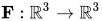




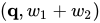


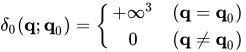



![{\displaystyle [{\text{length}}^{-3}]}](https://wikimedia.org/api/rest_v1/media/math/render/svg/f47dc1f54ff83cee047f13a89963be53e50e7c68)
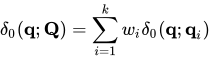


![{\displaystyle t\in [0,1]}](https://wikimedia.org/api/rest_v1/media/math/render/svg/31a5c18739ff04858eecc8fec2f53912c348e0e5)




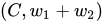





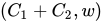







![{\displaystyle [{\text{length}}^{-2}]}](https://wikimedia.org/api/rest_v1/media/math/render/svg/4a8f008385d7814ada2da7fb68f9a471050956ea)

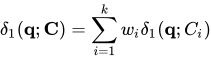





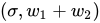







![{\displaystyle [{\text{length}}^{-1}]}](https://wikimedia.org/api/rest_v1/media/math/render/svg/cd425f2e748862368ae08d387487697d8aca9ca3)
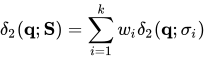





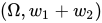


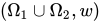

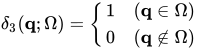


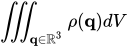
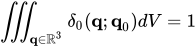

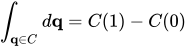


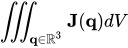








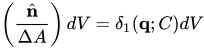


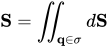





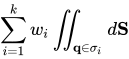

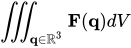













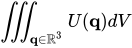





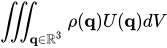





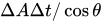


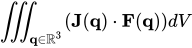




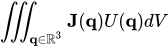





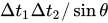


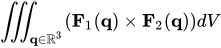



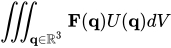




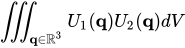









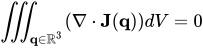







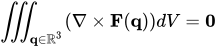



























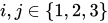


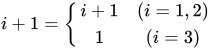
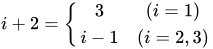









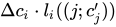


























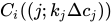
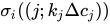
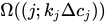


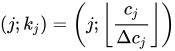








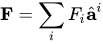






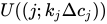







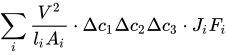


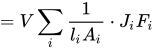
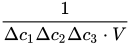
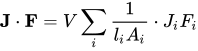

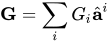

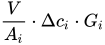










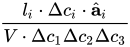


![{\displaystyle [Q]_{-i}}](https://wikimedia.org/api/rest_v1/media/math/render/svg/d152c58b0be34aa57582991fc354fedba56e86f0)

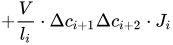
![{\displaystyle [C_{i}]_{-i}}](https://wikimedia.org/api/rest_v1/media/math/render/svg/6ac8c3b8d50622e3ce23bb6e2e5ba641260be72a)
![{\displaystyle -\left[{\frac {V}{l_{i}}}\cdot \Delta c_{i+1}\Delta c_{i+2}\cdot J_{i}\right]_{-i}}](https://wikimedia.org/api/rest_v1/media/math/render/svg/7e331c511314520f4f4d7b747d6da2f793783d54)
![{\displaystyle \sum _{i}\left(+{\frac {V}{l_{i}}}\cdot \Delta c_{i+1}\Delta c_{i+2}\cdot J_{i}-\left[{\frac {V}{l_{i}}}\cdot \Delta c_{i+1}\Delta c_{i+2}\cdot J_{i}\right]_{-i}\right)}](https://wikimedia.org/api/rest_v1/media/math/render/svg/accce601bc61934ac0d550a3f97f059104fd3405)

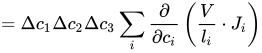

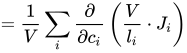
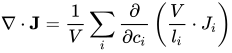
![{\displaystyle [\sigma _{i+1}]_{-(i+2)}}](https://wikimedia.org/api/rest_v1/media/math/render/svg/df888a24e161f07248ca9a0cd57caf6129aacfae)
![{\displaystyle [\sigma _{i+2}]_{-(i+1)}}](https://wikimedia.org/api/rest_v1/media/math/render/svg/45fb988037b87cd22e39567bb074e71464ec588d)
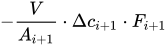
![{\displaystyle +\left[{\frac {V}{A_{i+1}}}\cdot \Delta c_{i+1}\cdot F_{i+1}\right]_{-(i+2)}}](https://wikimedia.org/api/rest_v1/media/math/render/svg/8948c837b7651e7791d98ce9914b0f3c8e89b1a7)
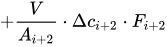
![{\displaystyle -\left[{\frac {V}{A_{i+2}}}\cdot \Delta c_{i+2}\cdot F_{i+2}\right]_{-(i+1)}}](https://wikimedia.org/api/rest_v1/media/math/render/svg/cd311fffa71fd26e95d14b2a3ce4efbf828028d9)
![{\displaystyle -{\frac {V}{A_{i+1}}}\cdot \Delta c_{i+1}\cdot F_{i+1}+\left[{\frac {V}{A_{i+1}}}\cdot \Delta c_{i+1}\cdot F_{i+1}\right]_{-(i+2)}+{\frac {V}{A_{i+2}}}\cdot \Delta c_{i+2}\cdot F_{i+2}-\left[{\frac {V}{A_{i+2}}}\cdot \Delta c_{i+2}\cdot F_{i+2}\right]_{-(i+1)}}](https://wikimedia.org/api/rest_v1/media/math/render/svg/55ad911e10208e352edc2cfebb46619e4889dbff)





![{\displaystyle -[U]_{-i}}](https://wikimedia.org/api/rest_v1/media/math/render/svg/bb2b2472c143cf9d17c5e643083153e02fdc8a5f)
![{\displaystyle U-[U]_{-i}\approx \Delta c_{i}{\frac {\partial U}{\partial c_{i}}}}](https://wikimedia.org/api/rest_v1/media/math/render/svg/dc0a7c70563dd1e5c4af1a57c721393894b9de31)

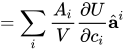
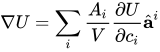
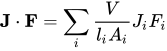

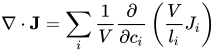





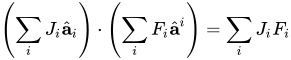


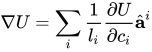


.