第十一章:關於使積分取到極大值或極小值的曲線的場的概念。共軛點的幾何意義。
145 場的概念。146 屬於曲線族 G = 0 {\displaystyle G=0} 147 級數反演中的一個一般定理。148 相鄰曲線的座標用 k {\displaystyle k} k {\displaystyle k} 149 滿足方程 G = 0 {\displaystyle G=0} 150 對 k {\displaystyle k} 151 兩條相鄰曲線的交點。共軛點。152 一個點不能是它自己的共軛點。 Θ ( t , t ′ ) {\displaystyle \Theta (t,t')} 第 145 條 A {\displaystyle A} G = 0 {\displaystyle G=0} B {\displaystyle B} A {\displaystyle A} B {\displaystyle B}
我們首先可以引入關於使積分取到極大值或極小值的曲線的場 的概念。
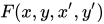
我們假設對於曲線中積分要取最大值或最小值的這一部分的所有點,函式 F ( x , y , x ′ , y ′ ) {\displaystyle F(x,y,x',y')} x , y , x ′ {\displaystyle x,y,x'} y ′ {\displaystyle y'} F 1 {\displaystyle F_{1}} A B {\displaystyle AB} C {\displaystyle C} D {\displaystyle D} D ′ {\displaystyle D'} D D ′ {\displaystyle DD'} C {\displaystyle C} D D ′ {\displaystyle DD'} D {\displaystyle D} D ′ {\displaystyle D'} A B {\displaystyle AB}
第 146 條 G = 0 {\displaystyle G=0} A B {\displaystyle AB}
1 ) x = ϕ ( t , α , β ) y = ψ ( t , α , β ) ( t = t 0 … t 1 ) {\displaystyle 1)\qquad x=\phi (t,\alpha ,\beta )\quad y=\psi (t,\alpha ,\beta )\quad (t=t_{0}\ldots t_{1})} 並且我們用以下方程表示滿足微分方程 G = 0 {\displaystyle G=0}
2 ) x ¯ = ϕ ( t , α + α ′ , β + β ′ ) y ¯ = ψ ( t , α + α ′ , β + β ′ ) {\displaystyle 2)\qquad {\bar {x}}=\phi (t,\alpha +\alpha ',\beta +\beta ')\quad {\bar {y}}=\psi (t,\alpha +\alpha ',\beta +\beta ')} 兩條曲線都將透過同一個點 A {\displaystyle A} A {\displaystyle A} t 0 {\displaystyle t_{0}} t o + τ ′ {\displaystyle t_{o}+\tau '}
第一條曲線與第二條曲線相交的條件可以用以下兩個方程表示:
3 ϕ ( t 0 + τ ′ , α + α ′ , β + β ′ ) − ϕ ( t 0 , α , β ) = 0 ψ ( t 0 + τ ′ , α + α ′ , β + β ′ ) − ψ ( t 0 , α , β ) = 0 {\displaystyle 3\qquad \phi (t_{0}+\tau ',\alpha +\alpha ',\beta +\beta ')-\phi (t_{0},\alpha ,\beta )=0\quad \psi (t_{0}+\tau ',\alpha +\alpha ',\beta +\beta ')-\psi (t_{0},\alpha ,\beta )=0} 或者,用 τ ′ {\displaystyle \tau '} α ′ {\displaystyle \alpha '} β ′ {\displaystyle \beta '}
4 ) ϕ ′ ( t 0 ) τ ′ + ϕ 1 ( t 0 ) α ′ + ϕ 2 ( t 0 ) β ′ + ( τ ′ , α ′ , β ′ ) 2 = 0 ψ ′ ( t 0 ) τ ′ + ψ 1 ( t 0 ) α ′ + ψ 2 ( t 0 ) β ′ + ( τ ′ , α ′ , β ′ ) 2 = 0 {\displaystyle 4)\qquad \phi '(t_{0})\tau '+\phi _{1}(t_{0})\alpha '+\phi _{2}(t_{0})\beta '+(\tau ',\alpha ',\beta ')_{2}=0\quad \psi '(t_{0})\tau '+\psi _{1}(t_{0})\alpha '+\psi _{2}(t_{0})\beta '+(\tau ',\alpha ',\beta ')_{2}=0} 其中 ( τ ′ , α ′ , β ′ ) 2 {\displaystyle (\tau ',\alpha ',\beta ')_{2}} α ′ {\displaystyle \alpha '} β ′ {\displaystyle \beta '}
第 147 條 τ ′ {\displaystyle \tau '} α ′ {\displaystyle \alpha '} / b e t a ′ {\displaystyle /beta'}
a x + b y + c z + ( x , y , z ) 2 = 0 a ′ x + b ′ y + c ′ z + ( x , y , z ) 2 = 0 {\displaystyle ax+by+cz+(x,y,z)_{2}=0\quad a'x+b'y+c'z+(x,y,z)_{2}=0} 其中三個行列式之一 a b ′ − a ′ b , a c ′ − a ′ c , b c ′ − b ′ c {\displaystyle ab'-a'b,ac'-a'c,bc'-b'c} x , y , z {\displaystyle x,y,z}
我們可以將這個變數選為 s = c 1 x + c 2 y + c 2 z {\displaystyle s=c_{1}x+c_{2}y+c_{2}z} c 1 {\displaystyle c_{1}} c 3 {\displaystyle c_{3}}
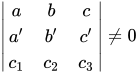
| a b c a ′ b ′ c ′ c 1 c 2 c 3 | ≠ 0 {\displaystyle {\begin{vmatrix}a&b&c\\a'&b'&c'\\c_{1}&c_{2}&c_{3}\\\end{vmatrix}}\neq 0} 為簡潔起見,寫成 (參見第 126 條)
ψ 1 ( t 0 ) ϕ 2 ( t 0 ) − ϕ 1 ( t 0 ) ψ 2 ( t 0 ) = θ 3 ( t 0 ) {\displaystyle \psi _{1}(t_{0})\phi _{2}(t_{0})-\phi _{1}(t_{0})\psi _{2}(t_{0})=\theta _{3}(t_{0})} 那麼,方程組 4) 中對應於以下行列式的三個表示式
a b ′ − a ′ b , a c ′ − a ′ c , b c ′ − b ′ c {\displaystyle ab'-a'b,ac'-a'c,bc'-b'c} 是
5 ) {\displaystyle 5)} ϕ ′ ( t 0 ) ψ 1 ( t 0 ) − ψ ′ ( t 0 ) ϕ 1 ( t 0 ) = − θ 1 ( t 0 ) {\displaystyle \phi '(t_{0})\psi _{1}(t_{0})-\psi '(t_{0})\phi _{1}(t_{0})=-\theta _{1}(t_{0})} ϕ ′ ( t 0 ) ψ 2 ( t 0 ) − ψ ′ ( t 0 ) ϕ 2 ( t 0 ) = − θ 2 ( t 0 ) {\displaystyle \phi '(t_{0})\psi _{2}(t_{0})-\psi '(t_{0})\phi _{2}(t_{0})=-\theta _{2}(t_{0})} ϕ 1 ( t 0 ) ψ 2 ( t 0 ) − ψ 1 ( t 0 ) ϕ 2 ( t 0 ) = − θ 3 ( t 0 ) {\displaystyle \phi _{1}(t_{0})\psi _{2}(t_{0})-\psi _{1}(t_{0})\phi _{2}(t_{0})=-\theta _{3}(t_{0})} 其中 θ 1 ( t 0 ) {\displaystyle \theta _{1}(t_{0})} θ 2 ( t 0 ) {\displaystyle \theta _{2}(t_{0})}
因此我們可以寫成
c 1 = 0 c 2 α ′ + c 3 β ′ = k 1 {\displaystyle c_{1}=0\quad c_{2}\alpha '+c_{3}\beta '=k_{1}} 並進一步對常數 c 2 {\displaystyle c_{2}} c 3 {\displaystyle c_{3}}
6 ) | ϕ ′ ( t 0 ) ϕ 1 ( t 0 ) ϕ 2 ( t 0 ) ψ ′ ( t 0 ) ψ 1 ( t 0 ) ψ 2 ( t 0 ) 0 c 2 c 3 | = c 2 θ 2 ( t 0 ) − c 3 θ 1 ( t 0 ) = 1 {\displaystyle 6)\qquad {\begin{vmatrix}\phi '(t_{0})&\phi _{1}(t_{0})&\phi _{2}(t_{0})\\\psi '(t_{0})&\psi _{1}(t_{0})&\psi _{2}(t_{0})\\0&c_{2}&c_{3}\end{vmatrix}}=c_{2}\theta _{2}(t_{0})-c_{3}\theta _{1}(t_{0})=1} 如果我們只考慮方程 4) 中的線性項,我們有
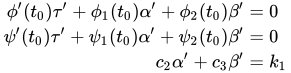
ϕ ′ ( t 0 ) τ ′ + ϕ 1 ( t 0 ) α ′ + ϕ 2 ( t 0 ) β ′ = 0 ψ ′ ( t 0 ) τ ′ + ψ 1 ( t 0 ) α ′ + ψ 2 ( t 0 ) β ′ = 0 c 2 α ′ + c 3 β ′ = k 1 {\displaystyle {\begin{aligned}\phi '(t_{0})\tau '+\phi _{1}(t_{0})\alpha '+\phi _{2}(t_{0})\beta '&=0\\\psi '(t_{0})\tau '+\psi _{1}(t_{0})\alpha '+\psi _{2}(t_{0})\beta '&=0\\c_{2}\alpha '+c_{3}\beta '&=k_{1}\end{aligned}}} 從這些方程中,我們得到了 τ ′ , α ′ {\displaystyle \tau ',\alpha '} / b e t a ′ {\displaystyle /beta'}
7 ) τ ′ = − k 1 θ 3 ( t 0 ) α ′ = + k 1 θ 2 ( t 0 ) β ′ = − k 1 θ 1 ( t 0 ) {\displaystyle 7)\qquad \tau '=-k_{1}\theta _{3}(t_{0})\quad \alpha '=+k_{1}\theta _{2}(t_{0})\quad \beta '=-k_{1}\theta _{1}(t_{0})} 因此,最終得到:
7 a ) τ ′ = − k 1 θ 3 ( t 0 ) + k 1 2 P 1 ( k 1 , t 0 ) α ′ = + k 1 θ 2 ( t 0 ) + k 1 2 P 2 ( k 1 , t 0 ) β ′ = − k 1 θ 1 ( t 0 ) + k 1 2 P 3 ( k 1 , t 0 ) {\displaystyle 7^{a})\qquad \tau '=-k_{1}\theta _{3}(t_{0})+k_{1}^{2}P_{1}(k_{1},t_{0})\quad \alpha '=+k_{1}\theta _{2}(t_{0})+k_{1}^{2}P_{2}(k_{1},t_{0})\quad \beta '=-k_{1}\theta _{1}(t_{0})+k_{1}^{2}P_{3}(k_{1},t_{0})} 其中 P 1 ( k 1 , t 0 ) , P 2 ( k 1 , t 0 ) {\displaystyle P_{1}(k_{1},t_{0}),P_{2}(k_{1},t_{0})} P 3 ( k 1 , t 0 ) {\displaystyle P_{3}(k_{1},t_{0})} k 1 {\displaystyle k_{1}} t 0 {\displaystyle t_{0}}
如果我們將這些表示式代入方程 2) 中,或者等價地,代入
8 ) x ¯ = ϕ ( t + τ ′ , α + α ′ , β + β ′ ) y ¯ = ψ ( t + τ ′ , α + α ′ , β + β ′ ) {\displaystyle 8)\qquad {\bar {x}}=\phi (t+\tau ',\alpha +\alpha ',\beta +\beta ')\quad {\bar {y}}=\psi (t+\tau ',\alpha +\alpha ',\beta +\beta ')} 其中,現在, t {\displaystyle t} t 0 {\displaystyle t_{0}}
9 ) {\displaystyle 9)} x ¯ = x − k 1 [ ϕ ′ ( t ) θ 3 ( t 0 ) − ϕ 1 ( t ) θ 2 ( t 0 ) + ϕ 2 ( t ) θ 1 ( t 0 ) ] + k 1 ( t , k 1 ) {\displaystyle {\bar {x}}=x-k_{1}[\phi '(t)\theta _{3}(t_{0})-\phi _{1}(t)\theta _{2}(t_{0})+\phi _{2}(t)\theta _{1}(t_{0})]+k_{1}(t,k_{1})} y ¯ = y − k 1 [ ψ ′ ( t ) θ 3 ( t 0 ) − ψ 1 ( t ) θ 2 ( t 0 ) + ψ 2 ( t ) θ 1 ( t 0 ) ] + k 1 ( t , k 1 ) I n t h e s e e q u a t i o n s t h e s y m b o l < m a t h > ( t , k 1 ) {\displaystyle {\bar {y}}=y-k_{1}[\psi '(t)\theta _{3}(t_{0})-\psi _{1}(t)\theta _{2}(t_{0})+\psi _{2}(t)\theta _{1}(t_{0})]+k_{1}(t,k_{1})Intheseequationsthesymbol<math>(t,k_{1})} t {\displaystyle t} k 1 {\displaystyle k_{1}} 當 k 1 = 0 {\displaystyle k_{1}=0} k 1 {\displaystyle k_{1}} t {\displaystyle t} G = 0 {\displaystyle G=0} A {\displaystyle A}
第 148 條 τ ′ , α ′ , β ′ {\displaystyle \tau ',\alpha ',\beta '} k 1 {\displaystyle k_{1}} c 1 , c 2 , c 3 {\displaystyle c_{1},c_{2},c_{3}} τ ′ , α ′ , β ′ {\displaystyle \tau ',\alpha ',\beta '}
| ϕ ′ ( t 0 ) ϕ 1 ( t 0 ) ϕ 2 ( t 0 ) ψ ′ ( t 0 ) ψ 1 ( t 0 ) ψ 2 ( t 0 ) 0 c 2 c 3 | ≠ 0 {\displaystyle {\begin{vmatrix}\phi '(t_{0})&\phi _{1}(t_{0})&\phi _{2}(t_{0})\\\psi '(t_{0})&\psi _{1}(t_{0})&\psi _{2}(t_{0})\\0&c_{2}&c_{3}\end{vmatrix}}\neq 0} 這個條件由表示兩條曲線在點 A = t 0 {\displaystyle A=t_{0}}
因為,用 k {\displaystyle k}
k = d y 0 d x 0 − d y ¯ 0 d x ¯ 0 1 + d y 0 d x 0 d y ¯ 0 d x ¯ 0 = x ¯ 0 ′ y 0 ′ − y ¯ 0 ′ x 0 ′ x ¯ 0 ′ x 0 ′ + y ¯ 0 ′ y 0 ′ = | ϕ ″ ( t 0 ) ψ ″ ( t 0 ) ϕ ′ ( t 0 ) ψ ′ ( t 0 ) | τ ′ + | ϕ 1 ′ ( t 0 ) ψ 1 ′ ( t 0 ) ϕ ′ ( t 0 ) ψ ′ ( t 0 ) | α ′ + | ϕ 2 ′ ( t 0 ) ψ 2 ′ ( t 0 ) ϕ ′ ( t 0 ) ψ ′ ( t 0 ) | β ′ + ( τ ′ , α ′ , β ′ ) 2 ϕ ′ 2 ( t 0 ) + ψ ′ 2 ( t 0 ) + ( τ ′ , α ′ , β ′ ) 1 {\displaystyle k={\frac {{\frac {{\text{d}}y_{0}}{{\text{d}}x_{0}}}-{\frac {{\text{d}}{\bar {y}}_{0}}{{\text{d}}{\bar {x}}_{0}}}}{1+{\frac {{\text{d}}y_{0}}{{\text{d}}x_{0}}}{\frac {{\text{d}}{\bar {y}}_{0}}{{\text{d}}{\bar {x}}_{0}}}}}={\frac {{\bar {x}}_{0}'y_{0}'-{\bar {y}}_{0}'x_{0}'}{{\bar {x}}_{0}'x_{0}'+{\bar {y}}_{0}'y_{0}'}}={\frac {{\begin{vmatrix}\phi ''(t_{0})&\psi ''(t_{0})\\\phi '(t_{0})&\psi '(t_{0})\end{vmatrix}}\tau '+{\begin{vmatrix}\phi _{1}'(t_{0})&\psi _{1}'(t_{0})\\\phi '(t_{0})&\psi '(t_{0})\end{vmatrix}}\alpha '+{\begin{vmatrix}\phi _{2}'(t_{0})&\psi _{2}'(t_{0})\\\phi '(t_{0})&\psi '(t_{0})\end{vmatrix}}\beta '+(\tau ',\alpha ',\beta ')_{2}}{\phi '^{2}(t_{0})+\psi '^{2}(t_{0})+(\tau ',\alpha ',\beta ')_{1}}}} 假設曲線在點 A {\displaystyle A} ϕ ′ ( t 0 ) {\displaystyle \phi '(t_{0})} ψ ′ ( t 0 ) {\displaystyle \psi '(t_{0})} ϕ ′ 2 ( t 0 ) + ψ ′ 2 ( t 0 ) {\displaystyle \phi '^{2}(t_{0})+\psi '^{2}(t_{0})}
因此,等式 4)和 10)的行列式為
1 ϕ ′ 2 ( t 0 ) + ψ ′ 2 ( t 0 ) | ϕ ′ ( t 0 ) ϕ 1 ( t 0 ) ϕ 2 ( t 0 ) ψ ′ ( t 0 ) ψ 1 ( t 0 ) ψ 2 ( t 0 ) | ϕ ″ ( t 0 ) ψ ″ ( t 0 ) ϕ ′ ( t 0 ) ψ ′ ( t 0 ) | | ϕ 1 ′ ( t 0 ) ψ 1 ′ ( t 0 ) ϕ ′ ( t 0 ) ψ ′ ( t 0 ) | | ϕ 2 ′ ( t 0 ) ψ 2 ′ ( t 0 ) ϕ ′ ( t 0 ) ψ ′ ( t 0 ) | | {\displaystyle {\frac {1}{\phi '^{2}(t_{0})+\psi '^{2}(t_{0})}}{\begin{vmatrix}\phi '(t_{0})&\phi _{1}(t_{0})&\phi _{2}(t_{0})\\\psi '(t_{0})&\psi _{1}(t_{0})&\psi _{2}(t_{0})\\{\begin{vmatrix}\phi ''(t_{0})&\psi ''(t_{0})\\\phi '(t_{0})&\psi '(t_{0})\end{vmatrix}}&{\begin{vmatrix}\phi _{1}'(t_{0})&\psi _{1}'(t_{0})\\\phi '(t_{0})&\psi '(t_{0})\end{vmatrix}}&{\begin{vmatrix}\phi _{2}'(t_{0})&\psi _{2}'(t_{0})\\\phi '(t_{0})&\psi '(t_{0})\end{vmatrix}}\end{vmatrix}}} 將第一行水平乘以 ψ ″ ( t 0 ) {\displaystyle \psi ''(t_{0})} − ϕ ″ ( t 0 ) {\displaystyle -\phi ''(t_{0})}
0 | ϕ 1 ′ ( t 0 ) ψ 1 ′ ( t 0 ) ϕ ′ ( t 0 ) ψ ′ ( t 0 ) | + | ϕ 1 ( t 0 ) ψ 1 ( t 0 ) ϕ ″ ( t 0 ) ψ ″ ( t 0 ) | | ϕ 2 ′ ( t 0 ) ψ 2 ′ ( t 0 ) ϕ ′ ( t 0 ) ψ ′ ( t 0 ) | + | ϕ 2 ( t 0 ) ψ 2 ( t 0 ) ϕ ″ ( t 0 ) ψ ″ ( t 0 ) | {\displaystyle 0\qquad {\begin{vmatrix}\phi _{1}'(t_{0})&\psi _{1}'(t_{0})\\\phi '(t_{0})&\psi '(t_{0})\end{vmatrix}}+{\begin{vmatrix}\phi _{1}(t_{0})&\psi _{1}(t_{0})\\\phi ''(t_{0})&\psi ''(t_{0})\end{vmatrix}}\qquad {\begin{vmatrix}\phi _{2}'(t_{0})&\psi _{2}'(t_{0})\\\phi '(t_{0})&\psi '(t_{0})\end{vmatrix}}+{\begin{vmatrix}\phi _{2}(t_{0})&\psi _{2}(t_{0})\\\phi ''(t_{0})&\psi ''(t_{0})\end{vmatrix}}} 或者,等價於
0 θ 1 ′ ( t 0 ) θ 2 ′ ( t 0 ) {\displaystyle 0\qquad \theta _{1}'(t_{0})\qquad \theta _{2}'(t_{0})} 因此,上述行列式為
10 ) 1 ϕ ′ 2 ( t 0 ) + ψ ′ 2 ( t 0 ) [ θ 1 ′ ( t 0 ) θ 2 ( t 0 ) − θ 2 ′ ( t 0 ) θ 1 ( t 0 ) ] = 1 ϕ ′ 2 ( t 0 ) + ψ ′ 2 ( t 0 ) C F 1 ( t 0 ) {\displaystyle 10)\qquad {\frac {1}{\phi '^{2}(t_{0})+\psi '^{2}(t_{0})}}[\theta _{1}'(t_{0})\theta _{2}(t_{0})-\theta _{2}'(t_{0})\theta _{1}(t_{0})]={\frac {1}{\phi '^{2}(t_{0})+\psi '^{2}(t_{0})}}{\frac {C}{F_{1}(t_{0})}}\quad } 這個表示式(loc. cit. )不等於零。
因此,我們可以用 k {\displaystyle k} k 1 {\displaystyle k_{1}}
11 ) x ¯ = x + k f 1 ( t , k ) y ¯ = y + k f 2 ( t , k ) {\displaystyle 11)\qquad {\bar {x}}=x+kf_{1}(t,k)\quad {\bar {y}}=y+kf_{2}(t,k)} 第 149 條 G = 0 {\displaystyle G=0} 因此,只要知道了曲線上的初始點以及該點處的切線方向,就完全確定了滿足方程 G = 0 {\displaystyle G=0}
設 a , b {\displaystyle a,b} A {\displaystyle A} X {\displaystyle X} X {\displaystyle X} t , v {\displaystyle t,v} x , y {\displaystyle x,y} A {\displaystyle A}
12 ) t = ( x − a ) cos λ − ( y − b ) sin λ v = ( x − a ) sin λ + ( y − b ) cos λ {\displaystyle 12)\qquad t=(x-a)\cos \lambda -(y-b)\sin \lambda \quad v=(x-a)\sin \lambda +(y-b)\cos \lambda } 或者
13 ) x = a + t cos λ + v sin λ y = b − t sin λ + v cos λ {\displaystyle 13)\qquad x=a+t\cos \lambda +v\sin \lambda \quad y=b-t\sin \lambda +v\cos \lambda } 現在如果我們選擇 t {\displaystyle t}
x ′ = cos λ + d v d t sin λ d x ′ d t = d 2 v d t 2 sin λ {\displaystyle x'=\cos \lambda +{\frac {{\text{d}}v}{{\text{d}}t}}\sin \lambda \qquad {\frac {{\text{d}}x'}{{\text{d}}t}}={\frac {{\text{d}}^{2}v}{{\text{d}}t^{2}}}\sin \lambda } y ′ = − sin λ + d v d t cos λ d y ′ d t = d 2 v d t 2 cos λ {\displaystyle y'=-\sin \lambda +{\frac {{\text{d}}v}{{\text{d}}t}}\cos \lambda \qquad {\frac {{\text{d}}y'}{{\text{d}}t}}={\frac {{\text{d}}^{2}v}{{\text{d}}t^{2}}}\cos \lambda } 因此
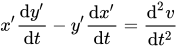
x ′ d y ′ d t − y ′ d x ′ d t = d 2 v d t 2 {\displaystyle x'{\frac {{\text{d}}y'}{{\text{d}}t}}-y'{\frac {{\text{d}}x'}{{\text{d}}t}}={\frac {{\text{d}}^{2}v}{{\text{d}}t^{2}}}} 微分方程 G = 0 {\displaystyle G=0}
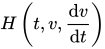
F 1 ( x ′ d y ′ d t − y ′ d x ′ d t ) + H ( x , y , x ′ , y ′ ) = 0 {\displaystyle F_{1}\left(x'{\frac {{\text{d}}y'}{{\text{d}}t}}-y'{\frac {{\text{d}}x'}{{\text{d}}t}}\right)+H(x,y,x',y')=0} 則變為
14 ) 0 = d 2 v d t 2 F 1 ( a + t cos λ + v sin λ , b − t sin λ + v cos λ , cos λ + d v d t sin λ , − sin λ + d v d t cos λ ) + H ( t , v , d v d t ) {\displaystyle 14)\qquad 0={\frac {{\text{d}}^{2}v}{{\text{d}}t^{2}}}F_{1}\left(a+t\cos \lambda +v\sin \lambda ,b-t\sin \lambda +v\cos \lambda ,\cos \lambda +{\frac {{\text{d}}v}{{\text{d}}t}}\sin \lambda ,-\sin \lambda +{\frac {{\text{d}}v}{{\text{d}}t}}\cos \lambda \right)+H\left(t,v,{\frac {{\text{d}}v}{{\text{d}}t}}\right)\quad } 根據第六章給出的積分方法,我們以如下方式解上述方程:當 t = 0 {\displaystyle t=0} v = 0 {\displaystyle v=0} d v d t = 0 {\displaystyle {\frac {{\text{d}}v}{{\text{d}}t}}=0} v {\displaystyle v} A {\displaystyle A}
因此,如果 F 1 ( a , b , cos λ , − sin λ ) {\displaystyle F_{1}(a,b,\cos \lambda ,-\sin \lambda )} H ( t , v , d v d t ) {\displaystyle H\left(t,v,{\frac {{\text{d}}v}{{\text{d}}t}}\right)} A {\displaystyle A} F 1 {\displaystyle F_{1}} H {\displaystyle H} t {\displaystyle t} t = 0 {\displaystyle t=0}
這個冪級數的形式為
v = t 2 P ( t ) {\displaystyle v=t^{2}P(t)} 將此 v {\displaystyle v}
15 ) x = a + t cos λ + A 1 t 2 + … y = b − t sin λ + B 1 t 2 … {\displaystyle 15)\qquad x=a+t\cos \lambda +A_{1}t^{2}+\ldots \quad y=b-t\sin \lambda +B_{1}t^{2}\ldots } 其中常數 A 1 , B 1 , … {\displaystyle A_{1},B_{1},\ldots }
因此,方程 15) 完全確定了滿足微分方程 G = 0 {\displaystyle G=0} a , b {\displaystyle a,b} X {\displaystyle X}
由此,我們立即得到,透過方程 11),我們擁有所有經過相同初始點的且滿足微分方程 G = 0 {\displaystyle G=0}
第 150 條 k {\displaystyle k} k {\displaystyle k} G = 0 {\displaystyle G=0}
這使得能夠在兩條曲線之間建立一個單值關係,使得對於原始曲線上的每個點,我們都可以確定鄰近曲線上的點,該點是原始曲線上該點法線與鄰近曲線相交的點。
設 x , y {\displaystyle x,y} P {\displaystyle P} x + ξ , y + η {\displaystyle x+\xi ,y+\eta }
如果 P ′ {\displaystyle P'} P {\displaystyle P}
x + ξ = ϕ ( t + τ , α + α ′ , β + β ′ ) y + η = ψ ( t + τ , α + α ′ , β + β ′ ) {\displaystyle x+\xi =\phi (t+\tau ,\alpha +\alpha ',\beta +\beta ')\qquad y+\eta =\psi (t+\tau ,\alpha +\alpha ',\beta +\beta ')} 此外,由於 ( X − x ) x ′ + ( Y − y ) y ′ = 0 {\displaystyle (X-x)x'+(Y-y)y'=0} X = x + ξ , Y = y + η {\displaystyle X=x+\xi ,Y=y+\eta }
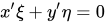
x ′ ξ + y ′ η = 0 {\displaystyle x'\xi +y'\eta =0} 因此,需要從以下方程中確定 ξ , η {\displaystyle \xi ,\eta } τ {\displaystyle \tau }
16 ) ξ = ϕ ′ ( t ) τ + ϕ 1 ( t ) α ′ + ϕ 2 ( t ) β ′ + … η = ψ ′ ( t ) τ + ψ 1 ( t ) α ′ + ψ 2 ( t ) β ′ + … 0 = ϕ ′ ( t ) ξ + ψ ′ ( t ) η {\displaystyle 16)\qquad \xi =\phi '(t)\tau +\phi _{1}(t)\alpha '+\phi _{2}(t)\beta '+\ldots \quad \eta =\psi '(t)\tau +\psi _{1}(t)\alpha '+\psi _{2}(t)\beta '+\ldots \quad 0=\phi '(t)\xi +\psi '(t)\eta } 將最後一個方程與第一個和第二個方程結合起來得到
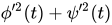
17 ) 0 = [ ϕ ′ 2 ( t ) + ψ ′ 2 ( t ) ] τ + k f ( t ) + ( t , k ) {\displaystyle 17)\qquad 0=[\phi '^{2}(t)+\psi '^{2}(t)]\tau +kf(t)+(t,k)} 當對於 α ′ , β ′ {\displaystyle \alpha ',\beta '} 7 a ) {\displaystyle 7^{a})} k {\displaystyle k}
由於曲線 A B {\displaystyle AB} ϕ ′ 2 ( t ) + ψ ′ 2 ( t ) {\displaystyle \phi '^{2}(t)+\psi '^{2}(t)} τ {\displaystyle \tau } ξ {\displaystyle \xi } η {\displaystyle \eta } k {\displaystyle k} k {\displaystyle k}
第 151 條 P P ′ {\displaystyle PP'} ξ , η {\displaystyle \xi ,\eta } t {\displaystyle t} t , τ , τ ′ , α ′ , β ′ {\displaystyle t,\tau ,\tau ',\alpha ',\beta '} ξ {\displaystyle \xi } η {\displaystyle \eta }
方程 4) 和 16) 中具有相同維度的項分別是 τ ′ , α ′ , β ′ {\displaystyle \tau ',\alpha ',\beta '} τ , α ′ , β ′ {\displaystyle \tau ,\alpha ',\beta '}
( ϕ ′ ( t 0 ) + v ) τ ′ + ( ϕ 1 ( t 0 ) + p ) α ′ + ( ϕ 2 ( t 0 ) + q ) β ′ = 0 {\displaystyle (\phi '(t_{0})+v)\tau '+(\phi _{1}(t_{0})+p)\alpha '+(\phi _{2}(t_{0})+q)\beta '=0} ( ψ ′ ( t 0 ) + v 1 ) τ ′ + ( ψ 1 ( t 0 ) + p 1 ) α ′ + ( ψ 2 ( t 0 ) + q 1 ) β ′ = 0 {\displaystyle (\psi '(t_{0})+v_{1})\tau '+(\psi _{1}(t_{0})+p_{1})\alpha '+(\psi _{2}(t_{0})+q_{1})\beta '=0} ( ϕ ′ ( t 0 ) + v 2 ) τ ′ + ( ϕ 1 ( t 0 ) + p 2 ) α ′ + ( ϕ 2 ( t 0 ) + q 2 ) β ′ = 0 {\displaystyle (\phi '(t_{0})+v_{2})\tau '+(\phi _{1}(t_{0})+p_{2})\alpha '+(\phi _{2}(t_{0})+q_{2})\beta '=0} ( ψ ′ ( t 0 ) + v 3 ) τ ′ + ( ψ 1 ( t 0 ) + p 3 ) α ′ + ( ψ 2 ( t 0 ) + q 2 ) β ′ = 0 {\displaystyle (\psi '(t_{0})+v_{3})\tau '+(\psi _{1}(t_{0})+p_{3})\alpha '+(\psi _{2}(t_{0})+q_{2})\beta '=0} 其中 v , p , q , v 1 , p 1 , q 1 {\displaystyle v,p,q,v_{1},p_{1},q_{1}} τ ′ , α ′ , β ′ {\displaystyle \tau ',\alpha ',\beta '} v 2 , p 2 , q 2 , v 3 , q 3 , q 3 {\displaystyle v_{2},p_{2},q_{2},v_{3},q_{3},q_{3}} τ , α ′ , β ′ {\displaystyle \tau ,\alpha ',\beta '} k {\displaystyle k}
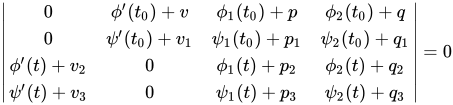
前兩個等式表示兩條相鄰曲線經過初始點 A {\displaystyle A}
為了使這四個等式同時成立,它們的行列式必須為零。當在該行列式中令 k = 0 {\displaystyle k=0}
| ϕ ′ ( t 0 ) 0 ϕ 1 ( t 0 ) ϕ 2 ( t 0 ) ψ ′ ( t 0 ) 0 ψ 1 ( t 0 ) ψ 2 ( t 0 ) 0 ϕ ′ ( t ) ϕ 1 ( t ) ϕ 2 ( t ) 0 ψ ′ ( t ) ψ 1 ( t ) ψ 2 ( t ) | {\displaystyle {\begin{vmatrix}\phi '(t_{0})&0&\phi _{1}(t_{0})&\phi _{2}(t_{0})\\\psi '(t_{0})&0&\psi _{1}(t_{0})&\psi _{2}(t_{0})\\0&\phi '(t)&\phi _{1}(t)&\phi _{2}(t)\\0&\psi '(t)&\psi _{1}(t)&\psi _{2}(t)\end{vmatrix}}} 這只不過是函式 − Θ ( t , t 0 ) {\displaystyle -\Theta (t,t_{0})} − Θ ( t , t 0 ) − k ( t , t 0 , k ) {\displaystyle -\Theta (t,t_{0})-k(t,t_{0},k)}
18 ) Θ ( t , t 0 ) + k ( t , t 0 , k ) = 0 {\displaystyle 18)\qquad \Theta (t,t_{0})+k(t,t_{0},k)=0} If, now, C {\displaystyle C} t = t ′ {\displaystyle t=t'} A {\displaystyle A} Θ ( t ′ , t 0 ) {\displaystyle \Theta (t',t_{0})} k {\displaystyle k} k {\displaystyle k} Θ ( t ′ , t 0 ) + k ( t ′ , t 0 , k ) {\displaystyle \Theta (t',t_{0})+k(t',t_{0},k)} t ′ {\displaystyle t'} h {\displaystyle h} t {\displaystyle t} t ′ − h … t ′ + h {\displaystyle t'-h\ldots t'+h} C {\displaystyle C} C {\displaystyle C} A B {\displaystyle AB} A {\displaystyle A} k {\displaystyle k} h {\displaystyle h} Θ ( t ′ − h , t 0 ) − k ( t ′ − h , t 0 , k ) {\displaystyle \Theta (t'-h,t_{0})-k(t'-h,t_{0},k)} Θ ( t ′ − h , t 0 ) {\displaystyle \Theta (t'-h,t_{0})} T h e t a ( t ′ + h , t 0 ) + k ( t ′ + h , t 0 , k ) {\displaystyle Theta(t'+h,t_{0})+k(t'+h,t_{0},k)} Θ ( t ′ + h , t 0 ) {\displaystyle \Theta (t'+h,t_{0})} Θ ( t ′ , t 0 ) {\displaystyle \Theta (t',t_{0})} Θ ( t ′ , t 0 ) {\displaystyle \Theta (t',t_{0})} Θ ( t , t 0 ) + k ( t , t 0 , k ) {\displaystyle \Theta (t,t_{0})+k(t,t_{0},k)} t ′ − h … t ′ + h {\displaystyle t'-h\ldots t'+h} If, in the interval A B {\displaystyle AB} t = t ′ {\displaystyle t=t'} G = 0 {\displaystyle G=0} A {\displaystyle A} t ′ {\displaystyle t'}
如果在區間 A B {\displaystyle AB}
第 152 條 A {\displaystyle A} A {\displaystyle A} t {\displaystyle t}
| 0 ϕ ′ ( t 0 ) + v ϕ 1 ( t 0 ) + p ϕ 2 ( t 0 ) + q 0 ψ ′ ( t 0 ) + v 1 ψ 1 ( t 0 ) + p 1 ψ 2 ( t 0 ) + q 1 ϕ ′ ( t ) + v 2 0 ϕ 1 ( t ) + p 2 ϕ 2 ( t ) + q 2 ψ ′ ( t ) + v 3 0 ψ 1 ( t ) + p 3 ψ 2 ( t ) + q 3 | = 0 {\displaystyle {\begin{vmatrix}0&\phi '(t_{0})+v&\phi _{1}(t_{0})+p&\phi _{2}(t_{0})+q\\0&\psi '(t_{0})+v_{1}&\psi _{1}(t_{0})+p_{1}&\psi _{2}(t_{0})+q_{1}\\\phi '(t)+v_{2}&0&\phi _{1}(t)+p_{2}&\phi _{2}(t)+q_{2}\\\psi '(t)+v_{3}&0&\psi _{1}(t)+p_{3}&\psi _{2}(t)+q_{3}\end{vmatrix}}=0} 當 k = 0 {\displaystyle k=0} Θ ( t , t 0 ) = 0 {\displaystyle \Theta (t,t_{0})=0} k {\displaystyle k} τ , τ ′ , α ′ , β ′ {\displaystyle \tau ,\tau ',\alpha ',\beta '} t {\displaystyle t} k {\displaystyle k} ϕ ′ ( t ) , ϕ 1 ( t ) , … ψ 2 ( t ) {\displaystyle \phi '(t),\phi _{1}(t),\ldots \psi _{2}(t)} t {\displaystyle t} t 0 {\displaystyle t_{0}} t − t 0 {\displaystyle t-t_{0}} k {\displaystyle k} t − t 0 {\displaystyle t-t_{0}} k {\displaystyle k} A {\displaystyle A} t − t 0 {\displaystyle t-t_{0}} k {\displaystyle k}
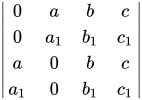
如果我們寫 t − t 0 {\displaystyle t-t_{0}} v , p , q {\displaystyle v,p,q} v 2 , p 2 , q 2 {\displaystyle v_{2},p_{2},q_{2}} v 1 , p 1 , q 1 {\displaystyle v_{1},p_{1},q_{1}} v 3 , p 3 , q 3 {\displaystyle v_{3},p_{3},q_{3}}
在這種情況下,行列式具有以下形式
| 0 a b c 0 a 1 b 1 c 1 a 0 b c a 1 0 b 1 c 1 | {\displaystyle {\begin{vmatrix}0&a&b&c\\0&a_{1}&b_{1}&c_{1}\\a&0&b&c\\a_{1}&0&b_{1}&c_{1}\end{vmatrix}}} 它恆等於零。因此,關於 t − t 0 {\displaystyle t-t_{0}} k {\displaystyle k} t − t 0 {\displaystyle t-t_{0}} k {\displaystyle k} t − t 0 {\displaystyle t-t_{0}}
因此,當行列式被 t − t 0 {\displaystyle t-t_{0}} t = t 0 {\displaystyle t=t_{0}}
19 ) [ d Θ ( t , t 0 ) d t ] t = t 0 + ( t − t 0 , k ) t = t 0 = 0 {\displaystyle 19)\qquad \left[{\frac {{\text{d}}\Theta (t,t_{0})}{{\text{d}}t}}\right]_{t=t_{0}}+(t-t_{0},k)_{t=t_{0}}=0} 我們在第 128 和 129 條中看到
Θ ( t , t 0 ) = θ 1 ( t 0 ) θ 2 ( t ) − θ 2 ( t 0 ) θ 1 ( t ) {\displaystyle \Theta (t,t_{0})=\theta _{1}(t_{0})\theta _{2}(t)-\theta _{2}(t_{0})\theta _{1}(t)} 以及
θ 1 ( t ) θ 2 ′ ( t ) − θ 2 ( t ) θ 1 ′ ( t ) = C F 1 ( t ) {\displaystyle \theta _{1}(t)\theta _{2}'(t)-\theta _{2}(t)\theta _{1}'(t)={\frac {C}{F_{1}(t)}}} 如果 t ′ {\displaystyle t'} t 0 {\displaystyle t_{0}}
Θ ( t , t 0 ) = θ 1 ( t 0 ) θ 2 ( t ′ ) − θ 2 ( t 0 ) θ 1 t ′ ) = 0 {\displaystyle \Theta (t,t_{0})=\theta _{1}(t_{0})\theta _{2}(t')-\theta _{2}(t_{0})\theta _{1}t')=0} 那麼我們可以得出
θ 1 ( t ′ ) = λ θ 1 ( t 0 ) θ 2 ( t ′ ) = λ θ 2 ( t 0 ) {\displaystyle \theta _{1}(t')=\lambda \theta _{1}(t_{0})\qquad \theta _{2}(t')=\lambda \theta _{2}(t_{0})} 其中 λ {\displaystyle \lambda }
我們進一步得到,由於
d d t Θ ( t , t 0 ) = θ 1 ( t 0 ) θ 2 ′ ( t ) − θ 2 ( t 0 ) θ 1 ′ ( t ) {\displaystyle {\frac {\text{d}}{{\text{d}}t}}\Theta (t,t_{0})=\theta _{1}(t_{0})\theta _{2}'(t)-\theta _{2}(t_{0})\theta _{1}'(t)} 關係
[ d d t Θ ( t , t 0 ) ] t = t ′ = 1 λ C F 1 ( t ′ ) {\displaystyle \left[{\frac {\text{d}}{{\text{d}}t}}\Theta (t,t_{0})\right]_{t=t'}={\frac {1}{\lambda }}{\frac {C}{F_{1}(t')}}} 不等於零。
因此可以看出 Θ ( t , t 0 ) {\displaystyle \Theta (t,t_{0})}
同時,我們也表明只要 k {\displaystyle k} t − t 0 {\displaystyle t-t_{0}}
由於變數 t {\displaystyle t} α {\displaystyle \alpha } / b e t a {\displaystyle /beta} Θ {\displaystyle \Theta } Θ ( t , t 0 ) {\displaystyle \Theta (t,t_{0})} Θ {\displaystyle \Theta }









































![{\displaystyle {\bar {x}}=x-k_{1}[\phi '(t)\theta _{3}(t_{0})-\phi _{1}(t)\theta _{2}(t_{0})+\phi _{2}(t)\theta _{1}(t_{0})]+k_{1}(t,k_{1})}](https://wikimedia.org/api/rest_v1/media/math/render/svg/8e9d3bdb548541bd3c86212eb7d90402a0245955)
![{\displaystyle {\bar {y}}=y-k_{1}[\psi '(t)\theta _{3}(t_{0})-\psi _{1}(t)\theta _{2}(t_{0})+\psi _{2}(t)\theta _{1}(t_{0})]+k_{1}(t,k_{1})Intheseequationsthesymbol<math>(t,k_{1})}](https://wikimedia.org/api/rest_v1/media/math/render/svg/9bd86b9d7f1230a08f664402d9b4363063ef66f1)







![{\displaystyle 10)\qquad {\frac {1}{\phi '^{2}(t_{0})+\psi '^{2}(t_{0})}}[\theta _{1}'(t_{0})\theta _{2}(t_{0})-\theta _{2}'(t_{0})\theta _{1}(t_{0})]={\frac {1}{\phi '^{2}(t_{0})+\psi '^{2}(t_{0})}}{\frac {C}{F_{1}(t_{0})}}\quad }](https://wikimedia.org/api/rest_v1/media/math/render/svg/2e6a57311d2fb066ee9164c368927576a5fe4a1b)






















![{\displaystyle 17)\qquad 0=[\phi '^{2}(t)+\psi '^{2}(t)]\tau +kf(t)+(t,k)}](https://wikimedia.org/api/rest_v1/media/math/render/svg/16259c762e8d090c5731a07cc279217c4870ded2)






























![{\displaystyle 19)\qquad \left[{\frac {{\text{d}}\Theta (t,t_{0})}{{\text{d}}t}}\right]_{t=t_{0}}+(t-t_{0},k)_{t=t_{0}}=0}](https://wikimedia.org/api/rest_v1/media/math/render/svg/8b8ae95a1662137077d02db4b55e8c71400bdc7c)






![{\displaystyle \left[{\frac {\text{d}}{{\text{d}}t}}\Theta (t,t_{0})\right]_{t=t'}={\frac {1}{\lambda }}{\frac {C}{F_{1}(t')}}}](https://wikimedia.org/api/rest_v1/media/math/render/svg/0d0a822243bdd1993c58069ae789f931b662d607)


