


分形/複平面上的迭代/f(z)=z+z^2的Fatou座標
http://math.stackexchange.com/questions/208996/half-iterate-of-x2c?
" 這可能會有所幫助。
令

我們使用Ecalle的技術來求解Fatou座標,它解決了


對於任何

令

然後我們得到精確的

關鍵是,這個表示式比人們預期的收斂速度快得多,我們可以停在相當小的上。

它足夠快,我們可以合理地期望數值求解.

我們有

注意



由此可見,如果我們定義
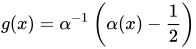
我們得到神奇的

...
注意實際上是在一個不包含原點的開扇區中全純的,例如實部為正。這就是這裡的關鍵點,不能作為單值全純函式擴充套件到原點附近。因此,由於我們正在尋找一個關於的冪級數,不僅存在一個項,這還不算太糟糕,但還有一個項。所以業務至關重要。


我在我的問題http://mathoverflow.net/questions/45608/formal-power-series-convergence中給出了一個完整的示例,作為我的答案http://mathoverflow.net/questions/45608/formal-power-series-convergence/46765#46765
Ecalle技術在英文書中有所描述,請參見
- [K_C_G PDF] http://zakuski.utsa.edu/~jagy/K_C_G_book_excerpts.pdf
- [BAKER] http://zakuski.utsa.edu/~jagy/other.html
Julia方程是KCG第346頁上的定理8.5.1。
用其他允許更長的冪級數的計算機代數系統,並進行足夠的程式設計,使得可以自動找到正確的係數,我一次找到一個係數,生成的50項,這不成問題。

無論如何,你總是得到

當

正如我在評論中所說,改進方法是獲取展開後的幾十項,以便以更合理的評估次數獲得所需的十進位制精度。這是一個簡短的GP-PARI會話版本,它產生了。

=======

        ? taylor( (-1 + sqrt(1 + 4 * x))/2  , x  )
        %1 = x - x^2 + 2*x^3 - 5*x^4 + 14*x^5 - 42*x^6 + 132*x^7 - 429*x^8 + 1430*x^9 - 4862*x^10 + 16796*x^11 - 58786*x^12 + 208012*x^13 - 742900*x^14 + 2674440*x^15 + O(x^16)

        f = x - x^2 + 2*x^3 - 5*x^4 + 14*x^5 - 42*x^6 + 132*x^7 - 429*x^8 + 1430*x^9 - 4862*x^10 + 16796*x^11 - 58786*x^12 + 208012*x^13 - 742900*x^14 + 2674440*x^15

        ? fp = deriv(f)
        %3 = 40116600*x^14 - 10400600*x^13 + 2704156*x^12 - 705432*x^11 + 184756*x^10 - 48620*x^9 + 12870*x^8 - 3432*x^7 + 924*x^6 - 252*x^5 + 70*x^4 - 20*x^3 + 6*x^2 - 2*x + 1

        L = - f^2 + a * f^3

        R = - x^2 + a * x^3

        compare = L - fp * R

        19129277941464384000*a*x^45 - 15941064951220320000*a*x^44 +
     8891571783902889600*a*x^43 - 4151151429711140800*a*x^42 +
    1752764158206050880*a*x^41 - 694541260905326880*a*x^40 +
    263750697873178528*a*x^39 - 97281246609064752*a*x^38 + 35183136631942128*a*x^37
    - 12571609170862072*a*x^36 + 4469001402841488*a*x^35 - 1592851713897816*a*x^34 +
    575848308018344*a*x^33 - 216669955210116*a*x^32 + 96991182256584*a*x^31 +
    (-37103739145436*a - 7152629313600)*x^30 + (13153650384828*a +
    3973682952000)*x^29 + (-4464728141142*a - 1664531636560)*x^28 + (1475471500748*a
    + 623503489280)*x^27 + (-479514623058*a - 220453019424)*x^26 + (154294360974*a +
    75418138224)*x^25 + (-49409606805*a - 25316190900)*x^24 + (15816469500*a +
    8416811520)*x^23 + (-5083280370*a - 2792115360)*x^22 + (1648523850*a +
    930705120)*x^21 + (-543121425*a - 314317080)*x^20 + (183751830*a +
    108854400)*x^19 + (-65202585*a - 39539760)*x^18 + (-14453775*a + 15967980)*x^17
    + (3380195*a + 30421755)*x^16 + (-772616*a - 7726160)*x^15 + (170544*a +
    1961256)*x^14 + (-35530*a - 497420)*x^13 + (6630*a + 125970)*x^12 + (-936*a -
    31824)*x^11 + 8008*x^10 + (77*a - 2002)*x^9 + (-45*a + 495)*x^8 + (20*a -
    120)*x^7 + (-8*a + 28)*x^6 + (3*a - 6)*x^5 + (-a + 1)*x^4

        Therefore a = 1  !!!

        ?
        L = - f^2 +  f^3 + a * f^4

        R = - x^2 +  x^3 + a * x^4

        compare = L - fp * R
         ....+ (1078*a + 8008)*x^10 + (-320*a - 1925)*x^9 + (95*a + 450)*x^8 + (-28*a - 100)*x^7 + (8*a + 20)*x^6 + (-2*a - 3)*x^5

        This time a = -3/2  !


        L = - f^2 +  f^3  - 3 * f^4 / 2  + c * f^5

        R = - x^2 +  x^3 - 3 * x^4 / 2  + c * x^5

         compare = L - fp * R
        ...+ (2716*c - 27300)*x^11 + (-749*c + 6391)*x^10 + (205*c - 1445)*x^9 + (-55*c + 615/2)*x^8 + (14*c - 58)*x^7 + (-3*c + 8)*x^6


        So c = 8/3 .

        The printouts began to get too long, so I said no using semicolons, and requested coefficients one at a time..

        L = - f^2 +  f^3  - 3 * f^4 / 2  + 8 * f^5 / 3 + a * f^6;

        R = - x^2 +  x^3 - 3 * x^4 / 2  + 8 * x^5 / 3  + a * x^6;

           compare = L - fp * R;

        ? polcoeff(compare,5)
        %22 = 0
        ?
        ?  polcoeff(compare,6)
        %23 = 0
        ?
        ?  polcoeff(compare,7)
        %24 = -4*a - 62/3

        So this a = -31/6


        I ran out of energy about here:
          L = - f^2 +  f^3  - 3 * f^4 / 2  + 8 * f^5 / 3 - 31 * f^6 / 6 + 157 * f^7 / 15 - 649 * f^8 / 30 + 9427 * f^9 / 210 + b * f^10 ;

          R = - x^2 +  x^3 - 3 * x^4 / 2  + 8 * x^5 / 3  - 31 * x^6 / 6 + 157 * x^7 / 15 - 649 * x^8 / 30 + 9427 * x^9 / 210  + b * x^10;

           compare = L - fp * R;
        ?
        ?  polcoeff(compare, 10 )
        %56 = 0
        ?
        ?
        ?  polcoeff(compare, 11 )
        %57 = -8*b - 77692/105
        ?
        ?
          L = - f^2 +  f^3  - 3 * f^4 / 2  + 8 * f^5 / 3 - 31 * f^6 / 6 + 157 * f^7 / 15 - 649 * f^8 / 30 + 9427 * f^9 / 210 - 19423 * f^10 / 210 ;

          R = - x^2 +  x^3 - 3 * x^4 / 2  + 8 * x^5 / 3  - 31 * x^6 / 6 + 157 * x^7 / 15 - 649 * x^8 / 30 + 9427 * x^9 / 210 - 19423 * x^10 / 210;

           compare = L - fp * R;
        ?  polcoeff(compare, 10 )
        %61 = 0
        ?
        ?  polcoeff(compare, 11 )
        %62 = 0
        ?
        ?  polcoeff(compare, 12)
        %63 = 59184/35
        ?

        So R = 1 / alpha' solves the Julia equation   R(f(x)) = f'(x) R(x).

        Reciprocal is alpha'

        ? S =   taylor( 1 / R, x)
        %65 = -x^-2 - x^-1 + 1/2 - 2/3*x + 13/12*x^2 - 113/60*x^3 + 1187/360*x^4 - 1754/315*x^5 + 14569/1680*x^6 + 532963/3024*x^7 + 1819157/151200*x^8 - 70379/4725*x^9 + 10093847/129600*x^10 - 222131137/907200*x^11 + 8110731527/12700800*x^12 - 8882574457/5953500*x^13 + 24791394983/7776000*x^14 - 113022877691/18144000*x^15 + O(x^16)

        The bad news is that Pari refuses to integrate 1/x,
    even when I took out that term it put it all on a common denominator,
     so i integrated one term at a time to get

    alpha = integral(S)

    and i had to type in the terms myself, especially the log(x)

        ? alpha = 1 / x - log(x) + x / 2 - x^2 / 3 + 13 * x^3 / 36 - 113 * x^4 / 240 + 1187 * x^5 / 1800 - 877 * x^6 / 945 + 14569 * x^7 / 11760 + 532963 * x^8 / 24192

======
"
來自http://math.stackexchange.com/questions/911818/how-to-obtain-fx-if-it-is-known-that-ffx-x2x?
"以下是一種技術,用於查詢表示給定函式(例如
.
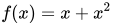
的) 分數迭代的正式冪級數的前幾項。
我再重複一次,這是一個對問題的正式解決方案,並且沒有解決級數答案收斂性的所有考慮因素。
我將找到

的前六項,即的“半次”迭代,一直到項。


讓我們寫下的迭代,從零次開始。

其中同餘關係是模所有度數為或更高的項。

- 的 項:總是 。
- 的 項?在 中,它是 。
- 項在 中的係數是 ,正如我們可以透過觀察得到的。


現在,經過片刻思考(好吧,也許是幾分鐘)你會發現 ,即 項在 中的係數,是一個關於 的度數為 的多項式。


一個熟悉的有限差分技術表明了這一點
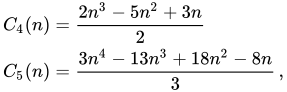
我不會詳細介紹這個技巧。重要的是,除了度數為 及以上的項之外,你還有

.

現在,您只需將 代入此公式即可獲得您想要的級數。

我將留給您使用我給您的迭代式來提高一度。