


分形/複平面迭代/平均速度
< 分形
"非吸引盆地和花瓣的離散速度:計算未逃逸點的平均離散速度軌跡:" [1][2]


在動態平面,可以觀察到
- 填充的 Julia 集的外部(藍色),用等高線法著色,
- Julia 集的內部,顯示無理流動(綠色),用速度的正弦著色
對於未逃逸的點,計算軌跡的平均離散速度

其中
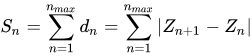
在 Octave 中,它看起來像
# octave code
 d=0;
 iter = 0;

 while (iter < maxiter) && (abs(z)<ER)
   h=z; # previous point = z_(n)
   z=z*z+c; # next point = z_(n+1)
   iter = iter+1;
   d=d+abs(z-h); # sum of distances along orbit
 end

 if iter < maxiter  # exterior
    measure = iter;
    myflag=3; # escaping to infinity

    else # iter==maxiter ( inside filled julia set )
      measure=20*d/iter; # average distance (d/iter) = 0.5
在 Chris King 的 Maple 程式碼中,這種離散速度僅透過點之間距離的總和來測量
因為
- 來自 Julia 集內部的所有正向軌跡都落入 Siegal 圓盤
- 在 Siegal 圓盤內部,點繞其中心(無差異週期點)旋轉
所以距離是衡量點落入哪個 Siegal 軌道的一個很好的指標
使用週期函式(sin,cos)建立帶狀結構 [3],顯示 Julia 集內部的動態(Siegal 圓盤及其前像)。
% code by Chris King
% http://www.dhushara.com/DarkHeart/Viewers/source/siegel.m
function siegel();
nx = 480;
ny = 480;
ColorMset = zeros(nx,ny,3);
magc=0.65;
xmin = -1/magc;
xmax = 1/magc;
ymin = -1/magc;
ymax = 1/magc;
maxiter = 1200;
wb = waitbar(0,'Please wait...');
for iy = 1:ny
  cy = ymin + iy*(ymax - ymin)/(ny - 1);
  for ix= 1:nx
    cx = xmin + ix*(xmax - xmin)/(nx - 1);
    [k myfl] = Mlevel(cy,cx,maxiter);
    if myfl==2
        ColorMset(ix,iy,2) = abs(sin(5*k/10+pi/4));
    else
        if myfl==1
            ColorMset(ix,iy,1) = abs(sin(2*k/10));
        else
            %ColorMset(ix,iy,2) = abs(sin(2*k/10+pi/4));
            ColorMset(ix,iy,3) = abs(cos(2*k/10));
        end
    end
  end
  waitbar(iy/ny,wb)
end
close(wb);
image(ColorMset);
imwrite(ColorMset,'siegel.jpg','jpg','Quality',100);

function [potential myfl] = Mlevel(cx,cy,maxiter)
z = complex(cx,cy);
th=pi*(-1+sqrt(5));
d=exp(complex(0,th));
d=d/2-d*d/4;
%e=(1-sqrt(1-4*d))/2;
%e=0;
%a=complex(0,sqrt(3));
%a=sqrt(3);
a=4;
ang=0;
iter = 0;
while (iter < maxiter)&&(abs(z) > 0.001)&&(abs(z)<20)
   h=z;
   %z=d*z*z*(z-a)/(1-a*z);
   z=z*z+d;
     hh=abs(z-h)*(z-h);
     if iter>maxiter/2
       ang=ang+hh;
    end
   iter = iter+1;
end
if iter < maxiter
    potential = iter;
    if abs(z)>=20
        myfl=0;
    else
        myfl=1;
    end
else
    %potential = -(ang-floor(ang));
    potential=abs(ang);
    myfl=2;
end
# http://www.dhushara.com/DarkHeart/DarkHeart.htm
# it is Octave m-file
# converted from matlab m-file by Chris King
# http://www.dhushara.com/DarkHeart/Viewers/source/siegel.m
#

# ------------- load packages ------------------------
pkg load image;
pkg load miscellaneous; # waitbar

# --------- definitions ------------------------------

function [potential myfl] = Mlevel(zx,zy,c,maxiter)
 ER=2.0; # escape radius = bailout value
 z = complex(zx,zy);
 ang=0;
 iter = 0;

 while (iter < maxiter) && (abs(z) > 0.001) && (abs(z)<ER)
   h=z; # previous point = z_(n)
   z=z*z+c; # next point = z_(n+1)


     # for the points that don''t escape compute
     #  the average discrete velocity  on the orbit = abs( z_(n+1) - z_n )
     if iter>maxiter/2 # ???
       zh=z-h;
       hh=abs(zh)*zh;
       ang=ang+hh;
    endif;

   iter = iter+1;
 end

 if iter < maxiter
    potential = iter;
    if abs(z)>=ER  myfl=3; # escaping to infinity
             else  myfl=1; # ??? falling into Siegel disc
    end
 else # iter==maxite ( inside filled julia set )
    potential=abs(ang);
    myfl=2;
 end
endfunction; # Mlevel

# ------------- const ------------------------------

# integer ( screen ) coordinate
iSide=1000
nx = iSide;
ny = iSide;

# image as a 2D matrix of 24 bit colors coded from 0.0 to 1.0
MyImage = zeros(ny,nx,3); # matrix filled with 0

# world ( float) coordinate - dynamical (Z) plane
magc=0.65;
dSide=1/magc
Zxmin = -dSide;
Zxmax = dSide;
Zymin = -dSide;
Zymax = dSide;

stepy = (Zymax - Zymin)/(ny - 1); # pixel height
stepx = (Zxmax - Zxmin)/(nx - 1); # pixel width

maxiter = 2000

# fc(z) = z*z + c
# rotation number or internal angle
t = (-1+sqrt(5))/2
th=2*pi*t;  # from turns to radians
d=exp(complex(0,th)); #
c =d/2-d*d/4 # point on boundary of main cardioid


pi4=pi/4;

# --------------- main : 2 loops ---------------------

waitbar(0,'Please wait...'); # info

# scan all pixels of image and comput color
for iy = 1:ny
  Zy = Zymax - iy*stepy; # invert y axis
  for ix= 1:nx
    Zx = Zxmin + ix*stepx; # map from screen to world coordinate

    [k myfl] = Mlevel(Zx,Zy,c, maxiter);
    # color
    switch (myfl)
     case 1 MyImage(iy,ix,1) = abs(sin(2*k/10)); # ?? Julia set in red
     case 2 MyImage(iy,ix,2) = abs(sin(5*k/10 + pi4)); # irrational flow (green) by the sine of the velocity.
     case 3 MyImage(iy,ix,3) = abs(cos(2*k/10)); # Exterior (blue) by level sets of escape time
    endswitch;

   # check plane orientation
   # first quadrant should be in upper right position
   # if(Zy>0 && Zx>0)
   # MyImage(iy,ix,2)=1.0-MyImage(iy,ix,2);
   # endif;
  endfor; # for ix

  waitbar(iy/ny);
endfor; # for iy

# image

image(MyImage); # display image
imwrite(MyImage,'si-test.png');  # save image to file
# this requires the ImageMagick "convert" utility.
-
 灰色 Siegal 圓盤
 -
 彩色 Siegal 圓盤

