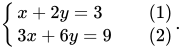
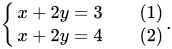
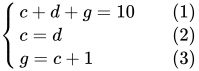
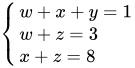
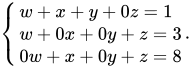
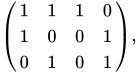
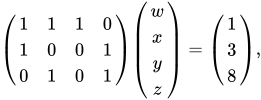
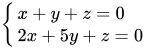
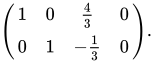
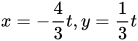
在以矩陣形式表示線性方程組之前,我們應該定義什麼是線性方程組
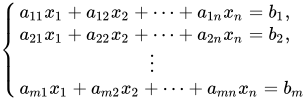
定義。 (線性方程組)一個線性方程組 n {\displaystyle n} x 1 , x 2 , … , x n {\displaystyle x_{1},x_{2},\ldots ,x_{n}} { a 11 x 1 + a 12 x 2 + ⋯ + a 1 n x n = b 1 , a 21 x 1 + a 22 x 2 + ⋯ + a 2 n x n = b 2 , ⋮ a m 1 x 1 + a m 2 x 2 + ⋯ + a m n x n = b m , {\displaystyle {\begin{cases}a_{11}x_{1}+a_{12}x_{2}+\cdots +a_{1n}x_{n}=b_{1},\\a_{21}x_{1}+a_{22}x_{2}+\cdots +a_{2n}x_{n}=b_{2},\\\quad \qquad \qquad \qquad \vdots \\a_{m1}x_{1}+a_{m2}x_{2}+\cdots +a_{mn}x_{n}=b_{m},\end{cases}}} a i j {\displaystyle a_{ij}} b k {\displaystyle b_{k}}
備註。
在其他一些定義中,單個線性方程可以被視為線性方程組,但由於我們已經可以很容易地解出單個線性方程,所以我們對這種情況不感興趣,因此我們不包括這種可能性。
一致 不一致
定義。
這個由三個線性方程組成的二元方程組是不一致 (線性方程組的一致性)
如果一個線性方程組至少有一個解,那麼它就是一致 不一致
備註。
正如我們所見,SLE 可以沒有解,一個唯一解,或無窮多個解。因此,SLE 是一致的當且僅當它有一個唯一解或無窮多個解。
練習。
在定義了一個 線性方程組
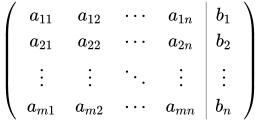
定義。 (係數矩陣和增廣矩陣) 令 { a 11 x 1 + a 12 x 2 + ⋯ + a 1 n x n = b 1 , a 21 x 1 + a 22 x 2 + ⋯ + a 2 n x n = b 2 , ⋮ a m 1 x 1 + a m 2 x 2 + ⋯ + a m n x n = b m {\displaystyle {\begin{cases}a_{11}x_{1}+a_{12}x_{2}+\cdots +a_{1n}x_{n}=b_{1},\\a_{21}x_{1}+a_{22}x_{2}+\cdots +a_{2n}x_{n}=b_{2},\\\quad \qquad \qquad \qquad \vdots \\a_{m1}x_{1}+a_{m2}x_{2}+\cdots +a_{mn}x_{n}=b_{m}\end{cases}}} x 1 , x 2 , … , x n {\displaystyle x_{1},x_{2},\ldots ,x_{n}} a i j {\displaystyle a_{ij}} b k {\displaystyle b_{k}}
矩陣 ( a i j ) m × n {\displaystyle {\color {green}(a_{ij})_{m\times n}}} 係數矩陣 ( a 11 a 12 ⋯ a 1 n b 1 a 21 a 22 ⋯ a 2 n b 2 ⋮ ⋮ ⋱ ⋮ ⋮ a m 1 a m 2 ⋯ a m n b n ) {\displaystyle \left({\begin{array}{cccc|c}a_{11}&a_{12}&\cdots &a_{1n}&b_{1}\\a_{21}&a_{22}&\cdots &a_{2n}&b_{2}\\\vdots &\vdots &\ddots &\vdots &\vdots \\a_{m1}&a_{m2}&\cdots &a_{mn}&b_{n}\end{array}}\right)} 增廣矩陣
備註。
增廣矩陣中的豎線是 可選的
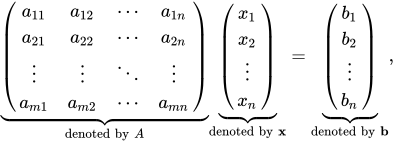
該方程組等價於 ( a 11 a 12 ⋯ a 1 n a 21 a 22 ⋯ a 2 n ⋮ ⋮ ⋱ ⋮ a m 1 a m 2 ⋯ a m n ) ⏟ denoted by A ( x 1 x 2 ⋮ x n ) ⏟ denoted by x = ( b 1 b 2 ⋮ b n ) ⏟ denoted by b , {\displaystyle \underbrace {\begin{pmatrix}a_{11}&a_{12}&\cdots &a_{1n}\\a_{21}&a_{22}&\cdots &a_{2n}\\\vdots &\vdots &\ddots &\vdots \\a_{m1}&a_{m2}&\cdots &a_{mn}\end{pmatrix}} _{{\text{denoted by}}\;A}\underbrace {\begin{pmatrix}x_{1}\\x_{2}\\\vdots \\x_{n}\end{pmatrix}} _{{\text{denoted by}}\;\mathbf {x} }=\underbrace {\begin{pmatrix}b_{1}\\b_{2}\\\vdots \\b_{n}\end{pmatrix}} _{{\text{denoted by}}\;\mathbf {b} },} A x = b {\displaystyle A\mathbf {x} =\mathbf {b} }
增廣矩陣 所有必要資訊
練習。
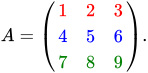
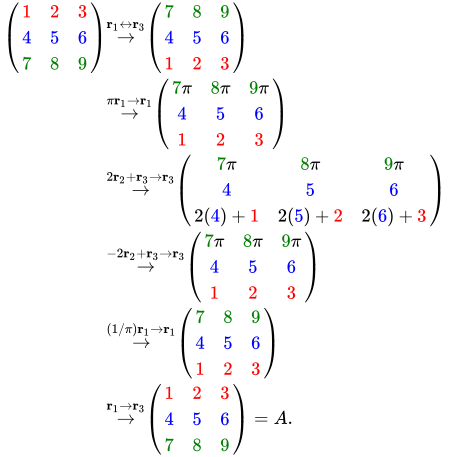
定義。 (初等行變換) 我們可以在一個 矩陣 三種 初等行變換
(型別 I) 交換
(型別 II) 用 非零 乘以
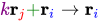
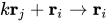
(型別 III) 將 一行 標量倍數 加 另一行
定義。 (行等價) 兩個 相同大小 一些 ERO 行等價
練習。
示例. (每種型別 ERO 的逆過程的說明)
( 1 2 3 4 ) → r 1 ↔ r 2 ( 3 4 1 2 ) → r 1 ↔ r 2 ( 1 2 3 4 ) {\displaystyle {\begin{pmatrix}{\color {red}1}&{\color {red}2}\\{\color {blue}3}&{\color {blue}4}\\\end{pmatrix}}{\overset {\mathbf {r} _{1}\leftrightarrow \mathbf {r} _{2}}{\to }}{\begin{pmatrix}{\color {blue}3}&{\color {blue}4}\\{\color {red}1}&{\color {red}2}\\\end{pmatrix}}{\overset {\mathbf {r} _{1}\leftrightarrow \mathbf {r} _{2}}{\to }}{\begin{pmatrix}{\color {red}1}&{\color {red}2}\\{\color {blue}3}&{\color {blue}4}\\\end{pmatrix}}}
( 1 2 3 4 ) → k r 1 → r 1 ( 1 k 2 k 3 4 ) → 1 k r 1 → r 1 ( 1 k ⋅ 1 k 2 k ⋅ 1 k 3 4 ) = ( 1 2 3 4 ) ( k ≠ 0 ) {\displaystyle {\begin{pmatrix}{\color {red}1}&{\color {red}2}\\{\color {blue}3}&{\color {blue}4}\\\end{pmatrix}}{\overset {{\color {green}k}\mathbf {r} _{1}\to \mathbf {r} _{1}}{\to }}{\begin{pmatrix}{\color {red}1}{\color {green}k}&{\color {red}2}{\color {green}k}\\{\color {blue}3}&{\color {blue}4}\\\end{pmatrix}}{\overset {{\color {green}{\frac {1}{k}}}\mathbf {r} _{1}\to \mathbf {r} _{1}}{\to }}{\begin{pmatrix}{\color {red}1}{\color {green}{\cancel {k}}}\cdot {\color {green}{\frac {1}{\cancel {k}}}}&{\color {red}2}{\color {green}{\cancel {k}}}\cdot {\color {green}{\frac {1}{\cancel {k}}}}\\{\color {blue}3}&{\color {blue}4}\\\end{pmatrix}}={\begin{pmatrix}{\color {red}1}&{\color {red}2}\\{\color {blue}3}&{\color {blue}4}\\\end{pmatrix}}\quad (k\neq 0)}
( 1 2 3 4 ) → k r 2 + r 1 → r 1 ( 1 + 3 k 2 + 4 k 3 4 ) → − k r 2 + r 1 → r 1 ( 1 + 3 k − 3 k 2 + 4 k − 4 k 3 4 ) = ( 1 2 3 4 ) {\displaystyle {\begin{pmatrix}{\color {red}1}&{\color {red}2}\\{\color {blue}3}&{\color {blue}4}\\\end{pmatrix}}{\overset {{\color {green}k}\mathbf {r} _{2}+\mathbf {r} _{1}\to \mathbf {r} _{1}}{\to }}{\begin{pmatrix}{\color {red}1}+{\color {blue}3}{\color {green}k}&{\color {red}2}+{\color {blue}4}{\color {green}k}\\{\color {blue}3}&{\color {blue}4}\\\end{pmatrix}}{\overset {{\color {green}-k}\mathbf {r} _{2}+\mathbf {r} _{1}\to \mathbf {r} _{1}}{\to }}{\begin{pmatrix}{\color {red}1}{\cancel {+{\color {blue}3}{\color {green}k}-{\color {blue}3}{\color {green}k}}}&{\color {red}2}{\cancel {+{\color {blue}4}{\color {green}k}-{\color {blue}4}{\color {green}k}}}\\{\color {blue}3}&{\color {blue}4}\\\end{pmatrix}}={\begin{pmatrix}{\color {red}1}&{\color {red}2}\\{\color {blue}3}&{\color {blue}4}\\\end{pmatrix}}}
練習。
證明。 大綱:足以表明如果我們執行一個行初等變換,解集將保持不變。例如
Compare { x + 2 y = 3 4 x + 5 y = 6 and { 4 x + 5 y = 6 x + 2 y = 3 {\displaystyle {\text{Compare }}{\begin{cases}x+2y=3\\4x+5y=6\\\end{cases}}{\text{ and }}{\begin{cases}4x+5y=6\\x+2y=3\\\end{cases}}}
Compare { x + 2 y = 3 4 x + 5 y = 6 and { k x + 2 k y = 3 k 4 x + 5 y = 6 ⇔ { x + 2 y = 3 4 x + 5 y = 6 ( k ≠ 0 ) {\displaystyle {\text{Compare }}{\begin{cases}x+2y=3\\4x+5y=6\\\end{cases}}{\text{ and }}{\begin{cases}kx+2ky=3k\\4x+5y=6\\\end{cases}}\Leftrightarrow {\begin{cases}x+2y=3\\4x+5y=6\\\end{cases}}\quad (k\neq 0)}
Compare { x + 2 y = 3 4 x + 5 y = 6 and { x + 2 y = 3 ( 1 ) ( 4 + k ) x + ( 5 + 2 k ) y = 6 + 3 k ( 2 ) {\displaystyle {\text{Compare }}{\begin{cases}x+2y=3\\4x+5y=6\\\end{cases}}{\text{ and }}{\begin{cases}x+2y=3&\quad (1)\\(4+k)x+(5+2k)y=6+3k&\quad (2)\\\end{cases}}} ( 1 ) − k ( 2 ) : {\displaystyle (1)-k(2):} ( 4 + k − k ) x + ( 5 + 2 k − 2 k ) y = 6 + 3 k − 3 k ⟺ 4 x + 5 y = 6 {\displaystyle (4+k-k)x+(5+2k-2k)y=6+3k-3k\iff 4x+5y=6}
◻ {\displaystyle \Box }
練習. 考慮三個行等價矩陣 A = ( 7 5 3 4 6 2 3 2 4 8 1 6 ) , B = ( 1 0 0 − 1 0 1 0 1 0 0 1 2 ) , C = ( 7 5 3 4 0 16 − 3 10 0 0 1 2 ) . {\displaystyle A={\begin{pmatrix}7&5&3&4\\6&2&3&2\\4&8&1&6\\\end{pmatrix}},B={\begin{pmatrix}1&0&0&-1\\0&1&0&1\\0&0&1&2\\\end{pmatrix}},C={\begin{pmatrix}7&5&3&4\\0&16&-3&10\\0&0&1&2\end{pmatrix}}.}
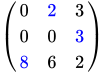
定義. (主元) 矩陣中一行中的 主元 左邊的非零元素.
例如: 矩陣 ( 0 2 3 0 0 3 8 6 2 ) {\displaystyle {\begin{pmatrix}0&{\color {blue}2}&3\\0&0&{\color {blue}3}\\{\color {blue}8}&6&2\\\end{pmatrix}}} 2 , 3 , 8 {\displaystyle 2,3,8}
練習。
定義: (行階梯形)一個矩陣處於 行階梯形
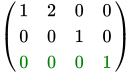
所有 零行 底部
每個非零行的 首項 上方行 首項 右側
定義: (簡化行階梯形)一個矩陣處於 簡化行階梯形
它處於行階梯形 (REF),
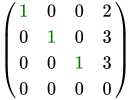
每個 非零行 首項 1 {\displaystyle {\color {green}1}} 首一
對於每個 首一 同一列中的其他 零
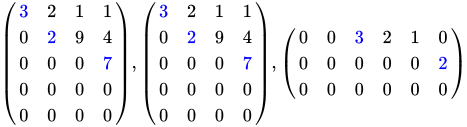
例如: (REF 和 RREF 的示例)
( 3 2 1 1 0 2 9 4 0 0 0 7 0 0 0 0 0 0 0 0 ) , ( 3 2 1 1 0 2 9 4 0 0 0 7 0 0 0 0 0 0 0 0 ) , ( 0 0 3 2 1 0 0 0 0 0 0 2 0 0 0 0 0 0 ) {\displaystyle {\begin{pmatrix}{\color {blue}3}&2&1&1\\0&{\color {blue}2}&9&4\\0&0&0&{\color {blue}7}\\0&0&0&0\\0&0&0&0\\\end{pmatrix}},{\begin{pmatrix}{\color {blue}3}&2&1&1\\0&{\color {blue}2}&9&4\\0&0&0&{\color {blue}7}\\0&0&0&0\\0&0&0&0\\\end{pmatrix}},{\begin{pmatrix}0&0&{\color {blue}3}&2&1&0\\0&0&0&0&0&{\color {blue}2}\\0&0&0&0&0&0\\\end{pmatrix}}}
( 1 0 7 0 1 0 1 9 0 2 0 0 0 1 9 0 0 0 0 0 ) , ( 1 0 7 0 1 0 1 9 0 2 0 0 0 1 9 ) , ( 1 0 7 0 0 1 9 0 0 0 0 1 ) , ( 0 1 0 0 0 0 1 0 0 0 0 1 ) , I , O {\displaystyle {\begin{pmatrix}{\color {blue}1}&{\color {green}0}&7&{\color {green}0}&1\\{\color {green}0}&{\color {blue}1}&9&{\color {green}0}&2\\{\color {green}0}&{\color {green}0}&0&{\color {blue}1}&9\\{\color {green}0}&{\color {green}0}&0&{\color {green}0}&0\\\end{pmatrix}},{\begin{pmatrix}{\color {blue}1}&{\color {green}0}&7&{\color {green}0}&1\\{\color {green}0}&{\color {blue}1}&9&{\color {green}0}&2\\{\color {green}0}&{\color {green}0}&0&{\color {blue}1}&9\\\end{pmatrix}},{\begin{pmatrix}{\color {blue}1}&{\color {green}0}&7&{\color {green}0}\\{\color {green}0}&{\color {blue}1}&9&{\color {green}0}\\{\color {green}0}&{\color {green}0}&0&{\color {blue}1}\\\end{pmatrix}},{\begin{pmatrix}0&{\color {blue}1}&{\color {green}0}&{\color {green}0}\\0&{\color {green}0}&{\color {blue}1}&{\color {green}0}\\0&{\color {green}0}&{\color {green}0}&{\color {blue}1}\\\end{pmatrix}},I,O}
以下矩陣不是 REF (因此也不在 RREF 中) ( 1 2 1 1 0 0 0 0 0 1 9 4 0 0 0 1 0 0 0 0 ) , ( 0 0 0 0 0 1 0 0 1 2 1 0 0 0 0 0 0 0 ) , ( 1 2 3 4 5 6 7 8 9 ) , ( 0 0 1 0 1 0 1 0 0 ) , ( 1 0 0 0 1 0 0 1 0 ) {\displaystyle {\begin{pmatrix}1&2&1&1\\{\color {red}0}&{\color {red}0}&{\color {red}0}&{\color {red}0}\\0&1&9&4\\0&0&0&1\\0&0&0&0\\\end{pmatrix}},{\begin{pmatrix}0&0&0&0&0&{\color {red}1}\\0&0&{\color {red}1}&2&1&0\\0&0&0&0&0&0\\\end{pmatrix}},{\begin{pmatrix}{\color {red}1}&2&3\\{\color {red}4}&5&6\\{\color {red}7}&8&9\\\end{pmatrix}},{\begin{pmatrix}0&0&{\color {red}1}\\0&{\color {red}1}&0\\{\color {red}1}&0&0\\\end{pmatrix}},{\begin{pmatrix}{\color {red}1}&0&0\\0&{\color {red}1}&0\\0&{\color {red}1}&0\\\end{pmatrix}}}
練習。
備註。
矩陣 A {\displaystyle A} A {\displaystyle A} 因此,每個矩陣都有其RREF,因為我們可以對任何矩陣應用高斯-若爾當消元法 矩陣的RREF是唯一的
在一些其他關於高斯-若爾當消元法的定義中,某些步驟可能有所不同,但我們也應該能夠透過這些方法將矩陣轉換為其RREF。
你可以訪問這個網站 ,它可以幫助你進行初等行變換、高斯-若爾當消元法等相關計算。
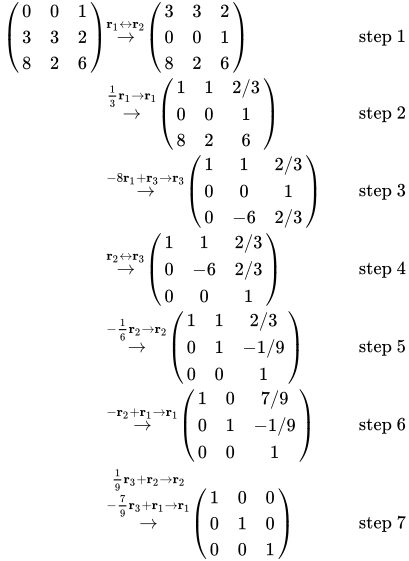
示例。 (高斯-約旦消元法的圖示) ( 0 0 1 3 3 2 8 2 6 ) → r 1 ↔ r 2 ( 3 3 2 0 0 1 8 2 6 ) step 1 → 1 3 r 1 → r 1 ( 1 1 2 / 3 0 0 1 8 2 6 ) step 2 → − 8 r 1 + r 3 → r 3 ( 1 1 2 / 3 0 0 1 0 − 6 2 / 3 ) step 3 → r 2 ↔ r 3 ( 1 1 2 / 3 0 − 6 2 / 3 0 0 1 ) step 4 → − 1 6 r 2 → r 2 ( 1 1 2 / 3 0 1 − 1 / 9 0 0 1 ) step 5 → − r 2 + r 1 → r 1 ( 1 0 7 / 9 0 1 − 1 / 9 0 0 1 ) step 6 → − 7 9 r 3 + r 1 → r 1 1 9 r 3 + r 2 → r 2 ( 1 0 0 0 1 0 0 0 1 ) step 7 {\displaystyle {\begin{aligned}{\begin{pmatrix}0&0&1\\3&3&2\\8&2&6\\\end{pmatrix}}&{\overset {\mathbf {r} _{1}\leftrightarrow \mathbf {r} _{2}}{\to }}{\begin{pmatrix}3&3&2\\0&0&1\\8&2&6\\\end{pmatrix}}&{\text{step 1}}\\&{\overset {{\frac {1}{3}}\mathbf {r} _{1}\to \mathbf {r} _{1}}{\to }}{\begin{pmatrix}1&1&2/3\\0&0&1\\8&2&6\\\end{pmatrix}}&{\text{step 2}}\\&{\overset {-8\mathbf {r} _{1}+\mathbf {r} _{3}\to \mathbf {r} _{3}}{\to }}{\begin{pmatrix}1&1&2/3\\0&0&1\\0&-6&2/3\\\end{pmatrix}}&{\text{step 3}}\\&{\overset {\mathbf {r} _{2}\leftrightarrow \mathbf {r} _{3}}{\to }}{\begin{pmatrix}1&1&2/3\\0&-6&2/3\\0&0&1\\\end{pmatrix}}&{\text{step 4}}\\&{\overset {-{\frac {1}{6}}\mathbf {r} _{2}\to \mathbf {r} _{2}}{\to }}{\begin{pmatrix}1&1&2/3\\0&1&-1/9\\0&0&1\\\end{pmatrix}}&{\text{step 5}}\\&{\overset {-\mathbf {r} _{2}+\mathbf {r} _{1}\to \mathbf {r} _{1}}{\to }}{\begin{pmatrix}1&0&7/9\\0&1&-1/9\\0&0&1\\\end{pmatrix}}&{\text{step 6}}\\&{\overset {{\frac {1}{9}}\mathbf {r} _{3}+\mathbf {r} _{2}\to \mathbf {r} _{2}}{\overset {-{\frac {7}{9}}\mathbf {r} _{3}+\mathbf {r} _{1}\to \mathbf {r} _{1}}{\to }}}{\begin{pmatrix}1&0&0\\0&1&0\\0&0&1\\\end{pmatrix}}&{\text{step 7}}\end{aligned}}}
練習。
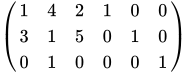
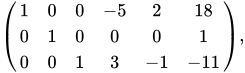
( 1 4 2 1 0 0 3 1 5 0 1 0 0 1 0 0 0 1 ) {\displaystyle {\begin{pmatrix}1&4&2&1&0&0\\3&1&5&0&1&0\\0&1&0&0&0&1\end{pmatrix}}} ( 1 0 0 − 5 2 18 0 1 0 0 0 1 0 0 1 3 − 1 − 11 ) , {\displaystyle {\begin{pmatrix}1&0&0&-5&2&18\\0&1&0&0&0&1\\0&0&1&3&-1&-11\\\end{pmatrix}},}
並且 ( 1 4 2 3 1 5 0 1 0 ) ( − 5 2 18 0 0 1 3 − 1 − 11 ) = ( 1 0 0 0 1 0 0 0 1 ) = I 3 {\displaystyle {\begin{pmatrix}1&4&2\\3&1&5\\0&1&0\\\end{pmatrix}}{\begin{pmatrix}-5&2&18\\0&0&1\\3&-1&-11\\\end{pmatrix}}={\begin{pmatrix}1&0&0\\0&1&0\\0&0&1\\\end{pmatrix}}=I_{3}}
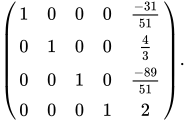
備註: 由於 R {\displaystyle R} 零 一 無窮多
備註。
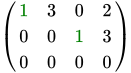
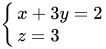
獨立未知數 沒有 依賴未知數 有
定義. (齊次線性方程組) 如果一個線性方程組的形式為 A x = 0 {\displaystyle A\mathbf {x} =\mathbf {0} } 齊次 齊次 一定 相容 每個 零 平凡解 非平凡解
注: 根據線性方程組解的個數判定命題,可知一個 齊次 唯一 無窮多個 相容
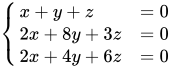
例: (齊次線性方程組的例子)SLE { x + y + z = 0 2 x + 8 y + 3 z = 0 2 x + 4 y + 6 z = 0 {\displaystyle {\begin{cases}x+y+z&=0\\2x+8y+3z&=0\\2x+4y+6z&=0\\\end{cases}}} 齊次
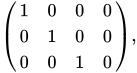
事實上,表示該 SLE 的增廣矩陣的 RREF 是 ( 1 0 0 0 0 1 0 0 0 0 1 0 ) , {\displaystyle {\begin{pmatrix}1&0&0&0\\0&1&0&0\\0&0&1&0\\\end{pmatrix}},} ( x , y , z ) = ( 0 , 0 , 0 ) {\displaystyle (x,y,z)=(0,0,0)} 平凡解
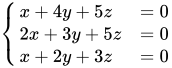
SLE { x + 4 y + 5 z = 0 2 x + 3 y + 5 z = 0 x + 2 y + 3 z = 0 {\displaystyle {\begin{cases}x+4y+5z&=0\\2x+3y+5z&=0\\x+2y+3z&=0\\\end{cases}}} 齊次
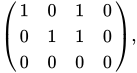
事實上,表示該 SLE 的增廣矩陣的 RREF 是 ( 1 0 1 0 0 1 1 0 0 0 0 0 ) , {\displaystyle {\begin{pmatrix}1&0&1&0\\0&1&1&0\\0&0&0&0\\\end{pmatrix}},} 無窮多個
命題: (齊次線性方程組有非平凡解的充分條件)一個 齊次 m {\displaystyle m} m < n {\displaystyle {\color {green}m<n}} 非平凡
備註。
該命題沒有斷言如果一個齊次線性方程組有一個非零解,那麼線性方程的個數嚴格小於未知數的個數(該命題的逆命題) 例如,在上面的例子中,即使線性方程的個數等於未知數的個數,線性方程組仍然可以有一個非零解