肽摺疊的複製交換分子動力學模擬。最低溫度副本以粗體標記。
 一個複製交換分子動力學模擬,其中有 4 個在不同溫度下的副本。在交換嘗試之間完成 m 步分子動力學。
複製交換分子動力學涉及對一個系統的多個 ( ) 副本進行同時模擬,每個副本對於某個控制變數具有不同的值。平行回火是一種複製交換方法,其中溫度用作控制引數。一組溫度分配給 個系統的副本,滿足
  。獨立系統的機率分佈取決於系統中所有原子的構型
  以及
以及  代表 個系統的副本的完整構型集。複製交換模擬是在正則系綜 (NVT) 系統上進行的。嘗試交換相鄰副本對之間的座標,並根據 Metropolis Monte Carlo 準則接受或拒絕嘗試的移動[1]。
圖示了在 4 個不同溫度下的副本上進行的複製交換模擬。在交換嘗試之間,對每個單獨的副本進行 m 步 MD。進行了副本 3 和 4 之間的第一次嘗試交換, ,嘗試交換被接受,
 以及
以及  。副本 1 和 2 之間的嘗試交換被拒絕,因此,
 其中
其中  以及
以及  。
。
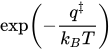
複製交換分子動力學的目的是確保高溫構型能夠輕鬆越過勢能面上的勢壘。低溫複製體對最低能量最小值進行取樣,而高溫複製體能夠對整個表面進行取樣,從而使低溫構型在高溫下變得更容易獲取。此外,傳統的分子動力學或蒙特卡羅方法在計算平衡性質時表現出極其緩慢的收斂性,因此,構型需要很長時間才能逃脫區域性最小值,因為越過高度為  的勢壘的機率與
  成正比。複製交換方法透過使越過能量勢壘變得更容易,提高了取樣效率。
模擬兩個 NVT 系統,其中第二個模擬在更高的溫度  下進行恆溫控制。
系統 1 的機率分佈

 表示系統 1 中所有原子的座標。
系統 2 的機率分佈

 表示系統 2 中所有原子的座標。
系統 1 具有座標 且系統 2 具有座標 的機率

系統 1 的座標為 ,系統 2 的座標為 的機率。

接受系統 1 和 2 之間嘗試交換座標的機率變為
![{\displaystyle {\begin{aligned}{\frac {P_{\textit {swapped}}}{P_{\textit {old}}}}&={\frac {{\frac {\exp \left(-{\mathcal {V}}(\mathbf {R} _{2})/k_{B}T_{1}\right)}{\int \exp \left(-{\mathcal {V}}(\mathbf {r} )/k_{B}T_{1}\right)d\mathbf {r} }}{\frac {\exp \left(-{\mathcal {V}}(\mathbf {R} _{1})/k_{B}T_{2}\right)}{\int \exp \left(-{\mathcal {V}}(\mathbf {r} )/k_{B}T_{2}\right)d\mathbf {r} }}}{{\frac {\exp \left(-{\mathcal {V}}(\mathbf {R} _{1})/k_{B}T_{1}\right)}{\int \exp \left(-{\mathcal {V}}(\mathbf {r} )/k_{B}T_{1}\right)d\mathbf {r} }}{\frac {\exp \left(-{\mathcal {V}}(\mathbf {R} _{2})/k_{B}T_{2}\right)}{\int \exp \left(-{\mathcal {V}}(\mathbf {r} )/k_{B}T_{2}\right)d\mathbf {r} }}}}\\&={\frac {\exp \left(-{\mathcal {V}}\left(\mathbf {R} _{2}\right)/k_{B}T_{1}\right)}{\exp \left(-{\mathcal {V}}\left(\mathbf {R} _{1}\right)/k_{B}T_{1}\right)}}{\frac {\exp \left(-{\mathcal {V}}\left(\mathbf {R} _{1}\right)/k_{B}T_{2}\right)}{\exp \left(-{\mathcal {V}}\left(\mathbf {R} _{2}\right)/k_{B}T_{2}\right)}}\\&=\exp \left({\frac {-{\mathcal {V}}\left(\mathbf {R} _{2}\right)}{k_{B}T_{1}}}\right)\exp \left({\frac {+{\mathcal {V}}\left(\mathbf {R} _{1}\right)}{k_{B}T_{1}}}\right)\exp \left({\frac {-{\mathcal {V}}\left(\mathbf {R} _{1}\right)}{k_{B}T_{2}}}\right)\exp \left({\frac {+{\mathcal {V}}\left(\mathbf {R} _{2}\right)}{k_{B}T_{2}}}\right)\\&=\exp \left({\frac {[-{\mathcal {V}}(\mathbf {R} _{2})+{\mathcal {V}}(\mathbf {R} _{1})]}{k_{B}T_{1}}}\right)\exp \left({\frac {[-{\mathcal {V}}(\mathbf {R} _{1})+{\mathcal {V}}(\mathbf {R} _{2})]}{k_{B}T_{2}}}\right)\end{aligned}}}](https://wikimedia.org/api/rest_v1/media/math/render/svg/8dc2c87b157d8102a29f828cc4710c1a0aa8b89c)
令 
![{\displaystyle {\begin{aligned}{\frac {P_{\textit {swapped}}}{P_{\textit {old}}}}&=\exp \left({\frac {-\Delta {\mathcal {V}}}{k_{B}T_{1}}}\right)\exp \left({\frac {+\Delta {\mathcal {V}}}{k_{B}T_{2}}}\right)\\&=\exp \left({\frac {-\Delta {\mathcal {V}}}{k_{B}T_{1}}}+{\frac {\Delta {\mathcal {V}}}{k_{B}T_{2}}}\right)\\&=\exp \left(-\Delta {\mathcal {V}}\beta _{1}+\Delta {\mathcal {V}}\beta _{2}\right)\\&=\exp \left(-\Delta {\mathcal {V}}\left[\beta _{1}-\beta _{2}\right]\right)\\\end{aligned}}}](https://wikimedia.org/api/rest_v1/media/math/render/svg/9561d1ba10be361f26f65bf450ff64010ee6dae5)
其中 以及
以及  .
.
![{\displaystyle {\begin{aligned}P_{\textit {acceptance}}={\text{min}}\left[1,\exp \left(-\Delta {\mathcal {V}}\left({\frac {1}{k_{B}T_{1}}}-{\frac {1}{k_{B}T_{2}}}\right)\right)\right]\\\end{aligned}}}](https://wikimedia.org/api/rest_v1/media/math/render/svg/42aebcedddb85d39696e095cad774b79f3594d9b)
- ↑ Tuckerman, M. E. 蒙特卡洛.統計力學:理論與分子模擬;牛津大學出版社有限公司:紐約,2010;第 300-304 頁。





