超幾何分佈
機率質量函式

|
累積分佈函式

|
| 符號 |
|
| 引數 |
|
| 支援
|

|
| PMF
|

|
| CDF
|
![{\displaystyle 1-{{{n \choose {k+1}}{{N-n} \choose {m-k-1}}} \over {N \choose m}}\,_{3}F_{2}\!\!\left[{\begin{array}{c}1,\ k+1-m,\ k+1-n\\k+2,\ N+k+2-m-n\end{array}};1\right],}](https://wikimedia.org/api/rest_v1/media/math/render/svg/70d1d2d44a9d8a3ede85e778fa510f5761c9d59d) 其中 其中  是 廣義超幾何函式 是 廣義超幾何函式 |
| 期望值
|

|
| 中位數
|
模式 =  |
| 方差
|
|
| 偏度
|
![{\displaystyle {\frac {(N-2m)(N-1)^{\frac {1}{2}}(N-2n)}{[nm(N-m)(N-n)]^{\frac {1}{2}}(N-2)}}}](https://wikimedia.org/api/rest_v1/media/math/render/svg/450c7c5a3a3b8ae698af5ee0cd3d225a1fa89d68)
|
| 峰度
|

 ![{\displaystyle {}+6nm(N-m)(N-n)(5N-6){\Big ]}}](https://wikimedia.org/api/rest_v1/media/math/render/svg/5778f9423c4744b49f0a62a91555233dbb7a5b20)
|
| 熵
|
???
|
| 矩生成函式
|
|
| 特徵函式
|
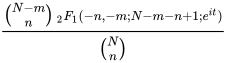
|
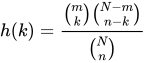
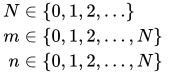
超幾何分佈描述了從包含 *m* 個成功的總體中,不放回地抽取 *n* 次後,成功次數的分佈情況。
它的機率質量函式為
![{\displaystyle f(x)={{{m \choose x}{{N-m} \choose {n-x}}} \over {N \choose n}}{\text{ for all }}x\in [0,n]}](https://wikimedia.org/api/rest_v1/media/math/render/svg/a6c330687b40587ed4a2d75eb490552603789497)
從技術上講,函式的支援範圍僅在 *x∈[max(0, n+m-N), min(m, n)]* 處。在該範圍不為 *[0,n]* 的情況下,*f(x)=0*,因為對於 *k>0*, .
.
我們首先檢查 *f(x)* 是否是一個有效的機率質量函式。這要求它在任何地方都非負,並且它的總和等於 1。第一個條件是顯而易見的。對於第二個條件,我們將從 範德蒙德恆等式 開始
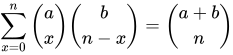
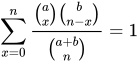
現在我們看到,如果 *a=m* 並且 *b=N-m*,那麼條件就滿足了。
我們推匯出平均值如下
![{\displaystyle \operatorname {E} [X]=\sum _{x=0}^{n}x\cdot f(x;n,m,N)=\sum _{x=0}^{n}x\cdot {{{m \choose x}{{N-m} \choose {n-x}}} \over {N \choose n}}}](https://wikimedia.org/api/rest_v1/media/math/render/svg/ee678a691b4e5c3cacc31c0093f39e4fb4128531)
![{\displaystyle \operatorname {E} [X]=0\cdot {{{m \choose 0}{{N-m} \choose {n-0}}} \over {N \choose n}}+\sum _{x=1}^{n}x\cdot {{{m \choose x}{{N-m} \choose {n-x}}} \over {N \choose n}}}](https://wikimedia.org/api/rest_v1/media/math/render/svg/39432db25cf68f4997af8b9cad284188a847e7a0)
我們使用恆等式  在分母中。
在分母中。
![{\displaystyle \operatorname {E} [X]=0+\sum _{x=1}^{n}x\cdot {{{m \choose x}{{N-m} \choose {n-x}}} \over {{N \over n}{{N-1} \choose {n-1}}}}}](https://wikimedia.org/api/rest_v1/media/math/render/svg/dc72b2fc87517df1421353858acfa5abfc9a1d09)
![{\displaystyle \operatorname {E} [X]={n \over N}\sum _{x=1}^{n}x\cdot {{{m \choose x}{{N-m} \choose {n-x}}} \over {{N-1} \choose {n-1}}}}](https://wikimedia.org/api/rest_v1/media/math/render/svg/2090566b0ae8ab1d2eba5cdd3ad10991d1e62f8b)
接下來我們使用恆等式  在分子中的第一個二項式中。
![{\displaystyle \operatorname {E} [X]={n \over N}\sum _{x=1}^{n}{m{{m-1 \choose x-1}{{N-m} \choose {n-x}}} \over {{N-1} \choose {n-1}}}}](https://wikimedia.org/api/rest_v1/media/math/render/svg/3a0006dea506dff720378b04156b5ffdd03e9873)
接下來,對於和式中的變數,我們定義相應的比它們少一的素變數。所以 N′=N−1, m′=m−1, x′=x−1, n′=n-1.
![{\displaystyle \operatorname {E} [X]={mn \over N}\sum _{x'=0}^{n'}{{{m' \choose x'}{{N'-m'} \choose {n'-x'}}} \over {{N'} \choose {n'}}}}](https://wikimedia.org/api/rest_v1/media/math/render/svg/5e1cd1722f894cc5a6f955a9b731d503a3cfe82b)
![{\displaystyle \operatorname {E} [X]={mn \over N}\sum _{x'=0}^{n'}f(x';n',m',N')}](https://wikimedia.org/api/rest_v1/media/math/render/svg/440dbb68d37e1dd929891ffc060edf32baf0f25b)
現在我們看到,這個和式是關於修改引數的超幾何分佈pmf的總和。它等於1。因此
![{\displaystyle \operatorname {E} [X]={nm \over N}}](https://wikimedia.org/api/rest_v1/media/math/render/svg/6f646539677956727e04993ee125d5c96eb3b2c9)
我們首先確定 E(X2).
![{\displaystyle \operatorname {E} [X^{2}]=\sum _{x=0}^{n}f(x;n,m,N)\cdot x^{2}=\sum _{x=0}^{n}{{{m \choose x}{{N-m} \choose {n-x}}} \over {N \choose n}}\cdot x^{2}}](https://wikimedia.org/api/rest_v1/media/math/render/svg/2c57e1b3542512836927eb966f4b00fac3f6577b)
![{\displaystyle \operatorname {E} [X^{2}]={{{m \choose 0}{{N-m} \choose {n-0}}} \over {N \choose n}}\cdot 0^{2}+\sum _{x=1}^{n}{{{m \choose x}{{N-m} \choose {n-x}}} \over {N \choose n}}\cdot x^{2}}](https://wikimedia.org/api/rest_v1/media/math/render/svg/945e5cce59894c9a6af230a7085439ee45c02aee)
![{\displaystyle \operatorname {E} [X^{2}]=0+\sum _{x=1}^{n}{{m{m-1 \choose x-1}{{N-m} \choose {n-x}}} \over {{N \over n}{{N-1} \choose {n-1}}}}\cdot x}](https://wikimedia.org/api/rest_v1/media/math/render/svg/cf2626751e1653818a91ded798fa6ceddb341e3d)
![{\displaystyle \operatorname {E} [X^{2}]={mn \over N}\sum _{x=1}^{n}{{{m-1 \choose x-1}{{N-m} \choose {n-x}}} \over {{N-1} \choose {n-1}}}\cdot x}](https://wikimedia.org/api/rest_v1/media/math/render/svg/3de1f2629e002b99b8cb83436e299c7e66bcc360)
我們使用與推導均值時相同的變數替換。
![{\displaystyle \operatorname {E} [X^{2}]={mn \over N}\sum _{x'=0}^{n'}{{{m' \choose x'}{{N'-m'} \choose {n'-x'}}} \over {{N'} \choose {n'}}}(x'+1)}](https://wikimedia.org/api/rest_v1/media/math/render/svg/d2d212f2d913e29e5a6bfba51a16dabc1b053b7f)
![{\displaystyle \operatorname {E} [X^{2}]={mn \over N}\left[\sum _{x'=0}^{n'}{{{m' \choose x'}{{N'-m'} \choose {n'-x'}}} \over {{N'} \choose {n'}}}x'+\sum _{x'=0}^{n'}{{{m' \choose x'}{{N'-m'} \choose {n'-x'}}} \over {{N'} \choose {n'}}}\right]}](https://wikimedia.org/api/rest_v1/media/math/render/svg/716677fe3389d264e4c693d47a1b2504f33e6276)
第一個求和是具有引數 (n',m',N') 的超幾何隨機變數的期望值。第二個求和是該隨機變數的機率質量函式的總和。
![{\displaystyle \operatorname {E} [X^{2}]={mn \over N}\left[{n'm' \over N'}+1\right]}](https://wikimedia.org/api/rest_v1/media/math/render/svg/757a9e4a2da301b9482bd1523263ec26b5d700da)
![{\displaystyle \operatorname {E} [X^{2}]={mn \over N}\left[{(n-1)(m-1) \over (N-1)}+1\right]={mn \over N}\left[{{(n-1)(m-1)+(N-1)} \over (N-1)}\right]}](https://wikimedia.org/api/rest_v1/media/math/render/svg/31e91eee15b9c70d335de29d7ecea6c9b764598c)
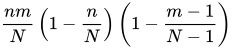
然後我們求解方差
![{\displaystyle \operatorname {Var} (X)=\operatorname {E} [X^{2}]-(\operatorname {E} [X])^{2}}](https://wikimedia.org/api/rest_v1/media/math/render/svg/cd5a922df13bdee788c0f06474fe002a42c25d8a)
![{\displaystyle \operatorname {Var} (X)={mn \over N}\left[{{(n-1)(m-1)+(N-1)} \over (N-1)}\right]-\left({mn \over N}\right)^{2}}](https://wikimedia.org/api/rest_v1/media/math/render/svg/56995fabfd1f82e08f69ae429457ac1c2db7d222)
![{\displaystyle \operatorname {Var} (X)={Nmn \over N^{2}}\left[{{(n-1)(m-1)+(N-1)} \over (N-1)}\right]-{(N-1)(mn)^{2} \over (N-1)N^{2}}}](https://wikimedia.org/api/rest_v1/media/math/render/svg/af036c806a95a3b386c81675d1a20f547d48985f)
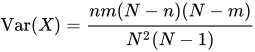
或者等效地,






