在前面的章節中,我們討論了兩種用於估計未知引數 點估計 區間估計 假設檢驗 決策 置信區間 假設檢驗
在討論如何進行 評估
定義。 (假設)一個(統計)假設
有兩個術語用來對假設進行分類
定義。 (簡單和複合假設)如果一個假設完全指定 簡單假設 複合假設
有時,是否一個假設是簡單還是複合並不立即清楚。為了更清楚地理解假設的分類,讓我們考慮以下示例。
在假設檢驗中,我們考慮兩個假設。
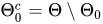
H 0 {\displaystyle H_{0}} H 1 {\displaystyle H_{1}} H 0 : θ ∈ Θ 0 {\displaystyle H_{0}:\theta \in \Theta _{0}} H 1 : θ ∈ Θ 1 {\displaystyle H_{1}:\theta \in \Theta _{1}} Θ 1 = Θ 0 c {\displaystyle \Theta _{1}=\Theta _{0}^{c}} Θ 0 {\displaystyle \Theta _{0}} 補集 Θ {\displaystyle \Theta } Θ 0 c = Θ ∖ Θ 0 {\displaystyle \Theta _{0}^{c}=\Theta \setminus \Theta _{0}} Θ {\displaystyle \Theta } θ {\displaystyle \theta } Θ 0 {\displaystyle \Theta _{0}} H 1 {\displaystyle H_{1}} H 1 {\displaystyle H_{1}} H 0 {\displaystyle H_{0}}
示例. 假設你的朋友給你一枚硬幣讓你拋,你不知道它是否是公平的。然而,由於這枚硬幣是由你的朋友給你的,你相信這枚硬幣是公平的,除非有充分的證據表明並非如此。在這個背景下,零假設和備擇假設是什麼(假設硬幣永遠不會立起來)?
解答 p {\displaystyle p} H 0 : p = 1 2 {\displaystyle H_{0}:p={\frac {1}{2}}} H 1 : p ≠ 1 2 {\displaystyle H_{1}:p\neq {\frac {1}{2}}}
練習. 假設我們在上面的問題中將“硬幣”替換為“六面骰子”。零假設和備擇假設是什麼?(提示 p 1 , p 2 , … , p 6 {\displaystyle p_{1},p_{2},\dotsc ,p_{6}}
解決方案
令 p 1 , p 2 , … , p 6 {\displaystyle p_{1},p_{2},\dotsc ,p_{6}} H 0 : p 1 = p 2 = ⋯ = p 6 = 1 6 {\displaystyle H_{0}:p_{1}=p_{2}=\dotsb =p_{6}={\frac {1}{6}}} H 1 : 至少有一個 p 1 , … , p 6 ≠ 1 6 {\displaystyle H_{1}:{\text{at least one of }}p_{1},\dotsc ,p_{6}\neq {\frac {1}{6}}} p 1 , … , p 6 {\displaystyle p_{1},\dotsc ,p_{6}} 1 6 {\displaystyle {\frac {1}{6}}} 1 6 {\displaystyle {\frac {1}{6}}}
我們已經提到,假設 H 0 {\displaystyle H_{0}} H 1 {\displaystyle H_{1}} 決定 確定 足夠的證據 [ 2] 不是
現在,我們面臨著兩個問題。首先,我們應該考慮哪些證據?其次,“足夠”是什麼意思?對於第一個問題,一個自然的答案是,我們應該考慮觀察到的樣本
為了回答第二個問題,我們需要假設檢驗 拒絕域 臨界域 是否 零 H 0 {\displaystyle H_{0}} H 1 {\displaystyle H_{1}} H 1 {\displaystyle H_{1}} H 0 {\displaystyle H_{0}} H 1 {\displaystyle H_{1}} 不 H 0 {\displaystyle H_{0}} H 0 {\displaystyle H_{0}} H 0 {\displaystyle H_{0}} H 1 {\displaystyle H_{1}} H 0 {\displaystyle H_{0}} H 1 {\displaystyle H_{1}}
讓我們正式定義以下與假設檢驗相關的術語。
備註:
假設檢驗有時為了簡潔起見簡稱為“檢驗”。我們有時也使用希臘字母" φ {\displaystyle \varphi } ψ {\displaystyle \psi }
備註:
    S
*------------*
|///|........|
|///\........|
|////\.......|
|/////\......|
*------------*

*--*
|//|: R
*--*

*--*
|..|: R^c
*--*
通常,我們使用 檢驗統計量 X 1 , … , X n {\displaystyle X_{1},\dotsc ,X_{n}} X ¯ {\displaystyle {\overline {X}}} R = { x : x ¯ < 2 } {\displaystyle R=\{\mathbf {x} :{\overline {x}}<2\}} x 1 , … , x n {\displaystyle x_{1},\dotsc ,x_{n}} x ¯ {\displaystyle {\overline {x}}} X 1 , … , X n {\displaystyle X_{1},\dotsc ,X_{n}} X ¯ {\displaystyle {\overline {X}}} x ∈ R {\displaystyle \mathbf {x} \in R} H 0 {\displaystyle H_{0}} H 1 {\displaystyle H_{1}} x ∈ R c {\displaystyle \mathbf {x} \in R^{c}} H 0 {\displaystyle H_{0}} 拒絕域 H 0 {\displaystyle H_{0}} H 1 {\displaystyle H_{1}}
示例。 假設拒絕域為 R = { ( x 1 , x 2 , x 3 ) : x 1 + x 2 + x 3 > 6 } {\displaystyle R=\{(x_{1},x_{2},x_{3}):x_{1}+x_{2}+x_{3}>6\}} x 1 = 1 , x 2 = 2 , x 3 = 3 {\displaystyle x_{1}=1,x_{2}=2,x_{3}=3} H 0 {\displaystyle H_{0}} H 1 {\displaystyle H_{1}}
解答 ( x 1 , x 2 , x 3 ) ∈ R c {\displaystyle (x_{1},x_{2},x_{3})\in R^{c}} H 0 {\displaystyle H_{0}}
練習。 這種假設檢驗是什麼型別?
正如我們已經提到的,假設檢驗做出的決定不應該完美,並且會發生錯誤。事實上,當我們仔細思考時,實際上有兩種型別
我們可以使用以下表格更清楚地說明這兩種型別的錯誤。
I 類和 II 類錯誤
接受 H 0 {\displaystyle H_{0}}
拒絕 H 0 {\displaystyle H_{0}}
H 0 {\displaystyle H_{0}} 正確決策
I 類錯誤
H 0 {\displaystyle H_{0}} II 類錯誤
正確決策
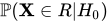
我們可以表示 H 0 : θ ∈ Θ 0 {\displaystyle H_{0}:\theta \in \Theta _{0}} H 1 : θ ∈ Θ 0 c {\displaystyle H_{1}:\theta \in \Theta _{0}^{c}} R = R ( X ) {\displaystyle R=R(\mathbf {X} )} X {\displaystyle X} x {\displaystyle x} R {\displaystyle R} X {\displaystyle X} R = R ( X ) {\displaystyle R=R(\mathbf {X} )}
接下來,我們針對犯第一類和第二類錯誤的 機率 X 1 , … , X n {\displaystyle X_{1},\dotsc ,X_{n}} X = ( X 1 , … , X n ) {\displaystyle \mathbf {X} =(X_{1},\dotsc ,X_{n})}
犯第一類錯誤的機率,記作 α ( θ ) {\displaystyle \alpha (\theta )} θ ∈ Θ 0 {\displaystyle \theta \in \Theta _{0}} P θ ( X ∈ R ) {\displaystyle \mathbb {P} _{\theta }(\mathbf {X} \in R)}
犯第二類錯誤的機率,記作 β ( θ ) {\displaystyle \beta (\theta )} θ ∈ Θ 0 c {\displaystyle \theta \in \Theta _{0}^{c}} P θ ( X ∈ R c ) = 1 − P θ ( X ∈ R ) {\displaystyle \mathbb {P} _{\theta }(\mathbf {X} \in R^{c})=1-\mathbb {P} _{\theta }(\mathbf {X} \in R)} 請注意, α ( θ ) {\displaystyle \alpha (\theta )} β ( θ ) {\displaystyle \beta (\theta )} P θ ( ( X 1 , … , X n ) ∈ R ) {\displaystyle \mathbb {P} _{\theta }((X_{1},\dotsc ,X_{n})\in R)} P θ ( ( X 1 , … , X n ) ∈ R ) = { α ( θ ) , θ ∈ Θ 0 ; 1 − β ( θ ) , θ ∈ Θ 0 c . {\displaystyle \mathbb {P} _{\theta }((X_{1},\dotsc ,X_{n})\in R)={\begin{cases}\alpha (\theta ),&\theta \in \Theta _{0};\\1-\beta (\theta ),&\theta \in \Theta _{0}^{c}.\end{cases}}} R {\displaystyle R}
示例: 假設我們擲一枚(公平或不公平)硬幣 5 次(假設硬幣永遠不會側立),並且我們有以下假設: H 0 : p ≤ 1 2 vs. H 1 : p > 1 2 {\displaystyle H_{0}:p\leq {\frac {1}{2}}\quad {\text{vs.}}\quad H_{1}:p>{\frac {1}{2}}} p {\displaystyle p} X 1 , … , X 5 {\displaystyle X_{1},\dotsc ,X_{5}} x 1 , … , x 5 {\displaystyle x_{1},\dotsc ,x_{5}} H 0 {\displaystyle H_{0}}
(a) 確定拒絕區域 R {\displaystyle R}
(b) 功率函式是什麼 π ( p ) {\displaystyle \pi (p)} p {\displaystyle p}
(c) 計算 α ( 1 / 2 ) {\displaystyle \alpha (1/2)} β ( 2 / 3 ) {\displaystyle \beta (2/3)}
解決方案
(a) 拒絕區域 R = { ( x 1 , … , x 5 ) : x 1 + ⋯ + x 5 = 5 } {\displaystyle R=\{(x_{1},\dotsc ,x_{5}):x_{1}+\dotsb +x_{5}=5\}}
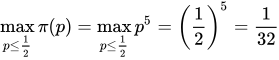
(b) 功率函式為 π ( p ) = { P θ ( ( X 1 , … , X 5 ) ∈ R ) = p 5 , p ≤ 1 2 ; 1 − P θ ( ( X 1 , … , X 5 ) ∈ R ) = 1 − p 5 , p > 1 2 . {\displaystyle \pi (p)={\begin{cases}\mathbb {P} _{\theta }((X_{1},\dotsc ,X_{5})\in R)=p^{5},&p\leq {\frac {1}{2}};\\1-\mathbb {P} _{\theta }((X_{1},\dotsc ,X_{5})\in R)=1-p^{5},&p>{\frac {1}{2}}.\end{cases}}}
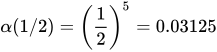
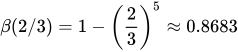
(c) 我們有 α ( 1 / 2 ) = ( 1 2 ) 5 = 0.03125 {\displaystyle \alpha (1/2)=\left({\frac {1}{2}}\right)^{5}=0.03125} β ( 2 / 3 ) = 1 − ( 2 3 ) 5 ≈ 0.8683 {\displaystyle \beta (2/3)=1-\left({\frac {2}{3}}\right)^{5}\approx 0.8683} H 0 {\displaystyle H_{0}} H 0 {\displaystyle H_{0}}
示例。 假設 X 1 , … , X n {\displaystyle X_{1},\dotsc ,X_{n}} N ( μ , σ 2 ) {\displaystyle {\mathcal {N}}(\mu ,\sigma ^{2})} σ 2 {\displaystyle \sigma ^{2}} H 0 : μ ≤ μ 0 vs. μ > μ 0 {\displaystyle H_{0}:\mu \leq \mu _{0}\quad {\text{vs.}}\quad \mu >\mu _{0}} μ 0 {\displaystyle \mu _{0}} T = X ¯ − μ 0 σ / n ∼ N ( 0 , 1 ) {\displaystyle T={\frac {{\overline {X}}-\mu _{0}}{\sigma /{\sqrt {n}}}}\sim {\mathcal {N}}(0,1)} T ≥ k {\displaystyle T\geq k} H 0 {\displaystyle H_{0}}
求功效函式 π ( μ ) {\displaystyle \pi (\mu )} lim μ → − ∞ π ( μ ) {\displaystyle \lim _{\mu \to -\infty }\pi (\mu )} lim μ → ∞ π ( μ ) {\displaystyle \lim _{\mu \to \infty }\pi (\mu )}
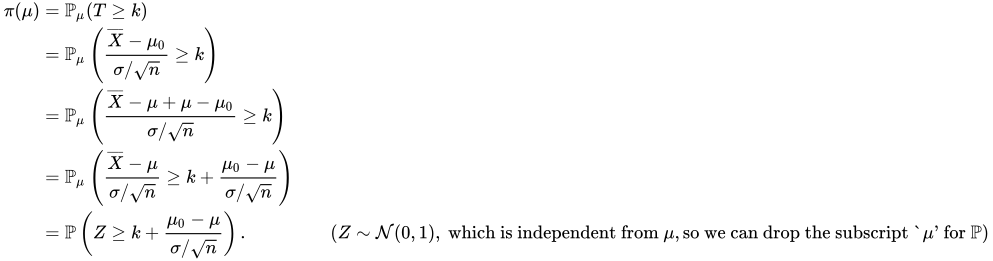
解決方案 π ( μ ) = P μ ( T ≥ k ) = P μ ( X ¯ − μ 0 σ / n ≥ k ) = P μ ( X ¯ − μ + μ − μ 0 σ / n ≥ k ) = P μ ( X ¯ − μ σ / n ≥ k + μ 0 − μ σ / n ) = P ( Z ≥ k + μ 0 − μ σ / n ) . ( Z ∼ N ( 0 , 1 ) , which is independent from μ , so we can drop the subscript ` μ ' for P ) {\displaystyle {\begin{aligned}\pi (\mu )&=\mathbb {P} _{\mu }(T\geq k)\\&=\mathbb {P} _{\mu }\left({\frac {{\overline {X}}-\mu _{0}}{\sigma /{\sqrt {n}}}}\geq k\right)\\&=\mathbb {P} _{\mu }\left({\frac {{\overline {X}}-\mu +\mu -\mu _{0}}{\sigma /{\sqrt {n}}}}\geq k\right)\\&=\mathbb {P} _{\mu }\left({\frac {{\overline {X}}-\mu }{\sigma /{\sqrt {n}}}}\geq k+{\frac {\mu _{0}-\mu }{\sigma /{\sqrt {n}}}}\right)\\&=\mathbb {P} \left(Z\geq k+{\frac {\mu _{0}-\mu }{\sigma /{\sqrt {n}}}}\right).&(Z\sim {\mathcal {N}}(0,1),{\text{ which is independent from }}\mu ,{\text{so we can drop the subscript `}}\mu {\text{' for }}\mathbb {P} )\\\end{aligned}}} lim μ → − ∞ π ( μ ) = P ( Z ≥ ∞ ) = 0 {\displaystyle \lim _{\mu \to -\infty }\pi (\mu )=\mathbb {P} (Z\geq \infty )=0} lim μ → ∞ π ( μ ) = P ( Z ≥ − ∞ ) = 1 {\displaystyle \lim _{\mu \to \infty }\pi (\mu )=\mathbb {P} (Z\geq -\infty )=1} π ( μ ) {\displaystyle \pi (\mu )} μ {\displaystyle \mu }
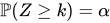
練習。 證明如果 P ( Z ≥ k ) = α {\displaystyle \mathbb {P} (Z\geq k)=\alpha } π ( μ 0 ) = α {\displaystyle \pi (\mu _{0})=\alpha }
解決方案
證明。 假設 P ( Z ≥ k ) = α {\displaystyle \mathbb {P} (Z\geq k)=\alpha } π ( μ 0 ) = P ( Z ≥ k + 0 ) = P ( Z ≥ k ) = α {\displaystyle \pi (\mu _{0})=\mathbb {P} (Z\geq k+0)=\mathbb {P} (Z\geq k)=\alpha }
◻ {\displaystyle \Box }
理想情況下,我們希望將 α ( θ ) {\displaystyle \alpha (\theta )} β ( θ ) {\displaystyle \beta (\theta )}
將拒絕域 R {\displaystyle R} S = { x } {\displaystyle S=\{\mathbf {x} \}} θ ∈ Θ {\displaystyle \theta \in \Theta } π ( θ ) = 1 {\displaystyle \pi (\theta )=1} β ( θ ) = 0 {\displaystyle \beta (\theta )=0} α ( θ ) = 1 {\displaystyle \alpha (\theta )=1}
另一個極端情況是將拒絕域 R {\displaystyle R} ∅ {\displaystyle \varnothing } θ ∈ Θ {\displaystyle \theta \in \Theta } π ( θ ) = 0 {\displaystyle \pi (\theta )=0} α ( θ ) = 0 {\displaystyle \alpha (\theta )=0} β ( θ ) = 1 {\displaystyle \beta (\theta )=1} 我們可以觀察到,為了使 α ( θ ) {\displaystyle \alpha (\theta )} β ( θ ) {\displaystyle \beta (\theta )} β ( θ ) {\displaystyle \beta (\theta )} α ( θ ) {\displaystyle \alpha (\theta )} 控制
現在,我們感興趣的是瞭解應該控制哪種型別的錯誤。為了激發這種選擇,我們可以再次考慮無罪推定法律原則的類比。在這種情況下,I 類錯誤意味著將無辜者判為有罪,而 II 類錯誤意味著赦免有罪者。然後,正如 布萊克斯通比率 所建議的那樣,I 類錯誤比 II 類錯誤更嚴重,也更重要。這促使我們控制 I 類錯誤的機率,即 α ( θ ) {\displaystyle \alpha (\theta )} α ∗ {\displaystyle \alpha ^{*}} β ( θ ) {\displaystyle \beta (\theta )}
為了更精確地描述“在該水平上控制 I 類錯誤機率”,讓我們定義以下術語。
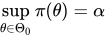
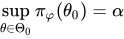
因此,根據這個定義,將 I 類錯誤機率控制在特定水平 α {\displaystyle \alpha } α {\displaystyle \alpha } sup θ ∈ Θ 0 π ( θ ) ≤ α {\displaystyle \sup _{\theta \in \Theta _{0}}\pi (\theta )\leq \alpha } 水平 α {\displaystyle \alpha }
例: 考慮正態分佈 N ( μ , 1 ) {\displaystyle {\mathcal {N}}(\mu ,1)} Θ = { μ : μ = 20 or 21 } {\displaystyle \Theta =\{\mu :\mu =20{\text{ or }}21\}} H 0 : μ = 20 vs. H 1 : μ = 21 {\displaystyle H_{0}:\mu =20\quad {\text{vs.}}\quad H_{1}:\mu =21} X 1 , … , X 10 {\displaystyle X_{1},\dotsc ,X_{10}} N ( μ , 1 ) {\displaystyle {\mathcal {N}}(\mu ,1)} x 1 , … , x 10 {\displaystyle x_{1},\dotsc ,x_{10}} { ( x 1 , … , x 10 ) : x ¯ ≥ k } {\displaystyle \{(x_{1},\dotsc ,x_{10}):{\overline {x}}\geq k\}}
(a) 求 k {\displaystyle k} α = 0.05 {\displaystyle \alpha =0.05}
(b) 計算第二類錯誤機率 β {\displaystyle \beta } β ≤ 0.05 {\displaystyle \beta \leq 0.05}
解決方案
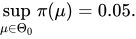
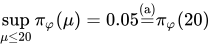
(a) 為了使顯著性水平為0.05,我們需要滿足 sup μ ∈ Θ 0 π ( μ ) = 0.05. {\displaystyle \sup _{\mu \in \Theta _{0}}\pi (\mu )=0.05.} Θ 0 = { 20 } {\displaystyle \Theta _{0}=\{20\}} 0.05 = π ( 20 ) = P μ = 20 ( X ¯ ≥ k ) = P ( X ¯ − 20 1 / 10 ≥ k − 20 1 / 10 ) = P ( Z ≥ 10 ( k − 20 ) ) {\displaystyle 0.05=\pi (20)=\mathbb {P} _{\mu =20}({\overline {X}}\geq k)=\mathbb {P} \left({\frac {{\overline {X}}-20}{1/{\sqrt {10}}}}\geq {\frac {k-20}{1/{\sqrt {10}}}}\right)=\mathbb {P} (Z\geq {\sqrt {10}}(k-20))} Z ∼ N ( 0 , 1 ) {\displaystyle Z\sim {\mathcal {N}}(0,1)} 10 ( k − 20 ) = z 0.05 ≈ 1.64 ⟹ k ≈ 20.51861. {\displaystyle {\sqrt {10}}(k-20)=z_{0.05}\approx 1.64\implies k\approx 20.51861.}
(b) II 類錯誤機率為 β ≈ 1 − P μ = 21 ( X ¯ ≥ 20.51861 ) = 1 − P ( X ¯ − 21 1 / 10 ≥ 20.51861 − 21 1 / 10 ) ≈ 1 − P ( Z ≥ − 1.522 ) = P ( Z < − 1.522 ) ≈ 0.06426. {\displaystyle \beta \approx 1-\mathbb {P} _{\mu =21}({\overline {X}}\geq 20.51861)=1-\mathbb {P} \left({\frac {{\overline {X}}-21}{1/{\sqrt {10}}}}\geq {\frac {20.51861-21}{1/{\sqrt {10}}}}\right)\approx 1-\mathbb {P} (Z\geq -1.522)=\mathbb {P} (Z<-1.522)\approx 0.06426.} Z ∼ N ( 0 , 1 ) {\displaystyle Z\sim {\mathcal {N}}(0,1)} n {\displaystyle n} β ≈ P ( Z < n ( 20.51861 − 21 ) ) {\displaystyle \beta \approx \mathbb {P} \left(Z<{\sqrt {n}}(20.51861-21)\right)} n {\displaystyle n} n ( 20.51861 − 21 ) {\displaystyle {\sqrt {n}}(20.51861-21)} P ( Z < n ∗ ( 20.51861 − 21 ) ≤ 0.05 ⟹ n ( 20.51861 − 21 ) ≥ − 1.64 ⟹ n ≥ 11.603. {\displaystyle \mathbb {P} (Z<{\sqrt {n^{*}}}(20.51861-21)\leq 0.05\implies {\sqrt {n}}(20.51861-21)\geq -1.64\implies n\geq 11.603.}
練習。 當樣本量為 12 時(拒絕域保持不變),計算 I 類錯誤機率和 II 類錯誤機率。
解決方案
II 類錯誤機率為 P ( Z < 12 ( 20.51861 − 21 ) ) ≈ P ( Z < − 1.668 ) ≈ 0.04746. {\displaystyle \mathbb {P} (Z<{\sqrt {12}}(20.51861-21))\approx \mathbb {P} (Z<-1.668)\approx 0.04746.} P ( Z ≥ 12 ( 20.51861 − 20 ) ) ≈ P ( Z ≥ 1.797 ) ≈ 0.0359. {\displaystyle \mathbb {P} (Z\geq {\sqrt {12}}(20.51861-20))\approx \mathbb {P} (Z\geq 1.797)\approx 0.0359.}
到目前為止,我們一直專注於使用 拒絕域 p {\displaystyle p}
下面的定理允許我們使用 p {\displaystyle p}
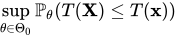
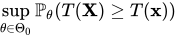
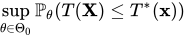
Proof. (Partial) We can prove "if" and "only if" directions at once. Let us first consider the case 1 in the definition of p {\displaystyle p} p {\displaystyle p} sup θ ∈ Θ 0 P θ ( T ( X ) ≤ T ∗ ( x ) ) {\displaystyle \sup _{\theta \in \Theta _{0}}\mathbb {P} _{\theta }(T(\mathbf {X} )\leq T^{*}(\mathbf {x} ))} α = sup θ ∈ Θ 0 π ( θ ) = sup θ ∈ Θ 0 P θ ( T ( X ) ≤ T ∗ ( x ) ) {\displaystyle \alpha =\sup _{\theta \in \Theta _{0}}\pi (\theta )=\sup _{\theta \in \Theta _{0}}\mathbb {P} _{\theta }(T(\mathbf {X} )\leq T^{*}(\mathbf {x} ))} T ∗ ( X ) {\displaystyle T^{*}(\mathbf {X} )} T ( X ) ≤ T ∗ ( x ) ⟺ ( X 1 , … , X n ) ∈ R {\displaystyle T(\mathbf {X} )\leq T^{*}(\mathbf {x} )\iff (X_{1},\dotsc ,X_{n})\in R} p -value ≤ α ⟺ sup θ ∈ Θ 0 P θ ( T ( X ) ≤ T ( x ) ) ≤ sup θ ∈ Θ 0 P θ ( T ( X ) ≤ T ∗ ( x ) ) ⟺ T ( x ) ≤ T ∗ ( x ) ( by some omitted arguments and the monotonicity of cdf ) ⟺ ( x 1 , … , x n ) ∈ { ( y 1 , … , y n ) : T ( y 1 , … , y n ) ≤ T ∗ ( x ) } ( x 1 , … , x n are realizations of X 1 , … , X n respectively ) ⟺ ( x 1 , … , x n ) ∈ R ( defined above ) ⟺ H 0 is rejected at significance level α . ( the test with power function π ( θ ) is size α test ) {\displaystyle {\begin{aligned}p{\text{-value}}\leq \alpha &\iff \sup _{\theta \in \Theta _{0}}\mathbb {P} _{\theta }(T(\mathbf {X} )\leq T(\mathbf {x} ))\leq \sup _{\theta \in \Theta _{0}}\mathbb {P} _{\theta }(T(\mathbf {X} )\leq T^{*}(\mathbf {x} ))\\&\iff T(\mathbf {x} )\leq T^{*}(\mathbf {x} )&({\text{by some omitted arguments and the monotonicity of cdf}})\\&\iff (x_{1},\dotsc ,x_{n})\in \{(y_{1},\dotsc ,y_{n}):T(y_{1},\dotsc ,y_{n})\leq T^{*}(\mathbf {x} )\}&(x_{1},\dotsc ,x_{n}{\text{ are realizations of }}X_{1},\dotsc ,X_{n}{\text{ respectively}})\\&\iff (x_{1},\dotsc ,x_{n})\in R&({\text{defined above}})\\&\iff H_{0}{\text{ is rejected at significance level }}\alpha .&({\text{the test with power function }}\pi (\theta ){\text{ is size }}\alpha {\text{ test}})\end{aligned}}} T {\displaystyle T}
◻ {\displaystyle \Box }
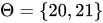
示例。 回想之前示例的設定:考慮正態分佈 N ( μ , 1 ) {\displaystyle {\mathcal {N}}(\mu ,1)} μ {\displaystyle \mu } Θ = { 20 , 21 } {\displaystyle \Theta =\{20,21\}} H 0 : μ = 20 vs. H 1 : μ = 21 {\displaystyle H_{0}:\mu =20\quad {\text{vs.}}\quad H_{1}:\mu =21} X 1 , … , X 10 {\displaystyle X_{1},\dotsc ,X_{10}} N ( μ , 1 ) {\displaystyle {\mathcal {N}}(\mu ,1)} x 1 , … , x 10 {\displaystyle x_{1},\dotsc ,x_{10}}
在顯著性水平 α = 0.05 {\displaystyle \alpha =0.05} R = { ( y 1 , … , y 10 ) : y ¯ ≥ 20.51861 } {\displaystyle R=\{(y_{1},\dotsc ,y_{10}):{\overline {y}}\geq 20.51861\}} x ¯ = 20.5 {\displaystyle {\overline {x}}=20.5}
(a) 使用拒絕域來確定我們是否應該拒絕 H 0 {\displaystyle H_{0}}
(b) 使用 p {\displaystyle p} H 0 {\displaystyle H_{0}}
解決方案
(a) 由於 x ¯ = 20.5 < 20.51861 {\displaystyle {\overline {x}}=20.5<20.51861} ( x 1 , … , x 10 ) ∈ R c {\displaystyle (x_{1},\dotsc ,x_{10})\in R^{c}} H 0 {\displaystyle H_{0}}
(b) 由於檢驗是右尾檢驗, p {\displaystyle p} sup μ ∈ { 20 } P μ ( X ¯ ≥ x ¯ ) = P μ = 20 ( X ¯ ≥ 20.5 ) = P ( X ¯ − 20 1 / 10 ≥ 20.5 − 20 1 / 10 ) ≈ P ( Z ≥ 1.581 ) ≈ 0.05705 > α = 0.05 {\displaystyle \sup _{\mu \in \{20\}}\mathbb {P} _{\mu }({\overline {X}}\geq {\overline {x}})=\mathbb {P} _{\mu =20}({\overline {X}}\geq 20.5)=\mathbb {P} \left({\frac {{\overline {X}}-20}{1/{\sqrt {10}}}}\geq {\frac {20.5-20}{1/{\sqrt {10}}}}\right)\approx \mathbb {P} (Z\geq 1.581)\approx 0.05705>\alpha =0.05} Z ∼ N ( 0 , 1 ) {\displaystyle Z\sim {\mathcal {N}}(0,1)} H 0 {\displaystyle H_{0}}
練習。
在討論了一些基本概念和術語之後,我們現在來研究一些評估假設檢驗好壞的方法。正如我們之前提到的,我們希望犯 I 類錯誤和 II 類錯誤的機率都很小,但我們已經提到,通常不可能使這兩個機率都任意小。因此,我們建議控制 I 類錯誤,使用檢驗的規模,並且“最佳”檢驗應該是控制 I 類錯誤後,具有最小犯 II 類錯誤機率的檢驗。
這些想法導致了以下定義。
使用這個定義,與其說“最佳”檢驗(具有最小 II 類錯誤機率的檢驗),不如說“具有最大功效的檢驗”,換句話說,就是“最強大的檢驗”。
構建假設檢驗的方法很多,但當然並非所有方法都是好的(即“強大”的)。在下文中,我們將提供一些構建假設檢驗的常用方法。特別是,以下引理對於構建大小為 α {\displaystyle \alpha }
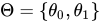
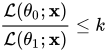
引理。 (奈曼-皮爾遜引理)令 X 1 , … , X n {\displaystyle X_{1},\dotsc ,X_{n}} f ( x ; θ ) {\displaystyle f(x;\theta )} θ {\displaystyle \theta } Θ = { θ 0 , θ 1 } {\displaystyle \Theta =\{\theta _{0},\theta _{1}\}} L ( ⋅ ) {\displaystyle {\mathcal {L}}(\cdot )} φ {\displaystyle \varphi } R = { ( x 1 , … , x n ) : L ( θ 0 ; x ) L ( θ 1 ; x ) ≤ k } {\displaystyle R=\left\{(x_{1},\dotsc ,x_{n}):{\frac {{\mathcal {L}}(\theta _{0};\mathbf {x} )}{{\mathcal {L}}(\theta _{1};\mathbf {x} )}}\leq k\right\}} α {\displaystyle \alpha } H 0 : θ = θ 0 vs. H 1 : θ = θ 1 {\displaystyle H_{0}:\theta =\theta _{0}\quad {\text{vs.}}\quad H_{1}:\theta =\theta _{1}} k {\displaystyle k} α {\displaystyle \alpha }
證明。 讓我們首先考慮基礎分佈是連續的情況。 假設 φ {\displaystyle \varphi } α {\displaystyle \alpha } ,作為 UMP 檢驗的“大小”要求立即得到滿足。因此,只需證明 φ {\displaystyle \varphi }
請注意,在這種情況下,“ Θ 1 {\displaystyle \Theta _{1}} { θ 1 } {\displaystyle \{\theta _{1}\}} R ∗ ≠ R {\displaystyle R^{*}\neq R} π ψ ( θ 0 ) ≤ α {\displaystyle {\color {purple}\pi _{\psi }(\theta _{0})\leq \alpha }} ψ {\displaystyle \psi } π φ ( θ 1 ) ≥ π ψ ( θ 1 ) {\displaystyle \pi _{\varphi }(\theta _{1})\geq \pi _{\psi }(\theta _{1})}
Since π φ ( θ 1 ) − π ψ ( θ 1 ) = P θ 1 ( ( X 1 , … , X n ) ∈ R ) − P θ 1 ( ( X 1 , … , X n ) ∈ R ∗ ) = ∫ ⋯ ∫ R L ( θ 1 ; x ) d x n ⋯ d x 1 − ∫ ⋯ ∫ R ∗ L ( θ 1 ; x ) d x n ⋯ d x 1 = ∫ ⋯ ∫ R L ( θ 1 ; x ) d x n ⋯ d x 1 − ∫ ⋯ ∫ R ∩ R ∗ L ( θ 1 ; x ) d x n ⋯ d x 1 − ( ∫ ⋯ ∫ R ∗ L ( θ 1 ; x ) d x n ⋯ d x 1 − ∫ ⋯ ∫ R ∩ R ∗ L ( θ 1 ; x ) d x n ⋯ d x 1 ) = ∫ ⋯ ∫ R ∖ R ∗ L ( θ 1 ; x ) d x n ⋯ d x 1 − ∫ ⋯ ∫ R ∗ ∖ R L ( θ 1 ; x ) d x n ⋯ d x 1 ≥ 1 k ∫ ⋯ ∫ R ∖ R ∗ L ( θ 0 ; x ) d x n ⋯ d x 1 − 1 k ∫ ⋯ ∫ R ∗ ∖ R L ( θ 0 ; x ) d x n ⋯ d x 1 ( In R , L ( θ 1 ; x ) ≥ 1 k L ( θ 0 ; x ) . In R c , L ( θ 1 ; x ) < 1 k L ( θ 0 ; x ) ⟺ − L ( θ 1 ; x ) > − 1 k L ( θ 0 ; x ) ) = 1 k ∫ ⋯ ∫ R ∖ R ∗ L ( θ 0 ; x ) d x n ⋯ d x 1 + 1 k ∫ ⋯ ∫ R ∩ R ∗ L ( θ 0 ; x ) d x n ⋯ d x 1 − ( 1 k ∫ ⋯ ∫ R ∗ ∖ R L ( θ 0 ; x ) d x n ⋯ d x 1 + 1 k ∫ ⋯ ∫ R ∩ R ∗ L ( θ 0 ; x ) d x n ⋯ d x 1 ) = 1 k ∫ ⋯ ∫ R L ( θ 0 ; x ) d x n ⋯ d x 1 − 1 k ∫ ⋯ ∫ R ∗ L ( θ 0 ; x ) d x n ⋯ d x 1 = 1 k ( P θ 0 ( ( X 1 , … , X n ) ∈ R ) ⏟ = α − P θ 0 ( ( X 1 , … , X n ) ∈ R ∗ ) ⏟ ≤ α ) ≥ 1 k ( α − α ) = 0 , {\displaystyle {\begin{aligned}\pi _{\varphi }(\theta _{1})-\pi _{\psi }(\theta _{1})&=\mathbb {P} _{\theta _{1}}((X_{1},\dotsc ,X_{n})\in R)-\mathbb {P} _{\theta _{1}}((X_{1},\dotsc ,X_{n})\in R^{*})\\&=\int \dotsi \int _{R}^{}{\mathcal {L}}(\theta _{1};\mathbf {x} )\,dx_{n}\cdots \,dx_{1}-\int \dotsi \int _{R^{*}}^{}{\mathcal {L}}(\theta _{1};\mathbf {x} )\,dx_{n}\cdots \,dx_{1}\\&={\color {blue}\int \dotsi \int _{R}^{}{\mathcal {L}}(\theta _{1};\mathbf {x} )\,dx_{n}\cdots \,dx_{1}-\int \dotsi \int _{R\cap R^{*}}^{}{\mathcal {L}}(\theta _{1};\mathbf {x} )\,dx_{n}\cdots \,dx_{1}}-\left({\color {red}\int \dotsi \int _{R^{*}}^{}{\mathcal {L}}(\theta _{1};\mathbf {x} )\,dx_{n}\cdots \,dx_{1}-\int \dotsi \int _{R\cap R^{*}}^{}{\mathcal {L}}(\theta _{1};\mathbf {x} )\,dx_{n}\cdots \,dx_{1}}\right)\\&={\color {blue}\int \dotsi \int _{R\setminus R^{*}}^{}{\mathcal {L}}(\theta _{1};\mathbf {x} )\,dx_{n}\cdots \,dx_{1}}-{\color {red}\int \dotsi \int _{R^{*}\setminus R}^{}{\mathcal {L}}(\theta _{1};\mathbf {x} )\,dx_{n}\cdots \,dx_{1}}\\&\geq {\color {blue}{\frac {1}{k}}}\int \dotsi \int _{R\setminus R^{*}}^{}{\color {blue}{\mathcal {L}}(\theta _{0};\mathbf {x} )}\,dx_{n}\cdots \,dx_{1}-{\color {red}{\frac {1}{k}}}\int \dotsi \int _{R^{*}\setminus R}^{}{\color {red}{\mathcal {L}}(\theta _{0};\mathbf {x} )}\,dx_{n}\cdots \,dx_{1}\qquad ({\text{In }}R,{\color {blue}{\mathcal {L}}(\theta _{1};\mathbf {x} )\geq {\frac {1}{k}}{\mathcal {L}}(\theta _{0};\mathbf {x} )}.{\text{ In }}R^{c},{\mathcal {L}}(\theta _{1};\mathbf {x} )<{\frac {1}{k}}{\mathcal {L}}(\theta _{0};\mathbf {x} )\iff {\color {red}-{\mathcal {L}}(\theta _{1};\mathbf {x} )>-{\frac {1}{k}}{\mathcal {L}}(\theta _{0};\mathbf {x} )})\\&={\frac {1}{k}}\int \dotsi \int _{R\setminus R^{*}}^{}{\mathcal {L}}(\theta _{0};\mathbf {x} )\,dx_{n}\cdots \,dx_{1}+{\frac {1}{k}}\int \dotsi \int _{R\cap R^{*}}^{}{\mathcal {L}}(\theta _{0};\mathbf {x} )\,dx_{n}\cdots \,dx_{1}-\left({\frac {1}{k}}\int \dotsi \int _{R^{*}\setminus R}^{}{\mathcal {L}}(\theta _{0};\mathbf {x} )\,dx_{n}\cdots \,dx_{1}+{\frac {1}{k}}\int \dotsi \int _{R\cap R^{*}}^{}{\mathcal {L}}(\theta _{0};\mathbf {x} )\,dx_{n}\cdots \,dx_{1}\right)\\&={\frac {1}{k}}\int \dotsi \int _{R}^{}{\mathcal {L}}(\theta _{0};\mathbf {x} )\,dx_{n}\cdots \,dx_{1}-{\frac {1}{k}}\int \dotsi \int _{R^{*}}^{}{\mathcal {L}}(\theta _{0};\mathbf {x} )\,dx_{n}\cdots \,dx_{1}\\&={\frac {1}{k}}{\bigg (}{\color {brown}\underbrace {\mathbb {P} _{\theta _{0}}((X_{1},\dotsc ,X_{n})\in R)} _{=\alpha }}-{\color {purple}\underbrace {\mathbb {P} _{\theta _{0}}((X_{1},\dotsc ,X_{n})\in R^{*})} _{\leq \alpha }}{\bigg )}\\&\geq {\frac {1}{k}}(\alpha -\alpha )=0,\end{aligned}}} π ϕ ( θ 1 ) ≥ π ψ ( θ 1 ) {\displaystyle \pi _{\phi }(\theta _{1})\geq \pi _{\psi }(\theta _{1})}
對於底層分佈為離散的情況,證明非常類似(只需將積分替換為求和),因此省略。
◻ {\displaystyle \Box }
即使奈曼-皮爾遜引理中涉及的假設很簡單,在一些條件下,我們可以使用該引理來構造一個UMP檢驗,以檢驗複合 複合 H 0 : θ ≤ θ 0 vs. H 1 : θ > θ 0 {\displaystyle H_{0}:\theta \leq \theta _{0}\quad {\text{vs.}}\quad H_{1}:\theta >\theta _{0}}
找到一個MP檢驗 φ {\displaystyle \varphi } α {\displaystyle \alpha } H 0 : θ = θ 0 vs. H 1 : θ = θ 1 > θ 0 {\displaystyle H_{0}:\theta =\theta _{0}\quad {\text{vs.}}\quad H_{1}:\theta =\theta _{1}>\theta _{0}} θ 1 {\displaystyle \theta _{1}} θ 1 > θ 0 {\displaystyle \theta _{1}>\theta _{0}}
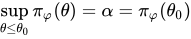
如果拒絕域 R {\displaystyle R} θ 1 {\displaystyle \theta _{1}} φ {\displaystyle \varphi } θ ∈ Θ 1 = { ϑ : ϑ > θ 0 } {\displaystyle \theta \in \Theta _{1}=\{\vartheta :\vartheta >\theta _{0}\}} φ {\displaystyle \varphi } α {\displaystyle \alpha } H 0 : θ = θ 0 vs. H 1 : θ > θ 0 {\displaystyle H_{0}:\theta =\theta _{0}\quad {\text{vs.}}\quad H_{1}:\theta >\theta _{0}} 如果我們能進一步證明 sup θ ≤ θ 0 π φ ( θ ) = α = π φ ( θ 0 ) {\displaystyle \sup _{\theta \leq \theta _{0}}\pi _{\varphi }(\theta )=\alpha =\pi _{\varphi }(\theta _{0})} φ {\displaystyle \varphi } α {\displaystyle \alpha } H 0 : θ ≤ θ {\displaystyle H_{0}:\theta \leq \theta } H 0 : θ = θ 0 {\displaystyle H_{0}:\theta =\theta _{0}} H 0 : θ ≤ θ 0 {\displaystyle H_{0}:\theta \leq \theta _{0}} H 1 {\displaystyle H_{1}} φ {\displaystyle \varphi } φ {\displaystyle \varphi } H 1 {\displaystyle H_{1}} φ {\displaystyle \varphi } H 0 {\displaystyle H_{0}} φ {\displaystyle \varphi } α {\displaystyle \alpha } H 0 : θ ≤ θ 0 vs. H 1 : θ > θ 0 {\displaystyle H_{0}:\theta \leq \theta _{0}\quad {\text{vs.}}\quad H_{1}:\theta >\theta _{0}} 對於測試 H 0 : θ ≥ θ 0 vs. H 1 : θ < θ 0 {\displaystyle H_{0}:\theta \geq \theta _{0}\quad {\text{vs.}}\quad H_{1}:\theta <\theta _{0}} H 0 : θ = θ 0 vs. H 1 : θ ≠ θ 0 {\displaystyle H_{0}:\theta =\theta _{0}\quad {\text{vs.}}\quad H_{1}:\theta \neq \theta _{0}}
當然,當步驟 3 中的條件成立而步驟 2 中的條件不成立時,步驟 1 中的檢驗 φ {\displaystyle \varphi } α {\displaystyle \alpha } H 0 : θ ≤ θ 0 vs. H 1 : θ = θ 1 {\displaystyle H_{0}:\theta \leq \theta _{0}\quad {\text{vs.}}\quad H_{1}:\theta =\theta _{1}} θ 1 {\displaystyle \theta _{1}} θ 0 {\displaystyle \theta _{0}} H 1 {\displaystyle H_{1}} H 0 {\displaystyle H_{0}}
示例。 令 X 1 , … , X 10 {\displaystyle X_{1},\dotsc ,X_{10}} N ( μ , 1 ) {\displaystyle {\mathcal {N}}(\mu ,1)}
(a) 構造一個大小為 0.05 的MP檢驗 φ {\displaystyle \varphi } H 0 : μ = 20 vs. H 1 : μ = 21 {\displaystyle H_{0}:\mu =20\quad {\text{vs.}}\quad H_{1}:\mu =21}
(b) 因此,證明檢驗 φ {\displaystyle \varphi } H 0 : μ = 20 vs. H 1 : μ > 20 {\displaystyle H_{0}:\mu =20\quad {\text{vs.}}\quad H_{1}:\mu >20}
(c) 因此,證明檢驗 φ {\displaystyle \varphi } H 0 : μ ≤ 20 vs. H 1 : μ > 20 {\displaystyle H_{0}:\mu \leq 20\quad {\text{vs.}}\quad H_{1}:\mu >20}
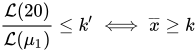
Solution L ( 20 ) L ( 21 ) = ( 1 2 π ( 1 ) ) 10 ∏ i = 1 10 exp ( − ( x i − 20 ) 2 2 ) ( 1 2 π ( 1 ) ) 10 ∏ i = 1 10 exp ( − ( x i − 21 ) 2 2 ) = exp ( − 1 2 ∑ i = 1 10 [ ( x i − 20 ) 2 − ( x i − 21 ) 2 ] ) = exp ( − 1 2 ∑ i = 1 10 [ x i 2 − 40 x i + 400 − x i 2 + 42 x i − 441 ] ) = exp ( − 1 2 ∑ i = 1 10 [ 2 x i − 41 ] ) = exp ( 41 2 − ∑ i = 1 10 x i ) . {\displaystyle {\frac {{\mathcal {L}}(20)}{{\mathcal {L}}(21)}}={\frac {{\cancel {\left({\frac {1}{\sqrt {2\pi (1)}}}\right)^{10}}}\prod _{i=1}^{10}\exp \left(-{\frac {(x_{i}-20)^{2}}{2}}\right)}{{\cancel {\left({\frac {1}{\sqrt {2\pi (1)}}}\right)^{10}}}\prod _{i=1}^{10}\exp \left(-{\frac {(x_{i}-21)^{2}}{2}}\right)}}=\exp \left(-{\frac {1}{2}}\sum _{i=1}^{10}{\big [}(x_{i}-20)^{2}-(x_{i}-21)^{2}{\big ]}\right)=\exp \left(-{\frac {1}{2}}\sum _{i=1}^{10}{\big [}{\cancel {x_{i}^{2}}}-40x_{i}+400{\cancel {-x_{i}^{2}}}+42x_{i}-441{\big ]}\right)=\exp \left(-{\frac {1}{2}}\sum _{i=1}^{10}{\big [}2x_{i}-41{\big ]}\right)=\exp \left({\frac {41}{2}}-\sum _{i=1}^{10}x_{i}\right).} L ( 20 ) L ( 21 ) ≤ k ′ ⟺ exp ( 41 2 − 10 x ¯ ) ≤ k ′ ⟺ − 10 x ¯ ≤ k ″ ⟺ x ¯ ≥ k {\displaystyle {\frac {{\mathcal {L}}(20)}{{\mathcal {L}}(21)}}\leq k'\iff \exp \left({\frac {41}{2}}-10{\overline {x}}\right)\leq k'\iff -10{\overline {x}}\leq k''\iff {\overline {x}}\geq k} k , k ′ , k ″ {\displaystyle k,k',k''} k {\displaystyle k} 0.05 = P μ = 20 ( X ¯ ≥ k ) = P μ = 20 ( X ¯ − 20 1 / 10 ≥ k − 20 1 / 10 ) = P ( Z ≥ 10 ( k − 20 ) ) . {\displaystyle 0.05=\mathbb {P} _{\mu =20}({\overline {X}}\geq k)=\mathbb {P} _{\mu =20}\left({\frac {{\overline {X}}-20}{1/{\sqrt {10}}}}\geq {\frac {k-20}{1/{\sqrt {10}}}}\right)=\mathbb {P} (Z\geq {\sqrt {10}}(k-20)).} Z ∼ N ( 0 , 1 ) {\displaystyle Z\sim {\mathcal {N}}(0,1)} 10 ( k − 20 ) ≈ 1.64 ⟹ k ≈ 20.51861 {\displaystyle {\sqrt {10}}(k-20)\approx 1.64\implies k\approx 20.51861} R = { ( x 1 , … , x n ) : x ¯ ≥ 20.51861 } , {\displaystyle R=\{(x_{1},\dotsc ,x_{n}):{\overline {x}}\geq 20.51861\},} φ {\displaystyle \varphi } R {\displaystyle R} H 0 : μ = 20 vs. μ = 21 {\displaystyle H_{0}:\mu =20\quad {\text{vs.}}\quad \mu =21}
(b)
(c)
現在,讓我們考慮另一個例子,其中基礎分佈是離散的。
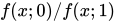
例: 令 X {\displaystyle X} θ x 1 2 3 4 5 6 7 8 0 f ( x ; θ ) 0 0.02 0.02 0.02 0.02 0.02 0.02 0.88 1 f ( x ; θ ) 0.01 0.02 0.03 0.04 0.05 0 0.06 0.79 {\displaystyle {\begin{array}{c|ccccccccc}\theta &x&1&2&3&4&5&6&7&8\\\hline 0&f(x;\theta )&0&0.02&0.02&0.02&0.02&0.02&0.02&0.88\\1&f(x;\theta )&0.01&0.02&0.03&0.04&0.05&0&0.06&0.79\\\end{array}}} Θ = { 0 , 1 } {\displaystyle \Theta =\{0,1\}} 單一觀測值 x {\displaystyle x} H 0 : θ = 0 vs. H 1 : θ = 1 {\displaystyle H_{0}:\theta =0\quad {\text{vs.}}\quad H_{1}:\theta =1}
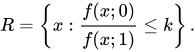
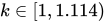
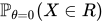
Solution f ( x ; 0 ) / f ( x ; 1 ) {\displaystyle f(x;0)/f(x;1)} x {\displaystyle x} x 1 2 3 4 5 6 7 8 f ( x ; 0 ) f ( x ; 1 ) 0 1 0.667 0.5 0.4 undefined 0.333 1.114 {\displaystyle {\begin{array}{ccccccccc}x&1&2&3&4&5&6&7&8\\\hline {\frac {f(x;0)}{f(x;1)}}&0&1&0.667&0.5&0.4&{\text{undefined}}&0.333&1.114\end{array}}} x 1 7 5 4 3 2 8 6 f ( x ; 0 ) f ( x ; 1 ) 0 0.333 0.4 0.5 0.667 1 1.114 undefined {\displaystyle {\begin{array}{ccccccccc}x&1&7&5&4&3&2&8&6\\\hline {\frac {f(x;0)}{f(x;1)}}&0&0.333&0.4&0.5&0.667&1&1.114&{\text{undefined}}\end{array}}} H 0 : θ = 0 vs. H 1 : θ = 1 {\displaystyle H_{0}:\theta =0\quad {\text{vs.}}\quad H_{1}:\theta =1} R = { x : f ( x ; 0 ) f ( x ; 1 ) ≤ k } . {\displaystyle R=\left\{x:{\frac {f(x;0)}{f(x;1)}}\leq k\right\}.} R {\displaystyle R} 0.1 = α ( 0 ) = P θ = 0 ( X ∈ R ) . {\displaystyle 0.1=\alpha (0)=\mathbb {P} _{\theta =0}(X\in R).} P θ = 0 ( X = 1 ) + P θ = 0 ( X = 7 ) + P θ = 0 ( X = 5 ) + P θ = 0 ( X = 4 ) + P θ = 0 ( X = 3 ) + P θ = 0 ( X = 2 ) = 0 + 0.02 + 0.02 + 0.02 + 0.02 + 0.02 = 0.1. {\displaystyle \mathbb {P} _{\theta =0}(X=1)+\mathbb {P} _{\theta =0}(X=7)+\mathbb {P} _{\theta =0}(X=5)+\mathbb {P} _{\theta =0}(X=4)+\mathbb {P} _{\theta =0}(X=3)+\mathbb {P} _{\theta =0}(X=2)=0+0.02+0.02+0.02+0.02+0.02=0.1.} k ∈ [ 1 , 1.114 ) {\displaystyle k\in [1,1.114)} { x : f ( x ; 0 ) f ( x ; 1 ) ≤ k } = { 1 , 7 , 5 , 4 , 3 , 2 } . {\displaystyle \left\{x:{\frac {f(x;0)}{f(x;1)}}\leq k\right\}=\{1,7,5,4,3,2\}.}
練習: 計算上述檢驗的第二類錯誤機率。
解決方案
機率為 β ( 1 ) = P θ = 1 ( X ∈ R c ) = P θ = 1 ( X = 8 ) + P θ = 1 ( X = 6 ) = 0.79. {\displaystyle \beta (1)=\mathbb {P} _{\theta =1}(X\in R^{c})=\mathbb {P} _{\theta =1}(X=8)+\mathbb {P} _{\theta =1}(X=6)=0.79.}
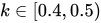
使用 Neyman-Pearson 引理構建另一個大小為 0.05 的最優檢驗來檢驗 H 0 : θ = 0 vs. H 1 : θ = 1 {\displaystyle H_{0}:\theta =0\quad {\text{vs.}}\quad H_{1}:\theta =1}
之前,我們建議使用 Neyman-Pearson 引理來構建檢驗簡單零假設與簡單備擇假設的最優檢驗。然而,當假設是複合的時候,我們可能無法使用 Neyman-Pearson 引理。因此,在接下來的內容中,我們將提供一個通用的方法來構建任何假設檢驗,不受限於簡單假設。但我們應該注意到,構建的檢驗不一定是均勻最優檢驗。
我們已經提到,假設檢驗與置信區間之間存在相似之處。在本節中,我們將介紹一個定理,該定理建議如何從置信區間(或更一般地,置信 集
定理。 對於每個 θ 0 ∈ Θ {\displaystyle \theta _{0}\in \Theta } R ( θ 0 ) {\displaystyle R(\theta _{0})} α {\displaystyle \alpha } H 0 : θ = θ 0 vs. H 1 : θ ≠ θ 0 {\displaystyle H_{0}:\theta =\theta _{0}\quad {\text{vs.}}\quad H_{1}:\theta \neq \theta _{0}} x 1 , … , x n {\displaystyle x_{1},\dotsc ,x_{n}} X 1 , … , X n {\displaystyle X_{1},\dotsc ,X_{n}} x = ( x 1 , … , x n ) {\displaystyle \mathbf {x} =(x_{1},\dotsc ,x_{n})} X = ( X 1 , … , X n ) {\displaystyle \mathbf {X} =(X_{1},\dotsc ,X_{n})}
定義一個集合 C ( x ) = { θ 0 : x ∈ R ( θ 0 ) c } . {\displaystyle C(\mathbf {x} )=\{\theta _{0}:\mathbf {x} \in R(\theta _{0})^{c}\}.} C ( X ) {\displaystyle C(\mathbf {X} )} 1 − α {\displaystyle 1-\alpha } θ 0 {\displaystyle \theta _{0}}
相反,設集合 C ∗ ( X ) {\displaystyle C^{*}(\mathbf {X} )} θ {\displaystyle \theta } 1 − α {\displaystyle 1-\alpha } θ 0 ∈ Θ {\displaystyle \theta _{0}\in \Theta } R ( θ 0 ) = { x : θ 0 ∉ C ∗ ( x ) } . {\displaystyle R(\theta _{0})=\{\mathbf {x} :\theta _{0}\notin C^{*}(\mathbf {x} )\}.} R ( θ 0 ) {\displaystyle R(\theta _{0})} H 0 : θ = θ 0 vs. H 1 : θ ≠ θ 0 {\displaystyle H_{0}:\theta =\theta _{0}\quad {\text{vs.}}\quad H_{1}:\theta \neq \theta _{0}} α {\displaystyle \alpha }
↑ 如果 Θ 0 {\displaystyle \Theta _{0}} ↑ 因此,一個自然衡量假設檢驗“好壞”的指標是它的“誤差大小”。我們將在本章後面討論這些。 ↑ 這是因為在" θ ∈ Θ 0 {\displaystyle \theta \in \Theta _{0}} H 0 {\displaystyle H_{0}} ↑ 即使對於 Θ 0 {\displaystyle \Theta _{0}} Θ 0 {\displaystyle \Theta _{0}} 不能很好地控制 





































































































































![{\displaystyle {\frac {{\mathcal {L}}(20)}{{\mathcal {L}}(21)}}={\frac {{\cancel {\left({\frac {1}{\sqrt {2\pi (1)}}}\right)^{10}}}\prod _{i=1}^{10}\exp \left(-{\frac {(x_{i}-20)^{2}}{2}}\right)}{{\cancel {\left({\frac {1}{\sqrt {2\pi (1)}}}\right)^{10}}}\prod _{i=1}^{10}\exp \left(-{\frac {(x_{i}-21)^{2}}{2}}\right)}}=\exp \left(-{\frac {1}{2}}\sum _{i=1}^{10}{\big [}(x_{i}-20)^{2}-(x_{i}-21)^{2}{\big ]}\right)=\exp \left(-{\frac {1}{2}}\sum _{i=1}^{10}{\big [}{\cancel {x_{i}^{2}}}-40x_{i}+400{\cancel {-x_{i}^{2}}}+42x_{i}-441{\big ]}\right)=\exp \left(-{\frac {1}{2}}\sum _{i=1}^{10}{\big [}2x_{i}-41{\big ]}\right)=\exp \left({\frac {41}{2}}-\sum _{i=1}^{10}x_{i}\right).}](https://wikimedia.org/api/rest_v1/media/math/render/svg/e452d2e3960d4fa864fdc616434f2acf2b862927)

















![{\displaystyle {\frac {{\mathcal {L}}(20)}{{\mathcal {L}}(\mu _{1})}}=\exp \left(-{\frac {1}{2}}\sum _{i=1}^{10}{\big [}(x_{i}-20)^{2}-(x_{i}-\mu _{1})^{2}{\big ]}\right)=\exp \left(-{\frac {1}{2}}\sum _{i=1}^{10}{\big [}{\cancel {x_{i}^{2}}}-40x_{i}+400{\cancel {-x_{i}^{2}}}+2\mu _{1}x_{i}-\mu _{1}^{2}{\big ]}\right)=\exp \left(-{\frac {1}{2}}\sum _{i=1}^{10}{\big [}(2\mu _{1}-40)x_{i}+400-\mu _{1}^{2}{\big ]}\right)=\exp \left({\frac {\mu _{1}^{2}-400}{2}}-(\mu _{1}-20)\sum _{i=1}^{10}x_{i}\right).}](https://wikimedia.org/api/rest_v1/media/math/render/svg/f5290fd44e8b64cd58dfd31e332b93c29f75ad04)











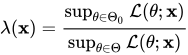



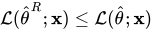



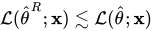









![{\displaystyle [-1,1]}](https://wikimedia.org/api/rest_v1/media/math/render/svg/51e3b7f14a6f70e614728c583409a0b9a8b9de01)
![{\displaystyle 0\in [-1,1]}](https://wikimedia.org/api/rest_v1/media/math/render/svg/5123cbf77c54b612d0cb810aa4931e29da199475)


