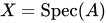
交換環 A {\displaystyle A} A {\displaystyle A} 譜 ,記為 Spec ( A ) {\displaystyle \operatorname {Spec} (A)}
在 A {\displaystyle A} A {\displaystyle A} 冪零根 。給定任何理想 a {\displaystyle {\mathfrak {a}}} A {\displaystyle A} a {\displaystyle {\mathfrak {a}}} a {\displaystyle {\sqrt {\mathfrak {a}}}} x ∈ a {\displaystyle x\in {\sqrt {\mathfrak {a}}}} x n ∈ a {\displaystyle x^{n}\in {\mathfrak {a}}} n {\displaystyle n}
命題 A.14。
令
i , j ◃ A {\displaystyle {\mathfrak {i}},{\mathfrak {j}}\triangleleft A} 。
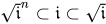
(i) i n = i {\displaystyle {\sqrt {{\mathfrak {i}}^{n}}}={\sqrt {\mathfrak {i}}}}
(ii) i j = i ∩ j = i ∩ j {\displaystyle {\sqrt {{\mathfrak {i}}{\mathfrak {j}}}}={\sqrt {{\mathfrak {i}}\cap {\mathfrak {j}}}}={\sqrt {\mathfrak {i}}}\cap {\sqrt {\mathfrak {j}}}}
證明。 常規。 ◻ {\displaystyle \square }
練習。
一個環只有一個素理想當且僅當它的冪零根是極大的。
練習。
有限環中的每個素理想都是極大的。
命題 A.2。
令
A ≠ 0 {\displaystyle A\neq 0} 為一個環。如果
A {\displaystyle A} 中的每個主理想都是素理想,則
A {\displaystyle A} 是一個域。
證明. 令 0 ≠ x ∈ A {\displaystyle 0\neq x\in A} x 2 {\displaystyle x^{2}} ( x 2 ) {\displaystyle (x^{2})} x ∈ ( x 2 ) {\displaystyle x\in (x^{2})} x = a x 2 {\displaystyle x=ax^{2}} ( 0 ) {\displaystyle (0)} A {\displaystyle A} 1 = a x {\displaystyle 1=ax} ◻ {\displaystyle \square }
引理。
令
p ◃ A {\displaystyle {\mathfrak {p}}\triangleleft A} 。則
p {\displaystyle {\mathfrak {p}}} 是素理想當且僅當
p ⊊ a ◃ A , p ⊊ b ◃ A {\displaystyle {\mathfrak {p}}\subsetneq {\mathfrak {a}}\triangleleft A,{\mathfrak {p}}\subsetneq {\mathfrak {b}}\triangleleft A} a b ⊄ p {\displaystyle {\mathfrak {a}}{\mathfrak {b}}\not \subset {\mathfrak {p}}}
證明。 ( ⇒ {\displaystyle \Rightarrow } ⇐ {\displaystyle \Leftarrow } x ¯ {\displaystyle {\overline {x}}} x ∈ A {\displaystyle x\in A} A / p {\displaystyle A/{\mathfrak {p}}} a ¯ {\displaystyle {\overline {a}}} a ¯ b ¯ = 0 {\displaystyle {\overline {a}}{\overline {b}}=0} b ∈ A ∖ p {\displaystyle b\in A\backslash {\mathfrak {p}}} a = ( a , p ) {\displaystyle {\mathfrak {a}}=(a,{\mathfrak {p}})} b = ( b , p ) {\displaystyle {\mathfrak {b}}=(b,{\mathfrak {p}})} a b = a b + p ⊂ p {\displaystyle {\mathfrak {a}}{\mathfrak {b}}=ab+{\mathfrak {p}}\subset {\mathfrak {p}}} b {\displaystyle {\mathfrak {b}}} p {\displaystyle {\mathfrak {p}}} a ⊂ p {\displaystyle {\mathfrak {a}}\subset {\mathfrak {p}}} a ¯ = 0 {\displaystyle {\overline {a}}=0} ◻ {\displaystyle \square }
定理 A.11 (乘法迴避)。
令
S ⊂ A {\displaystyle S\subset A} 為一個乘法系統。如果
a ◃ A {\displaystyle {\mathfrak {a}}\triangleleft A} 與
S {\displaystyle S} 不交,則存在一個素理想
p ⊃ a {\displaystyle {\mathfrak {p}}\supset {\mathfrak {a}}} ,它是在與
S {\displaystyle S} 不交的理想中最大的。
證明。 令 m {\displaystyle {\mathfrak {m}}} S {\displaystyle S} a {\displaystyle {\mathfrak {a}}} b {\displaystyle {\mathfrak {b}}} m {\displaystyle {\mathfrak {m}}} m {\displaystyle {\mathfrak {m}}} a ∈ a ∩ S {\displaystyle a\in {\mathfrak {a}}\cap S} b ∈ b ∩ S {\displaystyle b\in {\mathfrak {b}}\cap S} S {\displaystyle S} a b ∈ S {\displaystyle ab\in S} a b ⊄ m {\displaystyle {\mathfrak {a}}{\mathfrak {b}}\not \subset {\mathfrak {m}}} m {\displaystyle {\mathfrak {m}}} ◻ {\displaystyle \square }
注意,當 S {\displaystyle S}
練習。
如果一個整環 A 中的每個素理想都是主理想,則它是一個主理想整環。
Goldman 域 是一個其分數域 K {\displaystyle K} A {\displaystyle A} K 始終具有 A [ f − 1 ] {\displaystyle A[f^{-1}]} K = A [ s 1 − 1 , . . . , s n − 1 ] {\displaystyle K=A[s_{1}^{-1},...,s_{n}^{-1}]} s = s 1 . . . s n {\displaystyle s=s_{1}...s_{n}} K = A [ s − 1 ] {\displaystyle K=A[s^{-1}]}
引理。
令
A {\displaystyle A} 是一個分數域為
K {\displaystyle K} 的域,且
0 ≠ f ∈ A {\displaystyle 0\neq f\in A} 。那麼
K = A [ f − 1 ] {\displaystyle K=A[f^{-1}]} 當且僅當
A {\displaystyle A} 的每個非零素理想包含
f {\displaystyle f} 。
證明。 ( ⇐ {\displaystyle \Leftarrow } 0 ≠ x ∈ A {\displaystyle 0\neq x\in A} S = { f n | n ≥ 0 } {\displaystyle S=\{f^{n}|n\geq 0\}} ( x ) {\displaystyle (x)} S {\displaystyle S} S {\displaystyle S} ( x ) {\displaystyle (x)} f {\displaystyle f} y x = f n {\displaystyle yx=f^{n}} y x {\displaystyle yx} x {\displaystyle x} A [ f − 1 ] . {\displaystyle A[f^{-1}].} ⇒ {\displaystyle \Rightarrow } p {\displaystyle {\mathfrak {p}}} s {\displaystyle s} 1 / s = a / f n {\displaystyle 1/s=a/f^{n}} f n = a s ∈ p {\displaystyle f^{n}=as\in {\mathfrak {p}}} f ∈ p {\displaystyle f\in {\mathfrak {p}}} ◻ {\displaystyle \square }
如果一個素理想 p ∈ Spec ( A ) {\displaystyle {\mathfrak {p}}\in \operatorname {Spec} (A)} A / p {\displaystyle A/{\mathfrak {p}}} p {\displaystyle {\mathfrak {p}}} Goldman 理想 。
定理 A.21.
設
A {\displaystyle A} 為一個環,
a ◃ A {\displaystyle {\mathfrak {a}}\triangleleft A} 。則
a {\displaystyle {\sqrt {\mathfrak {a}}}} 是包含
a {\displaystyle {\mathfrak {a}}} 的所有最小 Goldman 理想在
A 中的交集。
證明。 由理想對應關係,只需證明情況 a = a = 0 {\displaystyle {\mathfrak {a}}={\sqrt {\mathfrak {a}}}=0} 0 ≠ f ∈ A {\displaystyle 0\neq f\in A} S = { f n | n ≥ 0 } {\displaystyle S=\{f^{n}|n\geq 0\}} f {\displaystyle f} ( 0 ) {\displaystyle {\sqrt {(0)}}} g {\displaystyle {\mathfrak {g}}} f {\displaystyle f} p ◃ A / g {\displaystyle {\mathfrak {p}}\triangleleft A/{\mathfrak {g}}} f ∈ p {\displaystyle f\in {\mathfrak {p}}} p {\displaystyle {\mathfrak {p}}} S {\displaystyle S} A / g {\displaystyle A/{\mathfrak {g}}} f {\displaystyle f} g {\displaystyle {\mathfrak {g}}} ◻ {\displaystyle \square }
在某些環中,戈德曼理想是極大的;這將在下一節中討論。另一方面,
引理。
設
a ◃ A {\displaystyle {\mathfrak {a}}\triangleleft A} 。那麼
a {\displaystyle {\mathfrak {a}}} 是一個戈德曼理想,當且僅當它是在
A [ X ] {\displaystyle A[X]} 中一個極大理想的收縮。
定理。
證明。 清楚。 ◻ {\displaystyle \square }
滿足定理中等價條件的環稱為Hilbert-Jacobson 環 。
引理。
令
A ⊂ B {\displaystyle A\subset B} 是域,使得
B {\displaystyle B} 在
A {\displaystyle A} 上是代數的且型別有限。那麼
A {\displaystyle A} 是一個 Goldman 域當且僅當
B {\displaystyle B} 是一個 Goldman 域。
證明。 令 K ⊂ L {\displaystyle K\subset L} A {\displaystyle A} B {\displaystyle B} ◻ {\displaystyle \square }
定理 A.19。
令
A {\displaystyle A} 是一個 Hilbert-Jacobson 環。那麼
A [ X ] {\displaystyle A[X]} 是一個 Hilbert-Jacobson 環。
證明。 令 q ◃ A [ X ] {\displaystyle {\mathfrak {q}}\triangleleft A[X]} p = q ∩ A {\displaystyle {\mathfrak {p}}={\mathfrak {q}}\cap A} A / p {\displaystyle A/{\mathfrak {p}}} A [ X ] / q {\displaystyle A[X]/{\mathfrak {q}}} A [ X ] / q {\displaystyle A[X]/{\mathfrak {q}}} A {\displaystyle A} p {\displaystyle {\mathfrak {p}}} A / p {\displaystyle A/{\mathfrak {p}}} A [ X ] / q {\displaystyle A[X]/{\mathfrak {q}}} q {\displaystyle {\mathfrak {q}}} ◻ {\displaystyle \square }
待辦事項 A / p {\displaystyle A/{\mathfrak {p}}}
定理 A.5 (素理想回避)。
令
p 1 , . . . , p r ◃ A {\displaystyle {\mathfrak {p}}_{1},...,{\mathfrak {p}}_{r}\triangleleft A} 是理想,最多兩個不是素理想,並且
a ◃ A {\displaystyle {\mathfrak {a}}\triangleleft A} 。如果
a ⊂ ⋃ 1 r p i {\displaystyle {\mathfrak {a}}\subset \bigcup _{1}^{r}{\mathfrak {p}}_{i}} ,那麼
a ⊂ p i {\displaystyle {\mathfrak {a}}\subset {\mathfrak {p}}_{i}} 對於某些
i {\displaystyle {\mathfrak {i}}} 成立。
Proof. We shall induct on r {\displaystyle r} a ∈ a {\displaystyle a\in {\mathfrak {a}}} p i {\displaystyle {\mathfrak {p}}_{i}} r = 1 {\displaystyle r=1} a ∈ a {\displaystyle a\in {\mathfrak {a}}} a ∉ p i {\displaystyle a\not \in {\mathfrak {p}}_{i}} i < r {\displaystyle i<r} a ∈ p r {\displaystyle a\in {\mathfrak {p}}_{r}} p i ⊂ p r {\displaystyle {\mathfrak {p}}_{i}\subset {\mathfrak {p}}_{r}} i < r {\displaystyle i<r} p i {\displaystyle {\mathfrak {p}}_{i}} p i ⊄ p r {\displaystyle {\mathfrak {p}}_{i}\not \subset {\mathfrak {p}}_{r}} i < r {\displaystyle i<r} a p 1 . . . p r − 1 ⊄ p r {\displaystyle {\mathfrak {a}}{\mathfrak {p}}_{1}...{\mathfrak {p}}_{r-1}\not \subset {\mathfrak {p}}_{r}} p r {\displaystyle {\mathfrak {p}}_{r}} p r {\displaystyle {\mathfrak {p}}_{r}} b {\displaystyle b} p r {\displaystyle {\mathfrak {p}}_{r}} a + b ∉ p i {\displaystyle a+b\not \in {\mathfrak {p}}_{i}} i ≤ r {\displaystyle i\leq r} p 1 {\displaystyle {\mathfrak {p}}_{1}} p 2 {\displaystyle {\mathfrak {p}}_{2}} ◻ {\displaystyle \square }
環中的元素 p 是一個 素數 ,如果 ( p ) {\displaystyle (p)} p = x y ⇒ {\displaystyle p=xy\Rightarrow } x {\displaystyle x} y {\displaystyle y}
我們寫 x | y {\displaystyle x|y} ( x ) ∋ y {\displaystyle (x)\ni y} x {\displaystyle x} y {\displaystyle y} x = y z {\displaystyle x=yz} x | y {\displaystyle x|y} x | z {\displaystyle x|z} s x = y {\displaystyle sx=y} s x z = x {\displaystyle sxz=x} x {\displaystyle x} z {\displaystyle z}
命題。
假設:對於每一個
x {\displaystyle x} 和
y {\displaystyle y} ,
( x ) ∩ ( y ) = ( x y ) {\displaystyle (x)\cap (y)=(xy)} 每當 (1) 是包含
( x , y ) {\displaystyle (x,y)} 的唯一主理想時。然後,每個不可約元素都是一個素元。
證明。 令 p {\displaystyle p} p | x y {\displaystyle p|xy} p ⧸ | y {\displaystyle p\not |y} ( p ) ∩ ( x ) = ( p x ) {\displaystyle (p)\cap (x)=(px)} p x | x y {\displaystyle px|xy} p | y {\displaystyle p|y} d {\displaystyle d} ( 1 ) ≠ ( d ) ⊃ ( p , x ) {\displaystyle (1)\neq (d)\supset (p,x)} d | p {\displaystyle d|p} p | d {\displaystyle p|d} p {\displaystyle p} p | x {\displaystyle p|x} ◻ {\displaystyle \square }
定理 A.16 (中國剩餘定理)。
令
a 1 , . . . , a n ◃ A {\displaystyle {\mathfrak {a}}_{1},...,{\mathfrak {a}}_{n}\triangleleft A} 。如果
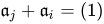
a j + a i = ( 1 ) {\displaystyle {\mathfrak {a}}_{j}+{\mathfrak {a}}_{i}=(1)} ,那麼
∏ a i → A → A / a 1 × ⋯ × a n → 0 {\displaystyle \prod {\mathfrak {a}}_{i}\to A\to A/{\mathfrak {a}}_{1}\times \cdots \times {\mathfrak {a}}_{n}\to 0} 是精確的。
A {\displaystyle A} 雅可比根 是所有極大理想的交集。
命題 A.6。
x ∈ A {\displaystyle x\in A} 屬於雅可比根當且僅當對於所有
y ∈ A {\displaystyle y\in A} ,
1 − x y {\displaystyle 1-xy} 是一個單位元。
證明。 令 x {\displaystyle x} 1 − x y {\displaystyle 1-xy} m {\displaystyle {\mathfrak {m}}} 1 = ( 1 − x y ) + x y {\displaystyle 1=(1-xy)+xy} m {\displaystyle {\mathfrak {m}}} m {\displaystyle {\mathfrak {m}}} x {\displaystyle x} m {\displaystyle {\mathfrak {m}}} ( x , m ) {\displaystyle (x,{\mathfrak {m}})} m {\displaystyle {\mathfrak {m}}} 1 {\displaystyle 1} 1 = x y + z {\displaystyle 1=xy+z} y ∈ A {\displaystyle y\in A} z ∈ m {\displaystyle z\in {\mathfrak {m}}} 1 − x y ∈ m {\displaystyle 1-xy\in {\mathfrak {m}}} m {\displaystyle {\mathfrak {m}}} 1 − x y {\displaystyle 1-xy} ◻ {\displaystyle \square }
注意,零根包含在 Jacobson 根中,特別地,如果素理想是極大理想(例如,環是主理想整環),那麼它們重合。另一個例子是
練習。
在
A [ X ] {\displaystyle A[X]} 中,零根和 Jacobson 根重合。
定理 A.17 (霍普金斯)。
令
A 是一個環。那麼以下等價。
A 是阿廷環A 是諾特環,且每個素理想都是極大理想。 Spec ( A ) {\displaystyle \operatorname {Spec} (A)} m {\displaystyle {\mathfrak {m}}} A m {\displaystyle A_{\mathfrak {m}}}
Proof. (1) ⇒ {\displaystyle \Rightarrow } p ◃ A {\displaystyle {\mathfrak {p}}\triangleleft A} x ∈ A / p {\displaystyle x\in A/{\mathfrak {p}}} A / p {\displaystyle A/{\mathfrak {p}}} ( x n ) {\displaystyle (x^{n})} x n = u x n + 1 {\displaystyle x^{n}=ux^{n+1}} u . Since A / p {\displaystyle A/{\mathfrak {p}}} x {\displaystyle x} p {\displaystyle {\mathfrak {p}}} Spec ( A ) {\displaystyle \operatorname {Spec} (A)} S {\displaystyle S} i ∈ S {\displaystyle {\mathfrak {i}}\in S} minimal element, which we have by (1). We write i = m 1 ∩ . . . ∩ m n {\displaystyle {\mathfrak {i}}={\mathfrak {m}}_{1}\cap ...\cap {\mathfrak {m}}_{n}} m {\displaystyle {\mathfrak {m}}} m ∩ i ∈ S {\displaystyle {\mathfrak {m}}\cap {\mathfrak {i}}\in S} m ∩ i = i {\displaystyle {\mathfrak {m}}\cap {\mathfrak {i}}={\mathfrak {i}}} m = m i {\displaystyle {\mathfrak {m}}={\mathfrak {m}}_{i}} i . (3) ⇒ {\displaystyle \Rightarrow } A {\displaystyle A} ◻ {\displaystyle \square }
如果一個環只有一個極大理想,則稱該環為區域性 環。
命題 A.17。
Proof. (1) ⇒ {\displaystyle \Rightarrow } x {\displaystyle x} x {\displaystyle x} 1 − x {\displaystyle 1-x} ⇒ {\displaystyle \Rightarrow } x , y ∈ A {\displaystyle x,y\in A} x {\displaystyle x} x y {\displaystyle xy} x {\displaystyle x} y {\displaystyle y} x y {\displaystyle xy} x , y {\displaystyle x,y} x + y {\displaystyle x+y} x + y {\displaystyle x+y} a ∈ A {\displaystyle a\in A} 1 = a ( x + y ) = a x + a y {\displaystyle 1=a(x+y)=ax+ay} a x {\displaystyle ax} 1 − a x = a y {\displaystyle 1-ax=ay} x {\displaystyle x} y {\displaystyle y} ⇒ {\displaystyle \Rightarrow } i {\displaystyle {\mathfrak {i}}} m ◃ A {\displaystyle {\mathfrak {m}}\triangleleft A} m ⊂ i {\displaystyle {\mathfrak {m}}\subset {\mathfrak {i}}} m {\displaystyle {\mathfrak {m}}} ◻ {\displaystyle \square }
例子。
如果
p {\displaystyle p} 是一個素理想,則
A p {\displaystyle A_{p}} 是一個區域性環,其中
p {\displaystyle p} 是其唯一的極大理想。
例子。
如果
i {\displaystyle {\sqrt {\mathfrak {i}}}} 是極大的,則
A / i {\displaystyle A/{\mathfrak {i}}} 是一個區域性環。特別地,
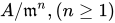
A / m n , ( n ≥ 1 ) {\displaystyle A/{\mathfrak {m}}^{n},(n\geq 1)} 對於任何極大理想
m {\displaystyle {\mathfrak {m}}} 都是區域性的。
( A , m ) {\displaystyle (A,{\mathfrak {m}})}
A. Lemma
(i) 設 i {\displaystyle {\mathfrak {i}}} A {\displaystyle A} M {\displaystyle M} i {\displaystyle {\mathfrak {i}}} M = 0 {\displaystyle M=0}
(ii) 所有 m k {\displaystyle {\mathfrak {m}}^{k}} k ≥ 1 {\displaystyle k\geq 1} 證明:我們用生成元的個數進行歸納法來證明 (i)。假設 M {\displaystyle M} n {\displaystyle n} x 1 , . . . x n {\displaystyle x_{1},...x_{n}} M {\displaystyle M}
x 1 = a 1 x 1 + a 2 x 2 + . . . + a n x n {\displaystyle x_{1}=a_{1}x_{1}+a_{2}x_{2}+...+a_{n}x_{n}} a i {\displaystyle a_{i}} i {\displaystyle {\mathfrak {i}}} 因此
( 1 − a 1 ) x 1 = a 2 x 2 + . . . + a n x n {\displaystyle (1-a_{1})x_{1}=a_{2}x_{2}+...+a_{n}x_{n}} 由於 a 1 {\displaystyle a_{1}} 1 − a 1 {\displaystyle 1-a_{1}} 1 − a 1 {\displaystyle 1-a_{1}} m {\displaystyle {\mathfrak {m}}} a 1 {\displaystyle a_{1}} 1 ∈ m {\displaystyle 1\in {\mathfrak {m}}} M {\displaystyle M} ◻ {\displaystyle \square }
如果一個理想 q ◃ A {\displaystyle {\mathfrak {q}}\triangleleft A} A / q {\displaystyle A/{\mathfrak {q}}} x y ∈ q {\displaystyle xy\in {\mathfrak {q}}} y ∉ q {\displaystyle y\not \in {\mathfrak {q}}} x ∈ q {\displaystyle x\in {\sqrt {\mathfrak {q}}}}
命題。
如果
q {\displaystyle {\mathfrak {q}}} 是主理想,那麼
q {\displaystyle {\sqrt {\mathfrak {q}}}} 是素理想。反之,如果
q {\displaystyle {\sqrt {\mathfrak {q}}}} 是極大理想,那麼
q {\displaystyle {\mathfrak {q}}} 是主理想。
證明. 顯然,第一部分是正確的。反之,如果 q {\displaystyle {\sqrt {\mathfrak {q}}}} m = q / q {\displaystyle {\mathfrak {m}}={\sqrt {\mathfrak {q}}}/{\mathfrak {q}}} A / q {\displaystyle A/{\mathfrak {q}}} A / q {\displaystyle A/{\mathfrak {q}}} A / q {\displaystyle A/{\mathfrak {q}}} m {\displaystyle {\mathfrak {m}}} ◻ {\displaystyle \square }
練習。
q {\displaystyle {\sqrt {\mathfrak {q}}}} 是素理想
⇏ q {\displaystyle \not \Rightarrow {\mathfrak {q}}} 是初等理想。
定理 A.8 (初等分解)
設
A {\displaystyle A} 是一個諾特環。如果
i ◃ A {\displaystyle {\mathfrak {i}}\triangleleft A} , 那麼
i {\displaystyle {\mathfrak {i}}} 是有限個初等理想的交集。
證明。 令 S {\displaystyle S} S {\displaystyle S} i {\displaystyle {\mathfrak {i}}} i {\displaystyle {\mathfrak {i}}} i {\displaystyle {\mathfrak {i}}} i {\displaystyle {\mathfrak {i}}} x ∉ i {\displaystyle x\not \in {\mathfrak {i}}} y ∉ i {\displaystyle y\not \in {\mathfrak {i}}} x y ∈ i {\displaystyle xy\in {\mathfrak {i}}} i = j ( i + x ) {\displaystyle {\mathfrak {i}}={\mathfrak {j}}({\mathfrak {i}}+x)} j {\displaystyle {\mathfrak {j}}} a x ∈ i {\displaystyle ax\in {\mathfrak {i}}} a ∈ A {\displaystyle a\in A} j , i + x ∉ S {\displaystyle {\mathfrak {j}},{\mathfrak {i}}+x\not \in S} i {\displaystyle {\mathfrak {i}}} ◻ {\displaystyle \square }
命題。
如果
( 0 ) {\displaystyle (0)} 是不可分解的,那麼零因子集是極小素數的並集。
設 A ⊂ B {\displaystyle A\subset B} b ∈ B {\displaystyle b\in B} f ∈ A [ X ] {\displaystyle f\in A[X]} b {\displaystyle b} 關於 A {\displaystyle A} 整的 。如果 B {\displaystyle B} A {\displaystyle A} B {\displaystyle B} 關於 A {\displaystyle A} 整的 或 B {\displaystyle B} A {\displaystyle A} 整擴張 。更一般地,我們稱環同態 f : A → B {\displaystyle f:A\to B} 整的 ,如果 A {\displaystyle A} B {\displaystyle B} f ( A ) {\displaystyle f(A)} A {\displaystyle A} A ⊂ B {\displaystyle A\subset B}
引理 A.9.
證明. (1) 意味著我們可以寫成
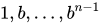
b n + r = − ( b r + n − 1 a n − 1 + . . . b r + 1 a 1 + b r a 0 ) {\displaystyle b^{n+r}=-(b^{r+n-1}a_{n-1}+...b^{r+1}a_{1}+b^{r}a_{0})} 因此, 1 , b , . . . , b n − 1 {\displaystyle 1,b,...,b^{n-1}} A [ b ] {\displaystyle A[b]} ⇒ {\displaystyle \Rightarrow } ⇒ {\displaystyle \Rightarrow } ⇒ {\displaystyle \Rightarrow } M / A [ b ] {\displaystyle M_{/A[b]}} x 1 , . . . , x n {\displaystyle x_{1},...,x_{n}} A {\displaystyle A} b x i ∈ M {\displaystyle bx_{i}\in M}
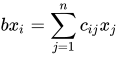
b x i = ∑ j = 1 n c i j x j {\displaystyle bx_{i}=\sum _{j=1}^{n}c_{ij}x_{j}} 其中 c k j ∈ A {\displaystyle c_{kj}\in A} C {\displaystyle C} c i j {\displaystyle c_{ij}} det ( b I − C ) {\displaystyle \det(bI-C)} M {\displaystyle M} det ( b I − C ) = 0 {\displaystyle \det(bI-C)=0} det ( b I − C ) {\displaystyle \det(bI-C)} b {\displaystyle b} ◻ {\displaystyle \square }
所有在 *B* 中且關於 *A* 整的元素的集合被稱為 *A* 在 *B* 中的 *整閉包*。根據引理,整閉包是 B {\displaystyle B} A {\displaystyle A} x {\displaystyle x} y {\displaystyle y} A [ x y ] {\displaystyle A[xy]} A [ x − y ] {\displaystyle A[x-y]} A [ x , y ] {\displaystyle A[x,y]} A {\displaystyle A} C {\displaystyle C} B {\displaystyle B} B {\displaystyle B} A {\displaystyle A} C {\displaystyle C} A {\displaystyle A}
命題。
證明。 (i) 假設 B {\displaystyle B} x ∈ A {\displaystyle x\in A} x − 1 ∈ B {\displaystyle x^{-1}\in B} A {\displaystyle A}
x − n = − ( a n − 1 x − ( n − 1 ) + . . . + a 1 x − 1 + a 0 ) {\displaystyle x^{-n}=-(a_{n-1}x^{-(n-1)}+...+a_{1}x^{-1}+a_{0})} 將兩邊乘以 x n − 1 {\displaystyle x^{n-1}} x − 1 ∈ A {\displaystyle x^{-1}\in A} 0 ≠ b ∈ B {\displaystyle 0\neq b\in B}
− a 0 = b n + a n − 1 b n − 1 + . . . + a 1 b = b ( b n − 1 + a n − 1 b n − 2 + . . . + a 1 ) {\displaystyle -a_{0}=b^{n}+a_{n-1}b^{n-1}+...+a_{1}b=b(b^{n-1}+a_{n-1}b^{n-2}+...+a_{1})} 由於 B {\displaystyle B} n {\displaystyle n} b {\displaystyle b} a 0 ≠ 0 {\displaystyle a_{0}\neq 0} b B ∩ A ≠ 0 {\displaystyle bB\cap A\neq 0} A {\displaystyle A} a 0 {\displaystyle a_{0}} b {\displaystyle b} ◻ {\displaystyle \square }
定理(諾特歸一化)。
設
A {\displaystyle A} 是一個有限生成的
k {\displaystyle k} -代數。那麼我們可以找到
z 1 , . . . , z d {\displaystyle z_{1},...,z_{d}} 使得
A {\displaystyle A} k [ z 1 , . . . , z d ] {\displaystyle k[z_{1},...,z_{d}]} z 1 , . . . , z d {\displaystyle z_{1},...,z_{d}} k {\displaystyle k} z 1 , . . . , z d {\displaystyle z_{1},...,z_{d}} A {\displaystyle A} K {\displaystyle K} K {\displaystyle K} k {\displaystyle k}
練習 A.10 (Artin-Tate)。
設
A ⊂ B ⊂ C {\displaystyle A\subset B\subset C} 是環。假設
A {\displaystyle A} 是諾特環。如果
C {\displaystyle C} 作為
A {\displaystyle A} -代數是有限生成的,並且關於
B {\displaystyle B} 是整的,那麼
B {\displaystyle B} 作為
A {\displaystyle A} -代數是有限生成的。
練習。
練習。
定理 A.7(希爾伯特基定理)。
A {\displaystyle A} 是一個諾特環當且僅當
A [ T 1 , . . . T n ] {\displaystyle A[T_{1},...T_{n}]} 是諾特環。
證明。 用歸納法證明,只需證明 A [ T ] {\displaystyle A[T]} I ◃ A [ T ] {\displaystyle I\triangleleft A[T]} L n {\displaystyle L_{n}} I {\displaystyle I} ≤ n {\displaystyle \leq n} L n ◃ A {\displaystyle L_{n}\triangleleft A} d {\displaystyle d}
L 0 ⊂ L 1 ⊂ L 2 , . . . , ⊂ L d = L d + 1 = . . . {\displaystyle L_{0}\subset L_{1}\subset L_{2},...,\subset L_{d}=L_{d+1}=...} 對於每個 0 ≤ n ≤ d {\displaystyle 0\leq n\leq d} f 1 n , f 2 n , . . . f m n n {\displaystyle f_{1n},f_{2n},...f_{m_{n}n}} I {\displaystyle I} b 1 n , . . . b m n n {\displaystyle b_{1n},...b_{m_{n}n}} L n {\displaystyle L_{n}} I ′ {\displaystyle I'} f j n {\displaystyle f_{jn}} j , n {\displaystyle j,n} I = I ′ {\displaystyle I=I'} I ⊂ I ′ {\displaystyle I\subset I'} I {\displaystyle I} f ∈ I {\displaystyle f\in I} a {\displaystyle a} f {\displaystyle f} n {\displaystyle n} f {\displaystyle f} a ∈ L n {\displaystyle a\in L_{n}} n ≤ d {\displaystyle n\leq d}
a = a 1 b 1 n + a 2 b 2 n + . . . + a m n b m n n {\displaystyle a=a_{1}b_{1n}+a_{2}b_{2n}+...+a_{m_{n}}b_{{m_{n}}n}} 特別是,如果 g = a 1 f 1 n + a 2 f 2 n + . . . + a m n f m n n {\displaystyle g=a_{1}f_{1n}+a_{2}f_{2n}+...+a_{m_{n}}f_{{m_{n}}n}} f − g {\displaystyle f-g} f {\displaystyle f} f − g ∈ I ′ {\displaystyle f-g\in I'} g ∈ I ′ {\displaystyle g\in I'} f ∈ I ′ {\displaystyle f\in I'} n ≥ d {\displaystyle n\geq d} a ∈ L d {\displaystyle a\in L_{d}} f ∈ I ′ {\displaystyle f\in I'} ◻ {\displaystyle \square }
練習。
令
A {\displaystyle A} 為區間
[ 0 , 1 ] {\displaystyle [0,1]} 上所有連續函式構成的環
f : [ 0 , 1 ] → [ 0 , 1 ] {\displaystyle f:[0,1]\to [0,1]} 。
A {\displaystyle A} 不是諾特環。
( A , m ) {\displaystyle (A,{\mathfrak {m}})} k = A / m {\displaystyle k=A/{\mathfrak {m}}} i ◃ A {\displaystyle {\mathfrak {i}}\triangleleft A} i {\displaystyle {\mathfrak {i}}} 定義理想 ,如果 A / i {\displaystyle A/{\mathfrak {i}}}
定理。
dim k ( m / m 2 ) ≥ dim A {\displaystyle \dim _{k}({\mathfrak {m}}/{\mathfrak {m}}^{2})\geq \dim A}
A {\displaystyle A} 正則 。
定理。
設
A {\displaystyle A} 是一個諾特環。則
dim A [ T 1 , . . . , T n ] = n + dim A {\displaystyle \dim A[T_{1},...,T_{n}]=n+\dim A} .
證明。 由歸納法,只需證明 n = 1 {\displaystyle n=1} ◻ {\displaystyle \square }
定理。
設
A {\displaystyle A} 是一個有限維
k {\displaystyle k} -代數。如果
A {\displaystyle A} 是一個域,其分數域為
K {\displaystyle K} ,則
dim A = trdeg k K {\displaystyle \dim A=\operatorname {trdeg} _{k}K} .
證明。 由諾特歸約引理, A {\displaystyle A} k [ x 1 , . . . , x n ] {\displaystyle k[x_{1},...,x_{n}]} x 1 , . . . , x n {\displaystyle x_{1},...,x_{n}} k {\displaystyle k} dim A = dim k [ x 1 , . . . , x n ] = n {\displaystyle \dim A=\dim k[x_{1},...,x_{n}]=n} trdeg k K = n {\displaystyle \operatorname {trdeg} _{k}K=n} ◻ {\displaystyle \square }
定理。
設
A {\displaystyle A} 是一個具有 (ACCP) 的域。則
A {\displaystyle A} 是唯一分解域當且僅當每個高度為 1 的素理想
p {\displaystyle {\mathfrak {p}}} 是主理想。
證明。 ( ⇒ {\displaystyle \Rightarrow } p {\displaystyle {\mathfrak {p}}} x {\displaystyle x}
0 ⊂ ( x ) ⊂ p {\displaystyle 0\subset (x)\subset {\mathfrak {p}}} 其中第二個包含關係必須是等式,因為 p {\displaystyle {\mathfrak {p}}} ⇐ {\displaystyle \Leftarrow } A {\displaystyle A} ◻ {\displaystyle \square }
定理。
正則區域性環是 UFD。
定理 A.10 (克魯爾交定理)。
令
i ◃ A {\displaystyle {\mathfrak {i}}\triangleleft A} 是一個真理想。如果
A {\displaystyle A} 是一個諾特域或一個區域性環,那麼
⋂ n ≥ 1 i n = 0 {\displaystyle \bigcap _{n\geq 1}{\mathfrak {i}}^{n}=0} 。
定理 A.15。
令
i ◃ A {\displaystyle {\mathfrak {i}}\triangleleft A} 。如果
A {\displaystyle A} 是諾特環,
i n ⊂ i ⊂ i {\displaystyle {\sqrt {\mathfrak {i}}}^{n}\subset {\mathfrak {i}}\subset {\sqrt {\mathfrak {i}}}} n {\displaystyle n} 特別地,
A {\displaystyle A} 的零根是冪零的。
證明。 當 i = 0 {\displaystyle {\mathfrak {i}}=0} A {\displaystyle A} x 1 , . . . , x n {\displaystyle x_{1},...,x_{n}} ( 0 ) {\displaystyle {\sqrt {(0)}}} x j {\displaystyle x_{j}} ( 0 ) {\displaystyle {\sqrt {(0)}}} ◻ {\displaystyle \square }
命題 A.8.
如果
A {\displaystyle A} 是諾特環,那麼
A ^ {\displaystyle {\hat {A}}} 是諾特環。
推論。
如果
A {\displaystyle A} 是諾特環,那麼
A [ [ X ] ] {\displaystyle A[[X]]} 是諾特環。
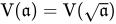
對於給定的 a ◃ A {\displaystyle {\mathfrak {a}}\triangleleft A} V ( a ) = { p ∈ Spec ( A ) | p ⊃ a } {\displaystyle \operatorname {V} ({\mathfrak {a}})=\{{\mathfrak {p}}\in \operatorname {Spec} (A)|{\mathfrak {p}}\supset {\mathfrak {a}}\}} V ( a ) = V ( a ) {\displaystyle \operatorname {V} ({\mathfrak {a}})=\operatorname {V} ({\sqrt {\mathfrak {a}}})}
V ( a ) ∪ V ( b ) = V ( a b ) = V ( a ∩ b ) {\displaystyle V({\mathfrak {a}})\cup V({\mathfrak {b}})=V({\mathfrak {a}}{\mathfrak {b}})=V({\mathfrak {a}}\cap {\mathfrak {b}})} ∩ α V ( a α ) = V ( ( a α | α ) ) {\displaystyle \cap _{\alpha }V({\mathfrak {a}}_{\alpha })=V(({\mathfrak {a}}_{\alpha }|\alpha ))} 因此,形式為 V ( a ) {\displaystyle \operatorname {V} ({\mathfrak {a}})} Spec ( A ) {\displaystyle \operatorname {Spec} (A)} Spec ( A ) {\displaystyle \operatorname {Spec} (A)} Z ( i ) {\displaystyle \operatorname {Z} ({\mathfrak {i}})} Zariski 拓撲 。令 X = Spec ( A ) {\displaystyle X=\operatorname {Spec} (A)} X f = X ∖ V ( ( f ) ) = { P ∈ X | P ∋ f } {\displaystyle X_{f}=X\backslash V((f))=\{P\in X|P\ni f\}}
命題 A.16。
證明。 我們有: X f ⊂ ⋃ α X f α = X ∖ V ( ( f α | α ) ) ⇔ ( f ) ⊂ ( f α | α ) ⇔ f ∈ ( f α 1 , . . . , f α n ) {\displaystyle X_{f}\subset \bigcup _{\alpha }X_{f_{\alpha }}=X\backslash V((f_{\alpha }|\alpha ))\Leftrightarrow (f)\subset (f_{\alpha }|\alpha )\Leftrightarrow f\in (f_{\alpha _{1}},...,f_{\alpha _{n}})} ◻ {\displaystyle \square }
練習。
令
A {\displaystyle A} 為區域性環。則
Spec ( A ) {\displaystyle \operatorname {Spec} (A)} 是連通的。
推論。
Spec ( B ) → Spec ( A ) {\displaystyle \operatorname {Spec} (B)\to \operatorname {Spec} (A)} 是一個閉滿射。
定理 A.12。
如果對於每個極大理想
m {\displaystyle {\mathfrak {m}}} ,
A m {\displaystyle A_{m}} 是諾特環,並且對於每個
x ∈ A {\displaystyle x\in A} ,集合
{ m ∈ Max ( A ) | x ∈ m } {\displaystyle \{{\mathfrak {m}}\in \operatorname {Max} (A)|x\in m\}} 是有限的,那麼
A {\displaystyle A} 是諾特環。
引理 A.8。
在 GCD 域中,如果
( x , y ) = 1 = ( x , z ) {\displaystyle (x,y)=1=(x,z)} ,那麼
( x , y z ) = 1 {\displaystyle (x,yz)=1} 。
命題 A.9。
在 GCD 域中,每個不可約元素都是素元素。
證明。 令 x {\displaystyle x} x | y z {\displaystyle x|yz} x | ( x , y z ) {\displaystyle x|(x,yz)} ( x , y z ) = 1 {\displaystyle (x,yz)=1} x {\displaystyle x} d = ( x , y ) {\displaystyle d=(x,y)} x {\displaystyle x} x | d {\displaystyle x|d} x | y {\displaystyle x|y} ◻ {\displaystyle \square }
特別是,在作為 GCD 域的多項式環中,每個不可約多項式都是一個素元素。
定理(未定義:ACC)。
令
A 為一個滿足主理想升鏈條件的環(例如:諾特環)。那麼
A {\displaystyle A} 中的每個
x 都是不可約元素的有限乘積。
定理 A.10。
令
A {\displaystyle A} 為一個域。以下條件等價。
每個非零非單位元素都是素元素的有限乘積。
(Kaplansky)每個非零素理想包含一個素元素。
A {\displaystyle A}
Proof. (3) ⇒ {\displaystyle \Rightarrow } p ∈ Spec ( A ) {\displaystyle {\mathfrak {p}}\in \operatorname {Spec} (A)} p {\displaystyle {\mathfrak {p}}} x , which we factor into irreducibles: x = p 1 . . . p n {\displaystyle x=p_{1}...p_{n}} p j ∈ p {\displaystyle p_{j}\in {\mathfrak {p}}} j {\displaystyle j} A {\displaystyle A} ⇒ {\displaystyle \Rightarrow } S {\displaystyle S} S {\displaystyle S} x {\displaystyle x} x ∉ S {\displaystyle x\not \in S} ( x ) {\displaystyle (x)} S {\displaystyle S} p {\displaystyle {\mathfrak {p}}} x {\displaystyle x} S {\displaystyle S} p {\displaystyle {\mathfrak {p}}} y {\displaystyle y} p {\displaystyle {\mathfrak {p}}} S {\displaystyle S} ⇒ {\displaystyle \Rightarrow } A {\displaystyle A} ◻ {\displaystyle \square }
滿足定理中等價條件的域稱為唯一分解域 或簡稱為 UFD。
推論。
如果
A {\displaystyle A} 是一個唯一分解整環,則
A [ X ] {\displaystyle A[X]} 是一個唯一分解整環。如果 A 是一個主理想整環,則
A [ [ X ] ] {\displaystyle A[[X]]} 是一個唯一分解整環。
定理 A.13 (Nagata 準則)。
設
A 為一個整環,
S ⊂ A {\displaystyle S\subset A} 為由素元生成的乘法封閉子集。則
A {\displaystyle A} 是一個唯一分解整環當且僅當
S − 1 A {\displaystyle S^{-1}A} 是一個唯一分解整環。














![{\displaystyle A[f^{-1}]}](https://wikimedia.org/api/rest_v1/media/math/render/svg/d6480dbcadf8004f8c3d89b2a712f272567cfea7)
![{\displaystyle K=A[s_{1}^{-1},...,s_{n}^{-1}]}](https://wikimedia.org/api/rest_v1/media/math/render/svg/eb4c3e2d7418239e367f901db27015f7dee751b8)

![{\displaystyle K=A[s^{-1}]}](https://wikimedia.org/api/rest_v1/media/math/render/svg/04b93e3c0f44e34472dda02df8cfb26baecedae1)

![{\displaystyle K=A[f^{-1}]}](https://wikimedia.org/api/rest_v1/media/math/render/svg/ad99172ebebd6a8c9ade9a6f616a1e47739e7092)


![{\displaystyle A[f^{-1}].}](https://wikimedia.org/api/rest_v1/media/math/render/svg/9bd51c41fd2153c16ac8b7df343f89531c320c10)


![{\displaystyle A[X]}](https://wikimedia.org/api/rest_v1/media/math/render/svg/40abd94a808a2369931fac9811cbd1cbdd44497d)


![{\displaystyle {\mathfrak {q}}\triangleleft A[X]}](https://wikimedia.org/api/rest_v1/media/math/render/svg/39c4e8c270e5130a214b1729281d412364d57ec2)

![{\displaystyle A[X]/{\mathfrak {q}}}](https://wikimedia.org/api/rest_v1/media/math/render/svg/7934892532dcda7570f5044d5e85143eb52ca135)





































![{\displaystyle f\in A[X]}](https://wikimedia.org/api/rest_v1/media/math/render/svg/c03fa6066f11e40bbef9e562dcec44275ecfcff8)


![{\displaystyle A[b]}](https://wikimedia.org/api/rest_v1/media/math/render/svg/ca79decb9d0d5e08ac9f77f713e8df03aad88d70)

![{\displaystyle M_{/A[b]}}](https://wikimedia.org/api/rest_v1/media/math/render/svg/32656e00479c5d2ac82a7fefb42aadaf39a9d53f)




![{\displaystyle A[xy]}](https://wikimedia.org/api/rest_v1/media/math/render/svg/acdff52502dd0004b54a1c455fd71a6fb59600f4)
![{\displaystyle A[x-y]}](https://wikimedia.org/api/rest_v1/media/math/render/svg/596f922745a9a56e2ba9595699480e7f8b3cd4d7)
![{\displaystyle A[x,y]}](https://wikimedia.org/api/rest_v1/media/math/render/svg/122e228634b011b3179d73914fc07875ee24a7e9)







![{\displaystyle k[z_{1},...,z_{d}]}](https://wikimedia.org/api/rest_v1/media/math/render/svg/2fec2c52f9dbbecd15983166c23606ecd1ffb216)


![{\displaystyle F:A[b]\to \Omega }](https://wikimedia.org/api/rest_v1/media/math/render/svg/c828706fb105401f48f9fe8f28e38667aa14a36f)
![{\displaystyle A[T_{1},...T_{n}]}](https://wikimedia.org/api/rest_v1/media/math/render/svg/677546759f035fa8112cafe3a299c1d129d301f8)
![{\displaystyle A[T]}](https://wikimedia.org/api/rest_v1/media/math/render/svg/8758a34c001ce431bb36472bc15a9c8bbc4dd206)
![{\displaystyle I\triangleleft A[T]}](https://wikimedia.org/api/rest_v1/media/math/render/svg/2332b669139b6446341cb82f477fdec142df22fb)











![{\displaystyle [0,1]}](https://wikimedia.org/api/rest_v1/media/math/render/svg/d7f30e67c917197b91870693f74d662714e96198)
![{\displaystyle f:[0,1]\to [0,1]}](https://wikimedia.org/api/rest_v1/media/math/render/svg/f64956bbc19d5bbe642fd7bf4f1aa62487006f4d)


![{\displaystyle \dim A[T_{1},...,T_{n}]=n+\dim A}](https://wikimedia.org/api/rest_v1/media/math/render/svg/501367e7288dd75b9e62ef82ca42fcc924684e69)


![{\displaystyle k[x_{1},...,x_{n}]}](https://wikimedia.org/api/rest_v1/media/math/render/svg/6c94122b5f7993f4d088b504b7118b4d914b35d1)
![{\displaystyle \dim A=\dim k[x_{1},...,x_{n}]=n}](https://wikimedia.org/api/rest_v1/media/math/render/svg/0867a015e4d4df861459e5255030dd3d76c6509e)





![{\displaystyle A[[X]]}](https://wikimedia.org/api/rest_v1/media/math/render/svg/6859aedb35d49362a6fea7725d7cc9c2f6301fd2)








![{\displaystyle \operatorname {Spec} (A[f^{-1}])_{g}}](https://wikimedia.org/api/rest_v1/media/math/render/svg/3177dc24db406f84600b61ae828cd9b17a03a800)







