設  為向量空間。
 ![{\displaystyle (V,[,])}](https://wikimedia.org/api/rest_v1/media/math/render/svg/67b38acfc3dd8d15b023ab217171bba8058fbb33) 稱為李代數,如果它配備了雙線性運算元
稱為李代數,如果它配備了雙線性運算元  ,記為
,記為 ![{\displaystyle [,]}](https://wikimedia.org/api/rest_v1/media/math/render/svg/f04349be7aa458edb6f1ab423189a8455c6e21f7) ,滿足以下性質:對於所有
,滿足以下性質:對於所有 
- (i) [x, x] = 0
- (ii) [x, [y, z]] + [y, [z, x]] + [z, [x, y]] = 0
(ii) 稱為雅可比恆等式。
示例:對於  ,定義
,定義 ![{\displaystyle [x,y]=x\times y}](https://wikimedia.org/api/rest_v1/media/math/render/svg/f5aefe8419a31bfa73e0bacb7fa4cf381f4e197f) ,即
,即  和
和  的叉積。叉積的已知性質表明
 ![{\displaystyle (R^{3},[,])}](https://wikimedia.org/api/rest_v1/media/math/render/svg/a31d5366eef9bd0efc14fbe1e5eb2b4d64bae83a) 是李代數。
是李代數。
示例:設  。
。  的元素稱為導數。定義
 ![{\displaystyle [x,y]=xy-yx}](https://wikimedia.org/api/rest_v1/media/math/render/svg/42b4220c8122ebd2a21c517ca80639581679cfa6) 。然後
。然後 ![{\displaystyle [x,y]\in \operatorname {Der} (V)}](https://wikimedia.org/api/rest_v1/media/math/render/svg/4c7b35983ceb3051c32ad32e326a99e42025adb4) 。
。
定理 設 為有限維向量空間。
- (i) 如果
 是一個由冪零元素組成的李代數,則存在
  使得
使得  對每個
對每個  成立。
成立。
- (ii) 如果
 是可解的,則存在一個共同的特徵值 。
定理 (Engel) 是冪零的當且僅當  對每個 都是冪零的。
證明:直接部分是清楚的。對於反方向,注意到根據前面的定理, 是
是  的子代數。因此, 是冪零的,所以 也是冪零的。
定理 是可解的當且僅當 ![{\displaystyle [{\mathfrak {g}},{\mathfrak {g}}]}](https://wikimedia.org/api/rest_v1/media/math/render/svg/9bdae7b3a7c17f4b13b9eea7f88b9a466d2e97aa) 是冪零的。
是冪零的。
證明:假設 是可解的。那麼 ![{\displaystyle \operatorname {ad} [{\mathfrak {g}},{\mathfrak {g}}]}](https://wikimedia.org/api/rest_v1/media/math/render/svg/99108c70a03e890f581c8bec89532633d68d83d7) 是
是  的一個子代數。因此,
![{\displaystyle \operatorname {ad} [{\mathfrak {g}},{\mathfrak {g}}]\subset {\mathfrak {n}}_{k}}](https://wikimedia.org/api/rest_v1/media/math/render/svg/67a7bf1f8162c18185eeaecf4368d1dc72a8210e) 。因此, 是冪零的,因此 是冪零的。反之,注意到以下精確序列:
。因此, 是冪零的,因此 是冪零的。反之,注意到以下精確序列:
![{\displaystyle 0\longrightarrow [{\mathfrak {g}},{\mathfrak {g}}]\longrightarrow {\mathfrak {g}}\longrightarrow {\mathfrak {g}}/{[{\mathfrak {g}},{\mathfrak {g}}]}\longrightarrow 0}](https://wikimedia.org/api/rest_v1/media/math/render/svg/6a96df3ec916ead33753d4c7bf5fae8302d2fdad)
由於 和 ![{\displaystyle {\mathfrak {g}}/[{\mathfrak {g}},{\mathfrak {g}}]}](https://wikimedia.org/api/rest_v1/media/math/render/svg/483af7f49dfeb78dacd52249b9a6c04a91a9664a) 都是可解的, 是可解的。
都是可解的, 是可解的。
3 定理(外爾定理) 有限維半單李代數的每一個表示:
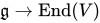
是完全可約的。
Proof: It suffices to prove that every -submodule has a -submodule complement. Furthermore, the proof reduces to the case when  is simple (as a module) and has codimension one. Indeed, given a -submodule , let
  be the subspace consisting of elements
  such that
  is a scalar multiplication. Since any commutator of elements
  is zero (that is, multiplication by zero), it is clear that
 ![{\displaystyle E/[E,E]}](https://wikimedia.org/api/rest_v1/media/math/render/svg/0ad554fd17284bf1d68b22c4f57b2265b47025e2) has dimension 1.
has dimension 1.  may not be simple, but by induction on the dimension of , we can assume that. Hence, has complement of dimension 1, which is spanned by, say, . It follows that is the direct sum of and the kernel of . Now, to complete the proof, let be a simple -submodule of codimension 1. Let
  be a Casimir element of . It follows that is the direct sum of and the kernel of . (TODO: obviously, the proof is very sketchy; we need more details.)


