跳轉到內容
Main menu
Main menu
move to sidebar
hide
Navigation
Main Page
Help
Browse
Cookbook
Wikijunior
Featured books
Recent changes
Random book
Using Wikibooks
Community
Reading room forum
Community portal
Bulletin Board
Help out!
Policies and guidelines
Contact us
Search
Search
Donations
Appearance
Create account
Log in
Personal tools
Create account
Log in
Pages for logged out editors
learn more
Contributions
Discussion for this IP address
微積分/微分/微分的定義/解答
Add languages
Add links
Book
Discussion
English
Read
Edit
Edit source
View history
Tools
Tools
move to sidebar
hide
Actions
Read
Edit
Edit source
View history
General
What links here
Related changes
Upload file
Special pages
Permanent link
Page information
Cite this page
Get shortened URL
Download QR code
Sister projects
Wikipedia
Wikiversity
Wiktionary
Wikiquote
Wikisource
Wikinews
Wikivoyage
Commons
Wikidata
MediaWiki
Meta-Wiki
Print/export
Create a collection
Download as PDF
Printable version
In other projects
外觀
移動到側邊欄
隱藏
來自 Wikibooks,開放世界中的開放書籍
<
微積分
|
微分
|
微分的定義
1. 求曲線
y
=
x
2
{\displaystyle y=x^{2}}
在點
(
1
,
1
)
{\displaystyle (1,1)}
處的切線的斜率。
函式
f
{\displaystyle f}
在
x
0
{\displaystyle x_{0}}
處的斜率的定義是
lim
h
→
0
[
f
(
x
0
+
h
)
−
f
(
x
0
)
h
]
{\displaystyle \lim _{h\to 0}\left[{\frac {f\left(x_{0}+h\right)-f\left(x_{0}\right)}{h}}\right]}
代入
f
(
x
)
=
x
2
{\displaystyle f(x)=x^{2}}
和
x
0
=
1
{\displaystyle x_{0}=1}
得到
lim
h
→
0
[
(
1
+
h
)
2
−
1
h
]
=
lim
h
→
0
[
h
2
+
2
h
h
]
=
lim
h
→
0
[
h
(
h
+
2
)
h
]
=
lim
h
→
0
h
+
2
=
2
{\displaystyle {\begin{aligned}\lim _{h\to 0}\left[{\frac {(1+h)^{2}-1}{h}}\right]&=\lim _{h\to 0}\left[{\frac {h^{2}+2h}{h}}\right]\\&=\lim _{h\to 0}\left[{\frac {h(h+2)}{h}}\right]\\&=\lim _{h\to 0}h+2\\&=\mathbf {2} \end{aligned}}}
函式
f
{\displaystyle f}
在
x
0
{\displaystyle x_{0}}
處的斜率的定義是
lim
h
→
0
[
f
(
x
0
+
h
)
−
f
(
x
0
)
h
]
{\displaystyle \lim _{h\to 0}\left[{\frac {f\left(x_{0}+h\right)-f\left(x_{0}\right)}{h}}\right]}
代入
f
(
x
)
=
x
2
{\displaystyle f(x)=x^{2}}
和
x
0
=
1
{\displaystyle x_{0}=1}
得到
lim
h
→
0
[
(
1
+
h
)
2
−
1
h
]
=
lim
h
→
0
[
h
2
+
2
h
h
]
=
lim
h
→
0
[
h
(
h
+
2
)
h
]
=
lim
h
→
0
h
+
2
=
2
{\displaystyle {\begin{aligned}\lim _{h\to 0}\left[{\frac {(1+h)^{2}-1}{h}}\right]&=\lim _{h\to 0}\left[{\frac {h^{2}+2h}{h}}\right]\\&=\lim _{h\to 0}\left[{\frac {h(h+2)}{h}}\right]\\&=\lim _{h\to 0}h+2\\&=\mathbf {2} \end{aligned}}}
2. 利用導數的定義求函式
f
(
x
)
=
2
x
+
3
{\displaystyle f(x)=2x+3}
的導數。
f
′
(
x
)
=
lim
Δ
x
→
0
(
2
(
x
+
Δ
x
)
+
3
)
−
(
2
x
+
3
)
Δ
x
=
lim
Δ
x
→
0
2
x
+
2
Δ
x
+
3
−
2
x
−
3
)
Δ
x
=
lim
Δ
x
→
0
2
Δ
x
Δ
x
=
lim
Δ
x
→
0
2
=
2
{\displaystyle {\begin{aligned}f^{'}(x)&=\lim _{\Delta x\to 0}{\frac {(2(x+\Delta x)+3)-(2x+3)}{\Delta x}}\\&=\lim _{\Delta x\to 0}{\frac {2x+2\Delta x+3-2x-3)}{\Delta x}}\\&=\lim _{\Delta x\to 0}{\frac {2\Delta x}{\Delta x}}\\&=\lim _{\Delta x\to 0}2\\&=\mathbf {2} \end{aligned}}}
f
′
(
x
)
=
lim
Δ
x
→
0
(
2
(
x
+
Δ
x
)
+
3
)
−
(
2
x
+
3
)
Δ
x
=
lim
Δ
x
→
0
2
x
+
2
Δ
x
+
3
−
2
x
−
3
)
Δ
x
=
lim
Δ
x
→
0
2
Δ
x
Δ
x
=
lim
Δ
x
→
0
2
=
2
{\displaystyle {\begin{aligned}f^{'}(x)&=\lim _{\Delta x\to 0}{\frac {(2(x+\Delta x)+3)-(2x+3)}{\Delta x}}\\&=\lim _{\Delta x\to 0}{\frac {2x+2\Delta x+3-2x-3)}{\Delta x}}\\&=\lim _{\Delta x\to 0}{\frac {2\Delta x}{\Delta x}}\\&=\lim _{\Delta x\to 0}2\\&=\mathbf {2} \end{aligned}}}
3. 利用導數的定義,求函式
f
(
x
)
=
x
3
{\displaystyle f(x)=x^{3}}
的導數。現在嘗試
f
(
x
)
=
x
4
{\displaystyle f(x)=x^{4}}
。你能看出規律嗎?在下一節中,我們將找到
f
(
x
)
=
x
n
{\displaystyle f(x)=x^{n}}
對所有
n
{\displaystyle n}
的導數。
d
x
3
d
x
=
lim
Δ
x
→
0
(
x
+
Δ
x
)
3
−
x
3
Δ
x
d
x
4
d
x
=
lim
Δ
x
→
0
(
x
+
Δ
x
)
4
−
x
4
Δ
x
=
lim
Δ
x
→
0
x
3
+
3
x
2
Δ
x
+
3
x
Δ
x
2
+
Δ
x
3
−
x
3
Δ
x
=
lim
Δ
x
→
0
x
4
+
4
x
3
Δ
x
+
6
x
2
Δ
x
2
+
4
x
Δ
x
3
+
Δ
x
4
−
x
4
Δ
x
=
lim
Δ
x
→
0
3
x
2
Δ
x
+
3
x
Δ
x
2
+
Δ
x
3
Δ
x
=
lim
Δ
x
→
0
4
x
3
Δ
x
+
6
x
2
Δ
x
2
+
4
x
Δ
x
3
+
Δ
x
4
Δ
x
=
lim
Δ
x
→
0
3
x
2
+
3
x
Δ
x
+
Δ
x
2
=
lim
Δ
x
→
0
4
x
3
+
6
x
2
Δ
x
+
4
x
Δ
x
2
+
Δ
x
3
=
3
x
2
=
4
x
3
{\displaystyle {\begin{alignedat}{2}{\frac {dx^{3}}{dx}}&=\lim _{\Delta x\to 0}{\frac {(x+\Delta x)^{3}-x^{3}}{\Delta x}}&\qquad {\frac {dx^{4}}{dx}}&=\lim _{\Delta x\to 0}{\frac {(x+\Delta x)^{4}-x^{4}}{\Delta x}}\\&=\lim _{\Delta x\to 0}{\frac {x^{3}+3x^{2}\Delta x+3x\Delta x^{2}+\Delta x^{3}-x^{3}}{\Delta x}}&&=\lim _{\Delta x\to 0}{\frac {x^{4}+4x^{3}\Delta x+6x^{2}\Delta x^{2}+4x\Delta x^{3}+\Delta x^{4}-x^{4}}{\Delta x}}\\&=\lim _{\Delta x\to 0}{\frac {3x^{2}\Delta x+3x\Delta x^{2}+\Delta x^{3}}{\Delta x}}&&=\lim _{\Delta x\to 0}{\frac {4x^{3}\Delta x+6x^{2}\Delta x^{2}+4x\Delta x^{3}+\Delta x^{4}}{\Delta x}}\\&=\lim _{\Delta x\to 0}3x^{2}+3x\Delta x+\Delta x^{2}&&=\lim _{\Delta x\to 0}4x^{3}+6x^{2}\Delta x+4x\Delta x^{2}+\Delta x^{3}\\&=\mathbf {3x^{2}} &&=\mathbf {4x^{3}} \end{alignedat}}}
d
x
3
d
x
=
lim
Δ
x
→
0
(
x
+
Δ
x
)
3
−
x
3
Δ
x
d
x
4
d
x
=
lim
Δ
x
→
0
(
x
+
Δ
x
)
4
−
x
4
Δ
x
=
lim
Δ
x
→
0
x
3
+
3
x
2
Δ
x
+
3
x
Δ
x
2
+
Δ
x
3
−
x
3
Δ
x
=
lim
Δ
x
→
0
x
4
+
4
x
3
Δ
x
+
6
x
2
Δ
x
2
+
4
x
Δ
x
3
+
Δ
x
4
−
x
4
Δ
x
=
lim
Δ
x
→
0
3
x
2
Δ
x
+
3
x
Δ
x
2
+
Δ
x
3
Δ
x
=
lim
Δ
x
→
0
4
x
3
Δ
x
+
6
x
2
Δ
x
2
+
4
x
Δ
x
3
+
Δ
x
4
Δ
x
=
lim
Δ
x
→
0
3
x
2
+
3
x
Δ
x
+
Δ
x
2
=
lim
Δ
x
→
0
4
x
3
+
6
x
2
Δ
x
+
4
x
Δ
x
2
+
Δ
x
3
=
3
x
2
=
4
x
3
{\displaystyle {\begin{alignedat}{2}{\frac {dx^{3}}{dx}}&=\lim _{\Delta x\to 0}{\frac {(x+\Delta x)^{3}-x^{3}}{\Delta x}}&\qquad {\frac {dx^{4}}{dx}}&=\lim _{\Delta x\to 0}{\frac {(x+\Delta x)^{4}-x^{4}}{\Delta x}}\\&=\lim _{\Delta x\to 0}{\frac {x^{3}+3x^{2}\Delta x+3x\Delta x^{2}+\Delta x^{3}-x^{3}}{\Delta x}}&&=\lim _{\Delta x\to 0}{\frac {x^{4}+4x^{3}\Delta x+6x^{2}\Delta x^{2}+4x\Delta x^{3}+\Delta x^{4}-x^{4}}{\Delta x}}\\&=\lim _{\Delta x\to 0}{\frac {3x^{2}\Delta x+3x\Delta x^{2}+\Delta x^{3}}{\Delta x}}&&=\lim _{\Delta x\to 0}{\frac {4x^{3}\Delta x+6x^{2}\Delta x^{2}+4x\Delta x^{3}+\Delta x^{4}}{\Delta x}}\\&=\lim _{\Delta x\to 0}3x^{2}+3x\Delta x+\Delta x^{2}&&=\lim _{\Delta x\to 0}4x^{3}+6x^{2}\Delta x+4x\Delta x^{2}+\Delta x^{3}\\&=\mathbf {3x^{2}} &&=\mathbf {4x^{3}} \end{alignedat}}}
4. 文字指出
|
x
|
{\displaystyle \left|x\right|}
在
x
=
0
{\displaystyle x=0}
處沒有定義。利用導數的定義證明這一點。
lim
Δ
x
→
0
−
|
0
+
Δ
x
|
−
|
0
|
Δ
x
=
lim
Δ
x
→
0
−
−
Δ
x
Δ
x
lim
Δ
x
→
0
+
|
0
+
Δ
x
|
−
|
0
|
Δ
x
=
lim
Δ
x
→
0
+
Δ
x
Δ
x
=
lim
Δ
x
→
0
−
−
1
=
lim
Δ
x
→
0
+
1
=
−
1
=
1
{\displaystyle {\begin{alignedat}{2}\lim _{\Delta x\to 0^{-}}{\frac {\left|0+\Delta x\right|-\left|0\right|}{\Delta x}}&=\lim _{\Delta x\to 0^{-}}{\frac {-\Delta x}{\Delta x}}&\qquad \lim _{\Delta x\to 0^{+}}{\frac {\left|0+\Delta x\right|-\left|0\right|}{\Delta x}}&=\lim _{\Delta x\to 0^{+}}{\frac {\Delta x}{\Delta x}}\\&=\lim _{\Delta x\to 0^{-}}-1&&=\lim _{\Delta x\to 0^{+}}1\\&=-1&&=1\end{alignedat}}}
由於在
x
=
0
{\displaystyle x=0}
處左極限和右極限不相等,因此極限不存在,所以
|
x
|
{\displaystyle \left|x\right|}
在
x
=
0
{\displaystyle x=0}
處不可導。
lim
Δ
x
→
0
−
|
0
+
Δ
x
|
−
|
0
|
Δ
x
=
lim
Δ
x
→
0
−
−
Δ
x
Δ
x
lim
Δ
x
→
0
+
|
0
+
Δ
x
|
−
|
0
|
Δ
x
=
lim
Δ
x
→
0
+
Δ
x
Δ
x
=
lim
Δ
x
→
0
−
−
1
=
lim
Δ
x
→
0
+
1
=
−
1
=
1
{\displaystyle {\begin{alignedat}{2}\lim _{\Delta x\to 0^{-}}{\frac {\left|0+\Delta x\right|-\left|0\right|}{\Delta x}}&=\lim _{\Delta x\to 0^{-}}{\frac {-\Delta x}{\Delta x}}&\qquad \lim _{\Delta x\to 0^{+}}{\frac {\left|0+\Delta x\right|-\left|0\right|}{\Delta x}}&=\lim _{\Delta x\to 0^{+}}{\frac {\Delta x}{\Delta x}}\\&=\lim _{\Delta x\to 0^{-}}-1&&=\lim _{\Delta x\to 0^{+}}1\\&=-1&&=1\end{alignedat}}}
由於在
x
=
0
{\displaystyle x=0}
處左極限和右極限不相等,因此極限不存在,所以
|
x
|
{\displaystyle \left|x\right|}
在
x
=
0
{\displaystyle x=0}
處不可導。
6. 利用導數的定義證明
sin
x
{\displaystyle \sin x}
的導數是
cos
x
{\displaystyle \cos x}
。提示:使用合適的積化和差公式,以及
lim
t
→
0
sin
(
t
)
t
=
1
{\displaystyle \lim _{t\to 0}{\frac {\sin(t)}{t}}=1}
和
lim
t
→
0
cos
(
t
)
−
1
t
=
0
{\displaystyle \lim _{t\to 0}{\frac {\cos(t)-1}{t}}=0}
。
lim
Δ
x
→
0
sin
(
x
+
Δ
x
)
−
sin
(
x
)
Δ
x
=
lim
Δ
x
→
0
(
sin
(
x
)
cos
(
Δ
x
)
+
cos
(
x
)
sin
(
Δ
x
)
)
−
sin
(
x
)
Δ
x
=
lim
Δ
x
→
0
sin
(
x
)
(
cos
(
Δ
x
)
−
1
)
+
cos
(
x
)
sin
(
Δ
x
)
Δ
x
=
sin
(
x
)
⋅
lim
Δ
x
→
0
cos
(
Δ
x
)
−
1
Δ
x
+
cos
(
x
)
⋅
lim
Δ
x
→
0
sin
(
Δ
x
)
Δ
x
=
sin
(
x
)
⋅
0
+
cos
(
x
)
⋅
1
=
cos
(
x
)
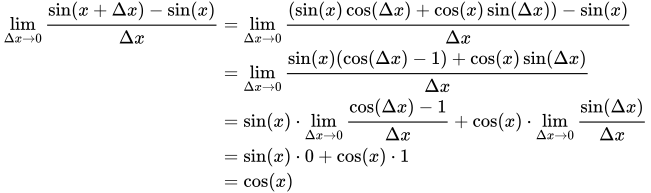
{\displaystyle {\begin{aligned}\lim _{\Delta x\to 0}{\frac {\sin(x+\Delta x)-\sin(x)}{\Delta x}}&=\lim _{\Delta x\to 0}{\frac {(\sin(x)\cos(\Delta x)+\cos(x)\sin(\Delta x))-\sin(x)}{\Delta x}}\\&=\lim _{\Delta x\to 0}{\frac {\sin(x)(\cos(\Delta x)-1)+\cos(x)\sin(\Delta x)}{\Delta x}}\\&=\sin(x)\cdot \lim _{\Delta x\to 0}{\frac {\cos(\Delta x)-1}{\Delta x}}+\cos(x)\cdot \lim _{\Delta x\to 0}{\frac {\sin(\Delta x)}{\Delta x}}\\&=\sin(x)\cdot 0+\cos(x)\cdot 1\\&=\cos(x)\end{aligned}}}
lim
Δ
x
→
0
sin
(
x
+
Δ
x
)
−
sin
(
x
)
Δ
x
=
lim
Δ
x
→
0
(
sin
(
x
)
cos
(
Δ
x
)
+
cos
(
x
)
sin
(
Δ
x
)
)
−
sin
(
x
)
Δ
x
=
lim
Δ
x
→
0
sin
(
x
)
(
cos
(
Δ
x
)
−
1
)
+
cos
(
x
)
sin
(
Δ
x
)
Δ
x
=
sin
(
x
)
⋅
lim
Δ
x
→
0
cos
(
Δ
x
)
−
1
Δ
x
+
cos
(
x
)
⋅
lim
Δ
x
→
0
sin
(
Δ
x
)
Δ
x
=
sin
(
x
)
⋅
0
+
cos
(
x
)
⋅
1
=
cos
(
x
)
{\displaystyle {\begin{aligned}\lim _{\Delta x\to 0}{\frac {\sin(x+\Delta x)-\sin(x)}{\Delta x}}&=\lim _{\Delta x\to 0}{\frac {(\sin(x)\cos(\Delta x)+\cos(x)\sin(\Delta x))-\sin(x)}{\Delta x}}\\&=\lim _{\Delta x\to 0}{\frac {\sin(x)(\cos(\Delta x)-1)+\cos(x)\sin(\Delta x)}{\Delta x}}\\&=\sin(x)\cdot \lim _{\Delta x\to 0}{\frac {\cos(\Delta x)-1}{\Delta x}}+\cos(x)\cdot \lim _{\Delta x\to 0}{\frac {\sin(\Delta x)}{\Delta x}}\\&=\sin(x)\cdot 0+\cos(x)\cdot 1\\&=\cos(x)\end{aligned}}}
求解以下方程的導數
7.
f
(
x
)
=
42
{\displaystyle f(x)=42}
f
′
(
x
)
=
0
{\displaystyle \mathbf {f'(x)=0} }
f
′
(
x
)
=
0
{\displaystyle \mathbf {f'(x)=0} }
8.
f
(
x
)
=
6
x
+
10
{\displaystyle f(x)=6x+10}
f
′
(
x
)
=
6
{\displaystyle \mathbf {f'(x)=6} }
f
′
(
x
)
=
6
{\displaystyle \mathbf {f'(x)=6} }
9.
f
(
x
)
=
2
x
2
+
12
x
+
3
{\displaystyle f(x)=2x^{2}+12x+3}
f
′
(
x
)
=
4
x
+
12
{\displaystyle \mathbf {f'(x)=4x+12} }
f
′
(
x
)
=
4
x
+
12
{\displaystyle \mathbf {f'(x)=4x+12} }
分類
:
書籍:微積分
華夏公益教科書



 在點
在點  處的切線的斜率。
 在
在  處的斜率的定義是
 ![{\displaystyle \lim _{h\to 0}\left[{\frac {f\left(x_{0}+h\right)-f\left(x_{0}\right)}{h}}\right]}](https://wikimedia.org/api/rest_v1/media/math/render/svg/46421a58871ed833110f81a775ee74e7b4f12d42)


![{\displaystyle {\begin{aligned}\lim _{h\to 0}\left[{\frac {(1+h)^{2}-1}{h}}\right]&=\lim _{h\to 0}\left[{\frac {h^{2}+2h}{h}}\right]\\&=\lim _{h\to 0}\left[{\frac {h(h+2)}{h}}\right]\\&=\lim _{h\to 0}h+2\\&=\mathbf {2} \end{aligned}}}](https://wikimedia.org/api/rest_v1/media/math/render/svg/3a29a2398180bb5093cdb55e78fc4abce2a45763) 在 處的斜率的定義是
在 處的斜率的定義是 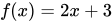 的導數。
的導數。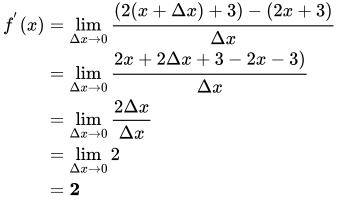
 的導數。現在嘗試
  。你能看出規律嗎?在下一節中,我們將找到
  對所有
對所有  的導數。
的導數。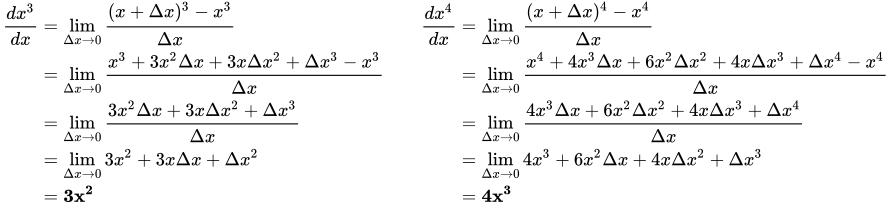
 在
在  處沒有定義。利用導數的定義證明這一點。
 處左極限和右極限不相等,因此極限不存在,所以在處不可導。
處左極限和右極限不相等,因此極限不存在,所以在處不可導。
處左極限和右極限不相等,因此極限不存在,所以在處不可導。 的導數是
的導數是 。提示:使用合適的積化和差公式,以及
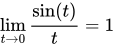 和
和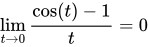 。
。