形式上,元胞自動機用 4 元組 ( Z , S , N , f ) {\displaystyle (Z,S,N,f)}
Z {\displaystyle Z} 格點 S {\displaystyle S} 狀態 或 值 的有限集合 N {\displaystyle N} 鄰域 f {\displaystyle f} 區域性轉換函式 格點 是有限或無限的離散規則網格,在有限數量的維度上包含單元格。每個 單元格 由其離散的 位置 (每個維度上的整數)及其離散的 值 (有限整數集中的一個)定義。時間也是離散的。單元格的未來狀態(時間 t + 1 {\displaystyle t+1} t − 1 {\displaystyle t-1}
為了提高可讀性,接下來的定義將重點放在一維一階元胞自動機上。
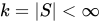
無限全域性狀態是 配置 C ∈ S Z {\displaystyle C\in S^{Z}} S {\displaystyle S} k = | S | < ∞ {\displaystyle k=|S|<\infty } 單元格狀態 c ∈ S {\displaystyle c\in S} S = { 0 , 1 , … , k − 1 } {\displaystyle S=\{0,1,\dots ,k-1\}} Z {\displaystyle Z} 迴圈群 的無限 整數 { . . . , − 1 , 0 , 1 , 2 , . . . } {\displaystyle \{...,-1,0,1,2,...\}} 位置索引 x ∈ Z {\displaystyle x\in Z}
C = … c − 1 c 0 c 1 c 2 … c x − 1 c x c x + 1 … {\displaystyle C=\dots c_{-1}c_{0}c_{1}c_{2}\dots c_{x-1}c_{x}c_{x+1}\dots } 有限的全域性狀態是一個有限配置 C ∈ S Z {\displaystyle C\in S^{Z}} Z {\displaystyle Z} N {\displaystyle N} { 0 , 1 , 2 , . . . , N − 1 } {\displaystyle \{0,1,2,...,N-1\}}
C = c 0 c 1 … c x − 1 c x c x + 1 … c N − 2 c N − 1 {\displaystyle C=c_{0}c_{1}\dots c_{x-1}c_{x}c_{x+1}\dots c_{N-2}c_{N-1}} 有限配置及其部分通常可以寫成由字母表開頭的希臘小寫字母表示的字串 ( α {\displaystyle \alpha } β {\displaystyle \beta }
字串可以簡潔地寫成數字。一個包含 N {\displaystyle N} C {\displaystyle C} | S | {\displaystyle |S|} N {\displaystyle N} | S | {\displaystyle |S|}
α = ∑ i = 0 N − 1 k N − 1 − i c i = k N − 1 c 0 + ⋯ + k 1 c N − 2 + k 0 c N − 1 {\displaystyle \alpha =\sum _{i=0}^{N-1}k^{N-1-i}c_{i}=k^{N-1}c_{0}+\cdots +k^{1}c_{N-2}+k^{0}c_{N-1}} 鄰域的大小和位置 鄰域 A {\displaystyle A} m = | A | {\displaystyle m=|A|}
A = { a 0 , a 1 , … , a m − 1 } {\displaystyle A=\{a_{0},a_{1},\dots ,a_{m-1}\}} 將集合 A {\displaystyle A} c x {\displaystyle c_{x}}
n x = c x + a 0 c x − a 1 … c x + a m − 1 {\displaystyle n_{x}=c_{x+a_{0}}c_{x-a_{1}}\dots c_{x+a_{m-1}}} 術語“鄰域”既可以指代相對距離集合,也可以指代與觀測單元格相關的實際單元格子串。
鄰域值 n x {\displaystyle n_{x}} m {\displaystyle m} k {\displaystyle k}
n x = ∑ i = 0 m − 1 k m − 1 − i c x + a i = c x + a 0 k m − 1 + c x + a 1 k m − 2 + ⋯ + c x + a m − 1 k 0 {\displaystyle n_{x}=\sum _{i=0}^{m-1}{k^{m-1-i}c_{x+a_{i}}}=c_{x+a_{0}}k^{m-1}+c_{x+a_{1}}k^{m-2}+\dots +c_{x+a_{m-1}}k^{0}} 鄰域單元格索引和區域性轉換函式 有關常見鄰域的定義,請參見鄰域。
區域性轉換函式
f : S N ↦ S {\displaystyle f:S^{N}\mapsto S} 根據當前觀測單元格的鄰域計算單個未來單元格 c x {\displaystyle c_{x}}
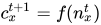
c x t + 1 = f ( n x t ) {\displaystyle c_{x}^{t+1}=f(n_{x}^{t})} 轉換表 透過列出每個輸入值的輸出值來定義區域性轉換函式。
 n  -> f(n)
-----------
000 -> 0
001 -> 0
........
111 -> 0
規則 f {\displaystyle f} m {\displaystyle m} k {\displaystyle k}
f = ∑ i = 1 k m − 1 f ( i ) k i = f ( k m − 1 ) k k m − 1 + ⋯ + f ( 1 ) k 1 + f ( 0 ) k 0 {\displaystyle f=\sum _{i=1}^{k^{m}-1}{f(i)k^{i}}=f(k^{m}-1)k^{k^{m}-1}+\dots +f(1)k^{1}+f(0)k^{0}} 另見
元胞自動機的全域性動力學由全域性轉換函式 描述
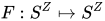
F : S Z ↦ S Z {\displaystyle F:S^{Z}\mapsto S^{Z}} F {\displaystyle F} C t {\displaystyle C^{t}} C t + 1 {\displaystyle C^{t+1}}
C t + 1 = F ( C t ) {\displaystyle C^{t+1}=F\left(C^{t}\right)} 全域性轉換函式 F {\displaystyle F} f {\displaystyle f}
F ( … c x − 1 c x c x + 1 … ) = … f ( n x − 1 ) f ( n x ) f ( n x + 1 ) … {\displaystyle F(\dots c_{x-1}c_{x}c_{x+1}\dots )=\dots f(n_{x-1})f(n_{x})f(n_{x+1})\dots } 晶格邊界大小(左和右) 無限元胞自動機沒有邊界,因此其邊界描述 B {\displaystyle B} l {\displaystyle l}
區域性轉換函式中使用的鄰域在左側越過晶格邊界 r L {\displaystyle r_{L}} r R {\displaystyle r_{R}}
越過問題有兩個常見的解決方案
晶格被包裹成一個圓圈(對於 2D 元胞自動機則是環面)
鄰域越過部分的值被明確定義為邊界 B {\displaystyle B} 迴圈邊界 經常被使用,因為沒有必要明確定義邊界值,並且不會將外部資訊引入元胞自動機,否則這些資訊會導致邊界處的干擾。
有限格子的元胞自動機的狀態是格子 S Z {\displaystyle S^{Z}} 配置 ,其中 Z {\displaystyle Z} 迴圈群 ,對 N {\displaystyle N} 模 ( { 0 , 1 , . . . , N − 1 } {\displaystyle \{0,1,...,N-1\}}
C = c 0 c 1 … c x − 1 c i c x + 1 … c N − 1 c ∈ S {\displaystyle C=c_{0}c_{1}\dots c_{x-1}c_{i}c_{x+1}\dots c_{N-1}\qquad c\in S} 迴圈位置索引計算為
x ∘ = x mod N x ≤ 0 ∨ x > N {\displaystyle x_{\circ }=x\mod N\qquad x\leq 0\vee x>N} 格子的邊界(左和右) 顯式定義的邊界 比較少見,因為簡單常數值只對週期為1的靜止背景上觀察事件的CA有用。邊界可以定義為單個集合(左和右部分組合),長度為 k − 1 {\displaystyle k-1}
B = { b − k 0 , … b − 2 , b − 1 , b l , b N + 1 , … , b k − k 0 − 1 } b ∈ S {\displaystyle B=\{b_{-k_{0}},\dots b_{-2},b_{-1},b_{l},b_{N+1},\dots ,b_{k-k_{0}-1}\}\quad b\in S} 對於時空週期性的靜止背景,可以使用時間相關的邊界 B = B ( t ) {\displaystyle B=B(t)}
二維格子中的鄰域 n 維CA的定義類似於一維CA,格子變為n 維, k {\displaystyle k} k 0 {\displaystyle k_{0}} n {\displaystyle n}
二維格子可以用不同的方式用單元格進行平鋪
方格(4重旋轉對稱 )
三角形網格(3重對稱)或六邊形網格(6重對稱)
準週期網格(彭羅斯拼貼 ) 二維元胞自動機通常用於模擬真實動態系統(流體和氣體動力學)
另見
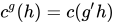
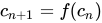
One further generalization of the concept of a CA extends the n -dimensional construct. Given a finitely generated group, G {\displaystyle G} A {\displaystyle A} C = A G {\displaystyle C=A^{G}} G {\displaystyle G} A {\displaystyle A} G {\displaystyle G} Z n {\displaystyle Z^{n}} n -dimensional lattice with possibly periodic boundary conditions. This space admits a group action, where c g ( h ) = c ( g ′ h ) {\displaystyle c^{g}(h)=c(g'h)} g ′ {\displaystyle g'} g {\displaystyle g} d ( g , h ) {\displaystyle d(g,h)} g {\displaystyle g} h {\displaystyle h} d ( c , c ′ ) {\displaystyle d(c,c')} 1 / ( 1 + d ( e , h ) ) {\displaystyle 1/(1+d(e,h))} h {\displaystyle h} c {\displaystyle c} c ′ {\displaystyle c'} h {\displaystyle h} e {\displaystyle e} f : C → C {\displaystyle f:C\to C} c 0 {\displaystyle c_{0}} c n + 1 = f ( c n ) {\displaystyle c_{n+1}=f(c_{n})}
如果不僅使用當前配置,還使用過去配置來計算未來,則 CA 為更高階。 二階區域性轉移函式定義為
c x t + 1 = f ( n x t , n x t − 1 ) {\displaystyle c_{x}^{t+1}=f(n_{x}^{t},n_{x}^{t-1})} 二階區域性轉移函式通常用於構造可逆規則。