此練習推薦給所有讀者。
問題 1
將向量投影到 M {\displaystyle M} N {\displaystyle N}
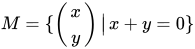
( 3 − 2 ) , M = { ( x y ) | x + y = 0 } , N = { ( x y ) | − x − 2 y = 0 } {\displaystyle {\begin{pmatrix}3\\-2\end{pmatrix}},\quad M=\{{\begin{pmatrix}x\\y\end{pmatrix}}\,{\big |}\,x+y=0\},\quad N=\{{\begin{pmatrix}x\\y\end{pmatrix}}\,{\big |}\,-x-2y=0\}} ( 1 2 ) , M = { ( x y ) | x − y = 0 } , N = { ( x y ) | 2 x + y = 0 } {\displaystyle {\begin{pmatrix}1\\2\end{pmatrix}},\quad M=\{{\begin{pmatrix}x\\y\end{pmatrix}}\,{\big |}\,x-y=0\},\quad N=\{{\begin{pmatrix}x\\y\end{pmatrix}}\,{\big |}\,2x+y=0\}} ( 3 0 1 ) , M = { ( x y z ) | x + y = 0 } , N = { c ⋅ ( 1 0 1 ) | c ∈ R } {\displaystyle {\begin{pmatrix}3\\0\\1\end{pmatrix}},\quad M=\{{\begin{pmatrix}x\\y\\z\end{pmatrix}}\,{\big |}\,x+y=0\},\quad N=\{c\cdot {\begin{pmatrix}1\\0\\1\end{pmatrix}}\,{\big |}\,c\in \mathbb {R} \}}
答案
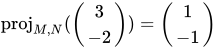
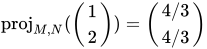
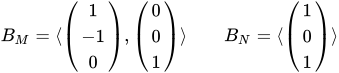
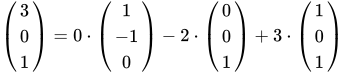
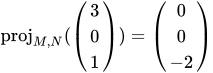
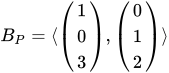
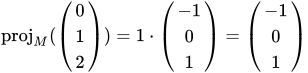
當子空間的基 B M = ⟨ ( 1 − 1 ) ⟩ B N = ⟨ ( 2 − 1 ) ⟩ {\displaystyle B_{M}=\langle {\begin{pmatrix}1\\-1\end{pmatrix}}\rangle \qquad B_{N}=\langle {\begin{pmatrix}2\\-1\end{pmatrix}}\rangle } B = B M ⌢ B N = ⟨ ( 1 − 1 ) , ( 2 − 1 ) ⟩ {\displaystyle B=B_{M}\!{\mathbin {{}^{\frown }}}\!B_{N}=\langle {\begin{pmatrix}1\\-1\end{pmatrix}},{\begin{pmatrix}2\\-1\end{pmatrix}}\rangle } ( 3 − 2 ) = 1 ⋅ ( 1 − 1 ) + 1 ⋅ ( 2 − 1 ) {\displaystyle {\begin{pmatrix}3\\-2\end{pmatrix}}=1\cdot {\begin{pmatrix}1\\-1\end{pmatrix}}+1\cdot {\begin{pmatrix}2\\-1\end{pmatrix}}} M {\displaystyle M} N {\displaystyle N} proj M , N ( ( 3 − 2 ) ) = ( 1 − 1 ) {\displaystyle {\mbox{proj}}_{M,N}({\begin{pmatrix}3\\-2\end{pmatrix}})={\begin{pmatrix}1\\-1\end{pmatrix}}} 當基底 B M = ⟨ ( 1 1 ) ⟩ B N ⟨ ( 1 − 2 ) ⟩ {\displaystyle B_{M}=\langle {\begin{pmatrix}1\\1\end{pmatrix}}\rangle \qquad B_{N}\langle {\begin{pmatrix}1\\-2\end{pmatrix}}\rangle } ( 1 2 ) = ( 4 / 3 ) ⋅ ( 1 1 ) − ( 1 / 3 ) ⋅ ( 1 − 2 ) {\displaystyle {\begin{pmatrix}1\\2\end{pmatrix}}=(4/3)\cdot {\begin{pmatrix}1\\1\end{pmatrix}}-(1/3)\cdot {\begin{pmatrix}1\\-2\end{pmatrix}}} M {\displaystyle M} proj M , N ( ( 1 2 ) ) = ( 4 / 3 4 / 3 ) {\displaystyle {\mbox{proj}}_{M,N}({\begin{pmatrix}1\\2\end{pmatrix}})={\begin{pmatrix}4/3\\4/3\end{pmatrix}}} 對於這些基底 B M = ⟨ ( 1 − 1 0 ) , ( 0 0 1 ) ⟩ B N = ⟨ ( 1 0 1 ) ⟩ {\displaystyle B_{M}=\langle {\begin{pmatrix}1\\-1\\0\end{pmatrix}},{\begin{pmatrix}0\\0\\1\end{pmatrix}}\rangle \qquad B_{N}=\langle {\begin{pmatrix}1\\0\\1\end{pmatrix}}\rangle } ( 3 0 1 ) = 0 ⋅ ( 1 − 1 0 ) − 2 ⋅ ( 0 0 1 ) + 3 ⋅ ( 1 0 1 ) {\displaystyle {\begin{pmatrix}3\\0\\1\end{pmatrix}}=0\cdot {\begin{pmatrix}1\\-1\\0\end{pmatrix}}-2\cdot {\begin{pmatrix}0\\0\\1\end{pmatrix}}+3\cdot {\begin{pmatrix}1\\0\\1\end{pmatrix}}} proj M , N ( ( 3 0 1 ) ) = ( 0 0 − 2 ) {\displaystyle {\mbox{proj}}_{M,N}({\begin{pmatrix}3\\0\\1\end{pmatrix}})={\begin{pmatrix}0\\0\\-2\end{pmatrix}}}
此練習推薦給所有讀者。
問題 2
求 M ⊥ {\displaystyle M^{\perp }}
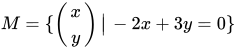
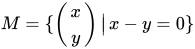
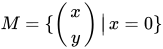
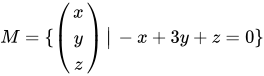
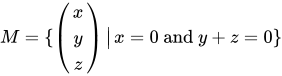
M = { ( x y ) | x + y = 0 } {\displaystyle M=\{{\begin{pmatrix}x\\y\end{pmatrix}}\,{\big |}\,x+y=0\}} M = { ( x y ) | − 2 x + 3 y = 0 } {\displaystyle M=\{{\begin{pmatrix}x\\y\end{pmatrix}}\,{\big |}\,-2x+3y=0\}} M = { ( x y ) | x − y = 0 } {\displaystyle M=\{{\begin{pmatrix}x\\y\end{pmatrix}}\,{\big |}\,x-y=0\}} M = { 0 → } {\displaystyle M=\{{\vec {0}}\,\}} M = { ( x y ) | x = 0 } {\displaystyle M=\{{\begin{pmatrix}x\\y\end{pmatrix}}\,{\big |}\,x=0\}} M = { ( x y z ) | − x + 3 y + z = 0 } {\displaystyle M=\{{\begin{pmatrix}x\\y\\z\end{pmatrix}}\,{\big |}\,-x+3y+z=0\}} M = { ( x y z ) | x = 0 and y + z = 0 } {\displaystyle M=\{{\begin{pmatrix}x\\y\\z\end{pmatrix}}\,{\big |}\,x=0{\text{ and }}y+z=0\}}
答案
如同在示例 3.5 中,我們可以透過僅僅找出垂直於 M {\displaystyle M}
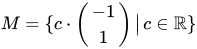
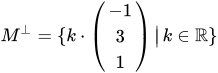
引數化得到 M = { c ⋅ ( − 1 1 ) | c ∈ R } {\displaystyle M=\{c\cdot {\begin{pmatrix}-1\\1\end{pmatrix}}\,{\big |}\,c\in \mathbb {R} \}} M ⊥ { ( u v ) | 0 = ( u v ) ⋅ ( − 1 1 ) } = { ( u v ) | 0 = − u + v } {\displaystyle M^{\perp }\{{\begin{pmatrix}u\\v\end{pmatrix}}\,{\big |}\,0={\begin{pmatrix}u\\v\end{pmatrix}}\cdot {\begin{pmatrix}-1\\1\end{pmatrix}}\}=\{{\begin{pmatrix}u\\v\end{pmatrix}}\,{\big |}\,0=-u+v\}} M ⊥ = { k ⋅ ( 1 1 ) | k ∈ R } {\displaystyle M^{\perp }=\{k\cdot {\begin{pmatrix}1\\1\end{pmatrix}}\,{\big |}\,k\in \mathbb {R} \}} 如先前部分的答案所示, M {\displaystyle M} M = { c ⋅ ( 3 / 2 1 ) | c ∈ R } B M = ⟨ ( 3 / 2 1 ) ⟩ {\displaystyle M=\{c\cdot {\begin{pmatrix}3/2\\1\end{pmatrix}}\,{\big |}\,c\in \mathbb {R} \}\qquad B_{M}=\langle {\begin{pmatrix}3/2\\1\end{pmatrix}}\rangle } M ⊥ {\displaystyle M^{\perp }} M ⊥ = { ( u v ) | ( 3 / 2 ) ⋅ u + 1 ⋅ v = 0 } = { k ⋅ ( − 2 / 3 1 ) | k ∈ R } {\displaystyle M^{\perp }=\{{\begin{pmatrix}u\\v\end{pmatrix}}\,{\big |}\,(3/2)\cdot u+1\cdot v=0\}=\{k\cdot {\begin{pmatrix}-2/3\\1\end{pmatrix}}\,{\big |}\,k\in \mathbb {R} \}} 對 M {\displaystyle M} M = { c ⋅ ( 1 1 ) | c ∈ R } B M = ⟨ ( 1 1 ) ⟩ {\displaystyle M=\{c\cdot {\begin{pmatrix}1\\1\end{pmatrix}}\,{\big |}\,c\in \mathbb {R} \}\qquad B_{M}=\langle {\begin{pmatrix}1\\1\end{pmatrix}}\rangle } M ⊥ {\displaystyle M^{\perp }} B M {\displaystyle B_{M}} M ⊥ = { ( u v ) | u + v = 0 } = { k ⋅ ( − 1 1 ) | k ∈ R } {\displaystyle M^{\perp }=\{{\begin{pmatrix}u\\v\end{pmatrix}}\,{\big |}\,u+v=0\}=\{k\cdot {\begin{pmatrix}-1\\1\end{pmatrix}}\,{\big |}\,k\in \mathbb {R} \}} 空間中的每個向量都垂直於零向量,所以 M ⊥ = R n {\displaystyle M^{\perp }=\mathbb {R} ^{n}} 對 M {\displaystyle M} M = { y ⋅ ( 0 1 ) | y ∈ R } B M = ⟨ ( 0 1 ) ⟩ {\displaystyle M=\{y\cdot {\begin{pmatrix}0\\1\end{pmatrix}}\,{\big |}\,y\in \mathbb {R} \}\qquad B_{M}=\langle {\begin{pmatrix}0\\1\end{pmatrix}}\rangle } M ⊥ = { ( u v ) | 0 ⋅ u + 1 ⋅ v = 0 } = { k ⋅ ( 1 0 ) | k ∈ R } {\displaystyle M^{\perp }=\{{\begin{pmatrix}u\\v\end{pmatrix}}\,{\big |}\,0\cdot u+1\cdot v=0\}=\{k\cdot {\begin{pmatrix}1\\0\end{pmatrix}}\,{\big |}\,k\in \mathbb {R} \}} ( y -axis ) ⊥ = x -axis {\displaystyle (y{\text{-axis}})^{\perp }=x{\text{-axis}}} 使用引數方程很容易找到 M {\displaystyle M} M = { c ⋅ ( 3 1 0 ) + d ⋅ ( 1 0 1 ) | c , d ∈ R } B M = ⟨ ( 3 1 0 ) , ( 1 0 1 ) ⟩ {\displaystyle M=\{c\cdot {\begin{pmatrix}3\\1\\0\end{pmatrix}}+d\cdot {\begin{pmatrix}1\\0\\1\end{pmatrix}}\,{\big |}\,c,d\in \mathbb {R} \}\qquad B_{M}=\langle {\begin{pmatrix}3\\1\\0\end{pmatrix}},{\begin{pmatrix}1\\0\\1\end{pmatrix}}\rangle } M ⊥ {\displaystyle M^{\perp }} 3 u + v = 0 u + w = 0 → − ( 1 / 3 ) ρ 1 + ρ 2 3 u + v = 0 − ( 1 / 3 ) v + w = 0 {\displaystyle {\begin{array}{*{3}{rc}r}3u&+&v&&&=&0\\u&&&+&w&=&0\end{array}}\;{\xrightarrow[{}]{-(1/3)\rho _{1}+\rho _{2}}}\;{\begin{array}{*{3}{rc}r}3u&+&v&&&=&0\\&&-(1/3)v&+&w&=&0\end{array}}} M ⊥ = { k ⋅ ( − 1 3 1 ) | k ∈ R } {\displaystyle M^{\perp }=\{k\cdot {\begin{pmatrix}-1\\3\\1\end{pmatrix}}\,{\big |}\,k\in \mathbb {R} \}} 這裡, M {\displaystyle M} M = { c ⋅ ( 0 − 1 1 ) | c ∈ R } B M = ⟨ ( 0 − 1 1 ) ⟩ {\displaystyle M=\{c\cdot {\begin{pmatrix}0\\-1\\1\end{pmatrix}}\,{\big |}\,c\in \mathbb {R} \}\qquad B_{M}=\langle {\begin{pmatrix}0\\-1\\1\end{pmatrix}}\rangle } M ⊥ {\displaystyle M^{\perp }} M ⊥ = { ( u v w ) | 0 ⋅ u − 1 ⋅ v + 1 ⋅ w = 0 } = { j ⋅ ( 1 0 0 ) + k ⋅ ( 0 1 1 ) | j , k ∈ R } {\displaystyle M^{\perp }=\{{\begin{pmatrix}u\\v\\w\end{pmatrix}}\,{\big |}\,0\cdot u-1\cdot v+1\cdot w=0\}=\{j\cdot {\begin{pmatrix}1\\0\\0\end{pmatrix}}+k\cdot {\begin{pmatrix}0\\1\\1\end{pmatrix}}\,{\big |}\,j,k\in \mathbb {R} \}}
此練習推薦給所有讀者。
問題 4
我們有三種方法可以找到向量在直線上的正交投影,第一種方法是本節第一小節中給出的定義 1.1 方法,第二種方法是透過示例 3.2 和3.3 使用空間基底表示向量,然後保留 M {\displaystyle M} 定理 3.8 。對於這些情況,請使用所有三種方法。
v → = ( 1 − 3 ) , M = { ( x y ) | x + y = 0 } {\displaystyle {\vec {v}}={\begin{pmatrix}1\\-3\end{pmatrix}},\quad M=\{{\begin{pmatrix}x\\y\end{pmatrix}}\,{\big |}\,x+y=0\}} v → = ( 0 1 2 ) , M = { ( x y z ) | x + z = 0 and y = 0 } {\displaystyle {\vec {v}}={\begin{pmatrix}0\\1\\2\end{pmatrix}},\quad M=\{{\begin{pmatrix}x\\y\\z\end{pmatrix}}\,{\big |}\,x+z=0{\text{ and }}y=0\}}
答案
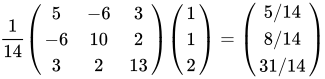
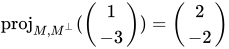
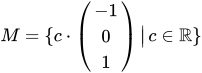
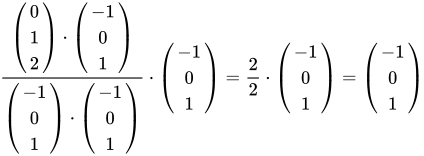
引數化給出以下結果。 M = { c ⋅ ( − 1 1 ) | c ∈ R } {\displaystyle M=\{c\cdot {\begin{pmatrix}-1\\1\end{pmatrix}}\,{\big |}\,c\in \mathbb {R} \}} M {\displaystyle M} s → = ( − 1 1 ) {\displaystyle {\vec {s}}={\begin{pmatrix}-1\\1\end{pmatrix}}} 定義 1.1 公式給出以下結果。 proj [ s → ] ( ( 1 − 3 ) ) = ( 1 − 3 ) ⋅ ( − 1 1 ) ( − 1 1 ) ⋅ ( − 1 1 ) ⋅ ( − 1 1 ) = − 4 2 ⋅ ( − 1 1 ) = ( 2 − 2 ) {\displaystyle {\mbox{proj}}_{[{\vec {s}}\,]}({\begin{pmatrix}1\\-3\end{pmatrix}})={\frac {{\begin{pmatrix}1\\-3\end{pmatrix}}\cdot {\begin{pmatrix}-1\\1\end{pmatrix}}}{{\begin{pmatrix}-1\\1\end{pmatrix}}\cdot {\begin{pmatrix}-1\\1\end{pmatrix}}}}\cdot {\begin{pmatrix}-1\\1\end{pmatrix}}={\frac {-4}{2}}\cdot {\begin{pmatrix}-1\\1\end{pmatrix}}={\begin{pmatrix}2\\-2\end{pmatrix}}} B M = ⟨ ( − 1 1 ) ⟩ {\displaystyle B_{M}=\langle {\begin{pmatrix}-1\\1\end{pmatrix}}\rangle } 示例 3.5 和 3.6 中,我們只需找到垂直於基底中所有向量的向量) M ⊥ = { ( u v ) | − 1 ⋅ u + 1 ⋅ v = 0 } = { k ⋅ ( 1 1 ) | k ∈ R } B M ⊥ = ⟨ ( 1 1 ) ⟩ {\displaystyle M^{\perp }=\{{\begin{pmatrix}u\\v\end{pmatrix}}\,{\big |}\,-1\cdot u+1\cdot v=0\}=\{k\cdot {\begin{pmatrix}1\\1\end{pmatrix}}\,{\big |}\,k\in \mathbb {R} \}\qquad B_{M^{\perp }}=\langle {\begin{pmatrix}1\\1\end{pmatrix}}\rangle } ( 1 − 3 ) = − 2 ⋅ ( − 1 1 ) − 1 ⋅ ( 1 1 ) {\displaystyle {\begin{pmatrix}1\\-3\end{pmatrix}}=-2\cdot {\begin{pmatrix}-1\\1\end{pmatrix}}-1\cdot {\begin{pmatrix}1\\1\end{pmatrix}}} M {\displaystyle M} proj M , M ⊥ ( ( 1 − 3 ) ) = ( 2 − 2 ) {\displaystyle {\mbox{proj}}_{M,M^{\perp }}({\begin{pmatrix}1\\-3\end{pmatrix}})={\begin{pmatrix}2\\-2\end{pmatrix}}} 1 × 1 {\displaystyle 1\!\times \!1} 1 × 1 {\displaystyle 1\!\times \!1} A ( A t r a n s A ) − 1 A t r a n s = ( − 1 1 ) ( ( − 1 1 ) ( − 1 1 ) ) − 1 ( − 1 1 ) = ( − 1 1 ) ( 2 ) − 1 ( − 1 1 ) {\displaystyle A\left({{A}^{\rm {trans}}}A\right)^{-1}{{A}^{\rm {trans}}}={\begin{pmatrix}-1\\1\end{pmatrix}}\left({\begin{pmatrix}-1&1\end{pmatrix}}{\begin{pmatrix}-1\\1\end{pmatrix}}\right)^{-1}{\begin{pmatrix}-1&1\end{pmatrix}}={\begin{pmatrix}-1\\1\end{pmatrix}}{\begin{pmatrix}2\end{pmatrix}}^{-1}{\begin{pmatrix}-1&1\end{pmatrix}}} = ( − 1 1 ) ( 1 / 2 ) ( − 1 1 ) = ( − 1 1 ) ( − 1 / 2 1 / 2 ) = ( 1 / 2 − 1 / 2 − 1 / 2 1 / 2 ) {\displaystyle ={\begin{pmatrix}-1\\1\end{pmatrix}}{\begin{pmatrix}1/2\end{pmatrix}}{\begin{pmatrix}-1&1\end{pmatrix}}={\begin{pmatrix}-1\\1\end{pmatrix}}{\begin{pmatrix}-1/2&1/2\end{pmatrix}}={\begin{pmatrix}1/2&-1/2\\-1/2&1/2\end{pmatrix}}} proj M ( ( 1 − 3 ) ) = ( 1 / 2 − 1 / 2 − 1 / 2 1 / 2 ) ( 1 − 3 ) = ( 2 − 2 ) {\displaystyle {\mbox{proj}}_{M}({\begin{pmatrix}1\\-3\end{pmatrix}})={\begin{pmatrix}1/2&-1/2\\-1/2&1/2\end{pmatrix}}{\begin{pmatrix}1\\-3\end{pmatrix}}={\begin{pmatrix}2\\-2\end{pmatrix}}} 引數化給出以下結果。 M = { c ⋅ ( − 1 0 1 ) | c ∈ R } {\displaystyle M=\{c\cdot {\begin{pmatrix}-1\\0\\1\end{pmatrix}}\,{\big |}\,c\in \mathbb {R} \}} ( 0 1 2 ) ⋅ ( − 1 0 1 ) ( − 1 0 1 ) ⋅ ( − 1 0 1 ) ⋅ ( − 1 0 1 ) = 2 2 ⋅ ( − 1 0 1 ) = ( − 1 0 1 ) {\displaystyle {\frac {{\begin{pmatrix}0\\1\\2\end{pmatrix}}\cdot {\begin{pmatrix}-1\\0\\1\end{pmatrix}}}{{\begin{pmatrix}-1\\0\\1\end{pmatrix}}\cdot {\begin{pmatrix}-1\\0\\1\end{pmatrix}}}}\cdot {\begin{pmatrix}-1\\0\\1\end{pmatrix}}={\frac {2}{2}}\cdot {\begin{pmatrix}-1\\0\\1\end{pmatrix}}={\begin{pmatrix}-1\\0\\1\end{pmatrix}}} M ⊥ {\displaystyle M^{\perp }} M ⊥ = { ( u v w ) | − u + w = 0 } = { j ⋅ ( 1 0 1 ) + k ⋅ ( 0 1 0 ) | j , k ∈ R } {\displaystyle M^{\perp }=\{{\begin{pmatrix}u\\v\\w\end{pmatrix}}\,{\big |}\,-u+w=0\}=\{j\cdot {\begin{pmatrix}1\\0\\1\end{pmatrix}}+k\cdot {\begin{pmatrix}0\\1\\0\end{pmatrix}}\,{\big |}\,j,k\in \mathbb {R} \}} B M {\displaystyle B_{M}} B M ⊥ {\displaystyle B_{M^{\perp }}} ( 0 1 2 ) = 1 ⋅ ( − 1 0 1 ) + 1 ⋅ ( 1 0 1 ) + 1 ⋅ ( 0 1 0 ) {\displaystyle {\begin{pmatrix}0\\1\\2\end{pmatrix}}=1\cdot {\begin{pmatrix}-1\\0\\1\end{pmatrix}}+1\cdot {\begin{pmatrix}1\\0\\1\end{pmatrix}}+1\cdot {\begin{pmatrix}0\\1\\0\end{pmatrix}}} M {\displaystyle M} proj M ( ( 0 1 2 ) ) = 1 ⋅ ( − 1 0 1 ) = ( − 1 0 1 ) {\displaystyle {\mbox{proj}}_{M}({\begin{pmatrix}0\\1\\2\end{pmatrix}})=1\cdot {\begin{pmatrix}-1\\0\\1\end{pmatrix}}={\begin{pmatrix}-1\\0\\1\end{pmatrix}}} A ( A t r a n s A ) − 1 A t r a n s = ( − 1 0 1 ) ( ( − 1 0 1 ) ( − 1 0 1 ) ) − 1 ( − 1 0 1 ) = ( − 1 0 1 ) ( 2 ) − 1 ( − 1 0 1 ) {\displaystyle A\left({{A}^{\rm {trans}}}A\right)^{-1}{{A}^{\rm {trans}}}={\begin{pmatrix}-1\\0\\1\end{pmatrix}}{\bigl (}{\begin{pmatrix}-1&0&1\end{pmatrix}}{\begin{pmatrix}-1\\0\\1\end{pmatrix}}{\bigr )}^{-1}{\begin{pmatrix}-1&0&1\end{pmatrix}}={\begin{pmatrix}-1\\0\\1\end{pmatrix}}{\begin{pmatrix}2\end{pmatrix}}^{-1}{\begin{pmatrix}-1&0&1\end{pmatrix}}} = ( − 1 0 1 ) ( 1 / 2 ) ( − 1 0 1 ) = ( − 1 0 1 ) ( − 1 / 2 0 1 / 2 ) = ( 1 / 2 0 − 1 / 2 0 0 0 − 1 / 2 0 1 / 2 ) {\displaystyle ={\begin{pmatrix}-1\\0\\1\end{pmatrix}}{\begin{pmatrix}1/2\end{pmatrix}}{\begin{pmatrix}-1&0&1\end{pmatrix}}={\begin{pmatrix}-1\\0\\1\end{pmatrix}}{\begin{pmatrix}-1/2&0&1/2\end{pmatrix}}={\begin{pmatrix}1/2&0&-1/2\\0&0&0\\-1/2&0&1/2\end{pmatrix}}} proj M ( ( 0 1 2 ) ) ( 1 / 2 0 − 1 / 2 0 0 0 − 1 / 2 0 1 / 2 ) ( 0 1 2 ) = ( − 1 0 1 ) {\displaystyle {\mbox{proj}}_{M}({\begin{pmatrix}0\\1\\2\end{pmatrix}}){\begin{pmatrix}1/2&0&-1/2\\0&0&0\\-1/2&0&1/2\end{pmatrix}}{\begin{pmatrix}0\\1\\2\end{pmatrix}}={\begin{pmatrix}-1\\0\\1\end{pmatrix}}}
問題 5
驗證 定義 3.1 中的投影操作是定義良好的。也就是說,在 示例 3.2 和 3.3 中,答案是否依賴於所選基?
答案
不,將向量分解為 v → = m → + n → {\displaystyle {\vec {v}}={\vec {m}}+{\vec {n}}} m → ∈ M {\displaystyle {\vec {m}}\in M} n → ∈ N {\displaystyle {\vec {n}}\in N}
問題 6
什麼是到零子空間的正交投影?
答案
向量到子空間的正交投影是該子空間中的一個元素。由於零子空間只有一個元素,即 0 → {\displaystyle {\vec {0}}} 0 → {\displaystyle {\vec {0}}}
此練習推薦給所有讀者。 此練習推薦給所有讀者。
問題 10
證明如果一個向量垂直於一個集合中的每個向量,那麼它也垂直於該集合的生成空間中的每個向量。
答案
設 v → {\displaystyle {\vec {v}}} w → ∈ S {\displaystyle {\vec {w}}\in S} v → ⋅ ( c 1 w → 1 + ⋯ + c n w → n ) = v → ⋅ ( c 1 w → 1 ) + ⋯ + v → ⋅ ( c n ⋅ w → n ) = c 1 ( v → ⋅ w → 1 ) + ⋯ + c n ( v → ⋅ w → n ) = c 1 ⋅ 0 + ⋯ + c n ⋅ 0 = 0 {\displaystyle {\vec {v}}\cdot (c_{1}{\vec {w}}_{1}+\dots +c_{n}{\vec {w}}_{n})={\vec {v}}\cdot (c_{1}{\vec {w}}_{1})+\dots +{\vec {v}}\cdot (c_{n}\cdot {\vec {w}}_{n})=c_{1}({\vec {v}}\cdot {\vec {w}}_{1})+\dots +c_{n}({\vec {v}}\cdot {\vec {w}}_{n})=c_{1}\cdot 0+\dots +c_{n}\cdot 0=0}
問題 11
判斷對錯:子空間與其正交補集的交集是平凡的。
答案
正確;唯一與自身正交的向量是零向量。
問題 12
證明正交補集的維數之和等於整個空間的維數。
答案
這直接來自 引理 3.7 中的陳述,即空間是這兩個空間的直和。
此練習推薦給所有讀者。 此練習推薦給所有讀者。
問題 14
設 M , N {\displaystyle M,N} R n {\displaystyle \mathbb {R} ^{n}}
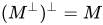
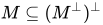
證明兩次正交運算抵消: ( M ⊥ ) ⊥ = M {\displaystyle (M^{\perp })^{\perp }=M} 證明 M ⊆ N {\displaystyle M\subseteq N} N ⊥ ⊆ M ⊥ {\displaystyle N^{\perp }\subseteq M^{\perp }} 證明 ( M + N ) ⊥ = M ⊥ ∩ N ⊥ {\displaystyle (M+N)^{\perp }=M^{\perp }\cap N^{\perp }}
答案
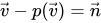
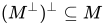
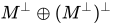
我們將證明這些集合是相互包含的, M ⊆ ( M ⊥ ) ⊥ {\displaystyle M\subseteq (M^{\perp })^{\perp }} ( M ⊥ ) ⊥ ⊆ M {\displaystyle (M^{\perp })^{\perp }\subseteq M} m → ∈ M {\displaystyle {\vec {m}}\in M} m → {\displaystyle {\vec {m}}} v → ∈ M ⊥ {\displaystyle {\vec {v}}\in M^{\perp }} m → ∈ ( M ⊥ ) ⊥ {\displaystyle {\vec {m}}\in (M^{\perp })^{\perp }} v → ∈ ( M ⊥ ) ⊥ {\displaystyle {\vec {v}}\in (M^{\perp })^{\perp }} 引理 3.7 的證明表明 R n = M ⊕ M ⊥ {\displaystyle \mathbb {R} ^{n}=M\oplus M^{\perp }} ⟨ κ → 1 , … , κ → k , κ → k + 1 , … , κ → n ⟩ {\displaystyle \langle {\vec {\kappa }}_{1},\dots ,{\vec {\kappa }}_{k},{\vec {\kappa }}_{k+1},\dots ,{\vec {\kappa }}_{n}\rangle } ⟨ κ → 1 , … , κ → k ⟩ {\displaystyle \langle {\vec {\kappa }}_{1},\dots ,{\vec {\kappa }}_{k}\rangle } M {\displaystyle M} M ⊥ {\displaystyle M^{\perp }} v → = proj [ κ → 1 ] ( v → ) + ⋯ + proj [ κ → n ] ( v → ) {\displaystyle {\vec {v}}={\mbox{proj}}_{[{\vec {\kappa }}_{1}]}({{\vec {v}}\,})+\dots +{\mbox{proj}}_{[{\vec {\kappa }}_{n}]}({{\vec {v}}\,})} v → ∈ ( M ⊥ ) ⊥ {\displaystyle {\vec {v}}\in (M^{\perp })^{\perp }} M ⊥ {\displaystyle M^{\perp }} v → = proj [ κ → 1 ] ( v → ) + ⋯ + proj [ κ → k ] ( v → ) {\displaystyle {\vec {v}}={\mbox{proj}}_{[{\vec {\kappa }}_{1}]}({{\vec {v}}\,})+\dots +{\mbox{proj}}_{[{\vec {\kappa }}_{k}]}({{\vec {v}}\,})} M {\displaystyle M} v → ∈ M {\displaystyle {\vec {v}}\in M} 備註 。這裡有一個更巧妙的方法來處理第二部分:將空間寫成 M ⊕ M ⊥ {\displaystyle M\oplus M^{\perp }} M ⊥ ⊕ ( M ⊥ ) ⊥ {\displaystyle M^{\perp }\oplus (M^{\perp })^{\perp }} M ⊆ ( M ⊥ ) ⊥ {\displaystyle M\subseteq (M^{\perp })^{\perp }} M {\displaystyle M} ( M ⊥ ) ⊥ {\displaystyle (M^{\perp })^{\perp }} M {\displaystyle M} ( M ⊥ ) ⊥ {\displaystyle (M^{\perp })^{\perp }} 因為 M ⊆ N {\displaystyle M\subseteq N} N {\displaystyle N} v → {\displaystyle {\vec {v}}} M {\displaystyle M} N ⊥ ⊆ M ⊥ {\displaystyle N^{\perp }\subseteq M^{\perp }} 我們將再次透過互相包含來證明集合相等。第一個方向很簡單;任何垂直於 v → {\displaystyle {\vec {v}}} M + N = { m → + n → | m → ∈ M , n → ∈ N } {\displaystyle M+N=\{{\vec {m}}+{\vec {n}}\,{\big |}\,{\vec {m}}\in M,\,{\vec {n}}\in N\}} m → + 0 → {\displaystyle {\vec {m}}+{\vec {0}}} M {\displaystyle M} 0 → + n → {\displaystyle {\vec {0}}+{\vec {n}}} N {\displaystyle N} ( M + N ) ⊥ ⊆ M ⊥ ∩ N ⊥ {\displaystyle (M+N)^{\perp }\subseteq M^{\perp }\cap N^{\perp }} v → ∈ M ⊥ ∩ N ⊥ {\displaystyle {\vec {v}}\in M^{\perp }\cap N^{\perp }} c m → + d n → {\displaystyle c{\vec {m}}+d{\vec {n}}} v → ⋅ ( c m → + d n → ) = c ⋅ ( v → ⋅ m → ) + d ⋅ ( v → ⋅ n → ) = c ⋅ 0 + d ⋅ 0 = 0 {\displaystyle {\vec {v}}\cdot (c{\vec {m}}+d{\vec {n}})=c\cdot ({\vec {v}}\cdot {\vec {m}})+d\cdot ({\vec {v}}\cdot {\vec {n}})=c\cdot 0+d\cdot 0=0}
此練習推薦給所有讀者。
問題 15
本小節中的材料使我們能夠表達線性對映的範圍空間和零空間之間尚未見過的幾何關係。
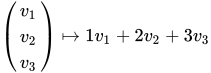
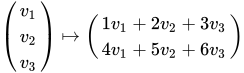
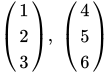
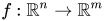
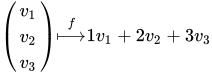
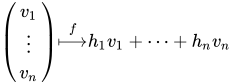
表示 f : R 3 → R {\displaystyle f:\mathbb {R} ^{3}\to \mathbb {R} } ( v 1 v 2 v 3 ) ↦ 1 v 1 + 2 v 2 + 3 v 3 {\displaystyle {\begin{pmatrix}v_{1}\\v_{2}\\v_{3}\end{pmatrix}}\mapsto 1v_{1}+2v_{2}+3v_{3}} ( 1 2 3 ) {\displaystyle {\begin{pmatrix}1\\2\\3\end{pmatrix}}} N ( f ) ⊥ {\displaystyle {\mathcal {N}}(f)^{\perp }} 將其推廣到適用於任何 f : R n → R {\displaystyle f:\mathbb {R} ^{n}\to \mathbb {R} } 表示 f : R 3 → R 2 {\displaystyle f:\mathbb {R} ^{3}\to \mathbb {R} ^{2}} ( v 1 v 2 v 3 ) ↦ ( 1 v 1 + 2 v 2 + 3 v 3 4 v 1 + 5 v 2 + 6 v 3 ) {\displaystyle {\begin{pmatrix}v_{1}\\v_{2}\\v_{3}\end{pmatrix}}\mapsto {\begin{pmatrix}1v_{1}+2v_{2}+3v_{3}\\4v_{1}+5v_{2}+6v_{3}\end{pmatrix}}} ( 1 2 3 ) , ( 4 5 6 ) {\displaystyle {\begin{pmatrix}1\\2\\3\end{pmatrix}},\;{\begin{pmatrix}4\\5\\6\end{pmatrix}}} N ( f ) ⊥ {\displaystyle {\mathcal {N}}(f)^{\perp }} 問題 14 的第三項。) 將其推廣到適用於任何 f : R n → R m {\displaystyle f:\mathbb {R} ^{n}\to \mathbb {R} ^{m}}
這個結果及其相關結果被稱為線性代數的基本定理(參見Strang 1993 )。
答案
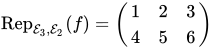
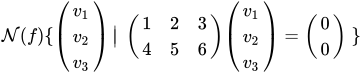
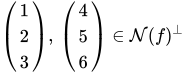
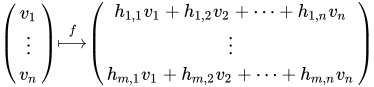
表示 ( v 1 v 2 v 3 ) ⟼ f 1 v 1 + 2 v 2 + 3 v 3 {\displaystyle {\begin{pmatrix}v_{1}\\v_{2}\\v_{3}\end{pmatrix}}{\stackrel {f}{\longmapsto }}1v_{1}+2v_{2}+3v_{3}} R e p E 3 , E 1 ( f ) = ( 1 2 3 ) {\displaystyle {\rm {Rep}}_{{\mathcal {E}}_{3},{\mathcal {E}}_{1}}(f)={\begin{pmatrix}1&2&3\end{pmatrix}}} f {\displaystyle f} N ( f ) = { ( v 1 v 2 v 3 ) | 1 v 1 + 2 v 2 + 3 v 3 = 0 } = { ( v 1 v 2 v 3 ) | ( 1 2 3 ) ⋅ ( v 1 v 2 v 3 ) = 0 } {\displaystyle {\mathcal {N}}(f)=\{{\begin{pmatrix}v_{1}\\v_{2}\\v_{3}\end{pmatrix}}\,{\big |}\,1v_{1}+2v_{2}+3v_{3}=0\}=\{{\begin{pmatrix}v_{1}\\v_{2}\\v_{3}\end{pmatrix}}\,{\big |}\,{\begin{pmatrix}1\\2\\3\end{pmatrix}}\cdot {\begin{pmatrix}v_{1}\\v_{2}\\v_{3}\end{pmatrix}}=0\}} N ( f ) ⊥ = [ { ( 1 2 3 ) } ] {\displaystyle {\mathcal {N}}(f)^{\perp }=[\{{\begin{pmatrix}1\\2\\3\end{pmatrix}}\}]} 推廣到任何 f : R n → R {\displaystyle f:\mathbb {R} ^{n}\to \mathbb {R} } h → {\displaystyle {\vec {h}}} ( v 1 ⋮ v n ) ⟼ f h 1 v 1 + ⋯ + h n v n {\displaystyle {\begin{pmatrix}v_{1}\\\vdots \\v_{n}\end{pmatrix}}{\stackrel {f}{\longmapsto }}h_{1}v_{1}+\dots +h_{n}v_{n}} h → ∈ N ( f ) ⊥ {\displaystyle {\vec {h}}\in {\mathcal {N}}(f)^{\perp }} f {\displaystyle f} h → {\displaystyle {\vec {h}}} 當然, R e p E 3 , E 2 ( f ) = ( 1 2 3 4 5 6 ) {\displaystyle {\rm {Rep}}_{{\mathcal {E}}_{3},{\mathcal {E}}_{2}}(f)={\begin{pmatrix}1&2&3\\4&5&6\end{pmatrix}}} N ( f ) { ( v 1 v 2 v 3 ) | ( 1 2 3 4 5 6 ) ( v 1 v 2 v 3 ) = ( 0 0 ) } {\displaystyle {\mathcal {N}}(f)\{{\begin{pmatrix}v_{1}\\v_{2}\\v_{3}\end{pmatrix}}\,{\big |}\,\;{\begin{pmatrix}1&2&3\\4&5&6\end{pmatrix}}{\begin{pmatrix}v_{1}\\v_{2}\\v_{3}\end{pmatrix}}={\begin{pmatrix}0\\0\end{pmatrix}}\;\}} ( 1 2 3 ) , ( 4 5 6 ) ∈ N ( f ) ⊥ {\displaystyle {\begin{pmatrix}1\\2\\3\end{pmatrix}},\,{\begin{pmatrix}4\\5\\6\end{pmatrix}}\in {\mathcal {N}}(f)^{\perp }} N ( f ) ⊥ {\displaystyle {\mathcal {N}}(f)^{\perp }} R n {\displaystyle \mathbb {R} ^{n}} M = [ { ( 1 2 3 ) } ] N = [ { ( 4 5 6 ) } ] {\displaystyle M=[\{{\begin{pmatrix}1\\2\\3\end{pmatrix}}\}]\qquad N=[\{{\begin{pmatrix}4\\5\\6\end{pmatrix}}\}]} 問題 14 的第三項中,如提示中所建議的那樣。 如上所述,從具體情況推廣到一般情況很容易:對於任何 f : R n → R m {\displaystyle f:\mathbb {R} ^{n}\to \mathbb {R} ^{m}} H {\displaystyle H} ( v 1 ⋮ v n ) ⟼ f ( h 1 , 1 v 1 + h 1 , 2 v 2 + ⋯ + h 1 , n v n ⋮ h m , 1 v 1 + h m , 2 v 2 + ⋯ + h m , n v n ) {\displaystyle {\begin{pmatrix}v_{1}\\\vdots \\v_{n}\end{pmatrix}}{\stackrel {f}{\longmapsto }}{\begin{pmatrix}h_{1,1}v_{1}+h_{1,2}v_{2}+\dots +h_{1,n}v_{n}\\\vdots \\h_{m,1}v_{1}+h_{m,2}v_{2}+\dots +h_{m,n}v_{n}\end{pmatrix}}} m {\displaystyle m} H {\displaystyle H} h → 1 = ( h 1 , 1 h 1 , 2 ⋮ h 1 , n ) , … h → m = ( h m , 1 h m , 2 ⋮ h m , n ) {\displaystyle {\vec {h}}_{1}={\begin{pmatrix}h_{1,1}\\h_{1,2}\\\vdots \\h_{1,n}\end{pmatrix}},\dots {\vec {h}}_{m}={\begin{pmatrix}h_{m,1}\\h_{m,2}\\\vdots \\h_{m,n}\end{pmatrix}}} N ( f ) ⊥ = [ { h → 1 , … , h → m } ] {\displaystyle {\mathcal {N}}(f)^{\perp }=[\{{\vec {h}}_{1},\dots ,{\vec {h}}_{m}\}]} Strang 1993 ) 中,此空間被描述為 H {\displaystyle H}
問題 16
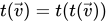
定義投影 為線性變換 t : V → V {\displaystyle t:V\to V} ( t ∘ t ) ( v → ) = t ( v → ) {\displaystyle (t\circ t)\,({\vec {v}})=t({\vec {v}})} v → ∈ V {\displaystyle {\vec {v}}\in V}
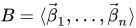
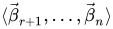
證明:將向量正交投影到直線上,具有該性質。 證明:將向量投影到子空間上,具有該性質。 證明:對於任何這樣的 t {\displaystyle t} B = ⟨ β → 1 , … , β → n ⟩ {\displaystyle B=\langle {\vec {\beta }}_{1},\ldots ,{\vec {\beta }}_{n}\rangle } V {\displaystyle V} t ( β → i ) = { β → i i = 1 , 2 , … , r 0 → i = r + 1 , r + 2 , … , n {\displaystyle t({\vec {\beta }}_{i})={\begin{cases}{\vec {\beta }}_{i}&i=1,2,\dots ,\,r\\{\vec {0}}&i=r+1,r+2,\dots ,\,n\end{cases}}} r {\displaystyle r} t {\displaystyle t} 由此推斷,每個投影都是沿子空間的投影。 同樣可以推斷,每個投影都有一個表示形式 R e p B , B ( t ) = ( I Z Z Z ) {\displaystyle {\rm {Rep}}_{B,B}(t)=\left({\begin{array}{c|c}I&Z\\\hline Z&Z\end{array}}\right)}
答案
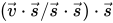
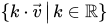
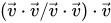
首先要注意,如果一個向量 v → {\displaystyle {\vec {v}}} v → {\displaystyle {\vec {v}}} s → {\displaystyle {\vec {s}}} ( v → ⋅ s → / s → ⋅ s → ) ⋅ s → {\displaystyle ({\vec {v}}\cdot {\vec {s}}/{\vec {s}}\cdot {\vec {s}})\cdot {\vec {s}}} { k ⋅ v → | k ∈ R } {\displaystyle \{k\cdot {\vec {v}}\,{\big |}\,k\in \mathbb {R} \}} v → = 0 → {\displaystyle {\vec {v}}={\vec {0}}} ( v → ⋅ v → / v → ⋅ v → ) ⋅ v → {\displaystyle ({\vec {v}}\cdot {\vec {v}}/{\vec {v}}\cdot {\vec {v}})\cdot {\vec {v}}} v → {\displaystyle {\vec {v}}} proj ℓ ( v → ) {\displaystyle {\mbox{proj}}_{\ell }({\vec {v}})} 這裡的論點與上一項中的論點類似。對於 V = M ⊕ N {\displaystyle V=M\oplus N} v → = m → + n → {\displaystyle {\vec {v}}={\vec {m}}+{\vec {n}}} proj M , N ( v → ) = m → {\displaystyle {\mbox{proj}}_{M,N}({{\vec {v}}\,})={\vec {m}}} proj M , N ( m → ) = m → {\displaystyle {\mbox{proj}}_{M,N}({\vec {m}})={\vec {m}}} M {\displaystyle M} M {\displaystyle M} N {\displaystyle N} m → = m → + 0 → {\displaystyle {\vec {m}}={\vec {m}}+{\vec {0}}} N {\displaystyle N} M {\displaystyle M} As suggested by the prior items, the condition gives that t {\displaystyle t} β → 1 {\displaystyle {\vec {\beta }}_{1}} β → r {\displaystyle {\vec {\beta }}_{r}} t {\displaystyle t} M {\displaystyle M} dim ( M ) = r {\displaystyle \dim(M)=r} N {\displaystyle N} t {\displaystyle t} V = M ⊕ N {\displaystyle V=M\oplus N} M ∩ N = { 0 → } {\displaystyle M\cap N=\{{\vec {0}}\}} M + N = V {\displaystyle M+N=V} m → {\displaystyle {\vec {m}}} v → ∈ V {\displaystyle {\vec {v}}\in V} t ( v → ) = m → {\displaystyle t({\vec {v}})={\vec {m}}} t {\displaystyle t} t ( m → ) = ( t ∘ t ) ( v → ) = t ( v → ) = m → {\displaystyle t({\vec {m}})=(t\circ t)\,({\vec {v}})=t({\vec {v}})={\vec {m}}} t ( m → ) = 0 → {\displaystyle t({\vec {m}})={\vec {0}}} v → {\displaystyle {\vec {v}}} t ( v → ) = t ( t ( v → ) ) {\displaystyle t({\vec {v}})=t(t({\vec {v}}))} t ( v → − t ( v → ) ) = 0 → {\displaystyle t({\vec {v}}-t({\vec {v}}))={\vec {0}}} v → = t ( v → ) + ( v → − t ( v → ) ) {\displaystyle {\vec {v}}=t({\vec {v}})+({\vec {v}}-t({\vec {v}}))} B = ⟨ β → 1 , … , β → n ⟩ {\displaystyle B=\langle {\vec {\beta }}_{1},\ldots ,{\vec {\beta }}_{n}\rangle } V {\displaystyle V} ⟨ β → 1 , … , β → r ⟩ {\displaystyle \langle {\vec {\beta }}_{1},\ldots ,{\vec {\beta }}_{r}\rangle } M {\displaystyle M} ⟨ β → r + 1 , … , β → n ⟩ {\displaystyle \langle {\vec {\beta }}_{r+1},\ldots ,{\vec {\beta }}_{n}\rangle } N {\displaystyle N} 每個投影(在本練習中定義)都是投影到其值域並沿著其零空間進行投影。 這也直接來自第三項。
Strang, Gilbert (1993), "線性代數基本定理", 美國數學月刊 , 美國數學學會: 848–855 Strang, Gilbert (1980), 線性代數及其應用 (第 2 版), Hartcourt Brace Javanovich 

























![{\displaystyle {\begin{array}{*{3}{rc}r}3u&+&v&&&=&0\\u&&&+&w&=&0\end{array}}\;{\xrightarrow[{}]{-(1/3)\rho _{1}+\rho _{2}}}\;{\begin{array}{*{3}{rc}r}3u&+&v&&&=&0\\&&-(1/3)v&+&w&=&0\end{array}}}](https://wikimedia.org/api/rest_v1/media/math/render/svg/9aba2fb1f7833438bedd9c17071d40c4936e0dea)






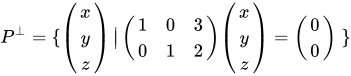
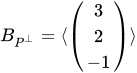

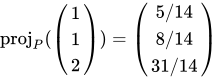
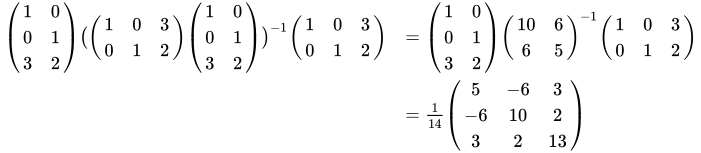



![{\displaystyle {\mbox{proj}}_{[{\vec {s}}\,]}({\begin{pmatrix}1\\-3\end{pmatrix}})={\frac {{\begin{pmatrix}1\\-3\end{pmatrix}}\cdot {\begin{pmatrix}-1\\1\end{pmatrix}}}{{\begin{pmatrix}-1\\1\end{pmatrix}}\cdot {\begin{pmatrix}-1\\1\end{pmatrix}}}}\cdot {\begin{pmatrix}-1\\1\end{pmatrix}}={\frac {-4}{2}}\cdot {\begin{pmatrix}-1\\1\end{pmatrix}}={\begin{pmatrix}2\\-2\end{pmatrix}}}](https://wikimedia.org/api/rest_v1/media/math/render/svg/3ab8c36b1ba917e7a3dfd6caa965ad861269a18f)

















![{\displaystyle {\vec {v}}={\mbox{proj}}_{[{\vec {\kappa }}_{1}]}({{\vec {v}}\,})+\dots +{\mbox{proj}}_{[{\vec {\kappa }}_{n}]}({{\vec {v}}\,})={\frac {{\vec {v}}\cdot {\vec {\kappa }}_{1}}{{\vec {\kappa }}_{1}\cdot {\vec {\kappa }}_{1}}}\cdot {\vec {\kappa }}_{1}+\dots +{\frac {{\vec {v}}\cdot {\vec {\kappa }}_{n}}{{\vec {\kappa }}_{n}\cdot {\vec {\kappa }}_{n}}}\cdot {\vec {\kappa }}_{n}}](https://wikimedia.org/api/rest_v1/media/math/render/svg/8fe1b3e5e8515281dce05e454783abc8d50c2349)















![{\displaystyle {\vec {v}}={\mbox{proj}}_{[{\vec {\kappa }}_{1}]}({{\vec {v}}\,})+\dots +{\mbox{proj}}_{[{\vec {\kappa }}_{n}]}({{\vec {v}}\,})}](https://wikimedia.org/api/rest_v1/media/math/render/svg/60f2b61a471c291b1d2d064cb0a57887e77bc73e)
![{\displaystyle {\vec {v}}={\mbox{proj}}_{[{\vec {\kappa }}_{1}]}({{\vec {v}}\,})+\dots +{\mbox{proj}}_{[{\vec {\kappa }}_{k}]}({{\vec {v}}\,})}](https://wikimedia.org/api/rest_v1/media/math/render/svg/1f14a7fab8047e6f3be3e5da8f2e419199ce045e)















![{\displaystyle {\mathcal {N}}(f)^{\perp }=[\{{\begin{pmatrix}1\\2\\3\end{pmatrix}}\}]}](https://wikimedia.org/api/rest_v1/media/math/render/svg/d754510f8453f245f0583c06ad45e2e6981d3585)


![{\displaystyle M=[\{{\begin{pmatrix}1\\2\\3\end{pmatrix}}\}]\qquad N=[\{{\begin{pmatrix}4\\5\\6\end{pmatrix}}\}]}](https://wikimedia.org/api/rest_v1/media/math/render/svg/18756942da312249ae314a7ca2e1cd43bfea08dd)



![{\displaystyle {\mathcal {N}}(f)^{\perp }=[\{{\vec {h}}_{1},\dots ,{\vec {h}}_{m}\}]}](https://wikimedia.org/api/rest_v1/media/math/render/svg/8653570926540892bb808449181ef23b66fc0385)