建議所有讀者進行此練習。
問題 1
判斷矩陣是否行等價。
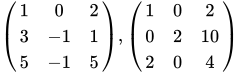
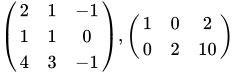
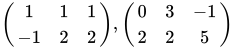
( 1 2 4 8 ) , ( 0 1 1 2 ) {\displaystyle {\begin{pmatrix}1&2\\4&8\end{pmatrix}},{\begin{pmatrix}0&1\\1&2\end{pmatrix}}} ( 1 0 2 3 − 1 1 5 − 1 5 ) , ( 1 0 2 0 2 10 2 0 4 ) {\displaystyle {\begin{pmatrix}1&0&2\\3&-1&1\\5&-1&5\end{pmatrix}},{\begin{pmatrix}1&0&2\\0&2&10\\2&0&4\end{pmatrix}}} ( 2 1 − 1 1 1 0 4 3 − 1 ) , ( 1 0 2 0 2 10 ) {\displaystyle {\begin{pmatrix}2&1&-1\\1&1&0\\4&3&-1\end{pmatrix}},{\begin{pmatrix}1&0&2\\0&2&10\\\end{pmatrix}}} ( 1 1 1 − 1 2 2 ) , ( 0 3 − 1 2 2 5 ) {\displaystyle {\begin{pmatrix}1&1&1\\-1&2&2\end{pmatrix}},{\begin{pmatrix}0&3&-1\\2&2&5\end{pmatrix}}} ( 1 1 1 0 0 3 ) , ( 0 1 2 1 − 1 1 ) {\displaystyle {\begin{pmatrix}1&1&1\\0&0&3\end{pmatrix}},{\begin{pmatrix}0&1&2\\1&-1&1\end{pmatrix}}}
答案
將每個矩陣化簡為行階梯形矩陣,然後進行比較。
第一個得到 → − 4 ρ 1 + ρ 2 ( 1 2 0 0 ) {\displaystyle {\xrightarrow[{}]{-4\rho _{1}+\rho _{2}}}{\begin{pmatrix}1&2\\0&0\end{pmatrix}}} → ρ 1 ↔ ρ 2 ( 1 2 0 1 ) → − 2 ρ 2 + ρ 1 ( 1 0 0 1 ) {\displaystyle {\xrightarrow[{}]{\rho _{1}\leftrightarrow \rho _{2}}}{\begin{pmatrix}1&2\\0&1\end{pmatrix}}{\xrightarrow[{}]{-2\rho _{2}+\rho _{1}}}{\begin{pmatrix}1&0\\0&1\end{pmatrix}}} 第一個是這個。 → − 5 ρ 1 + ρ 3 − 3 ρ 1 + ρ 2 ( 1 0 2 0 − 1 − 5 0 − 1 − 5 ) → − ρ 2 + ρ 3 ( 1 0 2 0 − 1 − 5 0 0 0 ) → − ρ 2 ( 1 0 2 0 1 5 0 0 0 ) {\displaystyle {\xrightarrow[{-5\rho _{1}+\rho _{3}}]{-3\rho _{1}+\rho _{2}}}{\begin{pmatrix}1&0&2\\0&-1&-5\\0&-1&-5\end{pmatrix}}{\xrightarrow[{}]{-\rho _{2}+\rho _{3}}}{\begin{pmatrix}1&0&2\\0&-1&-5\\0&0&0\end{pmatrix}}{\xrightarrow[{}]{-\rho _{2}}}{\begin{pmatrix}1&0&2\\0&1&5\\0&0&0\end{pmatrix}}} → − 2 ρ 1 + ρ 3 ( 1 0 2 0 2 10 0 0 0 ) → ( 1 / 2 ) ρ 2 ( 1 0 2 0 1 5 0 0 0 ) {\displaystyle {\xrightarrow[{}]{-2\rho _{1}+\rho _{3}}}{\begin{pmatrix}1&0&2\\0&2&10\\0&0&0\end{pmatrix}}{\xrightarrow[{}]{(1/2)\rho _{2}}}{\begin{pmatrix}1&0&2\\0&1&5\\0&0&0\end{pmatrix}}} 這兩個不是行等價的,因為它們的大小不同。 第一個是 → ρ 1 + ρ 2 ( 1 1 1 0 3 3 ) → ( 1 / 3 ) ρ 2 ( 1 1 1 0 1 1 ) → − ρ 2 + ρ 1 ( 1 0 0 0 1 1 ) {\displaystyle {\xrightarrow[{}]{\rho _{1}+\rho _{2}}}{\begin{pmatrix}1&1&1\\0&3&3\end{pmatrix}}{\xrightarrow[{}]{(1/3)\rho _{2}}}{\begin{pmatrix}1&1&1\\0&1&1\end{pmatrix}}{\xrightarrow[{}]{-\rho _{2}+\rho _{1}}}{\begin{pmatrix}1&0&0\\0&1&1\end{pmatrix}}} → ρ 1 ↔ ρ 2 ( 2 2 5 0 3 − 1 ) → ( 1 / 3 ) ρ 2 ( 1 / 2 ) ρ 1 ( 1 1 5 / 2 0 1 − 1 / 3 ) → − ρ 2 + ρ 1 ( 1 0 17 / 6 0 1 − 1 / 3 ) {\displaystyle {\xrightarrow[{}]{\rho _{1}\leftrightarrow \rho _{2}}}{\begin{pmatrix}2&2&5\\0&3&-1\end{pmatrix}}{\xrightarrow[{(1/3)\rho _{2}}]{(1/2)\rho _{1}}}{\begin{pmatrix}1&1&5/2\\0&1&-1/3\end{pmatrix}}{\xrightarrow[{}]{-\rho _{2}+\rho _{1}}}{\begin{pmatrix}1&0&17/6\\0&1&-1/3\end{pmatrix}}} 第一個是 → ( 1 / 3 ) ρ 2 ( 1 1 1 0 0 1 ) → − ρ 2 + ρ 1 ( 1 1 0 0 0 1 ) {\displaystyle {\xrightarrow[{}]{(1/3)\rho _{2}}}{\begin{pmatrix}1&1&1\\0&0&1\end{pmatrix}}{\xrightarrow[{}]{-\rho _{2}+\rho _{1}}}{\begin{pmatrix}1&1&0\\0&0&1\end{pmatrix}}} → ρ 1 ↔ ρ 2 ( 1 − 1 1 0 1 2 ) → ρ 2 + ρ 1 ( 1 0 3 0 1 2 ) {\displaystyle {\xrightarrow[{}]{\rho _{1}\leftrightarrow \rho _{2}}}{\begin{pmatrix}1&-1&1\\0&1&2\end{pmatrix}}{\xrightarrow[{}]{\rho _{2}+\rho _{1}}}{\begin{pmatrix}1&0&3\\0&1&2\end{pmatrix}}}
問題 2
描述 [Example 2.10](https://wikimedia.org/api/rest_v1/media/math/render/svg/6323f43e8a389e2ba36be0f77f67fb67abafde17) 中每類矩陣。
答案
首先,唯一與全零矩陣行等價的矩陣就是它本身(因為行運算對它沒有影響)。
其次,可以化簡為
( 1 a 0 0 ) {\displaystyle {\begin{pmatrix}1&a\\0&0\end{pmatrix}}} 的矩陣具有以下形式
( b b a c c a ) {\displaystyle {\begin{pmatrix}b&ba\\c&ca\end{pmatrix}}} (其中 a , b , c ∈ R {\displaystyle a,b,c\in \mathbb {R} } b {\displaystyle b} c {\displaystyle c}
接下來,可以化簡為
( 0 1 0 0 ) {\displaystyle {\begin{pmatrix}0&1\\0&0\end{pmatrix}}} 的矩陣具有以下形式
( 0 a 0 b ) {\displaystyle {\begin{pmatrix}0&a\\0&b\end{pmatrix}}} (其中 a , b ∈ R {\displaystyle a,b\in \mathbb {R} }
最後,可以化簡為
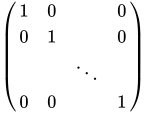
( 1 0 0 1 ) {\displaystyle {\begin{pmatrix}1&0\\0&1\end{pmatrix}}} 的矩陣是**非奇異矩陣**。這是因為係數矩陣為該矩陣的線性系統將有唯一的解,而這是非奇異性的定義。(另一種說法是,它們不屬於上述任何類別。)
問題 3
描述這些矩陣的行等價類中的所有矩陣。
( 1 0 0 0 ) {\displaystyle {\begin{pmatrix}1&0\\0&0\end{pmatrix}}} ( 1 2 2 4 ) {\displaystyle {\begin{pmatrix}1&2\\2&4\end{pmatrix}}} ( 1 1 1 3 ) {\displaystyle {\begin{pmatrix}1&1\\1&3\end{pmatrix}}}
答案
它們的形式為 ( a 0 b 0 ) {\displaystyle {\begin{pmatrix}a&0\\b&0\end{pmatrix}}} a , b ∈ R {\displaystyle a,b\in \mathbb {R} } 它們有這種形式(對於 a , b ∈ R {\displaystyle a,b\in \mathbb {R} } ( 1 a 2 a 1 b 2 b ) {\displaystyle {\begin{pmatrix}1a&2a\\1b&2b\end{pmatrix}}} 它們的形式為 ( a b c d ) {\displaystyle {\begin{pmatrix}a&b\\c&d\end{pmatrix}}} a , b , c , d ∈ R {\displaystyle a,b,c,d\in \mathbb {R} } a d − b c ≠ 0 {\displaystyle ad-bc\neq 0} 2 × 2 {\displaystyle 2\!\times \!2}
問題 4
有多少個行等價類?
答案
無限多個。例如,在
( 1 k 0 0 ) {\displaystyle {\begin{pmatrix}1&k\\0&0\end{pmatrix}}} 中,每個 k ∈ R {\displaystyle k\in \mathbb {R} }
問題 5
行等價類可以包含不同大小的矩陣嗎?
答案
不可以。行操作不會改變矩陣的大小。
問題 6
行等價類有多大?
證明任何零矩陣的類都是有限的。 還有其他類只包含有限多個成員嗎?
答案
對零矩陣進行行操作沒有效果。因此每個零矩陣都在其行等價類中是單獨存在的。 沒有。任何非零項都可以重新縮放。
建議所有讀者進行此練習。
問題 7
給出兩個行簡化階梯形矩陣,它們的主元位於相同的列中,但它們不是行等價的。
答案
這裡有兩個。
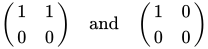
( 1 1 0 0 0 1 ) and ( 1 0 0 0 0 1 ) {\displaystyle {\begin{pmatrix}1&1&0\\0&0&1\end{pmatrix}}\quad {\text{and}}\quad {\begin{pmatrix}1&0&0\\0&0&1\end{pmatrix}}}
建議所有讀者進行此練習。 建議所有讀者進行此練習。
問題 9
描述包含這些矩陣的所有行等價類。
2 × 2 {\displaystyle 2\!\times \!2} 2 × 3 {\displaystyle 2\!\times \!3} 3 × 2 {\displaystyle 3\!\times \!2} 3 × 3 {\displaystyle 3\!\times \!3}
答案
由於每個類中只有一個行最簡形式矩陣,因此我們只需列出可能的行最簡形式矩陣。
有關該列表,請參閱 問題 1.5 的答案。
問題 10
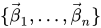
證明向量 β → 0 {\displaystyle {\vec {\beta }}_{0}} { β → 1 , … , β → n } {\displaystyle \{{\vec {\beta }}_{1},\ldots ,{\vec {\beta }}_{n}\}} 0 → = c 0 β → 0 + ⋯ + c n β → n {\displaystyle {\vec {0}}=c_{0}{\vec {\beta }}_{0}+\cdots +c_{n}{\vec {\beta }}_{n}} c 0 {\displaystyle c_{0}} β → 0 = 0 → {\displaystyle {\vec {\beta }}_{0}={\vec {0}}} 利用這一點簡化 引理 2.5 的證明。
答案
如果存在一個線性關係,其中 c 0 {\displaystyle c_{0}} c 0 β → 0 {\displaystyle c_{0}{\vec {\beta }}_{0}} − c 0 {\displaystyle -c_{0}} β → 0 {\displaystyle {\vec {\beta }}_{0}} 0 → = 3 ⋅ 0 → {\displaystyle {\vec {0}}=3\cdot {\vec {0}}} β → 0 {\displaystyle {\vec {\beta }}_{0}} β → 0 = c 1 β → 1 + ⋯ + c n β → n {\displaystyle {\vec {\beta }}_{0}=c_{1}{\vec {\beta }}_{1}+\dots +c_{n}{\vec {\beta }}_{n}} β → 0 {\displaystyle {\vec {\beta }}_{0}} β → 0 {\displaystyle {\vec {\beta }}_{0}} − 1 {\displaystyle -1} 第一行不是其他行的線性組合,原因在證明中給出:在包含第一行主元所在的列的元素方程中,唯一非零元素是第一行的主元,因此它的係數必須為零。因此,根據本練習的前面部分,第一行與其他行不存線上性關係。因此,在考慮第二行是否可以與其他行存線上性關係時,我們可以將第一行排除在外。但現在應用於第一行的論點將應用於第二行。(也就是說,我們在這裡透過歸納進行論證。)
建議所有讀者進行此練習。
問題 11
完成引理 2.5 的證明。
首先透過展示 c 2 = 0 {\displaystyle c_{2}=0} 進行完整的歸納步驟:當 1 ≤ n < i − 1 {\displaystyle 1\leq n<i-1} 1 < k < n {\displaystyle 1<k<n} c k = 0 {\displaystyle c_{k}=0} c n + 1 = 0 {\displaystyle c_{n+1}=0} 找到矛盾。
答案
在方程式 ρ i = c 1 ρ 1 + c 2 ρ 2 + … + c i − 1 ρ i − 1 + c i + 1 ρ i + 1 + … + c m ρ m {\displaystyle \rho _{i}=c_{1}\rho _{1}+c_{2}\rho _{2}+\ldots +c_{i-1}\rho _{i-1}+c_{i+1}\rho _{i+1}+\ldots +c_{m}\rho _{m}} c 1 = 0 {\displaystyle c_{1}=0} ℓ 2 {\displaystyle \ell _{2}} ρ i , ℓ 1 = c 2 ρ 2 , ℓ 2 + … + c i − 1 ρ i − 1 , ℓ 2 + c i + 1 ρ i + 1 , ℓ 2 + … + c m ρ m , ℓ 2 {\displaystyle \rho _{i,\ell _{1}}=c_{2}\rho _{2,\ell _{2}}+\ldots +c_{i-1}\rho _{i-1,\ell _{2}}+c_{i+1}\rho _{i+1,\ell _{2}}+\ldots +c_{m}\rho _{m,\ell _{2}}} ℓ 2 {\displaystyle \ell _{2}} i > 2 {\displaystyle i>2} ρ i , ℓ 2 = 0 {\displaystyle \rho _{i,\ell _{2}}=0} 0 = c 2 ρ 2 , ℓ 2 + 0 + … + 0 {\displaystyle 0=c_{2}\rho _{2,\ell _{2}}+0+\ldots +0} ρ 2 , ℓ 2 {\displaystyle \rho _{2,\ell _{2}}} 0 {\displaystyle 0} c 2 = 0 {\displaystyle c_{2}=0} 在方程式 ρ i = c 1 ρ 1 + c 2 ρ 2 + … + c i − 1 ρ i − 1 + c i + 1 ρ i + 1 + … + c m ρ m {\displaystyle \rho _{i}=c_{1}\rho _{1}+c_{2}\rho _{2}+\ldots +c_{i-1}\rho _{i-1}+c_{i+1}\rho _{i+1}+\ldots +c_{m}\rho _{m}} 0 = c 1 = c 2 = ⋯ = c n {\displaystyle 0=c_{1}=c_{2}=\dots =c_{n}} ℓ n + 1 {\displaystyle \ell _{n+1}} n + 1 {\displaystyle n+1} ρ i , ℓ n + 1 = c n + 1 ρ n + 1 , ℓ n + 1 + … + c i − 1 ρ i − 1 , ℓ n + 1 + c i + 1 ρ i + 1 , ℓ n + 1 + ⋯ + c m ρ m , ℓ n + 1 {\displaystyle \rho _{i,\ell _{n+1}}=c_{n+1}\rho _{n+1,\ell _{n+1}}+\ldots +c_{i-1}\rho _{i-1,\ell _{n+1}}+c_{i+1}\rho _{i+1,\ell _{n+1}}+\dots +c_{m}\rho _{m,\ell _{n+1}}} ℓ n + 1 {\displaystyle \ell _{n+1}} n + 1 {\displaystyle n+1} ρ j , ℓ n + 1 = 0 {\displaystyle \rho _{j,\ell _{n+1}}=0} j > n + 1 {\displaystyle j>{n+1}} 0 = c n + 1 ρ n + 1 , ℓ n + 1 + 0 + … + 0 {\displaystyle 0=c_{n+1}\rho _{n+1,\ell _{n+1}}+0+\ldots +0} ρ n + 1 , ℓ n + 1 {\displaystyle \rho _{n+1,\ell _{n+1}}} 0 {\displaystyle 0} c n + 1 = 0 {\displaystyle c_{n+1}=0} 從本練習中的前一項,我們知道在方程 ρ i = c 1 ρ 1 + c 2 ρ 2 + … + c i − 1 ρ i − 1 + c i + 1 ρ i + 1 + … + c m ρ m {\displaystyle \rho _{i}=c_{1}\rho _{1}+c_{2}\rho _{2}+\ldots +c_{i-1}\rho _{i-1}+c_{i+1}\rho _{i+1}+\ldots +c_{m}\rho _{m}} 0 = c 1 = c 2 = ⋯ = c i − 1 {\displaystyle 0=c_{1}=c_{2}=\dots =c_{i-1}} ℓ i {\displaystyle \ell _{i}} i {\displaystyle i} ρ i , ℓ i = c i + 1 ρ i + 1 , ℓ i + ⋯ + c m ρ m , ℓ i {\displaystyle \rho _{i,\ell _{i}}=c_{i+1}\rho _{i+1,\ell _{i}}+\dots +c_{m}\rho _{m,\ell _{i}}} ℓ i {\displaystyle \ell _{i}} i {\displaystyle i} ρ j , ℓ i = 0 {\displaystyle \rho _{j,\ell _{i}}=0} j > i {\displaystyle j>i} 0 {\displaystyle 0} 0 {\displaystyle 0}
問題 12
完成 引理 2.6 中的歸納論證。
陳述歸納假設。還要說明從該假設中必須證明什麼才能成立。 驗證歸納假設意味著在關係 β r + 1 = s r + 1 , 1 δ 1 + s r + 2 , 2 δ 2 + ⋯ + s r + 1 , m δ m {\displaystyle \beta _{r+1}=s_{r+1,1}\delta _{1}+s_{r+2,2}\delta _{2}+\dots +s_{r+1,m}\delta _{m}} s r + 1 , 1 , … , s r + 1 , r {\displaystyle s_{r+1,1},\,\ldots \,,s_{r+1,r}} 透過類似於基本情況的論證完成歸納步驟,即 ℓ r + 1 < k r + 1 {\displaystyle \ell _{r+1}<k_{r+1}} k r + 1 < ℓ r + 1 {\displaystyle k_{r+1}<\ell _{r+1}}
答案
歸納步驟是證明,如果該陳述在行 1 {\displaystyle 1} r {\displaystyle r} r + 1 {\displaystyle r+1} ℓ 1 = k 1 {\displaystyle \ell _{1}=k_{1}} ℓ 2 = k 2 {\displaystyle \ell _{2}=k_{2}} ℓ r = k r {\displaystyle \ell _{r}=k_{r}} ℓ r + 1 = k r + 1 {\displaystyle \ell _{r+1}=k_{r+1}} r {\displaystyle r} 1 . . m − 1 {\displaystyle 1\;..\;m-1}
Corollary 2.3 gives the relationship β r + 1 = s r + 1 , 1 δ 1 + s r + 2 , 2 δ 2 + ⋯ + s r + 1 , m δ m {\displaystyle \beta _{r+1}=s_{r+1,1}\delta _{1}+s_{r+2,2}\delta _{2}+\dots +s_{r+1,m}\delta _{m}} ℓ 1 = k 1 {\displaystyle \ell _{1}=k_{1}} r + 1 > 1 {\displaystyle r+1>1} β r + 1 {\displaystyle \beta _{r+1}} ℓ 1 {\displaystyle \ell _{1}} B {\displaystyle B} δ 1 {\displaystyle \delta _{1}} k 1 {\displaystyle k_{1}} k 1 {\displaystyle k_{1}} D {\displaystyle D} 0 = s r + 1 , 1 ⋅ d 1 , k 1 {\displaystyle 0=s_{r+1,1}\cdot d_{1,k_{1}}} d 1 , k 1 ≠ 0 {\displaystyle d_{1,k_{1}}\neq 0} s r + 1 , 1 = 0 {\displaystyle s_{r+1,1}=0} s r + 1 , 1 = 0 {\displaystyle s_{r+1,1}=0} s r + 1 , 2 = 0 {\displaystyle s_{r+1,2}=0} s r + 1 , 3 = 0 {\displaystyle s_{r+1,3}=0} s r + 1 , j = 0 {\displaystyle s_{r+1,j}=0} j {\displaystyle j} 1 . . r {\displaystyle 1\,..\,r} Problem 11 .) 注意,本練習的前一項表明,行之間的關係 β r + 1 = s r + 1 , 1 δ 1 + s r + 2 , 2 δ 2 + ⋯ + s r + 1 , m δ m {\displaystyle \beta _{r+1}=s_{r+1,1}\delta _{1}+s_{r+2,2}\delta _{2}+\dots +s_{r+1,m}\delta _{m}} β r + 1 = s r + 1 , r + 1 δ r + 1 + ⋯ + s r + 1 , m δ m {\displaystyle \beta _{r+1}=s_{r+1,r+1}\delta _{r+1}+\dots +s_{r+1,m}\delta _{m}} ℓ r + 1 {\displaystyle \ell _{r+1}} k r + 1 {\displaystyle k_{r+1}} δ r + 1 {\displaystyle \delta _{r+1}} δ r + 2 δ m {\displaystyle \delta _{r+2}\;\;\delta _{m}} ℓ r + 1 < k r + 1 {\displaystyle \ell _{r+1}<k_{r+1}} ℓ k + 1 {\displaystyle \ell _{k+1}} b r + 1 , ℓ r + 1 = s r + 1 , 1 ⋅ 0 + ⋯ + s r + 1 , m ⋅ 0 {\displaystyle b_{r+1,\ell _{r+1}}=s_{r+1,1}\cdot 0+\dots +s_{r+1,m}\cdot 0} b r + 1 , ℓ r + 1 {\displaystyle b_{r+1,\ell _{r+1}}} k r + 1 < ℓ r + 1 {\displaystyle k_{r+1}<\ell _{r+1}}
建議所有讀者進行此練習。
問題 15
高斯消元法不允許用零乘以行,這是證明化簡階梯形式唯一性的必要條件,否則每個矩陣都將與全零矩陣行等價。這個條件在哪裡被使用呢?
答案
如果允許用零乘以行,那麼 引理 2.6 將不成立。也就是說,當
( 1 3 2 1 ) → 0 ρ 2 ( 1 3 0 0 ) {\displaystyle {\begin{pmatrix}1&3\\2&1\end{pmatrix}}{\xrightarrow[{}]{0\rho _{2}}}{\begin{pmatrix}1&3\\0&0\end{pmatrix}}} 第二個矩陣的所有行都可以表示為第一個矩陣的行的線性組合,但反過來不成立。第一個矩陣的第二行不是第二個矩陣的行的線性組合。
建議所有讀者進行此練習。
問題 17
將行等價的定義擴充套件到線性系統。根據你的定義,等價的系統是否有相同的解集?(Hoffman & Kunze 1971 )
答案
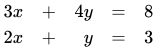
如果它們的增廣矩陣行等價,則定義線性系統等價。證明等價系統具有相同解集是很容易的。
建議所有讀者進行此練習。
問題 18
在這個矩陣中
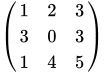
( 1 2 3 3 0 3 1 4 5 ) {\displaystyle {\begin{pmatrix}1&2&3\\3&0&3\\1&4&5\end{pmatrix}}} 第一列和第二列加起來等於第三列。
證明在任何行操作下仍然成立。 做一個推測。 證明它成立。
答案
三種可能的行交換很簡單,三種可能的重新縮放也是如此。六種可能的樞軸操作中的一種是 k ρ 1 + ρ 2 {\displaystyle k\rho _{1}+\rho _{2}} ( 1 2 3 k ⋅ 1 + 3 k ⋅ 2 + 0 k ⋅ 3 + 3 1 4 5 ) {\displaystyle {\begin{pmatrix}1&2&3\\k\cdot 1+3&k\cdot 2+0&k\cdot 3+3\\1&4&5\end{pmatrix}}} 明顯的推測是行操作不會改變列之間的線性關係。 逐案例的證明遵循第一項中給出的概要。
Hoffman, Kenneth; Kunze, Ray (1971), Linear Algebra (Second ed.), Prentice Hall Trono, Tony (compilier) (1991), University of Vermont Mathematics Department High School Prize Examinations 1958-1991 , mimeograhed printing 




![{\displaystyle {\xrightarrow[{}]{-4\rho _{1}+\rho _{2}}}{\begin{pmatrix}1&2\\0&0\end{pmatrix}}}](https://wikimedia.org/api/rest_v1/media/math/render/svg/49be71f72281d30f602c794dbf55e255eac603b7)
![{\displaystyle {\xrightarrow[{}]{\rho _{1}\leftrightarrow \rho _{2}}}{\begin{pmatrix}1&2\\0&1\end{pmatrix}}{\xrightarrow[{}]{-2\rho _{2}+\rho _{1}}}{\begin{pmatrix}1&0\\0&1\end{pmatrix}}}](https://wikimedia.org/api/rest_v1/media/math/render/svg/0ffdf1e5713acf865b38f236a42fcacbad621d9b)
![{\displaystyle {\xrightarrow[{-5\rho _{1}+\rho _{3}}]{-3\rho _{1}+\rho _{2}}}{\begin{pmatrix}1&0&2\\0&-1&-5\\0&-1&-5\end{pmatrix}}{\xrightarrow[{}]{-\rho _{2}+\rho _{3}}}{\begin{pmatrix}1&0&2\\0&-1&-5\\0&0&0\end{pmatrix}}{\xrightarrow[{}]{-\rho _{2}}}{\begin{pmatrix}1&0&2\\0&1&5\\0&0&0\end{pmatrix}}}](https://wikimedia.org/api/rest_v1/media/math/render/svg/674170f233ecf45bd3ba5e1e76fd83b779eb4692)
![{\displaystyle {\xrightarrow[{}]{-2\rho _{1}+\rho _{3}}}{\begin{pmatrix}1&0&2\\0&2&10\\0&0&0\end{pmatrix}}{\xrightarrow[{}]{(1/2)\rho _{2}}}{\begin{pmatrix}1&0&2\\0&1&5\\0&0&0\end{pmatrix}}}](https://wikimedia.org/api/rest_v1/media/math/render/svg/d540584a60412aef51e1159913e399e19a962)
![{\displaystyle {\xrightarrow[{}]{\rho _{1}+\rho _{2}}}{\begin{pmatrix}1&1&1\\0&3&3\end{pmatrix}}{\xrightarrow[{}]{(1/3)\rho _{2}}}{\begin{pmatrix}1&1&1\\0&1&1\end{pmatrix}}{\xrightarrow[{}]{-\rho _{2}+\rho _{1}}}{\begin{pmatrix}1&0&0\\0&1&1\end{pmatrix}}}](https://wikimedia.org/api/rest_v1/media/math/render/svg/eeff4747fda47b859798a0dc5f3179c6bd7190f4)
![{\displaystyle {\xrightarrow[{}]{\rho _{1}\leftrightarrow \rho _{2}}}{\begin{pmatrix}2&2&5\\0&3&-1\end{pmatrix}}{\xrightarrow[{(1/3)\rho _{2}}]{(1/2)\rho _{1}}}{\begin{pmatrix}1&1&5/2\\0&1&-1/3\end{pmatrix}}{\xrightarrow[{}]{-\rho _{2}+\rho _{1}}}{\begin{pmatrix}1&0&17/6\\0&1&-1/3\end{pmatrix}}}](https://wikimedia.org/api/rest_v1/media/math/render/svg/369079609d17012abab458fd0a9c0c006732c9ea)
![{\displaystyle {\xrightarrow[{}]{(1/3)\rho _{2}}}{\begin{pmatrix}1&1&1\\0&0&1\end{pmatrix}}{\xrightarrow[{}]{-\rho _{2}+\rho _{1}}}{\begin{pmatrix}1&1&0\\0&0&1\end{pmatrix}}}](https://wikimedia.org/api/rest_v1/media/math/render/svg/2810ef824ca874354a63557d04b7719c514e8ce6)
![{\displaystyle {\xrightarrow[{}]{\rho _{1}\leftrightarrow \rho _{2}}}{\begin{pmatrix}1&-1&1\\0&1&2\end{pmatrix}}{\xrightarrow[{}]{\rho _{2}+\rho _{1}}}{\begin{pmatrix}1&0&3\\0&1&2\end{pmatrix}}}](https://wikimedia.org/api/rest_v1/media/math/render/svg/6323f43e8a389e2ba36be0f77f67fb67abafde17)



























































![{\displaystyle \left({\begin{array}{*{3}{c}|c}4&1&10&8.45\\3&1&7&6.30\\1&1&1&p\end{array}}\right){\xrightarrow[{-(1/4)\rho _{1}+\rho _{3}}]{-(3/4)\rho _{1}+\rho _{2}}}\left({\begin{array}{*{3}{c}|c}4&1&10&8.45\\0&1/4&-1/2&-0.037\,5\\0&3/4&-3/2&p-2.112\,5\end{array}}\right){\xrightarrow[{}]{-3\rho _{2}+\rho _{3}}}\left({\begin{array}{*{3}{c}|c}4&1&10&8.45\\0&1/4&-1/2&-0.037\,5\\0&0&0&p-2.00\end{array}}\right)}](https://wikimedia.org/api/rest_v1/media/math/render/svg/4491641d813a44821824f0406132b774cdccd287)

![{\displaystyle {\begin{pmatrix}1&3\\2&1\end{pmatrix}}{\xrightarrow[{}]{0\rho _{2}}}{\begin{pmatrix}1&3\\0&0\end{pmatrix}}}](https://wikimedia.org/api/rest_v1/media/math/render/svg/196ac8f9fd3694971444225186adfc21ede39004)

![{\displaystyle \left({\begin{array}{*{2}{c}|c}3&-1&8\\2&1&3\end{array}}\right){\xrightarrow[{}]{-(2/3)\rho _{1}+\rho _{2}}}\left({\begin{array}{*{2}{c}|c}3&-1&8\\0&5/3&-7/3\end{array}}\right)}](https://wikimedia.org/api/rest_v1/media/math/render/svg/f13e5ab8adec434d0bc617b3f75bd2317d1e477a)




![{\displaystyle 0=5{\xrightarrow[{}]{(3/5)\rho _{1}}}0=3{\xrightarrow[{}]{x\rho _{1}}}0=3x}](https://wikimedia.org/api/rest_v1/media/math/render/svg/3d5890846579fc8551a20836701b7e92f2643144)