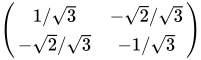
全等 的——對於歐幾里得的目的來說基本上是無法區分的——因為我們可以想象拿起平面,將其滑動並旋轉一點,但不要扭曲或拉伸它,然後將其放回去,以將第一個圖形疊加在第二個圖形上。(歐幾里得從未明確說明過這個原理,但他在書中經常使用它 (Casey 1890 )。)
在現代術語中,“拿起平面...”意味著考慮從平面到自身的對映。歐幾里得只將考慮範圍限制在平面上的某些變換,這些變換可能可以滑動或旋轉平面,但不能彎曲或拉伸它。 f : R 2 → R 2 {\displaystyle f:\mathbb {R} ^{2}\to \mathbb {R} ^{2}} 保距對映 、剛體運動 或等距對映 ,如果對於所有點 P 1 , P 2 ∈ R 2 {\displaystyle P_{1},P_{2}\in \mathbb {R} ^{2}} f ( P 1 ) {\displaystyle f(P_{1})} f ( P 2 ) {\displaystyle f(P_{2})} P 1 {\displaystyle P_{1}} P 2 {\displaystyle P_{2}} 圖形 為平面中的一組點,我們說兩個圖形是全等 的,如果存在一個保距對映從平面到自身,將一個圖形對映到另一個圖形上。
許多歐幾里得幾何中的命題可以很容易地從這些定義推匯出。其中一些是:(i)共線性在任何距離保持對映下都是不變的(也就是說,如果 P 1 {\displaystyle P_{1}} P 2 {\displaystyle P_{2}} P 3 {\displaystyle P_{3}} f ( P 1 ) {\displaystyle f(P_{1})} f ( P 2 ) {\displaystyle f(P_{2})} f ( P 3 ) {\displaystyle f(P_{3})} P 2 {\displaystyle P_{2}} P 1 {\displaystyle P_{1}} P 3 {\displaystyle P_{3}} f ( P 2 ) {\displaystyle f(P_{2})} f ( P 1 ) {\displaystyle f(P_{1})} f ( P 3 ) {\displaystyle f(P_{3})}
我們可以使用線性代數來描述平面的距離保持對映。
首先,存在一些不是線性的平面的距離保持變換。平移 。
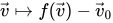
( x y ) ↦ ( x y ) + ( 1 0 ) = ( x + 1 y ) {\displaystyle {\begin{pmatrix}x\\y\end{pmatrix}}\quad \mapsto \quad {\begin{pmatrix}x\\y\end{pmatrix}}+{\begin{pmatrix}1\\0\end{pmatrix}}={\begin{pmatrix}x+1\\y\end{pmatrix}}} 然而,此例僅為唯一例,即若 f {\displaystyle f} 0 → {\displaystyle {\vec {0}}} v → 0 {\displaystyle {\vec {v}}_{0}} v → ↦ f ( v → ) − v → 0 {\displaystyle {\vec {v}}\mapsto f({\vec {v}})-{\vec {v}}_{0}} t {\displaystyle t} 0 → {\displaystyle {\vec {0}}}
t ( e → 1 ) = ( a b ) t ( e → 2 ) = ( c d ) {\displaystyle t({\vec {e}}_{1})={\begin{pmatrix}a\\b\end{pmatrix}}\qquad t({\vec {e}}_{2})={\begin{pmatrix}c\\d\end{pmatrix}}} a , b , c , d ∈ R {\displaystyle a,b,c,d\in \mathbb {R} } t {\displaystyle t} x , y ∈ R {\displaystyle x,y\in \mathbb {R} } t {\displaystyle t}
v → = ( x y ) ⟼ t ( a x + c y b x + d y ) ( ∗ ) {\displaystyle {\vec {v}}={\begin{pmatrix}x\\y\end{pmatrix}}{\stackrel {t}{\longmapsto }}{\begin{pmatrix}ax+cy\\bx+dy\end{pmatrix}}\qquad \qquad (*)} v → {\displaystyle {\vec {v}}} 0 → {\displaystyle {\vec {0}}} e → 1 {\displaystyle {\vec {e}}_{1}} e → 2 {\displaystyle {\vec {e}}_{2}} t ( v → ) {\displaystyle t({\vec {v}})} t ( 0 → ) {\displaystyle t({\vec {0}})} t ( e → 1 ) {\displaystyle t({\vec {e}}_{1})} t ( e → 2 ) {\displaystyle t({\vec {e}}_{2})} 0 → {\displaystyle {\vec {0}}} e → 1 {\displaystyle {\vec {e}}_{1}} e → 2 {\displaystyle {\vec {e}}_{2}} t {\displaystyle t} v → {\displaystyle {\vec {v}}} d 0 {\displaystyle d_{0}} 0 → {\displaystyle {\vec {0}}} d 1 {\displaystyle d_{1}} e → 1 {\displaystyle {\vec {e}}_{1}} d 2 {\displaystyle d_{2}} e → 2 {\displaystyle {\vec {e}}_{2}} t ( v → ) {\displaystyle t({\vec {v}})} d 0 {\displaystyle d_{0}} t ( 0 → ) {\displaystyle t({\vec {0}})} d 1 {\displaystyle d_{1}} t ( e → 1 ) {\displaystyle t({\vec {e}}_{1})} d 2 {\displaystyle d_{2}} t ( e → 2 ) {\displaystyle t({\vec {e}}_{2})} ∗ {\displaystyle *} d 0 {\displaystyle d_{0}} d 1 {\displaystyle d_{1}} d 2 {\displaystyle d_{2}}
dist ( ( x y ) , 0 → ) = dist ( t ( ( x y ) ) , t ( 0 → ) ) = dist ( ( a x + c y b x + d y ) , 0 → ) {\displaystyle {\text{dist}}\,({\begin{pmatrix}x\\y\end{pmatrix}},{\vec {0}})={\text{dist}}\,(t({\begin{pmatrix}x\\y\end{pmatrix}}),t({\vec {0}}))={\text{dist}}\,({\begin{pmatrix}ax+cy\\bx+dy\end{pmatrix}},{\vec {0}})} t {\displaystyle t} 0 → {\displaystyle {\vec {0}}}
dist ( ( x y ) , e → 1 ) = dist ( t ( ( x y ) ) , t ( e → 1 ) ) = dist ( ( a x + c y b x + d y ) , ( a b ) ) {\displaystyle {\text{dist}}\,({\begin{pmatrix}x\\y\end{pmatrix}},{\vec {e}}_{1})={\text{dist}}\,(t({\begin{pmatrix}x\\y\end{pmatrix}}),t({\vec {e}}_{1}))={\text{dist}}\,({\begin{pmatrix}ax+cy\\bx+dy\end{pmatrix}},{\begin{pmatrix}a\\b\end{pmatrix}})}
dist ( ( x y ) , e → 2 ) = dist ( t ( ( x y ) ) , t ( e → 2 ) ) = dist ( ( a x + c y b x + d y ) , ( c d ) ) {\displaystyle {\text{dist}}\,({\begin{pmatrix}x\\y\end{pmatrix}},{\vec {e}}_{2})={\text{dist}}\,(t({\begin{pmatrix}x\\y\end{pmatrix}}),t({\vec {e}}_{2}))={\text{dist}}\,({\begin{pmatrix}ax+cy\\bx+dy\end{pmatrix}},{\begin{pmatrix}c\\d\end{pmatrix}})} ∗ {\displaystyle *} t {\displaystyle t}
因此,任何保持距離的 f : R 2 → R 2 {\displaystyle f:\mathbb {R} ^{2}\to \mathbb {R} ^{2}} f ( v → ) = t ( v → ) + v → 0 {\displaystyle f({\vec {v}})=t({\vec {v}})+{\vec {v}}_{0}} v → 0 {\displaystyle {\vec {v}}_{0}} t {\displaystyle t}
並非所有線性對映都能保持距離,例如, v → ↦ 2 v → {\displaystyle {\vec {v}}\mapsto 2{\vec {v}}} t {\displaystyle t} | t ( e → 1 ) | = | t ( e → 2 ) | = 1 {\displaystyle |t({\vec {e}}_{1})|=|t({\vec {e}}_{2})|=1} t ( e → 1 ) {\displaystyle t({\vec {e}}_{1})} t ( e → 2 ) {\displaystyle t({\vec {e}}_{2})} t {\displaystyle t} t {\displaystyle t} p → {\displaystyle {\vec {p}}} q → {\displaystyle {\vec {q}}} | t ( p → − q → ) | = | t ( p → ) − t ( q → ) | = | p → − q → | {\displaystyle |t({\vec {p}}-{\vec {q}}\,)|=|t({\vec {p}})-t({\vec {q}}\,)|=|{\vec {p}}-{\vec {q}}\,|}
v → = ( x y ) t ( e → 1 ) = ( a b ) t ( e → 2 ) = ( c d ) {\displaystyle {\vec {v}}={\begin{pmatrix}x\\y\end{pmatrix}}\quad t({\vec {e}}_{1})={\begin{pmatrix}a\\b\end{pmatrix}}\quad t({\vec {e}}_{2})={\begin{pmatrix}c\\d\end{pmatrix}}} a 2 + b 2 = c 2 + d 2 = 1 {\displaystyle a^{2}+b^{2}=c^{2}+d^{2}=1} a c + b d = 0 {\displaystyle ac+bd=0}
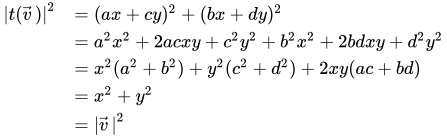
| t ( v → ) | 2 = ( a x + c y ) 2 + ( b x + d y ) 2 = a 2 x 2 + 2 a c x y + c 2 y 2 + b 2 x 2 + 2 b d x y + d 2 y 2 = x 2 ( a 2 + b 2 ) + y 2 ( c 2 + d 2 ) + 2 x y ( a c + b d ) = x 2 + y 2 = | v → | 2 {\displaystyle {\begin{array}{rl}|t({\vec {v}}\,)|^{2}&=(ax+cy)^{2}+(bx+dy)^{2}\\&=a^{2}x^{2}+2acxy+c^{2}y^{2}+b^{2}x^{2}+2bdxy+d^{2}y^{2}\\&=x^{2}(a^{2}+b^{2})+y^{2}(c^{2}+d^{2})+2xy(ac+bd)\\&=x^{2}+y^{2}\\&=|{\vec {v}}\,|^{2}\end{array}}} 這個特徵的妙處在於,我們可以很容易地識別出相對於標準基表示這種對映的矩陣。這些矩陣的列向量長度為1,並且互相正交。
我們可以利用這種洞察力來限定距離保持對映中可能出現的幾何操作。由於 | t ( v → ) | = | v → | {\displaystyle |t({\vec {v}}\,)|=|{\vec {v}}\,|} v → {\displaystyle {\vec {v}}} t {\displaystyle t} v → {\displaystyle {\vec {v}}} e → 1 {\displaystyle {\vec {e}}_{1}} e → 2 {\displaystyle {\vec {e}}_{2}} e → 1 {\displaystyle {\vec {e}}_{1}} a {\displaystyle a} b {\displaystyle b} e → 2 {\displaystyle {\vec {e}}_{2}} e → 2 {\displaystyle {\vec {e}}_{2}}
e → 1 {\displaystyle {\vec {e}}_{1}}
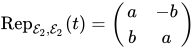
R e p E 2 , E 2 ( t ) = ( a − b b a ) {\displaystyle {\rm {Rep}}_{{\mathcal {E}}_{2},{\mathcal {E}}_{2}}(t)={\begin{pmatrix}a&-b\\b&a\end{pmatrix}}}
以及一個將點對映到逆時針方向四分之一圓弧上的變換。
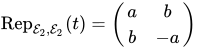
R e p E 2 , E 2 ( t ) = ( a b b − a ) {\displaystyle {\rm {Rep}}_{{\mathcal {E}}_{2},{\mathcal {E}}_{2}}(t)={\begin{pmatrix}a&b\\b&-a\end{pmatrix}}}
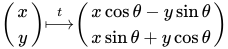
我們可以用幾何方法描述這兩種情況。設 θ {\displaystyle \theta } x {\displaystyle x} e → 1 {\displaystyle {\vec {e}}_{1}} θ {\displaystyle \theta }
( x y ) ⟼ t ( x cos θ − y sin θ x sin θ + y cos θ ) {\displaystyle {\begin{pmatrix}x\\y\end{pmatrix}}{\stackrel {t}{\longmapsto }}{\begin{pmatrix}x\cos \theta -y\sin \theta \\x\sin \theta +y\cos \theta \end{pmatrix}}}
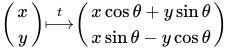
上面的第二個矩陣表示平面關於經過 e → 1 {\displaystyle {\vec {e}}_{1}} t ( e → 1 ) {\displaystyle t({\vec {e}}_{1})}
( x y ) ⟼ t ( x cos θ + y sin θ x sin θ − y cos θ ) {\displaystyle {\begin{pmatrix}x\\y\end{pmatrix}}{\stackrel {t}{\longmapsto }}{\begin{pmatrix}x\cos \theta +y\sin \theta \\x\sin \theta -y\cos \theta \end{pmatrix}}}
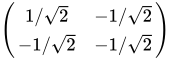
(這張圖片展示了 e → 1 {\displaystyle {\vec {e}}_{1}} e → 2 {\displaystyle {\vec {e}}_{2}}
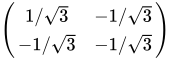
再次注意: e → 1 {\displaystyle {\vec {e}}_{1}} e → 2 {\displaystyle {\vec {e}}_{2}} t ( e → 1 ) {\displaystyle t({\vec {e}}_{1})} t ( e → 2 ) {\displaystyle t({\vec {e}}_{2})}
3 / 2 {\displaystyle 3/2}
從以上工作中,我們得知,如果存在正交矩陣 T {\displaystyle T} q → {\displaystyle {\vec {q}}} p → {\displaystyle {\vec {p}}} q → = ( k T ) v → + p → 0 {\displaystyle {\vec {q}}=(kT){\vec {v}}+{\vec {p}}_{0}} k {\displaystyle k} p → 0 {\displaystyle {\vec {p}}_{0}}
儘管許多這些想法最初是由歐幾里得探索的,但數學是永恆的,它們在今天仍然被廣泛應用。上面研究的對映的一個應用是計算機圖形學。例如,我們可以透過將立方體旋轉的電影幀組合在一起,來製作這個立方體頂檢視的動畫;這是一種剛體運動。
我們還可以透過製作立方體縮小的電影幀,讓立方體看起來像是在遠離我們,這將給我們提供相似的圖形。
計算機圖形學在許多其他方面結合了來自線性代數的技術(參見 問題 4 )。
因此,以上對距離保持對映的分析既有用又有趣。一本探討這方面內容的精彩書籍是 (Weyl 1952 )。更多關於變換群以及其他方面的內容,可以在任何一本關於現代代數的書籍中找到,例如 (Birkhoff & MacLane 1965 )。更多關於克萊因和埃爾朗根綱領的內容,可以在 (Yaglom 1988 ) 中找到。
問題 3
關於距離保持對映同時將零向量對映到自身這一點的證明間接表明,這樣的對映是單射且滿射的(由 d 0 {\displaystyle d_{0}} d 1 {\displaystyle d_{1}} d 2 {\displaystyle d_{2}} 證明平面圖形間的全等是一個等價關係。
問題 4
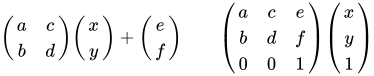
在實踐中,距離保持線性變換的矩陣和平移通常組合成一個矩陣。驗證這兩種計算是否產生相同的首兩個分量。
( a c b d ) ( x y ) + ( e f ) ( a c e b d f 0 0 1 ) ( x y 1 ) {\displaystyle {\begin{pmatrix}a&c\\b&d\end{pmatrix}}{\begin{pmatrix}x\\y\end{pmatrix}}+{\begin{pmatrix}e\\f\end{pmatrix}}\qquad {\begin{pmatrix}a&c&e\\b&d&f\\0&0&1\end{pmatrix}}{\begin{pmatrix}x\\y\\1\end{pmatrix}}} 齊次座標 ;參見射影幾何主題)。
問題 5
驗證本主題第二段描述的性質在距離保持對映下確實是保持不變的。 從你在學習歐幾里得幾何時所獲得的經驗中,再給出兩個在歐幾里得幾何中具有興趣且在距離保持對映下也保持不變的性質。 給出一個在歐幾里得幾何中不具有興趣,且在距離保持對映下不保持不變的性質。
解答
Birkhoff, Garrett; MacLane, Saunders (1965), 現代代數概論 , Macmillan Casey, John (1890), 歐幾里得原本,第一卷到第六卷和第十一卷 (第九版), Hodges, Figgis, and Co. Weyl, Hermann (1952), 對稱性 , 普林斯頓大學出版社 Yaglom, I. M. (1988), 費利克斯·克萊因和索菲斯·李:19 世紀對稱性思想的演變 , Birkhäuser