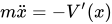
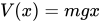
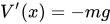
物理學 - 經典力學
上一頁 上一級 下一頁
在牛頓力學中,機械系統總是由質點或剛體組成,它們受到已知力的作用。因此,必須指定系統的組成以及作用在各個物體上的力的性質。然後,為系統編寫運動方程。以下是一些關於如何在牛頓力學中描述機械系統的示例(這些示例您在學校物理課上肯定都學過)。
這是所有機械系統中最簡單的一個:一個不與任何其他物體相互作用且不受任何力的質點。引入座標 x , y , z {\displaystyle x,y,z} x ¨ = 0 , y ¨ = 0 , z ¨ = 0 {\displaystyle {\ddot {x}}=0,{\ddot {y}}=0,{\ddot {z}}=0} x = x 0 + v x t {\displaystyle x=x_{0}+v_{x}t}
物理彈簧示例 兩個物體可以沿一條線( x {\displaystyle x} m 1 {\displaystyle m_{1}} m 2 {\displaystyle m_{2}} m 1 {\displaystyle m_{1}} k {\displaystyle k} L {\displaystyle L}
為了寫出運動方程,我們首先引入兩個座標 x 1 , x 2 {\displaystyle x_{1},x_{2}} m 1 {\displaystyle m_{1}} F 1 {\displaystyle F_{1}} F 2 {\displaystyle F_{2}} m 2 {\displaystyle m_{2}} F 2 {\displaystyle F_{2}} F 1 = k ( x 1 − L ) {\displaystyle F_{1}=k(x_{1}-L)} F 2 = k ( x 2 − x 1 − L ) {\displaystyle F_{2}=k(x_{2}-x_{1}-L)} a 1 , a 2 {\displaystyle a_{1},a_{2}}
a 1 = x 1 ¨ = F 2 − F 1 m 1 = k m 1 ( x 2 − x 1 − L ) − k m 1 ( x 1 − L ) , {\displaystyle a_{1}={\ddot {x_{1}}}={\frac {F_{2}-F_{1}}{m_{1}}}={\frac {k}{m_{1}}}(x_{2}-x_{1}-L)-{\frac {k}{m_{1}}}(x_{1}-L),} a 2 = x 2 ¨ = − F 2 m 2 = − k m 2 ( x 2 − x 1 − L ) . {\displaystyle a_{2}={\ddot {x_{2}}}=-{\frac {F_{2}}{m_{2}}}=-{\frac {k}{m_{2}}}(x_{2}-x_{1}-L).} 至此,我們完成了對系統的描述;現在我們需要針對特定的初始條件求解這些方程,並確定該系統的實際運動。
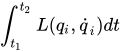
機械系統的拉格朗日描述 則有所不同:首先,我們不尋求給定初始條件下系統的演化,而是假設系統在兩個不同時刻 t 1 {\displaystyle t_{1}} t 2 {\displaystyle t_{2}} x , y , z {\displaystyle x,y,z} x 1 , x 2 {\displaystyle x_{1},x_{2}} q i {\displaystyle q_{i}} q i ( t 1 ) = A i {\displaystyle q_{i}(t_{1})=A_{i}} q i ( t 2 ) = B i {\displaystyle q_{i}(t_{2})=B_{i}} A i , B i {\displaystyle A_{i},B_{i}} t 1 {\displaystyle t_{1}} t 2 {\displaystyle t_{2}} 之間 是如何運動的?拉格朗日描述的答案是:在這段時間內,系統必須以這樣一種方式運動 ,使得積分 ∫ t 1 t 2 L ( q i , q ˙ i ) d t {\displaystyle \int _{t_{1}}^{t_{2}}L(q_{i},{\dot {q}}_{i})dt} L ( q i , q ˙ i ) {\displaystyle L(q_{i},{\dot {q}}_{i})} 拉格朗日函式 或拉格朗日量 。例如,自由質點的拉格朗日量為
L ( x , y , z , x ˙ , y ˙ , z ˙ ) = m 2 [ x ˙ 2 + y ˙ 2 + z ˙ 2 ] . {\displaystyle L(x,y,z,{\dot {x}},{\dot {y}},{\dot {z}})={\frac {m}{2}}[{\dot {x}}^{2}+{\dot {y}}^{2}+{\dot {z}}^{2}].} 上面兩個質量連線到牆上的例子,其拉格朗日量為
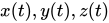
L ( x 1 , x 2 , x ˙ 1 , x ˙ 2 ) = m 2 [ x ˙ 1 2 + x ˙ 2 2 ] − k 2 ( x 1 − L ) 2 − k 2 ( x 2 − x 1 − L ) 2 . {\displaystyle L(x_{1},x_{2},{\dot {x}}_{1},{\dot {x}}_{2})={\frac {m}{2}}[{\dot {x}}_{1}^{2}+{\dot {x}}_{2}^{2}]-{\frac {k}{2}}(x_{1}-L)^{2}-{\frac {k}{2}}(x_{2}-x_{1}-L)^{2}.} 例如,根據拉格朗日描述,自由質點以這樣的方式運動,使得函式 x ( t ) , y ( t ) , z ( t ) {\displaystyle x(t),y(t),z(t)} ∫ t 1 t 2 m 2 [ x ˙ 2 + y ˙ 2 + z ˙ 2 ] d t {\displaystyle \int _{t_{1}}^{t_{2}}{\frac {m}{2}}[{\dot {x}}^{2}+{\dot {y}}^{2}+{\dot {z}}^{2}]dt} x ( t ) , y ( t ) , z ( t ) {\displaystyle x(t),y(t),z(t)} t 1 , 2 {\displaystyle t_{1,2}}
原則上,要找到積分 ∫ t 1 t 2 L ( q i , q ˙ i ) d t {\displaystyle \int _{t_{1}}^{t_{2}}L(q_{i},{\dot {q}}_{i})dt} q i ( t ) {\displaystyle q_{i}(t)} q i ∗ ( t ) {\displaystyle q_{i}^{*}(t)} q i ( t ) {\displaystyle q_{i}(t)} q i ( t ) {\displaystyle q_{i}(t)} 作用量 。因此,要求積分應具有最小值通常被稱為“最小作用量原理”或簡稱作用量原理 。
在這一點上,我們需要回答一個緊迫的問題
為什麼正確的軌跡 q i ∗ ( t ) {\displaystyle q_{i}^{*}(t)} 簡短的答案是,如果拉格朗日量 L {\displaystyle L} 數學上等價於 力的考慮。某個積分具有最小值(當積分選擇正確時)的條件在數學上與牛頓的加速度方程相同。點質量可能“不知道”關於這個積分的任何資訊。僅僅是在數學上方便地用一句話而不是很多句話來表述力學定律。(我們將在下面 看到另一種更直觀的解釋。)
假設我們理解了如何將某個積分具有最小值的條件轉化為加速度的方程。顯然,由於運動方程不同,每個力學系統的積分形式都需要不同。然後第二個問題出現了
我們如何找到對應於每個力學系統的拉格朗日函式 L ( q i , q ˙ i ) {\displaystyle L(q_{i},{\dot {q}}_{i})} 這是一個更復雜的問題,需要研究許多例子才能掌握這種方法。(簡而言之:拉格朗日函式是動能減去勢能。)
在考慮拉格朗日函式之前,我們將看看“最小作用量”的數學要求如何等價於上述例子中給出的運動方程。
函式是從數到數的對映;泛函 是從函式到數的對映。泛函作用於函式通常用方括號表示,例如 S [ f ( x ) ] {\displaystyle S[f(x)]}
泛函的隨機例子,僅用於說明概念
S [ f ( x ) ] = ∫ 0 ∞ f ( 3 x ) d x {\displaystyle S[f(x)]=\int _{0}^{\infty }{\sqrt {f(3x)}}dx} S [ f ( x ) ] = ∫ − 1 1 f ( x ) 1 − x 2 d x {\displaystyle S[f(x)]=\int _{-1}^{1}{\frac {f(x)}{1-x^{2}}}dx} S [ f ( x ) ] = f ( 15 ) − 8 f ′ ( 3 ) − ∫ 0 1 sin [ ( f ( x − 2 ) + x e − x ) 3 ] d x {\displaystyle S[f(x)]=f(15)-8f'(3)-\int _{0}^{1}\sin \left[(f(x-2)+{\sqrt {x}}e^{-x})^{3}\right]dx} 原則上,泛函可以是任何將數字分配給任何函式的東西。在實踐中,只有某些泛函是有趣的並且在物理學中得到應用。
由於作用積分將軌跡對映到數字,因此我們可以將其稱為作用泛函 。作用量原理表述如下:軌跡 q i ( t ) {\displaystyle q_{i}(t)}
這可能看起來類似於我們熟悉的機械平衡條件:座標 x , y , z {\displaystyle x,y,z} x , y , z {\displaystyle x,y,z} 泛函 時,我們必須改變整個函式 q i ( t ) {\displaystyle q_{i}(t)}
稱為變分法 的數學分支研究最小化(最大化,極值化)泛函的問題。此時需要學習一些變分學知識。讓我們從解決一些涉及多個變數函式的簡單最小化問題開始;這將為我們處理可以被認為是無限多個變數的函式的泛函做好準備。在檢視解答之前,您應該自己嘗試這些例子。
例1 :關於 x , y {\displaystyle x,y} f ( x , y ) = x 2 + x y + y 2 {\displaystyle f(x,y)=x^{2}+xy+y^{2}}
示例 2 :針對所有 x j {\displaystyle x_{j}} f ( x 1 , . . . , x n ) = x 1 2 + x 1 x 2 + x 2 2 + x 2 x 3 + . . . + x n 2 {\displaystyle f(x_{1},...,x_{n})=x_{1}^{2}+x_{1}x_{2}+x_{2}^{2}+x_{2}x_{3}+...+x_{n}^{2}}
示例 3 :針對所有 x j {\displaystyle x_{j}} x 0 = 0 , x n = A {\displaystyle x_{0}=0,x_{n}=A} f ( x 0 , . . . , x n ) = ( x 1 − x 0 ) 2 + ( x 2 − x 1 ) 2 + . . . + ( x n − x n − 1 ) 2 {\displaystyle f(x_{0},...,x_{n})=(x_{1}-x_{0})^{2}+(x_{2}-x_{1})^{2}+...+(x_{n}-x_{n-1})^{2}}
解法 1: 計算 f {\displaystyle f} x , y {\displaystyle x,y} x = 0 , y = 0 {\displaystyle x=0,y=0}
解法 2: 計算 f {\displaystyle f} x j {\displaystyle x_{j}} j = 1 , . . . , n {\displaystyle j=1,...,n} x j = 0 {\displaystyle x_{j}=0}
方案 3: 計算 f {\displaystyle f} x j {\displaystyle x_{j}} j = 2 , . . . , n − 1 {\displaystyle j=2,...,n-1} x j − x j − 1 = x j + 1 − x j {\displaystyle x_{j}-x_{j-1}=x_{j+1}-x_{j}} j = 1 , 2 , . . . , n − 1 {\displaystyle j=1,2,...,n-1} x 0 , x n {\displaystyle x_{0},x_{n}} x j = j A / n {\displaystyle x_{j}=jA/n}
現在讓我們考慮最小化泛函 S [ x ] = ∫ 0 1 x ˙ ( t ) 2 d t {\displaystyle S[x]=\int _{0}^{1}{{\dot {x}}(t)}^{2}dt} x ( t ) {\displaystyle x(t)} x ( 0 ) = 0 , x ( 1 ) = L {\displaystyle x(0)=0,x(1)=L}
Let us imagine that we are trying to minimize the integral L [ x ] {\displaystyle L[x]} x ( t ) {\displaystyle x(t)} x ( t ) {\displaystyle x(t)} finitely many values x ( t 0 ) , x ( t 1 ) , . . . , x ( t N ) {\displaystyle x(t_{0}),x(t_{1}),...,x(t_{N})} [ 0 , 1 ] {\displaystyle [0,1]} N {\displaystyle N} [ 0 , t 1 ] , [ t 1 , t 2 ] , . . . , [ t N − 1 , 1 ] {\displaystyle [0,t_{1}],[t_{1},t_{2}],...,[t_{N-1},1]} t j − t j − 1 ≡ Δ t = 1 / N {\displaystyle t_{j}-t_{j-1}\equiv \Delta t=1/N} t j = j / N , j = 1 , . . . , N − 1 {\displaystyle t_{j}=j/N,j=1,...,N-1} x ( t ) {\displaystyle x(t)} x j {\displaystyle x_{j}} t j {\displaystyle t_{j}} x ( t ) {\displaystyle x(t)} straight line between these points. The time moments t 1 , . . . , t N − 1 {\displaystyle t_{1},...,t_{N-1}} x j {\displaystyle x_{j}} x ( t ) {\displaystyle x(t)} all possible functions x ( t ) {\displaystyle x(t)} do describe is broad enough so that we get the correct results in the limit N → ∞ {\displaystyle N\to \infty } x ( t ) {\displaystyle x(t)} Δ t {\displaystyle \Delta t}
由於我們已經離散化了時間並減少了對分段線性函式的關注,所以我們有
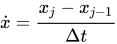
x ˙ = x j − x j − 1 Δ t {\displaystyle {\dot {x}}={\frac {x_{j}-x_{j-1}}{\Delta t}}} 在每個區間 t ∈ [ t j − 1 , t j ] {\displaystyle t\in [t_{j-1},t_{j}]} S [ x ] {\displaystyle S[x]}
S [ x ] = ∫ 0 1 x ˙ ( t ) 2 d t = ∑ j = 1 N ( x j − x j − 1 ) 2 Δ t 2 Δ t , {\displaystyle S[x]=\int _{0}^{1}{{\dot {x}}(t)}^{2}dt=\sum _{j=1}^{N}{\frac {{(x_{j}-x_{j-1})}^{2}}{\Delta t^{2}}}\Delta t,} 其中,為方便起見,我們定義了 t 0 = 0 , t N = 1 {\displaystyle t_{0}=0,t_{N}=1}
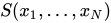
At this point we can perform the minimization of S [ x ] {\displaystyle S[x]} S [ x ] {\displaystyle S[x]} function of N − 1 {\displaystyle N-1} x 1 , . . . , x N − 1 {\displaystyle x_{1},...,x_{N-1}} S [ x ] = S ( x 1 , . . . , x N − 1 ) {\displaystyle S[x]=S(x_{1},...,x_{N-1})} x j {\displaystyle x_{j}} S ( x 1 , . . . , x N − 1 ) {\displaystyle S(x_{1},...,x_{N-1})} x j {\displaystyle x_{j}} x j = j L / N , j = 0 , . . . , N {\displaystyle x_{j}=jL/N,j=0,...,N} x j {\displaystyle x_{j}} x ( t ) {\displaystyle x(t)} t j = j / N {\displaystyle t_{j}=j/N} S [ x ] {\displaystyle S[x]} x j {\displaystyle x_{j}} x ( t ) = L t {\displaystyle x(t)=Lt} N {\displaystyle N} x ( t ) = L t {\displaystyle x(t)=Lt} N → ∞ {\displaystyle N\to \infty } x ( t ) = L t {\displaystyle x(t)=Lt} L [ x ] {\displaystyle L[x]} x ( 0 ) = 0 , x ( 1 ) = L {\displaystyle x(0)=0,x(1)=L}
上述計算的優點在於更直觀和視覺化:它清楚地表明,泛函 S [ x ( t ) ] {\displaystyle S[x(t)]} x ( t ) {\displaystyle x(t)} S ( x 1 , . . . , x N ) {\displaystyle S(x_{1},...,x_{N})} x j {\displaystyle x_{j}} S [ x ] {\displaystyle S[x]} x ( t ) {\displaystyle x(t)}
讓我們考慮函式 x ( t ) {\displaystyle x(t)} ϵ ( t ) {\displaystyle \epsilon (t)} S [ x ] {\displaystyle S[x]}
δ S [ x ( t ) , ϵ ( t ) ] ≡ S [ x ( t ) + ϵ ( t ) ] − S [ x ( t ) ] . {\displaystyle \delta S[x(t),\epsilon (t)]\equiv S[x(t)+\epsilon (t)]-S[x(t)].} (在許多教科書中, x ( t ) {\displaystyle x(t)} δ x ( t ) {\displaystyle \delta x(t)} Q {\displaystyle Q} δ Q {\displaystyle \delta Q} ϵ ( t ) {\displaystyle \epsilon (t)} δ x ( t ) {\displaystyle \delta x(t)}
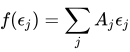
泛函 S [ x ] {\displaystyle S[x]} x ( t ) {\displaystyle x(t)} ϵ ( t ) {\displaystyle \epsilon (t)} δ S [ x , ϵ ] {\displaystyle \delta S[x,\epsilon ]} x ( t ) {\displaystyle x(t)} ϵ ( t ) {\displaystyle \epsilon (t)} ϵ ( t ) {\displaystyle \epsilon (t)} ϵ ( t ) {\displaystyle \epsilon (t)} α {\displaystyle \alpha } f ( t + α ) − f ( t ) = f ′ ( t ) α {\displaystyle f(t+\alpha )-f(t)=f'(t)\alpha } S [ x ] {\displaystyle S[x]} δ S [ x , ϵ ] {\displaystyle \delta S[x,\epsilon ]} ϵ ( t ) {\displaystyle \epsilon (t)} α j {\displaystyle \alpha _{j}} j = 1 , 2 , . . . {\displaystyle j=1,2,...} f ( ϵ j ) {\displaystyle f(\epsilon _{j})}
f ( ϵ j ) = ∑ j A j ϵ j {\displaystyle f(\epsilon _{j})=\sum _{j}^{}A_{j}\epsilon _{j}} 其中 A j {\displaystyle A_{j}} j {\displaystyle j} t {\displaystyle t} ϵ j {\displaystyle \epsilon _{j}} A j {\displaystyle A_{j}} ϵ ( t ) , A ( t ) {\displaystyle \epsilon (t),A(t)} j {\displaystyle j} t {\displaystyle t} ϵ ( t ) {\displaystyle \epsilon (t)}
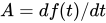
δ S [ x , ϵ ] = ∫ 0 1 A ( t ) ϵ ( t ) d t , {\displaystyle \delta S[x,\epsilon ]=\int _{0}^{1}A(t)\epsilon (t)dt,} 其中 A ( t ) {\displaystyle A(t)} f ( t ) {\displaystyle f(t)} A {\displaystyle A} A = d f ( t ) / d t {\displaystyle A=df(t)/dt} A ( t ) {\displaystyle A(t)} 變分導數 ,並用 δ S [ x ] / δ x ( t ) {\displaystyle \delta S[x]/\delta x(t)}
如果一個函式在某一點的導數為零,則該點為函式的極小值(或極大值,或極值點)。因此,泛函 S [ x ( t ) ] {\displaystyle S[x(t)]} x ( t ) {\displaystyle x(t)} S [ x ( t ) ] = ∫ 0 1 x ˙ 2 d t {\displaystyle S[x(t)]=\int _{0}^{1}{\dot {x}}^{2}dt}
將 x ( t ) + ϵ ( t ) {\displaystyle x(t)+\epsilon (t)} x ( t ) {\displaystyle x(t)}
δ S [ x , ϵ ] = ∫ 0 1 [ ( x ˙ + ϵ ˙ ) 2 − x ˙ 2 ] d t = 2 ∫ 0 1 x ˙ ϵ ˙ d t + O ( ϵ 2 ) , {\displaystyle \delta S[x,\epsilon ]=\int _{0}^{1}[({\dot {x}}+{\dot {\epsilon }})^{2}-{\dot {x}}^{2}]dt=2\int _{0}^{1}{\dot {x}}{\dot {\epsilon }}dt+O(\epsilon ^{2}),} 其中我們將忽略 ϵ ( t ) {\displaystyle \epsilon (t)} ϵ ( t ) {\displaystyle \epsilon (t)}
δ S [ x ( t ) , ϵ ( t ) ] = ϵ ( t ) x ˙ ( t ) | 0 1 − 2 ∫ 0 1 x ¨ ( t ) ϵ ( t ) d t . {\displaystyle \delta S[x(t),\epsilon (t)]=\left.\epsilon (t){\dot {x}}(t)\right|_{0}^{1}-2\int _{0}^{1}{\ddot {x}}(t)\epsilon (t)dt.} 由於在我們的例子中,值 x ( 0 ) , x ( 1 ) {\displaystyle x(0),x(1)} ϵ ( t ) {\displaystyle \epsilon (t)} ϵ ( 0 ) = ϵ ( 1 ) = 0 {\displaystyle \epsilon (0)=\epsilon (1)=0}
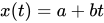
δ S / δ x ( t ) = − 2 x ¨ ( t ) . {\displaystyle \delta S/\delta x(t)=-2{\ddot {x}}(t).} 泛函 S [ x ] {\displaystyle S[x]} ϵ ( t ) {\displaystyle \epsilon (t)} ϵ ( t ) {\displaystyle \epsilon (t)} ϵ ( t ) {\displaystyle \epsilon (t)} x ( t ) {\displaystyle x(t)} ∫ 0 1 A ( t ) ϵ ( t ) {\displaystyle \int _{0}^{1}A(t)\epsilon (t)} A ( t ) {\displaystyle A(t)} t {\displaystyle t} ϵ ( t ) {\displaystyle \epsilon (t)} A ( t ) {\displaystyle A(t)} δ S / δ x ( t ) {\displaystyle \delta S/\delta x(t)} − 2 x ¨ ( t ) {\displaystyle -2{\ddot {x}}(t)} S [ x ] {\displaystyle S[x]} x ( t ) {\displaystyle x(t)} − 2 x ¨ ( t ) = 0 {\displaystyle -2{\ddot {x}}(t)=0} x ¨ = 0 {\displaystyle {\ddot {x}}=0} x ( t ) = a + b t {\displaystyle x(t)=a+bt} x ( 0 ) = 0 , x ( 1 ) = L {\displaystyle x(0)=0,x(1)=L} x ( t ) = L t {\displaystyle x(t)=Lt}
概括來說:要求泛函 S [ x ( t ) ] {\displaystyle S[x(t)]} x ( t ) {\displaystyle x(t)} x ( t ) {\displaystyle x(t)}
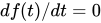
δ S [ x ] / δ x ( t ) = 0. {\displaystyle \delta S[x]/\delta x(t)=0.} 這個過程與尋找函式 f ( t ) {\displaystyle f(t)} t {\displaystyle t} d f ( t ) / d t = 0 {\displaystyle df(t)/dt=0}
假設現在要求我們最小化泛函 S [ x ( t ) ] = ∫ 0 1 ( x 2 + x ˙ 2 − x 4 sin t ) d t {\displaystyle S[x(t)]=\int _{0}^{1}(x^{2}+{\dot {x}}^{2}-x^{4}\sin t)dt} x ( 0 ) = 0 , x ( 1 ) = 1 {\displaystyle x(0)=0,x(1)=1} x ( t ) {\displaystyle x(t)} S [ x ] {\displaystyle S[x]}
S [ x i ( t ) ] = ∫ a b L ( x i , x ˙ i , t ) d t , {\displaystyle S[x_{i}(t)]=\int _{a}^{b}L(x_{i},{\dot {x}}_{i},t)dt,} 其中 L ( x i , v i , t ) d t {\displaystyle L(x_{i},v_{i},t)dt} x i {\displaystyle x_{i}} v i ≡ x ˙ i {\displaystyle v_{i}\equiv {\dot {x}}_{i}} n {\displaystyle n} i = 1 , . . . , n {\displaystyle i=1,...,n} L ( x i , v i , t ) d t {\displaystyle L(x_{i},v_{i},t)dt} 拉格朗日函式 或簡稱拉格朗日量 。
我們將無窮小變化 ϵ i ( t ) {\displaystyle \epsilon _{i}(t)} x i ( t ) {\displaystyle x_{i}(t)} ϵ i ( t ) {\displaystyle \epsilon _{i}(t)} ϵ ˙ i ( t ) {\displaystyle {\dot {\epsilon }}_{i}(t)}
δ S [ x i ( t ) , ϵ i ( t ) ] = ∫ a b ∑ i = 1 n [ ∂ L ∂ x i ϵ i ( t ) + ∂ L ∂ v i ϵ ˙ i ( t ) ] d t . {\displaystyle \delta S[x_{i}(t),\epsilon _{i}(t)]=\int _{a}^{b}\sum _{i=1}^{n}\left[{\frac {\partial L}{\partial x_{i}}}\epsilon _{i}(t)+{\frac {\partial L}{\partial v_{i}}}{\dot {\epsilon }}_{i}(t)\right]dt.} 然後我們進行分部積分,捨棄邊界項,得到
δ S [ x i ( t ) , ϵ i ( t ) ] = ∫ a b ∑ i = 1 n [ ∂ L ∂ x i − d d t ∂ L ∂ v i ] ϵ i ( t ) d t . {\displaystyle \delta S[x_{i}(t),\epsilon _{i}(t)]=\int _{a}^{b}\sum _{i=1}^{n}\left[{\frac {\partial L}{\partial x_{i}}}-{\frac {d}{dt}}{\frac {\partial L}{\partial v_{i}}}\right]\epsilon _{i}(t)dt.} 因此,變分導數可以寫成
δ S [ x ] δ x i ( t ) = ∂ L ∂ x i − d d t ∂ L ∂ v i . {\displaystyle {\frac {\delta S[x]}{\delta x_{i}(t)}}={\frac {\partial L}{\partial x_{i}}}-{\frac {d}{dt}}{\frac {\partial L}{\partial v_{i}}}.} 再次考慮泛函在 x i ( t ) {\displaystyle x_{i}(t)} δ S [ x i , ϵ i ] {\displaystyle \delta S[x_{i},\epsilon _{i}]} ϵ i ( t ) {\displaystyle \epsilon _{i}(t)} ϵ i ( a ) = ϵ i ( b ) = 0 {\displaystyle \epsilon _{i}(a)=\epsilon _{i}(b)=0} t {\displaystyle t}
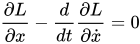
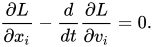
∂ L ∂ x i − d d t ∂ L ∂ v i = 0. {\displaystyle {\frac {\partial L}{\partial x_{i}}}-{\frac {d}{dt}}{\frac {\partial L}{\partial v_{i}}}=0.} 這些是表達以下數學要求的微分方程:泛函 S [ x i ( t ) , x ˙ i ( t ) , t ] {\displaystyle S[x_{i}(t),{\dot {x}}_{i}(t),t]} x i ( t ) {\displaystyle x_{i}(t)} x i ( t ) {\displaystyle x_{i}(t)} i = 1 , . . . , n {\displaystyle i=1,...,n}
注意,尤拉-拉格朗日方程涉及拉格朗日量關於座標和速度的偏導數。關於速度 v = x ˙ {\displaystyle v={\dot {x}}} ∂ L / ∂ x ˙ {\displaystyle \partial L/\partial {\dot {x}}} L ( x , v , t ) {\displaystyle L(x,v,t)}
尤拉-拉格朗日方程還涉及關於時間的導數 d / d t {\displaystyle d/dt} 不是 關於 t {\displaystyle t} 全導數 。換句話說,要計算 d d t ∂ L ∂ x ˙ i {\displaystyle {\frac {d}{dt}}{\frac {\partial L}{\partial {\dot {x}}_{i}}}} x i ( t ) {\displaystyle x_{i}(t)} x ˙ i ( t ) {\displaystyle {\dot {x}}_{i}(t)} ∂ L ∂ x ˙ i {\displaystyle {\frac {\partial L}{\partial {\dot {x}}_{i}}}}
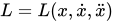
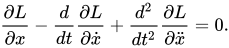
註記: 如果拉格朗日量包含高階導數(例如二階導數),則尤拉-拉格朗日公式會有所不同。例如,如果拉格朗日量為 L = L ( x , x ˙ , x ¨ ) {\displaystyle L=L(x,{\dot {x}},{\ddot {x}})}
∂ L ∂ x − d d t ∂ L ∂ x ˙ + d 2 d t 2 ∂ L ∂ x ¨ = 0. {\displaystyle {\frac {\partial L}{\partial x}}-{\frac {d}{dt}}{\frac {\partial L}{\partial {\dot {x}}}}+{\frac {d^{2}}{dt^{2}}}{\frac {\partial L}{\partial {\ddot {x}}}}=0.} 請注意,該方程的時間導數最高可達四階!通常,在經典力學的學習中不會遇到這種拉格朗日量,因為普通系統是由僅包含一階導數的拉格朗日量來描述的。
總結: 在力學中,人們透過編寫拉格朗日量並指出其中的未知函式來指定一個系統。由此,人們使用尤拉-拉格朗日公式推匯出運動方程。你需要非常瞭解這個公式,並理解如何應用它。這隻有透過實踐才能掌握。
基本規則是拉格朗日量等於動能減去勢能。(兩者都應該在慣性參考系中測量!在非慣性系中,此規則可能會失效。)
可以證明,對於由點質量、彈簧、繩索、無摩擦導軌等組成的任意機械系統,無論如何引入廣義座標,此規則都適用。我們不會研究該陳述的證明,而是直接轉向各種系統的拉格朗日量的示例。
沿直線運動的自由質點,其座標為 x {\displaystyle x} L = 1 2 m x ˙ 2 . {\displaystyle L={\frac {1}{2}}m{\dot {x}}^{2}.}
解
∂ L ∂ x − d d t ∂ L ∂ x ˙ = 0 {\displaystyle {\frac {\partial L}{\partial x}}-{\frac {d}{dt}}{\frac {\partial L}{\partial {\dot {x}}}}=0}
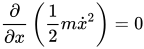
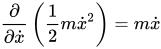
∂ ∂ x ( 1 2 m x ˙ 2 ) = 0 {\displaystyle {\frac {\partial }{\partial x}}\left({\frac {1}{2}}m{\dot {x}}^{2}\right)=0}
∂ ∂ x ˙ ( 1 2 m x ˙ 2 ) = m x ˙ {\displaystyle {\frac {\partial }{\partial {\dot {x}}}}\left({\frac {1}{2}}m{\dot {x}}^{2}\right)=m{\dot {x}}}
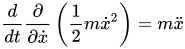
d d t ∂ ∂ x ˙ ( 1 2 m x ˙ 2 ) = m x ¨ {\displaystyle {\frac {d}{dt}}{\frac {\partial }{\partial {\dot {x}}}}\left({\frac {1}{2}}m{\dot {x}}^{2}\right)=m{\ddot {x}}}
尤拉-拉格朗日方程簡化為 0 − m x ¨ = 0 {\displaystyle 0-m{\ddot {x}}=0} x ¨ = 0 {\displaystyle {\ddot {x}}=0}
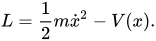
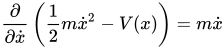
一個沿直線運動的質點,其座標為 x {\displaystyle x} V ( x ) {\displaystyle V(x)} L = 1 2 m x ˙ 2 − V ( x ) . {\displaystyle L={\frac {1}{2}}m{\dot {x}}^{2}-V(x).}
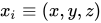
一個在三維空間中運動的質點,其座標為 x i ≡ ( x , y , z ) {\displaystyle x_{i}\equiv (x,y,z)} V ( x , y , z ) {\displaystyle V(x,y,z)} L = 1 2 ∑ i = 1 3 ( m x ˙ i 2 ) − V ( x , y , z ) = m 2 | x → ˙ | 2 − V ( x → ) . {\displaystyle L={\frac {1}{2}}\sum _{i=1}^{3}\left(m{{\dot {x}}_{i}}^{2}\right)-V(x,y,z)={\frac {m}{2}}|{\dot {\vec {x}}}|^{2}-V({\vec {x}}).}
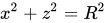
一個點質量約束在圓上運動,該圓的方程為 x 2 + z 2 = R 2 {\displaystyle x^{2}+z^{2}=R^{2}} z {\displaystyle z} θ {\displaystyle \theta } z = R cos θ , x = R sin θ {\displaystyle z=R\cos \theta ,x=R\sin \theta } U = m g z = m g R cos θ {\displaystyle U=mgz=mgR\cos \theta } K = m v 2 / 2 = m R 2 ω 2 / 2 = m R 2 θ ˙ 2 / 2 {\displaystyle K=mv^{2}/2=mR^{2}\omega ^{2}/2=mR^{2}{\dot {\theta }}^{2}/2} L = K − U = m 2 R 2 θ ˙ 2 − m g R cos θ . {\displaystyle L=K-U={\frac {m}{2}}R^{2}{\dot {\theta }}^{2}-mgR\cos \theta .}
需要注意的是,我們在不知道維持質量沿圓周運動所需的力的前提下,寫出了拉格朗日量(因此我們也可以推匯出運動方程)。這展示了拉格朗日方法巨大的概念優勢;在傳統的牛頓方法中,第一步將是確定這個最初未知的力,這需要透過包含點質量未知加速度的方程組來求解。
兩個(相等)的點質量透過長度為 l {\displaystyle l} L = m 2 ( x ˙ 1 2 + x ˙ 2 2 ) − k 2 ( x 1 − x 2 − l ) 2 . {\displaystyle L={\frac {m}{2}}({\dot {x}}_{1}^{2}+{\dot {x}}_{2}^{2})-{\frac {k}{2}}(x_{1}-x_{2}-l)^{2}.}
一個數學擺 ,即一個無質量的剛性杆,長度為 l {\displaystyle l} z {\displaystyle z} x − z {\displaystyle x-z} z {\displaystyle z} θ {\displaystyle \theta } L = m 2 l 2 θ ˙ 2 + m g l cos θ . {\displaystyle L={\frac {m}{2}}l^{2}{\dot {\theta }}^{2}+mgl\cos \theta .}
一個質量為 m {\displaystyle m} α {\displaystyle \alpha } x , y {\displaystyle x,y} y {\displaystyle y} z {\displaystyle z} z = x tan α {\displaystyle z=x\tan \alpha } U = m g z = m g x tan α {\displaystyle U=mgz=mgx\tan \alpha } K = m 2 ( x ˙ 2 + y ˙ 2 + z ˙ 2 ) = m 2 ( x ˙ 2 / cos 2 α + y ˙ 2 ) . {\displaystyle K={\frac {m}{2}}({\dot {x}}^{2}+{\dot {y}}^{2}+{\dot {z}}^{2})={\frac {m}{2}}({\dot {x}}^{2}/\cos ^{2}\alpha +{\dot {y}}^{2}).} 因此,拉格朗日量為:
L = K − U = m 2 ( x ˙ 2 / cos 2 α + y ˙ 2 ) − m g x tan α . {\displaystyle L=K-U={\frac {m}{2}}({\dot {x}}^{2}/\cos ^{2}\alpha +{\dot {y}}^{2})-mgx\tan \alpha .} 練習: 你現在應該確定從上述每個拉格朗日量推匯出的尤拉-拉格朗日方程,並驗證這些方程是否與從中學水平的牛頓力學考慮中獲得的相應物理系統的方程相同。這最多應該佔用你一兩個小時的時間。只有這樣,你才能開始理解拉格朗日方法的強大之處。
這裡有一些關於拉格朗日的更多練習。
有關為機械系統建立拉格朗日量和推導尤拉-拉格朗日方程的更多示例,請諮詢你的物理老師或查閱任何理論力學問題書籍。很多時候,某個複雜系統的尤拉-拉格朗日方程(例如,連線到另一個擺的端點上的擺)將難以求解,但關鍵是要獲得推導它們的經驗。在使用力的舊牛頓方法中,它們的推導將不那麼直接。
有關微分方程的簡要入門知識,請參見此處。
如果你第一次接觸拉格朗日量,你可能仍然會問自己:為什麼可以透過說某個積分具有最小值來描述系統的運動?這僅僅是一個純粹的形式數學技巧嗎?如果不是,如何才能獲得更直觀的理解?部分答案在這裡 。
















![{\displaystyle L(x,y,z,{\dot {x}},{\dot {y}},{\dot {z}})={\frac {m}{2}}[{\dot {x}}^{2}+{\dot {y}}^{2}+{\dot {z}}^{2}].}](https://wikimedia.org/api/rest_v1/media/math/render/svg/b596f5c2e892d7829518a06d4a47591ab1d87ffc)
![{\displaystyle L(x_{1},x_{2},{\dot {x}}_{1},{\dot {x}}_{2})={\frac {m}{2}}[{\dot {x}}_{1}^{2}+{\dot {x}}_{2}^{2}]-{\frac {k}{2}}(x_{1}-L)^{2}-{\frac {k}{2}}(x_{2}-x_{1}-L)^{2}.}](https://wikimedia.org/api/rest_v1/media/math/render/svg/99a9fab445404c0bfecfdef01a253d7b0fb8725d)
![{\displaystyle \int _{t_{1}}^{t_{2}}{\frac {m}{2}}[{\dot {x}}^{2}+{\dot {y}}^{2}+{\dot {z}}^{2}]dt}](https://wikimedia.org/api/rest_v1/media/math/render/svg/b6e83cb45a5f1b74d13a5558fc9cb914625bb846)


![{\displaystyle S[f(x)]}](https://wikimedia.org/api/rest_v1/media/math/render/svg/219daac0ff2efa18d46e629a69ecd8c96256de00)
![{\displaystyle S[f(x)]=\int _{0}^{\infty }{\sqrt {f(3x)}}dx}](https://wikimedia.org/api/rest_v1/media/math/render/svg/1b2e762170c2189d31a5f10e6113880423c3bf53)
![{\displaystyle S[f(x)]=\int _{-1}^{1}{\frac {f(x)}{1-x^{2}}}dx}](https://wikimedia.org/api/rest_v1/media/math/render/svg/2687b1a1148e95f0c3de3c50b76b1fe2f22b46a9)
![{\displaystyle S[f(x)]=f(15)-8f'(3)-\int _{0}^{1}\sin \left[(f(x-2)+{\sqrt {x}}e^{-x})^{3}\right]dx}](https://wikimedia.org/api/rest_v1/media/math/render/svg/43bf800fa989617a50d8ea0620c6132e76567b25)













![{\displaystyle S[x]=\int _{0}^{1}{{\dot {x}}(t)}^{2}dt}](https://wikimedia.org/api/rest_v1/media/math/render/svg/185baa4d56bea15a6d97675a3270035b0dc59ad8)


![{\displaystyle L[x]}](https://wikimedia.org/api/rest_v1/media/math/render/svg/1ad481528cdf71b58ddc4e631b288d663701e3d1)

![{\displaystyle [0,1]}](https://wikimedia.org/api/rest_v1/media/math/render/svg/738f7d23bb2d9642bab520020873cccbef49768d)

![{\displaystyle [0,t_{1}],[t_{1},t_{2}],...,[t_{N-1},1]}](https://wikimedia.org/api/rest_v1/media/math/render/svg/4fda25623b86c19bf5d1d96736ffebbb255986c7)




![{\displaystyle t\in [t_{j-1},t_{j}]}](https://wikimedia.org/api/rest_v1/media/math/render/svg/af84fe336bded76d3d25a7ab89c1187ea9d1f05b)
![{\displaystyle S[x]}](https://wikimedia.org/api/rest_v1/media/math/render/svg/e2ec9a5aa2223a25c0c76570fe05c7b812d796a0)
![{\displaystyle S[x]=\int _{0}^{1}{{\dot {x}}(t)}^{2}dt=\sum _{j=1}^{N}{\frac {{(x_{j}-x_{j-1})}^{2}}{\Delta t^{2}}}\Delta t,}](https://wikimedia.org/api/rest_v1/media/math/render/svg/f617fcc42419cb529e4cf50f2376fba074de71d8)



![{\displaystyle S[x]=S(x_{1},...,x_{N-1})}](https://wikimedia.org/api/rest_v1/media/math/render/svg/4050b930c5e43572412bca78458486ef67455ac2)




![{\displaystyle S[x(t)]}](https://wikimedia.org/api/rest_v1/media/math/render/svg/ed75d4ae411041a5a76c9b843c723f6c61cfb5f1)

![{\displaystyle \delta S[x(t),\epsilon (t)]\equiv S[x(t)+\epsilon (t)]-S[x(t)].}](https://wikimedia.org/api/rest_v1/media/math/render/svg/25e3cf111d408339e827a47bce096dafb5a18784)


![{\displaystyle \delta S[x,\epsilon ]}](https://wikimedia.org/api/rest_v1/media/math/render/svg/da6aa8c0dfe27ac1997f8692d3a1f2bbfbedcd11)






![{\displaystyle \delta S[x,\epsilon ]=\int _{0}^{1}A(t)\epsilon (t)dt,}](https://wikimedia.org/api/rest_v1/media/math/render/svg/244c83014b6e0d8147967ea04a40d69b7cfa86f4)


![{\displaystyle \delta S[x]/\delta x(t)}](https://wikimedia.org/api/rest_v1/media/math/render/svg/a9ba38d017f72e1bef6e427a8d1a80c1baf575a6)
![{\displaystyle S[x(t)]=\int _{0}^{1}{\dot {x}}^{2}dt}](https://wikimedia.org/api/rest_v1/media/math/render/svg/c1f9a38cf1e1f3b6beb2075627540ed4aa7b7a06)

![{\displaystyle \delta S[x,\epsilon ]=\int _{0}^{1}[({\dot {x}}+{\dot {\epsilon }})^{2}-{\dot {x}}^{2}]dt=2\int _{0}^{1}{\dot {x}}{\dot {\epsilon }}dt+O(\epsilon ^{2}),}](https://wikimedia.org/api/rest_v1/media/math/render/svg/470d9446e73e4d011c2f3235312517eed7a32aec)
![{\displaystyle \delta S[x(t),\epsilon (t)]=\left.\epsilon (t){\dot {x}}(t)\right|_{0}^{1}-2\int _{0}^{1}{\ddot {x}}(t)\epsilon (t)dt.}](https://wikimedia.org/api/rest_v1/media/math/render/svg/324c19beff3b4901ee544baf465d54b8dce672d1)





![{\displaystyle \delta S[x]/\delta x(t)=0.}](https://wikimedia.org/api/rest_v1/media/math/render/svg/3f55e423eff2904a461bdf19f24c3f066acc3107)
![{\displaystyle S[x(t)]=\int _{0}^{1}(x^{2}+{\dot {x}}^{2}-x^{4}\sin t)dt}](https://wikimedia.org/api/rest_v1/media/math/render/svg/e4d6c61ea95f269c5bc7ae5a52cca52d3195f75d)

![{\displaystyle S[x_{i}(t)]=\int _{a}^{b}L(x_{i},{\dot {x}}_{i},t)dt,}](https://wikimedia.org/api/rest_v1/media/math/render/svg/b1fd505011b3a0401995c98807b13252e5207ed6)


![{\displaystyle \delta S[x_{i}(t),\epsilon _{i}(t)]=\int _{a}^{b}\sum _{i=1}^{n}\left[{\frac {\partial L}{\partial x_{i}}}\epsilon _{i}(t)+{\frac {\partial L}{\partial v_{i}}}{\dot {\epsilon }}_{i}(t)\right]dt.}](https://wikimedia.org/api/rest_v1/media/math/render/svg/d90e1839d5facdadc9064e934b533056f1ba0b8e)
![{\displaystyle \delta S[x_{i}(t),\epsilon _{i}(t)]=\int _{a}^{b}\sum _{i=1}^{n}\left[{\frac {\partial L}{\partial x_{i}}}-{\frac {d}{dt}}{\frac {\partial L}{\partial v_{i}}}\right]\epsilon _{i}(t)dt.}](https://wikimedia.org/api/rest_v1/media/math/render/svg/a2431194aea8f2bffad5d709b20bbe36d51073b7)
![{\displaystyle {\frac {\delta S[x]}{\delta x_{i}(t)}}={\frac {\partial L}{\partial x_{i}}}-{\frac {d}{dt}}{\frac {\partial L}{\partial v_{i}}}.}](https://wikimedia.org/api/rest_v1/media/math/render/svg/2ba21300c7455424d91b64cfd0c1d70442673474)
![{\displaystyle \delta S[x_{i},\epsilon _{i}]}](https://wikimedia.org/api/rest_v1/media/math/render/svg/e87b3ad341abdfeee23c0c0f4b7682a10e228424)

![{\displaystyle S[x_{i}(t),{\dot {x}}_{i}(t),t]}](https://wikimedia.org/api/rest_v1/media/math/render/svg/931f960f5731f45870f5e6572807b47291959963)