區間劃分圖示 對於(黎曼)積分,我們考慮黎曼和。回想一下,在單變數情況下,我們將區間分成越來越多的子區間,它們的寬度越來越小,我們透過對每個子區間對應矩形的面積求和來對區間進行積分。對於多元變數情況,我們需要做類似的事情,但問題在於我們需要在 R 2 , R 3 {\displaystyle \mathbb {R} ^{2},\mathbb {R} ^{3}} R n {\displaystyle \mathbb {R} ^{n}} R {\displaystyle \mathbb {R} } 區間
在多元變數情況下,我們需要考慮的不只是'區間'本身(在多元變數情況下沒有定義),而是 R 2 {\displaystyle \mathbb {R} ^{2}} 笛卡爾積 R n {\displaystyle \mathbb {R} ^{n}} n 元笛卡爾積
笛卡爾積示例圖示。
定義。 n 元笛卡爾積) 在 n {\displaystyle n} X 1 , X 2 , … , X n {\displaystyle X_{1},X_{2},\ldots ,X_{n}} n 元笛卡爾積 X 1 × X 2 × ⋯ × X n = { ( x 1 , x 2 , … , x n ) : x i ∈ X i for each i ∈ { 1 , 2 , … , n } } {\displaystyle X_{1}\times X_{2}\times \cdots \times X_{n}=\{(x_{1},x_{2},\ldots ,x_{n}):x_{i}\in X_{i}{\text{ for each }}i\in \{1,2,\ldots ,n\}\}} n {\displaystyle n}
備註。
回想一下 區間 [ 0 , 1 ] = { x : 0 ≤ x ≤ 1 } {\displaystyle [0,1]=\left\{x:0\leq x\leq 1\right\}}
二元笛卡爾積簡稱為笛卡爾積,例如 [ 0 , 1 ] × [ 0 , 2 ] = { ( x 1 , x 2 ) : x 1 ∈ [ 0 , 1 ] and x 2 ∈ [ 0 , 2 ] } {\displaystyle [0,1]\times [0,2]=\{(x_{1},x_{2}):x_{1}\in [0,1]{\text{ and }}x_{2}\in [0,2]\}} 笛卡爾積 矩形
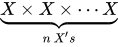
特殊情況 X × X × ⋯ X ⏟ n X ′ s {\displaystyle \underbrace {X\times X\times \cdots X} _{n\,X's}} n 階笛卡爾冪 X n {\displaystyle X^{n}} R 3 = R × R × R = { ( x , y , z ) : x ∈ R , y ∈ R and z ∈ R } {\displaystyle \mathbb {R} ^{3}=\mathbb {R} \times \mathbb {R} \times \mathbb {R} =\{(x,y,z):x\in \mathbb {R} ,y\in \mathbb {R} {\text{ and }}z\in \mathbb {R} \}}
面積(對於 n = 2 {\displaystyle n=2} n = 3 {\displaystyle n=3} n {\displaystyle n} R 2 {\displaystyle \mathbb {R} ^{2}} R 3 {\displaystyle \mathbb {R} ^{3}} R n {\displaystyle \mathbb {R} ^{n}}
示例。
[ 1 , 2 ] × [ 3 , 4 ] {\displaystyle [1,2]\times [3,4]} R 2 {\displaystyle \mathbb {R} ^{2}} 1 {\displaystyle 1} [ 1 , 2 ] × [ 2 , 10 ] × [ − π , − 1 ] {\displaystyle [1,2]\times [{\sqrt {2}},10]\times [-\pi ,-1]} R 3 {\displaystyle \mathbb {R} ^{3}} [ 0.3 , 1.7 ] × [ 0.3 , 1.7 ] × [ 0.3 , 1.7 ] × [ 0.3 , 1.7 ] {\displaystyle [0.3,1.7]\times [0.3,1.7]\times [0.3,1.7]\times [0.3,1.7]} [ 0.3.1.7 ] 4 {\displaystyle [0.3.1.7]^{4}} 四維立方體 ,位於 R 4 {\displaystyle \mathbb {R} ^{4}}
現在,我們準備用與單積分類似的方式定義多重積分。為簡便起見,我們先討論二重積分,然後以類似的方式推廣到多重積分。
將矩形劃分為 R 2 {\displaystyle \mathbb {R} ^{2}}
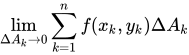
定義。 f ( x , y ) {\displaystyle f(x,y)} R 2 {\displaystyle \mathbb {R} ^{2}} R {\displaystyle R} R {\displaystyle R} Δ A 1 , Δ A 2 , … , Δ A n {\displaystyle \Delta A_{1},\Delta A_{2},\ldots ,\Delta A_{n}} k {\displaystyle k} ( x k , y k ) {\displaystyle (x_{k},y_{k})} lim Δ A k → 0 ∑ k = 1 n f ( x k , y k ) Δ A k {\displaystyle \lim _{\Delta A_{k}\to 0}\sum _{k=1}^{n}f(x_{k},y_{k})\Delta A_{k}} f {\displaystyle f} R {\displaystyle R} 可積的 ∬ R f d A {\displaystyle \iint _{R}f\,dA} A {\displaystyle A} f {\displaystyle f} R {\displaystyle R} 二重積分
二重積分的物理意義是計算體積。
我們還介紹一些二重積分的性質,以簡化二重積分的計算。
命題。 f ( x , y ) {\displaystyle f(x,y)} g ( x , y ) {\displaystyle g(x,y)} R 2 {\displaystyle \mathbb {R} ^{2}} R {\displaystyle R} 可積
(線性) a f + b g {\displaystyle af+bg} R {\displaystyle R} a {\displaystyle a} b {\displaystyle b} ∬ R ( a f + b g ) d A = a ∬ R f d A + b ∬ R g d A {\displaystyle \iint _{R}(af+bg)\,dA=a\iint _{R}f\,dA+b\iint _{R}g\,dA}
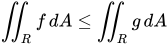
(單調性) 如果對於每個 ( x , y ) ∈ R {\displaystyle (x,y)\in R} f ( x , y ) ≤ g ( x , y ) {\displaystyle f(x,y)\leq g(x,y)} ∬ R f d A ≤ ∬ R g d A {\displaystyle \iint _{R}f\,dA\leq \iint _{R}g\,dA}
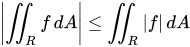
(三角不等式) | f | {\displaystyle |f|} R {\displaystyle R} | ∬ R f d A | ≤ ∬ R | f | d A {\displaystyle \left|\iint _{R}f\,dA\right|\leq \iint _{R}|f|\,dA}
注.
值得慶幸的是,我們並不總是需要使用黎曼和來計算多變數積分。有一些結果可以使我們的生活更輕鬆。在陳述結果之前,我們需要定義 重複積分
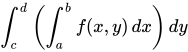
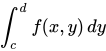
定義. f ( x , y ) {\displaystyle f(x,y)} [ a , b ] × [ c , d ] {\displaystyle [a,b]\times [c,d]} [ a , b ] × [ c , d ] {\displaystyle [a,b]\times [c,d]} R 2 {\displaystyle \mathbb {R} ^{2}} ∫ a b ∫ c d f ( x , y ) d y d x = ∫ a b ( ∫ c d f ( x , y ) d y ) d x {\displaystyle \int _{a}^{b}\int _{c}^{d}f(x,y)\,dy\,dx=\int _{a}^{b}\left(\int _{c}^{d}f(x,y)\,dy\right)dx} ∫ c d ∫ a b f ( x , y ) d x d y = ∫ c d ( ∫ a b f ( x , y ) d x ) d y {\displaystyle \int _{c}^{d}\int _{a}^{b}f(x,y)\,dx\,dy=\int _{c}^{d}\left(\int _{a}^{b}f(x,y)\,dx\right)dy}
計算逐次積分通常比使用黎曼和直接計算二重積分容易得多。 所以,如果我們能找到逐次積分和二重積分之間的關係,以便藉助逐次積分來計算二重積分,那就太好了。 事實上,確實如此,以下定理是逐次積分和二重積分之間的橋樑。
定理. f ( x , y ) {\displaystyle f(x,y)} R = [ a , b ] × [ c , d ] {\displaystyle R=[a,b]\times [c,d]} R = [ a , b ] × [ c , d ] {\displaystyle R=[a,b]\times [c,d]} R 2 {\displaystyle \mathbb {R} ^{2}} ∬ R f d A = ∫ a b ∫ c d f ( x , y ) d y d x = ∫ c d ∫ a b f ( x , y ) d x d y . {\displaystyle \iint _{R}f\,dA=\int _{a}^{b}\int _{c}^{d}f(x,y)\,dy\,dx=\int _{c}^{d}\int _{a}^{b}f(x,y)\,dx\,dy.}
備註。
也就是說,我們可以使用 任何
需要注意的是,在改變積分順序後,每個積分的積分限也會發生變化
證明。
(i) 因為對於每個 ( x , y ) ∈ [ 0 , 2 ] × [ 0 , 3 ] {\displaystyle (x,y)\in [0,2]\times [0,3]} z = 4 > 0 {\displaystyle z=4>0} ∬ [ 0 , 2 ] × [ 0 , 3 ] 4 d A {\displaystyle \iint _{[0,2]\times [0,3]}4\,\,dA} ∫ 0 2 ∫ 0 3 4 d y d x = 4 ∫ 0 2 ∫ 0 3 d y d x = 4 ∫ 0 2 ( 3 − 0 ) d x = 4 ( 3 ( 2 ) − 3 ( 0 ) ) = 24. {\displaystyle \int _{0}^{2}\int _{0}^{3}4\,dy\,dx=4\int _{0}^{2}\int _{0}^{3}\,dy\,dx=4\int _{0}^{2}(3-0)\,dx=4(3(2)-3(0))=24.}
備註。 2 ( 3 ) ( 4 ) = 24 {\displaystyle 2(3)(4)=24}
(ii) 所需體積由 ∬ [ 0 , ℓ ] × [ 0 , w ] h d x d y {\displaystyle \iint _{[0,\ell ]\times [0,w]}h\,dx\,dy} z = h {\displaystyle z=h} [ 0 , ℓ ] × [ 0 , w ] {\displaystyle [0,\ell ]\times [0,w]} ℓ {\displaystyle \ell } w {\displaystyle w} ∬ [ 0 , ℓ ] × [ 0 , w ] h d y d x {\displaystyle \iint _{[0,\ell ]\times [0,w]}h\,dy\,dx} ∬ [ 0 , ℓ ] × [ 0 , w ] h d x d y = ∫ 0 ℓ ∫ 0 w h d y d x = h ∫ 0 ℓ ∫ 0 w d y d x = h ∫ 0 ℓ w d x = ℓ w h . {\displaystyle \iint _{[0,\ell ]\times [0,w]}h\,dx\,dy=\int _{0}^{\ell }\int _{0}^{w}h\,dy\,dx=h\int _{0}^{\ell }\int _{0}^{w}\,dy\,dx=h\int _{0}^{\ell }w\,dx=\ell wh.} ◻ {\displaystyle \Box }
我們已經定義了在 R 2 {\displaystyle \mathbb {R} ^{2}} 。但是,我們經常想要計算在除了矩形之外形狀的區域上的二重積分,例如圓形、三角形等等。因此,我們將討論一種方法,在不改變二重積分定義的情況下,對更一般的區域進行二重積分計算。
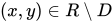
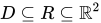
考慮一個函式 f : D → R {\displaystyle f:D\to \mathbb {R} } D ⊆ R 2 {\displaystyle D\subseteq \mathbb {R} ^{2}} D {\displaystyle D} R {\displaystyle R} 包含 D {\displaystyle D} R {\displaystyle R} R ⊇ D {\displaystyle R\supseteq D} f ( x , y ) = 0 {\displaystyle f(x,y)=0} ( x , y ) ∈ R {\displaystyle (x,y)\in R} 外部 D {\displaystyle D} ( x , y ) ∈ R ∖ D {\displaystyle (x,y)\in R\setminus D} 不會 f {\displaystyle f} D {\displaystyle D}
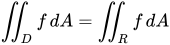
定義. f ( x , y ) {\displaystyle f(x,y)} D ⊆ R ⊆ R 2 {\displaystyle D\subseteq R\subseteq \mathbb {R} ^{2}} f ( x , y ) = 0 {\displaystyle f(x,y)=0} D {\displaystyle D} ( x , y ) ∈ R {\displaystyle (x,y)\in R} ( x , y ) ∈ R ∖ D {\displaystyle (x,y)\in R\setminus D} f {\displaystyle f} D {\displaystyle D} 二重積分 ∬ D f d A = ∬ R f d A {\displaystyle \iint _{D}f\,dA=\iint _{R}f\,dA}
注.
然而,這種計算方法(透過計算黎曼和)通常非常困難,我們通常使用傅比尼定理的推廣版本來計算這些積分。這將在下面討論。
定理. f ( x , y ) {\displaystyle f(x,y)} D {\displaystyle D}
(i) 如果 D = { ( x , y ) : a ≤ x ≤ b and g 1 ( x ) ≤ y ≤ h 1 ( x ) } {\displaystyle D=\{(x,y):a\leq x\leq b{\text{ and }}g_{1}(x)\leq y\leq h_{1}(x)\}} g 1 {\displaystyle g_{1}} h 1 {\displaystyle h_{1}} ∬ D f d A = ∫ a b ∫ g 1 ( x ) h 1 ( x ) f ( x , y ) d y d x . {\displaystyle \iint _{D}f\,dA=\int _{a}^{b}\int _{g_{1}(x)}^{h_{1}(x)}f(x,y)\,dy\,dx.} D = { ( x , y ) : c ≤ y ≤ d and g 2 ( y ) ≤ x ≤ h 2 ( y ) } {\displaystyle D=\{(x,y):c\leq y\leq d{\text{ and }}g_{2}(y)\leq x\leq h_{2}(y)\}} g 2 {\displaystyle g_{2}} h 2 {\displaystyle h_{2}} ∬ D f d A = ∫ c d ∫ g 2 ( y ) h 2 ( y ) f ( x , y ) d x d y . {\displaystyle \iint _{D}f\,dA=\int _{c}^{d}\int _{g_{2}(y)}^{h_{2}(y)}f(x,y)\,dx\,dy.} a , b , c , d {\displaystyle a,b,c,d}
證明。 Fubini 定理(非泛化版本) 和應用 一般區域上的二重積分定義 來證明這個定理。(我們可以使用 Fubini 定理,因為我們假設函式 g {\displaystyle g} h {\displaystyle h}
部分 (i):( D = { ( x , y ) : a ≤ x ≤ b and g ( x ) ≤ y ≤ h ( x ) } {\displaystyle D=\{(x,y):a\leq x\leq b{\text{ and }}g(x)\leq y\leq h(x)\}}
取任意矩形 R = [ a , b ] × [ c , d ] {\displaystyle R=[a,b]\times [c,d]} D {\displaystyle D} c ≤ g ( x ) {\displaystyle c\leq g(x)} d ≥ h ( x ) {\displaystyle d\geq h(x)} f ( x , y ) = 0 {\displaystyle f(x,y)=0} ( x , y ) ∈ R ∖ D {\displaystyle (x,y)\in R\setminus D} ∬ D f d A = def ∬ R f d A = ∫ a b ∫ c d f ( x , y ) d y d x = ∫ a b ( ∫ c g ( x ) f ( x , y ) d y ⏟ 0 because y < ( or ≤ ) g ( x ) + ∫ g ( x ) h ( x ) f ( x , y ) d y + ∫ h ( x ) d f ( x , y ) d y ⏟ 0 because y > ( or ≥ ) h ( x ) ) d x . {\displaystyle \iint _{D}f\,dA{\overset {\text{ def }}{=}}\iint _{R}f\,dA=\int _{a}^{b}\int _{c}^{d}f(x,y)\,dy\,dx=\int _{a}^{b}\left(\underbrace {\int _{c}^{g(x)}f(x,y)\,dy} _{0{\text{ because }}y<({\text{ or }}\leq )g(x)}+\int _{g(x)}^{h(x)}f(x,y)\,dy+\underbrace {\int _{h(x)}^{d}f(x,y)\,dy} _{0{\text{ because }}y>({\text{ or }}\geq )h(x)}\right)dx.}
部分 (ii):( D = { ( x , y ) : c ≤ y ≤ d and g ( x ) ≤ x ≤ h ( x ) } {\displaystyle D=\{(x,y):c\leq y\leq d{\text{ and }}g(x)\leq x\leq h(x)\}}
類似地,取任意矩形 R = [ a , b ] × [ c , d ] {\displaystyle R=[a,b]\times [c,d]} D {\displaystyle D} a ≤ g ( x ) {\displaystyle a\leq g(x)} b ≥ h ( x ) {\displaystyle b\geq h(x)} f ( x , y ) = 0 {\displaystyle f(x,y)=0} ( x , y ) ∈ R ∖ D {\displaystyle (x,y)\in R\setminus D} ∬ D f d A = def ∬ R f d A = ∫ c d ∫ a b f ( x , y ) d x d y = ∫ c d ( ∫ a g ( x ) f ( x , y ) d x ⏟ 0 because x < ( or ≤ ) g ( x ) + ∫ g ( x ) h ( x ) f ( x , y ) d x + ∫ h ( x ) b f ( x , y ) d x ⏟ 0 because x > ( or ≥ ) h ( x ) ) d x . {\displaystyle \iint _{D}f\,dA{\overset {\text{ def }}{=}}\iint _{R}f\,dA=\int _{c}^{d}\int _{a}^{b}f(x,y)\,dx\,dy=\int _{c}^{d}\left(\underbrace {\int _{a}^{g(x)}f(x,y)\,dx} _{0{\text{ because }}x<({\text{ or }}\leq )g(x)}+\int _{g(x)}^{h(x)}f(x,y)\,dx+\underbrace {\int _{h(x)}^{b}f(x,y)\,dx} _{0{\text{ because }}x>({\text{ or }}\geq )h(x)}\right)dx.} ◻ {\displaystyle \Box }
備註。 x {\displaystyle x} y {\displaystyle y}
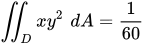
示例。 D {\displaystyle D} R 2 {\displaystyle \mathbb {R} ^{2}} ( 0 , 0 ) , ( 0 , 1 ) {\displaystyle (0,0),(0,1)} ( 1 , 0 ) {\displaystyle (1,0)} ∬ D x y 2 d A = 1 60 {\displaystyle \iint _{D}xy^{2}\,\,dA={\frac {1}{60}}}
證明。
方法 1 的示意圖 方法 2 的示意圖 Approach 1: The bound for x {\displaystyle x} 0 ≤ x ≤ 1 {\displaystyle 0\leq x\leq 1} x {\displaystyle x} y {\displaystyle y} 0 ≤ y ≤ 1 − x {\displaystyle 0\leq y\leq 1-x} ∫ 0 1 ∫ 0 1 − x x y 2 d y d x = ∫ 0 1 [ 1 3 y 3 x ] y = 0 y = 1 − x d x = 1 3 ∫ 0 1 x ( 1 − x ) 3 d x = 1 3 ∫ 0 1 ( x − 3 x 2 + 3 x 3 − x 4 ) d x = 1 3 ( 1 2 − 1 + 3 4 − 1 5 ) = 1 60 . {\displaystyle {\begin{aligned}\int _{0}^{1}\int _{0}^{1-x}xy^{2}\,dy\,dx&=\int _{0}^{1}\left[{\frac {1}{3}}y^{3}x\right]_{y=0}^{y=1-x}\,dx\\&={\frac {1}{3}}\int _{0}^{1}x(1-x)^{3}\,dx\\&={\frac {1}{3}}\int _{0}^{1}\left(x-3x^{2}+3x^{3}-x^{4}\right)\,dx\\&={\frac {1}{3}}\left({\frac {1}{2}}-1+{\frac {3}{4}}-{\frac {1}{5}}\right)\\&={\frac {1}{60}}.\end{aligned}}} y {\displaystyle y} 0 ≤ y ≤ 1 {\displaystyle 0\leq y\leq 1} y {\displaystyle y} x {\displaystyle x} 0 ≤ x ≤ 1 − y {\displaystyle 0\leq x\leq 1-y} ∫ 0 1 ∫ 0 1 − y x y 2 d x d y = ∫ 0 1 [ 1 2 x 2 y 2 ] x = 0 x = 1 − y d y = ∫ 0 1 1 2 ( 1 − y ) 2 y 2 d y = 1 2 ∫ 0 1 ( y 2 − 2 y 3 + y 4 ) d y = 1 2 ( 1 3 − 2 4 + 1 5 ) = 1 60 . {\displaystyle {\begin{aligned}\int _{0}^{1}\int _{0}^{1-y}xy^{2}\,dx\,dy&=\int _{0}^{1}\left[{\frac {1}{2}}x^{2}y^{2}\right]_{x=0}^{x=1-y}\,dy\\&=\int _{0}^{1}{\frac {1}{2}}(1-y)^{2}y^{2}\,dy\\&={\frac {1}{2}}\int _{0}^{1}\left(y^{2}-2y^{3}+y^{4}\right)\,dy\\&={\frac {1}{2}}\left({\frac {1}{3}}-{\frac {2}{4}}+{\frac {1}{5}}\right)\\&={\frac {1}{60}}.\end{aligned}}} ◻ {\displaystyle \Box }
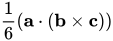
示例。 R 3 {\displaystyle \mathbb {R} ^{3}} ( 0 , 0 , 0 ) , ( a , 0 , 0 ) , ( 0 , b , 0 ) {\displaystyle (0,0,0),(a,0,0),(0,b,0)} ( 0 , 0 , c ) {\displaystyle (0,0,c)} a , b {\displaystyle a,b} c {\displaystyle c} a = ( a , 0 , 0 ) , b = ( 0 , b , 0 ) {\displaystyle \mathbf {a} =(a,0,0),\mathbf {b} =(0,b,0)} c = ( 0 , 0 , c ) {\displaystyle \mathbf {c} =(0,0,c)} 1 6 ( a ⋅ ( b × c ) ) {\displaystyle {\frac {1}{6}}(\mathbf {a} \cdot (\mathbf {b} \times \mathbf {c} ))} 1 6 {\displaystyle {\frac {1}{6}}} a , b {\displaystyle \mathbf {a} ,\mathbf {b} } c {\displaystyle \mathbf {c} }
證明。
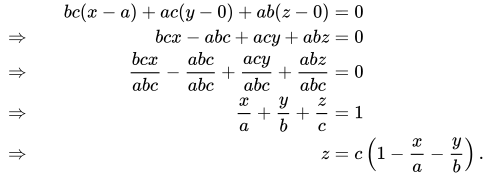
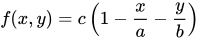
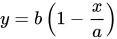
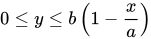
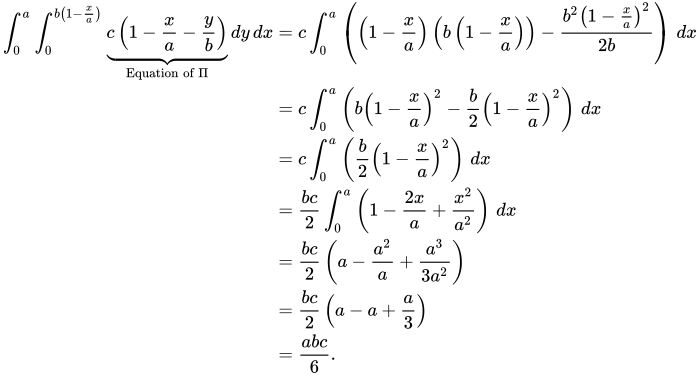
用二重積分求四面體體積的示意圖 Let the plane containing ( a , 0 , 0 ) , ( 0 , b , 0 ) {\displaystyle (a,0,0),(0,b,0)} ( 0 , 0 , c ) {\displaystyle (0,0,c)} Π {\displaystyle \Pi } Π {\displaystyle \Pi } Π {\displaystyle \Pi } [ ( a , 0 , 0 ) − ( 0 , 0 , c ) ] × [ ( 0 , b , 0 ) − ( 0 , 0 , c ) ] = ( a , 0 , − c ) × ( 0 , b , − c ) = | i j k a 0 − c 0 b − c | = ( b c , a c , a b ) . {\displaystyle [(a,0,0)-(0,0,c)]\times [(0,b,0)-(0,0,c)]=(a,0,-c)\times (0,b,-c)={\begin{vmatrix}\mathbf {i} &\mathbf {j} &\mathbf {k} \\a&0&-c\\0&b&-c\end{vmatrix}}=(bc,ac,ab).} Π {\displaystyle \Pi } b c ( x − a ) + a c ( y − 0 ) + a b ( z − 0 ) = 0 ⇒ b c x − a b c + a c y + a b z = 0 ⇒ b c x a b c − a b c a b c + a c y a b c + a b z a b c = 0 ⇒ x a + y b + z c = 1 ⇒ z = c ( 1 − x a − y b ) . {\displaystyle {\begin{aligned}&&bc(x-a)+ac(y-0)+ab(z-0)&=0\\&\Rightarrow &bcx-abc+acy+abz&=0\\&\Rightarrow &{\frac {bcx}{abc}}-{\frac {abc}{abc}}+{\frac {acy}{abc}}+{\frac {abz}{abc}}&=0\\&\Rightarrow &{\frac {x}{a}}+{\frac {y}{b}}+{\frac {z}{c}}&=1\\&\Rightarrow &z&=c\left(1-{\frac {x}{a}}-{\frac {y}{b}}\right).\end{aligned}}} f ( x , y ) = c ( 1 − x a − y b ) {\displaystyle f(x,y)=c\left(1-{\frac {x}{a}}-{\frac {y}{b}}\right)} D {\displaystyle D} D {\displaystyle D} ( 0 , 0 ) , ( a , 0 ) , ( 0 , b ) {\displaystyle (0,0),(a,0),(0,b)} R 2 {\displaystyle \mathbb {R} ^{2}} ( a , 0 ) {\displaystyle (a,0)} ( 0 , b ) {\displaystyle (0,b)} y = b ( 1 − x a ) {\displaystyle y=b\left(1-{\frac {x}{a}}\right)} x {\displaystyle x} 0 ≤ x ≤ a {\displaystyle 0\leq x\leq a} y {\displaystyle y} 0 ≤ y ≤ b ( 1 − x a ) {\displaystyle 0\leq y\leq b\left(1-{\frac {x}{a}}\right)} x {\displaystyle x} ∫ 0 a ∫ 0 b ( 1 − x a ) c ( 1 − x a − y b ) ⏟ Equation of Π d y d x = c ∫ 0 a ( ( 1 − x a ) ( b ( 1 − x a ) ) − b 2 ( 1 − x a ) 2 2 b ) d x = c ∫ 0 a ( b ( 1 − x a ) 2 − b 2 ( 1 − x a ) 2 ) d x = c ∫ 0 a ( b 2 ( 1 − x a ) 2 ) d x = b c 2 ∫ 0 a ( 1 − 2 x a + x 2 a 2 ) d x = b c 2 ( a − a 2 a + a 3 3 a 2 ) = b c 2 ( a − a + a 3 ) = a b c 6 . {\displaystyle {\begin{aligned}\int _{0}^{a}\int _{0}^{b\left(1-{\frac {x}{a}}\right)}\underbrace {c\left(1-{\frac {x}{a}}-{\frac {y}{b}}\right)} _{{\text{Equation of }}\Pi }\,dy\,dx&=c\int _{0}^{a}\left(\left(1-{\frac {x}{a}}\right)\left(b\left(1-{\frac {x}{a}}\right)\right)-{\frac {b^{2}\left(1-{\frac {x}{a}}\right)^{2}}{2b}}\right)\,dx\\&=c\int _{0}^{a}\left(b\left(1-{\frac {x}{a}}\right)^{2}-{\frac {b}{2}}\left(1-{\frac {x}{a}}\right)^{2}\right)\,dx\\&=c\int _{0}^{a}\left({\frac {b}{2}}\left(1-{\frac {x}{a}}\right)^{2}\right)\,dx\\&={\frac {bc}{2}}\int _{0}^{a}\left(1-{\frac {2x}{a}}+{\frac {x^{2}}{a^{2}}}\right)\,dx\\&={\frac {bc}{2}}\left(a-{\frac {a^{2}}{a}}+{\frac {a^{3}}{3a^{2}}}\right)\\&={\frac {bc}{2}}\left(a-a+{\frac {a}{3}}\right)\\&={\frac {abc}{6}}.\end{aligned}}} 1 6 ( a ⋅ ( b × c ) ) = 1 6 ( ( a , 0 , 0 ) ⋅ | i j k 0 b 0 0 0 c | ) = 1 6 ( ( a , 0 , 0 ) ⋅ ( b c , 0 , 0 ) ) = a b c 6 {\displaystyle {\frac {1}{6}}(\mathbf {a} \cdot (\mathbf {b} \times \mathbf {c} ))={\frac {1}{6}}\left((a,0,0)\cdot {\begin{vmatrix}\mathbf {i} &\mathbf {j} &\mathbf {k} \\0&b&0\\0&0&c\end{vmatrix}}\right)={\frac {1}{6}}((a,0,0)\cdot (bc,0,0))={\frac {abc}{6}}} ◻ {\displaystyle \Box }
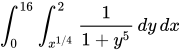
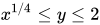
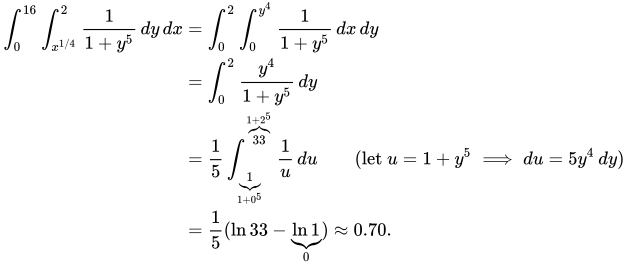
示例。 ∫ 0 16 ∫ x 1 / 4 2 1 1 + y 5 d y d x {\displaystyle \int _{0}^{16}\int _{x^{1/4}}^{2}{\frac {1}{1+y^{5}}}\,dy\,dx} 0.70 {\displaystyle 0.70}
備註。
在 R {\displaystyle \mathbb {R} } ∫ [ 0 , 2 ] f d x = ∫ [ 0 , 1 ] f d x + ∫ [ 1 , 2 ] f d x {\displaystyle \int _{[0,2]}fdx=\int _{[0,1]}fdx+\int _{[1,2]}fdx} [ 0 , 1 ] {\displaystyle [0,1]} [ 1 , 2 ] {\displaystyle [1,2]} 零長度
曲線 點 R 2 {\displaystyle \mathbb {R} ^{2}}
備註。
證明。
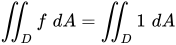
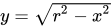
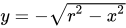
Solving y = r 2 − x 2 {\displaystyle y={\sqrt {r^{2}-x^{2}}}} y = − r 2 − x 2 {\displaystyle y=-{\sqrt {r^{2}-x^{2}}}} r 2 − x 2 = − r 2 − x 2 ⟹ r 2 − x 2 = 0 ⟹ x = ± r {\displaystyle {\sqrt {r^{2}-x^{2}}}=-{\sqrt {r^{2}-x^{2}}}\implies {\sqrt {r^{2}-x^{2}}}=0\implies x=\pm r} x = ± r ⟹ y = 0 {\displaystyle x=\pm r\implies y=0} ( r , 0 ) {\displaystyle ({\sqrt {r}},0)} ( − r , 0 ) {\displaystyle (-{\sqrt {r}},0)} x {\displaystyle x} − r ≤ x ≤ r {\displaystyle -{\sqrt {r}}\leq x\leq {\sqrt {r}}} x {\displaystyle x} y {\displaystyle y} − r 2 − x 2 ≤ y ≤ r 2 − x 2 {\displaystyle -{\sqrt {r^{2}-x^{2}}}\leq y\leq {\sqrt {r^{2}-x^{2}}}} ∬ D 1 d A = ∫ − r r ∫ − r 2 − x 2 r 2 − x 2 1 d y d x = 2 ∫ − r r r 2 − x 2 d x = 2 ∫ arcsin ( − r / r ) arcsin ( r / r ) r cos θ r 2 − r 2 sin 2 θ d θ let x = r sin θ ⟹ d x = r cos θ d θ and θ = arcsin ( x / r ) = 2 r ∫ arcsin ( − 1 ) ⏟ − π / 2 arcsin 1 ⏞ π / 2 cos θ r 2 ⏟ = | r | = r because r > 0 cos θ d θ = 2 r 2 ∫ − π / 2 π / 2 1 + cos ( 2 θ ) 2 d θ by double angle formula: cos ( 2 θ ) = 2 cos 2 θ − 1 ⟹ cos 2 θ = 1 + cos ( 2 θ ) 2 = 2 r 2 2 [ θ 2 + sin 2 ( θ ) 4 ] = 2 r 2 2 ( π 2 + 1 4 ⋅ sin ( 2 ( π / 2 ) ) ⏟ = sin π = 0 − ( − π 2 + 1 4 ⋅ sin ( 2 ( − π / 2 ) ) ⏟ = sin ( − π ) = 0 ) ) = π r 2 {\displaystyle {\begin{aligned}\iint _{D}1\,dA&=\int _{-r}^{r}\int _{-{\sqrt {r^{2}-x^{2}}}}^{\sqrt {r^{2}-x^{2}}}1\,dy\,dx\\&=2\int _{-r}^{r}{\sqrt {r^{2}-x^{2}}}\,dx\\&=2\int _{\arcsin(-r/r)}^{\arcsin(r/r)}r\cos \theta {\sqrt {r^{2}-r^{2}\sin ^{2}\theta }}\,d\theta \qquad {\text{let }}x=r\sin \theta \implies dx=r\cos \theta \,d\theta {\text{ and }}\theta =\arcsin(x/r)\\&=2r\int _{\underbrace {\arcsin(-1)} _{-\pi /2}}^{\overbrace {\arcsin 1} ^{\pi /2}}\cos \theta \underbrace {\sqrt {r^{2}}} _{=|r|=r{\text{ because }}r>0}\cos \theta \,d\theta \\&=2r^{2}\int _{-\pi /2}^{\pi /2}{\frac {1+\cos(2\theta )}{2}}\,d\theta \qquad {\text{by double angle formula:}}\cos(2\theta )=2\cos ^{2}\theta -1\implies \cos ^{2}\theta ={\frac {1+\cos(2\theta )}{2}}\\&={\frac {2r^{2}}{2}}\left[{\frac {\theta }{2}}+{\frac {\sin 2(\theta )}{4}}\right]\\&={\frac {2r^{2}}{2}}\left({\frac {\pi }{2}}+{\frac {1}{4}}\cdot \underbrace {\sin(2(\pi /2))} _{=\sin \pi =0}-\left(-{\frac {\pi }{2}}+{\frac {1}{4}}\cdot \underbrace {\sin(2(-\pi /2))} _{=\sin(-\pi )=0}\right)\right)\\&=\pi r^{2}\end{aligned}}} ◻ {\displaystyle \Box } Remark. D {\displaystyle D} disk (region in a plane bounded by a circle) of radius r {\displaystyle r}
二重積分部分 中的概念可以類推應用到 三重積分
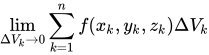
定義。 f ( x , y , z ) {\displaystyle f(x,y,z)} R 3 {\displaystyle \mathbb {R} ^{3}} B {\displaystyle B} B {\displaystyle B} Δ V 1 , Δ V 2 , … , Δ V n {\displaystyle \Delta V_{1},\Delta V_{2},\ldots ,\Delta V_{n}} k {\displaystyle k} 任意 ( x k , y k , z k ) {\displaystyle (x_{k},y_{k},z_{k})} f {\displaystyle f} R {\displaystyle R} 可積 lim Δ V k → 0 ∑ k = 1 n f ( x k , y k , z k ) Δ V k {\displaystyle \lim _{\Delta V_{k}\to 0}\sum _{k=1}^{n}f(x_{k},y_{k},z_{k})\Delta V_{k}} ∭ B f d V {\displaystyle \iiint _{B}f\,dV} V {\displaystyle V} 三重積分 B {\displaystyle B} f {\displaystyle f}
定理。 f ( x , y , z ) {\displaystyle f(x,y,z)} D {\displaystyle D}
(i) if D = { ( x , y , z ) : a 1 ≤ x ≤ b 1 , g 1 ( x ) ≤ y ≤ h 1 ( x ) , φ 1 ( x , y ) ≤ z ≤ ψ 1 ( x , y ) } {\displaystyle D=\{(x,y,z):a_{1}\leq x\leq b_{1},g_{1}(x)\leq y\leq h_{1}(x),\varphi _{1}(x,y)\leq z\leq \psi _{1}(x,y)\}} ∭ D f d V = ∫ a 1 b 1 ∫ g 1 ( x ) h 1 ( x ) ∫ φ 1 ( x , y ) ψ 1 ( x , y ) f d z d y d x {\displaystyle \iiint _{D}fdV=\int _{a_{1}}^{b_{1}}\int _{g_{1}(x)}^{h_{1}(x)}\int _{\varphi _{1}(x,y)}^{\psi _{1}(x,y)}f\,dz\,dy\,dx} D = { ( x , y , z ) : a 2 ≤ x ≤ b 2 , g 2 ( x ) ≤ z ≤ h 2 ( x ) , φ 2 ( x , z ) ≤ y ≤ ψ 2 ( x , z ) } {\displaystyle D=\{(x,y,z):a_{2}\leq x\leq b_{2},g_{2}(x)\leq z\leq h_{2}(x),\varphi _{2}(x,z)\leq y\leq \psi _{2}(x,z)\}} ∭ D f d V = ∫ a 2 b 2 ∫ g 2 ( x ) h 2 ( x ) ∫ φ 2 ( x , z ) ψ 2 ( x , z ) f d y d z d x {\displaystyle \iiint _{D}fdV=\int _{a_{2}}^{b_{2}}\int _{g_{2}(x)}^{h_{2}(x)}\int _{\varphi _{2}(x,z)}^{\psi _{2}(x,z)}f\,dy\,dz\,dx} D = { ( x , y , z ) : a 3 ≤ y ≤ b 3 , g 3 ( y ) ≤ x ≤ h 3 ( y ) , φ 3 ( x , y ) ≤ z ≤ ψ 3 ( x , y ) } {\displaystyle D=\{(x,y,z):a_{3}\leq y\leq b_{3},g_{3}(y)\leq x\leq h_{3}(y),\varphi _{3}(x,y)\leq z\leq \psi _{3}(x,y)\}} ∭ D f d V = ∫ a 3 b 3 ∫ g 3 ( y ) h 3 ( y ) ∫ φ 3 ( x , y ) ψ 3 ( x , y ) f d z d x d y {\displaystyle \iiint _{D}fdV=\int _{a_{3}}^{b_{3}}\int _{g_{3}(y)}^{h_{3}(y)}\int _{\varphi _{3}(x,y)}^{\psi _{3}(x,y)}f\,dz\,dx\,dy} D = { ( x , y , z ) : a 4 ≤ y ≤ b 4 , g 4 ( y ) ≤ z ≤ h 4 ( y ) , φ 4 ( y , z ) ≤ x ≤ ψ 4 ( y , z ) } {\displaystyle D=\{(x,y,z):a_{4}\leq y\leq b_{4},g_{4}(y)\leq z\leq h_{4}(y),\varphi _{4}(y,z)\leq x\leq \psi _{4}(y,z)\}} ∭ D f d V = ∫ a 4 b 4 ∫ g 4 ( y ) h 4 ( y ) ∫ φ 4 ( y , z ) ψ 4 ( y , z ) f d x d z d y {\displaystyle \iiint _{D}fdV=\int _{a_{4}}^{b_{4}}\int _{g_{4}(y)}^{h_{4}(y)}\int _{\varphi _{4}(y,z)}^{\psi _{4}(y,z)}f\,dx\,dz\,dy} D = { ( x , y , z ) : a 5 ≤ z ≤ b 5 , g 5 ( z ) ≤ y ≤ h 5 ( z ) , φ 5 ( y , z ) ≤ x ≤ ψ 5 ( y , z ) } {\displaystyle D=\{(x,y,z):a_{5}\leq z\leq b_{5},g_{5}(z)\leq y\leq h_{5}(z),\varphi _{5}(y,z)\leq x\leq \psi _{5}(y,z)\}} ∭ D f d V = ∫ a 5 b 5 ∫ g 5 ( z ) h 5 ( z ) ∫ φ 5 ( y , z ) ψ 5 ( y , z ) f d x d y d z {\displaystyle \iiint _{D}fdV=\int _{a_{5}}^{b_{5}}\int _{g_{5}(z)}^{h_{5}(z)}\int _{\varphi _{5}(y,z)}^{\psi _{5}(y,z)}f\,dx\,dy\,dz} D = { ( x , y , z ) : a 6 ≤ z ≤ b 6 , g 6 ( z ) ≤ x ≤ h 6 ( z ) , φ 6 ( x , z ) ≤ y ≤ ψ 6 ( x , z ) } {\displaystyle D=\{(x,y,z):a_{6}\leq z\leq b_{6},g_{6}(z)\leq x\leq h_{6}(z),\varphi _{6}(x,z)\leq y\leq \psi _{6}(x,z)\}} ∭ D f d V = ∫ a 6 b 6 ∫ g 6 ( z ) h 6 ( z ) ∫ φ 6 ( x , z ) ψ 6 ( x , z ) f d y d x d z {\displaystyle \iiint _{D}fdV=\int _{a_{6}}^{b_{6}}\int _{g_{6}(z)}^{h_{6}(z)}\int _{\varphi _{6}(x,z)}^{\psi _{6}(x,z)}f\,dy\,dx\,dz} 3 ! = 6 {\displaystyle 3!=6}
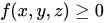
命題。 f ( x , y , z ) {\displaystyle f(x,y,z)} R 3 {\displaystyle \mathbb {R} ^{3}} B {\displaystyle B} 可積 ( x , y , z ) ∈ B {\displaystyle (x,y,z)\in B} f ( x , y , z ) ≥ 0 {\displaystyle f(x,y,z)\geq 0} f {\displaystyle f} B {\displaystyle B} 四維體積 ∭ B f d V . {\displaystyle \iiint _{B}fdV.}
證明。
(i) 給定 D {\displaystyle D} x 2 + y 2 + z 2 ≤ r 2 , x ≥ 0 , y ≥ 0 {\displaystyle x^{2}+y^{2}+z^{2}\leq r^{2},x\geq 0,y\geq 0} z ≥ 0 {\displaystyle z\geq 0}
x 2 ≤ x 2 + y 2 + z 2 ≤ r 2 and x ≥ 0 ⟹ 0 ≤ x ≤ r {\displaystyle x^{2}\leq x^{2}+y^{2}+z^{2}\leq r^{2}{\text{ and }}x\geq 0\implies 0\leq x\leq r} 給定一個固定的 x {\displaystyle x} y {\displaystyle y} g ( x ) ≤ y ≤ h ( x ) {\displaystyle g(x)\leq y\leq h(x)} 步驟: y 2 ≤ y 2 + z 2 ⏟ ≥ 0 ≤ r 2 − x 2 ⏟ by x 2 + y 2 + z 2 ≤ r 2 and y ≥ 0 ⟹ 0 ≤ y ≤ r 2 − x 2 {\displaystyle y^{2}\leq y^{2}+\underbrace {z^{2}} _{\geq 0}\underbrace {\leq r^{2}-x^{2}} _{{\text{by }}x^{2}+y^{2}+z^{2}\leq r^{2}}{\text{ and }}y\geq 0\implies 0\leq y\leq {\sqrt {r^{2}-x^{2}}}} 給定固定的 x {\displaystyle x} y {\displaystyle y} x {\displaystyle x} 0 ≤ x ≤ r {\displaystyle 0\leq x\leq r} y {\displaystyle y} x {\displaystyle x} z {\displaystyle z} φ ( x , y ) ≤ z ≤ ψ ( x , y ) {\displaystyle \varphi (x,y)\leq z\leq \psi (x,y)} 步驟: x 2 ≤ r 2 − y 2 − z 2 ⏟ by x 2 + y 2 + z 2 ≤ r 2 and z ≥ 0 ⟹ 0 ≤ z ≤ r 2 − y 2 − z 2 {\displaystyle x^{2}\underbrace {\leq r^{2}-y^{2}-z^{2}} _{{\text{by }}x^{2}+y^{2}+z^{2}\leq r^{2}}{\text{ and }}z\geq 0\implies 0\leq z\leq {\sqrt {r^{2}-y^{2}-z^{2}}}} Therefore, by generalized Fubini's theorem (triple integrals version) (i) and proposition about volume given by triple integration , the desired volume is ∭ D 1 d V = ∫ 0 r ∫ 0 r 2 − z 2 ∫ 0 r 2 − y 2 − z 2 1 d x d y d z = ∫ 0 r ∫ 0 r 2 − z 2 ( r 2 − y 2 − z 2 ) d y d z = ∫ 0 r ∫ 0 π / 2 ( ( r 2 − z 2 − ( r 2 − z 2 ) sin 2 θ ⏟ ( r 2 − z 2 ) ( 1 − sin 2 θ ) = ( r 2 − z 2 ) | cos θ | ) ( r 2 − z 2 ) cos θ ) d θ d z let y = r 2 − z 2 sin θ ⟹ d y = ( r 2 − z 2 ) cos θ d θ and θ = arcsin ( y r 2 − z 2 ) ( by restricting the domain of sine function to − π 2 ≤ θ ≤ π 2 ) = ∫ 0 r ( r 2 − z 2 ) 2 ∫ 0 π / 2 ( cos θ ) ( cos θ ) d θ d z | cos θ | = cos θ because cos θ ≥ 0 when − π 2 ≤ θ ≤ π 2 = ∫ 0 r ( r 2 − z 2 ) ∫ 0 π / 2 1 + cos ( 2 θ ) 2 d θ d z by double angle formula = 1 2 ∫ 0 r ( r 2 − z 2 ) ( π 2 + 1 2 ⋅ sin π ⏟ 0 ) d z = π 4 [ r 2 z − z 3 3 ] 0 r = π 4 ( r 3 − r 3 3 ) = π 4 ⋅ 2 3 ⋅ r 3 = 1 6 π r 3 {\displaystyle {\begin{aligned}\iiint _{D}1dV&=\int _{0}^{r}\int _{0}^{\sqrt {r^{2}-z^{2}}}\int _{0}^{\sqrt {r^{2}-y^{2}-z^{2}}}1\,dx\,dy\,dz\\&=\int _{0}^{r}\int _{0}^{\sqrt {r^{2}-z^{2}}}\left({\sqrt {r^{2}-y^{2}-z^{2}}}\right)\,dy\,dz\\&=\int _{0}^{r}\int _{0}^{\pi /2}\left(\left(\underbrace {\sqrt {r^{2}-z^{2}-\left(r^{2}-z^{2}\right)\sin ^{2}\theta }} _{{\sqrt {(r^{2}-z^{2})(1-\sin ^{2}\theta )}}={\sqrt {(r^{2}-z^{2})}}|\cos \theta |}\right)\left({\sqrt {r^{2}-z^{2}}}\right)\cos \theta \right)\,d\theta \,dz\qquad {\text{let }}y={\sqrt {r^{2}-z^{2}}}\sin \theta \implies dy=\left({\sqrt {r^{2}-z^{2}}}\right)\cos \theta \,d\theta {\text{ and }}\theta =\arcsin \left({\frac {y}{\sqrt {r^{2}-z^{2}}}}\right)({\text{by restricting the domain of sine function to }}-{\frac {\pi }{2}}\leq \theta \leq {\frac {\pi }{2}})\\&=\int _{0}^{r}\left({\sqrt {r^{2}-z^{2}}}\right)^{2}\int _{0}^{\pi /2}(\cos \theta )(\cos \theta )\,d\theta \,dz\qquad |\cos \theta |=\cos \theta {\text{ because }}\cos \theta \geq 0{\text{ when }}{\frac {-\pi }{2}}\leq \theta \leq {\frac {\pi }{2}}\\&=\int _{0}^{r}\left(r^{2}-z^{2}\right)\int _{0}^{\pi /2}{\frac {1+\cos(2\theta )}{2}}\,d\theta \,dz\qquad {\text{by double angle formula}}\\&={\frac {1}{2}}\int _{0}^{r}\left(r^{2}-z^{2}\right)\left({\frac {\pi }{2}}+{\frac {1}{2}}\cdot \underbrace {\sin \pi } _{0}\right)\,dz\\&={\frac {\pi }{4}}\left[r^{2}z-{\frac {z^{3}}{3}}\right]_{0}^{r}\\&={\frac {\pi }{4}}\left(r^{3}-{\frac {r^{3}}{3}}\right)\\&={\frac {\pi }{4}}\cdot {\frac {2}{3}}\cdot r^{3}\\&={\frac {1}{6}}\pi r^{3}\end{aligned}}}
(ii) 由於有八個八分圓(在 R 3 {\displaystyle \mathbb {R} ^{3}} D {\displaystyle D} 8 ( 1 6 π r 3 ) = 4 3 π r 3 . {\displaystyle 8\left({\frac {1}{6}}\pi r^{3}\right)={\frac {4}{3}}\pi r^{3}.} ◻ {\displaystyle \Box } 備註: r {\displaystyle r} 球體 (由球面包圍的立體圖形)。



.gif)




![{\displaystyle [0,1]=\left\{x:0\leq x\leq 1\right\}}](https://wikimedia.org/api/rest_v1/media/math/render/svg/eddf44fe7374453abcea73659c0fed093a43b276)
![{\displaystyle [0,1]\times [0,2]=\{(x_{1},x_{2}):x_{1}\in [0,1]{\text{ and }}x_{2}\in [0,2]\}}](https://wikimedia.org/api/rest_v1/media/math/render/svg/a173971c107a584380fa3358cfb564639220efe8)




![{\displaystyle [1,2]\times [3,4]}](https://wikimedia.org/api/rest_v1/media/math/render/svg/7eabb6486483d3fd4f304a10f6990c7b86dff65d)

![{\displaystyle [1,2]\times [{\sqrt {2}},10]\times [-\pi ,-1]}](https://wikimedia.org/api/rest_v1/media/math/render/svg/be9688cf8cf9d88a5007253dfed34538ace7f948)
![{\displaystyle [0.3,1.7]\times [0.3,1.7]\times [0.3,1.7]\times [0.3,1.7]}](https://wikimedia.org/api/rest_v1/media/math/render/svg/afea7e79455bc8d5fca9fd7a89220d43ca754e27)
![{\displaystyle [0.3.1.7]^{4}}](https://wikimedia.org/api/rest_v1/media/math/render/svg/2219231bfd9025db9bec45aa621839cf2ad947b9)










![{\displaystyle [a,b]\times [c,d]}](https://wikimedia.org/api/rest_v1/media/math/render/svg/7f42b01d8e291301085820acf1945742482839ca)




![{\displaystyle R=[a,b]\times [c,d]}](https://wikimedia.org/api/rest_v1/media/math/render/svg/3493a3bdcd7bd76960bb3d7b766bd6c6b1c4b3ee)


![{\displaystyle [0,2]\times [0,3]}](https://wikimedia.org/api/rest_v1/media/math/render/svg/781a4bd2b1074caa7538573badf3209c9ec6a8ea)


![{\displaystyle (x,y)\in [0,2]\times [0,3]}](https://wikimedia.org/api/rest_v1/media/math/render/svg/c1af527fe9e8d4c04b1c4bdc773a4fbb1703bc08)

![{\displaystyle \iint _{[0,2]\times [0,3]}4\,\,dA}](https://wikimedia.org/api/rest_v1/media/math/render/svg/531c72481d6e69a5c54d45092fe66b79bbb10e79)


![{\displaystyle \iint _{[0,\ell ]\times [0,w]}h\,dx\,dy}](https://wikimedia.org/api/rest_v1/media/math/render/svg/1b059f3d233e811cc70e3a434c5cb987b01c2705)

![{\displaystyle [0,\ell ]\times [0,w]}](https://wikimedia.org/api/rest_v1/media/math/render/svg/2f7ae9c917f4aff74a99b0814ef64f0703b0bd96)
![{\displaystyle \iint _{[0,\ell ]\times [0,w]}h\,dy\,dx}](https://wikimedia.org/api/rest_v1/media/math/render/svg/8cc9649e2a5e3371a22c85f1e1bee120530def57)
![{\displaystyle \iint _{[0,\ell ]\times [0,w]}h\,dx\,dy=\int _{0}^{\ell }\int _{0}^{w}h\,dy\,dx=h\int _{0}^{\ell }\int _{0}^{w}\,dy\,dx=h\int _{0}^{\ell }w\,dx=\ell wh.}](https://wikimedia.org/api/rest_v1/media/math/render/svg/0063eb64118c444a885c2714e1b3b95f1103cb08)






















![{\displaystyle {\begin{aligned}\int _{0}^{1}\int _{0}^{1-x}xy^{2}\,dy\,dx&=\int _{0}^{1}\left[{\frac {1}{3}}y^{3}x\right]_{y=0}^{y=1-x}\,dx\\&={\frac {1}{3}}\int _{0}^{1}x(1-x)^{3}\,dx\\&={\frac {1}{3}}\int _{0}^{1}\left(x-3x^{2}+3x^{3}-x^{4}\right)\,dx\\&={\frac {1}{3}}\left({\frac {1}{2}}-1+{\frac {3}{4}}-{\frac {1}{5}}\right)\\&={\frac {1}{60}}.\end{aligned}}}](https://wikimedia.org/api/rest_v1/media/math/render/svg/4c46f746049df7bf5b7ebe2f05cce75948bd2baa)


![{\displaystyle {\begin{aligned}\int _{0}^{1}\int _{0}^{1-y}xy^{2}\,dx\,dy&=\int _{0}^{1}\left[{\frac {1}{2}}x^{2}y^{2}\right]_{x=0}^{x=1-y}\,dy\\&=\int _{0}^{1}{\frac {1}{2}}(1-y)^{2}y^{2}\,dy\\&={\frac {1}{2}}\int _{0}^{1}\left(y^{2}-2y^{3}+y^{4}\right)\,dy\\&={\frac {1}{2}}\left({\frac {1}{3}}-{\frac {2}{4}}+{\frac {1}{5}}\right)\\&={\frac {1}{60}}.\end{aligned}}}](https://wikimedia.org/api/rest_v1/media/math/render/svg/0c216013685188f341c9ef852fcf486cedd619d6)









![{\displaystyle [(a,0,0)-(0,0,c)]\times [(0,b,0)-(0,0,c)]=(a,0,-c)\times (0,b,-c)={\begin{vmatrix}\mathbf {i} &\mathbf {j} &\mathbf {k} \\a&0&-c\\0&b&-c\end{vmatrix}}=(bc,ac,ab).}](https://wikimedia.org/api/rest_v1/media/math/render/svg/55bc9bac6376b23f6de40718b4a123fa8e04a26a)












![{\displaystyle \int _{[0,2]}fdx=\int _{[0,1]}fdx+\int _{[1,2]}fdx}](https://wikimedia.org/api/rest_v1/media/math/render/svg/a3944dc8942f412830a4c6ad0e609eb8d0aa42cd)
![{\displaystyle [0,1]}](https://wikimedia.org/api/rest_v1/media/math/render/svg/738f7d23bb2d9642bab520020873cccbef49768d)
![{\displaystyle [1,2]}](https://wikimedia.org/api/rest_v1/media/math/render/svg/f2614991ef363710c34e03eb9110d7423e3f60c2)





















![{\displaystyle {\begin{aligned}\iint _{D}1\,dA&=\int _{-r}^{r}\int _{-{\sqrt {r^{2}-x^{2}}}}^{\sqrt {r^{2}-x^{2}}}1\,dy\,dx\\&=2\int _{-r}^{r}{\sqrt {r^{2}-x^{2}}}\,dx\\&=2\int _{\arcsin(-r/r)}^{\arcsin(r/r)}r\cos \theta {\sqrt {r^{2}-r^{2}\sin ^{2}\theta }}\,d\theta \qquad {\text{let }}x=r\sin \theta \implies dx=r\cos \theta \,d\theta {\text{ and }}\theta =\arcsin(x/r)\\&=2r\int _{\underbrace {\arcsin(-1)} _{-\pi /2}}^{\overbrace {\arcsin 1} ^{\pi /2}}\cos \theta \underbrace {\sqrt {r^{2}}} _{=|r|=r{\text{ because }}r>0}\cos \theta \,d\theta \\&=2r^{2}\int _{-\pi /2}^{\pi /2}{\frac {1+\cos(2\theta )}{2}}\,d\theta \qquad {\text{by double angle formula:}}\cos(2\theta )=2\cos ^{2}\theta -1\implies \cos ^{2}\theta ={\frac {1+\cos(2\theta )}{2}}\\&={\frac {2r^{2}}{2}}\left[{\frac {\theta }{2}}+{\frac {\sin 2(\theta )}{4}}\right]\\&={\frac {2r^{2}}{2}}\left({\frac {\pi }{2}}+{\frac {1}{4}}\cdot \underbrace {\sin(2(\pi /2))} _{=\sin \pi =0}-\left(-{\frac {\pi }{2}}+{\frac {1}{4}}\cdot \underbrace {\sin(2(-\pi /2))} _{=\sin(-\pi )=0}\right)\right)\\&=\pi r^{2}\end{aligned}}}](https://wikimedia.org/api/rest_v1/media/math/render/svg/25efe1440cf121b5fedb7429c15d576fbfa9dcd0)

































![{\displaystyle {\begin{aligned}\iiint _{D}1dV&=\int _{0}^{r}\int _{0}^{\sqrt {r^{2}-z^{2}}}\int _{0}^{\sqrt {r^{2}-y^{2}-z^{2}}}1\,dx\,dy\,dz\\&=\int _{0}^{r}\int _{0}^{\sqrt {r^{2}-z^{2}}}\left({\sqrt {r^{2}-y^{2}-z^{2}}}\right)\,dy\,dz\\&=\int _{0}^{r}\int _{0}^{\pi /2}\left(\left(\underbrace {\sqrt {r^{2}-z^{2}-\left(r^{2}-z^{2}\right)\sin ^{2}\theta }} _{{\sqrt {(r^{2}-z^{2})(1-\sin ^{2}\theta )}}={\sqrt {(r^{2}-z^{2})}}|\cos \theta |}\right)\left({\sqrt {r^{2}-z^{2}}}\right)\cos \theta \right)\,d\theta \,dz\qquad {\text{let }}y={\sqrt {r^{2}-z^{2}}}\sin \theta \implies dy=\left({\sqrt {r^{2}-z^{2}}}\right)\cos \theta \,d\theta {\text{ and }}\theta =\arcsin \left({\frac {y}{\sqrt {r^{2}-z^{2}}}}\right)({\text{by restricting the domain of sine function to }}-{\frac {\pi }{2}}\leq \theta \leq {\frac {\pi }{2}})\\&=\int _{0}^{r}\left({\sqrt {r^{2}-z^{2}}}\right)^{2}\int _{0}^{\pi /2}(\cos \theta )(\cos \theta )\,d\theta \,dz\qquad |\cos \theta |=\cos \theta {\text{ because }}\cos \theta \geq 0{\text{ when }}{\frac {-\pi }{2}}\leq \theta \leq {\frac {\pi }{2}}\\&=\int _{0}^{r}\left(r^{2}-z^{2}\right)\int _{0}^{\pi /2}{\frac {1+\cos(2\theta )}{2}}\,d\theta \,dz\qquad {\text{by double angle formula}}\\&={\frac {1}{2}}\int _{0}^{r}\left(r^{2}-z^{2}\right)\left({\frac {\pi }{2}}+{\frac {1}{2}}\cdot \underbrace {\sin \pi } _{0}\right)\,dz\\&={\frac {\pi }{4}}\left[r^{2}z-{\frac {z^{3}}{3}}\right]_{0}^{r}\\&={\frac {\pi }{4}}\left(r^{3}-{\frac {r^{3}}{3}}\right)\\&={\frac {\pi }{4}}\cdot {\frac {2}{3}}\cdot r^{3}\\&={\frac {1}{6}}\pi r^{3}\end{aligned}}}](https://wikimedia.org/api/rest_v1/media/math/render/svg/53b9377aa68db74bdd473d148efc597036cf4e39)
