


分形/複平面迭代/曼德勃羅集內部
< 分形
(重定向自 分形/複平面迭代/曼德勃羅集)本書展示瞭如何為繪製引數平面[1](曼德勃羅集[2])編寫不同的演算法,用於復二次多項式。[3]
人們可以在引數平面上找到不同型別的點/集。[4]
此頁面介紹了曼德勃羅集的內部點。[5]
The “capture-time algorithm” is a natural counterpart for points inside the set to the “escape-time algorithm”. Given some desired tolerance, the orbit P is generated for each point c ∈ C until some point in the orbit is closer than to some previous point in the orbit. The number of iterations needed for this to occur is mapped to a color and displayed at the pixel corresponding to c. Adam Cunningham[6]
-
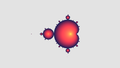 整個集合
整個集合 -
 迷你曼德勃羅集
 -
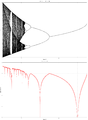 實二次對映
實二次對映

_-_Matlab.png)

數學方程 :[7]
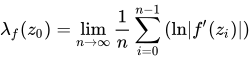
其中
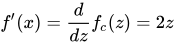
表示 f 相對於 z 的一階導數
另請參閱
JPBotelho 的 HLSL 程式碼[10]
Shader "Fractals/Coloring Techniques/Escape-Time"
{
	Properties
	{
		_MainTex ("Texture", 2D) = "white" {}

		_Iter ("Iterations", Range(0, 250)) = 100
		_Dividend ("Dividend", Range (0, 0.5)) = 15

		_Zoom ("Zoom", Range (0.1, 1000)) = 0.65
		_Position ("Offset", Vector) = (0.4, 0, 0, 0)

		_Background ("Background", Color) = (0, 0.25, 1, 0)
		_Origin ("Origin", Color) = (0, 0, 0, 0)
	}
	SubShader
	{
		Cull Off ZWrite Off ZTest Always

		Pass
		{
			CGPROGRAM

			#pragma vertex vert
			#pragma fragment frag

			#include "UnityCG.cginc"
			#include "Complex.cginc"
			#include "FractalOperations.cginc"

			struct appdata
			{
				float4 vertex : POSITION;
				float2 uv : TEXCOORD0;
			};

			struct v2f
			{
				float2 uv : TEXCOORD0;
				float4 vertex : SV_POSITION;
			};

			sampler2D _MainTex;

			int _Iter;
			fixed _Zoom;
			fixed _Dividend;
			float2 _Position;
			fixed4 _Background;
			fixed4 _Origin;

			v2f vert (appdata v)
			{
				v2f o;
				o.vertex = UnityObjectToClipPos(v.vertex);
				o.uv = v.uv;
				return o;
			}

			fixed4 frag (v2f i) : SV_Target
			{
				float x0 = (ClampScaleX(i.uv) + _Position.x) / _Zoom;
				float y0 = (ClampScaleY(i.uv) + _Position.y) / _Zoom;

				float2 z = float2(x0, y0);
				float2 c = float2(x0, y0);

				int iteration = 0;

				float l = 0;

				while (IsBounded(z, 40) && iteration < _Iter)
				{
					l += log (cabs(2 * z));

					z = cmul(z, z);
					z += c;

					iteration++;
				}

				l /= iteration;

				if (l > 0)
					return _Background;

                float3 color = tanh(l >= 0 ?
											float3(0, 0.7 * log(1 + l), log(1 + l)) :
											3 * float3(_Origin.x-l, _Origin.y-l * 0.1, _Origin.z));

				return float4(color + _Dividend, 1);


			}
			ENDCG
		}
	}
	CustomEditor "FractalEditor"
}

# Hypercomputing the Mandelbrot Set? by Petrus H. Potgieter February 1, 2008
n=1000; # For an nxn grid
m=50; # Number of iterations
c=meshgrid(linspace(-2,2,n))\ # Set up grid
+i*meshgrid(linspace(2,-2,n))’;
x=zeros(n,n); # Initial value on grid
for i=1:m
x=x.^2+c; # Iterate the mapping
endfor
imagesc(min(abs(x),2.1)) # Plot monochrome, absolute
# value of 2.1 is escape
點的顏色
- 與 z 在最後一次迭代時的值成正比。
- 顯示了週期性吸引子的內部水平集。
bof60 的影像位於“分形的美麗”這本書的第 60 頁。方法描述在 bof 的第 63 頁。它僅用於曼德勃羅集的內部點。
點的顏色與
- 其軌道到原點[11][12]的最小距離成正比
- 迭代過程中 z 獲得的最小值[13]
- 闡明瞭原點(臨界點)的迭代在集合內部到原點的最近距離
- “每個影片幀的每個畫素都代表一個特定的複數 c = a + ib。對於每個連續幀 n,z(c,n) := z(c, n-1)^2 + c 的幅度顯示為這些點 c 中的每個點的灰度強度值:幅度較大的點更白,幅度較小的點更暗。當 n 從 1 增加到 256 時,曼德勃羅集外部的點會迅速飽和為純白色,而曼德勃羅集內部的點會在較暗的強度之間振盪。” 布萊恩·高沃特[14]
距離的水平集是具有相同距離的點集。[15]
if (Iteration==IterationMax)
 /* interior of Mandelbrot set = color is proportional to modulus of last iteration */
 else { /* exterior of Mandelbrot set = black */
  color[0]=0;
  color[1]=0;
  color[2]=0;
 }
- 程式碼片段 : 來自 Gnofract4d 的 fractint.cfrm[16]
bof60 {
 init:
       float mag_of_closest_point = 1e100
 loop:
       float zmag = |z|
       if zmag < mag_of_closest_point
               mag_of_closest_point = zmag
       endif
 final:
       #index = sqrt(mag_of_closest_point) * 75.0/256.0
}
另請參閱
- Bof61
-
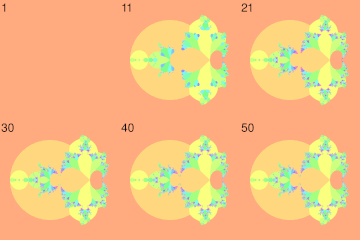 動畫
動畫 -
 2D
2D -
 3D
3D


曼德勃羅集的雙曲分量的週期是臨界軌道的極限集的週期。
用於計算週期的演算法
- 直接從動力學平面上的臨界點 z = 0.0 的迭代中檢測週期
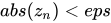
- “快速而骯髒”演算法:檢查是否,則將 c 點用顏色 n 著色。這裡 n 是吸引軌道的週期,eps 是吸引點周圍圓的半徑 = 數值計算的精度
- “如果正確實現,基於區間算術的方法能夠找到相當大的 n 的所有周期 n 迴圈。” (ZBIGNIEW GALIAS)[17]
- Floyd 的迴圈查詢演算法[18]
- 蜘蛛演算法
- 原子域,BOF61
- 週期檢測
內部檢測
[edit | edit source]如果以下所有內容都成立,則畫素很有可能是內部[19]
- 畫素被標記為內部(黑色)
- 所有周圍的畫素都被標記為內部(黑色)
- 所有黑色畫素具有相同的週期
內部座標和乘數對映
[edit | edit source]

克勞德·海蘭德-艾倫的演算法
- 檢查 c
- 當 c 在曼德布羅集之外時
- 現在放棄
- 或使用外部座標
- 當 c 不在外部(在內部或邊界上)時:對於每個週期 p,從 1 開始並遞增
- 找到週期點 z0,使得 fp(z0,c)=z0,使用牛頓法在一個復變數中
- 透過在 z0 處對 fp 關於 z 的一階導數進行求值來找到 b
- 如果 |b|≤1,則返回 b,否則繼續下一個 p
- 當 c 在曼德布羅集之外時
計算
[edit | edit source]對於週期:[23]
- 1 到 3 可以使用顯式方程[24]
- >3 必須使用數值方法來找到
週期 1
[edit | edit source]從邊界方程開始
c+(w/2)^2-w/2=0;
並針對 w 求解
(%i1) eq1:c+(w/2)^2-w/2=0;
                                                                                                              2
                                                                                                             w    w
(%o1)                                                                                                        -- - - + c = 0
                                                                                                             4    2
(%i2) solve(eq1,w);
(%o2)                                                                                        [w = 1 - sqrt(1 - 4 c), w = sqrt(1 - 4 c) + 1]
(%i3) s:solve(eq1,w);
(%o3)                                                                                        [w = 1 - sqrt(1 - 4 c), w = sqrt(1 - 4 c) + 1]
(%i4) s:map(rhs,s);
(%o4)                                                                                            [1 - sqrt(1 - 4 c), sqrt(1 - 4 c) + 1]
所以
w = w(c) = 1.0 - csqrt(1.0-4.0*c)
週期 2
[edit | edit source]w = 4.0*c + 4;
週期 3
[edit | edit source]

它可以使用 Maxima CAS 求解
(%i1) e1:c^3 + 2*c^2 - (w/8-1)*c + (w/8-1)^2 = 0;

                      3      2        w       w     2
(%o1)                c  + 2 c  + (1 - -) c + (- - 1)  = 0
                                      8       8
(%i2) solve(e1,w);
(%o2) [w = (- 4 sqrt((- 4 c) - 7) c) + 4 c + 8, w = 4 sqrt((- 4 c) - 7) c + 4 c + 8]
數值逼近
[edit | edit source]complex double AproximateMultiplierMap(complex double c, int period, double eps2, double er2)
{
complex double z; // variable z
complex double zp ; // periodic point
complex double zcr = 0.0; // critical point
complex double d = 1;
int p;
// first find periodic point
zp = GivePeriodic( c, zcr, period, eps2, er2); // Find periodic point z0 such that Fp(z0,c)=z0 using Newton's method in one complex variable
// Find w by evaluating first derivative with respect to z of Fp at z0
if ( cabs2(zp)<er2) {
z = zp;
for (p=0; p < period; p++){
d = 2*z*d; /* first derivative with respect to z */
z = z*z +c ; /* complex quadratic polynomial */
}}
else d= 10000; //
return d;
}
另請參閱
內角
[edit | edit source]
Renato Fonseca 的方法:[25] “集合中的一個點 c 的色調等於引數
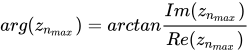
(適當縮放,以便最終得到 0 到 255 範圍內的數字)。數字 z_nmax 是 z 序列中計算的最後一個數字。”
另請參閱
Fractint
[edit | edit source]Fractint:顏色引數:INSIDE=ATAN
顏色透過確定最後一次迭代值相對於實軸的角度(以度為單位)並使用絕對值來確定。此功能應與 periodicity=0[26] 一起使用
內部射線
[edit | edit source]沿著內部射線從雙曲引數到拋物線引數[27]
-
 內部和外部射線
 -
 乘數對映和內部射線
 -
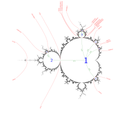 內部和外部射線


當 變化而 保持不變時, 沿著 內部射線 移動。 [28] 它被用作曼德勃羅集內部的 路徑。


double complex Give_c(double t, double r, int p)
{
	/*
	input:
	InternalRadius = r in [0,1]
  	InternalAngleInTurns = t in range [0,1]
  	p = period

  	output = c = complex point of 2D parameter plane
  	*/


	complex double w = 0.0;
	complex double c = 0.0;

	t = t*2*M_PI; // from turns to radians
  	// point of unit circle
  	w = r* cexp(I*t);

	// map circle to component
	switch (p){

	case 1: c = (2.0*w - w*w)/4.0; break;
	case 2: c = (w -4.0)/ 4.0; break;

	}
	return c;
}
/* find c in component of Mandelbrot set
 uses complex type so #include <complex.h> and -lm
 uses code by Wolf Jung from program Mandel
 see function mndlbrot::bifurcate from mandelbrot.cpp
 http://www.mndynamics.com/indexp.html

  */
double complex GiveC(double InternalAngleInTurns, double InternalRadius, unsigned int period)
{
  //0 <= InternalRay<= 1
  //0 <= InternalAngleInTurns <=1
  double t = InternalAngleInTurns *2*M_PI; // from turns to radians
  double R2 = InternalRadius * InternalRadius;
  double Cx, Cy; /* C = Cx+Cy*i */
  switch ( period ) {
    case 1: // main cardioid
      Cx = (cos(t)*InternalRadius)/2-(cos(2*t)*R2)/4;
      Cy = (sin(t)*InternalRadius)/2-(sin(2*t)*R2)/4;
      break;
   case 2: // only one component
      Cx = InternalRadius * 0.25*cos(t) - 1.0;
      Cy = InternalRadius * 0.25*sin(t);
      break;
  // for each period  there are 2^(period-1) roots.
  default: // safe values
      Cx = 0.0;
      Cy = 0.0;
    break; }

  return Cx+ Cy*I;
}

// draws points to memory array data
int DrawInternalRay(double InternalAngleInTurns, unsigned int period, int iMax, unsigned char data[])
{

   complex double c;
   double InternalRadius;
   double RadiusStep; // between radius of points
   int i; // number of point to draw

  RadiusStep = 1.0/iMax;

  for(i=0;i<=iMax;++i){
   InternalRadius = i * RadiusStep;
   c = GiveC(InternalAngleInTurns, InternalRadius, period);
   DrawPoint(c,data);
  }

return 0;
}
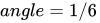
示例:角度為 1/6 的主心形的內部射線。
內角
射線的半徑

單位圓的內部半徑點

將點 對映到引數平面

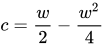
對於 ,這是主心形的方程。

當 保持不變而 變化時, 沿著內部曲線移動。
/* find c in component of Mandelbrot set
 uses complex type so #include <complex.h> and -lm
 uses code by Wolf Jung from program Mandel
 see function mndlbrot::bifurcate from mandelbrot.cpp
 http://www.mndynamics.com/indexp.html
*/
double complex GiveC(double InternalAngleInTurns, double InternalRadius, unsigned int period)
{
  //0 <= InternalRay<= 1
  //0 <= InternalAngleInTurns <=1
  double t = InternalAngleInTurns *2*M_PI; // from turns to radians
  double R2 = InternalRadius * InternalRadius;
  double Cx, Cy; /* C = Cx+Cy*i */
  switch ( period ) {
    case 1: // main cardioid
      Cx = (cos(t)*InternalRadius)/2-(cos(2*t)*R2)/4;
      Cy = (sin(t)*InternalRadius)/2-(sin(2*t)*R2)/4;
      break;
    case 2: // only one component
      Cx = InternalRadius * 0.25*cos(t) - 1.0;
      Cy = InternalRadius * 0.25*sin(t);
      break;
    // for each period  there are 2^(period-1) roots.
    default: // safe values
      Cx = 0.0;
      Cy = 0.0;
    break;
  }

  return Cx+ Cy*I;
}

// draws points to memory array data
int DrawInternalCurve(double InternalRadius , unsigned int period,  int iMax, unsigned char data[])
{
  complex double c;
  double InternalAngle; // in turns = from 0.0 to 1.0
  double AngleStep;
  int i;
  // int iMax =100;

  AngleStep = 1.0/iMax;

  for (i=0; i<=iMax; ++i) {
    InternalAngle = i * AngleStep;
    c = GiveC(InternalAngle, InternalRadius, period);
    DrawPoint(c,data);
  }

  return 0;
}


教程
- 在 Basic 中,請參見 Mandelbrot Dazibao
- 在 Java 中,請參見 Evgeny Demidov
- 在 C 中,請參見 Linas Vepstas
- 在 C++ 中,請參見 Wolf Jung 頁面,
- 在 Factor 中,請參見由 Slava Pestov 編寫的 程式
- 在 Gnuplot 中,請參見由 T.Kawano 編寫的 教程
- 在 Lisp(Maxima)中,請參見
- Jaime E. Villate 編寫的 Dynamics
- Robert P. Munafo 編寫的 Mu-Ency - 曼德勃羅集百科全書
- Yannick Gingras 編寫的 Frac,以及其精美的 [1] 影像庫
- Takaya Iwamoto 編寫的 Lisp 中的分形
- 在 Octave 中,請參見 華夏公益教科書 或由 Christopher Wellons 編寫的另一個版本
- 如何手動繪製曼德勃羅集
- 各種語言的比較
- 計算機語言基準遊戲:使用 ≈12 個有缺陷的基準測試,比較 ≈30 種程式語言在 4 種不同的作業系統/機器組合下的效能。
- rosettacode
- 由 Erik Wrenholt 編寫的,在 Ruby、Io、PHP、Python、Lua、Java、Perl、Applescript、TCL、ELisp、Javascript、OCaml、Ghostscript 和 C 中的 分形基準測試
- 由 Xavier Calbet 編寫的,在 PDL、IDL、MATLAB、Octave、C 和 FORTRAN77 中
- ASCII 圖形:[29]
- Robert P. Munafo 編寫的,在 Mu-Ency 上的 ASCII 圖形
- 由 Warp 編寫的,使用指令碼語言
- Theo Wollenleben 編寫的分形基準測試
- 在 Bill Clementson 的部落格 上,使用 Lisp
- 3D
-
 這是影像“Mandel zoom 03 seehorse.jpg” DEM 的 3D 版本。
 -
 半 3D 超複數 Mandelbrot 分形。使用 Mandelbulber 0.80 渲染。


- ↑ 維基百科中的引數平面
- ↑ 維基百科中的 Mandelbrot 集
- ↑ 維基百科中的復二次多項式
- ↑ reenigne 部落格:mandelbrot-set-taxonomy
- ↑ 透過 A Cunningham 展示 Mandelbrot 集的內部結構(帶有 python 3 程式和程式碼)
- ↑ Adam Cunningham 展示 Mandelbrot 集的內部結構
- ↑ 2013 年 10 月 4 日,Didier Gonze 的邏輯方程
- ↑ janthor 的 Lyapunov 指數和 Mandelbrot 集
- ↑ Anders Sandberg 的影像
- ↑ github 庫 JPBotelho:Fractal-Megacollection(Unity 的 HLSL 著色器)
- ↑ Fractint:各種選項和演算法
- ↑ Java™ Number Cruncher:Java 程式設計師的數值計算指南,作者 Ronald Mak
- ↑ Firefly 應用程式幫助,作者 Terry W. Gintz
- ↑ Mandelbrot 振盪,作者 Brian Gawalt
- ↑ Fractint 文件,作者 Noel Giffin
- ↑ gnofract4d
- ↑ 使用區間方法對電子電路中的週期軌道進行嚴格研究,作者 Zbigniew Galias
- ↑ Milan 的 Mandelbrot 集繪製
- ↑ fractalforums.org:使用級數逼近確定跳過的最佳迭代次數
- ↑ Mandelbrot 集內部座標,作者 Claude Heiland-Allen
- ↑ 內部距離渲染實踐,作者 Claude Heiland-Allen
- ↑ math.stackexchange 問題:測試 Mandelbrot 球中週期為 n 的成員資格/1151953#1151953
- ↑ Brown 方法,作者 Robert P. Munafo,2003 年 9 月 22 日。
- ↑ 精確座標,作者 Robert P. Munafo,2003 年 9 月 22 日。
- ↑ Mandelbrot 集,作者 Renato Fonseca
- ↑ fractint 顏色引數
- ↑ 沿著內射線的雙曲引數到拋物線引數,作者 Yi-Chiuan Chen 和 Tomoki Kawahira
- ↑ 維基百科中的內部射線
- ↑ ASCII 圖形