


分形/複平面上的迭代/曼德布羅集外部/引數外部射線

調整外部射線
對於具有有界後臨界集的復多項式 f,杜瓦迪-哈伯德著陸定理針對週期性外部
- 每個週期性外部射線都著陸在一個排斥或拋物線週期點上
- 相反,每個排斥或拋物線點都是至少一個週期性外部射線的著陸點
曼德布羅集演示 3(外部射線)第 8 頁
對於 p 週期角,連線的朱利亞集的相應動態射線著陸在一個週期除以 p 的排斥或拋物線點上。相應的引數射線著陸在一個週期為 p 的雙曲分量的根部。
為了證明這一點,考慮一個引數 c0,其中引數射線累積。對於此射線上的引數 c,相應的動態射線分支。如果 c0 的動態射線著陸在一個排斥週期點上,那麼根據隱函式定理和拉回引數,它也會在 c ≈ c0 時不著陸。這個矛盾表明 c0 的動態射線必須著陸在一個拋物線點上,而 c0 則是一個根。
事實上,恰好有兩個具有周期角的引數射線著陸在每個根部。這由
- 阿德里安·杜瓦迪和約翰·哈馬爾·哈伯德使用拋物線內爆的 Fatou 座標(第 2 章)證明。
- 迪爾克·施萊希特和約翰·米爾諾提供了組合證明。
對於位於兩條引數射線之間的尾流中的引數 c
- 具有相同角度的兩條動態射線一起著陸,
- 臨界值 z = c 始終位於它們之間的尾流中,即使還有更多動態射線著陸。
左側影像顯示了具有 2 週期角 1/3 和 2/3 的引數射線,它們著陸在週期為 2 的分量的根部。十字表示中心 c = -1。
右側影像顯示了相應的填充朱利亞集(“大教堂”)以及著陸在排斥不動點 αc 上的兩條動態射線。十字表示臨界值 z = c。現在,您將看到對應於 p 週期角 1/(2p-1) 和 2/(2p-1) 的中心的朱利亞集,以及所有具有這些分母的引數射線:按回車鍵或按“Go”按鈕以增加週期(2...9)。
如何計算著陸在 臨界點 的樹枝狀朱利亞集的動態外部射線?

步驟
- 前週期角 (具有偶數分母的十進位制小數)
- 在引數平面上找到引數外部射線 的著陸點,它是一個米西烏列維奇點:
- 在動態平面上
- 具有角度 的射線的著陸點是臨界值:
- 在臨界點 z = 0 上,著陸射線具有角度: 和




引數射線的示例:[5]
- 角度為 的射線落到點 ,來自引數平面。它是主天線的頂端(1/2 肢的末端)。
- 角度為 的射線落到點 ,來自引數平面。它是 1/3 尾跡的第一個頂端。
- 角度為 的射線落到點 ,來自引數平面。它是 1/3 尾跡的最後一個頂端
- 角度為 的射線落到點 ,來自引數平面。它是 1/4 尾跡的主 Misiurewicz 點(分支點或樞紐)。
- 角度為 的射線落到點 ,來自引數平面。它是 1/3 尾跡的主 Misiurewicz 點(分支點或樞紐)。
- 角度為 的射線落在引數平面的點 上。它就是 1/7 區域的主Misiurewicz點(分支點或中心點)。





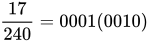

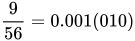



動態平面上由動態射線劃分的動態平面分割槽與 kneading 序列有關。
-
 1/4
1/4 -
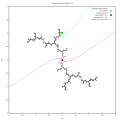 1/6
1/6 -
 9/56
9/56 -
 129/16256


來自 Wolf Jung 編寫的程式 mandel演示 3(外部射線)第 9/12 頁的筆記
角度為 1/7 和 2/7 的引數射線落在週期為 3 的分量根部,該分量是旋轉數為 1/3 的衛星型分量。
對於區域中所有射線之間的引數 c
- 對於 Mandelbrot 集 1/3 肢體中的 c
- 對於等於區域的主Misiurewicz點的 c
角度為 1/7、2/7 和 4/7 的動態射線
- 共同落在排斥不動點 上。
- 臨界值 z = c 位於前兩條射線之間。

我們將計算不動點 alpha 在 下的某些原像的外部角。

注意,角度 在 模 1 倍增下的兩個原像 是 。

點 是 唯一的原像,與不動點本身不同。

角度 1/7 的原像是 (1/7)/2 = 1/14 和 (1/7 + 1)/2 = 4/7。後一個角度屬於 ,所以 1/14 是 的外部角。
同樣,可以得到其他角度 9/14 和 11/14。這些射線用藍色繪製。
將 z 移動到 2/7 和 4/7 射線之間 的原像。角度 1/14 的原像是 (1/14)/2 = 1/28 和 (1/14 + 1)/2 = 15/28。只有後一個角度在選定區間內。z 的另外兩個外部角度是 9/28 和 11/28。這些射線用洋紅色繪製。
現在 z 是 1/7 和 2/7 射線之間原像。透過在該區間內取原像,可以得到外部角度 9/56、11/56 和 15/56。這些射線用紅色繪製。
具有前週期角度(即,偶數分母)的射線落在動態平面的前週期點上,或者落在引數平面的 Misiurewicz 點上。對於這些引數,臨界值在 fc(z) 的迭代下是前週期的。
| z | 軌道肖像 | 描述 |
|---|---|---|
| -0.327586178699357 +0.577756453298949 i | (1/7, 2/7, 4/7) | 排斥不動點 α |
| +0.327586178699356 -0.577756453298949 i | (1/14, 9/14, 11/14) | 原像: |
| -1.005359779818338 +0.762932332734299 i | (9/28, 11/28, 15/28 ) | a(z) |
| -0.101096363845622 +0.956286510809142 i | (9/56, 11/56, 和 15/56) | a(z) |
| -0.000000003174826 +0.000000002063599 i | (9/56, 11/56, 和 15/56) | a(z); 它應該是臨界點 z = 0 |
| -0.728941649258717 +0.655941740822478 i | a(z) | |
| -0.184581740009785 +0.813582020547489 i | a(z) | |
| -0.202294024682997 +0.352715534938011 i | a(z) | |
| -0.505370243253601 +0.597157217578291 i | a(z) | |
| -0.261224737974777 +0.687395259758146 i | a(z) | |
| -0.276433581450372 +0.486357789166200 i | a(z) |

- 取一條直射線段(接近無窮大)
- 將其拉回曼德布羅集的邊界
- 用於 Julia 集的二進位制分解方法 (BDM/J)
- 場線 標量場(勢)
- SAM = 條帶平均方法 基本上是計算角度的一種廉價方法。
-
 BDM,一些射線可以被看到
 -
 BDM 的邊界
 -
 場線
場線 -
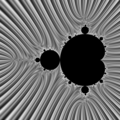 SAM
SAM


在 BDM 影像中,角度(以圈數測量)的外部射線

可以看作是子集的邊界。
這意味著
- 計算(近似)射線的 DS 點。結果是一組複數 (引數平面上的點),使用數值演算法
- 用線段連線點,[6] 使用圖形演算法)

這將給出射線 的近似值。

追蹤以圈數為單位的角度 t 的外部射線,這意味著(Claude Heiland-Allen 的描述)[7]
- 從一個大圓開始(例如 r = 65536,x = r cos(2 pi t),y = r sin(2 pi t))
- 沿著逃逸線(就像二進位制分解著色的大逃逸半徑的邊緣)向曼德布羅集移動。
該演算法為 O(週期^2),這意味著週期加倍需要 4 倍的時間,因此它只適用於週期不超過幾千的週期。
透過求解多項式方程

使用數值方法。上述方程的根是點 .


它是外部引數射線 上的一個點


或

使用 牛頓方法(迭代) 可以計算點 的近似值
你需要什麼來開始?
- 任意選擇的外角 ,即要繪製的射線 的角度。角度通常以圈數表示。
- 函式 P(近似於 Boettcher 對映)的值及其導數 P'
- 起點 (初始近似值)
- 停止規則(停止迭代的標準):射線追蹤有一個自然的停止條件:當射線進入週期為 p 的原子域時,牛頓法很可能收斂到其中心的核。[8]


射線何時著陸 ?
[edit | edit source]"射線越來越靠近邊界,但在有限時間內不會到達邊界 - 對於更精確的邊界點,當射線足夠靠近時,你需要切換到其他方法。對於雙曲分量的邊界上的點,將內部角度地址(可從角度計算)拆分為島嶼和子路徑分量,當追蹤射線到父島嶼時,使用原子域測試(檢視牛頓法是否可能收斂到正確的位置),並切換到牛頓法來找到父島嶼的核,然後透過連線分量的鏈追蹤內部射線到所需的邊界點。
對於 Misiurewicz 點,可能存在與原子域測試類似的測試,在此測試之後牛頓法將收斂到所需位置(儘管 Misiurewicz 點的射線往往比雙曲分量根的射線收斂得快得多)。原子域測試檢查|z|的最後一個最小值的迭代次數是否與射線的週期相同。" Claude Heiland-Allen[9]
因此,射線在有限時間內不會"著陸"。著陸點可以表示為

演算法
[edit | edit source]
追蹤射線
[edit | edit source]- 向外:"形式為 2pi*n/32 的外部射線,疊加在勢梯度的模量上。對於每個點 c,建立一個路徑來跟隨勢梯度的方向。每個步長與到 M 的距離估計成正比。當點足夠遠離 M 時,它的相位近似於 phi(c) 的相位。" Inigo Quilez[12]
- 向內 :"繪製方法 : ... 路徑以相反順序跟隨:從無窮大到 M,跟隨負梯度。"
追蹤射線
- 向內 = 從無窮大到 Mandelbrot 集
- 向外 = 從 Mandelbrot 集附近的點到無窮大
在穿過駐留帶(水平集的邊界)時收集外部角度的二進位制展開的位
- 向內:在二進位制展開的末尾新增位
- 向外:在二進位制展開的開頭新增位
穿過駐留帶(水平集的邊界)
- 當射線值改變其整數部分時
另請參閱
- 二進位制分解
- 從二進位制分解中讀取位 = 收集外部角度的二進位制展開的位
在
[edit | edit source]- 當向內追蹤時,每次射線穿過駐留帶(歸一化迭代計數的整數部分增加 1),都會剝離最高有效位(也稱為角度加倍)。
追蹤角度為 t(以圈數表示)的外部射線,這意味著(Claude Heiland-Allen 的描述)[13]
- 從一個大圓開始(例如 r = 65536,x = r cos(2 pi t),y = r sin(2 pi t))
- 沿著逃逸線(就像二進位制分解著色的大逃逸半徑的邊緣)向曼德布羅集移動。
該演算法為 O(週期^2),這意味著週期加倍需要 4 倍的時間,因此它只適用於週期不超過幾千的週期。
向外
[edit | edit source]
"you need to trace a ray outwards, which means using different C values, and the bits come in reverse order, first the deepest bit from the iteration count of the start pixel, then move C outwards along the ray (perhaps using the newton's method of mandel-exray.pdf in reverse), repeat until no more bits left. you move C a fractional iteration count each time, and collect bits when crossing integer dwell boundaries" Claude Heiland-Allen
牛頓法
[edit | edit source]- 使用牛頓法
- Tomoki Kawahira 的描述[14]
- 向內追蹤(從無窮大到 Mandelbrot 集)= 射線-入
- 任意精度(mpfr),Claude Heiland-Allen 使用動態精度調整
變數
[edit | edit source]- r = 半徑引數 = 半徑(參見復勢)
- m = 半徑索引 = 射線上點的索引,整數
- j = 銳度 = 駐留帶上的點數,整數
- k = 整數深度 = 駐留帶的數量,整數
- d = m/S = 真實深度,浮點數(Kawahira 未使用 d 這個名稱)
- l = 牛頓迭代的索引(Kawahira 未使用 l 這個名稱)
- n = 計算牛頓對映的迭代索引
名稱來自 T Kawahira 的描述
半徑引數 r
[edit | edit source]常數值
[edit | edit source]- S = =
- D = =
- R = ER = 逃逸半徑
- DS = = 點的數量



- 清晰度 :
- 徑向索引 :
- 深度
- 射線的半徑(子集):
- 迭代次數
- 二次方 :
- 牛頓 :




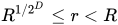


m-序列(沿著射線朝向曼德勃羅集)



牛頓序列 = l-序列,這裡 m 是常數
- 從 初始值 朝向對 的近似值




將它與 c=0 動態平面上的逆迭代比較
使用固定整數 D(最大深度):[15]

和固定的徑向引數最大值(逃逸半徑 = ER)

可以使用公式計算 D 個射線點

即

當 則 並且半徑足夠接近曼德勃羅集的邊界


/*
Maxima CAS code

Number of ray points = depth
r = radial parametr : 1 < R^{1/{2^D}} <= r > ER
*/

GiveRadius( depth):=
block (
 [ r, R: 65536],
 r:R,
 print("r = ER = ", float(R)),

 for k:1   thru depth  do
   (
     r:er^(1/(2^k)),
     print("k = ", k, " r = ", float(r))
    )
)$

compile(all)$

/* --------------------------- */

GiveRadius(10)$
輸出
r = ER =  65536.0
"k = "1"  r = "256.0
"k = "2"  r = "16.0
"k = "3"  r = "4.0
"k = "4"  r = "2.0
"k = "5"  r = "1.414213562373095
"k = "6"  r = "1.189207115002721
"k = "7"  r = "1.090507732665258
"k = "8"  r = "1.044273782427414
"k = "9"  r = "1.021897148654117
"k = "10" r = "1.0108892860517
如何使射線更平滑?在等值線之間新增更多點。
使用
- 固定整數 S = 最大銳度
- 固定整數 D = 最大深度

可以使用公式計算 S*D 個射線點


注意,k 等於 d 的整數部分

最後一個點與深度方法中相同

但這裡有更多點,因為

/* Maxima CAS code */
kill(all);
remvalue(all);

GiveRadius(  depth, sharpness):=
block (
 [ r, R: 65536, d ],

 r:R,

 print("r = ER = ", float(R)),

 for k:1   thru depth  do
   (
     for j:1   thru sharpness  do
      (  d: (k-1) + j/sharpness,
         r:R^(1/(2^d)),
         print("k = ", k, " ; j = ", j , "; d = ", float(d), "; r = ", float(r))
      )
    )
)$

compile(all)$

/* --------------------------- */

GiveRadius( 10, 4)$
compile(all)$
輸出
r = ER =  65536.0
k =  1  ; j =  1 ; d =  0.25 ; r =  11224.33726645605
k =  1  ; j =  2 ; d =  0.5 ; r =  2545.456152628088
k =  1  ; j =  3 ; d =  0.75 ; r =  730.9641900482128
k =  1  ; j =  4 ; d =  1.0 ; r =  256.0
k =  2  ; j =  1 ; d =  1.25 ; r =  105.9449728229521
k =  2  ; j =  2 ; d =  1.5 ; r =  50.45251383854013
k =  2  ; j =  3 ; d =  1.75 ; r =  27.0363494216252
k =  2  ; j =  4 ; d =  2.0 ; r =  16.0
k =  3  ; j =  1 ; d =  2.25 ; r =  10.29295743812011
k =  3  ; j =  2 ; d =  2.5 ; r =  7.10299330131601
k =  3  ; j =  3 ; d =  2.75 ; r =  5.199648971000369
k =  3  ; j =  4 ; d =  3.0 ; r =  4.0
k =  4  ; j =  1 ; d =  3.25 ; r =  3.208263928999625
k =  4  ; j =  2 ; d =  3.5 ; r =  2.665144142690224
k =  4  ; j =  3 ; d =  3.75 ; r =  2.280273880699502
k =  4  ; j =  4 ; d =  4.0 ; r =  2.0
k =  5  ; j =  1 ; d =  4.25 ; r =  1.791162731021284
k =  5  ; j =  2 ; d =  4.5 ; r =  1.632526919438152
k =  5  ; j =  3 ; d =  4.75 ; r =  1.51005757529291
k =  5  ; j =  4 ; d =  5.0 ; r =  1.414213562373095
k =  6  ; j =  1 ; d =  5.25 ; r =  1.338343278468302
k =  6  ; j =  2 ; d =  5.5 ; r =  1.277703768264832
k =  6  ; j =  3 ; d =  5.75 ; r =  1.228843999575581
k =  6  ; j =  4 ; d =  6.0 ; r =  1.189207115002721
k =  7  ; j =  1 ; d =  6.25 ; r =  1.156867874248526
k =  7  ; j =  2 ; d =  6.5 ; r =  1.13035559372475
k =  7  ; j =  3 ; d =  6.75 ; r =  1.108532362890494
k =  7  ; j =  4 ; d =  7.0 ; r =  1.090507732665258
k =  8  ; j =  1 ; d =  7.25 ; r =  1.075577925697867
k =  8  ; j =  2 ; d =  7.5 ; r =  1.063181825335982
k =  8  ; j =  3 ; d =  7.75 ; r =  1.052868635153737
k =  8  ; j =  4 ; d =  8.0 ; r =  1.044273782427414
k =  9  ; j =  1 ; d =  8.25 ; r =  1.037100730738276
k =  9  ; j =  2 ; d =  8.5 ; r =  1.031107087230023
k =  9  ; j =  3 ; d =  8.75 ; r =  1.026093872486205
k =  9  ; j =  4 ; d =  9.0 ; r =  1.021897148654117
k =  10  ; j =  1 ; d =  9.25 ; r =  1.018381426940945
k =  10  ; j =  2 ; d =  9.5 ; r =  1.015434432757735
k =  10  ; j =  3 ; d =  9.75 ; r =  1.012962917626408
k =  10  ; j =  4 ; d =  10.0 ; r =  1.0108892860517
可以使用一個迴圈:m 迴圈,並從 m 中計算 j、k 和 d
/* Maxima CAS code */
kill(all);
remvalue(all)$

GiveRadius( depth, sharpness):=
block (
 [ r, R: 65536, j, k, d, mMax ],

 r:float(R),
 mMax:depth*sharpness,

 print("r = ER = ", r),
 print( "m k j  r"),

 for m:1   thru mMax  do
   (
      d: m/sharpness,
      r:float(R^(1/(2^d))),

      k: floor(d),
      j: m - k*sharpness ,

      print( m, k, j, r)

    )
)$

compile(all)$

/* --------------------------- */

GiveRadius( 10, 4)$
輸出
r = ER =  65536.0
m k j r
1 0 1 11224.33726645605
2 0 2 2545.456152628088
3 0 3 730.9641900482128
4 1 0 256.0
5 1 1 105.9449728229521
6 1 2 50.45251383854013
7 1 3 27.0363494216252
8 2 0 16.0
9 2 1 10.29295743812011
10 2 2 7.10299330131601
11 2 3 5.199648971000369
12 3 0 4.0
13 3 1 3.208263928999625
14 3 2 2.665144142690224
15 3 3 2.280273880699502
16 4 0 2.0
17 4 1 1.791162731021284
18 4 2 1.632526919438152
19 4 3 1.51005757529291
20 5 0 1.414213562373095
21 5 1 1.338343278468302
22 5 2 1.277703768264832
23 5 3 1.228843999575581
24 6 0 1.189207115002721
25 6 1 1.156867874248526
26 6 2 1.13035559372475
27 6 3 1.108532362890494
28 7 0 1.090507732665258
29 7 1 1.075577925697867
30 7 2 1.063181825335982
31 7 3 1.052868635153737
32 8 0 1.044273782427414
33 8 1 1.037100730738276
34 8 2 1.031107087230023
35 8 3 1.026093872486205
36 9 0 1.021897148654117
37 9 1 1.018381426940945
38 9 2 1.015434432757735
39 9 3 1.012962917626408
40 10 0 1.0108892860517
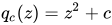
迭代


與 c=0 平面上的正向迭代 進行比較


P 是關於變數 c 的 次多項式。


關於 c 的導數

牛頓對映:
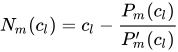
注意這裡


- 從 開始
- 計算值 (無需迭代)
- 計算 和 使用從 n=1 到 n=k 的二次迭代
- 使用一次牛頓迭代計算下一個點


任意名稱
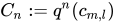

請注意常數的導數為零。
遞迴公式和初始值


在 k 次二次迭代之後,使用一次牛頓迭代計算新的值

它在以下地方實現
- mandelbrot-numerics 庫
- c/lib/m_d_exray_in_step = 雙精度
- c/lib/m_r_exray_in.c = mpfr(任意精度)
公式

牛頓迭代給出牛頓序列(= l 序列,這裡 m 是常數)
- 從初始值 向 的近似值逼近
序列
- 值 據推測是 在射線上的“鄰居”,所以將其用作 的初始值,即
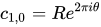


- Claude Heiland-Allen 編寫的 c 程式碼
- 書中的控制檯程式和 GUI 版本,使用流
- mandelbrot-numerics 庫
- mandelbrot 擾動器 GUI 程式
- newtonRay - 來自 Wolf Jung 編寫的程式 Mandel 的 cpp 程式碼
- sage
- 由 Nils Berglund 製作的 Mandelbrot 電容器和場線 和 c 程式碼:heat.c
使用基於 Claude Heiland-Allen 的 mandelbrot-book 程式碼 的牛頓方法計算外部射線向內的程式碼
外部角度從字串(二進位制分數)中讀取
/*

code is from :
https://code.mathr.co.uk/mandelbrot-book
mandelbrot-book/code/examples/ray-in.sh
mandelbrot-book/code/examples/ray-in.c
mandelbrot-book/code/bin/mandelbrot_external_ray_in.c
mandelbrot-book/code/lib/mandelbrot_external_ray_in.c
mandelbrot-book/code/lib/mandelbrot_external_ray_in.h
mandelbrot-book/code/lib/mandelbrot_external_ray_in_native.c
mandelbrot-book/code/lib/mandelbrot_external_ray_in_native.h
mandelbrot-book/code/lib/mandelbrot_binary_angle.c
mandelbrot-book/code/lib/mandelbrot_binary_angle.h
mandelbrot-book/code/lib/pi.c
mandelbrot-book/code/lib/pi.h


--------------------------------------------------------

gcc r.c -std=c99 -Wall -Wextra -pedantic -lm -lgmp -lmpfr
./a.out


*/
#include <stdio.h>
#include <stdlib.h>
#include <string.h>
#include <math.h>
#include <complex.h>
#include <gmp.h>
#include <mpfr.h>
#include <stdbool.h>


const float pif = 3.14159265358979323846264338327950288419716939937510f;
const double pi = 3.14159265358979323846264338327950288419716939937510;
const long double pil = 3.14159265358979323846264338327950288419716939937510l;


// ------------------------------------------------------------
struct mandelbrot_binary_angle {
  int preperiod;
  int period;
  char *pre;
  char *per;
};

struct mandelbrot_external_ray_in {
  mpq_t angle;
  mpq_t one;
  unsigned int sharpness; // number of steps to take within each dwell band
  unsigned int precision; // delta needs this many bits of effective precision
  unsigned int accuracy;  // epsilon is scaled relative to magnitude of delta
  double escape_radius;
  mpfr_t epsilon2;
  mpfr_t cx;
  mpfr_t cy;
  unsigned int j;
  unsigned int k;
  // temporaries
  mpfr_t zx, zy, dzx, dzy, ux, uy, vx, vy, ccx, ccy, cccx, cccy;
};


// ----------------------------------------------------------------------------


int depth = 0;
mpq_t angle;
int base = 2; // The base can vary from 2 to 62, or if base is 0 then the leading characters are used: 0x or 0X for hex, 0b or 0B for binary, 0 for octal, or decimal otherwise.
char *s;
struct mandelbrot_binary_angle *a ;
mpfr_t cre, cim;

struct mandelbrot_external_ray_in *ray; //  = mandelbrot_external_ray_in_new(angle);


// ----------------------------------------------------------------------------
void mandelbrot_binary_angle_delete(struct mandelbrot_binary_angle *a) {
  free(a->pre);
  free(a->per);
  free(a);
}


// FIXME check canonical form, ie no .01(01) etc
struct mandelbrot_binary_angle *mandelbrot_binary_angle_from_string(const char *s) {
  const char *dot = strchr(s,   '.');
  if (! dot) { return 0; }
  const char *bra = strchr(dot, '(');
  if (! bra) { return 0; }
  const char *ket = strchr(bra, ')');
  if (! ket) { return 0; }
  if (s[0] != '.') { return 0; }
  if (ket[1] != 0) { return 0; }
  struct mandelbrot_binary_angle *a = malloc(sizeof(struct mandelbrot_binary_angle));
  a->preperiod = bra - dot - 1;
  a->period = ket - bra - 1;
  fprintf( stderr	, "external angle \n");
  fprintf( stderr	, "\thas preperiod = %d \t period = %d\n",  a->preperiod,  a->period);

  if (a->period < 1) {
    free(a);
    return 0;
  }
  a->pre = malloc(a->preperiod + 1);
  a->per = malloc(a->period + 1);
  memcpy(a->pre, dot + 1, a->preperiod);
  memcpy(a->per, bra + 1, a->period);
  a->pre[a->preperiod] = 0;
  a->per[a->period] = 0;
  for (int i = 0; i < a->preperiod; ++i) {
    if (a->pre[i] != '0' && a->pre[i] != '1') {
      mandelbrot_binary_angle_delete(a);
      return 0;
    }
  }
  for (int i = 0; i < a->period; ++i) {
    if (a->per[i] != '0' && a->per[i] != '1') {
      mandelbrot_binary_angle_delete(a);
      return 0;
    }
  }
  return a;
}


void mandelbrot_binary_angle_to_rational(mpq_t r, const struct mandelbrot_binary_angle *t) {
  mpq_t pre, per;
  mpq_init(pre);
  mpq_init(per);
  mpz_set_str(mpq_numref(pre), t->pre, 2);
  mpz_set_si(mpq_denref(pre), 1);
  mpz_mul_2exp(mpq_denref(pre), mpq_denref(pre), t->preperiod);
  mpq_canonicalize(pre);
  mpz_set_str(mpq_numref(per), t->per, 2);
  mpz_set_si(mpq_denref(per), 1);
  mpz_mul_2exp(mpq_denref(per), mpq_denref(per), t->period);
  mpz_sub_ui(mpq_denref(per), mpq_denref(per), 1);
  mpz_mul_2exp(mpq_denref(per), mpq_denref(per), t->preperiod);
  mpq_canonicalize(per);
  mpq_add(r, pre, per);
  mpq_clear(pre);
  mpq_clear(per);
}

// -------------------------------------------------------------

struct mandelbrot_external_ray_in *mandelbrot_external_ray_in_new(mpq_t angle) {
  struct mandelbrot_external_ray_in *r = malloc(sizeof(struct mandelbrot_external_ray_in));
  mpq_init(r->angle);
  mpq_set(r->angle, angle);
  mpq_init(r->one);
  mpq_set_ui(r->one, 1, 1);
  r->sharpness = 4;
  r->precision = 4;
  r->accuracy  = 4;
  r->escape_radius = 65536.0;
  mpfr_init2(r->epsilon2, 53);
  mpfr_set_ui(r->epsilon2, 1, GMP_RNDN);
  double a = 2.0 * pi * mpq_get_d(r->angle);
  mpfr_init2(r->cx, 53);
  mpfr_init2(r->cy, 53);
  mpfr_set_d(r->cx, r->escape_radius * cos(a), GMP_RNDN);
  mpfr_set_d(r->cy, r->escape_radius * sin(a), GMP_RNDN);
  r->k = 0;
  r->j = 0;
  // initialize temporaries
  mpfr_inits2(53, r->zx, r->zy, r->dzx, r->dzy, r->ux, r->uy, r->vx, r->vy, r->ccx, r->ccy, r->cccx, r->cccy, (mpfr_ptr) 0);
  return r;
}

int mandelbrot_external_ray_in_step(struct mandelbrot_external_ray_in *r) {
  if (r->j >= r->sharpness) {
    mpq_mul_2exp(r->angle, r->angle, 1);
    if (mpq_cmp_ui(r->angle, 1, 1) >= 0) {
      mpq_sub(r->angle, r->angle, r->one);
    }
    r->k++;
    r->j = 0;
  }
  // r0 <- er ** ((1/2) ** ((j + 0.5)/sharpness))
  // t0 <- r0 cis(2 * pi * angle)
  double r0 = pow(r->escape_radius, pow(0.5, (r->j + 0.5) / r->sharpness));
  double a0 = 2.0 * pi * mpq_get_d(r->angle);
  double t0x = r0 * cos(a0);
  double t0y = r0 * sin(a0);
  // c <- r->c
  mpfr_set(r->ccx, r->cx, GMP_RNDN);
  mpfr_set(r->ccy, r->cy, GMP_RNDN);
  for (unsigned int i = 0; i < 64; ++i) { // FIXME arbitrary limit
    // z <- 0
    // dz <- 0
    mpfr_set_ui(r->zx, 0, GMP_RNDN);
    mpfr_set_ui(r->zy, 0, GMP_RNDN);
    mpfr_set_ui(r->dzx, 0, GMP_RNDN);
    mpfr_set_ui(r->dzy, 0, GMP_RNDN);
    // iterate
    for (unsigned int p = 0; p <= r->k; ++p) {
      // dz <- 2 z dz + 1
      mpfr_mul(r->ux, r->zx, r->dzx, GMP_RNDN);
      mpfr_mul(r->uy, r->zy, r->dzy, GMP_RNDN);
      mpfr_mul(r->vx, r->zx, r->dzy, GMP_RNDN);
      mpfr_mul(r->vy, r->zy, r->dzx, GMP_RNDN);
      mpfr_sub(r->dzx, r->ux, r->uy, GMP_RNDN);
      mpfr_add(r->dzy, r->vx, r->vy, GMP_RNDN);
      mpfr_mul_2ui(r->dzx, r->dzx, 1, GMP_RNDN);
      mpfr_mul_2ui(r->dzy, r->dzy, 1, GMP_RNDN);
      mpfr_add_ui(r->dzx, r->dzx, 1, GMP_RNDN);
      // z <- z^2 + c
      mpfr_sqr(r->ux, r->zx, GMP_RNDN);
      mpfr_sqr(r->uy, r->zy, GMP_RNDN);
      mpfr_sub(r->vx, r->ux, r->uy, GMP_RNDN);
      mpfr_mul(r->vy, r->zx, r->zy, GMP_RNDN);
      mpfr_mul_2ui(r->vy, r->vy, 1, GMP_RNDN);
      mpfr_add(r->zx, r->vx, r->ccx, GMP_RNDN);
      mpfr_add(r->zy, r->vy, r->ccy, GMP_RNDN);
    }
    // c' <- c - (z - t0) / dz
    mpfr_sqr(r->ux, r->dzx, GMP_RNDN);
    mpfr_sqr(r->uy, r->dzy, GMP_RNDN);
    mpfr_add(r->vy, r->ux, r->uy, GMP_RNDN);
    mpfr_sub_d(r->zx, r->zx, t0x, GMP_RNDN);
    mpfr_sub_d(r->zy, r->zy, t0y, GMP_RNDN);
    mpfr_mul(r->ux, r->zx, r->dzx, GMP_RNDN);
    mpfr_mul(r->uy, r->zy, r->dzy, GMP_RNDN);
    mpfr_add(r->vx, r->ux, r->uy, GMP_RNDN);
    mpfr_div(r->ux, r->vx, r->vy, GMP_RNDN);
    mpfr_sub(r->cccx, r->ccx, r->ux, GMP_RNDN);
    mpfr_mul(r->ux, r->zy, r->dzx, GMP_RNDN);
    mpfr_mul(r->uy, r->zx, r->dzy, GMP_RNDN);
    mpfr_sub(r->vx, r->ux, r->uy, GMP_RNDN);
    mpfr_div(r->uy, r->vx, r->vy, GMP_RNDN);
    mpfr_sub(r->cccy, r->ccy, r->uy, GMP_RNDN);
    // delta^2 = |c' - c|^2
    mpfr_sub(r->ux, r->cccx, r->ccx, GMP_RNDN);
    mpfr_sub(r->uy, r->cccy, r->ccy, GMP_RNDN);
    mpfr_sqr(r->vx, r->ux, GMP_RNDN);
    mpfr_sqr(r->vy, r->uy, GMP_RNDN);
    mpfr_add(r->ux, r->vx, r->vy, GMP_RNDN);
    // enough_bits = 0 < 2 * prec(eps^2) + exponent eps^2 - 2 * precision
    int enough_bits = 0 < 2 * (mpfr_get_prec(r->epsilon2) - r->precision) + mpfr_get_exp(r->epsilon2);
    if (enough_bits) {
      // converged = delta^2 < eps^2
      int converged = mpfr_less_p(r->ux, r->epsilon2);
      if (converged) {
        // eps^2 <- |c' - r->c|^2 >> (2 * accuracy)
        mpfr_sub(r->ux, r->cccx, r->cx, GMP_RNDN);
        mpfr_sub(r->uy, r->cccy, r->cy, GMP_RNDN);
        mpfr_sqr(r->vx, r->ux, GMP_RNDN);
        mpfr_sqr(r->vy, r->uy, GMP_RNDN);
        mpfr_add(r->ux, r->vx, r->vy, GMP_RNDN);
        mpfr_div_2ui(r->epsilon2, r->ux, 2 * r->accuracy, GMP_RNDN);
        // j <- j + 1
        r->j = r->j + 1;
        // r->c <- c'
        mpfr_set(r->cx, r->cccx, GMP_RNDN);
        mpfr_set(r->cy, r->cccy, GMP_RNDN);
        return 1;
      }
    } else {
      // bump precision
      mpfr_prec_t prec = mpfr_get_prec(r->cx) + 32;
      mpfr_prec_round(r->cx, prec, GMP_RNDN);
      mpfr_prec_round(r->cy, prec, GMP_RNDN);
      mpfr_prec_round(r->epsilon2, prec, GMP_RNDN);
      mpfr_set_prec(r->ccx, prec);
      mpfr_set_prec(r->ccy, prec);
      mpfr_set_prec(r->cccx, prec);
      mpfr_set_prec(r->cccy, prec);
      mpfr_set_prec(r->zx, prec);
      mpfr_set_prec(r->zy, prec);
      mpfr_set_prec(r->dzx, prec);
      mpfr_set_prec(r->dzy, prec);
      mpfr_set_prec(r->ux, prec);
      mpfr_set_prec(r->uy, prec);
      mpfr_set_prec(r->vx, prec);
      mpfr_set_prec(r->vy, prec);
      i = 0;
      // c <- r->c
      mpfr_set(r->cccx, r->cx, GMP_RNDN);
      mpfr_set(r->cccy, r->cy, GMP_RNDN);
    }
    mpfr_set(r->ccx, r->cccx, GMP_RNDN);
    mpfr_set(r->ccy, r->cccy, GMP_RNDN);
  }
  return 0;
}

void mandelbrot_external_ray_in_get(struct mandelbrot_external_ray_in *r, mpfr_t x, mpfr_t y) {
  mpfr_set_prec(x, mpfr_get_prec(r->cx));
  mpfr_set(x, r->cx, GMP_RNDN);
  mpfr_set_prec(y, mpfr_get_prec(r->cy));
  mpfr_set(y, r->cy, GMP_RNDN);
}


void mandelbrot_external_ray_in_delete(struct mandelbrot_external_ray_in *r) {
  mpfr_clear(r->epsilon2);
  mpfr_clear(r->cx);
  mpfr_clear(r->cy);
  mpq_clear(r->angle);
  mpq_clear(r->one);
  mpfr_clears(r->zx, r->zy, r->dzx, r->dzy, r->ux, r->uy, r->vx, r->vy, r->ccx, r->ccy, r->cccx, r->cccy, (mpfr_ptr) 0);
  free(r);
}

// -------------------------------------------------------------------------------------------------------

void PrintCInfo (void)
{

  fprintf(stderr,"gcc version: %d.%d.%d\n", __GNUC__, __GNUC_MINOR__, __GNUC_PATCHLEVEL__);	// https://stackoverflow.com/questions/20389193/how-do-i-check-my-gcc-c-compiler-version-for-my-eclipse
  // OpenMP version is displayed in the console : export  OMP_DISPLAY_ENV="TRUE"

  fprintf(stderr,"__STDC__ = %d\n", __STDC__);
  fprintf(stderr,"__STDC_VERSION__ = %ld\n", __STDC_VERSION__);
  fprintf(stderr,"c dialect = ");
  switch (__STDC_VERSION__)
    {				// the format YYYYMM
    case 199409L:
      fprintf(stderr,"C94\n");
      break;
    case 199901L:
      fprintf(stderr,"C99\n");
      break;
    case 201112L:
      fprintf(stderr,"C11\n");
      break;
    case 201710L:
      fprintf(stderr,"C18\n");
      break;
      //default : /* Optional */
      }
      //gmp_printf (" GMP-%s \n ", gmp_version );
      mpfr_printf("Versions: MPFR-%s \n GMP-%s \n", mpfr_version, gmp_version );


}

void PrintInfo(void){

	//
	fprintf(stderr, "console C program  ( CLI ) for computing external ray of Mandelbrot set (parametric ray)\n");
	fprintf(stderr, "using Newton method described by Tomoki Kawahira \n");
	fprintf(stderr, "tracing inward ( from infinity toward Mandelbrot set) = ray-in\n");
	fprintf(stderr, "arbitrary precision (gmp, mpfr) with dynamic precision adjustment.\n Based on the code by Claude Heiland-Allen: https://mathr.co.uk/web/\n");
	fprintf(stderr, "usage: ./a.out angle depth\n outputs space-separated complex numbers on stdout\n example command \n./a.out 1/3 25\n or\n ./a.out .(01) 25\n");
	fprintf( stderr	, "\n");
  	fprintf( stderr	, "\tsharpness = %d\n", ray->sharpness);
  	fprintf( stderr	, "\tprecision = %d\n", ray->precision);
  	fprintf( stderr	, "\taccuracy = %d\n", ray->accuracy);
  	fprintf( stderr	, "\tescape_radius = %.0f\n", ray->escape_radius);
	//
	PrintCInfo();
}


int setup(void){
	// 2 parameters of external ray : depth, angle
	depth  = 35;
	// external angle
	s = ".(01)";  // landing point c = -0.750000000000000  +0.000000000000000 i    period = 10000
	// mpq
	mpq_init(angle);
	// mpq init from string or 2 integers

	a = mandelbrot_binary_angle_from_string(s); // set a from string
	// gmp_fprintf (stderr, "\tas a binary fraction = %0b\n", a); // 0b or 0B for binary // not works
    	if (a) {
      		mandelbrot_binary_angle_to_rational(angle, a); // convert binary string to decimal rational number
      		mandelbrot_binary_angle_delete(a); } // use only rational form so delete string form

	mpq_canonicalize (angle); // It is the responsibility of the user to canonicalize the assigned variable before any arithmetic operations are performed on that variable.

	gmp_fprintf (stderr, "\tas a decimal rational number = %Qd\n", angle); //
	fprintf( stderr	, "\tas a formated binary string = 0%s\n", s);


	// ---------------------------------------------------

	mpfr_init2(cre, 53);
	mpfr_init2(cim, 53);


	return 0;
}


int compute_ray(mpq_t angle){


	ray = mandelbrot_external_ray_in_new(angle);
	if (ray ==NULL ){ fprintf(stderr, " ray error \n"); return 1;}

	for (int i = 0; i < depth * 4; ++i) { // FIXME 4 = implementation's sharpness
		//fprintf( stderr	, "i = %d\n", i);
		mandelbrot_external_ray_in_step(ray); //fprintf(stderr, " ray step ok \n");
		mandelbrot_external_ray_in_get(ray, cre, cim); //fprintf(stderr, " ray get ok \n");
		mpfr_out_str(stdout, 10, 0, cre, GMP_RNDN);

		putchar(' ');
		mpfr_out_str(stdout, 10, 0, cim, GMP_RNDN);
		putchar('\n');
		}


	return 0;


}


int end(void){

	PrintInfo();
	fprintf(stderr, " allways free memory (deallocate )  to avoid memory leaks \n");	// wikipedia C_dynamic_memory_allocation
	mpq_clear (angle);
	mpfr_clear(cre);
	mpfr_clear(cim);
	mandelbrot_external_ray_in_delete(ray);
	return 0;
}

int main(void){

	setup();

	compute_ray(angle);
	end();

	return 0;
}
過程中的射線
r"""
Mandelbrot and Julia sets (Cython helper)

This is the helper file providing functionality for mandel_julia.py.
https://git.sagemath.org/sage.git/tree/src/sage/dynamics/complex_dynamics/mandel_julia_helper.pyx?id=bf9df0d7ff4f272b19293fd0d04ef3a649d05863

AUTHORS:

- Ben Barros

"""

#*****************************************************************************
#       Copyright (C) 2017 BEN BARROS <bbarros@slu.edu>
#
# This program is free software: you can redistribute it and/or modify
# it under the terms of the GNU General Public License as published by
# the Free Software Foundation, either version 2 of the License, or
# (at your option) any later version.
#                  http://www.gnu.org/licenses/
#*****************************************************************************

from __future__ import absolute_import, division
from sage.plot.colors import Color
from sage.repl.image import Image
from copy import copy
from cysignals.signals cimport sig_check
from sage.rings.complex_field import ComplexField
from sage.functions.log import exp, log
from sage.symbolic.constants import pi


def external_ray(theta, **kwds):
    r"""
    Draws the external ray(s) of a given angle (or list of angles)
    by connecting a finite number of points that were approximated using
    Newton's method. The algorithm used is described in a paper by
    Tomoki Kawahira.
    https://git.sagemath.org/sage.git/tree/src/sage/dynamics/complex_dynamics/mandel_julia.py?id=bf9df0d7ff4f272b19293fd0d04ef3a649d05863
    REFERENCE:

    [Kaw2009]_

    INPUT:

    - ``theta`` -- double or list of doubles, angles between 0 and 1 inclusive.

    kwds:

    - ``image`` -- 24-bit RGB image (optional - default: None) user specified image of Mandelbrot set.

    - ``D`` -- long (optional - default: ``25``) depth of the approximation. As ``D`` increases, the external ray gets closer to the boundary of the Mandelbrot set. If the ray doesn't reach the boundary of the Mandelbrot set, increase ``D``.

    - ``S`` -- long (optional - default: ``10``) sharpness of the approximation. Adjusts the number of points used to approximate the external ray (number of points is equal to ``S*D``). If ray looks jagged, increase ``S``.

    - ``R`` -- long (optional - default: ``100``) radial parameter. If ``R`` is large, the external ray reaches sufficiently close to infinity. If ``R`` is too small, Newton's method may not converge to the correct ray.

    - ``prec`` -- long (optional - default: ``300``) specifies the bits of precision used by the Complex Field when using Newton's method to compute points on the external ray.

    - ``ray_color`` -- RGB color (optional - default: ``[255, 255, 255]``) color of the external ray(s).

    OUTPUT:

    24-bit RGB image of external ray(s) on the Mandelbrot set.

    EXAMPLES::

        sage: external_ray(1/3)
        500x500px 24-bit RGB image

    ::

        sage: external_ray(0.6, ray_color=[255, 0, 0])
        500x500px 24-bit RGB image

    ::

        sage: external_ray([0, 0.2, 0.4, 0.7]) # long time
        500x500px 24-bit RGB image

    ::

        sage: external_ray([i/5 for i in range(1,5)]) # long time
        500x500px 24-bit RGB image

    WARNING:

    If you are passing in an image, make sure you specify
    which parameters to use when drawing the external ray.
    For example, the following is incorrect::

        sage: M = mandelbrot_plot(x_center=0) # not tested
        sage: external_ray(5/7, image=M) # not tested
        500x500px 24-bit RGB image

    To get the correct external ray, we adjust our parameters::

        sage: M = mandelbrot_plot(x_center=0) # not tested
        sage: external_ray(5/7, x_center=0, image=M) # not tested
        500x500px 24-bit RGB image

    TODO:

    The ``copy()`` function for bitmap images needs to be implemented in Sage.
    """

    x_0 = kwds.get("x_center", -1)
    y_0 = kwds.get("y_center", 0)
    plot_width = kwds.get("image_width", 4)
    pixel_width = kwds.get("pixel_count", 500)
    depth = kwds.get("D", 25)
    sharpness = kwds.get("S", 10)
    radial_parameter = kwds.get("R", 100)
    precision = kwds.get("prec", 300)
    precision = max(precision, -log(pixel_width * 0.001, 2).round() + 10)
    ray_color = kwds.get("ray_color", [255]*3)
    image = kwds.get("image", None)
    if image is None:
        image = mandelbrot_plot(**kwds)

    # Make a copy of the bitmap image.
    # M = copy(image)
    old_pixel = image.pixels()
    M = Image('RGB', (pixel_width, pixel_width))
    pixel = M.pixels()
    for i in range(pixel_width):
        for j in range(pixel_width):
            pixel[i,j] = old_pixel[i,j]

    # Make sure that theta is a list so loop below works
    if type(theta) != list:
        theta = [theta]

    # Check if theta is in the invterval [0,1]
    for angle in theta:
        if angle < 0 or angle > 1:
            raise \
            ValueError("values for theta must be in the closed interval [0,1].")

    # Loop through each value for theta in list and plot the external ray.
    for angle in theta:
        E = fast_external_ray(angle, D=depth, S=sharpness, R=radial_parameter,
         prec=precision, image_width=plot_width, pixel_count=pixel_width)

        # Convert points to pixel coordinates.
        pixel_list = convert_to_pixels(E, x_0, y_0, plot_width, pixel_width)

        # Find the pixels between points in pixel_list.
        extra_points = []
        for i in range(len(pixel_list) - 1):
            if min(pixel_list[i+1]) >= 0 and max(pixel_list[i+1]) < pixel_width:
                for j in get_line(pixel_list[i], pixel_list[i+1]):
                    extra_points.append(j)

        # Add these points to pixel_list to fill in gaps in the ray.
        pixel_list += extra_points

        # Remove duplicates from list.
        pixel_list = list(set(pixel_list))

        # Check if point is in window and if it is, plot it on the image to
        # create an external ray.
        for k in pixel_list:
            if max(k) < pixel_width and min(k) >= 0:
                pixel[int(k[0]), int(k[1])] = tuple(ray_color)
    return M


cpdef fast_external_ray(double theta, long D=30, long S=10, long R=100,
 long pixel_count=500, double image_width=4, long prec=300):
    r"""
    Returns a list of points that approximate the external ray for a given angle.

    INPUT:

    - ``theta`` -- double, angle between 0 and 1 inclusive.

    - ``D`` -- long (optional - default: ``25``) depth of the approximation. As ``D`` increases, the external ray gets closer to the boundary of the Mandelbrot set.

    - ``S`` -- long (optional - default: ``10``) sharpness of the approximation. Adjusts the number of points used to approximate the external ray (number of points is equal to ``S*D``).

    - ``R`` -- long (optional - default: ``100``) radial parameter. If ``R`` is sufficiently large, the external ray reaches enough close to infinity.

    - ``pixel_count`` -- long (optional - default: ``500``) side length of image in number of pixels.

    - ``image_width`` -- double (optional - default: ``4``) width of the image in the complex plane.

    - ``prec`` -- long (optional - default: ``300``) specifies the bits of precision used by the Complex Field when using Newton's method to compute points on the external ray.

    OUTPUT:

    List of tuples of Real Interval Field Elements

    EXAMPLES::

        sage: from sage.dynamics.complex_dynamics.mandel_julia_helper import fast_external_ray
        sage: fast_external_ray(0,S=1,D=1)
        [(100.000000000000000000000000000000000000000000000000000000000000000000000000000000000000000,
          0.000000000000000000000000000000000000000000000000000000000000000000000000000000000000000000),
         (9.51254777713729174697578576623132297117784691109499464854806785133621315075854778426714908,
          0.000000000000000000000000000000000000000000000000000000000000000000000000000000000000000000)]


    ::

        sage: from sage.dynamics.complex_dynamics.mandel_julia_helper import fast_external_ray
        sage: fast_external_ray(1/3,S=1,D=1)
        [(-49.9999999999999786837179271969944238662719726562500000000000000000000000000000000000000000,
          86.6025403784438765342201804742217063903808593750000000000000000000000000000000000000000000),
         (-5.50628047023173006234970878097113901879832542655926629309001652388544528575532346900138516,
          8.64947510053972513843999918917106032664030380426885745306040284140385975750462108180377187)]

    ::

        sage: from sage.dynamics.complex_dynamics.mandel_julia_helper import fast_external_ray
        sage: fast_external_ray(0.75234,S=1,D=1)
        [(1.47021239172637052661229972727596759796142578125000000000000000000000000000000000000000000,
          -99.9891917935294287644865107722580432891845703125000000000000000000000000000000000000000000),
         (-0.352790406744857508500937144524776555433184352559852962308757189778284058275081335121601384,
          -9.98646630765023514178761177926164047797465369576787921409326037870837930920646860774032363)]
    """

    cdef:
        CF = ComplexField(prec)
        PI = CF.pi()
        I = CF.gen()
        c_0, r_m, t_m, temp_c, C_k, D_k, old_c, x, y, dist
        int k, j, t
        double difference, m
        double error = pixel_count * 0.0001

        double pixel_width = image_width / pixel_count

        # initialize list with c_0
        c_list = [CF(R*exp(2*PI*I*theta))]

    # Loop through each subinterval and approximate point on external ray.
    for k in range(1,D+1):
        for j in range(1,S+1):
            m = (k-1)*S + j
            r_m = CF(R**(2**(-m/S)))
            t_m = CF(r_m**(2**k) * exp(2*PI*I*theta * 2**k))
            temp_c = c_list[-1]
            difference = error

            # Repeat Newton's method until points are close together.
            while error <= difference:
                sig_check()
                old_c = temp_c
                # Recursive formula for iterates of q(z) = z^2 + c
                C_k, D_k = CF(old_c), CF(1)
                for t in range(k):
                    C_k, D_k = C_k**2 + old_c, CF(2)*D_k*C_k + CF(1)
                temp_c = old_c - (C_k - t_m) / D_k   # Newton map
                difference = abs(old_c) - abs(temp_c)

            dist = (2*C_k.abs()*(C_k.abs()).log()) / D_k.abs()
            if dist < pixel_width:
                break
            c_list.append(CF(temp_c))
        if dist < pixel_width:
            break

    # Convert Complex Field elements into tuples.
    for k in range(len(c_list)):
        x,y = c_list[k].real(), c_list[k].imag()
        c_list[k] = (x, y)

    return c_list
| 角度 以圈為單位 | 著陸點 | 精度 |
|---|---|---|
| 0 | 1/4 | |
| 1/2 | -2 | |
| 1/3 | -3/4 | |
| 1/4 | -0.228155493653962 +1.115142508039937i | |
| 1/5 | -0.154724526314600 +1.031047184160779i | |
| 1/6 | i | |
| 1/10 | 0.384063957 +0.666805123i |
見
沃爾夫·榮格測試 : 角度(以圈為單位)的外部引數射線
- 1/7(週期 3)
- 321685687669320/2251799813685247(週期 51)
- 321685687669322/2251799813685247(週期 51)
角度相差約 ,但對應引數射線的著陸點相差約 0.035。[16]

- ↑ 維基百科 : 外部射線
- ↑ Adam Majewski 的 gitlab 倉庫:引數外部角度
- ↑ Adam Epstein 和 Giulio Tiozzo 的 Douady 魔法公式的推廣
- ↑ fractalforums.org : Douady 魔法公式的推廣
- ↑ Mary Wilkerson 的臨界前週期二次配對的細分規則構造
- ↑ 維基百科 : 線段
- ↑ fractalforums.org: 為分形藝術提供創意幫助
- ↑ Claude Heiland-Allen
- ↑ fractalforums : 曼德博集中的尋路
- ↑ Yi-Chiuan Chen、Tomoki Kawahira、Juan-Ming Yuan 的作為微分方程軌道的不變康託集族 II:Julia 集
- ↑ Tomoki Kawahira 的繪製曼德博集外部射線的演算法
- ↑ I Quilez 的場線
- ↑ fractalforums.org: 為分形藝術提供創意幫助
- ↑ Tomoki Kawahira 的繪製曼德博集外部射線的演算法
- ↑ 使用牛頓法繪製外部射線(由 T Kawahira 描述)
- ↑ 沃爾夫·榮格的繪製引數射線精度的測試