


分形/複平面迭代/Julia 集
"... a single algorithm for computing all quadratic Julia sets does not exist."[1]
本書展示瞭如何為在動態平面中繪製集合編寫不同的演算法:Julia、填充的 Julia 或 Fatou 集,用於 復二次多項式。它分為兩部分
- 各種演算法的描述[2]
- 動態平面中各種集合視覺化技術的描述
- Julia 集
- Fatou 集
- 無限吸引盆 (開集)
- 有限吸引子的吸引盆

這裡顏色與吸引速度 (收斂到吸引子) 成正比。這些方法用於 Fatou 集。
如何找到
首先閱讀 定義
這裡計算復點 Z0 的正向迭代

這是一個計算最後迭代的函式,即第一個落在目標集中的迭代 (例如,離開以給定逃逸半徑 ER 為中心的圓) 用於上述 復二次多項式 的迭代。這是一個迭代 (整數),對於它 (abs(Z)>ER) 成立。它也可以改進[5]
C 版本 (這裡 ER2=ER*ER) 使用雙精度浮點數 (沒有複數型別數字)
 int GiveLastIteration(double Zx, double Zy, double Cx, double Cy, int IterationMax, int ER2)
 {
  double Zx2, Zy2; /* Zx2=Zx*Zx;  Zy2=Zy*Zy  */
  int i=0;
  Zx2=Zx*Zx;
  Zy2=Zy*Zy;
  while (i<IterationMax && (Zx2+Zy2<ER2) ) /* ER2=ER*ER */
  {
   Zy=2*Zx*Zy + Cy;
   Zx=Zx2-Zy2 +Cx;
   Zx2=Zx*Zx;
   Zy2=Zy*Zy;
   i+=1;
  }
  return i;
 }
帶有來自 GSL 的複數型別的 C:[6]
#include <gsl/gsl_complex.h>
#include <gsl/gsl_complex_math.h>
#include <stdio.h>
// gcc -L/usr/lib -lgsl -lgslcblas -lm t.c
// function fc(z) = z*z+c

gsl_complex f(gsl_complex z, gsl_complex c) {
  return gsl_complex_add(c, gsl_complex_mul(z,z));
}

int main () {
  gsl_complex c = gsl_complex_rect(0.123, 0.125);
  gsl_complex z = gsl_complex_rect(0.0, 0.0);
  int i;
  for (i = 0; i < 10; i++) {
    z = f(z, c);
    double zx = GSL_REAL(z);
    double zy = GSL_IMAG(z);
    printf("Real: %f4 Imag: %f4\n", zx, zy);
  }
  return 0;
}
C++ 版本:
 int GiveLastIteration(complex C,complex Z , int imax, int ER)
  {
   int i; // iteration number
   for(i=0;i<=imax-1;i++) // forward iteration
    {
      Z=Z*Z+C; // overloading of operators
      if(abs(Z)>ER) break;
    }
   return i;
 }
#include <complex> // C++ complex library

// bailout2 = bailout * bailout
// this function is based on function esctime from mndlbrot.cpp
// from program mandel ver. 5.3 by Wolf Jung
// http://www.mndynamics.com/indexp.html

int escape_time(complex<double> Z, complex<double> C , int iter_max,  double bailout2)
{
  // z= x+ y*i   z0=0
  long double x =Z.real(), y =Z.imag(),  u ,  v ;
  int iter; // iteration
  for ( iter = 0; iter <= iter_max-1; iter++)
  { u = x*x;
    v = y*y;
    if ( u + v <= bailout2 )
       {
         y = 2 * x * y + C.imag();
         x = u - v + C.real();
       } // if
    else break;
  } // for
  return iter;
} // escape_time
Delphi 版本 (使用使用者定義的複數型別、cabs 和 f 函式)
function GiveLastIteration(z,c:Complex;ER:real;iMax:integer):integer;
  var i:integer;
  begin
  i:=0;
  while (cabs(z)<ER) and (i<iMax) do
    begin
      z:= f(z,c);
      inc(i);
    end;
  result := i;
end;
其中
type complex = record x, y: real; end;

function cabs(z:complex):real;
begin
  cabs:=sqrt(z.x*z.x+z.y*z.y)
end;

function f(z,c:complex):complex; // complex quadratic polynomial
  var tmp:complex;
begin
  tmp.x := (z.x*z.x) - (z.y*z.y) + c.x;
  tmp.y := 2*z.x*z.y + c.y ;
  result := tmp;

end;
沒有明確定義複數的 Delphi 版本
function GiveLastIteration(zx0,zy0,cx,cy,ER2:extended;iMax:integer):integer;
  // iteration of z=zx+zy*i under fc(z)=z*z+c
  // where c=cx+cy*i
  // until abs(z)<ER  ( ER2=ER*ER )  or i>=iMax
  var i:integer;
      zx,zy,
      zx2,zy2:extended;
  begin
  zx:=zx0;
  zy:=zy0;
  zx2:=zx*zx;
  zy2:=zy*zy;

  i:=0;
  while (zx2+zy2<ER2) and (i<iMax) do
    begin
      zy:=2*zx*zy + cy;
      zx:=zx2-zy2 +cx;
      zx2:=zx*zx;
      zy2:=zy*zy;
      //
      inc(i);
    end;
  result := i;
end;
Euler 版本 由 R. Grothmann 編寫 (略微更改:從 z^2-c 到 z^2+c) [8]
function iter (z,c,n=100) ...

h=z;
loop 1 to n;
h=h^2 + c;
if totalmax(abs(h))>1e20; m=#; break; endif;
end;
return {h,m};
endfunction
Lisp 版本
此版本使用複數。它使程式碼變短,但效率也很低。
((DEFUN GIVELASTITERATION (Z_0 _C IMAX ESCAPE_RADIUS)
  (SETQ Z Z_0)
  (SETQ I 0)
  (LOOP WHILE (AND (< I IMAX) (< (ABS Z) ESCAPE_RADIUS)) DO
    (INCF I)
    (SETQ Z (+ (* Z Z) _C)))
   I)
Maxima 版本
/* easy to read but very slow version, uses complex type numbers */
GiveLastIteration(z,c):=
 block([i:0],
  while abs(z)<ER and i<iMax
     do (z:z*z + c,i:i+1),
  i)$
/* faster version, without use of complex type numbers,
   compare with c version, ER2=ER*ER */
GiveLastIter(zx,zy,cx,cy,ER2,iMax):=
block(
 [i:0,zx2,zy2],
 zx2:zx*zx,
 zy2:zy*zy,
 while (zx2+zy2<ER2) and i<iMax do
 (
  zy:2*zx*zy + cy,
  zx:zx2-zy2 +cx,
  zx2:zx*zx,
  zy2:zy*zy,
  i:i+1
 ),
 return(i)
);
演算法:對於動態平面 (z 平面) 的每個點 z,計算 z 的幅度大於逃逸半徑的迭代次數 (最後迭代)。如果 last_iteration=max_iteration,則該點位於填充的 Julia 集中,否則它位於其補集 (無限的吸引盆) 中。這裡有兩個選項,因此它被稱為布林演算法。
if (LastIteration==IterationMax)
   then color=BLACK;   /* bounded orbits = Filled-in Julia set */
   else color=WHITE;  /* unbounded orbits = exterior of Filled-in Julia set  */
理論上,該方法用於繪製 填充的 Julia 集 及其補集 (外部),但當 c 是 Misiurewicz 點 ( 填充的 Julia 集 沒有內部) 時,該方法不會繪製任何東西。例如對於 c=i。這意味著它非常適合繪製 填充的 Julia 集 的內部。
; common lisp
(loop for y from -2 to 2 by 0.05 do
      (loop for x from -2 to 2 by 0.025 do
		(let* ((z (complex x y))
                   	(c (complex -1 0))
                   	(iMax 20)
			(i 0))

		(loop  	while (< i iMax ) do
			(setq z (+ (* z z) c))
			(incf i)
			(when (> (abs z) 2) (return i)))


           (if (= i iMax) (princ (code-char 42)) (princ (code-char 32)))))
      (format t "~%"))

-
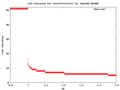 C=0 且 0.9<Z<1.5 時逃逸時間的水平集
 -


逃逸時間測量逃逸到無窮大的時間(無窮大是多項式的超吸引點)。時間以逃逸出給定半徑圓圈所需的步數(迭代 = i)來衡量(ER = 逃逸半徑)。
你可以看到一些東西
這裡的水平集是具有相同逃逸時間的點集。以下是黑白版本中選擇顏色的演算法。
  if (LastIteration==IterationMax)
   then color=BLACK;   /* bounded orbits = Filled-in Julia set */
   else   /* unbounded orbits = exterior of Filled-in Julia set  */
        if ((LastIteration%2)==0) /* odd number */
           then color=BLACK;
           else color=WHITE;
以下是 c 函式,它
- 使用複數雙精度型別
- 計算 8 位顏色(灰度色調)
- 檢查逃逸和吸引測試
unsigned char ComputeColorOfLSM(complex double z){

 int nMax = 255;
  double cabsz;
  unsigned char iColor;

  int n;

  for (n=0; n < nMax; n++){ //forward iteration
	cabsz = cabs(z);
    	if (cabsz > ER) break; // esacping
    	if (cabsz< PixelWidth) break; // fails into finite attractor = interior


     	z = z*z +c ; /* forward iteration : complex quadratic polynomial */
  }


  iColor = 255 - 255.0 * ((double) n)/20; // nMax or lower walues in denominator


  return iColor;
}
"if a 2-variable function z = f(x,y) has non-extremal critical points, i.e. it has saddle points, then it's best if the contour z heights are chosen so that the saddle points are on a contour, so that the crossing contours appear visually."Alan Ableson
如何選擇水平曲線穿過臨界點(及其前像)的引數?
- 選擇引數 c 使其位於逃逸線上,那麼臨界值也將位於逃逸線上
- 選擇逃逸半徑等於臨界值的第 n 次迭代
// find such ER for LSM/J that level curves croses critical point and it's preimages ( only for disconnected Julia sets)
double GiveER(int i_Max){

	complex double z= 0.0; // criical point
	int i;
	 ; // critical point escapes very fast here. Higher valus gives infinity
	for (i=0; i< i_Max; ++i ){
		z=z*z +c;

	 }

	 return cabs(z);


}
- 水平曲線在臨界點處交叉
-
 不交叉
不交叉 -
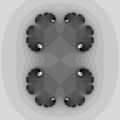 交叉
交叉 -
 交叉
交叉
.jpg)


-
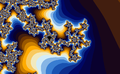 整數逃逸時間 = LSM
 -
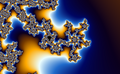 真實逃逸時間
 -
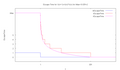 C=0 且 0.5<Z<2.5 時的逃逸時間


數學公式

Maxima 版本
GiveNormalizedIteration(z,c,E_R,i_Max):=
/* */
block(
 [i:0,r],
 while abs(z)<E_R and i<i_Max
   do (z:z*z + c,i:i+1),
 r:i-log2(log2(cabs(z))),
 return(float(r))
)$
在 Maxima 中,log(x) 是 x 的自然(以 e 為底)對數。要計算 log2,請使用
log2(x) := log(x) / log(2);
描述
- FF:julia-smooth-colouring-how-to-do
- stefan bion:fraktal-generator/colormapping/
- FF smooth-histogram-rendering/
- FF creating-a-good-palette-using-bezier-interpolation/
-
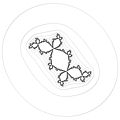 邊緣檢測影像和 C 程式碼
 -
 圓的前像
圓的前像


這些曲線是逃逸時間水平集的邊界(eLSM/J)。它們可以使用以下方法繪製
- 水平曲線的邊緣檢測(= 水平集的邊界)。
- 基於 M. Romera 等人的論文的演算法[9]
- 索貝爾濾波器
- 繪製勒尼薩卡 = 曲線 ,參見 解釋和原始碼
- 繪製圓圈 及其前像。參見 此影像、解釋和原始碼
- Harold V. McIntosh 描述的方法[10]


/* Maxima code : draws lemniscates of Julia set */
c: 1*%i;
ER:2;
z:x+y*%i;
f[n](z) := if n=0 then z else (f[n-1](z)^2 + c);
load(implicit_plot); /* package by Andrej Vodopivec */
ip_grid:[100,100];
ip_grid_in:[15,15];
implicit_plot(makelist(abs(ev(f[n](z)))=ER,n,1,4),[x,-2.5,2.5],[y,-2.5,2.5]);
水平曲線的密度[11]
"The spacing between level curves is a good way to estimate gradients: level curves that are close together represent areas of steeper descent/ascent." [12]
"The density of the contour lines tells how steep is the slope of the terrain/function variation. When very close together it means f is varying rapidly (the elevation increase or decrease rapidly). When the curves are far from each other the variation is slower" [13]
如何控制水平曲線
- 逃逸半徑
- 目標集的形狀
- 手動
- 繪製等勢線
- 更改水平集(水平曲線是水平集的邊界)
- 如何找到週期吸引子?
- 到達吸引子需要多少迭代?

-
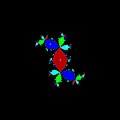 週期為 4 的法圖集的組成部分
 -
 週期為 3 的法圖集的組成部分
 -
 在 西格爾盤 的情況下,臨界軌道是邊界西格爾盤組成部分。所有其他組成部分都是該組成部分的前像


參見
- Wolf Jung 編寫的 Mandel 程式的演算法 0
-
 吸引
吸引 -
 吸引
吸引 -
 吸引
吸引 -
 拋物線型
拋物線型 -
沿內部射線 0 的 c 的影片
-
 弱吸引
弱吸引 -
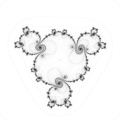
-

-

-
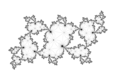 拋物線型週期 3


%3D_z%5E3%2B(1.0149042485835864102%2B0.10183008497976470119i)*z;_(zoom).png)

%3D1_over_az5%2Bz3%2Bbz.png)
%3D1_over_z3%2Bz*(-3-3*I).png)
_%3D_rho_*_z%5E2_*_(z-3)_over_(1-3z)_with_LCM_and_critical_orbit.png)
如何選擇 吸引陷阱 的大小,使水平曲線在臨界點處交叉?
這取決於
- 動態型別(超吸引/吸引、拋物線型、排斥型)
- 週期(拋物線型情況下 的子週期)
- 拋物線型情況下的花瓣
- 對於週期 1 和 2:以拋物點為中心的圓形,拋物點位於圓形邊界上
- 對於更高的週期,以拋物點為中心的圓形扇區
- 對於其他情況(除了排斥),它是以吸引子為中心的圓形半徑
int local_setup(double cx){

	c = cx;
	zp = GiveFixed(c);

	switch ( DynamicType){
		case repelling: // no  interior = no attracting fixed point = only escaping points

			break;
		case attracting:
			delta = sqrt(1.0 - 4.0* creal(c));  // delta is a distance between alfa and beta fixed points
			AR =  delta /20.0;

	  		break;

		case superattracting: // cabs(zp - zcr_last ) < PixelWidth
			AR = 30.0* PixelWidth * iWidth / 5000 ; //
	  		break;

		case parabolic:
				// zcr_last < parabolic_trap_center < zp
				int i; /* nr of point of critical orbit */
  				complex double z = zcr;
  				for (i=1;i<IterMax ; ++i)
    					{ z = f(z); }
  				zcr_last = z;
				//
				AR = (zp - zcr_last)/2.0;
				parabolic_trap_center = ( creal(zp) + creal(zcr_last))/ 2.0;
				break;
		default:
	}


	AR2 = AR*AR;


	return 0;
}

// and print program info
fprintf (stdout, "DynamicType value is setup manually; Once can do it also numerically ( from multiplier of fixed point alfa or from some other properities)\n");
  		switch ( DynamicType){
		case repelling:
				fprintf (stdout, "\tThere is only one Fatou basin: basin of infinity \n");
				fprintf (stdout, "\tthere is no interior = Julia set is disconnected \n");
				fprintf (stdout, "\tcritical point z=0 is repelling = attracted to infinity \n");
				break;
		case attracting:
	  			fprintf (stdout, "\tbasin type is attracting \n");
	  			fprintf (stdout, "\tzcr_last =  %.16f \talfa fixed point zp = %.16f\n", creal (zcr_last), creal(zp));//
	  			fprintf (stdout, "\tdelta =  %.16f is the distance between fixed points\n", delta);//
	  			fprintf (stdout, "\tAtracting Radius AR is set manually  = %.16f = %f * PixelWidth = %f * ImageWidth \n", AR, AR / PixelWidth, AR /ImageWidth );
	  			break;

		case superattracting:
				fprintf (stdout, "\tbasin type is superattracting \n");
	  			fprintf (stdout, "\tzcr =  %.16f  = zp = %.16f\n", creal (zcr), creal(zp));//
	  			fprintf (stdout, "\tAtracting Radius AR is set manually  = %.16f = %f *PixelWidth = %f *ImageWidth \n", AR, AR / PixelWidth, AR /ImageWidth);
	  			break;

		case parabolic:
				fprintf (stdout, "\tbasin type  is parabolic \n");
				fprintf (stdout, "\tzcr_last =  %.16f < parabolic_trap_center = %.16f < zp = %.16f\n", creal (zcr_last), creal (parabolic_trap_center), creal(zp));//
				fprintf (stdout, "\tzp - zcr_last =  %.16f AR*2 = %.16f \t difference = %.16f\n", creal (zp - zcr_last), AR *2.0, creal (zp - zcr_last) -  AR *2.0);//
				fprintf (stdout, "\tAtracting Radius AR is tuned  = (zp - zcr_last)/2 = %.16f = %f *PixelWidth = %f *ImageWidth \n", AR, AR / PixelWidth, AR /ImageWidth);
				fprintf (stdout, "\tparabolic_trap_center z =  %.16f %+.16f*i  \n", creal (parabolic_trap_center), cimag (parabolic_trap_center));// parabolic_trap_center
				break;
		default:


	}
拋物盆地的步驟
- 選擇臨界點位於內部的元件
- 選擇 陷阱
陷阱是一個圓盤
- 臨界點位於內部的元件內
- 陷阱在其邊界上具有拋物點
- 陷阱的中心是臨界軌道的最後一個點和不動點之間的中點
- 陷阱的半徑是不動點和臨界軌道的最後一個點之間距離的一半
- 分解
-
 整個動力平面的二進位制分解,圓形 Julia 集 c = 0
 -
沿內部射線 0 的二進位制分解
-
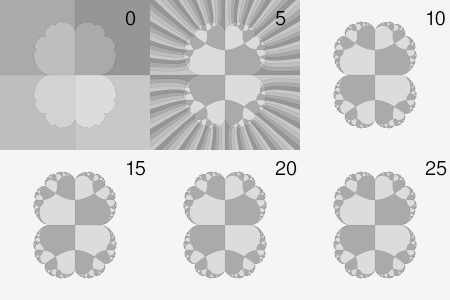 從分解到拋物棋盤
 -
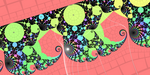 BD 在曼德布羅集外部和內部的邊界


示例
-
 BDM 的 LC
 -

-
 1
1 -
 2
2 -
 3
3 -
 4
4 -
 11
11

_%3D_z%5E2_%2B_i_using_BDM_DEM_LSM.png)


_%3D_z*z_%2B_0.25%2B0.5i_BDM.png)
_%3D_z*z_-0.6978381951224250%2B0.2793041341013660i.png)
這裡畫素的顏色(Julia 集的外部)與最後一次迭代的虛部的符號成正比(cimag)= 徑向邊界位於二進角(顯示二進角的外部射線)。
主迴圈與逃逸時間相同。
半徑
- 逃逸半徑 (ER) 應該更大:ER = 200
- 吸引半徑 (AR)
- 對於超吸引情況很小:AR = 畫素寬度
換句話說,目標集被分解成 2 部分(二進位制分解)


虛擬碼中的演算法 (Im(Zn) = Zy)
if (LastIteration==IterationMax)
   then color=BLACK;   /* bounded orbits = Filled-in Julia set */
   else   /* unbounded orbits = exterior of Filled-in Julia set  */
        if (Zy>0) /* Zy=Im(Z) */
           then color=BLACK;
           else color=WHITE;
描述
unsigned char ComputeColorOfBD (complex double z)
{

  double cabsz;


  int i;			// number of iteration
  for (i = 0; i < IterMax_LSM; ++i)
    {


	cabsz = cabs(z); // numerical speed up : cabs(zp-z) = cabs(z) because zp = zcr = 0

      //
       if ( cabsz > ER  ||  cabsz < AR ) // if z is inside target set ( orbit trap)
       		{
       			if (cimag(z) > 0) // binary decomposition of target set
       				{  return 0;}
       				else {return 255; }


      		}


      z = f(z);

    }

  return iColorOfUnknown;


}
- 僅一個元件 Julia 集的拋物 BDM 邊界(上排是 Blascheke 積,下排是 Multibrot 集
-
 d=2
d=2 -
 d=3
d=3 -
 d=4
d=4 -
 d=5
d=5 -

-

-

-
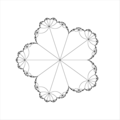
_%3D_(z%5Ed_%2B_a)_over_(1_%2B_a*z%5Ed)_with_a_%3D_(d_-_1)_over_(_d_%2B_1)_for_d_%3D_2.png)
_%3D_(z%5Ed_%2B_a)_over_(1_%2B_a*z%5Ed)_with_a_%3D_(d_-_1)_over_(_d_%2B_1)_for_d_%3D_3.png)
_%3D_(z%5Ed_%2B_a)_over_(1_%2B_a*z%5Ed)_with_a_%3D_(d_-_1)_over_(_d_%2B_1)_for_d_%3D_4.png)
_%3D_(z%5Ed_%2B_a)_over_(1_%2B_a*z%5Ed)_with_a_%3D_(d_-_1)_over_(_d_%2B_1)_for_d_%3D_5.png)
_%3D_z*z_%2B_0.25.png)
_%3D_z%5E3_%2B_0.3849001794597505.png)
_%3D_z*z*z*z_%2B_0.472464424146544.png)
_%3D_z*z*z*z*z_%2B_0.5349922439811376.png)
- 沿內部/外部射線 0 的動力演化
-
中心 = 超吸引
-
 吸引
吸引 -
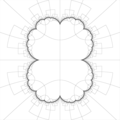 拋物線型
拋物線型 -
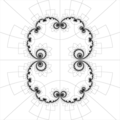 排斥
排斥


吸引情況用於 "場線" 著色方法由 Gertbuschmann


這些曲線
- 是二元分解框的邊界
- 不是電勢場線 = 外部射線
註釋
- 如果逃逸半徑太低,那麼二進位制(或三進位制等)分解射線將在迭代帶上具有可見的不連續性。增加逃逸半徑會使不連續性變小,但會改變縱橫比
- mrob 說 exp(pi) 是二進位制分解的最佳逃逸半徑,因為它使框具有正方形縱橫比(可能在使用指數對映變換時更明顯?)
-
修改後的二進位制分解
-


 // for MBD
 double t0 = 1.0 / 3.0; // period = 3

// Modified BD
unsigned char ComputeColorOfMBD (complex double z)
{

  double cabsz;
  double turn;

  int i;			// number of iteration
  for (i = 0; i < IterMax_LSM; ++i)
    {


	cabsz = cabs(z); // numerical speed up : cabs2(zp-z) = cabs2(z) because zp = zcr = 0

      //  if z is inside target set ( orbit trap) = exterior of circle with radius ER
       if ( cabsz > ER  ) // exterior
       		{
       			if (creal(z) > 0) // binary decomposition of target set
       				{  return 0;}
       				else {return 255; }


      		}

      	if ( cabsz  < AR ) // if z is inside target set ( orbit trap) = interior of circle with radius AR
      		{
      			turn = c_turn(z);
      			if (turn < t0 || turn > t0+0.5) // modified binary decomposition of target set
      				{  return 0;}
       				else {return 255; }


      		}


      z = f(z);

    }

  return iColorOfUnknown;


}
- 修改後的分解
-
 整個動力平面的修改後的二進位制分解,圓形 Julia 集。帶有原始碼的影像
 -
 二進位制分解的另一種修改
 -
 帶有樹枝狀 Julia 集的動力平面的修改後的分解。帶有原始碼的影像
 -
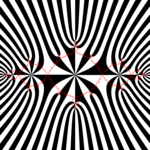 帶有巴西利卡 Julia 集的動力平面的修改後的分解。帶有原始碼的影像
 -

-


這裡 Julia 集的外部被分解成徑向水平集。
這是因為主迴圈沒有跳出測試,並且迭代次數(迭代最大值)是恆定的。
它建立了徑向水平集。
另請參閱
- mandel:演算法 9 = qn(c) 的零點
- bryceguy72 的影片[15]
- FreymanArt 的影片[16]
  for (Iteration=0;Iteration<8;Iteration++)
 /* modified loop without checking of abs(zn) and low iteration max */
    {
    Zy=2*Zx*Zy + Cy;
    Zx=Zx2-Zy2 +Cx;
    Zx2=Zx*Zx;
    Zy2=Zy*Zy;
   };
  iTemp=((iYmax-iY-1)*iXmax+iX)*3;
  /* --------------- compute  pixel color (24 bit = 3 bajts) */
 /* exterior of Filled-in Julia set  */
 /* binary decomposition  */
  if (Zy>0 )
   {
    array[iTemp]=255; /* Red*/
    array[iTemp+1]=255;  /* Green */
    array[iTemp+2]=255;/* Blue */
  }
  if (Zy<0 )
   {
    array[iTemp]=0; /* Red*/
    array[iTemp+1]=0;  /* Green */
    array[iTemp+2]=0;/* Blue */
  };
它也與莫比烏斯變換群的自同構函式有關 [17]
吸引域中的 BDM(通常是 Julia 集的內部)給出了(偽)場線
解釋 由 Gert Buschmann


在每個 Fatou 域(不是中性的)中,有兩個相互垂直的線系:等勢線(用於勢函式或實數迭代次數)和場線。
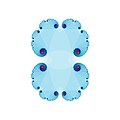
如果我們根據迭代次數(而不是實數迭代次數 ,如上一節所定義)對 Fatou 域進行著色,則迭代的帶顯示了等勢線的路徑。如果迭代趨於 ∞(就像通常迭代 的外部 Fatou 域中那樣),我們可以很容易地顯示場線的路徑,即根據迭代序列中的最後一個點在x軸上方還是下方來改變顏色(第一張圖片),但在這種情況下(更確切地說:當 Fatou 域是超吸引時),我們無法連貫地繪製場線 - 至少不能透過我們在這裡描述的方法。在這種情況下,場線也稱為外部射線。


設z為吸引 Fatou 域中的一個點。如果我們對z進行大量的迭代,迭代序列的終點是一個有限迴圈C,而 Fatou 域(根據定義)是迭代序列收斂於C的點的集合。場線從C的點以及迭代到C中的點的(無限多個)點發出。它們在 Julia 集中結束於非混沌點(即生成有限迴圈的點)。設r為迴圈C的階數(其點的數量),設z*為C中的一個點。我們有(r 次複合),我們定義複數 α 為


如果C的點是,α 是r 個數 的乘積。實數 1/|α| 是迴圈的吸引力,我們假設迴圈既不中性也不超吸引,這意味著 1 < 1/|α| < ∞。點z* 是 的不動點,在這個點附近,對映 具有(與場線相關的)旋轉的特徵,旋轉的角度為 α 的幅角 β(即)。


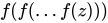

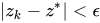
為了給 Fatou 域著色,我們選擇了一個小的數字 ε,並設定迭代序列 在 時停止,我們根據數字k(或者如果我們希望平滑著色,則根據實際迭代次數)對點z 著色。如果我們從z* 選擇一個由角度 θ 給出的方向,則從z* 以這個方向發出的場線由以下點z 組成:數 的幅角 ψ 滿足以下條件:



如果我們在場線方向(遠離迴圈)上透過一個迭代帶,則迭代次數k增加 1,而數字 ψ 增加 β,因此數字 沿場線保持恆定。



對 Fatou 域場線的著色意味著我們對場線對之間的空間進行著色:我們選擇從 z* 發出的幾個規則分佈的方向,並在每個方向上選擇兩個圍繞該方向的方向。由於場線對的兩個場線可能不會在 Julia 集的同一點結束,因此我們著色的場線在它們通往 Julia 集的路上可以(無限地)分叉。我們可以根據到場線中心線的距離進行著色,並且可以將這種著色與通常的著色混合在一起。這種圖片可以非常裝飾性(第二張圖片)。
一條著色的場線(兩條場線之間的區域)被迭代帶劃分,這樣一部分可以與單位正方形建立一一對應關係:一個座標是(從)到其中一條邊界場線的距離計算出來的,另一個座標是(從)到邊界迭代帶的內側距離計算出來的(這個數字是實迭代次數的非整數部分)。因此,我們可以將圖片放入場線中(第三張圖片)。
待辦事項
[edit | edit source]- 將斜率新增到白色
復勢 - Boettcher 座標
[edit | edit source]DEM/J
[edit | edit source]該演算法有兩個版本
將它與 引數平面和 Mandelbrot 集的版本 : DEM/M 進行比較。它與 M 集外部距離估計相同,但使用對 Z 的導數而不是對 C 的導數。
收斂
[edit | edit source]在這個演算法中,檢查同一個軌道上兩個點的距離
軌道的平均離散速度
[edit | edit source]
它在以下情況下使用
柯西收斂演算法 (CCA)
[edit | edit source]該演算法由使用者:Georg-Johann 描述。這裡還有 Paul Nylander 編寫的 Matemathics 程式碼
正規性
[edit | edit source]正規性 在此演算法中,檢查兩個軌道上點的距離
Michael Becker 檢查 等連續性
[edit | edit source]"迭代在 Fatou 集 上是等連續的,而在 Julia 集 上則不是"。(Wolf Jung)[18][19]
Michael Becker 在黎曼球面上比較了迭代下兩個靠近點的距離。[20][21]
此方法不僅可以用於繪製多項式的 Julia 集(其中無窮大始終是超吸引不動點),還可以應用於其他函式(對映),其中無窮大不是吸引不動點。[22]
使用 Wolf Jung 的 Marty 準則
[edit | edit source]Wolf Jung 正在使用“一種檢查正規性的替代方法,它基於 Marty 的準則:|f'| / (1 + |f|^2) 對於所有迭代必須有界”。它在 mndlbrot::marty 函式中實現(請參閱 程式 Mandel 版本 5.3 的原始碼)。它使用動態平面上的一點。
科尼格斯座標
[edit | edit source]科尼格斯座標 用於有限吸引(非超吸引)點(迴圈)的吸引盆中。
最佳化
[edit | edit source]你不需要平方根來比較距離。[23]
二次 Julia 集始終具有旋轉對稱性(180 度)
colour(x,y) = colour(-x,-y)
當 c 位於實軸上(cy = 0)時,Julia 集也具有反射對稱性:[26]
colour(x,y) = colour(x,-y)
演算法
- 計算一半影像
- 旋轉並新增另一半
- 將影像寫入檔案 [27]
- 計算機圖形中的顏色
- Georg-Johann 對 Julia 集的視覺化
- Chris King 對 Julia 集和引數平面的聯合描繪方法
- 關於分形著色技術 Jussi Harkonen 碩士論文,Åbo Akademi 大學數學系,圖爾庫,2007 年,61 頁。論文是在 教授 Goran Hognas 的指導下完成的
- 技術資訊 - 由 Michael Condron 著色
- Shawn Hargreaves 的 Technicolor Julias
- 前向軌道的陷阱
- 它是一個集合,可以捕獲任何趨於固定點/ 週期點 的軌道。
"大多數用於計算 Julia 集的程式在基礎動力學是雙曲的時執行良好,但在拋物線情況下會遇到指數級減速。"(Mark Braverman)[28]
- 當 Julia 集是不會在二次對映迭代下逃逸到無窮大的點集時(= 填充的 Julia 集沒有內部 = dendrt)
- IIM/J
- DEM/J
- 檢查正態性
- 當 Julia 集是兩個吸引盆之間的邊界時(= 填充的 Julia 集沒有空的內部)
- 邊界掃描 [29]
- 邊緣檢測
填充的 Julia 集的內部可以被著色
- 吸引速度(整數值 = 用於猜測點是否在集合中的迭代次數),它被轉換為顏色(或灰色陰影) [30]
- Siegel 盤情況下的離散速度
更多內容請檢視 這裡
可以使用 製作影片
- 放大動態平面
- 沿引數平面內的路徑更改引數 c [32]
- 更改著色方案(例如顏色迴圈)
示例
- 超複數迭代 - 書籍
- hvidtfeldts : distance-estimated-3d-fractals-v-the-mandelbulb-different-de-approximations/
- 在 Java 中檢視 Evgeny Demidov
- 在 C 中檢視
- 在 C++ 中檢視 Wolf Jung 頁面,
- 在 Gnuplot 中檢視 T.Kawano 的教程
- 在 Maxima 的 Lisp 中檢視 Jaime E. Villate 的動態
- 在 Mathemathica 中檢視
- ↑ Mark Braverman 和 Michael Yampolsky 的 Julia 集的可計算性
- ↑ 來自 Ultra Fractal 的標準著色演算法
- ↑ 新分形論壇 : 曼德爾布羅集的最低最佳逃逸值/
- ↑ math.stackexchange 問題:多項式的逃逸半徑及其填充的 Julia 集
- ↑ Bruce Dawson(Fractal eXtreme 的作者)的透過代數實現更快的分形
- ↑ 來自 tensorpudding 的使用 gsl 的 C 程式碼
- ↑ Wolf Jung 在 GNU 通用公共許可證 下的程式 Mandel
- ↑ R. Grothmann 的 Euler 示例
- ↑ 透過逃逸線方法繪製曼德爾布羅集。M. Romera 等人
- ↑ Julia 曲線,曼德爾布羅集,Harold V. McIntosh。
- ↑ PythonDataScienceHandbook:Jake VanderPlas 的密度和等高線圖
- ↑ math.stackexchange 問題:等高線表示什麼
- ↑ Rodolphe Vaillant 的等高線
- ↑ E Demidov 的不動點和週期軌道
- ↑ 影片 : bryceguy72 的 Julia 集與磁場線的變形
- ↑ 影片 : FreymanArt 的用色帶/條紋變形 Julia 集
- ↑ Gerard Westendorp : 黎曼曲面的柏拉圖式鑲嵌 - 8 次迭代自同態函式 z->z^2 -0.1+ 0.75i
- ↑ Alan F. Beardon, S. Axler, F.W. Gehring, K.A. Ribet : 有理函式迭代:複分析動力系統。Springer,2000 年;ISBN 0387951512,9780387951515;第 49 頁
- ↑ Joseph H. Silverman : 動力系統的算術。Springer,2007 年。 ISBN 0387699031,9780387699035;第 22 頁
- ↑ Georg-Johann 視覺化 Julia 集
- ↑ 問題 : 在迭代下,兩個相近點的距離如何變化?如果我知道這一點,我能判斷這些點屬於哪個集合嗎?
- ↑ Michael Becker 的 Julia 集。請檢視度量 d(z,w)
- ↑ 演算法 : wikibooks 中的距離近似
- ↑ Evgeny Demidov 的 Julia 集對稱性
- ↑ mathoverflow : z2c 的 Julia 集對稱性
- ↑ htJulia Jewels:Michael McGoodwin 對 Julia 集的探索 (2000 年 3 月)
- ↑ Jonas Lundgren 在 Matlab 中的 Julia 集
- ↑ Mark Braverman : 關於拋物線 Julia 集的有效計算
- ↑ 拋物線不動點情況下的 Julia 集計算機建模演算法 N.B.Ampilova,E.Petrenko
- ↑ Keenan Crane 在 GPU 上的射線追蹤四元數 Julia 集
- ↑ Tomoki Kawahira 對填充的 Julia 集內部的鑲嵌
- ↑ devianart 上的 Julia 集動畫
- Drakopoulos V.,比較 Julia 集的渲染方法,WSCG 雜誌 10 (2002),155–161
- Nathaniel D. Emerson 的動力學樹
- "Julia 集和相關集合中的螺旋結構",M. Michelitsch 和 O. E. Roessler 在一本書中 : 螺旋對稱 I. Hargittai 和 C. Pickover。(1992) 世界科學出版社,
- "Julia 集中三臂螺旋的演化,以及更高階螺旋",A. G. Davis Philip 在一本書中 : 螺旋對稱 I. Hargittai 和 C. Pickover。(1992) 世界科學出版社,
- Beardon,A. : Julia 集的對稱性。數學情報員。1996-03-01 Springer 紐約 ISSN: 0343-6993 第 43 - 44 頁。