


分形/複平面迭代/動態外射線
- 落在alpha不動點上的射線
-
 雙可達
雙可達 -
 三可達
三可達


- 落在臨界點和臨界值上的射線
-
 1/4
1/4 -
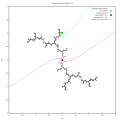 1/6
1/6 -
 9/56
9/56 -
 129/16256


令 為從閉合單位圓盤 的補集(外部)到填充的Julia集 的補集的對映(保角對映,同構)。



其中 表示黎曼球面(擴充套件複平面)。

令 表示

- 逆Boettcher對映
- 黎曼對映
角度為 的外射線記為 是


- 在 下的直線 的像

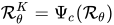
- 具有相同外部角 的填充後的 Julia 集外部的點集


重要問題
[edit | edit source]哪些是獨特的射線?
[edit | edit source]- "落在 Julia 集的關鍵點(或包含關鍵點的球體的根點)上的射線 t 對該 Julia 集是唯一的,因此是識別 Julia 集的一種方式。因此,我用 t 來命名 Julia 集 Jc。在餘下部分中,我只能處理 t=p/q 為有理數的 Julia 集。"[1]
- 臨界前週期多項式通常由 落在臨界值的外部射線 的角度 進行引數化
如何逼近外部射線?
[edit | edit source]- 用於 Julia 集的二進位制分解方法 (BDM/J)
- 場線 的標量場(勢)
- SAM = 條帶平均方法 基本上是計算角度的一種廉價方式。
-

-
 BDM 的邊界
 -
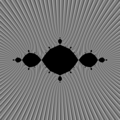 SAM
SAM
_%3D_z*z_%2B_0.25%2B0.5i_BDM.png)


在 BDM 影像中,角度(以圈數測量)的外部射線

可以看作子集的邊界。
當兩個外部動態射線落在同一點時
[edit | edit source]問題:[2]
- Q1:給定 Julia 集中的一個點,有多少條射線落在該點上?
- Q2:給定兩條射線 和 ,在什麼條件下它們落在同一點?
- Q3:哪些射線支援相同的 Fatou 分量?


定理 1.2 設 f 為度數 d ≥ 2 的多項式,其 Julia 集區域性連通。如果兩個角度 和 關於臨界肖像具有相同的行程,那麼外部射線 和 的著陸點要麼重合,要麼屬於 Fatou 域的邊界,該邊界最終被迭代到 Siegel 盤上。


如何找到落在臨界值 z= c 上的外部射線的角度呢?
[edit | edit source]這取決於具體情況。
- 例如,當引數 c 是一個 Misiurewicz 點時,可以使用組合方法。
- 大多數情況下,你首先構造角度,然後確定引數。
- 但是,如果你想從 Julia 集或 Hubbard 樹中讀取角度,你可以按照 Mandel 程式 中的 Demo 4 第 1 和 2 頁的說明進行。
構造 填充 Julia 集 的脊柱
[edit | edit source]構造脊柱的演算法由 A. Douady[5] 描述
- 連線 和 ,
- (待完成)


繪製外部射線是什麼意思呢?
[edit | edit source]這意味著
- 計算(近似)射線的某些點
- 用線段連線這些點
這將給出射線 的近似值。

繪製 動態外部射線
[edit | edit source]演算法
逆向迭代
[edit | edit source]
這種方法已經被許多人使用,並被 Thierry Bousch 證明。[8]
Wolf Jung 的 C++ 程式碼可以在 qmnplane.cpp 檔案中的 QmnPlane::backray() 函式中找到(參見 Mandel 程式 的原始碼)。[9]
- 週期性角度的射線(最簡單的情況)
我們將透過一個例子來解釋它
首先選擇外部角度 (以圈數為單位)。週期性射線的外部角度是一個有理數。


計算外部角度在 倍增對映 下的週期。
因為 "1/3 的倍增結果是 2/3,而 2/3 的倍增結果是 4/3,它與 1/3 同餘" [10]

或者
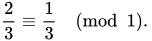
因此外部角 在倍增對映下週期為2。
從無窮遠處的兩個點開始(在共軛平面上)
在射線 1/3 上有一個點
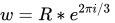
在射線 2/3 上有一個點 .
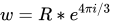
在無窮遠附近 因此可以切換到動力學平面(博特切爾共軛)

向後迭代(從兩個可能性中適當選擇)[12] 在射線 1/3 上的點會到射線 2/3,再回到 1/3,依此類推。
在 C 語言中是
/* choose one of 2 roots: zNm1 or -zNm1  where zN = sqrt(zN - c )  */
if (creal(zNm1)*creal(zN) + cimag(zNm1)*cimag(zN) <= 0) zNm1=-zNm1;
或者在 Maxima CAS
if (z1m1.z01>0) then z11:z1m1 else z11:-z1m1;
必須將點集分成 2 個子集(2 條射線)。繪製這兩個集合中的一個,並將這些點連線起來。它將近似於射線。
- 對於預週期角的射線(待完成)
/*

compute last point ~ landing point
of the dynamic ray for periodic angles ( in turns )

 gcc r.c -lm -Wall -march=native

landing point of ray for angle = 1 / 15 = 0.0666666666666667 is = (0.0346251977103306 ;  0.4580500411138030 ) ; iDistnace = 18
landing point of ray for angle = 2 / 15 = 0.1333333333333333 is = (0.0413880816505388 ;  0.5317194187688231 ) ; iDistnace = 17
landing point of ray for angle = 4 / 15 = 0.2666666666666667 is = (-0.0310118081927549 ;  0.5440125864026020 ) ; iDistnace = 17
landing point of ray for angle = 8 / 15 = 0.5333333333333333 is = (-0.0449867688014234 ;  0.4662592852362425 ) ; iDistnace = 18

*/

// https://gitlab.com/adammajewski/ray-backward-iteration
#include <stdio.h>
#include <stdlib.h> // malloc
#include <math.h> // M_PI; needs -lm also
#include <complex.h>

/* --------------------------------- global variables and consts ------------------------------------------------------------ */
#define iPeriodChild 4 // iPeriodChild of secondary component joined by root point

// - --------------------- functions ------------------------

/*
   principal square  root of complex number
   wikipedia  Square_root

   z1= I;
   z2 = root(z1);
   printf("zx  = %f \n", creal(z2));
   printf("zy  = %f \n", cimag(z2));
*/
double complex root(double x, double y)
{

  double u;
  double v;
  double r = sqrt(x*x + y*y);

  v = sqrt(0.5*(r - x));
  if (y < 0) v = -v;
  u = sqrt(0.5*(r + x));
  return u + v*I;
}

// This function only works for periodic  angles.
// You must know the iPeriodChild n before calling this function.
// draws all "iPeriodChild" external rays
// commons  File:Backward_Iteration.svg
// based on the code by Wolf Jung from program Mandel
// http://www.mndynamics.com/

int ComputeRays( //unsigned char A[],
			    int n, //iPeriodChild of ray's angle under doubling map
			    int iterMax,
                            double Cx,
                            double Cy,
                            double dAlfaX,
                            double dAlfaY,
                            double PixelWidth,
                            complex double zz[iPeriodChild] // output array

			    )
{
  double xNew; // new point of the ray
  double yNew;

  const double R = 10000; // very big radius = near infinity
  int j; // number of ray
  int iter; // index of backward iteration

  double t,t0; // external angle in turns
  double num, den; // t = num / den

  double complex zPrev;
  double u,v; // zPrev = u+v*I

  int iDistance ; // dDistance/PixelWidth = distance to fixed in pixels


  /* dynamic 1D arrays for coordinates ( x, y) of points with the same R on preperiodic and periodic rays  */
  double *RayXs, *RayYs;
  int iLength = n+2; // length of arrays ?? why +2

  //  creates arrays :  RayXs and RayYs  and checks if it was done
  RayXs = malloc( iLength * sizeof(double) );
  RayYs = malloc( iLength * sizeof(double) );
  if (RayXs == NULL || RayYs==NULL)
    {
      fprintf(stderr,"Could not allocate memory");
      getchar();
      return 1; // error
    }

   // external angle of the first ray
   num = 1.0;
   den = pow(2.0,n) -1.0;
   t0 = num/den; // http://fraktal.republika.pl/mset_external_ray_m.html
   t=t0;
   // printf(" angle t = %.0f / %.0f = %f in turns \n", num, den, t0);

  //  starting points on preperiodic and periodic rays
  //  with angles t, 2t, 4t...  and the same radius R
  for (j = 0; j < n; j++)
    { // z= R*exp(2*Pi*t)
      RayXs[j] = R*cos((2*M_PI)*t);
      RayYs[j] = R*sin((2*M_PI)*t);
      //
      // printf(" %d angle t = = %.0f / %.0f =  %.16f in turns \n", j, num , den,  t);
      //
      num *= 2.0;
      t *= 2.0; // t = 2*t
      if (t > 1.0) t--; // t = t modulo 1

    }
  //zNext = RayXs[0] + RayYs[0] *I;

  // printf("RayXs[0]  = %f \n", RayXs[0]);
  // printf("RayYs[0]  = %f \n", RayYs[0]);

  // z[k] is n-periodic. So it can be defined here explicitly as well.
  RayXs[n] = RayXs[0];
  RayYs[n] = RayYs[0];

  //   backward iteration of each point z
  for (iter = -10; iter <= iterMax; iter++)
    {

      for (j = 0; j < n; j++) // n +preperiod
	{ // u+v*i = sqrt(z-c)   backward iteration in fc plane
	  zPrev = root(RayXs[j+1] - Cx , RayYs[j+1] - Cy ); // , u, v
	  u=creal(zPrev);
	  v=cimag(zPrev);

	  // choose one of 2 roots: u+v*i or -u-v*i
	  if (u*RayXs[j] + v*RayYs[j] > 0)
	    { xNew = u; yNew = v; } // u+v*i
	  else { xNew = -u; yNew = -v; } // -u-v*i

	  // draw part of the ray = line from zPrev to zNew
	 // dDrawLine(A, RayXs[j], RayYs[j], xNew, yNew, j, 255);


	  //
	  RayXs[j] = xNew; RayYs[j] = yNew;


	} // for j ...

          //RayYs[n+k] cannot be constructed as a preimage of RayYs[n+k+1]
      RayXs[n] = RayXs[0];
      RayYs[n] = RayYs[0];

      // convert to pixel coordinates
      //  if z  is in window then draw a line from (I,K) to (u,v) = part of ray

      // printf("for iter = %d cabs(z) = %f \n", iter, cabs(RayXs[0] + RayYs[0]*I));

    }

  // Approximate end of ray by straight line to it's landing point here = alfa fixed point
 // for (j = 0; j < n + 1; j++)
  //  dDrawLine(A, RayXs[j],RayYs[j], dAlfaX, dAlfaY,j, 255 );

  // this check can be done only from inside this function
  t=t0;
  num = 1.0;
  for (j = 0; j < n ; j++)
    {

      zz[j] = RayXs[j] +  RayYs[j] * I; // save to the output array
      // Approximate end of ray by straight line to it's landing point here = alfa fixed point
      //dDrawLine(RayXs[j],RayYs[j], creal(alfa), cimag(alfa), 0, data);
      iDistance = (int) round(sqrt((RayXs[j]-dAlfaX)*(RayXs[j]-dAlfaX) +  (RayYs[j]-dAlfaY)*(RayYs[j]-dAlfaY))/PixelWidth);
      printf("last point of the ray for angle = %.0f / %.0f = %.16f is = (%.16f ;  %.16f ) ; Distance to fixed = %d  pixels \n",num, den, t, RayXs[j], RayYs[j],  iDistance);
      num *= 2.0;
      t *= 2.0; // t = 2*t
      if (t > 1) t--; // t = t modulo 1
    } // end of the check

  // free memmory
  free(RayXs);
  free(RayYs);

  return  0; //
}

int main()
{

  complex double l[iPeriodChild];
  int i;
  // external angle in turns = num/den;
  double num = 1.0;
  double den = pow(2.0, iPeriodChild) -1.0;

   ComputeRays( iPeriodChild,
                   10000,
                   0.25, 0.5,
                   0.00, 0.5,
                   0.003,
                   l ) ;


  printf("\n see what is in the output array : \n");

  for (i = 0; i < iPeriodChild ; i++) {
       printf("last point of the ray for angle = %.0f / %.0f = %.16f is = (%.16f ;  %.16f ) \n",num, den, num/den, creal(l[i]), cimag(l[i]));
       num *= 2.0;}

  return 0;
}
執行它
./a.out
輸出
last point of the ray for angle = 1 / 15 = 0.0666666666666667 is = (0.0346251977103306 ;  0.4580500411138030 ) ; Distance to fixed = 18  pixels
last point of the ray for angle = 2 / 15 = 0.1333333333333333 is = (0.0413880816505388 ;  0.5317194187688231 ) ; Distance to fixed = 17  pixels
last point of the ray for angle = 4 / 15 = 0.2666666666666667 is = (-0.0310118081927549 ;  0.5440125864026020 ) ; Distance to fixed = 18  pixels
last point of the ray for angle = 8 / 15 = 0.5333333333333333 is = (-0.0449867688014234 ;  0.4662592852362425 ) ; Distance to fixed = 19  pixels

 see what is in the output array :
last point of the ray for angle = 1 / 15 = 0.0666666666666667 is = (0.0346251977103306 ;  0.4580500411138030 )
last point of the ray for angle = 2 / 15 = 0.1333333333333333 is = (0.0413880816505388 ;  0.5317194187688231 )
last point of the ray for angle = 4 / 15 = 0.2666666666666667 is = (-0.0310118081927549 ;  0.5440125864026020 )
last point of the ray for angle = 8 / 15 = 0.5333333333333333 is = (-0.0449867688014234 ;  0.4662592852362425 )
射線上的點正在向後移動
- 當它離茱莉亞集合很遠時,速度很快
- 靠近茱莉亞集合時速度很慢(經過 50 次迭代後,點之間的距離 = 0 畫素)
參見計算示例(這裡 畫素大小 = 0.003)
# iteration distance_between_points_in_pixels
0 	 3300001
1 	 30007
2 	 2296
3 	 487
4 	 179
5 	 92
6 	 54
7 	 34
8 	 23
9 	 18
10 	 14
11 	 11
12 	 9
13 	 7
14 	 6
15 	 5
16 	 5
17 	 4
18 	 4
19 	 3
20 	 3
21 	 3
22 	 3
23 	 2
24 	 2
25 	 2
26 	 2
27 	 2
28 	 2
29 	 2
30 	 1
31 	 1
32 	 1
33 	 1
34 	 1
35 	 1
36 	 1
37 	 1
38 	 1
39 	 1
40 	 1
41 	 1
42 	 1
43 	 1
44 	 1
45 	 1
46 	 1
47 	 1
48 	 1
49 	 1
50 	 1
51 	 1
52 	 1
53 	 1
54 	 1
55 	 1
56 	 0
57 	 0
58 	 0
59 	 0
60 	 0
可以選擇畫素大小不同的點
#iteration    distance(z1,z2)   distance (z,alfa)
       0 	 3300001 	 33368
       1 	   30007 	  3364
       2 	    2296 	  1074
       3 	     487 	   591
       4 	     179 	   413
       5 	      92 	   321
       6 	      54 	   267
       7 	      34 	   234
       8 	      23 	   211
       9 	      18 	   193
      10 	      14 	   179
      11 	      11 	   169
      12 	       9 	   160
      13 	       7 	   153
      14 	       6 	   146
      15 	       5 	   141
      16 	       5 	   136
      17 	       4 	   132
      18 	       4 	   128
      19 	       3 	   125
      20 	       3 	   122
      21 	       3 	   119
      22 	       3 	   117
      23 	       2 	   115
      24 	       2 	   112
      25 	       2 	   110
      26 	       2 	   109
      27 	       2 	   107
      28 	       2 	   105
      29 	       2 	   104
      30 	       1 	   102
      31 	       1 	   101
      32 	       1 	   100
      33 	       1 	    99
      34 	       1 	    97
      35 	       1 	    96
      36 	       1 	    95
      38 	       2 	    93
      40 	       2 	    92
      42 	       2 	    90
      44 	       2 	    88
      46 	       1 	    87
      48 	       1 	    86
      50 	       1 	    84
      52 	       1 	    83
      54 	       1 	    82
      56 	       1 	    81
      59 	       1 	    80
      62 	       1 	    78
      65 	       1 	    77
      68 	       1 	    76
      71 	       1 	    75
      74 	       1 	    74
      78 	       1 	    73
      82 	       1 	    71
      86 	       1 	    70
      90 	       1 	    69
      95 	       1 	    68
     100 	       1 	    67
     105 	       1 	    66
     111 	       1 	    65
     117 	       1 	    64
     124 	       1 	    63
     131 	       1 	    62
     139 	       1 	    60
     147 	       1 	    59
     156 	       1 	    58
     166 	       1 	    57
     177 	       1 	    56
     189 	       1 	    55
     202 	       1 	    54
     216 	       1 	    53
     231 	       1 	    52
     247 	       1 	    51
     265 	       1 	    50
     285 	       1 	    49
     307 	       1 	    48
     331 	       1 	    47
     358 	       1 	    46
     388 	       1 	    45
     421 	       1 	    44
     458 	       1 	    43
     499 	       1 	    42
     545 	       1 	    41
     597 	       1 	    40
     655 	       1 	    39
     721 	       1 	    38
     796 	       1 	    37
     881 	       1 	    36
     978 	       1 	    35
    1090 	       1 	    34
    1219 	       1 	    33
    1368 	       1 	    32
    1542 	       1 	    31
    1746 	       1 	    30
    1986 	       1 	    29
    2270 	       1 	    28
    2608 	       1 	    27
    3013 	       1 	    26
    3502 	       1 	    25
    4098 	       1 	    24
    4830 	       1 	    23
    5737 	       1 	    22
    6873 	       1 	    21
    8312 	       1 	    20
   10157 	       1 	    19
   12555 	       1 	    18
   15719 	       1 	    17
   19967 	       1 	    16
   25780 	       1 	    15
   33911 	       1 	    14
   45574 	       1 	    13
   62798 	       1 	    12
   89119 	       1 	    11
  131011 	       1 	    10
  201051 	       1 	     9
  325498 	       1 	     8
  564342 	       1 	     7
 1071481 	       1 	     6
 2308074 	       1 	     5
 5996970 	       1 	     4
21202243 	       1 	     3
136998728 	       1 	     2
可以觀察到,從畫素 12 移動到 alfa 附近的畫素 11 需要 27 000 次迭代。計算到 alfa 附近 1 畫素內的點需要:2m1.236 秒
使用柯蒂斯·麥克穆倫的逆博特切爾對映繪製動態外部射線
[edit | edit source]
該方法基於柯蒂斯·麥克穆倫的 C 程式[13] 及馬特亞茲·艾拉特的 Pascal 版本[14]
這裡有兩個平面[15]
- w-平面(或 f0 平面)
- z-平面(fc 平面的動力學平面)
該方法包含 3 個主要步驟
- 計算圓形外部射線在角 和不同半徑(光柵化)上的某些 w 點
- 其中


- 使用逆博特切爾對映將 w 點對映到 z 點

- 繪製 z 點(並使用線段連線它們(線段是直線的一部分,由兩個不同的端點界定[16]))
第一步和最後一步很容易,但第二步不容易,需要更多解釋。
光柵化
[edit | edit source]對於給定的外部射線,在 平面 中,射線的每個點都有

- 常數 (外角以轉為單位)
- 變數半徑

所以 射線的點由半徑 引數化,可以使用 複數的指數形式 計算。


可以使用 **線性尺度** 沿著射線前進。
t:1/3; /* example value */
R_Max:4;
R_Min:1.1;
for R:R_Max step -0.5 thru R_Min do w:R*exp(2*%pi*%i*t);
/* Maxima allows non-integer values in for statement */
這會得到一些 w 點,這些點之間的距離相等。
另一種方法是使用 **非線性尺度**。
為了做到這一點,我們引入浮點 指數 ,使得


和

為了計算外射線在 平面上的角度為 的一些 w 點,使用以下 Maxima 程式碼
t:1/3; /* external angle in turns */
/* range for computing  R ; as r tends to 0 R tends to 1 */
rMax:2; /* so Rmax=2^2=4 /
rMin:0.1; /* rMin > 0   */
caution:0.93; /* positive number < 1 ; r:r*caution  gives smaller r */
r:rMax;
unless r<rMin do
(
 r:r*caution, /* new smaller r */
 R:2^r, /* new smaller R */
 w:R*exp(2*%pi*%i*t) /* new point w in f0 plane */
);
在這個方法中,點之間的距離並不相等,而是與填充的 Julia 集邊界距離 成反比。
這是好的,因為在這裡射線具有更大的 曲率,因此曲線會更加平滑。

- 在 平面中進行向前迭代

直到 接近無窮大


- 切換平面(從 到 )

(因為這裡,接近無窮大:)

- 在 平面上進行反向迭代相同()次迭代次數
- 最後一個點 在我們的外部射線上


步驟 1、2 和 4 很容易。第三個不容易。

反向迭代使用複數的平方根。它是一個雙值函式,因此反向迭代會產生二叉樹。
在沒有額外資訊的情況下,無法在這樣的樹中選擇正確的路徑。為了解決這個問題,我們將使用兩件事
- 無窮大吸引域的等度連續性
- 和 平面之間的共軛關係
無窮大吸引域的等度連續性
[edit | edit source]無窮大吸引域(填充的 Julia 集的補集)包含在正向迭代下趨於無窮大的所有點。

無窮大是一個超吸引不動點,所有點的軌道都具有類似的行為。換句話說,如果兩個點的初始位置很接近,則它們的軌道被認為會保持接近。
這就是等度連續性(與正規性比較)。
在 平面上,可以使用射線先前點的正向軌道來計算下一個點的反向軌道。
演算法的詳細版本
[edit | edit source]- 計算射線的第一個點(從無窮大附近開始,朝 Julia 集移動)
- 其中


這裡可以輕鬆切換平面
這是射線的第一個 z 點。
- 計算射線的下一個 z 點
- 計算射線的下一個 w 點,對於
- 計算兩個點的正向迭代:前一個 z 點和當前 w 點。儲存 z 軌跡和最後一個 w 點
- 切換平面並使用最後一個 w 點作為起點:
- 使用前一個 z 點的正向軌跡,對新的 進行反向迭代,直到新的
- 是射線的下一個 z 點
- 依此類推(下一個點),直到



Maxima CAS 原始碼
/* gives a list of z-points of external ray for angle t in turns and coefficient c */
GiveRay(t,c):=
block(
 [r],
 /* range for drawing  R=2^r ; as r tends to 0 R tends to 1 */
 rMin:1E-20, /* 1E-4;  rMin > 0  ; if rMin=0 then program has infinity loop !!!!! */
 rMax:2,
 caution:0.9330329915368074, /* r:r*caution ; it gives smaller r */
 /* upper limit for iteration */
 R_max:300,
 /* */
 zz:[], /* array for z points of ray in fc plane */
 /*  some w-points of external ray in f0 plane  */
 r:rMax,
 while 2^r<R_max do r:2*r, /* find point w on ray near infinity (R>=R_max) in f0 plane */
 R:2^r,
 w:rectform(ev(R*exp(2*%pi*%i*t))),
 z:w, /* near infinity z=w */
 zz:cons(z,zz),
 unless r<rMin do
 ( /* new smaller R */
  r:r*caution,
  R:2^r,
  /* */
  w:rectform(ev(R*exp(2*%pi*%i*t))),
  /* */
  last_z:z,
  z:Psi_n(r,t,last_z,R_max), /* z=Psi_n(w) */
  zz:cons(z,zz)
 ),
 return(zz)
)$
- ↑ 康奈爾大學的配對理論
- ↑ 射線一起著陸的判據,作者:曾金松(arXiv:1503.05931 math.DS)
- ↑ 作為動力學系統的臨界前週期多項式的分類,作者:Ben Bielefeld、Yuval Fisher 和 John Hubbard
- ↑ 關於臨界有限多項式的第一部分:臨界肖像,作者:Alfredo Poirier
- ↑ A. Douady,“計算 Mandelbrot 集中角度的演算法”,在混亂動力學和分形,M. Barnsley 和 S. G. Demko 編,科學與工程數學筆記與報告,第 2 卷,第 155–168 頁,學術出版社,亞特蘭大,佐治亞州,美國,1986 年。
- ↑ 作為微分方程軌跡的不變康託集族 II:Julia 集,作者:陳一泉、川平朋樹、袁俊明
- ↑ 繪製 Mandelbrot 集外部射線的演算法,作者:川平朋樹
- ↑ Thierry Bousch:外部射線旋轉了多少?未發表的手稿,1995 年
- ↑ Wolf Jung 編寫的 Mandel 程式
- ↑ Wolf Jung 的解釋
- ↑ 維基百科中的模算術
- ↑ 複數的平方根給出 2 個值,因此必須只選擇一個。有關詳細資訊,請參閱 Wolf Jung 頁面
- ↑ Curtis McMullen 編寫的 c 程式(Julia.tar.gz 中的 quad.c)
- ↑ 二次多項式,作者:Matjaz Erat
- ↑ 維基百科:復二次多項式 / 平面 / 動力學平面
- ↑ 維基百科:線段