函式無處不在,從簡單的距離和時間之間的相關性到複雜的熱浪。本章重點介紹函式的基礎知識:定義、基本概念和其他定義方面。它包含大量的概念,需要大量的閱讀和理解。然而,這僅僅是對未來章節的回顧和介紹。
函式的定義
理解函式的一種簡單但模糊的方法是,記住函式就像一個處理器。它接受輸入以改變輸出。形式上,從集合 X 到集合 Y 的函式 f 由一組有序對 (x, y) 定義,使得 x ∈ X,y ∈ Y,並且 X 中的每個元素都是 G 中恰好一個有序對的第一個分量。換句話說,對於 X 中的每個 x,都存在唯一的元素 y,使得有序對 (x, y) 屬於定義函式 f 的對集。集合 G 稱為函式的圖形。嚴格來說,它可以被識別為函式,但這隱藏了通常對函式作為過程的解釋。因此,在常用用法中,函式通常與其圖形區分開來。
每當一個量唯一地決定另一個量的值時,我們都有一個函式。也就是說,集合 X {\displaystyle X} Y {\displaystyle Y} 函式 視為一種機器。您向機器提供原材料,機器將原材料轉變為成品。
日常生活中函式的例子
想象一下從橋上扔下一顆球。在每個時刻,球都位於地面的某一高度。球的高度是時間的函式。物理學家需要找出這個函式的公式。這種函式被稱為實值函式 ,因為“成品”是一個數字(更準確地說是實數)。
日常生活中函式的例子(多變數微積分的預覽)
想象一下一場風暴。在不同的位置,風可能以不同的方向和強度吹著。風的強度和方向可以看作位置的函式。這是一個有兩個實變數的函式(位置由兩個值描述 - 一個 x {\displaystyle x} y {\displaystyle y}
在學習多變數微積分之前,我們將研究實值函式。將實值函式視為輸入-輸出機器 ;您向函式提供輸入,它會給您一個數字(更準確地說是實數)作為輸出。例如,平方函式接受輸入 4 並輸出值 16。同一個平方函式接受輸入 -1 並輸出值 1。
這是一種理解函式的直觀方式:一個將輸入 x {\displaystyle x} f {\displaystyle f} f ( x ) {\displaystyle f(x)} 函式的使用非常廣泛,因此它們有特殊的符號。這種符號有點模糊,所以要熟悉它才能理解方程式或公式的含義。
雖然沒有嚴格的函式命名規則,但使用字母 f {\displaystyle f} g {\displaystyle g} h {\displaystyle h} x {\displaystyle x} y {\displaystyle y}
在討論或處理函式 f {\displaystyle f} x {\displaystyle x} f {\displaystyle f} f {\displaystyle f} f ( x ) {\displaystyle f(x)} f {\displaystyle f} x {\displaystyle x}
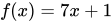
f ( x ) = 7 x + 1 {\displaystyle f(x)=7x+1} 並且如果我們想要使用 f {\displaystyle f} x {\displaystyle x} 2 {\displaystyle 2} x {\displaystyle x}
f ( 2 ) = 7 ( 2 ) + 1 = 14 + 1 = 15 {\displaystyle f(2)=7(2)+1=14+1=15} 這種表示法比省略自變數,直接寫成 ' f {\displaystyle f} f {\displaystyle f} 2 f {\displaystyle 2f}
透過將函式 f {\displaystyle f}
寫一個類似於下面的句子:“在 x = c {\displaystyle x=c} f {\displaystyle f}
計算函式的值。 人們可以用多種方式來描述函式。在上面的例子中,給出了一個文字描述(球在地球上方的高度作為時間的函式)。以下列出了一些描述函式的方法。前三種方法是最常見的。
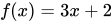
給函式一個名字(比如 f {\displaystyle f} f ( x ) = 3 x + 2 {\displaystyle f(x)=3x+2} 引數 (或自變數 ),把輸出稱為函式在給定引數時的值 。
用一個方程和兩個變數來描述函式。一個變數代表函式的輸入,另一個代表函式的輸出。代表輸入的變數稱為自變數 。代表輸出的變數稱為因變數 。例如, y = 3 x + 2 {\displaystyle y=3x+2}
對函式的文字描述。 當給函式命名時(如上面的第 1 號),函式的名字通常是一個字母(比如 f {\displaystyle f} g {\displaystyle g} y = sin ( x ) {\displaystyle y=\sin(x)}
函式的正式定義指出,函式實際上是一種對映 ,它將一個稱為函式定義域 的集合 A {\displaystyle A} 值域 的集合 B {\displaystyle B} 恰好對應一個 元素。函式的定義告訴我們值域中的哪個元素與我們從定義域中選取的元素對應。下面給出一個例子。
設函式
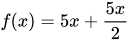
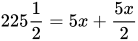
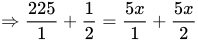
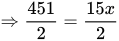
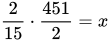
f ( x ) = 5 x + 5 x 2 {\displaystyle f(x)=5x+{\frac {5x}{2}}} 對所有
x {\displaystyle x} 成立。當
x {\displaystyle x} 取值為多少時,
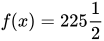
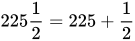
f ( x ) = 225 1 2 {\displaystyle f(x)=225{\frac {1}{2}}} ?
從經典的角度來看,從定義域中選取的元素被視為輸入函式的東西,而對應於值域中的元素則被視為輸出。由於我們“選取”定義域中的元素,其在值域中的對應元素是我們想要找到的,因此我們可以控制選擇哪個元素,因此該元素也被稱為“自變數”。值域中對映的元素超出了我們的控制範圍,並且由函式“對映到”。因此,該元素也被稱為“因變數”,因為它取決於我們選擇哪個自變數。由於從經典的觀點更好地理解了函式的基本概念,因此我們將在以後使用它。但是,務必始終牢記函式的正確定義。
簡單來說,對於函式 f ( x ) {\displaystyle f(x)} x {\displaystyle x} f ( x ) {\displaystyle f(x)} y {\displaystyle y} f {\displaystyle f} a ∈ A {\displaystyle a\in A} b ∈ B {\displaystyle b\in B} f : A → B {\displaystyle f:A\to B}
A {\displaystyle A} B {\displaystyle B} A {\displaystyle A} B {\displaystyle B} 如果一個元素 a ∈ A {\displaystyle a\in A} f {\displaystyle f} A {\displaystyle A} B {\displaystyle B} b ∈ B {\displaystyle b\in B} 一對一 函式。根據定義,因為只有一個元素 b {\displaystyle b} f {\displaystyle f} a {\displaystyle a} f : A → B {\displaystyle f:A\to B} b {\displaystyle b} 圖 1
如果來自函式 f {\displaystyle f} A {\displaystyle A} a 1 , a 2 , … a n ∈ A {\displaystyle a_{1},a_{2},\ldots a_{n}\in A} B {\displaystyle B} b ∈ B {\displaystyle b\in B} 多對一 函式。由於一些元素 ( a 1 , a 2 , … a n ) ∈ A {\displaystyle \left(a_{1},a_{2},\ldots a_{n}\right)\in A} b ∈ B {\displaystyle b\in B} f : A → B {\displaystyle f:A\to B}
如果函式域中恰好有一個元素 a ∈ A {\displaystyle a\in A} f {\displaystyle f} A {\displaystyle A} ( b 1 , b 2 , … b n ) ∈ B {\displaystyle \left(b_{1},b_{2},\ldots b_{n}\right)\in B} f {\displaystyle f} B {\displaystyle B} a {\displaystyle a} b {\displaystyle b} f : A → B {\displaystyle f:A\to B} b {\displaystyle b} 現代的定義足夠描述函式,它可以幫助我們判斷某種新型別的“函式”是否確實是函式。現在每個情況都在上面定義了,現在你可以證明函式是否屬於這些情況之一。以下是一個示例問題
**已知**:
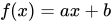
f ( x ) = a x + b {\displaystyle f(x)=ax+b} ,其中
a {\displaystyle a} 和
b {\displaystyle b} 為常數,且
a ≠ 0 {\displaystyle a\neq 0} 。
**證明**:函式
f {\displaystyle f} 是一對一函式。
注意函式
f {\displaystyle f} 中唯一變化的元素是
x {\displaystyle x} 。根據定義證明函式是一對一的可能是不可能的,因為雖然域集合
A {\displaystyle A} 中的兩個隨機元素可能不是多對一的,但可能存在一些元素
( a 1 , a 2 , … a n ) ∈ A {\displaystyle \left(a_{1},a_{2},\ldots a_{n}\right)\in A} 使函式成為多對一函式。為了解決這種可能性,我們必須證明不可能出現這樣的結果。
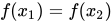
假設存在兩個不同的元素 x 1 ≠ x 2 {\displaystyle x_{1}\neq x_{2}} f ( x 1 ) = f ( x 2 ) {\displaystyle f\left(x_{1}\right)=f\left(x_{2}\right)} a x 1 + b = a x 2 + b {\displaystyle ax_{1}+b=ax_{2}+b}
從等式兩邊減去 b {\displaystyle b}
⇒ a x 1 = a x 2 {\displaystyle \Rightarrow ax_{1}=ax_{2}} 從等式兩邊減去 a x 2 {\displaystyle ax_{2}}
⇒ a x 1 − a x 2 = 0 {\displaystyle \Rightarrow ax_{1}-ax_{2}=0} 從等式左邊兩項中提取公因子 a {\displaystyle a}
⇒ a ( x 1 − x 2 ) = 0 {\displaystyle \Rightarrow a\left(x_{1}-x_{2}\right)=0} 在等式兩邊乘以 1 a {\displaystyle {\frac {1}{a}}}
⇒ ( x 1 − x 2 ) = 0 {\displaystyle \Rightarrow \left(x_{1}-x_{2}\right)=0} 在等式兩邊加上 x 2 {\displaystyle x_{2}}
⇒ x 1 = x 2 {\displaystyle \Rightarrow x_{1}=x_{2}} 注意到
x 1 = x 2 {\displaystyle x_{1}=x_{2}} 。然而,這不可能,因為
x 1 {\displaystyle x_{1}} 和
x 2 {\displaystyle x_{2}} 是不同的。因此,
f ( x 1 ) ≠ f ( x 2 ) {\displaystyle f\left(x_{1}\right)\neq f\left(x_{2}\right)} 。沒有兩個不同的輸入可以產生相同的輸出。因此,該函式必須是一對一的。
定義域是集合 A {\displaystyle A} B {\displaystyle B} B {\displaystyle B} B {\displaystyle B} 從函式的現代定義中,還有幾個重要的概念需要學習,這些概念來自於理解域、值域和陪域之間的區別。我們已經討論過其中一些,但瞭解集合為這三個概念帶來了新的定義。因此,讓我們基於這些新的概念來討論它們。令 A {\displaystyle A} B {\displaystyle B} 笛卡爾積 A × B {\displaystyle A\times B}
請注意,陪域不像其他兩個概念那樣重要。
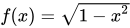
例如,取 f ( x ) = 1 − x 2 {\displaystyle f(x)={\sqrt {1-x^{2}}}}
該函式的定義域是區間[-1, 1] 由於平方根的存在,平方根內的內容必須嚴格不小於 0。
1 − x 2 ≥ 0 {\displaystyle 1-x^{2}\geq 0}
⇔ − 1 ≤ x ≤ 1 {\displaystyle \Leftrightarrow -1\leq x\leq 1}
因此,定義域是
x ∈ [ − 1 , 1 ] {\displaystyle x\in [-1,1]}
該函式的值域是區間[0, 1] 相應地,值域將是
f ( x ) ∈ [ 0 , 1 ] {\displaystyle f(x)\in [0,1]}
還有一個最後的方面需要定義。我們已經對什麼使對映成為函式有了很好的瞭解(例如,它不能是一對多)。但是,為了討論以下三個定義,您經常會聽到它們:單射 、滿射 、雙射 。
左邊的函式對映是單射函式的一個例子,因為它是一對一的。但是,它不是滿射,因為值域和陪域不相同。 如果函式是一對一的,則該函式是單射 的。
如果一個函式是滿射 ,則它就是“到”的。也就是說,對映 f : A → B {\displaystyle f:A\to B} B {\displaystyle B} 值域 ,其中函式的陪域和值域相同。
如果一個函式既是滿射又是單射,那麼它就是雙射 。 同樣地,上述定義經常令人感到困惑。我們會在專案符號的右側提供另一張圖片,並提供另一個例子。讓我們分析函式 g ( x ) = a x 2 {\displaystyle g(x)=ax^{2}}
給定 :
g ( x ) = a x 2 {\displaystyle g(x)=ax^{2}} ,其中
a {\displaystyle a} 為常數且
a ≠ 0 {\displaystyle a\neq 0} 。
證明 :函式
g {\displaystyle g} 是非滿射且非單射。
這是一個表示式無法透過垂直線測試的例子。 垂直線測試是一種系統性的測試方法,用於確定包含 x {\displaystyle x} y {\displaystyle y} x {\displaystyle x} y {\displaystyle y} x {\displaystyle x}
右側的圓形不是函式,因為當 x = 1 {\displaystyle x=1}
類似地,水平線測試雖然不能測試一個方程是否為函式,但可以測試一個函式是否為單射(一對一)。如果任何水平線在任何時候與圖形上的多個點相交,那麼該函式就不是一對一的;如果該線始終最多與圖形上的一個點相交,那麼該函式就是一對一的。
代數一對一測試是一種非幾何的方法,用於判斷一個函式是否為一對一的。基本概念是
假設存在一個函式 f {\displaystyle f}
f ( a ) = f ( b ) {\displaystyle f(a)=f(b)} a = b {\displaystyle a=b}
函式 f {\displaystyle f}
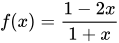
以下是一個示例:證明 f ( x ) = 1 − 2 x 1 + x {\displaystyle f(x)={\frac {1-2x}{1+x}}}
由於該符號是函式符號,所以該方程是一個函式。因此,我們只需要證明它是單射的。設 a {\displaystyle a} b {\displaystyle b} f ( a ) = f ( b ) {\displaystyle f(a)=f(b)}
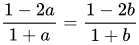
1 − 2 a 1 + a = 1 − 2 b 1 + b {\displaystyle {\frac {1-2a}{1+a}}={\frac {1-2b}{1+b}}} ⇔ ( 1 + b ) ( 1 − 2 a ) = ( 1 + a ) ( 1 − 2 b ) {\displaystyle \Leftrightarrow (1+b)(1-2a)=(1+a)(1-2b)} ⇔ 1 − 2 a + b − 2 a b = 1 − 2 b + a − 2 a b {\displaystyle \Leftrightarrow 1-2a+b-2ab=1-2b+a-2ab} ⇔ 1 − 2 a + b = 1 − 2 b + a {\displaystyle \Leftrightarrow 1-2a+b=1-2b+a} ⇔ 1 − 2 a + 3 b = 1 + a {\displaystyle \Leftrightarrow 1-2a+3b=1+a} ⇔ 1 + 3 b = 1 + 3 a {\displaystyle \Leftrightarrow 1+3b=1+3a} ⇔ a = b {\displaystyle \Leftrightarrow a=b} 所以,結果是 a = b {\displaystyle a=b}
另一個例子是證明 g ( x ) = x 2 {\displaystyle g(x)=x^{2}}
使用相同的方法,可以發現 a = ± b {\displaystyle a=\pm b} a = b {\displaystyle a=b}
以下是函式定義的直接結果
根據定義,對於每個“輸入”,函式僅返回一個與該輸入相對應的“輸出”。雖然同一個輸出可能對應多個輸入,但一個輸入不能對應多個輸出。這在圖形上表現為垂直線測試 :平行於因變數軸(通常是垂直的)繪製的直線只會與函式的圖形相交一次。但是,平行於自變數軸(通常是水平的)繪製的直線可以與函式的圖形相交任意多次。等價地,這具有代數(或公式)解釋。我們總是可以說如果 a = b {\displaystyle a=b} f ( a ) = f ( b ) {\displaystyle f(a)=f(b)} f ( a ) = f ( b ) {\displaystyle f(a)=f(b)} a = b {\displaystyle a=b}
每個函式都有一個值集,即函式的定義域 ,它可以接受作為輸入。也許這個集合是所有正實數;也許它是集合 {pork, mutton, beef}。這個集合必須在函式定義中隱式/顯式定義。你不能給函式輸入一個不在定義域中的元素,因為函式對於該輸入元素沒有定義。
每個函式都有一個值集,即函式的值域 ,它可以輸出。這可能是實數集。它可能是正整數集,甚至可能是集合 {0,1}。這個集合也必須在函式定義中隱式/顯式定義。 函式是數學的重要基礎。這種現代解釋是歷史上數學家努力的結果。直到最近,由勒內·笛卡爾在他的幾何 (1637)中引入關係的定義。將近一個世紀後,標準符號( f ( x ) = y {\displaystyle f(x)=y} 無窮分析導論 和微積分原理 中引入。函式一詞也是尤拉時代的新發明,是由戈特弗裡德·威廉·萊布尼茨在 1673 年的一封信中引入的,“用來描述與曲線上的點相關的量,例如座標或曲線的斜率”。最後,函式作為集合間關係的現代定義是 1908 年由戈弗雷·哈羅德·哈代首次引入的,其中兩個變數 x {\displaystyle x} y {\displaystyle y} x {\displaystyle x} y {\displaystyle y} 函式歷史 。
下面列出的函式對於微積分至關重要。本節僅作為回顧,並觸及這些函式的表面。如果有關於這些函式的任何問題,請在繼續之前複習相關資料 。更多關於繪圖的內容將在第1.4 章中解釋。
多項式函式是微積分世界中最常見和最方便的函式。它們頻繁出現以及在計算機計算中的應用使它們變得重要。
多項式函式的定義
單個未知數 x 的多項式始終可以寫成(或改寫成)以下形式
f ( x ) = a n x n + a n − 1 x n − 1 + a n − 2 x n − 2 + ⋅ ⋅ ⋅ + a 2 x 2 + a 1 x + a 0 {\displaystyle f(x)=a_{n}x^{n}+a_{n-1}x^{n-1}+a_{n-2}x^{n-2}+\cdot \cdot \cdot +a_{2}x^{2}+a_{1}x+a_{0}} 為了更簡潔,它也可以用求和的形式寫成
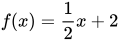
∑ k = 0 n a k x k {\displaystyle \sum _{k=0}^{n}a_{k}x^{k}} 影像上顯示了兩個線性函式。一個是 f ( x ) = 1 2 x + 2 {\displaystyle f(x)={\frac {1}{2}}x+2} g ( x ) = − 2 x + 5 {\displaystyle g(x)=-2x+5} 當 n = 0 {\displaystyle n=0}
f ( x ) = C {\displaystyle f(x)=C} C {\displaystyle C}
該函式的圖形是一條水平線,穿過點 ( 0 , C ) {\displaystyle (0,C)}
當 n = 1 {\displaystyle n=1}
f ( x ) = m x + b {\displaystyle f(x)=mx+b} m and b {\displaystyle m{\text{ and }}b}
該函式的圖形是一條直線,穿過點 ( 0 , b ) {\displaystyle (0,b)} ( − b m , 0 ) {\displaystyle (-{\frac {b}{m}},0)} m {\displaystyle m}
這是二次函式的影像。 當 n = 2 {\displaystyle n=2}
f ( x ) = a x 2 + b x + c {\displaystyle f(x)=ax^{2}+bx+c} a , b , c {\displaystyle a,b,c}
此函式的影像是一個拋物線,類似於籃球投進籃筐的軌跡。
如果有關於二次公式和其他基本多項式概念的問題,請檢視代數 中相應的章節。
三角函式也很重要,因為它可以連線代數和幾何。由於其重要性和難度,三角函式在這裡 進行了詳細解釋。
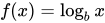
左側的曲線是指數函式,而右側的曲線是對數函式。 指數函式和對數函式在計算導數時具有獨特的身份,因此現在是回顧這些函式的好時機。
在這些函式中,會經常看到一個特殊的數字:尤拉常數,也稱為自然對數的底數。記為 e {\displaystyle e} e = ∑ n = 0 ∞ 1 n ! {\displaystyle e=\sum _{n=0}^{\infty }{\frac {1}{n!}}}
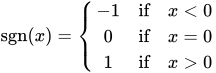
符號函式的定義很簡單
sgn ( x ) = { − 1 if x < 0 0 if x = 0 1 if x > 0 {\displaystyle {\mbox{sgn}}(x)=\left\{{\begin{matrix}-1&{\text{if}}&x<0\\0&{\text{if}}&x=0\\1&{\text{if}}&x>0\end{matrix}}\right.}
有時,很多函式操作如果沒有一些基本函式性質的幫助,是無法實現的。
這個概念在上面已經討論過了。
雖然看起來很容易發現一個函式是遞增還是遞減,但如果沒有繪圖軟體的幫助,我們需要用數學方法來判斷函式是遞增還是遞減,否則我們人類的大腦無法立即理解大量資訊。
假設一個函式 f ( x ) {\displaystyle f(x)} x 1 , x 2 {\displaystyle x_{1},x_{2}} x 1 ∈ [ a , b ] {\displaystyle x_{1}\in [a,b]} x 2 ∈ [ a , b ] {\displaystyle x_{2}\in [a,b]} x 2 > x 1 {\displaystyle x_{2}>x_{1}}
如果對於所有的 x 1 {\displaystyle x_{1}} x 2 {\displaystyle x_{2}} f ( x 2 ) − f ( x 1 ) > 0 {\displaystyle f(x_{2})-f(x_{1})>0}
f ( x ) {\displaystyle f(x)} [ a , b ] {\displaystyle [a,b]}
如果對於所有的 x 1 {\displaystyle x_{1}} x 2 {\displaystyle x_{2}} f ( x 2 ) − f ( x 1 ) < 0 {\displaystyle f(x_{2})-f(x_{1})<0}
f ( x ) {\displaystyle f(x)} [ a , b ] {\displaystyle [a,b]}
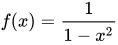
示例: 在哪些區間內 f ( x ) = 1 1 − x 2 {\displaystyle f(x)={\frac {1}{1-x^{2}}}}
首先,定義域很重要。因為分母不能為 0,所以該函式的定義域為
x ∈ ( − ∞ , − 1 ) ∪ ( − 1 , 1 ) ∪ ( 1 , ∞ ) {\displaystyle x\in (-\infty ,-1)\cup (-1,1)\cup (1,\infty )}
在 ( − ∞ , − 1 ) {\displaystyle (-\infty ,-1)}
設 x 1 , x 2 ∈ [ − ∞ , − 1 ] {\displaystyle x_{1},x_{2}\in [-\infty ,-1]} x 2 > x 1 {\displaystyle x_{2}>x_{1}}
f ( x 2 ) − f ( x 1 ) = 1 1 − x 2 2 − 1 1 − x 1 2 = x 2 2 − x 1 2 ( 1 − x 2 2 ) ( 1 − x 1 2 ) {\displaystyle f(x_{2})-f(x_{1})={\frac {1}{1-x_{2}^{2}}}-{\frac {1}{1-x_{1}^{2}}}={\frac {x_{2}^{2}-x_{1}^{2}}{(1-x_{2}^{2})(1-x_{1}^{2})}}}
∵ {\displaystyle \because } x 1 , x 2 ∈ [ − ∞ , − 1 ] {\displaystyle x_{1},x_{2}\in [-\infty ,-1]}
∴ {\displaystyle \therefore } ( 1 − x 2 2 ) ( 1 − x 1 2 ) > 0 {\displaystyle (1-x_{2}^{2})(1-x_{1}^{2})>0}
∵ {\displaystyle \because } x 2 > x 1 {\displaystyle x_{2}>x_{1}} x 1 < x 2 < 0 {\displaystyle x_{1}<x_{2}<0}
∴ {\displaystyle \therefore } x 2 2 − x 1 2 < 0 {\displaystyle x_{2}^{2}-x_{1}^{2}<0}
所以, f ( x 2 ) − f ( x 1 ) = x 2 2 − x 1 2 ( 1 − x 2 2 ) ( 1 − x 1 2 ) < 0 {\displaystyle f(x_{2})-f(x_{1})={\frac {x_{2}^{2}-x_{1}^{2}}{(1-x_{2}^{2})(1-x_{1}^{2})}}<0}
f ( x ) {\displaystyle f(x)} ( − ∞ , − 1 ) {\displaystyle (-\infty ,-1)}
在 ( − 1 , 1 ) {\displaystyle (-1,1)}
令 x 1 , x 2 ∈ [ − 1 , 1 ] {\displaystyle x_{1},x_{2}\in [-1,1]} x 2 > x 1 {\displaystyle x_{2}>x_{1}}
f ( x 2 ) − f ( x 1 ) = 1 1 − x 2 2 − 1 1 − x 1 2 = x 2 2 − x 1 2 ( 1 − x 2 2 ) ( 1 − x 1 2 ) {\displaystyle f(x_{2})-f(x_{1})={\frac {1}{1-x_{2}^{2}}}-{\frac {1}{1-x_{1}^{2}}}={\frac {x_{2}^{2}-x_{1}^{2}}{(1-x_{2}^{2})(1-x_{1}^{2})}}}
∵ {\displaystyle \because } x 1 , x 2 ∈ [ − ∞ , − 1 ] {\displaystyle x_{1},x_{2}\in [-\infty ,-1]}
∴ {\displaystyle \therefore } ( 1 − x 2 2 ) ( 1 − x 1 2 ) > 0 {\displaystyle (1-x_{2}^{2})(1-x_{1}^{2})>0}
然而, x 2 2 − x 1 2 {\displaystyle x_{2}^{2}-x_{1}^{2}} ( − 1 , 1 ) {\displaystyle (-1,1)} ( − 1 , 0 ) and ( 0 , 1 ) {\displaystyle (-1,0){\text{ and }}(0,1)}
在 ( − 1 , 0 ) {\displaystyle (-1,0)}
∵ {\displaystyle \because } x 2 > x 1 {\displaystyle x_{2}>x_{1}} x 1 < x 2 < 0 {\displaystyle x_{1}<x_{2}<0}
∴ {\displaystyle \therefore } x 2 2 − x 1 2 < 0 {\displaystyle x_{2}^{2}-x_{1}^{2}<0}
在 ( 0 , 1 ) {\displaystyle (0,1)}
∵ x 2 > x 1 and 0 < x 1 < x 2 {\displaystyle \because x_{2}>x_{1}{\text{ and }}0<x_{1}<x_{2}}
∴ x 2 2 − x 1 2 > 0 {\displaystyle \therefore x_{2}^{2}-x_{1}^{2}>0}
因此, f ( x ) {\displaystyle f(x)} ( − 1 , 0 ) {\displaystyle (-1,0)} ( 0 , 1 ) {\displaystyle (0,1)}
在 ( 1 , ∞ ) {\displaystyle (1,\infty )}
令 x 1 , x 2 ∈ [ 1 , ∞ ] {\displaystyle x_{1},x_{2}\in [1,\infty ]} x 2 > x 1 {\displaystyle x_{2}>x_{1}}
f ( x 2 ) − f ( x 1 ) = 1 1 − x 2 2 − 1 1 − x 1 2 = x 2 2 − x 1 2 ( 1 − x 2 2 ) ( 1 − x 1 2 ) {\displaystyle f(x_{2})-f(x_{1})={\frac {1}{1-x_{2}^{2}}}-{\frac {1}{1-x_{1}^{2}}}={\frac {x_{2}^{2}-x_{1}^{2}}{(1-x_{2}^{2})(1-x_{1}^{2})}}}
∵ {\displaystyle \because } x 1 , x 2 ∈ [ − ∞ , − 1 ] {\displaystyle x_{1},x_{2}\in [-\infty ,-1]}
∴ {\displaystyle \therefore } ( 1 − x 2 2 ) ( 1 − x 1 2 ) > 0 {\displaystyle (1-x_{2}^{2})(1-x_{1}^{2})>0}
∵ x 2 > x 1 and 0 < x 1 < x 2 {\displaystyle \because x_{2}>x_{1}{\text{ and }}0<x_{1}<x_{2}}
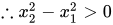
∴ x 2 2 − x 1 2 > 0 {\displaystyle \therefore x_{2}^{2}-x_{1}^{2}>0}
所以, f ( x 2 ) − f ( x 1 ) = x 2 2 − x 1 2 ( 1 − x 2 2 ) ( 1 − x 1 2 ) > 0 {\displaystyle f(x_{2})-f(x_{1})={\frac {x_{2}^{2}-x_{1}^{2}}{(1-x_{2}^{2})(1-x_{1}^{2})}}>0}
f ( x ) {\displaystyle f(x)} ( 1 , ∞ ) {\displaystyle (1,\infty )}
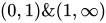
因此,函式遞增的區間為 ( 0 , 1 ) & ( 1 , ∞ ) {\displaystyle (0,1)\And (1,\infty )}
◼ {\displaystyle \blacksquare }
學習導數後,將會有更多方法來確定函式的增長情況。
奇偶性與對稱性相關。偶函式關於 y {\displaystyle y}
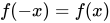
當 f ( − x ) = f ( x ) {\displaystyle f(-x)=f(x)} f ( − x ) = − f ( x ) {\displaystyle f(-x)=-f(x)}
例: 證明 f ( x ) = 1 1 − x 2 {\displaystyle f(x)={\frac {1}{1-x^{2}}}}
∵ f ( − x ) = 1 1 − ( − x ) 2 = 1 1 − x 2 = f ( x ) {\displaystyle \because f(-x)={\frac {1}{1-(-x)^{2}}}={\frac {1}{1-x^{2}}}=f(x)}
∴ f ( x ) {\displaystyle \therefore f(x)}
◼ {\displaystyle \blacksquare }
對於兩個實值函式,我們可以對它們進行加減乘除、乘方等運算。
f {\displaystyle f} g {\displaystyle g}
如果你被告知 f ( x ) = 3 x + 2 {\displaystyle f(x)=3x+2} g ( x ) = x 2 {\displaystyle g(x)=x^{2}} h ( x ) = f ( x ) + g ( x ) {\displaystyle h(x)=f(x)+g(x)} h {\displaystyle h} h ( x ) = x 2 + 3 x + 2 {\displaystyle h(x)=x^{2}+3x+2}
如果告訴你 f ( x ) = 3 x + 2 {\displaystyle f(x)=3x+2} g ( x ) = x 2 {\displaystyle g(x)=x^{2}} f + g {\displaystyle f+g} f {\displaystyle f} g {\displaystyle g} f + g {\displaystyle f+g} ( f + g ) ( x ) = x 2 + 3 x + 2 {\displaystyle (f+g)(x)=x^{2}+3x+2} 對於減法、乘法和除法,也可以做出類似的陳述。
示例:對有名稱的函式進行加減乘除運算
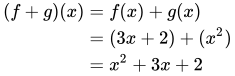
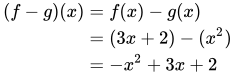
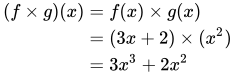
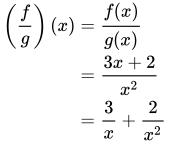
令 f ( x ) = 3 x + 2 {\displaystyle f(x)=3x+2} g ( x ) = x 2 {\displaystyle g(x)=x^{2}}
( f + g ) ( x ) = f ( x ) + g ( x ) = ( 3 x + 2 ) + ( x 2 ) = x 2 + 3 x + 2 {\displaystyle {\begin{aligned}(f+g)(x)&=f(x)+g(x)\\&=(3x+2)+(x^{2})\\&=x^{2}+3x+2\,\end{aligned}}}
( f − g ) ( x ) = f ( x ) − g ( x ) = ( 3 x + 2 ) − ( x 2 ) = − x 2 + 3 x + 2 {\displaystyle {\begin{aligned}(f-g)(x)&=f(x)-g(x)\\&=(3x+2)-(x^{2})\\&=-x^{2}+3x+2\,\end{aligned}}}
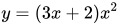
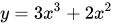
( f × g ) ( x ) = f ( x ) × g ( x ) = ( 3 x + 2 ) × ( x 2 ) = 3 x 3 + 2 x 2 {\displaystyle {\begin{aligned}(f\times g)(x)&=f(x)\times g(x)\\&=(3x+2)\times (x^{2})\\&=3x^{3}+2x^{2}\,\end{aligned}}}
( f g ) ( x ) = f ( x ) g ( x ) = 3 x + 2 x 2 = 3 x + 2 x 2 {\displaystyle {\begin{aligned}\left({\frac {f}{g}}\right)(x)&={\frac {f(x)}{g(x)}}\\&={\frac {3x+2}{x^{2}}}\\&={\frac {3}{x}}+{\frac {2}{x^{2}}}\end{aligned}}}
在我們討論函式複合是什麼之前,讓我們先從一個有趣(且不太複雜)的函式複合應用開始。
函式的組合是另一種組合函式的方式,它不同於加法、減法、乘法或除法。
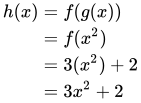
f {\displaystyle f} x {\displaystyle x} g {\displaystyle g} h {\displaystyle h} h {\displaystyle h} f {\displaystyle f} g {\displaystyle g}
函式的複合運算非常常見,主要是因為函式本身很常見。例如,平方和正弦都是函式
square ( x ) = x 2 {\displaystyle {\mbox{square}}(x)=x^{2}} sine ( x ) = sin ( x ) {\displaystyle {\mbox{sine}}(x)=\sin(x)} 因此,表示式 sin 2 ( x ) {\displaystyle \sin ^{2}(x)}
sin 2 ( x ) {\displaystyle \sin ^{2}(x)} = square ( sin ( x ) ) {\displaystyle ={\mbox{square}}(\sin(x))}
= square ( sine ( x ) ) {\displaystyle ={\mbox{square}}({\mbox{sine}}(x))}
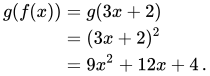
(注意,這與 sine ( square ( x ) ) = sin ( x 2 ) {\displaystyle {\mbox{sine}}({\mbox{square}}(x))=\sin(x^{2})} x = π 6 {\displaystyle x={\frac {\pi }{6}}} 1 2 {\displaystyle {\tfrac {1}{2}}}
square ( sin ( π 6 ) ) = square ( 1 2 ) {\displaystyle {\mbox{square}}\left(\sin \left({\tfrac {\pi }{6}}\right)\right)={\mbox{square}}\left({\tfrac {1}{2}}\right)} 由於平方函式在 x = π 6 {\displaystyle x={\frac {\pi }{6}}} 1 4 {\displaystyle {\frac {1}{4}}}
sin 2 ( π 6 ) = square ( sin ( π 6 ) ) = square ( 1 2 ) = 1 4 {\displaystyle \sin ^{2}\left({\tfrac {\pi }{6}}\right)={\mbox{square}}\left(\sin \left({\tfrac {\pi }{6}}\right)\right)={\mbox{square}}\left({\tfrac {1}{2}}\right)={\frac {1}{4}}} 變換是函式操作中非常常見的一種型別。它們包括對輸入或輸出乘以、除以、加上或減去常數。乘以常數稱為**伸縮**,加上常數稱為**平移**。以下是一些示例
f ( 2 × x ) {\displaystyle f(2\times x)} f ( x + 2 ) {\displaystyle f(x+2)} 2 × f ( x ) {\displaystyle 2\times f(x)} 2 + f ( x ) {\displaystyle 2+f(x)} 水平和垂直平移的示例 水平和垂直伸縮的示例 平移和伸縮可以是水平的,也可以是垂直的。右側顯示了垂直和水平平移的示例。紅色圖形表示函式的“原始”狀態,實線藍色圖形已水平平移(移動),虛線圖形已垂直平移。
伸縮以類似的方式展示。函式
f ( 2 × x ) {\displaystyle f(2\times x)} 的輸入已翻倍。一種思考方式是,現在輸入的任何變化都會翻倍。如果我在 x {\displaystyle x} f {\displaystyle f} 1 2 {\displaystyle {\frac {1}{2}}} y {\displaystyle y}
2 × f ( x ) {\displaystyle 2\times f(x)} 稍微更直接一些。在這種情況下,您將函式的輸出加倍。輸出表示到 x {\displaystyle x} a {\displaystyle a}
原始圖形
f ( x ) {\displaystyle f(x)} 繞原點旋轉
− f ( − x ) {\displaystyle -f(-x)}
水平平移 a {\displaystyle a}
f ( x + a ) {\displaystyle f(x+a)} 水平平移 a {\displaystyle a}
f ( x − a ) {\displaystyle f(x-a)}
水平拉伸 a {\displaystyle a}
f ( x × 1 a ) {\displaystyle f\left(x\times {\tfrac {1}{a}}\right)} 垂直拉伸 a {\displaystyle a}
a × f ( x ) {\displaystyle a\times f(x)}
垂直平移 a {\displaystyle a}
f ( x ) − a {\displaystyle f(x)-a} 垂直平移 a {\displaystyle a}
f ( x ) + a {\displaystyle f(x)+a}
關於 x {\displaystyle x}
− f ( x ) {\displaystyle -f(x)} 關於 y {\displaystyle y}
f ( − x ) {\displaystyle f(-x)}
我們稱 g ( x ) {\displaystyle g(x)} f ( x ) {\displaystyle f(x)} x {\displaystyle x}
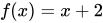
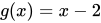
g ( f ( x ) ) = f ( g ( x ) ) = x {\displaystyle g(f(x))=f(g(x))=x} 一個函式 f ( x ) {\displaystyle f(x)} f ( x ) {\displaystyle f(x)} f ( x ) = x + 2 {\displaystyle f(x)=x+2} g ( x ) = x − 2 {\displaystyle g(x)=x-2} f ( x ) = 1 − x 2 {\displaystyle f(x)={\sqrt {1-x^{2}}}}
f {\displaystyle f} f − 1 ( x ) {\displaystyle f^{-1}(x)} f − 1 ( x ) {\displaystyle f^{-1}(x)}
f ( f − 1 ( x ) ) = f − 1 ( f ( x ) ) = x {\displaystyle f(f^{-1}(x))=f^{-1}(f(x))=x} 要確定給定函式 f {\displaystyle f} f − 1 ( x ) {\displaystyle f^{-1}(x)} f − 1 ( x ) {\displaystyle f^{-1}(x)} x {\displaystyle x} x {\displaystyle x} f ( x ) {\displaystyle f(x)} f − 1 ( x ) {\displaystyle f^{-1}(x)}
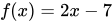
示例: 給定 f ( x ) = 2 x − 7 {\displaystyle f(x)=2x-7} f − 1 ( x ) {\displaystyle f^{-1}(x)}
將 f − 1 ( x ) {\displaystyle f^{-1}(x)} x {\displaystyle x} x {\displaystyle x} f ( x ) {\displaystyle f(x)} f − 1 ( x ) {\displaystyle f^{-1}(x)}
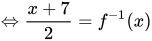
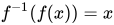
f ( x ) = 2 x − 7 {\displaystyle f(x)=2x-7} ⇔ x = 2 [ f − 1 ( x ) ] − 7 {\displaystyle \Leftrightarrow x=2[f^{-1}(x)]-7} ⇔ x + 7 = 2 [ f − 1 ( x ) ] {\displaystyle \Leftrightarrow x+7=2[f^{-1}(x)]} ⇔ x + 7 2 = f − 1 ( x ) {\displaystyle \Leftrightarrow {\frac {x+7}{2}}=f^{-1}(x)} 為了檢查你的工作,確認 f − 1 ( f ( x ) ) = x {\displaystyle f^{-1}(f(x))=x}
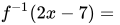
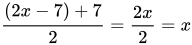
f − 1 ( f ( x ) ) = {\displaystyle f^{-1}(f(x))=} f − 1 ( 2 x − 7 ) = {\displaystyle f^{-1}(2x-7)={}} ( 2 x − 7 ) + 7 2 = 2 x 2 = x {\displaystyle {\frac {(2x-7)+7}{2}}={\frac {2x}{2}}=x}
如果 f {\displaystyle f}
示例: 給定 f ( x ) = x 2 {\displaystyle f(x)=x^{2}} f − 1 ( x ) {\displaystyle f^{-1}(x)}
將 f − 1 ( x ) {\displaystyle f^{-1}(x)} x {\displaystyle x} x {\displaystyle x} f ( x ) {\displaystyle f(x)} f − 1 ( x ) {\displaystyle f^{-1}(x)}
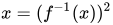
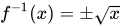
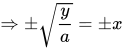
f ( x ) = x 2 {\displaystyle f(x)=x^{2}} x = ( f − 1 ( x ) ) 2 {\displaystyle x=(f^{-1}(x))^{2}} f − 1 ( x ) = ± x {\displaystyle f^{-1}(x)=\pm {\sqrt {x}}} 由於 f − 1 ( x ) {\displaystyle f^{-1}(x)} f ( x ) = x 2 {\displaystyle f(x)=x^{2}} f ( x ) {\displaystyle f(x)}










































![{\displaystyle x\in [-1,1]}](https://wikimedia.org/api/rest_v1/media/math/render/svg/1f9d0dda56ce3e01e14570ac9aef0021c6125722)

![{\displaystyle f(x)\in [0,1]}](https://wikimedia.org/api/rest_v1/media/math/render/svg/99f503c443788a9b9f65ff7a48589ce6fd1965d6)




























![{\displaystyle x_{1}\in [a,b]}](https://wikimedia.org/api/rest_v1/media/math/render/svg/0f03ee615e7879f20efa45f3c3c6296c14b53995)
![{\displaystyle x_{2}\in [a,b]}](https://wikimedia.org/api/rest_v1/media/math/render/svg/e93c068e15bd53700224ed82f922c758216ee03e)


![{\displaystyle [a,b]}](https://wikimedia.org/api/rest_v1/media/math/render/svg/9c4b788fc5c637e26ee98b45f89a5c08c85f7935)



![{\displaystyle x_{1},x_{2}\in [-\infty ,-1]}](https://wikimedia.org/api/rest_v1/media/math/render/svg/0cf5c7151b951ae1ff019d7e81b7649743e9a8ac)






![{\displaystyle x_{1},x_{2}\in [-1,1]}](https://wikimedia.org/api/rest_v1/media/math/render/svg/8ed87fe12ce57afdf247fb00036ed2503255e93f)




![{\displaystyle x_{1},x_{2}\in [1,\infty ]}](https://wikimedia.org/api/rest_v1/media/math/render/svg/740ee44dae32033ccc8b24018acf55e6c11fa60a)





































![{\displaystyle \Leftrightarrow x=2[f^{-1}(x)]-7}](https://wikimedia.org/api/rest_v1/media/math/render/svg/d823629e07ebfdf4e31604db723251807f12fd12)
![{\displaystyle \Leftrightarrow x+7=2[f^{-1}(x)]}](https://wikimedia.org/api/rest_v1/media/math/render/svg/5ef00069307c01d1d32178da59bf982da21648af)