跳轉到內容
Main menu
Main menu
move to sidebar
hide
Navigation
Main Page
Help
Browse
Cookbook
Wikijunior
Featured books
Recent changes
Random book
Using Wikibooks
Community
Reading room forum
Community portal
Bulletin Board
Help out!
Policies and guidelines
Contact us
Search
Search
Donations
Appearance
Create account
Log in
Personal tools
Create account
Log in
Pages for logged out editors
learn more
Contributions
Discussion for this IP address
目錄
移到側邊欄
隱藏
開始
1
算術平均數、幾何平均數和調和平均數之間的關係
切換目錄
統計學/摘要/平均數/算術平均數、幾何平均數和調和平均數之間的關係
Add languages
Add links
Book
Discussion
English
Read
Edit
Edit source
View history
Tools
Tools
move to sidebar
hide
Actions
Read
Edit
Edit source
View history
General
What links here
Related changes
Upload file
Special pages
Page information
Get shortened URL
Download QR code
Sister projects
Wikipedia
Wikiversity
Wiktionary
Wikiquote
Wikisource
Wikinews
Wikivoyage
Commons
Wikidata
MediaWiki
Meta-Wiki
Print/export
Create a collection
Download as PDF
Printable version
In other projects
外觀
移到側邊欄
隱藏
來自華夏公益教科書,開放的世界,開放的書籍
<
統計學
|
摘要
|
平均數
此頁面可能需要
審查
以確保質量。
統計學
簡介
什麼是統計學?
現代統計學中的主題
為什麼我應該學習統計學?
我需要知道哪些知識才能學習統計學?
不同型別的資料
原始資料和次要資料
定量資料和定性資料
資料收集方法
實驗
抽樣調查
觀察性研究
資料分析
資料清洗
移動平均
彙總統計量
集中趨勢的度量
平均數、中位數和眾數
幾何平均數
調和平均數
算術平均數、幾何平均數和調和平均數之間的關係
幾何中位數
離散程度的度量
資料的範圍
方差和標準差
四分位數和四分位數範圍
分位數
資料展示
條形圖
比較條形圖
直方圖
散點圖
箱線圖
餅圖
比較餅圖
象形圖
折線圖
頻率多邊形
機率
組合學
伯努利試驗
貝葉斯分析入門
分佈
離散分佈
均勻分佈
伯努利分佈
二項分佈
泊松分佈
幾何分佈
負二項分佈
超幾何分佈
連續分佈
均勻分佈
指數分佈
伽馬分佈
正態分佈
卡方分佈
學生t分佈
F分佈
貝塔分佈
威布林分佈
檢驗統計假設
統計檢驗的目的
使用的形式化
不同型別的檢驗
單樣本Z檢驗
雙樣本Z檢驗
單樣本t檢驗
雙樣本t檢驗
配對樣本t檢驗用於比較均值
單因素方差分析F檢驗
單樣本比例Z檢驗
雙樣本比例Z檢驗
在Microsoft Excel中檢驗比例A是否大於比例B
斯皮爾曼秩相關係數
皮爾遜積矩相關係數
卡方檢驗
卡方檢驗用於多個比例
卡方檢驗用於列聯表
分佈的近似
點估計
(2007年3月28日,星期三,UTC 12:07)
無偏性
優良性的度量
UMVUE
完備性
充分性和最小充分性
輔助性
練習題
彙總統計量問題
資料展示問題
分佈問題
資料檢驗問題
數值方法
基本線性代數和Gram-Schmidt正交化
無約束最佳化
分位數迴歸
統計軟體的數值比較
Excel中的數值
統計學/數值方法/隨機數生成
時間序列分析
多元資料分析
主成分分析
度量資料的因子分析
序數資料的因子分析
典型相關分析
判別分析
特定資料集的分析
結核病分析
附錄
作者
詞彙表
索引
連結
編輯此框
算術平均數、幾何平均數和調和平均數之間的關係
[
編輯
|
編輯原始碼
]
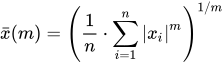
上面提到的平均數是廣義平均數的實現
x
¯
(
m
)
=
(
1
n
⋅
∑
i
=
1
n
|
x
i
|
m
)
1
/
m
{\displaystyle {\bar {x}}(m)=\left({\frac {1}{n}}\cdot \sum _{i=1}^{n}{|x_{i}|^{m}}\right)^{1/m}}
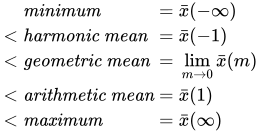
並按這種方式排序
m
i
n
i
m
u
m
=
x
¯
(
−
∞
)
<
h
a
r
m
o
n
i
c
m
e
a
n
=
x
¯
(
−
1
)
<
g
e
o
m
e
t
r
i
c
m
e
a
n
=
lim
m
→
0
x
¯
(
m
)
<
a
r
i
t
h
m
e
t
i
c
m
e
a
n
=
x
¯
(
1
)
<
m
a
x
i
m
u
m
=
x
¯
(
∞
)
{\displaystyle {\begin{alignedat}{2}&{\mathit {minimum}}&\;=\;&{\bar {x}}(-\infty )\\{\mathrel {<}}\;&{\mathit {harmonic\ mean}}&\;=\;&{\bar {x}}(-1)\\{\mathrel {<}}\;&{\mathit {geometric\ mean}}&\;=\;&\lim _{m\rightarrow 0}{\bar {x}}(m)\\{\mathrel {<}}\;&{\mathit {arithmetic\ mean}}&\;=\;&{\bar {x}}(1)\\{\mathrel {<}}\;&{\mathit {maximum}}&\;=\;&{\bar {x}}(\infty )\end{alignedat}}}
類別
:
書籍:統計學
華夏公益教科書